
80k After Tax UK: 2024/25 Take-Home Pay & Salary Guide
This guide is focused on the UK PAYE system (employees) and shows England/Wales/Northern Ireland figures first, then highlights Scotland where income tax bands differ.
Quick Snapshot: How Much Is £80,000 After Tax in the UK (2024/25)?
If you earn £80,000 a year as an employee under the UK PAYE system, your actual take-home pay will be significantly lower than your gross salary. This is because income tax and National Insurance contributions are deducted before your salary reaches your bank account.
For the 2024/25 tax year, assuming you are based in England, Wales, or Northern Ireland, are employed under PAYE, and have a standard tax code of 1257L (which means you are entitled to the full £12,570 Personal Allowance), your approximate take-home pay is as follows — provided there are no additional deductions.
These figures assume:
- one PAYE employment
- no pension contributions (including salary sacrifice)
- no student loan repayments
- no taxable benefits-in-kind (such as a company car or private medical insurance)
- no High Income Child Benefit Charge (HICBC)
Under these assumptions, your £80,000 salary after tax in the UK is approximately:
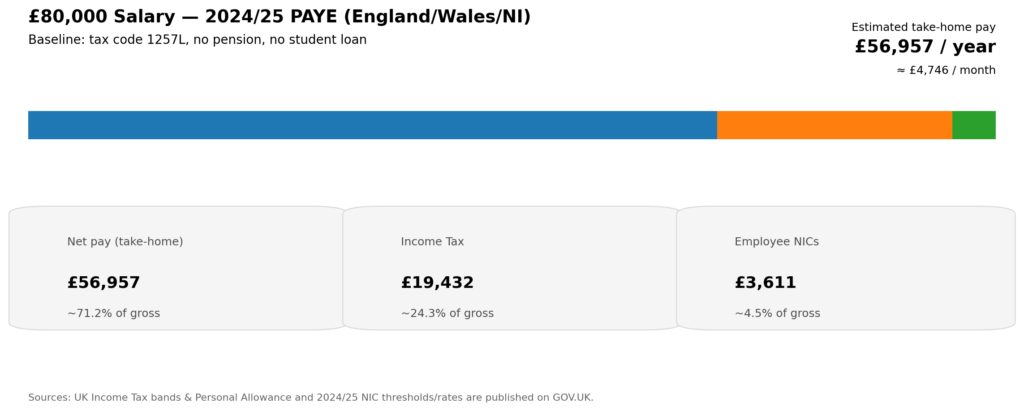
- Annual net pay: £56,957
(often shown as £56,956–£56,958 depending on payroll rounding across monthly or weekly pay cycles) - Monthly take-home pay: around £4,746
- Weekly take-home pay: around £1,095
- Daily take-home pay: around £219, based on a simple five-day working week for budgeting purposes
This means that, in practice, around 71% of your gross salary reaches you as net income, while approximately 29% is deducted through income tax and employee National Insurance contributions.
Learn more about the UK PAYE system on our page about personal tax self-assessment services.
Where do these deductions come from?
The difference between your £80,000 gross salary and your £56,957 take-home pay is driven by two main deductions applied through PAYE:
- Income Tax – approximately £19,432
- The first £12,570 of your income is tax-free under the Personal Allowance.
- Income between £12,571 and £50,270 is taxed at the basic rate of 20%.
- Income above £50,270 (up to £80,000 in this case) is taxed at the higher rate of 40%.
These progressive tax bands mean that not all of your salary is taxed at 40%, even though you are classed as a higher-rate taxpayer.
- Employee National Insurance (Class 1) – approximately £3,611
- National Insurance is charged at 8% on earnings between the Primary Threshold and the Upper Earnings Limit.
- Earnings above the Upper Earnings Limit are charged at a reduced rate of 2%.
Although National Insurance is often overlooked, it still reduces take-home pay by around £300 per month at an £80,000 salary level.
Why this “Quick Snapshot” is only a starting point
While these figures provide a reliable benchmark for “80k after tax UK” calculations, many people earning £80,000 will see lower take-home pay in reality.
Common reasons include:
- workplace pension contributions
- student loan repayments
- High Income Child Benefit Charge for families
- Scottish income tax rates (which are higher)
- taxable benefits and adjustments to tax codes
This is why two people earning the same £80,000 salary can receive very different net pay.
Which Tax Year Should This Page Use: 2024/25 or 2025/26?
When discussing UK salaries, tax, and take-home pay, one of the most important — and most frequently misunderstood — details is the tax year being used.
In the UK, tax is not calculated by calendar year. Instead, the UK operates a fixed tax year that always runs from 6 April to 5 April the following year. All PAYE calculations, payroll deductions, tax thresholds, and National Insurance contributions are tied to this structure.
For clarity:
- 2024/25 tax year:
Runs from 6 April 2024 to 5 April 2025 - 2025/26 tax year:
Runs from 6 April 2025 to 5 April 2026
This distinction matters because even when tax rates remain unchanged, thresholds, allowances, and contribution rules can differ between tax years — which directly affects take-home pay.
Why this article is based on the 2024/25 tax year
This guide is intentionally written around the 2024/25 tax year, for two key reasons:
- Accuracy of benchmark figures
The core figures people search for — such as “80k after tax UK”, “80,000 salary take-home pay”, and “80k take home pay UK” — are currently based on 2024/25 PAYE thresholds. Using this year ensures that the calculations shown reflect what most UK employees are actually seeing on their payslips right now. - Alignment with payroll reality
Most UK payroll systems apply the current tax year’s rules automatically. For the majority of employees reading this guide during the 2024/25 period, their monthly net pay is being calculated using 2024/25 PAYE tax bands and National Insurance thresholds. Presenting figures from a future year too early would risk confusion rather than clarity.
Why 2025/26 is still relevant — and included later in the article
Although the primary calculations use 2024/25, it would be incomplete — and professionally irresponsible — to ignore upcoming changes.
That is why this guide also includes a forward-looking section on 2025/26, focusing on areas that can materially affect higher-rate earners, such as:
- continued freezing of income tax thresholds (fiscal drag)
- changes to employer National Insurance costs
- indirect impacts on salary reviews, bonuses, and employment structures
This approach strikes a balance between current accuracy and future awareness — allowing readers to understand both their present take-home pay and the direction of travel.
Why official payroll thresholds matter more than “headline tax rates”
Many people assume that tax planning revolves only around income tax rates (20%, 40%, 45%). In practice, thresholds and limits are just as important — especially at higher incomes.
This is why official payroll guidance published by GOV.UK is used as the primary reference point throughout this article.
In particular, the GOV.UK publication “Rates and thresholds for employers 2024 to 2025” is one of the most reliable and practical sources because it brings together:
- PAYE income tax thresholds
- National Insurance contribution limits
- employee and employer NIC rates
- the exact figures used by payroll software
Using these sources ensures that the calculations shown in this guide match real-world payroll outcomes, not theoretical estimates.
80k After Tax UK: Detailed Annual & Monthly Calculations (2024/25)
This section shows the baseline PAYE calculation for an employee earning £80,000 per year in England, Wales, or Northern Ireland during the 2024/25 tax year.
It represents the simplest and most commonly searched scenario and forms the reference point for all further variations discussed later in this guide.
Assumptions used in this calculation
The figures below assume:
- one PAYE employment
- tax code 1257L (full Personal Allowance available)
- no pension contributions (including no salary sacrifice)
- no student loan repayments
- no taxable benefits-in-kind
- no High Income Child Benefit Charge (HICBC)
Any deviation from these assumptions will change the final take-home pay, sometimes significantly.
Step A — Start with gross salary
The calculation begins with the contractual gross salary:
- Gross annual salary: £80,000
This is the headline figure stated in the employment contract and the amount used by payroll before any deductions are applied.
Step B — Apply the Personal Allowance (tax-free income)
Under the UK income tax system, most individuals are entitled to a Personal Allowance, which represents the portion of income that is not subject to income tax.
For the 2024/25 tax year, the standard Personal Allowance is:
- £12,570
A tax code of 1257L indicates that the full allowance is available and that there are no adjustments for benefits, underpaid tax, or multiple employments.
After applying the Personal Allowance, only the remaining income is subject to income tax:
- Taxable income = £80,000 − £12,570 = £67,430
This figure is the starting point for applying the UK income tax bands.
Step C — Calculate Income Tax using UK bands (non-Scotland)
Income tax in England, Wales, and Northern Ireland is charged using progressive tax bands, meaning different portions of income are taxed at different rates.
The standard UK income tax bands for 2024/25 are published by GOV.UK and are applied automatically through PAYE payroll systems.
For this tax year:
- 20% basic rate applies to taxable income from £12,571 to £50,270
- 40% higher rate applies to taxable income above £50,270, up to £125,140
Applying these bands to the taxable income of £67,430:
Basic rate portion
- Amount taxed at 20%: £37,700
- Tax due: £37,700 × 20% = £7,540
Higher rate portion
- Remaining taxable income: £67,430 − £37,700 = £29,730
- Tax due: £29,730 × 40% = £11,892
Total income tax
- £7,540 + £11,892 = £19,432
Although the individual is classed as a higher-rate taxpayer, only the portion of income above the basic-rate limit is taxed at 40%.
Step D — Calculate employee National Insurance (Class 1)
In addition to income tax, employees pay Class 1 National Insurance contributions, which are deducted through PAYE.
For 2024/25, employee National Insurance operates using two main rates:
- 8% between the Primary Threshold and the Upper Earnings Limit
- 2% on earnings above the Upper Earnings Limit
The annual thresholds used by payroll systems are:
- Primary Threshold: £12,570
- Upper Earnings Limit: £50,270
Applying these thresholds to an £80,000 salary:
NIC at 8%
- Earnings between £12,570 and £50,270: £37,700
- NIC due: £37,700 × 8% = £3,016
NIC at 2%
- Earnings above £50,270: £29,730
- NIC due: £29,730 × 2% = £594.60
Total employee National Insurance
- £3,016 + £594.60 = £3,610.60
In practice, payroll systems often round this figure slightly, which is why payslips commonly show £3,611 or £3,612 as the annual NIC deduction.
Step E — Calculate take-home pay (net pay)
Finally, take-home pay is calculated by deducting income tax and employee National Insurance from the gross salary:
- Net pay = £80,000 − £19,432 − £3,610.60
- Net annual pay = £56,957.40
This is why most authoritative UK salary guides and payroll calculators cite an £80,000 after tax UK figure of approximately £56,956–£56,958, depending on rounding and pay frequency.
This net amount forms the baseline against which all further deductions and planning scenarios in this article are measured.
Table: £80,000 salary take-home pay (England/Wales/NI, 2024/25 baseline)
| Period | Gross Pay | Income Tax | Employee NICs | Net Pay (Take-home) |
| Annual | £80,000 | £19,432 | ~£3,611 | ~£56,957 |
| Monthly (÷12) | £6,666.67 | £1,619.33 | ~£300.88 | ~£4,746 |
| Weekly (÷52) | £1,538.46 | £373.69 | ~£69.43 | ~£1,095 |
| Daily (weekly ÷5) | £307.69 | £74.74 | ~£13.89 | ~£219 |
Note: monthly/weekly values can vary slightly depending on how payroll rounds NICs each period.
Infographic (ready to embed): “Where your £80,000 goes” (baseline PAYE)
Data source references (for compliance / trust):
- PAYE tax rates & thresholds + NIC thresholds and 2024/25 employee rates: GOV.UK employer rates and thresholds guidance. GOV.UK
- Income Tax bands overview: GOV.UK.
Infographic (ready to embed): “Where your £80,000 goes” (baseline PAYE)
Looking for a Stress-Free Way to Manage Your Higher-Rate Taxes?
Earning £80,000 a year places you firmly into higher-rate tax territory, where the UK tax system becomes noticeably more complex. At this income level, your take-home pay is influenced by far more than just headline tax rates. Payroll deductions, National Insurance, student loans, pension structures, and household-level charges such as the High Income Child Benefit Charge can all materially affect your real income.
Many higher-rate taxpayers are surprised to discover how easily small oversights — an incorrect tax code, poorly structured pension contributions, or missed reliefs — can result in overpaying tax year after year.
At Audit Consulting Group, we help bring clarity to this complexity. Our role is to ensure that your tax position is fully understood, correctly structured, and aligned with HMRC rules — so you can make confident decisions about your income, savings, and long-term plans.
We support UK employees, contractors, and company directors with:
- higher-rate personal tax planning
- PAYE and payroll-related queries
- pension and salary sacrifice optimisation
- student loan and Child Benefit considerations
- Self Assessment and HMRC compliance
Our approach is practical, transparent, and tailored to your circumstances. We focus not just on calculations, but on helping you understand why your take-home pay looks the way it does — and what can be done, legally and responsibly, to improve your position.
Don’t leave your take-home pay to chance. Professional guidance at the right time can make a meaningful difference to both your cash flow today and your financial position in the years ahead.
Contact Audit Consulting Group
Phone: +44 7386 212550
Email: info@auditconsultinggroup.co.uk
Website: https://auditconsultinggroup.co.uk
If you’d like a callback, simply fill out our contact form and a member of our team will be in touch.
How Is £80,000 After Tax Calculated? UK Tax Bands Explained
To understand how £80,000 after tax in the UK is calculated, it’s essential to first understand how the UK income tax system works at a structural level.
The UK uses a progressive income tax system. This means that your entire salary is not taxed at a single flat rate. Instead, different portions of your income are taxed at different rates, known as tax bands. Each band applies only to the slice of income that falls within it.
This distinction is critical, because misunderstandings around tax bands are one of the main reasons people searching “80k after tax UK” overestimate how much tax they expect to pay.
UK income tax bands (England, Wales, Northern Ireland)
For most UK residents (excluding Scotland, which has its own system), the standard income tax bands for the 2024/25 tax year are as follows, as published by GOV.UK:
- 0% on income covered by the Personal Allowance (up to £12,570)
- 20% on income from £12,571 to £50,270 (basic rate)
- 40% on income from £50,271 to £125,140 (higher rate)
- 45% on income above £125,140 (additional rate)
Each rate applies only to the income within that specific range, not to your entire salary.
Why £80,000 is taxed the way it is
At a salary of £80,000, you are firmly classed as a higher-rate taxpayer, because part of your income falls into the 40% band. However, this does not mean that your whole £80,000 is taxed at 40%.
Instead:
- the first part of your income is tax-free
- the next portion is taxed at 20%
- only the top slice is taxed at 40%
This is where many people feel surprised. They hear “40% tax” and assume their tax bill must be close to £32,000 (40% of £80,000). In reality, the tax bill is much lower because the earlier portions of income are taxed at 0% and 20%, not 40%.
Understanding this “layered” approach is the key to understanding all UK take-home pay calculations.
Understanding the 1257L tax code and the Personal Allowance
Most UK employees with a single job and no unusual circumstances are on the tax code 1257L.
This code indicates that:
- you are entitled to the standard Personal Allowance
- the allowance amount is £12,570
- there are no adjustments for benefits, underpayments, or multiple income sources
The Personal Allowance represents the portion of income you can earn without paying any income tax. It is applied before tax bands are considered and forms the foundation of all income tax calculations.
When your Personal Allowance may change
Your Personal Allowance — and therefore your tax code — is not fixed for life. It can be adjusted by HMRC if:
- you receive taxable benefits such as a company car or private medical insurance
- you underpaid tax in a previous year and HMRC is recovering it
- you have more than one job or pension at the same time
- HMRC estimates future tax adjustments and builds them into your code
Even relatively small adjustments to your tax code can change your net pay noticeably. For someone earning £80,000, a different tax code can shift take-home pay by hundreds or even thousands of pounds per year.
This is one of the reasons why two people on the same salary may see very different net figures on their payslips.
The impact of the 40% higher-rate band at £80,000
For the 2024/25 tax year, the higher-rate band begins once your taxable income exceeds the basic-rate limit. When combined with the Personal Allowance, this corresponds to a gross salary threshold of £50,270.
At an £80,000 salary:
- the portion of income taxed at the higher rate is £29,730
- that slice alone generates £11,892 of income tax
This higher-rate slice is the main driver of the jump in total tax liability once earnings move beyond £50,270.
Why £80k often feels like a “tax cliff”
Although the system is progressive, the experience at £80,000 can feel abrupt. Once you cross into higher-rate territory:
- marginal income tax increases to 40%
- employee National Insurance still applies
- student loan repayments may continue
- household charges such as HICBC can be triggered
As a result, each additional pound of income can be reduced much more heavily than at lower salary levels. This sharp rise in marginal deductions is why £80k salary after taxes often feels like a turning point — not because the system suddenly becomes unfair, but because multiple mechanisms start operating at once.
National Insurance and £80,000 After Tax UK Deductions
When calculating £80,000 after tax in the UK, many people focus almost entirely on income tax. However, income tax is only part of the picture. The second major deduction applied through PAYE is National Insurance, specifically Class 1 National Insurance contributions for employees.
Although National Insurance is often perceived as a smaller or secondary charge, it plays a crucial role in reducing take-home pay at higher income levels and significantly affects how additional earnings are taxed.
How employee National Insurance works (Class 1)
For the 2024/25 tax year, employee National Insurance is calculated using a tiered structure similar to income tax. The applicable rates and thresholds are published by GOV.UK and are embedded into all UK payroll systems.
For employees, the key rates are:
- 8% on earnings between the Primary Threshold and the Upper Earnings Limit (UEL)
- 2% on earnings above the Upper Earnings Limit
The annual thresholds used by payroll are:
- Primary Threshold: £12,570
- Upper Earnings Limit: £50,270
These thresholds align closely with the income tax Personal Allowance and basic-rate limit, which often leads people to assume that National Insurance “stops” at higher incomes. In reality, it continues — just at a lower rate.
National Insurance on an £80,000 salary
Applying the 2024/25 NIC structure to an £80,000 salary:
- Earnings between £12,570 and £50,270 (£37,700) are charged at 8%
- Earnings above £50,270 (£29,730) are charged at 2%
This results in total employee National Insurance of approximately £3,610–£3,612 per year, depending on payroll rounding.
In monthly terms, this equates to roughly £300–£301 per month being deducted from gross pay purely for National Insurance.
Why National Insurance matters at £80,000
While National Insurance is smaller than income tax in absolute terms, it becomes particularly important at higher income levels because of its interaction with income tax.
Above the Upper Earnings Limit:
- income tax is charged at 40%
- employee National Insurance is charged at 2%
This creates a combined marginal deduction rate of approximately 42% on each additional pound earned above £50,270 — before considering student loans, pension contributions, or household-level charges.
This “double marginal” effect explains why:
- bonuses can feel heavily taxed
- pay rises above £50,000 often feel less rewarding than expected
- higher-rate earners are especially sensitive to how additional income is structured
Understanding this interaction is essential when assessing whether extra pay, overtime, or bonuses will meaningfully improve take-home pay.
£80k a Year After Tax UK: Employee vs Employer National Insurance (“The Taxberg” Effect)
Most employees are aware of their own National Insurance deductions because they appear clearly on payslips. What is far less visible — but equally important — is employer National Insurance.
Employer National Insurance explained
In addition to your salary, employers must pay secondary (employer) Class 1 National Insurance on your earnings. For the 2024/25 tax year, the key figures published by GOV.UK are:
- Employer NIC rate: 13.8%
- Secondary Threshold: £9,100 per year
Employer NIC applies to earnings above the secondary threshold and is not deducted from your salary — it is an additional cost borne by the employer.
The real cost of an £80,000 salary to an employer
Using these figures, the employer’s National Insurance bill on an £80,000 salary is approximately:
- Employer NIC ≈ (£80,000 − £9,100) × 13.8%
- Employer NIC ≈ £9,784
This means the true employment cost of a role advertised as “£80,000 salary” is closer to:
- £89,784 per year, before considering:
- employer pension contributions
- benefits-in-kind
- training costs or bonuses
This hidden layer of taxation is often referred to as a “Taxberg” — only part of the cost is visible to the employee, while a significant portion sits below the surface.
Why the “Taxberg” matters in real life
The employer National Insurance cost has practical consequences well beyond payroll calculations. It directly influences:
- salary negotiations, especially at senior levels
- bonus structures, including whether rewards are paid in cash or benefits
- availability of salary sacrifice arrangements, such as pensions or electric vehicle schemes
- decisions around employment vs contractor models
- overall hiring budgets and role design
From a planning perspective, understanding employer NIC helps explain why some employers:
- prefer benefits over straight salary increases
- encourage pension salary sacrifice
- consider limited company or fixed-fee arrangements for certain roles
These dynamics become especially relevant when comparing PAYE employment with alternative working structures, which are explored later in this article.
Official references used in this section (for trust and compliance)
The figures and mechanisms described above are based on official UK government guidance, including:
- Income tax bands and the Personal Allowance — published by GOV.UK
- PAYE tax and National Insurance thresholds, including Class 1 employee and employer rates for 2024/25 — GOV.UK employer rates and thresholds
- National Insurance rates and allowances across tax years — GOV.UK NIC guidance
Using these sources ensures that the calculations and explanations in this section reflect actual payroll rules, not simplified estimates.
Why Your £80k After Tax UK May Be Lower (Pensions, Student Loans, Benefits)
We established a baseline calculation: an employee earning £80,000 per year under PAYE in England, Wales, or Northern Ireland, using tax code 1257L and with no additional deductions, typically takes home around £56,957 in the 2024/25 tax year.
This figure is mathematically correct — but in practice, many people earning £80,000 discover that their actual payslip net pay is lower. This is one of the most common reasons behind searches such as “why is my 80k take home pay lower” or “80k after tax UK calculator wrong”.
The explanation is straightforward: PAYE deductions are not limited to income tax and National Insurance. Payroll can, and often does, deduct other items before your salary reaches your bank account — all legitimately and in line with HMRC rules.
This section explains the most common reasons why your £80k after tax UK figure may be lower than the headline estimate, and why these differences are entirely normal.
The baseline vs real-life payroll
The £56,957 figure represents a clean reference point, not a universal outcome. It assumes:
- no workplace pension contributions
- no student loan repayments
- no taxable benefits
- no household-based tax charges
- no adjustments to your tax code
In reality, many employees at this income level have at least one of these factors in play — and often several at the same time.
Workplace pension contributions
Pension contributions are one of the most common — and most significant — reasons why take-home pay at £80,000 is lower than expected.
Most UK employees are enrolled into a workplace pension under auto-enrolment rules. Even if you have never actively chosen a contribution level, deductions may already be happening.
Key factors that affect how pensions reduce net pay include:
- whether contributions are calculated on qualifying earnings or full salary
- whether the scheme uses a net pay arrangement or relief at source
- whether contributions are made via salary sacrifice
At £80,000, pension contributions often move from being a minor deduction to a material planning tool, and the impact on monthly net pay can range from modest to substantial depending on structure.
Student loan repayments
Student loan repayments are another major reason why an £80k salary may not produce the expected take-home pay.
Unlike income tax and National Insurance, student loan repayments are:
- charged on top of tax
- calculated as a percentage of income above a threshold
- not capped annually
At £80,000, repayments under common plans can reduce take-home pay by around £360–£415 per month, depending on the plan type.
Because these deductions are taken automatically through payroll, many employees underestimate their impact until they see the net figure on their payslip.
Taxable benefits-in-kind
If you receive benefits such as:
- a company car
- private medical insurance
- other employer-provided perks
their taxable value is added to your income for tax purposes. This does not always reduce your salary directly, but it reduces your tax-free allowance or increases taxable pay, which lowers net income.
At higher income levels, even relatively modest benefits can result in noticeable reductions in take-home pay over the year.
High Income Child Benefit Charge (HICBC)
For employees with children, the High Income Child Benefit Charge can significantly affect overall household finances.
Although HICBC is not deducted directly from monthly payslips, it effectively reduces net income through:
- additional tax liabilities
- Self Assessment payments
- PAYE adjustments in some cases
At £80,000, the charge can equal 100% of the Child Benefit received, which can amount to several thousand pounds per year for larger families.
This often explains why household cash flow feels tighter than the headline “after tax” salary suggests.
Tax code adjustments and prior-year corrections
HMRC can adjust your tax code to:
- recover underpaid tax from a previous year
- account for benefits-in-kind
- reflect estimated changes in income
These adjustments are spread across the tax year and reduce monthly take-home pay. Many employees notice these changes only when comparing their payslip to online calculators that assume a standard tax code.
Why these differences matter
Understanding why your £80k after tax UK figure differs from a baseline calculation is essential for:
- accurate budgeting
- assessing the true value of pay rises or bonuses
- planning pension contributions
- deciding whether to seek professional tax advice
At higher income levels, payroll deductions are no longer “background noise” — they are central to how much money you actually have available each month.
Why Your £80k After Tax May Be Lower: Common Deductions
Once you move beyond the baseline calculation, it becomes clear why so many people earning £80,000 a year find that their actual take-home pay is lower than headline “after tax” figures.
At this income level, several additional deductions commonly apply through payroll or the wider tax system. Some reduce your net pay directly each month, while others affect your overall tax position across the year.
This section focuses on the three most common deductions that explain why £80k after tax UK figures vary so widely in practice.
Pension contributions (the number one reason net pay differs)
Workplace pension contributions are the single most common reason why an £80,000 salary does not translate into the expected take-home pay.
Most UK employees are enrolled into a pension scheme under auto-enrolment rules. Even if you have never actively chosen a contribution rate, deductions may already be taking place.
How much your pension reduces your net pay depends on three critical factors.
How pension contributions are calculated
- Qualifying earnings vs total salary
The headline “5% auto-enrolment contribution” is often misunderstood.
In many schemes, the minimum 5% employee contribution is calculated not on your full salary, but on qualifying earnings, which fall within a defined band (between a lower and upper limit set for each tax year).
As a result:
- many employees contribute significantly less than 5% of their full £80,000 salary
- unless they actively choose to increase contributions
Employers are allowed — and often encouraged — to set higher contribution rates, but the statutory minimum is lower than many people assume.
How tax relief is delivered
The way pension tax relief is applied has a direct impact on take-home pay, especially for higher-rate taxpayers.
- A) Net pay arrangement
Under a net pay arrangement:
- pension contributions are deducted from gross salary
- income tax is calculated on the reduced amount
- tax relief is applied automatically through PAYE
For someone earning £80,000, this structure is highly efficient because higher-rate tax relief (40%) is applied immediately, without the need to claim it separately.
This setup is common in many employer schemes and is particularly beneficial for higher earners.
- B) Relief at source
Under relief at source:
- pension contributions are taken from net pay (after tax)
- the pension provider claims basic-rate (20%) tax relief from HMRC
- higher-rate relief is not automatic
If you pay tax at 40%, you usually need to claim the additional 20% relief yourself — often via Self Assessment or by contacting HMRC.
If this extra relief is not claimed, higher-rate taxpayers can unintentionally overpay tax, even though they are contributing to a pension.
Salary sacrifice and National Insurance
Some employers offer pension contributions through salary sacrifice.
In this arrangement:
- your contractual salary is reduced
- pension contributions are made by the employer
- both income tax and employee National Insurance can be reduced
At £80,000, salary sacrifice can materially improve efficiency because it reduces income that would otherwise be subject to 40% tax and National Insurance.
Worked example: 5% pension on £80,000
To illustrate the impact in simple terms:
- Employee contribution: 5% of £80,000 = £4,000 per year (gross)
For a higher-rate taxpayer, if tax relief is handled efficiently:
- the effective reduction in take-home pay can feel closer to £2,400 per year
- because 40% tax relief reduces the “real” cost of the contribution
The exact outcome depends on the pension structure and how higher-rate relief is applied, but this example shows why pensions are not simply a “deduction” — they are also a planning opportunity.
Student loan repayments (particularly significant at £80k)
Student loan repayments are not income tax, but they behave very much like an additional payroll tax.
They are deducted automatically through PAYE and apply on top of income tax and National Insurance.
How student loan repayments work
HMRC applies student loan deductions based on:
- the loan plan you are on
- your income above the relevant threshold
- fixed repayment percentages
The standard rules are:
- 9% of income above the threshold for Plan 1, Plan 2, Plan 4, and Plan 5
- 6% of income above the threshold for a Postgraduate Loan, in addition to any undergraduate loan
2024/25 payroll thresholds
Payroll systems use HMRC’s official deduction tables, which are specific to each tax year.
For 2024/25, the annual thresholds are:
- Plan 1: £24,990
- Plan 2: £27,295
- Plan 4 (Scotland): £31,395
- Postgraduate Loan: £21,000
These thresholds determine how much of your income is subject to the 9% or 6% repayment rates.
Because £80,000 is far above all of these thresholds, repayments at this income level are substantial, often reducing take-home pay by £360–£415 per month, depending on the plan.
Why student loans feel especially heavy at £80k
At higher incomes:
- student loan repayments continue without a cap
- they combine with 40% income tax and National Insurance
- bonuses are often hit particularly hard
This is why many £80k earners experience a large gap between expected and actual net pay, especially in months with variable income.
Benefits-in-kind (BIK): company cars and other perks
Another common reason why £80k take-home pay differs between individuals is the presence of taxable benefits-in-kind.
These benefits do not usually reduce your gross salary, but they increase your taxable income or reduce your Personal Allowance, which lowers net pay.
Common taxable benefits
Examples include:
- company cars
- private medical insurance
- fuel benefits
- other employer-provided perks
A company car is the most frequently encountered example at higher salary levels.
The tax due on a company car depends on:
- the vehicle’s list price
- CO₂ emissions
- fuel type
- your income tax band
Higher-rate taxpayers pay more tax on the same benefit than basic-rate taxpayers.
Why benefits matter for £80k take-home pay UK
Two employees can both earn £80,000, but:
- one may receive only cash salary
- the other may receive taxable benefits alongside salary
As a result, their net pay can differ materially — even though the gross salary figure is identical.
This explains why online calculators often fail to match real payslips unless benefits-in-kind are included correctly.
80,000 Salary Take-Home Pay With Student Loan Repayments (Worked Examples)
Below are clean, payroll-style calculations for an £80,000 salary in 2024/25. These show how much the student loan alone can reduce take-home pay.
Table: Student loan deductions at £80,000 salary (2024/25)
Repayment formula (undergrad plans):
Annual repayment = 9% × (Salary − Threshold) if salary is above the threshold.
| Plan | 2024/25 annual threshold | Annual repayment at £80,000 | Monthly equivalent |
| Plan 2 | £27,295 | £4,743.45 | £395.29 |
| Plan 1 | £24,990 | £4,950.90 | £412.58 |
| Plan 4 | £31,395 | £4,374.45 | £364.54 |
| Postgraduate Loan (6%) | £21,000 | £3,540.00 | £295.00 |
Sources: repayment rates and how they’re calculated (9% / 6%) GOV.UK, 2024/25 plan thresholds used by payroll GOV.UK
What does this do to your £80k after tax UK take-home pay?
Take our baseline net pay from Part 1: ~£56,957/year (England/Wales/NI; no deductions).
Now subtract the student loan:
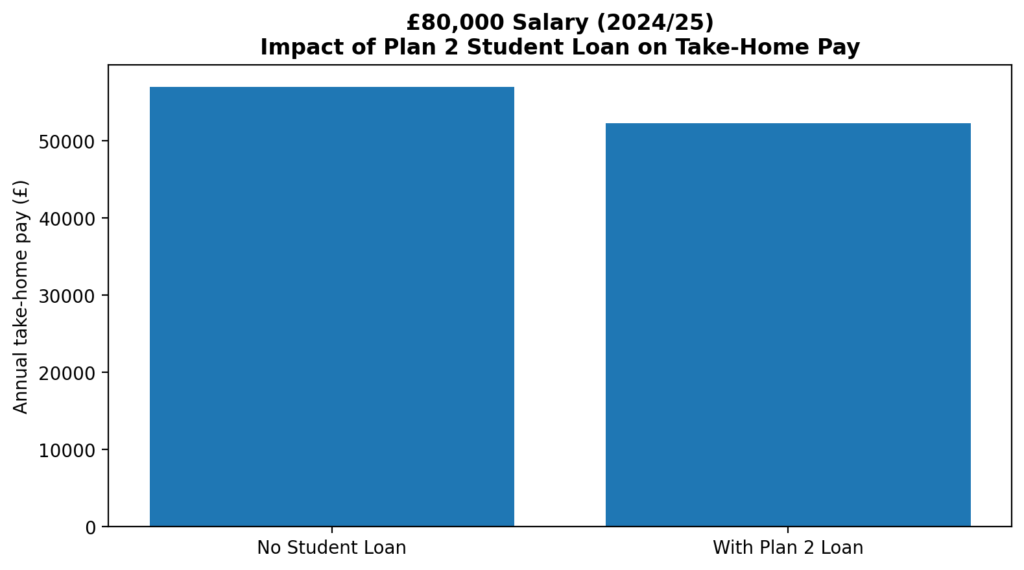
- With Plan 2:
~£56,957 − £4,743 = ~£52,214/year
≈ £4,351/month
Guidance – 2024 to 2025: Student and Postgraduate Loan deduction tables
80k Salary After Tax UK — Student Loan Plan 2 vs Plan 1 (What’s the difference?)
At £80,000:
- Plan 1 takes ~£413/month
- Plan 2 takes ~£395/month
So Plan 1 is slightly higher at this salary, because its threshold in 2024/25 is lower (£24,990 vs £27,295).
But the plan type you’re on depends on where and when you studied — you can’t just “choose” the cheaper plan.
Mini infographic: “£80k salary — net pay vs Plan 2 student loan”
Sources (for the page’s compliance notes): student loan repayment rates (9% / 6%); 2024/25 thresholds
CTA reminder placement note (editorial)
Your CTA block should sit around here (2–3 screen depth), because this is where many readers think:
“Wait — why is my net pay lower than the calculator?”
…and they’re primed to ask for help.
High Income Child Benefit Charge (HICBC) at £80,000: why it can wipe out Child Benefit (and how to plan around it)
If you earn £80,000 a year, the single biggest “unexpected” deduction many UK households face isn’t on the payslip — it’s the High Income Child Benefit Charge (HICBC).
From tax year 2024/25 onwards, the HICBC starts when an individual’s adjusted net income goes over £60,000 (it used to start at £50,000).
And crucially for this page:
- If adjusted net income is £80,000 or more, the charge is 100% of the Child Benefit received (i.e., it can fully cancel out Child Benefit).
- Between £60,000 and £80,000, the charge tapers up gradually at 1% for every £200 of income above £60,000.
That’s why people Googling “80k after tax UK” often feel their finances don’t match the “simple” take-home pay number — Child Benefit can be clawed back separately, and it’s based on adjusted net income, not just salary.
What Exactly Is the High Income Child Benefit Charge (HICBC) and Who Pays It?
The High Income Child Benefit Charge (HICBC) is one of the most misunderstood elements of the UK tax system — and one of the most financially significant for households earning around £80,000 a year.
HICBC is not a reduction in Child Benefit itself, and it does not appear automatically on most payslips. Instead, it is a separate tax charge that applies when:
- Child Benefit is being received by either partner, and
- the partner with the higher adjusted net income exceeds the relevant income threshold
The rules, thresholds, and calculation method are set out in official guidance published by GOV.UK, which also provides a calculator based on adjusted net income, not headline salary.
The key point that catches people out
One of the most common misconceptions about HICBC is who the charge applies to.
It does not matter:
- which partner actually receives the Child Benefit payments
- whose bank account the money goes into
What matters is which partner has the higher adjusted net income.
If one partner’s adjusted net income exceeds the threshold, that person becomes liable for the charge — even if:
- they never claimed Child Benefit themselves
- the benefit is paid to the other partner
This is why HICBC often comes as a shock: the link between the benefit payment and the tax charge is not intuitive, and many households do not realise the charge applies until HMRC issues an assessment.
What this means at £80,000 in practice
At an adjusted net income of £80,000 or above, a common real-world outcome is:
- Child Benefit continues to be paid during the year (cash in)
- A tax charge equal to 100% of the benefit becomes due later (cash out)
Unless this is planned for in advance, it can feel like an unexpected tax bill — even though the rules themselves are clear once understood.
HICBC Rates (2024/25): The £60,000–£80,000 Taper Explained
From the 2024/25 tax year onwards, the HICBC operates using a tapered mechanism between £60,000 and £80,000 of adjusted net income.
The structure is as follows:
- 0% charge if adjusted net income is £60,000 or less
- 1% of Child Benefit is repaid for every £200 of income above £60,000
- 100% charge once adjusted net income reaches £80,000 or more
This taper mechanism is explicitly confirmed in GOV.UK guidance and policy notes.
HICBC taper checkpoints (illustrative)
Adjusted net income and proportion of Child Benefit repaid:
- £60,000 → 0%
- £65,000 → 25%
- £70,000 → 50%
- £75,000 → 75%
- £80,000 and above → 100%
This matches the formal calculation rule of 1% per £200 within the £60k–£80k band, with full repayment above £80k.
How Much Is Child Benefit in 2024/25 — and What Does “100% Repayment” Mean in Pounds?
To understand the financial impact of HICBC, it’s essential to translate percentages into actual cash amounts.
HMRC publishes official weekly Child Benefit rates for each tax year. For 2024/25 (6 April 2024 to 5 April 2025), the rates are:
- £25.60 per week for the eldest or only child
- £16.95 per week for each additional child
Using a 52-week year (sufficiently accurate for planning), the estimated annual amounts are:
- 1 child: £1,331.20
- 2 children: £2,212.60
- 3 children: £3,094.00
These figures align directly with HMRC’s published rates for the year.
What happens at £80,000?
If your adjusted net income is £80,000 or above, the HICBC equals 100% of the Child Benefit received.
In practical terms:
- 1 child → £1,331.20 to repay
- 2 children → £2,212.60 to repay
- 3 children → £3,094.00 to repay
This is why many households at £80,000 feel they are “no better off” receiving Child Benefit — unless:
- they need the National Insurance credits linked to claiming (depending on who claims), or
- they plan to reduce adjusted net income using legitimate planning strategies
“Adjusted Net Income” — The Number HMRC Actually Uses
One of the most important — and least understood — aspects of HICBC is that it is not based purely on gross salary.
HMRC calculates liability using adjusted net income, which is a broader measure that can differ significantly from headline earnings.
GOV.UK provides a step-by-step method for calculating adjusted net income, including how certain deductions reduce it.
What commonly increases adjusted net income?
- Employment income (salary, bonuses)
- Taxable benefits-in-kind (such as company cars or private medical insurance)
- Interest, dividends, and other taxable income
HMRC’s own HICBC calculator explicitly includes taxable benefits when determining adjusted net income.
What can legitimately reduce adjusted net income?
- Certain pension contributions, depending on how they are structured
- Gift Aid donations, grossed up for tax purposes
Where pension contributions are made through a net pay arrangement or salary sacrifice, taxable employment income is already reduced at source — meaning those amounts are effectively reflected automatically in adjusted net income.
This is why pension structure matters so much for households near the HICBC thresholds.
Planning at £80,000: How to Reduce or Eliminate HICBC
Because the HICBC operates on a taper, even small reductions in adjusted net income can have a meaningful effect.
Strategy A — Reduce adjusted net income below £80,000
At exactly £80,000, the charge is 100%.
Reducing adjusted net income even slightly — for example to £79,800 — moves you off the full clawback.
Within the £60k–£80k range:
- every £200 reduction lowers the charge by 1% of Child Benefit
This can quickly translate into hundreds of pounds saved per year.
Strategy B — Reduce adjusted net income below £60,000
This is the cleanest outcome under the rules.
If adjusted net income is £60,000 or less, the HICBC is 0%.
For an £80,000 earner, this broadly requires a £20,000 reduction in adjusted net income. In practice, the most common route is pension planning, particularly where salary sacrifice is available.
Why salary sacrifice can be especially powerful
Where employers offer salary sacrifice:
- taxable pay is reduced
- employee National Insurance may also fall
- adjusted net income is reduced for HICBC purposes
This creates a “triple effect” for some households:
- lower income tax
- lower NICs
- reduced or eliminated HICBC
Where salary sacrifice is not available, pension contributions can still help — but the mechanics differ, and higher-rate relief must be handled correctly.
Worked Planning Illustration: £80,000 Earner With Two Children
Assumptions
- Salary: £80,000
- Children: 2
- Child Benefit (2024/25 estimate): £2,212.60
- Adjusted net income before planning: £80,000
Outcome without planning
- HICBC = 100% × £2,212.60
- Amount to repay: £2,212.60
If adjusted net income is reduced to £70,000
- Income above £60k: £10,000
- £10,000 ÷ £200 = 50
- HICBC = 50% × £2,212.60 ≈ £1,106.30
If adjusted net income is reduced to £60,000
- HICBC = 0%
- No repayment due
This is why advisers often refer to the “Child Benefit trap”: the issue is not just tax — it is household cash flow and avoidable repayments.
Compliance: Do You Need to File a Tax Return Because of HICBC?
In many cases, yes.
If you are liable to HICBC, HMRC generally expects the charge to be:
- reported and paid via Self Assessment, or
- formally accounted for through PAYE adjustments (in specific cases)
Because HICBC amounts at £80,000 can easily run into thousands of pounds, ensuring correct reporting is not optional. HMRC’s HICBC guidance and calculator are the starting point for determining liability — but many households benefit from professional support to ensure everything is handled correctly.
Salary Sacrifice Strategies for £80k Earners
For employees earning £80,000 a year, salary sacrifice is one of the most effective — and most misunderstood — tools available within the UK PAYE system. When structured correctly and offered by the employer, it can materially improve take-home outcomes without breaching HMRC rules.
Salary sacrifice is explicitly recognised by GOV.UK as a legitimate arrangement. Under it, an employee agrees to give up part of their cash salary in exchange for a non-cash benefit. Crucially, the employee’s contractual salary is reduced, meaning the sacrificed amount is no longer treated as pay for tax and National Insurance purposes.
Because of this structural change, salary sacrifice can reduce:
- Income Tax
- Employee National Insurance contributions
- Adjusted net income (which is critical for thresholds such as HICBC)
At £80,000, where higher-rate tax, NICs, and household-level charges often overlap, salary sacrifice can be particularly powerful.
How salary sacrifice differs from “normal” deductions
It is important to distinguish salary sacrifice from deductions taken after salary is earned.
With salary sacrifice:
- your contractual gross salary is reduced
- tax and NICs are calculated on the lower figure
- the sacrificed amount never becomes taxable income
This is why salary sacrifice can be more efficient than simply receiving salary and then paying for the same benefit out of net pay.
Pension Salary Sacrifice — The Gold Standard at £80k
Among all salary sacrifice options, pension salary sacrifice is generally regarded as the most effective for higher-rate taxpayers.
Why pension salary sacrifice works so well at £80,000
At this income level, three separate mechanisms often apply simultaneously:
- income above £50,270 is taxed at 40%
- employee National Insurance continues at 2% above the Upper Earnings Limit
- High Income Child Benefit Charge may apply once adjusted net income exceeds £60,000
Pension salary sacrifice can reduce exposure to all three at once.
Worked illustration: £80,000 salary with £10,000 pension via salary sacrifice
Before salary sacrifice
- Gross contractual salary: £80,000
- Baseline take-home pay (no deductions): ~£56,957
After £10,000 pension salary sacrifice
- New contractual salary: £70,000
- Taxable employment income falls
- Employee National Insurance is calculated on a lower figure
- Adjusted net income falls, reducing or potentially eliminating HICBC exposure
- The pension receives the full £10,000 contribution
The “effective cost” to the employee
Although £10,000 is contributed to the pension, the actual reduction in take-home pay is far smaller.
This is because:
- income tax at 40% is avoided on the sacrificed amount
- employee National Insurance is also avoided
- in some cases, employers share part of their NIC savings
As a result, the out-of-pocket impact can feel significantly less than £10,000, while the full amount is invested for the employee’s future.
This efficiency is why pension planning is usually the first topic accountants raise with £80k earners — particularly for families affected by Child Benefit tapering.
HMRC confirms that pension contributions made via salary sacrifice reduce taxable pay because the sacrificed amount is no longer treated as salary.
Practical considerations and limitations
- Salary sacrifice is employer-led — not all employers offer it
- Changes usually require a formal contract variation
- It may affect reference pay for certain statutory benefits
- Annual allowance and long-term pension planning still matter
Despite these considerations, where available, pension salary sacrifice is often the most impactful single planning tool at this income level.
Electric Vehicle (EV) Salary Sacrifice Schemes
Another increasingly popular salary sacrifice option for higher earners is an electric vehicle (EV) company car scheme.
While company cars were historically tax-inefficient, this has changed dramatically for electric vehicles.
Why EV salary sacrifice schemes appeal to £80k earners
EV schemes can be attractive because:
- Benefit-in-Kind (BIK) rates for electric vehicles are significantly lower than for petrol or diesel cars
- the cost is taken from gross salary under a salary sacrifice arrangement
- taxable income and adjusted net income may be reduced
- access to a new vehicle is combined with predictable monthly costs
HMRC publishes official BIK rates by fuel type and CO₂ emissions and confirms the preferential treatment of electric vehicles under the current system.
How EV salary sacrifice interacts with tax at £80k
For a higher-rate taxpayer:
- a low BIK percentage means relatively little additional income tax
- salary sacrifice reduces taxable pay before tax is calculated
- the structure can be more efficient than leasing privately from net income
This makes EV salary sacrifice particularly appealing for employees who were already considering changing vehicles.
Important editorial and practical notes
EV salary sacrifice schemes are highly employer-specific.
Their effectiveness depends on:
- the leasing rates negotiated by the employer
- how employer National Insurance savings are treated
- mileage needs and vehicle choice
- individual tax position and benefits mix
Because of these variables, EV schemes are not universally beneficial — but when structured well, they can be a tax-efficient alternative to private car ownership for £80k earners.
Avoiding the High Income Child Benefit Charge (HICBC) at £80k
Earlier in this guide, we explained why the High Income Child Benefit Charge (HICBC) becomes such a significant issue at an £80,000 salary. At this level of income, the charge can fully eliminate the value of Child Benefit, often catching households by surprise.
This section focuses on the practical question most families ask next:
“What can we actually do about it?”
The key planning principle behind HICBC
The most important concept to understand is this:
HICBC is based on adjusted net income, not your headline salary.
This distinction is critical. HMRC does not look only at the number on your employment contract. Instead, it looks at a broader income measure that can be legitimately reduced through certain types of planning.
If you can reduce adjusted net income:
- below £80,000, you move off the 100% repayment cliff
- below £60,000, the HICBC disappears entirely
Both the thresholds and the taper mechanism are clearly confirmed in guidance published by GOV.UK.
This is why HICBC is often described as a planning issue, not just a tax issue.
Pension Contributions as a Child Benefit Planning Tool
Among all available planning options, pension contributions are one of the most powerful — and explicitly recognised — ways of reducing adjusted net income.
HMRC guidance confirms that qualifying pension contributions can reduce adjusted net income for the purposes of HICBC calculations, provided they are structured and reported correctly.
Why £80k earners are a “sweet spot” for pension planning
Households earning around £80,000 sit in a unique position where pension planning is unusually effective.
First, income above £50,270 is taxed at 40%, meaning pension contributions attract higher-rate tax relief.
Second, £80,000 lies at the top of the HICBC taper, where even small reductions in adjusted net income can produce disproportionately large savings in Child Benefit repayments.
Third, most people earning £80,000 are still many years away from retirement, allowing pension contributions to benefit from long-term compounding rather than acting merely as short-term tax mitigation.
This combination makes pension planning exceptionally powerful for families affected by HICBC.
Why structure matters
Not all pension contributions reduce adjusted net income in the same way.
The impact depends on:
- whether contributions are made via salary sacrifice
- whether the scheme uses a net pay arrangement or relief at source
- whether higher-rate relief is claimed correctly
This is why two families with identical salaries and children can experience very different HICBC outcomes — even when both are “paying into a pension”.
Claiming Child Benefit vs Opting Out
When families first become aware of HICBC, a common reaction is to consider stopping Child Benefit payments altogether to avoid future tax complications.
While this may seem like a simple solution, it is not always the most appropriate one.
Why opting out is not always ideal
According to GOV.UK guidance, claiming Child Benefit can be important because it may protect National Insurance credits, particularly for:
- a non-working partner
- a lower-earning partner
- someone caring for children and not building NI credits through employment
These credits can count towards future State Pension entitlement, which means the long-term impact of opting out can extend far beyond the immediate tax year.
The approach many advisers recommend
For this reason, many advisers suggest a more nuanced approach:
- continue to claim Child Benefit, but
- manage adjusted net income through legitimate planning, where possible
This keeps National Insurance records protected while reducing — or even eliminating — the HICBC liability.
Why joined-up advice matters at £80k
HICBC sits at the intersection of:
- personal tax
- household income planning
- pension strategy
- PAYE and Self Assessment compliance
Generic calculators often fail to capture this interaction properly. That is why households earning around £80,000 frequently benefit from joined-up advice, rather than treating Child Benefit, pensions, and PAYE deductions as separate issues.
£80k Take-Home Pay: PAYE vs Limited Company (Contractors & Consultants)
A recurring question from higher earners — particularly consultants, IT specialists, project managers, and other in-demand professionals — is:
“Would I take home more if I operated through a limited company instead of PAYE?”
The honest answer is:
Sometimes — but not always.
And the “sometimes” depends on a combination of factors that matter far more than the headline day rate or annual figure. Structure can improve net income in certain scenarios, but in others it can create compliance risk, reduce certainty, and add admin without delivering a meaningful benefit.
PAYE employee at £80k (recap)
To compare fairly, we need a clear PAYE baseline.
For a standard employee in England/Wales/Northern Ireland under PAYE in 2024/25 (tax code 1257L, no additional deductions):
- Gross salary: £80,000
- Estimated take-home pay: ~£56,957 per year
- Monthly take-home pay: ~£4,746
This is what most people mean when they search “80k after tax UK” — a straightforward PAYE position.
The part many people forget: employer cost is higher than salary
Employees see only their own income tax and National Insurance deductions. Employers, however, also pay employer National Insurance (and often pension contributions), which increases the total cost of hiring.
At £80,000, once you add employer National Insurance (and before pension or benefits), the employer’s true cost is typically close to £90,000.
This “hidden cost” is one reason businesses are sometimes open to contractor arrangements — because their budgeting is often based on total employment cost, not salary alone.
However, moving from employment to contracting is not a simple “swap”. In the UK, it is constrained by the IR35 / off-payroll working rules, which determine whether someone can legitimately be treated as a contractor rather than an employee in substance.
Limited company contractor: why the numbers can differ
A limited company (often called a “personal service company”) allows earnings to be received by the company, and then extracted by the director/shareholder in multiple ways.
The common extraction tools are:
- a small salary (often set around thresholds for tax/NIC planning)
- dividends, paid from post-tax profits
- company pension contributions (employer pension contributions made by the company)
The UK tax system treats salary and dividends differently, and it treats company pension contributions differently again — and that is where the potential advantage can come from.
HMRC provides rules and guidance on dividends, company tax, and director remuneration, and these rules must be followed precisely.
Why some £80k-equivalent contractors can see higher net pay
In broad terms, a limited company can sometimes improve net pay because:
1) Corporation tax can be lower than higher-rate income tax on part of profits
Profits in a company are taxed under corporation tax rules, which can be lower than paying 40% income tax on equivalent salary. The difference is not always dramatic, but it can be meaningful depending on profit level and extraction strategy.
2) Dividends are taxed differently from salary
Dividends do not attract employee National Insurance and are taxed under dividend tax rates (after any available allowances). This often changes the overall tax/NIC mix compared with PAYE salary.
3) Company pension contributions can be highly efficient
Pension contributions made directly by the company are generally deductible for corporation tax purposes and do not attract National Insurance in the way salary does. This can be particularly attractive for higher earners who are already planning to invest for the long term.
These mechanisms explain why some contractors operating outside IR35 can increase net income compared with an equivalent PAYE salary — especially if they manage their extraction strategy carefully and keep compliance strong.
Why it’s not automatic — and can be a bad idea in the wrong case
It is equally important to understand why a limited company structure is not a guaranteed win.
1) IR35 / off-payroll rules may apply
If your contract is “inside IR35”, then much of the tax treatment begins to resemble employment. In many cases, the net benefit of operating via a limited company drops sharply, and the compliance burden remains.
2) Limited companies have additional compliance costs and admin
Running a company typically involves:
- bookkeeping and record-keeping
- annual accounts
- corporation tax returns
- payroll filings (even if only for a small salary)
- dividend paperwork and board minutes
- potentially VAT returns
- Self Assessment for the director
These costs and responsibilities must be factored into the decision. If the net uplift is small, the structure may not be worth the complexity.
3) Cash flow and risk profile are different
PAYE employees typically have:
- predictable monthly income
- employer benefits (holiday pay, sick pay, pension contributions)
- lower administrative responsibility
Contractors often have:
- gaps between contracts
- greater income volatility
- responsibility for taxes and planning
- higher personal risk exposure
A structure that looks “tax efficient” on paper may be less attractive once uncertainty and risk are priced in.
This is why responsible advisers never promise a fixed net uplift such as:
“You’ll definitely be £5,000 better off.”
Instead, they model scenarios properly and consider both tax and commercial reality.
Budget Allocation: The 50/30/20 Rule on £80k Take-Home Pay
Once you understand your £80k take-home pay UK figure, the next practical question is not about tax anymore — it’s about how that money actually works in day-to-day life.
A common mistake among higher earners is to focus heavily on gross salary, while underestimating how quickly money can be absorbed by lifestyle costs, housing, and commitments. That’s why many people benefit from a simple, structured budgeting framework that translates net pay into clear spending categories.
One of the most widely used frameworks is the 50/30/20 rule.
What is the 50/30/20 rule?
The 50/30/20 rule is a rule of thumb, not a rigid prescription. It divides your net monthly income into three broad categories:
- 50% Needs
Essential living costs such as housing, utilities, food, transport, insurance, and childcare. - 30% Wants
Discretionary spending such as eating out, travel, hobbies, entertainment, subscriptions, and non-essential shopping. - 20% Savings / Investing
Building long-term financial resilience through emergency funds, ISAs, pension top-ups, and debt overpayments.
The rule is not UK-specific, but it is popular because it is:
- easy to understand
- flexible
- adaptable to different income levels and locations
For higher earners, it provides a useful reality check: earning more does not automatically mean financial security unless savings scale with income.
Applying the 50/30/20 Rule to an £80,000 Salary (After Tax)
Using the baseline take-home pay established earlier in this guide:
- Annual net pay: ~£56,957
- Monthly net pay: ~£4,746
The 50/30/20 framework translates into the following monthly budget.
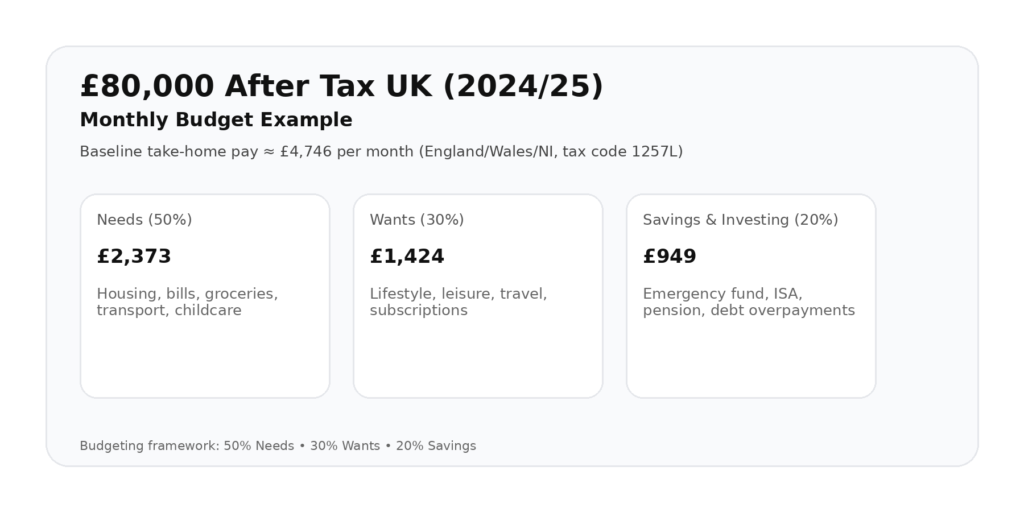
Table: 50/30/20 Budget on £4,746 Monthly Net Pay
Needs (50%)
- £2,373 per month
- Covers:
- rent or mortgage payments
- council tax and utilities
- groceries
- commuting and transport
- insurance
- childcare and other unavoidable costs
Wants (30%)
- £1,424 per month
- Covers:
- dining out and takeaways
- holidays and travel
- leisure activities and hobbies
- subscriptions and memberships
- discretionary shopping
Savings / Investing (20%)
- £949 per month
- Covers:
- emergency fund contributions
- Stocks & Shares ISA or Cash ISA
- pension top-ups
- overpayments on mortgages or other debt
These figures are rounded and align with the benchmarks specified in your brief. They are intentionally realistic rather than aspirational — the goal is usability, not perfection.
This kind of “Saving Tool–style” budgeting helps readers move from abstract tax numbers to practical financial planning.
How the Budget Changes With a Plan 2 Student Loan
As shown earlier in the article, student loan repayments can materially change monthly cash flow.
At an £80,000 salary in 2024/25, a Plan 2 student loan typically costs:
- ~£4,743 per year
- ~£395 per month
Applying this deduction to the baseline net pay:
- Original net pay: £4,746 per month
- Less student loan: ~£395
- Revised net pay: ~£4,351 per month
Using the same 50/30/20 framework, the budget adjusts as follows.
Table: 50/30/20 Budget on £4,351 Monthly Net Pay (With Plan 2 Loan)
Needs (50%)
- £2,176 per month
Wants (30%)
- £1,305 per month
Savings / Investing (20%)
- £870 per month
Why this matters for “£80k after tax UK” expectations
This comparison highlights a key reality for many higher earners:
- headline “after tax” figures often ignore student loans
- student loans reduce usable income every single month
- the impact is ongoing and uncapped
This is why two people on the same £80,000 salary can experience very different lifestyles and saving capacity, even before considering housing costs or location.
It also explains why many people feel that an £80k salary does not stretch as far as expected — not because the salary is low, but because additional deductions materially change cash flow.
Flexibility and realism
The 50/30/20 rule is not a moral standard. In real UK life:
- London housing costs may push “Needs” above 50%
- parents may prioritise savings over wants
- aggressive mortgage overpayments may temporarily exceed 20% savings
What matters is not strict adherence, but conscious allocation — knowing where your money is going, and why.
Mini infographic placement (editorial note)
Mortgage Affordability on £80,000 (UK Context)
Once people understand their £80k take-home pay UK figure and how monthly cash flow works, the next major question is usually about property:
“How much can I realistically borrow on an £80,000 salary?”
In the UK, mortgage affordability is assessed using a combination of income multiples and detailed affordability checks. While lenders increasingly focus on net income and outgoings, income multiples remain a useful starting point for planning.
The UK rule-of-thumb: income multiples
A commonly used rule-of-thumb in the UK mortgage market is that lenders may offer around 4.5 times annual salary for a single applicant.
This multiple is not fixed and can vary depending on:
- credit history and credit score
- existing financial commitments
- childcare and dependent costs
- whether the application is sole or joint
- interest rate environment
- lender-specific affordability and stress testing models
Some lenders may offer lower multiples (around 4.0×), while others may stretch to 5.0× or more for applicants with strong profiles and low outgoings.
Illustrative borrowing power on an £80,000 salary
The table below shows how borrowing capacity can vary depending on the income multiple applied.
Salary | Multiple | Illustrative maximum loan
£80,000 | 4.0× | £320,000
£80,000 | 4.5× | £360,000
£80,000 | 5.0× | £400,000
These figures are illustrative, not guarantees. They are designed to frame expectations rather than predict individual lender decisions.
Why take-home pay matters more than salary alone
While income multiples provide a headline number, modern mortgage affordability is heavily influenced by net monthly income and committed outgoings.
At £80,000, factors that can materially reduce borrowing capacity include:
- student loan repayments, which reduce monthly disposable income
- childcare costs, especially nursery fees
- high ongoing commitments such as car finance or personal loans
- credit card balances or other unsecured debt
For example, an £80k earner with:
- a Plan 2 student loan
- childcare costs
- and high fixed monthly expenses
may be offered a significantly lower loan than another £80k earner with minimal outgoings — even though their gross salary is identical.
This is why lenders increasingly stress-test affordability against net pay after deductions, not just headline salary.
Sole vs joint applications
Mortgage affordability also changes materially depending on whether the application is:
- sole, based on one income
- joint, combining two incomes
A joint application can increase borrowing capacity, but it also introduces:
- joint liability
- combined credit profiles
- shared affordability constraints
In some cases, a second income can lift borrowing power substantially. In others — particularly where the second applicant has high outgoings or weaker credit — the uplift may be more modest than expected.
Interest rates and lender stress tests
Lenders do not assess affordability based solely on the current mortgage rate. Instead, they apply stress tests, modelling whether the borrower could still afford repayments if rates were higher.
As interest rates rise:
- stress tests become stricter
- borrowing multiples may compress
- affordability caps can tighten
This means that the same £80,000 salary may support different borrowing amounts in different interest rate environments.
Responsible framing for this page
To keep guidance accurate and compliant, it’s important to position mortgage figures correctly.
The right message for an £80k salary is:
- income multiples provide a useful planning range
- real affordability depends on net pay and commitments
- individual outcomes vary by lender and personal circumstances
Presenting borrowing power as a starting point rather than a promise helps readers set realistic expectations and avoids the frustration that comes from relying on overly optimistic figures.
£80k Salary After Taxes: Living in London vs Regional UK
Two people can earn the same £80,000 salary and have very similar “after tax” figures — yet experience completely different lifestyles depending on where they live.
This is one of the biggest reasons higher earners sometimes feel confused by online discussions around “80k after tax UK”. The tax calculation may be broadly consistent, but the cost-of-living reality is not.
Starting point: the baseline net pay benchmark
Using the baseline PAYE scenario for England/Wales/Northern Ireland in 2024/25:
- Monthly take-home pay: ~£4,746
That figure looks strong on paper. The key question is how much of it is consumed by non-negotiable costs (housing, bills, childcare, commuting). These “needs” determine whether £80k feels like:
- a comfortable middle-class lifestyle, or
- a high-stress income that still leaves little room for saving
Why London can feel “tighter” even on £80k
London is often the first place where higher earners notice that salary and lifestyle are not directly proportional. Even with a strong net pay figure, costs can absorb income quickly.
London (and parts of the South East) typically involves:
- higher rents and housing costs (often the single biggest pressure point)
- higher childcare costs, especially for nursery-age children
- higher commuting costs, particularly if you travel daily and do not live centrally
- higher “baseline” spending, including food, services, and everyday convenience costs
- social pressure to spend, such as networking, events, dining out, and professional lifestyle expectations
This combination means that even on £4,746 per month net, the “needs” category can exceed the 50/30/20 guideline.
This matters because savings are rarely what people intend to compromise first. In many households, the squeeze shows up as:
- reduced saving and investing
- delayed deposit building
- less pension planning capacity
- reliance on bonuses for financial progress
Scenario A: London renter (illustrative budget pressure)
A typical London example is someone renting a one- or two-bedroom property and paying for utilities and council tax.
If rent + bills land around £2,400–£3,200 per month (depending on area, transport zones, and household size), that single expense can absorb:
- 51% to 67% of a £4,746 net monthly income
In other words, housing alone can consume all of the “needs” budget under a 50/30/20 plan before groceries, transport, or childcare are even included.
This is why many £80k earners in London say:
- “I earn a lot, but I don’t feel like I’m saving enough.”
- “My salary looks high, but it disappears.”
At this point, household planning becomes less about “how much do I earn?” and more about:
- “How much is fixed each month?”
- “How exposed am I to rent increases?”
- “Can I reduce commitments through lifestyle design or tax-efficient planning?”
What typically breaks the 50/30/20 rule in London?
Even disciplined households can struggle to keep needs at 50% because London costs are concentrated in categories that are hard to reduce quickly:
- rent / mortgage
- childcare
- commuting
- council tax and utilities
When these rise, households usually do one of three things:
- reduce savings
- reduce discretionary spending significantly
- change housing location or household structure
That’s why many London households treat the 50/30/20 rule as an aspiration rather than a realistic baseline.
Why £80k can feel “upper-middle” outside London
Outside London and the most expensive parts of the South East, the same £80,000 salary often feels materially different — primarily because housing costs are lower relative to income.
In many UK regions and cities, lower housing costs can mean:
- more disposable income
- easier saving and investing
- faster deposit building
- greater capacity to make pension contributions strategically
- ability to absorb shocks (car repairs, childcare changes, interest rate rises) without breaking the budget
This is why £80k can feel more like an “upper-middle” lifestyle in regional areas: not because spending is low, but because core fixed costs take a smaller share of income.
Scenario B: Regional homeowner (illustrative stability)
In many regions, it is more realistic for an £80k earner (or household) to have mortgage + bills closer to:
- £1,400–£1,900 per month
If we compare that to the same £4,746 net pay:
- £1,400 is ~29% of net pay
- £1,900 is ~40% of net pay
This is typically within (or closer to) the 50% “needs” range, leaving space for:
- a consistent 20%+ savings rate
- meaningful ISA contributions
- mortgage overpayments
- pension top-ups (especially valuable at higher-rate tax levels)
In other words, regional affordability often makes financial progress feel more controllable and less dependent on bonuses or salary jumps.
Building a UK Plan on £80k a Year After Tax
Once you know your £80k take-home pay UK figure, the next step is turning it into a plan you can actually follow. At this income level, the biggest risk is not “earning too little” — it is earning well but letting money leak through predictable gaps: unmanaged cash flow, expensive debt, inefficient savings, and missed tax planning opportunities.
Below is a practical, accountant-style framework that many higher-rate PAYE earners use. It is designed to be realistic, not idealistic — and it works whether you live in London, the South East, or elsewhere in the UK.
This plan is not personalised financial advice. It is a structured approach that helps you prioritise the fundamentals and avoid the most common mistakes higher earners make.
Step 1 — Stabilise cash flow (build a 3–6 month emergency fund)
Before investing aggressively or making long-term commitments, the first priority is stabilising cash flow. At £80,000, income is strong — but household obligations can still create vulnerability, especially if you have:
- childcare costs
- a mortgage or high rent
- car finance
- student loan deductions
- variable bonus income
An emergency fund protects you against predictable disruptions such as:
- job changes or contract gaps
- unexpected bills (repairs, medical costs, family emergencies)
- interest rate increases
- short-term income shocks (bonus structure changes, overtime reductions)
A practical emergency fund is usually defined as 3–6 months of essential outgoings, covering:
- mortgage or rent
- utilities and council tax
- food and basic household spending
- transport and commuting costs
- childcare or other dependent costs
- essential insurance and minimum debt payments
For many households earning around £80k net pay, this often works out to roughly £8,000–£20,000, depending on the household’s fixed commitments.
The objective is not to hold excessive cash indefinitely, but to ensure you have enough liquidity so that:
- you don’t rely on credit cards for emergencies
- you can make financial decisions calmly, not under pressure
- you can invest long-term funds without needing to withdraw them at the wrong time
Step 2 — Pay down “bad” debt aggressively
Not all debt is equal. At £80k income levels, the most damaging form of debt is usually high-interest consumer borrowing.
Priority debts to clear early typically include:
- high-interest credit cards
- expensive overdrafts
- unsecured loans with high APR
- buy-now-pay-later balances that are drifting into long-term habits
This type of debt is financially toxic because its interest rates often exceed realistic long-term investment returns. Even a disciplined investor can struggle to “out-invest” a high APR credit card.
A common professional rule is:
- clear high-interest debt first
- then focus on building investments and optimising long-term strategy
For many £80k earners, clearing bad debt quickly creates an immediate “take-home pay upgrade” because you remove monthly interest leakage and free up cash flow for savings, pensions, and future planning.
Step 3 — Use tax-efficient savings (ISAs)
Once cash flow is stable and bad debt is under control, the next step is building wealth using tax-efficient vehicles.
For UK residents, ISAs (Individual Savings Accounts) are one of the most practical tools because they allow eligible savings and investments to grow without UK tax on:
- interest (Cash ISA)
- dividends (Stocks & Shares ISA)
- capital gains within the ISA wrapper
ISAs are simple, mainstream, and widely used by higher earners who want flexibility outside pensions.
For the purposes of this guide, the key planning idea is:
- use ISAs for medium-to-long-term wealth building and flexibility
- keep pensions for tax efficiency and long-term retirement strategy
- don’t default to taxable accounts when ISA capacity is available
Step 4 — Optimise pension contributions (often the biggest tax lever at £80k)
At £80,000, pensions stop being “something you do later” and become one of the most important tax-efficiency tools available.
Why pensions are so powerful at £80k:
- you are paying higher-rate income tax on part of your income
- pension contributions can reduce taxable income
- salary sacrifice can reduce employee NICs as well
- for families, pension contributions may reduce adjusted net income and help manage HICBC exposure
This is why pension planning is often the most tax-efficient move for higher-rate PAYE earners — particularly when combined with salary sacrifice and employer matching.
At this stage, the planning focus usually becomes:
- whether your pension contributions are structured efficiently (net pay vs relief at source vs salary sacrifice)
- whether you are capturing full employer contributions
- whether pension contributions could reduce thresholds that trigger household-level charges (e.g., HICBC)
- whether your retirement planning aligns with your broader lifestyle goals
HMRC guidance on pension tax relief and adjusted net income becomes relevant at this level because the “right” structure can materially change outcomes.
Step 5 — Review and manage “hidden” deductions and threshold traps
This step is often overlooked but is crucial at £80k.
Higher earners frequently have deductions or charges that are not obvious from a basic take-home calculation, such as:
- student loan repayments
- benefits-in-kind taxation (company car, medical insurance)
- HICBC liability for families
- tax code adjustments and underpayment collection
- bonus months with unusual PAYE treatment
This is why many £80k earners benefit from an annual “financial housekeeping” review — even if they remain PAYE employees — because the complexity at this income level can quietly erode net income.
Editorial transition note (into Scotland section)
Up to this point, all baseline calculations have focused on England, Wales, and Northern Ireland, which use the same income tax bands.
However, Scotland operates a different income tax system, and for people earning £80,000, the difference is large enough to materially change take-home pay.
That is why many searches now include:
- “80k after tax Scotland”
- “80k take home pay Edinburgh”
- “why is my net pay lower in Scotland?”
£80k After Tax Scotland: Why Take-Home Pay Is Lower Than the Rest of the UK
Up to this point, all calculations in this guide have focused on England, Wales, and Northern Ireland, which share the same income tax bands.
Scotland is different.
If you earn £80,000 in Scotland — including in cities like Edinburgh or Glasgow — your take-home pay will be noticeably lower than someone earning the same salary elsewhere in the UK.
This difference is not due to National Insurance (which remains UK-wide), but because Scotland operates its own income tax system, with higher marginal rates applying at lower income levels.
This is why search queries such as:
- “80k after tax Scotland”
- “80k take home pay Edinburgh”
have become increasingly common.
The key reason: Scotland has higher income tax rates for higher earners
While the UK government sets National Insurance rules, the Scottish Government sets income tax rates and bands for non-savings, non-dividend income earned by Scottish residents.
At £80,000, the most important differences are:
- the higher rate in Scotland is 42% (not 40%)
- an additional Advanced Rate of 45% applies above a lower threshold than in the rest of the UK
These higher rates apply to employment income for Scottish taxpayers and are applied automatically through PAYE for anyone classed as a Scottish taxpayer by HMRC.
Scottish income tax bands (2024/25): what changes at £80k
For the 2024/25 tax year, Scotland applies the following income tax structure to earned income:
- Personal Allowance: £12,570 (UK-wide)
- Starter, Basic, and Intermediate rates apply at lower income levels
- Higher Rate: 42%
- Advanced Rate: 45% (applies above a lower threshold than the UK-wide additional rate)
While the lower bands affect modest earners, the material difference at £80,000 comes from the higher and advanced rates applying sooner and at higher percentages.
The rates and thresholds are published by GOV.UK and the Scottish Government, and are built directly into payroll systems.
Why this matters at £80,000 specifically
At £80,000:
- a larger slice of income is taxed above 40%
- part of income may be taxed at 45%, not 40%
- the cumulative income tax bill is higher than in England/Wales/NI
National Insurance contributions remain the same, but income tax alone increases by around £2,300–£2,500 per year, depending on exact thresholds and rounding.
£80k After Tax Scotland: headline take-home comparison
Using standard assumptions (PAYE employee, no pension, no student loan, no benefits):
- England / Wales / Northern Ireland:
- Take-home pay ≈ £56,957 per year
- Scotland:
- Take-home pay ≈ £54,500–£54,600 per year
That means a Scottish taxpayer earning £80,000 typically takes home around £2,400 less per year than a counterpart elsewhere in the UK.
On a monthly basis, this difference is roughly:
- £200 less per month
This gap alone is enough to:
- reduce savings capacity
- slow deposit building
- increase reliance on bonuses
- make cost-of-living pressures feel sharper
“80k Take Home Pay Edinburgh”: tax + cost of living combined
Edinburgh adds a second layer to the discussion.
Not only does Scotland tax income more heavily at £80,000, but Edinburgh is also one of the most expensive cities in the UK outside London.
For many households, this creates a double pressure:
- Lower net pay due to Scottish income tax
- Higher living costs compared to much of the UK
This is why people earning £80k in Edinburgh often report that their lifestyle feels closer to what £70k–£75k might feel like elsewhere.
Typical Edinburgh pressure points at £80k
While exact costs vary by household, common themes include:
- strong rental demand pushing rents higher
- limited housing stock in central areas
- childcare costs comparable to major English cities
- commuting costs if living outside the city centre
When these costs combine with a ~£200/month net pay disadvantage, budgeting margins can become tight — particularly for families.
Why Scottish £80k earners feel the difference more sharply
The impact of Scottish income tax is not linear — it is most noticeable at upper-middle incomes like £80,000.
At this level:
- you are firmly in higher-rate territory
- you do not yet have the income flexibility of very high earners
- fixed costs (housing, childcare) absorb a large share of income
This makes Scottish tax differences feel more acute at £80k than they might at much higher incomes, where planning options and surplus cash are greater.
Can Scottish £80k earners plan around the difference?
To a degree, yes — but with limits.
Scottish taxpayers cannot opt out of Scottish income tax, and there is no “workaround” to change the rates applied to employment income.
However, planning can soften the impact, particularly through:
- pension contributions (especially salary sacrifice where available)
- managing adjusted net income for HICBC
- careful bonus and benefit structuring
- long-term savings and investment efficiency
The principles discussed earlier in this guide apply just as strongly in Scotland — in some cases, even more so, because marginal tax rates are higher.
Why £80,000 After Tax Is Lower in Scotland
When people compare £80,000 after tax in Scotland with the rest of the UK, the difference can feel confusing — especially because payslips still show familiar items like PAYE and National Insurance.
The explanation comes down to how tax powers are split in the UK.
The key structural point
- National Insurance is set at a UK-wide level
- Income Tax on earnings is devolved in Scotland
This means that for a Scottish taxpayer:
- employee National Insurance Contributions (NICs) are calculated using the same thresholds and rates as England, Wales, and Northern Ireland
- Income Tax is calculated using Scottish-specific bands and rates, which are higher for upper earners
The Scottish Government sets these Income Tax rates and bands each year. They are then implemented operationally by HMRC through PAYE payroll systems.
As a result, the difference in take-home pay at £80,000 is systemic and unavoidable, not the result of an error or employer discretion.
Scottish Income Tax Bands (2024/25)
For the 2024/25 tax year, Scotland applies a more granular income tax structure than the rest of the UK, with additional bands and higher marginal rates for higher earners.
While lower bands affect modest incomes, the most important features for someone earning £80,000 are:
- the Higher Rate in Scotland is 42% (compared with 40% elsewhere in the UK)
- an Advanced Rate of 45% applies at a lower income threshold than the UK-wide additional rate
- the Personal Allowance of £12,570 still applies and remains UK-wide
These Scottish rates and thresholds are formally set by the Scottish Government and reflected in payroll guidance published by GOV.UK and HMRC.
Why the extra bands matter at £80,000
At £80,000, a Scottish taxpayer is affected in two ways:
- A larger slice of income is taxed above 40%
- Part of income is taxed at 45%, rather than 40%
Even though National Insurance remains unchanged, these higher income tax rates materially increase the total tax bill.
This is why the difference becomes noticeable at £80k, whereas at lower salaries it may appear relatively modest.
£80,000 After Tax — Scotland vs Rest of the UK (Headline Numbers)
Using the same assumptions throughout this guide:
- PAYE employee
- tax code 1257L (full Personal Allowance)
- no pension contributions
- no student loan repayments
- no taxable benefits
and applying official 2024/25 rates, the comparison is as follows.
Take-home pay comparison
Location | Annual net pay (approx.) | Monthly net pay (approx.)
England / Wales / Northern Ireland | £56,957 | ~£4,746
Scotland | ~£54,519 | ~£4,543
The difference
- Approximately £2,400 less per year in Scotland
- Roughly £200 less per month
This gap aligns closely with:
- HMRC-aligned payroll calculations
- independent tax calculators that apply Scottish income tax bands correctly
Why this difference feels significant in practice
A £2,400 annual difference may sound modest in percentage terms, but in real household planning it often translates into:
- reduced monthly saving capacity
- slower mortgage deposit accumulation
- less flexibility for pension top-ups
- greater reliance on bonuses or variable pay
Because many fixed costs (housing, childcare, transport) do not fall just because tax is higher, the marginal pressure of Scottish income tax is felt more sharply at upper-middle incomes like £80,000.
Why this is not something you can “opt out” of
HMRC determines whether someone is a Scottish taxpayer based on where they live and where their main place of residence is. If you meet the criteria:
- Scottish income tax rates apply automatically
- employers have no discretion to apply UK-wide bands instead
- PAYE deductions reflect Scottish bands by default
This is why searches such as “why is my net pay lower in Scotland?” are increasingly common — the answer lies in policy, not payroll error.
Why the Difference Is About £2,400 (Scotland vs Rest of the UK)
When comparing £80,000 after tax in Scotland with the rest of the UK, the recurring figure that appears across payroll systems, calculators, and real payslips is a gap of around £2,400 per year.
This difference is not accidental, and it is not driven by National Insurance. It is the direct result of higher marginal income tax rates being applied to the same taxable income under the Scottish system.
Understanding exactly where this difference comes from is important, because it removes confusion and explains why the gap is so consistent across sources.
What is the same across the UK (and therefore not the cause)
Several major components of the £80,000 calculation are identical whether you live in Scotland or elsewhere in the UK:
Personal Allowance
- £12,570
- Applies UK-wide
- Fully available at £80,000
Employee National Insurance
- Approximately £3,611 per year
- Charged at:
- 8% between the Primary Threshold and Upper Earnings Limit
- 2% above the Upper Earnings Limit
- Rates and thresholds are UK-wide
Because both of these elements are unchanged, they cannot explain the lower Scottish take-home pay.
This point matters, because many people initially assume the difference must come from National Insurance. It does not.
What is different in Scotland (and why it matters)
The entire difference comes from Income Tax, which is devolved in Scotland.
Unlike England, Wales, and Northern Ireland — which use a relatively simple structure of:
- 0% (Personal Allowance)
- 20% (basic rate)
- 40% (higher rate)
Scotland applies:
- more income tax bands, and
- higher marginal rates at upper-middle income levels
For someone earning £80,000, two features are decisive:
- The Scottish higher rate is 42%, not 40%
- An Advanced Rate of 45% applies to part of the income, at a lower threshold than the UK-wide additional rate
As a result, a larger portion of the same £80,000 salary is taxed above 40% in Scotland.
There is no single clean “basic + higher” split. Instead, income flows through several bands, each with slightly higher rates — and that incremental difference accumulates.
How the £2,400 difference builds up in practice
At £80,000, the taxable income (after the Personal Allowance) is broadly the same across the UK.
What changes is the rate applied to the upper slices of that income.
In practical terms:
- some income that would be taxed at 40% elsewhere is taxed at 42% in Scotland
- some income that would still sit below 45% elsewhere is taxed at 45% in Scotland
Across the full year, these extra 2–5 percentage points on multiple income slices typically produce:
- £2,300–£2,500 more income tax per year
This is why the headline difference consistently lands at around £2,400 annually, rather than fluctuating wildly.
Why the monthly impact feels so noticeable
Although £2,400 per year is only about 3% of an £80,000 salary, it translates into:
- £150–£200 less take-home pay per month
That monthly framing is what most employees feel day to day — not the annual figure.
Because:
- housing costs do not change
- childcare costs do not change
- commuting and bills do not change
the £150–£200 difference is usually absorbed directly by:
- reduced savings
- slower mortgage deposit growth
- fewer pension top-ups
- tighter monthly buffers
This is why many Scottish £80k earners describe the difference as material, even if it looks modest on paper.
Why the difference is stable (and not a calculator quirk)
Another reason this section is important is to explain why the gap is stable.
Once you apply:
- Scottish income tax bands correctly, and
- UK-wide National Insurance correctly
most calculators, payroll systems, and payslips converge on almost the same net figure.
So if someone sees:
- £56,900–£57,000 net outside Scotland, and
- £54,400–£54,600 net in Scotland
that consistency is a sign the system is working as designed — not that something is wrong.
Official thresholds and rates used in payroll are published and maintained by GOV.UK and HMRC, which is why the numbers line up across reputable sources.
Practical Implications for “80k Take Home Pay UK” Searches
This section directly answers a real-world problem that drives search behaviour.
It explains why:
- UK-wide calculators often overestimate Scottish take-home pay, because they default to England/Wales tax bands
- Scottish employees frequently feel they are “missing” £150–£200 per month compared to colleagues elsewhere
- discussions between colleagues on the same gross salary can feel confusing or unfair without understanding devolved tax
Many users arrive at this page not looking for abstract theory, but because:
- their payslip does not match what a generic calculator shows
- they want confirmation that the difference is structural, not an error
- they are planning budgets, mortgages, or relocations
The correct, reassuring answer is:
At £80,000, a Scottish taxpayer pays more income tax on the same salary — even though National Insurance is unchanged.
That understanding allows readers to move forward with realistic expectations, informed planning, and accurate comparisons — which is exactly what this guide is designed to provide.
London vs Edinburgh: £80k Take-Home Pay in Context
At this stage of the guide, it’s useful to step back from pure tax mechanics and look at how £80,000 actually feels in real life, once both taxation and cost of living are taken into account.
Two locations are especially relevant for comparison:
- London — the UK’s highest-cost city, but under the UK-wide income tax system
- Edinburgh — generally cheaper than London, but subject to Scottish income tax
The purpose of this section is not to calculate exact household budgets. Instead, it explains why lived experience can differ so sharply, even when the gross salary is identical.
The starting point: same salary, different frameworks
In both cases:
- the gross salary is £80,000
- National Insurance is calculated the same way
- the job may look identical on paper
What differs is:
- the income tax system, and
- the baseline cost structure of the city
It’s the interaction between these two elements that shapes how £80k actually feels.
£80k Salary in London (England)
Location: London
Tax system: UK-wide (England/Wales/NI)
Key characteristics at £80,000:
- Net pay: approximately £4,746 per month
- Income tax burden is lower than in Scotland at the same salary
- National Insurance is unchanged
- Housing, childcare, and commuting costs are typically very high
- Social and professional life often carries higher “background” spending
For many households, London is expensive not because of tax, but because fixed and semi-fixed costs absorb income quickly.
At £80k:
- rent or mortgage payments often dominate the budget
- childcare can rival housing as the largest monthly cost
- commuting and professional lifestyle spending are hard to avoid
However, an important — and often overlooked — point is that the tax system itself is relatively favourable at £80k compared with Scotland. London earners keep more of each gross pound earned, even if much of it is then consumed by living costs.
This is why many London professionals feel:
- “The salary is good, but costs eat it up”
rather than - “The tax system is taking too much”
£80k Salary in Edinburgh (Scotland)
Location: Edinburgh
Tax system: Scottish income tax
Key characteristics at £80,000:
- Net pay: approximately £4,543 per month
- Income tax burden is higher than elsewhere in the UK
- National Insurance remains UK-wide
- Housing costs are often lower than London on average (but not universally)
- Childcare and general living costs are still high by UK standards
The critical difference is the net pay gap.
Compared with an England-based role:
- Edinburgh-based earners typically take home ~£200 less per month on the same £80k salary
That gap exists before any cost-of-living differences are considered.
Why this narrows the London–Edinburgh lifestyle gap
Edinburgh is usually cheaper than London — but the tax differential narrows the gap more than many people expect.
In practice:
- lower housing costs in Edinburgh help
- but higher income tax partially offsets that advantage
- resulting in monthly disposable income that can feel closer to London levels than headline costs suggest
This often surprises people who assume:
“Edinburgh is cheaper, so I’ll automatically be better off on the same salary.”
At £80k, the answer is more nuanced.
The psychological effect of the £200/month gap
A £200 monthly difference may sound modest, but it often has an outsized impact because it tends to fall on:
- savings
- pension top-ups
- discretionary spending buffers
In other words, it reduces flexibility, not just spending power.
That’s why Scottish £80k earners often describe the tax difference as noticeable, even if their overall cost of living is slightly lower than London.
High-level comparison: £80k salary in London vs Edinburgh
This table deliberately avoids fragile cost statistics and instead focuses on tax reality and lived experience, which remains relevant even as prices change.
Factor | London (England) | Edinburgh (Scotland)
Gross salary | £80,000 | £80,000
Income tax system | UK-wide | Scottish
Net pay | ~£4,746/month | ~£4,543/month
Tax difference | — | ~£200/month lower
Cost of living | very high | high
Savings potential | depends heavily on housing | depends heavily on housing
Strategic Planning at £80k in Scotland
The planning principles discussed earlier in this guide apply across the UK — but for Scottish taxpayers earning £80,000, they are often even more valuable.
This is because Scotland applies higher marginal income tax rates to employment income, which increases both:
- the cost of inaction, and
- the value of legitimate, HMRC-compliant planning
In practical terms, the same planning move can save more tax per £1 in Scotland than it would elsewhere in the UK.
Why planning matters more at £80k in Scotland
At this income level, Scottish taxpayers sit squarely in the zone where:
- income above lower bands is taxed at 42% and 45%
- National Insurance continues to apply as usual
- household-level charges such as HICBC may also apply
This creates a situation where marginal deductions on additional income can be materially higher than in England, Wales, or Northern Ireland.
As a result:
- every planning decision has a larger impact
- inefficiencies cost more in absolute terms
- optimised structures deliver more noticeable savings
Pension Planning: the most powerful lever in Scotland
Why pensions are especially effective for Scottish £80k earners
Pension contributions remain one of the clearest, most robust planning tools recognised by HMRC.
Their effectiveness increases in Scotland because:
- contributions reduce taxable income, regardless of where you live
- income sheltered in a pension avoids higher Scottish income tax rates
- the value of tax relief rises with the marginal rate applied
In other words, when marginal tax rates are higher, the benefit of reducing taxable income increases.
Practical impact at £80k
For a Scottish taxpayer earning £80,000:
- income in the upper bands is taxed at 42% or 45%
- a pension contribution that reduces taxable income avoids those rates
- the “real cost” of contributing £1 into a pension can be significantly less than £1
This is why pension planning is often the first and most impactful conversation for Scottish higher-rate earners.
Pension planning and HICBC (still UK-wide)
It is important to emphasise that HICBC rules are UK-wide, not devolved.
That means:
- the £60,000–£80,000 taper applies equally in Scotland
- adjusted net income remains the relevant measure
- pension contributions can reduce adjusted net income when structured correctly
For Scottish households with children, pension planning can therefore:
- reduce income tax
- reduce or eliminate HICBC
- improve household cash flow
This “double benefit” makes pension contributions particularly valuable at £80k.
Salary Sacrifice in Scotland
How salary sacrifice works (and why it’s powerful)
Salary sacrifice arrangements operate in Scotland in exactly the same mechanical way as elsewhere in the UK.
Under a valid salary sacrifice agreement:
- part of your cash salary is contractually exchanged for a non-cash benefit
- the sacrificed amount is no longer treated as salary
- taxable pay is reduced at source
As a result, salary sacrifice can:
- reduce Income Tax
- reduce employee National Insurance
- reduce adjusted net income (relevant for HICBC)
HMRC explicitly recognises salary sacrifice as a legitimate arrangement when implemented correctly.
Why the savings can be greater in Scotland
While the mechanics are the same, the value per £1 sacrificed can be higher for Scottish taxpayers because:
- higher marginal income tax rates are avoided
- NICs may still be saved
- household-level charges may be reduced
In other words:
- the same £1 of salary sacrificed can save more tax in Scotland than elsewhere
This is why Scottish £80k earners often benefit disproportionately from:
- pension salary sacrifice
- employer-led benefit schemes
- structured remuneration planning
Important practical limits
As with all salary sacrifice arrangements:
- availability depends on the employer
- not all benefits qualify
- contractual changes must be made in advance
- arrangements must be compliant with HMRC guidance
Salary sacrifice is powerful — but it is not universal or automatic.
Why strategic planning matters more, not less, in Scotland
Because Scottish income tax increases the “headline” tax burden at £80k, it can be tempting to feel resigned to lower take-home pay.
In reality, the opposite is often true:
- good planning has more impact
- inefficient structures are more costly
- marginal improvements compound over time
This is why many Scottish professionals earning around £80,000 benefit from:
- regular reviews of pension structure
- careful consideration of salary sacrifice options
- joined-up planning that considers household-level effects
At £80k in Scotland, tax planning is not about avoidance or complexity — it is about using the mainstream tools that the system already allows, but using them well.
Key Takeaways for £80k Earners (UK-Wide)
After working through the calculations, comparisons, and planning considerations, several consistent conclusions emerge for anyone earning £80,000 a year in the UK.
These points apply regardless of profession and are relevant to employees, senior specialists, managers, consultants, and contractors considering their next steps.
£80,000 places you firmly in higher-rate territory
Across the UK, £80,000 is no longer a “borderline” salary. It is firmly within higher-rate tax territory, which means:
- part of your income is taxed at 40% (or higher in Scotland)
- payroll deductions accelerate sharply once you pass £50,270
- marginal take-home pay on additional income is materially lower
This is why £80k earners often feel a step-change in how their payslip behaves compared to earlier career stages.
Scotland materially changes the outcome
For Scottish taxpayers:
- income tax rates are higher
- additional bands apply earlier
- take-home pay is typically ~£2,400 per year lower than in England, Wales, or Northern Ireland
This difference is:
- structural
- policy-driven
- entirely due to income tax
National Insurance is not the cause.
Understanding this distinction is essential for accurate budgeting, salary comparisons, and relocation decisions.
National Insurance is not the villain — income tax is
A common misconception among £80k earners is that National Insurance is responsible for the perceived “tax hit”.
In reality:
- NICs are UK-wide
- NICs do not change in Scotland
- the net pay difference is driven by income tax bands and marginal rates
This matters because it shifts the focus of planning to the right levers — pensions, salary structure, and adjusted net income — rather than chasing NIC myths.
Pension planning becomes strategic at £80k
At this income level, pensions stop being a passive long-term consideration and become an active planning tool.
Why this matters:
- higher marginal tax rates increase the value of pension relief
- pension contributions can reduce taxable income
- in households with children, pensions can reduce adjusted net income and mitigate HICBC
In Scotland, where marginal rates are higher, pension planning is often more powerful, not less.
Salary sacrifice amplifies planning efficiency
Where available, salary sacrifice arrangements:
- reduce taxable pay
- reduce employee NICs
- reduce adjusted net income
The mechanics are the same across the UK, but the tax saved per £1 sacrificed can be greater in Scotland due to higher marginal rates.
This makes salary sacrifice one of the most effective tools for £80k earners — particularly for pensions and employer-provided benefits.
Cost of living must always sit alongside tax
Tax does not exist in a vacuum.
Two people earning £80,000 can experience very different lifestyles depending on:
- location
- housing costs
- childcare obligations
- commuting patterns
London, Edinburgh, and regional UK cities all interact differently with the same net pay figure.
This is why realistic planning always considers tax and cost of living together, rather than treating take-home pay as a standalone number.
2025/26 Outlook: Changes Affecting £80,000 Salary After Tax
For many readers, the natural next question after understanding their £80k after tax UK figure is:
“What changes next — and why does it feel like I’m paying more tax even when rates don’t go up?”
The 2025/26 tax year illustrates a key reality of the UK system: headline tax rates matter less than thresholds and employer-side costs — especially for higher-rate earners.
Headline Income Tax Rates Remain the Same — But Thresholds Still Do the Work
For England, Wales, and Northern Ireland, the core income tax bands remain unchanged going into 2025/26:
- Personal Allowance: £12,570
- Basic rate: 20% up to £50,270
- Higher rate: 40% up to £125,140
- Additional rate: 45% above £125,140
These figures continue to appear in employer PAYE guidance and payroll tables published on GOV.UK, including the official “Rates and thresholds for employers” documentation used by payroll software.
At first glance, this looks reassuring — no rate increases, no dramatic policy shifts.
However, for someone earning £80,000, the absence of change is precisely what creates pressure.
Why frozen thresholds matter at £80,000
At £80k, a substantial portion of income already sits in the higher-rate band.
When thresholds are frozen:
- any nominal pay increase
- any inflation-linked rise
- any bonus growth
is pushed straight into higher-rate taxation.
This means that:
- your marginal tax rate remains high, and
- your average tax rate quietly increases over time
Even without a single percentage point rise in tax rates.
Frozen Thresholds and “Fiscal Drag”
(Why You Can Pay More Tax Without a Tax Rise)
This phenomenon is widely referred to as fiscal drag.
Fiscal drag occurs when:
- tax thresholds are frozen, and
- wages rise due to inflation or market pressure
As income rises but thresholds do not, more income is taxed at higher rates, increasing the government’s tax take without changing rates.
Two authoritative sources explain this clearly:
- The House of Commons Library briefing on freezing the Personal Allowance and higher-rate threshold
- The Office for Budget Responsibility explainer on threshold freezes and their fiscal impact
Both confirm that fiscal drag disproportionately affects upper-middle earners, including those around £80,000.
What fiscal drag means in practice for £80k earners
For someone earning £80,000:
- small pay rises do not translate cleanly into higher take-home pay
- a growing share of income is taxed at 40% (or higher in Scotland)
- real purchasing power can fall even as gross pay rises
This is one reason many £80k earners report:
- “I’m earning more, but I don’t feel better off.”
The tax system has not become harsher overnight — it has simply become less forgiving over time.
Employer National Insurance Increase to 15% from 6 April 2025
(Why Employees Should Care About an ‘Employer Tax’)
One of the most important — and often misunderstood — changes for 2025/26 is on the employer side.
From 6 April 2025, the secondary (employer) Class 1 National Insurance rate increases:
- from 8%
- to 15%
This change is confirmed in official policy and guidance published by HMRC and referenced on GOV.UK.
Why this matters to employees on £80k
Although employer NIC is not deducted from your payslip, it directly affects total employment cost.
At £80,000 salary:
- employer NIC already represents a substantial additional cost
- a higher rate increases that cost further
- employers often respond by managing overall reward budgets
This can influence:
- salary review outcomes
- bonus pools
- benefit offerings
- willingness to offer salary sacrifice arrangements
- decisions about permanent roles vs contractors
This is where the earlier concept of the “Taxberg” becomes even more relevant: the visible salary is only part of the cost employers consider.
Why this matters in salary negotiations
In 2025/26 and beyond, employers are increasingly likely to think in terms of:
- total cost to company, not just gross salary
For £80k earners, this can mean:
- tighter pay rises
- greater emphasis on non-cash benefits
- more interest in tax-efficient reward structures
Understanding employer NIC changes allows employees to:
- frame negotiations more realistically
- understand resistance to headline salary increases
- explore alternative structures where appropriate
Another Employer-Side Change: Secondary Threshold Reduced to £5,000
In addition to the NIC rate increase, payroll guidance indicates a further pressure point:
- the employer NIC secondary threshold reduces
- from £9,100
- to £5,000
- effective from 6 April 2025
This change is widely discussed in payroll and HR industry guidance, including commentary from providers such as Sage and Moorepay.
Practical implication for £80k earners
While this change does not directly alter your take-home pay calculation, it increases employer NIC liability earlier in the pay scale.
In real-world terms:
- employers start paying NIC sooner
- total employment cost rises across the workforce
- pressure builds on reward budgets
For £80k earners, this often shows up indirectly:
- slower pay progression
- greater scrutiny of bonuses
- more emphasis on benefits and flexible reward
FAQs: £80,000 Salary After Tax UK
This section answers the most common follow-up questions people ask after searching “80k after tax UK”.
These are not theoretical questions — they are based on what people actually see on their payslips and in their bank accounts.
How much tax do I pay on a £5,000 bonus when I earn £80,000?
In England, Wales, and Northern Ireland, if your base salary is already £80,000, any additional bonus typically sits entirely within the 40% higher-rate income tax band.
Once your earnings are above the National Insurance Upper Earnings Limit, employee NICs are charged at 2%.
So, in a typical case (ignoring pension salary sacrifice and student loans), a £5,000 bonus is subject to:
- 40% Income Tax
- 2% Employee National Insurance
Total typical deduction: ~42%
Worked example (common scenario)
- Gross bonus: £5,000
- Estimated PAYE deductions (~42%): ~£2,100
- Net bonus received: ~£2,900
This is why many higher-rate taxpayers feel disappointed when bonuses land — the marginal tax rate is significantly higher than on base salary.
Why your bonus can be taxed at more than 42%
In practice, some people see even higher deductions on bonus months.
Common reasons include:
- Student loan repayments
- Undergraduate loans are deducted at 9% of income above the relevant threshold
- These deductions apply to bonuses as well
If student loans apply, the marginal deduction on part of the bonus can look like:
- 40% Income Tax
- 2% NIC
- 9% Student Loan
- = ~51% effective deduction
This does not mean the bonus is “taxed at 51% as a rule” — it means multiple payroll deductions are being applied to the same slice of income.
What is the hourly rate for £80,000 a year in the UK?
The hourly equivalent of an £80,000 salary depends on your contracted weekly hours.
Below are the most common UK assumptions.
Table: £80,000 Hourly Rate (Gross)
Weekly hours | Hours per year (×52) | Gross hourly rate
35 | 1,820 | £43.96/hour
37.5 | 1,950 | £41.03/hour
40 | 2,080 | £38.46/hour
This confirms the commonly quoted range of £38.46–£41.00 per hour, depending on hours worked.
Important note:
- These are gross rates, before tax and deductions
- Take-home hourly pay will be significantly lower once PAYE, NICs, and other deductions apply
Why does my £80k take-home pay differ from online calculators?
Most online calculators showing “80k after tax UK” assume a clean baseline scenario.
Your real take-home pay can differ — sometimes materially — because payroll legitimately deducts additional items.
The most common reasons include:
- Workplace pension contributions
- especially if you contribute more than the minimum
- or use salary sacrifice
- Student loan repayments
- Plan 1, Plan 2, Plan 4, or Postgraduate Loan
- Benefits-in-kind
- company car
- private medical insurance
- other taxable benefits
- High Income Child Benefit Charge (HICBC)
- applies if you or your partner receive Child Benefit
- and your adjusted net income exceeds £60,000 (2024/25 onwards)
- charged outside the payslip, often via Self Assessment
- Tax code differences
- not everyone is on the standard 1257L code
- adjustments for prior underpayments or benefits can reduce net pay
This is why two people on the same £80,000 salary can see very different net figures.
Is £80,000 a good salary in the UK?
From a tax-band perspective, £80,000 is firmly higher-rate income across the UK.
It typically delivers:
- strong baseline net pay (around £4,746/month in England/Wales/NI)
- good borrowing power
- solid saving potential if costs are controlled
However, it also introduces new complexity:
- higher marginal tax on bonuses (often ~42%)
- potential exposure to HICBC for families
- much greater value in pension and salary sacrifice planning
- more sensitivity to location-based cost of living
In short:
£80,000 is a strong income — but it’s also the point where good planning becomes essential, not optional.
Recap: £80,000 After Tax UK — All Key Scenarios in One Place (2024/25)
It is designed for readers who want:
- a final confirmation of numbers
- a quick comparison between scenarios
- clarity on why their own take-home pay may differ
Assumptions used throughout this recap
Unless explicitly stated otherwise, all figures below assume:
- Employee paid via PAYE
- Tax code 1257L (full Personal Allowance)
- England / Wales / Northern Ireland income tax system
(Scotland shown separately where relevant) - No taxable benefits-in-kind
- No additional income (interest, dividends, second jobs)
- 2024/25 tax year thresholds and rates
Income tax bands and Personal Allowance are based on official guidance published by GOV.UK.
National Insurance thresholds and employee rates are taken from HMRC payroll guidance for 2024/25.
Baseline: £80k Take-Home Pay UK (England / Wales / NI)
This is the clean reference scenario used throughout the article — and the figure most people expect when searching “80k after tax UK”.
Baseline scenario (no additional deductions)
| Scenario | Annual net pay | Monthly net pay | Notes |
| Baseline (no extra deductions) | ~£56,957 | ~£4,746 | Income Tax ~£19,432; Employee NICs ~£3,611 |
This calculation reflects:
- the standard Personal Allowance (£12,570)
- 20% income tax up to £50,270
- 40% income tax above that
- employee NICs at 8% / 2%
This is the benchmark against which all other scenarios should be compared.
With Student Loan: Why Your £80k After Tax May Be Lower
Student loan repayments are one of the most common reasons real-world take-home pay is lower than headline calculator results.
Repayments are deducted through payroll at:
- 9% of income above the plan threshold
- using HMRC’s official deduction tables
£80,000 salary with student loan repayments (2024/25)
| Scenario | Annual net pay (approx.) | Monthly net pay | Student loan deduction |
| Baseline (no loan) | ~£56,957 | ~£4,746 | £0 |
| Plan 2 loan | ~£52,214 | ~£4,351 | ~£4,743/year (~£395/month) |
| Plan 1 loan | ~£52,006 | ~£4,334 | ~£4,951/year |
| Plan 4 loan (Scotland plan) | ~£52,583 | ~£4,382 | ~£4,374/year |
Thresholds used above are the 2024/25 payroll thresholds published in HMRC student loan deduction guidance.
Key takeaway:
At £80k, a student loan alone can reduce take-home pay by £350–£415 per month, depending on plan type.
Scotland: £80,000 After Tax Scotland vs Rest of the UK
Scotland applies its own income tax bands, which materially affect take-home pay at £80,000.
£80k take-home pay comparison by location
| Location | Annual net pay (approx.) | Monthly net pay | Difference vs England/Wales/NI |
| England / Wales / NI (baseline) | ~£56,957 | ~£4,746 | — |
| Scotland (baseline) | ~£54,519 | ~£4,543 | ~£2,400 less per year |
This difference:
- is driven entirely by higher Scottish income tax rates
- is not caused by National Insurance
- is consistent across payroll systems and calculators
This table directly answers queries such as:
- “80k after tax Scotland”
- “80k take home pay Edinburgh”
Child Benefit (HICBC): The £80k “Cliff” Effect
For households with children, the High Income Child Benefit Charge (HICBC) can be one of the most expensive — and least visible — consequences of earning £80,000.
HICBC rules (2024/25 onwards)
- Starts when adjusted net income exceeds £60,000
- Increases by 1% for every £200 above £60,000
- Reaches 100% repayment at £80,000+
Child Benefit amounts and HICBC impact at £80k
| Number of children | Child Benefit received (2024/25 est.) | HICBC at £80k+ (100% repayment) |
| 1 | £1,331.20 | £1,331.20 |
| 2 | £2,212.60 | £2,212.60 |
| 3 | £3,094.00 | £3,094.00 |
At £80,000 adjusted net income:
- 100% of Child Benefit is clawed back via HICBC
- the charge is typically paid via Self Assessment or PAYE adjustment
Planning note
HMRC guidance confirms that adjusted net income can be reduced in legitimate ways, including:
- pension contributions (especially via salary sacrifice)
- certain Gift Aid donations (depending on structure)
This is why pension planning is often central for £80k households with children.
2025/26 “What Changes Next?” — The Short Version (For Readers)
If you’re earning around £80,000, the move into the 2025/26 tax year does not bring dramatic headline tax rises — but that does not mean your tax position stands still.
Two structural changes matter most for higher-rate earners.
Threshold freezes quietly increase tax over time (“fiscal drag”)
Even when income tax rates remain unchanged, your effective tax burden can still rise.
This happens because key thresholds — such as the Personal Allowance and the higher-rate threshold — remain frozen while:
- salaries increase
- inflation pushes wages upward
- bonuses and pay reviews nudge income higher
As a result, more of your income is gradually pulled into higher tax bands. This mechanism is widely known as fiscal drag.
Both the UK Parliament (via House of Commons Library briefings) and the Office for Budget Responsibility explain how frozen thresholds increase the overall tax take without raising rates.
For £80k earners, this typically means:
- pay rises do not translate cleanly into higher take-home pay
- bonuses feel more heavily taxed over time
- marginal tax rates become more noticeable
Employer National Insurance increases affect pay discussions (even if not your payslip)
From 6 April 2025, the employer National Insurance (secondary Class 1) rate increases to 15%.
This change is confirmed in official policy guidance from HMRC.
Although this is an employer-side tax, it matters to employees because employers make decisions based on total employment cost, not just gross salary.
In practice, this can influence:
- salary review outcomes
- bonus budgets
- willingness to offer pay rises
- greater emphasis on benefits and salary sacrifice instead of cash increases
This is especially relevant for higher earners, where small changes in employer costs quickly scale up.
Optional footnote (for HR, payroll, and cost-aware readers)
In addition to the NIC rate increase, payroll and HR industry guidance also discusses a reduction in the employer NIC secondary threshold to £5,000 from April 2025.
While this does not directly change employee take-home pay, it increases employer NIC exposure earlier in the pay scale and adds further pressure to overall reward budgets.
The practical takeaway for £80k earners
Going into 2025/26:
- your payslip may not change overnight
- but the system becomes less forgiving over time
- and employer-side costs increasingly shape pay outcomes
For higher-rate earners, this reinforces a central theme of this guide:
At £80,000, understanding how the system works matters just as much as knowing the headline tax rates.
This short recap keeps the page current, realistic, and useful — even as tax years roll forward.
Related Topics You May Find Useful
If you’re earning around £80,000 a year, questions about take-home pay rarely exist in isolation. In practice, tax calculations often lead to wider considerations around reporting obligations, planning opportunities, and long-term structure.
Depending on your situation, you may also find it helpful to explore related topics such as:
- Self Assessment support
Particularly relevant if you’re affected by the High Income Child Benefit Charge (HICBC), receive bonuses, or have income outside standard PAYE. - Tax planning for higher-rate taxpayers
Useful if you want to understand how pensions, salary sacrifice, and other legitimate planning tools can improve your overall position. - Limited company accounting for contractors
Relevant if you’re comparing PAYE employment with operating through a limited company, or considering consultancy or contracting work. - PAYE and payroll compliance
Helpful for understanding how tax codes, National Insurance, and payroll deductions actually work in practice.
These areas often overlap, especially once income reaches higher-rate levels. Looking at them together can give a more complete picture of how your income, tax, and planning decisions fit together over time.
Final Note: Want a Precise Calculation for Your Situation?
As this guide shows, earning around £80,000 a year places you in a part of the UK tax system where small details can have a big financial impact.
Factors such as:
- your tax code
- how your pension contributions are structured
- student loan repayments
- Child Benefit and the High Income Child Benefit Charge (HICBC)
- taxable benefits or bonuses
can easily change your actual take-home pay by thousands of pounds per year — even when the gross salary looks the same.
If you want clarity on your real numbers, rather than relying on generic calculators, professional support can make the difference.
Audit Consulting Group works with UK higher-rate earners to:
- ensure full HMRC compliance
- explain your tax position in clear, practical terms
- help you claim every allowance and relief you are legitimately entitled to
- support informed decisions around pensions, PAYE, Self Assessment, and long-term planning
Our approach is transparent, structured, and focused on giving you confidence in your finances — not complexity for its own sake.
Contact Audit Consulting Group
Phone: +44 7386 212550
Email: info@auditconsultinggroup.co.uk
Website: auditconsultinggroup.co.uk
If you earn around £80,000, understanding how the system applies to your situation is often the most valuable step you can take.
Frequently Asked Questions: £80,000 After Tax UK
How much is £80,000 after tax in the UK (2024/25)?
For the 2024/25 tax year, if you earn £80,000 a year as an employee under PAYE in England, Wales, or Northern Ireland, your approximate take-home pay is:
- £56,956–£56,958 per year
- Around £4,746 per month
This estimate assumes a standard, clean scenario:
- tax code 1257L (full Personal Allowance)
- no pension contributions
- no student loan repayments
- no taxable benefits-in-kind
- no High Income Child Benefit Charge (HICBC)
The calculation is based on:
- UK income tax bands (20% basic rate and 40% higher rate)
- employee National Insurance contributions (Class 1)
These bands, thresholds, and NIC rates are set out in official guidance published by GOV.UK.
This figure should be treated as a baseline reference, not a guarantee of what will appear on every payslip.
How much tax do you pay on a £5,000 bonus when you earn £80,000?
If your base salary is already £80,000, most (and often all) of a £5,000 bonus falls into the 40% higher-rate income tax band.
Above the National Insurance Upper Earnings Limit, employee NICs are charged at 2%.
In a typical case (excluding pension salary sacrifice and student loans), the deductions are:
- 40% Income Tax
- 2% Employee National Insurance
That gives a combined deduction of around 42%.
Worked example (typical scenario):
- Gross bonus: £5,000
- Estimated deductions (~42%): ~£2,100
- Net bonus received: ~£2,900
Why some bonuses feel taxed even more heavily
If you also repay a student loan, an additional 9% can apply to the same slice of income. In that case, the effective marginal deduction can rise to around 51% on part of the bonus.
This does not mean bonuses are “taxed at 51% as a rule” — it means multiple payroll deductions are applied simultaneously.
What is the hourly rate for £80,000 a year?
The hourly equivalent of an £80,000 salary depends on your contracted weekly hours.
Typical UK conversions are:
- 40 hours/week: £38.46 per hour
- 5 hours/week: £41.03 per hour
- 35 hours/week: £43.96 per hour
Most people therefore quote an £80,000 salary as being worth £38–£41 per hour, depending on working hours.
All figures are gross (before tax and deductions). Take-home hourly pay will be lower once PAYE and NICs are applied.
Why does my £80k take-home pay differ from online calculators?
Most online calculators assume a simple baseline scenario. In reality, payroll deductions and tax rules can legitimately reduce your net pay.
Common reasons include:
- Workplace pension contributions
(especially if you contribute above the minimum or use salary sacrifice) - Student loan repayments
(Plan 1, Plan 2, Plan 4, or Postgraduate Loan) - Taxable benefits-in-kind
(company car, private medical insurance, etc.) - High Income Child Benefit Charge (HICBC)
(applies if adjusted net income exceeds £60,000) - Non-standard tax codes
(for example, due to prior underpayments or benefits) - Scottish income tax rates, if you are a Scottish taxpayer
Even relatively small differences — such as how pension tax relief is delivered — can change annual take-home pay by hundreds or thousands of pounds.
How does Scotland change £80,000 after tax?
Scotland applies different income tax bands and higher marginal rates to employment income.
On an £80,000 salary in Scotland, approximate take-home pay is:
- £54,500 per year
- Around £4,540 per month
That is roughly £2,400 less per year than the same salary in England, Wales, or Northern Ireland.
National Insurance is calculated UK-wide and does not change.
The entire difference comes from higher Scottish income tax rates.
How do student loans affect £80k take-home pay?
Student loan repayments are taken in addition to income tax and National Insurance.
At £80,000 in 2024/25, typical annual repayments are:
- Plan 2 loan: ~£4,743 per year (~£395 per month)
- Plan 1 loan: ~£4,951 per year
- Plan 4 loan: ~£4,374 per year
This can reduce monthly take-home pay by £360–£415, which is why many £80k earners feel their net income is significantly lower than headline estimates.
What is HICBC and why does it matter at £80,000?
The High Income Child Benefit Charge (HICBC) applies when:
- you or your partner receive Child Benefit, and
- the higher earner’s adjusted net income exceeds £60,000 (2024/25 onwards)
Between £60,000 and £80,000, Child Benefit is gradually clawed back.
At £80,000 or above, the charge equals 100% of the Child Benefit received.
Approximate annual amounts to repay at £80k include:
- 1 child: ~£1,331
- 2 children: ~£2,213
Because the charge is based on adjusted net income, not just salary, pension contributions and salary sacrifice can play a critical role in reducing or eliminating HICBC exposure.
This is why £80k households with children often benefit most from joined-up tax and pension planning.
Deep Dive: Why £80,000 Is a “Tax Turning Point” in the UK
From an accounting, tax-policy, and behavioural finance perspective, £80,000 is not just another salary milestone.
It represents a structural turning point in how the UK tax system interacts with real household finances.
Below this level, many taxpayers can rely on relatively simple rules of thumb.
Above it, multiple systems begin to overlap, and marginal decisions suddenly matter far more than people expect.
This is why £80,000 consistently emerges as a psychological and financial pressure point.
£80,000 is where marginal tax reality becomes visible
At lower incomes, people tend to focus on average tax rates.
At £80,000, attention shifts — often abruptly — to marginal tax rates.
Why?
Because a meaningful portion of income is now exposed to:
- 40% income tax (or higher in Scotland)
- additional payroll deductions layered on top
For the first time, many earners experience situations where:
- a £1,000 bonus feels like £580–£600 in hand
- pay rises do not translate cleanly into lifestyle improvements
- extra effort feels disproportionately taxed
This is not a perception problem — it is a structural feature of the system.
The “stacking effect”: multiple systems apply at once
What makes £80,000 especially significant is not any single tax — it’s the stacking of several mechanisms.
At or around this level, the following often apply simultaneously:
- Higher-rate income tax
40% in England/Wales/NI, higher in Scotland - National Insurance
Still payable, even though the rate drops above the Upper Earnings Limit - Student loan repayments
Commonly 9% on income above the plan threshold - High Income Child Benefit Charge (HICBC)
For families, this can quietly remove thousands per year outside payroll - Pension tax relief decisions
The difference between 20% and 40% relief now becomes materially valuable - Bonus taxation visibility
Bonuses often crystallise the full marginal rate in a single payslip
Individually, none of these is unusual.
Together, they create a step-change in how income feels.
Why £80k earners often feel “worse off than expected”
From a behavioural perspective, £80,000 triggers a mismatch between:
- expectation (“This is a high salary”), and
- experience (“Why doesn’t it feel like one?”)
Several forces drive this:
- Net pay growth slows relative to gross pay growth
- Fixed costs (housing, childcare) often rise at the same time
- Family-related charges (like HICBC) appear outside payroll
- Marginal deductions become obvious rather than abstract
This is why many people at £80k start searching for answers — not because something is wrong, but because intuition stops working.
£80,000 is where “doing nothing” becomes a decision
Below higher-rate thresholds, not planning is often harmless.
At £80,000, inaction becomes a choice with a measurable cost.
Examples include:
- not understanding pension contribution mechanics
- ignoring adjusted net income for Child Benefit purposes
- assuming bonuses are “just taxed heavily” without context
- relying solely on generic calculators
At this level, small structural choices can shift outcomes by:
- hundreds per month
- thousands per year
This is why accountants view £80k as the point where:
tax awareness stops being optional and starts being strategic.
Why pension planning suddenly feels “worth it”
For many earners, pensions feel abstract until higher-rate tax applies.
At £80,000:
- 40% tax relief is real, not theoretical
- salary sacrifice can reduce multiple charges at once
- pension contributions can affect HICBC exposure
- long-term planning and short-term cash flow intersect
This combination explains why pension planning often becomes the first serious optimisation conversation at this income level.
£80,000 as a psychological threshold (not just a tax one)
Finally, £80k matters because it changes how people think about money.
It’s where:
- people start comparing PAYE vs limited company structures
- salary negotiations include tax efficiency, not just gross pay
- households reassess childcare, work patterns, and savings
- professional advice begins to feel proportionate
This is why so many searches cluster around phrases like:
- “80k after tax UK”
- “why is my take-home pay so low on 80k”
- “is £80k worth it in the UK”
They are not signs of confusion — they are signs of transition.
Psychological vs Actual Take-Home Pay at £80,000
For many people, £80,000 a year sounds like a point of genuine financial comfort — even freedom.
It is often perceived as the level where money should stop being a daily concern.
In practice, however, the lived experience at £80k can feel surprisingly constrained.
This gap between expectation and reality is not the result of poor money management or personal failure.
It is largely driven by how the UK tax and payroll system behaves once higher-rate thresholds are crossed.
Why expectations at £80k are often higher than reality
There are several psychological reasons why £80,000 sounds more powerful than it often feels.
1) People anchor on the gross number
Humans naturally anchor on the headline salary figure.
£80,000 is a large, round number — and round numbers carry emotional weight.
Very few people instinctively translate that number into:
- marginal tax rates
- household-level charges
- net monthly cash flow
As a result, expectations are set too high before deductions are even considered.
2) The jump from £50k to £80k feels transformational
In gross terms, the difference between £50,000 and £80,000 is dramatic.
But tax does not scale linearly:
- £50k largely sits in the basic-rate band
- £80k pushes a large slice into higher-rate territory
So while gross pay rises sharply, net pay rises much more slowly — a reality many people do not anticipate.
3) The tax system becomes less intuitive above the higher-rate threshold
Below higher-rate thresholds, tax is relatively simple and predictable.
Above them:
- marginal rates increase
- multiple deductions stack
- household-level charges appear outside payroll
This makes outcomes harder to “sense-check”, increasing frustration and uncertainty.
The marginal reality at £80,000
Once income exceeds £50,270, the nature of each additional pound changes.
For many £80k earners:
- Each extra £1 of salary can immediately lose around 42%
(40% income tax + 2% NICs) - With student loan repayments, marginal deductions can rise to around 51%
- With High Income Child Benefit Charge (HICBC) in play, the household-level loss can be even higher
This means that:
- pay rises feel smaller than expected
- bonuses feel disproportionately taxed
- extra effort does not always translate into lifestyle improvement
The “net pay compression zone”
Accountants sometimes describe this income range as a net pay compression zone.
In this zone:
- gross income continues to rise
- net income rises slowly
- fixed costs often rise at the same time
- flexibility, rather than comfort, becomes the limiting factor
From the outside, £80k looks affluent.
From the inside, it can feel surprisingly tight, especially for households with:
- children
- student loans
- high housing costs
Why this creates emotional friction
The frustration many £80k earners feel is not about money itself — it’s about mismatched expectations.
People often think:
“I’ve done everything right — why doesn’t this feel easier?”
The answer lies in:
- marginal taxation
- deduction stacking
- invisible household-level charges
Once these forces are understood, the emotional pressure often eases — even before any planning changes are made.
Reframing £80k: clarity over disappointment
£80,000 is not a poor income.
But it is an income where clarity matters more than optimism.
When people:
- understand marginal rates
- recognise household-level effects
- plan around thresholds rather than ignoring them
£80k stops feeling disappointing and starts feeling manageable and strategic.
£80k Salary and Bonuses: Why One Month Can Look “Wrong”
For many people earning around £80,000, the moment that triggers real anxiety is not the annual tax calculation — it’s the bonus payslip.
A typical reaction looks like this:
Example scenario
- Normal monthly net pay: ~£4,700
- Bonus month net pay: “Why did I only get about half of my bonus?”
At first glance, the numbers can look alarming. In reality, this is usually not a mistake — it’s the result of how UK payroll systems are required to operate.
What payroll is actually doing in a bonus month
UK payroll software does not treat bonuses as “special” or “one-off” by default.
Instead, for that pay period, the system typically:
- Adds the bonus to your regular monthly pay
- Annualises the combined figure
- Calculates PAYE tax as if that level of income will continue all year
So if you normally earn around £6,667 gross per month (£80,000 / 12), and you receive a £5,000 bonus in one month, payroll temporarily assumes:
“This person is now earning at a much higher annual rate.”
As a result:
- a larger proportion of that month’s pay is taxed at 40% (or higher)
- higher-rate tax is applied immediately
- the deduction appears severe on that payslip
HMRC permits this method because PAYE is designed to collect tax as income is paid, not wait until year end.
Why this usually corrects itself over the tax year
The key point — and the one many people miss — is that PAYE is cumulative.
If the bonus is genuinely one-off:
- your future monthly payslips reflect lower earnings again
- the payroll system recalculates tax cumulatively
- any overpaid income tax is normally corrected automatically over subsequent pay periods
In other words, a heavily taxed bonus month often reflects a timing mismatch, not a permanent loss.
This is why two people with the same annual income can see very different-looking bonus payslips — even though their final tax position is similar.
Why bonuses feel especially painful at £80k
At lower incomes, bonus taxation often feels manageable.
At £80,000, several factors combine to make bonus months feel disproportionately harsh:
- the bonus usually sits entirely in the higher-rate band
- employee National Insurance still applies
- student loan deductions (if applicable) are triggered immediately
- PAYE annualisation exaggerates marginal rates in that month
Psychologically, this is often the first time earners see their true marginal rate in one place.
The student loan complication (the part that doesn’t unwind)
Unlike income tax, student loan repayments are not reconciled at year end in the same way.
If your bonus increases earnings above the relevant threshold in that month:
- the 9% student loan deduction applies immediately
- and it is not refunded later, even if PAYE tax is
This is why bonus months can feel uniquely frustrating for £80k earners with student loans:
- income tax may partially unwind over time
- student loan deductions usually do not
From a cash-flow perspective, that money is gone.
When a bonus payslip really might be wrong
While most cases are timing issues, it is worth checking if:
- your tax code is incorrect
- payroll has applied an emergency code unexpectedly
- benefits-in-kind have been misallocated to that pay period
- salary sacrifice has not been applied correctly
If the following months do not gradually normalise, or if the figures look inconsistent, it’s reasonable to query payroll or seek advice.
The practical takeaway for £80k earners
A heavily taxed bonus month:
- rarely means you’ve lost the money permanently
- often reflects how PAYE handles one-off income
- becomes more noticeable at higher-rate levels
Understanding this helps separate:
- a genuine error, from
- a system doing exactly what it is designed to do
For £80k earners, this is another example of a broader theme:
once income reaches higher-rate levels, timing, structure, and marginal rules matter far more than headline numbers.
Recognising that can reduce stress — and lead to better planning decisions around bonuses, pensions, and overall pay structure.
£80,000 and Pension Strategy: Short-Term vs Long-Term Thinking
At an £80,000 salary, pensions stop being viewed simply as long-term retirement savings.
They become one of the most powerful and flexible tax-planning tools available to higher-rate taxpayers in the UK.
What changes at this income level is not just how much you can contribute — but what pension contributions actively do for your tax position today, as well as for your future financial security.
The shift at £80k: from saving to strategy
Below higher-rate thresholds, pensions are often treated as:
- a background workplace benefit
- something to “deal with later”
- a passive deduction on a payslip
At £80,000, that mindset becomes expensive.
This is the income level where:
- 40% tax relief is real and immediate
- pension contributions interact with adjusted net income
- contributions can influence family tax charges
- the opportunity cost of not using pensions becomes visible
In practical terms, pensions move from being optional to being structural.
Short-term impact: what pensions do right now
From a near-term cash-flow and tax perspective, pension contributions can have several immediate effects.
1) Reducing taxable income
For higher-rate taxpayers:
- every £1 contributed to a pension can avoid 40% income tax
- depending on structure, it may also reduce employee National Insurance
This means the net cost of a pension contribution is often far lower than the headline amount.
2) Reducing HICBC exposure for families
At £80k, many households are affected by the High Income Child Benefit Charge.
Because HICBC is based on adjusted net income, pension contributions can:
- move income below £80,000 (reducing or removing the 100% clawback)
- potentially move income below £60,000 (eliminating the charge entirely)
Few other planning tools have this dual effect.
3) Smoothing income across tax years
Bonuses, commission, and pay variability can push income unevenly across years.
Pension contributions can:
- absorb spikes in income
- reduce the impact of one-off high-earning years
- prevent permanent exposure to higher marginal rates
This “income smoothing” role is often underappreciated but extremely valuable at higher incomes.
Long-term impact: why pensions dominate at £80k
While the short-term tax effects are compelling, the long-term implications are even more powerful.
1) Compound growth on tax-relieved money
Money going into a pension benefits from:
- upfront tax relief
- tax-free growth within the pension wrapper
At higher contribution levels, compounding on gross contributions — rather than post-tax money — can create a substantial gap over time.
2) Employer contributions amplify returns
Many £80k earners receive:
- matched contributions
- fixed employer percentages
- or employer NIC savings passed into pensions under salary sacrifice
From a wealth-building perspective, employer contributions are often:
the highest-return “investment” available to an employee.
Ignoring them is equivalent to leaving part of your compensation unused.
3) Reducing future reliance on taxable income
A well-funded pension:
- reduces future dependence on taxable employment income
- can lower exposure to higher-rate tax later in life
- creates flexibility around retirement timing and income mix
For higher earners, this flexibility can be as valuable as the headline pot size.
Pensions vs ISAs at £80k: a common misconception
Many higher-rate taxpayers default to ISAs because:
- access feels easier
- withdrawals are tax-free
- pensions feel restrictive
However, at £80k:
- 40% relief + employer contributions often outweigh ISA flexibility
- salary sacrifice can tilt the maths even further in favour of pensions
- pensions can outperform ISAs on net wealth created, not just access
This does not mean ISAs are “bad” — it means that sequence matters:
pensions often come first at £80k, with ISAs layered on top.
The behavioural challenge
Despite the maths, many people hesitate:
- pensions feel distant
- cash flow feels more immediate
- tax savings feel abstract
But at £80k, the cost of delay is not just future wealth — it’s current-year tax leakage.
Those who engage early tend to:
- feel more in control
- reduce tax anxiety
- experience smoother household finances
The strategic takeaway
At £80,000, pensions are no longer passive.
They:
- shape take-home pay
- interact with family tax charges
- influence bonus efficiency
- compound long-term wealth more efficiently than many alternatives
For higher-rate earners, the question is rarely “Should I use pensions?”
It is usually “How do I use them intelligently alongside everything else?”
That shift in thinking often marks the move from earning well to planning well.
Household Planning on £80k: Single vs Couple vs Family
Two people earning £80,000 a year can have completely different financial outcomes, even under the same tax system.
The difference is not driven by tax rates alone, but by household structure, shared responsibilities, and how income interacts with family-related rules.
This is why the headline figure “£80k after tax UK” should always be interpreted in context, not in isolation.
Single individual on £80k
For a single person with no dependants, £80,000 is often at its most straightforward.
Key characteristics
- No exposure to the High Income Child Benefit Charge (HICBC)
- Typically no household-level benefit clawbacks
- Fewer reporting obligations
- Greater flexibility in cash-flow decisions
Financial experience
- Higher proportion of net pay available for discretionary spending
- Simpler budgeting and saving decisions
- Pension planning is usually focused on tax efficiency, not threshold management
At this stage, £80k often feels closest to the “comfortable income” people imagine — provided housing costs are controlled.
Couple with one higher earner (no children)
In a two-adult household where one person earns £80,000 and the other earns less (or nothing), planning becomes more interdependent.
What changes
- Individual take-home pay matters less than combined household cash flow
- Decisions around pensions, savings, and lifestyle are often made jointly
- Tax planning can still be efficient, but fewer family-related cliffs apply
Planning focus
- Balancing pension contributions between partners
- Using ISAs and savings allowances efficiently across two people
- Managing lifestyle inflation as household income rises
At this stage, £80k is often experienced as a strong household income, especially outside high-cost areas.
Family with children (one earner around £80k)
This is where £80,000 becomes structurally complex.
Why the system feels harsher
- Exposure to the High Income Child Benefit Charge
- Childcare costs absorb a large share of net income
- Cash flow becomes less predictable
- More decisions involve long-term commitments
Key pressure points
- Child Benefit may be fully clawed back at £80k
- Pension contributions affect not just retirement, but current household tax
- Education, housing, and childcare planning dominate financial decisions
At this stage, £80k can feel financially tight, even though the headline salary is high.
Household-level thinking becomes essential
At £80k, especially with children, planning shifts from:
“How much do I take home?”
to
“How does this income support the household over time?”
This includes:
- managing adjusted net income
- smoothing cash flow across years
- coordinating pensions and savings
- planning for future costs (housing upgrades, education, care)
Ignoring the household context often leads to frustration and a sense that the numbers “don’t add up”.
Why this matters for interpreting “£80k after tax UK”
The same £80,000 salary can represent:
- comfort and flexibility for a single person
- stability and planning opportunity for a couple
- pressure and complexity for a family
This is why there is no single “correct” take-home pay experience at £80k.
The number only becomes meaningful when viewed alongside:
- household structure
- dependants
- childcare costs
- long-term goals
Understanding that context is often the difference between feeling constrained — and feeling in control — at this income level.
When £80k Triggers the Need for Self Assessment
A very common belief among employees is:
“I’m paid through PAYE, so everything is handled automatically.”
For many people on lower incomes, that assumption is broadly correct.
At £80,000, however, it often breaks down.
This income level is where PAYE alone is frequently not sufficient to correctly assess, report, and settle your UK tax position.
Why PAYE is not always enough at £80k
PAYE is designed to:
- collect income tax and National Insurance on employment income
- handle simple, predictable situations
What it does not do well is manage:
- household-level charges
- multiple income streams
- retrospective adjustments
- claims that require taxpayer action
At £80k, it is very common for one or more of these to apply.
Situations where Self Assessment is commonly required
You may need to file a Self Assessment tax return if any of the following apply.
1) High Income Child Benefit Charge (HICBC)
This is the single most common trigger for Self Assessment at £80k.
If:
- you or your partner receive Child Benefit, and
- your adjusted net income exceeds £60,000,
HMRC expects the higher earner to declare and pay the charge, even if:
- tax is otherwise deducted correctly through PAYE
In many cases:
- PAYE cannot reliably collect the HICBC
- HMRC requires the charge to be reported via Self Assessment
Failing to register can lead to:
- backdated tax bills
- penalties and interest
2) Untaxed or lightly taxed income
At £80k, many people begin to accumulate non-PAYE income, such as:
- bank interest above the Personal Savings Allowance
- dividends above the dividend allowance
- rental income
- overseas income
While some tax may be deducted at source, HMRC still expects:
- full disclosure
- correct calculation
- payment of any additional tax due
PAYE cannot do this on your behalf.
3) Claiming additional pension tax relief (40%)
If your pension uses relief at source (common with personal pensions and some workplace schemes):
- only 20% tax relief is added automatically
- higher-rate relief must be claimed by the individual
At £80k, failing to claim this relief can mean:
- hundreds or thousands of pounds of unclaimed tax relief each year
Self Assessment is one of the primary ways to reclaim this additional relief.
4) Situations PAYE cannot fully correct through a tax code
Some liabilities:
- are too large or irregular to collect accurately via PAYE
- would distort monthly net pay if coded out
Examples include:
- HICBC
- prior-year underpayments
- complex benefit adjustments
In these cases, HMRC typically expects:
- active reporting
- direct settlement via Self Assessment
“HMRC didn’t contact me — so do I still need to register?”
Yes — potentially.
HMRC’s position is clear:
The responsibility to notify HMRC lies with the taxpayer, not with HMRC.
If you meet the criteria:
- waiting for a letter is not a defence
- PAYE deductions do not remove the obligation to report
This is particularly relevant for HICBC, where many people only discover the issue years later.
Timing matters: when to register
If you need to file a return for a tax year, you normally must:
- register by 5 October following the end of that tax year
- file and pay by the relevant January deadline
Missing these dates can result in:
- late filing penalties
- late payment interest
- unnecessary stress
The practical takeaway at £80k
At this income level, Self Assessment often shifts from being:
“Something for the self-employed”
to
“A reporting tool for higher-rate households.”
If any of the following apply:
- children and Child Benefit
- pensions with relief at source
- bonuses or variable income
- savings, dividends, or rental income
then relying entirely on PAYE is often not sufficient.
Understanding when Self Assessment is required — and acting early — can prevent:
- avoidable penalties
- lost tax relief
- unpleasant surprises years later
For many £80k earners, Self Assessment is not a sign of complexity gone wrong — it’s simply part of how the system works at higher income levels.
Common Mistakes £80k Earners Make
From an accounting and advisory perspective, people earning around £80,000 rarely make mistakes because they are careless or financially irresponsible.
Much more often, the issue is that the system becomes more complex faster than awareness catches up.
Below are the most common patterns advisers see among higher-rate earners — and why they happen.
1) Ignoring HICBC until a large bill appears
This is by far the most costly mistake for £80k households with children.
Many people:
- continue receiving Child Benefit
- assume PAYE “takes care of everything”
- are unaware the charge exists or how it works
Because HICBC:
- is based on adjusted net income, not salary alone
- is often collected via Self Assessment, not payroll
the problem can sit unnoticed for years.
By the time it surfaces, the bill may include:
- multiple years of backdated tax
- penalties
- interest
This mistake is not about negligence — it’s about a household-level tax that sits outside normal payslips.
2) Assuming pension tax relief “just happens” automatically
Many £80k earners correctly contribute to pensions — but still lose money by misunderstanding how tax relief is delivered.
Common issues include:
- assuming 40% relief is automatic in all schemes
- not claiming higher-rate relief on relief-at-source pensions
- misunderstanding the difference between net pay, salary sacrifice, and relief at source
At £80k, this can result in:
- hundreds or thousands of pounds of unclaimed tax relief each year
- distorted comparisons between pensions and ISAs
- underestimating the true efficiency of pension saving
This mistake often persists for years because nothing visibly “breaks”.
3) Comparing net pay with colleagues in different regions
A surprisingly common source of frustration is:
“We earn the same, but they take home more.”
At £80k, this is frequently explained by:
- Scottish vs rest-of-UK income tax bands
- different student loan plans
- different pension structures
Without adjusting for:
- location
- household situation
- deductions
these comparisons are misleading.
This mistake is not financial — it’s contextual.
It often leads to unnecessary dissatisfaction with an otherwise strong income.
4) Misunderstanding bonus taxation
Bonus payslips regularly trigger panic among £80k earners.
Common assumptions:
- “My bonus was taxed incorrectly”
- “Payroll made a mistake”
- “I’ve lost half my bonus forever”
In reality:
- PAYE annualisation
- higher-rate tax
- student loan deductions
combine to make bonus months look extreme.
Failing to understand this leads to:
- stress
- mistrust of payroll
- poor decisions around bonus timing or pension use
This mistake is emotional as much as technical.
5) Not reviewing tax codes annually
Tax codes change quietly — and errors can persist unnoticed.
At £80k, tax codes are more likely to be adjusted because of:
- benefits-in-kind
- prior-year underpayments
- HICBC coding attempts
- pension or employment changes
Many people:
- never check their code
- assume HMRC has it right
- only notice after a large adjustment
A simple annual review can prevent:
- incorrect monthly deductions
- surprise reconciliations
- long-running underpayments
6) Over-saving in cash instead of tax-efficient vehicles
As income rises, many people default to:
- holding large cash balances
- leaving money in standard savings accounts
This often feels “safe”, but at £80k it can be inefficient.
Common consequences:
- interest taxed at higher rates
- missed ISA allowances
- underused pension capacity
- erosion of real value through inflation
This is rarely about risk appetite — it’s about not reassessing strategy as income changes.
The underlying pattern: complexity outpaces awareness
None of these mistakes reflect poor financial behaviour.
They arise because:
- PAYE hides complexity until it doesn’t
- household-level taxes sit outside payroll
- marginal effects only become visible at higher incomes
- rules interact rather than operate in isolation
At £80k, intuition built at lower incomes stops working reliably.
The Accountant’s Perspective: Why £80k Is the Point to Get Advice
From a professional accounting perspective, £80,000 is not just a higher salary — it is a complexity threshold.
Below this level, many people can rely on:
- PAYE doing most of the work
- simple calculators
- rough rules of thumb
Around £80k, those tools stop being sufficient — not because they are “wrong”, but because the system now depends on interactions rather than single rules.
This is why many accounting and tax advisory firms see a noticeable increase in demand for advice in the £60k–£90k income range.
Why DIY spreadsheets stop being reliable
Spreadsheets are excellent for:
- static calculations
- single-variable scenarios
- rough projections
They struggle when:
- income varies across the year
- bonuses interact with marginal rates
- multiple thresholds apply simultaneously
- household-level charges sit outside payroll
At £80k, spreadsheets often fail to capture:
- PAYE cumulative effects
- adjusted net income calculations
- timing differences between payroll and Self Assessment
- interactions between pensions, Child Benefit, and tax codes
The result is not “wrong maths” — it’s incomplete modelling.
Why generic calculators stop being accurate
Online calculators are designed for averages.
They usually assume:
- one income source
- standard tax code
- no family-related charges
- no need for retrospective adjustment
At £80k, these assumptions often break down.
Calculators typically do not:
- model HICBC accurately
- distinguish between pension relief methods
- reflect student loan plan differences well
- handle Scottish vs rest-of-UK nuances correctly
- show employer-side cost pressures
This is why two people on the same gross salary can:
- see different net pay
- feel something is “wrong”
- lose trust in otherwise correct systems
Why small decisions suddenly have large cumulative effects
Below higher-rate thresholds, marginal decisions have limited impact.
At £80k, the same decisions compound.
Examples include:
- choosing the wrong pension structure
- delaying pension contributions by a few years
- ignoring HICBC for a single year
- misunderstanding bonus taxation timing
- missing higher-rate pension relief
Each individual choice may only cost:
- a few hundred pounds
But over time, these decisions can:
- compound into tens of thousands of pounds
- create avoidable stress and uncertainty
- lock people into inefficient patterns
This is why advisers focus less on one-off savings and more on decision frameworks.
Why £80k changes the adviser–client conversation
At lower incomes, advice often focuses on:
- “What do I need to do?”
At £80k, the question becomes:
- “What should I prioritise, and in what order?”
Advice shifts toward:
- sequencing decisions (pension vs ISA vs cash)
- managing thresholds, not just rates
- household-level planning
- smoothing income over time
- aligning tax efficiency with real life
This is also where advice becomes preventative, not reactive.
The behavioural reason advice becomes valuable
From experience, many £80k earners:
- are intelligent
- are financially engaged
- read widely
- try to do the right thing
What they lack is not information — it’s integration.
An adviser’s role at this level is often to:
- connect dots between rules
- translate legislation into consequences
- highlight what matters most for that individual
This reduces:
- cognitive overload
- decision fatigue
- anxiety around “doing something wrong”
Why firms see demand spike between £60k and £90k
Across the profession, this income band is where:
- higher-rate tax applies meaningfully
- family-related charges appear
- pension decisions become high-impact
- PAYE stops being the whole story
It is also where:
- mistakes become expensive
- delays become costly
- misunderstandings persist quietly
From an advisory standpoint, this is not about complexity for its own sake — it’s about risk management and opportunity cost.
The core professional insight
From an accountant’s perspective, £80k is the point where:
- income stops being “self-explanatory”
- rules start interacting rather than stacking neatly
- and understanding the system matters as much as earning within it
Seeking advice at this level is rarely about chasing loopholes.
More often, it is about:
making sure effort, income, and outcomes stay aligned — now and over time.
That is why £80,000 consistently marks the moment when good earners stop asking
“How much tax do I pay?”
and start asking
“How do I manage this properly?”
Final Summary: £80k After Tax UK — What You Need to Remember
Earning £80,000 a year in the UK places you firmly in higher-rate tax territory. By national standards, it is a strong and often hard-won salary.
At the same time, it represents a clear turning point — the point at which the UK tax system becomes materially more complex and where assumptions based on gross income stop being reliable.
At £80k, the right question is no longer simply “How much do I earn?”
It becomes “How does this income actually translate into real, usable money — now and over time?”
The sections below summarise the most important conclusions every £80k earner should understand.
£80,000 gross does not mean an £80,000 lifestyle
At this income level, the gap between headline salary and real spending power becomes impossible to ignore.
Income tax, National Insurance, and additional payroll deductions mean that a substantial portion of earnings never reaches your bank account. For many people, the psychological jump from £50,000 to £80,000 feels much larger than the financial reality.
This is not because £80k is “poor pay”.
It is because once you enter higher-rate territory, marginal deductions rise sharply, and each additional pound earned delivers a smaller improvement in day-to-day lifestyle.
Understanding this shift early prevents frustration later.
Baseline take-home pay (England, Wales, Northern Ireland): ~£56,957
For the 2024/25 tax year, a standard PAYE employee earning £80,000 in England, Wales, or Northern Ireland typically takes home around:
- £56,956–£56,958 per year
- Approximately £4,746 per month
This assumes a clean, simplified baseline:
- tax code 1257L
- no pension contributions
- no student loan repayments
- no taxable benefits
- no High Income Child Benefit Charge (HICBC)
This figure is an important reference point, but it is not what many real households actually experience once other factors apply.
Scotland: around £2,400 less net pay per year
In Scotland, income tax bands and rates are higher for upper-middle earners. While National Insurance is UK-wide, devolved Scottish income tax increases the overall burden at £80,000.
As a result:
- an £80k earner in Scotland typically takes home around £54,500 per year
- this is roughly £2,400 less annually than someone on the same salary elsewhere in the UK
This difference often surprises people who:
- move between regions
- compare payslips with colleagues
- rely on UK-wide online calculators
The key point is simple: the difference is structural, not an error.
Student loans can remove around £400 per month
For many £80k earners, student loan repayments are one of the largest and most underestimated deductions.
Under 2024/25 rules:
- a Plan 2 loan typically reduces take-home pay by around £395 per month
- other plans fall in a similar range
Because student loan repayments sit on top of income tax and National Insurance, they materially compress monthly cash flow. This effect becomes especially visible in bonus months, where deductions can feel disproportionately high.
For many households, this is the single biggest reason why £80k “doesn’t feel like £80k”.
HICBC can fully claw back Child Benefit
For families with children, the High Income Child Benefit Charge (HICBC) is often the most painful — and least understood — issue at this income level.
From 2024/25 onwards:
- the charge begins once adjusted net income exceeds £60,000
- it increases gradually as income rises
- at £80,000 or above, the charge equals 100% of the Child Benefit received
For a family with two children, this can mean repaying over £2,200 per year unless action is taken.
Crucially, HICBC operates outside payroll, which is why it often comes as a surprise long after the income has been earned.
Pension planning is no longer optional — it’s strategic
At £80,000, pensions stop being “just about retirement” and become one of the most powerful planning tools available.
Properly structured pension contributions can:
- reduce income taxed at 40% (or higher in Scotland)
- lower adjusted net income
- mitigate or eliminate HICBC
- convert heavily taxed cash into long-term wealth
- amplify value through employer contributions and salary sacrifice
For higher-rate taxpayers, failing to think strategically about pensions often means overpaying tax year after year, even while saving diligently.
2025/26 changes increase pressure on employers and pay reviews
Looking ahead, the environment becomes tighter rather than looser.
Frozen tax thresholds and higher employer National Insurance costs mean:
- real tax burdens can rise even without headline rate increases
- employers face higher total employment costs
- pay reviews and bonus structures may become more constrained
For employees earning around £80,000, this increases the value of forward planning, rather than relying on reactive adjustments after the fact.
The bottom line
An £80,000 salary is a strong position to be in — but it is also the point where informed decisions matter most.
At this level:
- small choices around pensions, benefits, and reporting
- misunderstandings about household-level taxes
- delays in addressing known issues
can easily change take-home pay by thousands of pounds per year.
Understanding how the system actually works — or seeking professional support when needed — is often the difference between simply earning £80k and making £80k work effectively for your life, your household, and your long-term goals.
Need Help With Your UK Taxes or Accounting?
Understanding your £80,000 take-home pay is only the first step. As this guide shows, once you reach higher-rate income levels, even small details — pension structure, student loans, Child Benefit, tax codes, or regional rules — can change your tax position by thousands of pounds per year.
If you want confidence that your tax affairs are:
- fully HMRC-compliant
- structured tax-efficiently
- aligned with your personal or family situation
our team is here to help.
Audit Consulting Group provides clear, practical accounting and tax support for UK employees, contractors, and business owners. We specialise in higher-rate taxpayers and offer transparent, fixed-fee solutions starting from £80 per month (ex. VAT).
Whether you need help with:
- personal tax planning
- Self Assessment and HMRC reporting
- pension and salary sacrifice planning
- student loan and Child Benefit issues
- PAYE, payroll, or contractor structures
we’ll help you understand your position and make informed decisions — without unnecessary complexity.
Contact Audit Consulting Group
Phone: +44 7386 212550
Email: info@auditconsultinggroup.co.uk
Website: auditconsultinggroup.co.uk
Take control of your take-home pay — and make sure your £80,000 salary works as hard as you do.
About the Author
Iryna Shmulenko
Tax & Accounting Adviser, Audit Consulting Group
Iryna Shmulenko is a member of the Audit Consulting Group team, where she supports UK employees, contractors, and business owners with clear, practical tax guidance and HMRC-compliant reporting.
Her work focuses on helping higher-rate taxpayers understand how UK tax rules apply to real life — particularly around:
- take-home pay calculations
- PAYE and Self Assessment obligations
- pension contributions and salary sacrifice
- student loan repayments
- family-related tax charges such as the High Income Child Benefit Charge (HICBC)
Iryna specialises in translating complex tax legislation into clear, actionable insight, allowing clients to make confident decisions about their income, savings, and long-term planning without unnecessary complexity.
She works closely with individuals earning £50,000+ who want clarity on their numbers, compliance with HMRC requirements, and a better understanding of how different planning choices affect their financial position over time.