
Payroll & Pension Services for UK Businesses
Leave your details and our team will get back to you shortly.
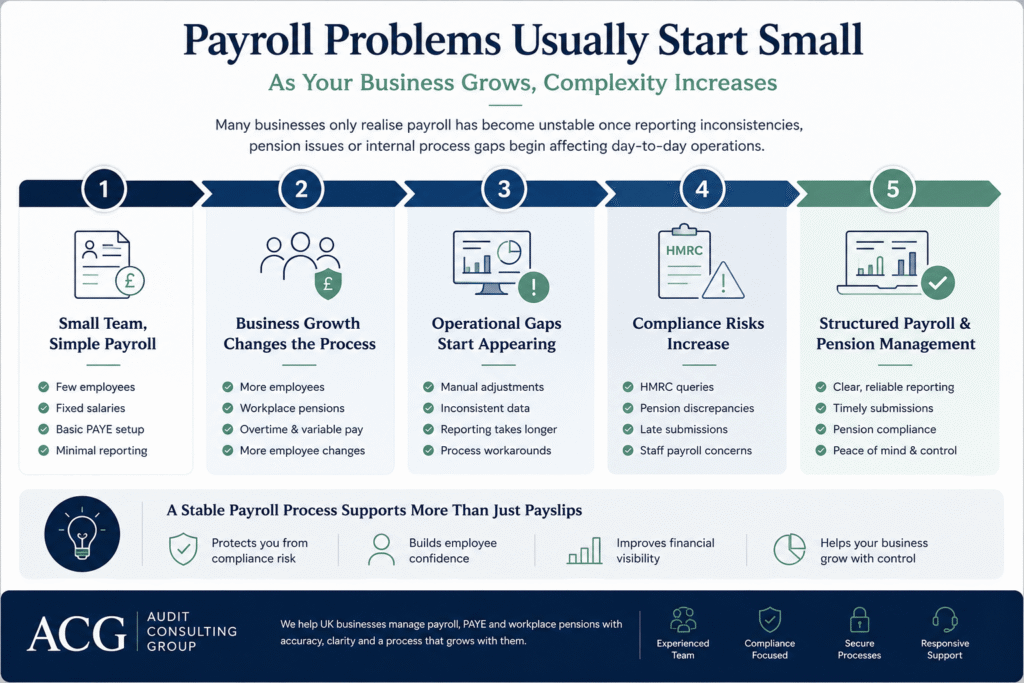
Most payroll problems do not begin with a major failure.
Usually, they start quietly.
A business grows from three employees to twelve. Someone starts managing payroll “temporarily”. Pension contributions are set up once and never checked again. Payslips go out every month, so everyone assumes the process is working properly.
Then something changes.
An employee questions a deduction. HMRC requests clarification. Pension records stop matching payroll reports. A director realises nobody is fully certain what has actually been submitted over the last six months.
That is normally the point where businesses start looking at their payroll process differently.
At Audit Consulting Group, we support UK businesses with payroll and pensions, PAYE administration, payroll processing, pension auto-enrolment and outsourced payroll management. Some clients need a fully managed payroll function. Others need help correcting an existing setup that has gradually become unreliable.
The important part is not simply running payroll software. It is making sure payroll, pensions, reporting, compliance and employee records continue to make sense as the business changes.
Payroll Starts Simple. It Rarely Stays Simple.
Very small companies often begin with relatively straightforward payroll.
One director. One employee. Fixed monthly salaries.
Then the business evolves.
New hires arrive. Different pay rates appear. Overtime becomes inconsistent. Pension responsibilities increase. Someone goes on maternity leave. Another employee joins halfway through a pay period. The bookkeeping no longer matches payroll reports. HMRC notices a discrepancy between submissions.
This is where many businesses discover that payroll is not really an “admin task”. It becomes an operational process tied directly to compliance, employee trust, cash flow visibility and business stability.
That is also why payroll problems are often ignored for too long. From the outside, everything still appears functional because employees are being paid. Internally, however, small inconsistencies can keep compounding underneath the surface.
What Businesses Usually Need Help With
Some businesses contact us because they are hiring employees for the first time and need PAYE registration, payroll setup and pension auto-enrolment configured correctly from the beginning.
Others already have payroll running but no longer fully trust the process. That tends to happen after rapid growth, changes in staffing, migration between accountants, software issues or periods where payroll responsibilities were handled informally.
In practice, payroll support often falls into several connected areas:
Payroll Services
 Ongoing payroll processing, payslips, PAYE calculations, National Insurance deductions, RTI submissions and regular payroll administration.
Payroll Setup & Implementation
Used when a business is creating payroll for the first time, restructuring an existing setup or moving away from spreadsheets and fragmented internal processes.
Payroll for Small Businesses
Support for smaller employers who need payroll handled properly without building a large in-house finance team.
Outsourced Payroll Management
For companies that no longer want payroll dependent on one internal staff member, inconsistent manual processes or rushed month-end administration.
Registration for PAYE & Filing for PAYE
Employer registration, PAYE reporting and ongoing HMRC payroll compliance.
Management of Pension Schemes
Support with workplace pensions, payroll pension deductions, auto-enrolment duties, re-enrolment and pension contribution administration.
Different businesses enter the process at different stages. The right route usually depends on whether the issue is setup, scale, reporting reliability, staffing complexity or compliance risk.
Where Payroll Problems Usually Come From

Payroll errors are rarely caused by one dramatic mistake.
More often, businesses experience gradual operational drift.
A payroll process is copied from an older setup that no longer reflects the workforce. Pension settings remain unchanged after salaries increase. Employee information arrives late every month, so payroll is finalised under time pressure. Directors rely heavily on software outputs without reviewing whether the underlying data still makes sense.
In many companies, nobody notices the weaknesses immediately because payroll continues functioning “well enough”. The problems usually become visible later through:
- incorrect PAYE deductions;
- pension contribution discrepancies;
- staff queries about payslips;
- late RTI submissions;
- year-end reconciliation issues;
- problems during accountant handovers;
- or HMRC compliance questions.
One of the more common situations we see is businesses outgrowing the payroll structure they originally built when the company was much smaller.
The process technically still works, but only because internal staff are manually correcting gaps each month behind the scenes.
Payroll Software Helps — But It Does Not Solve Everything
Many employers assume payroll software automatically guarantees compliance.
It does not.
Software can process calculations efficiently, but it still depends entirely on:
- accurate employee information;
- correct PAYE settings;
- proper pension configuration;
- timely reporting;
- and someone recognising when the figures no longer look right.
We regularly see businesses using decent payroll systems with poor underlying processes.
For example, the software may technically submit RTI correctly while pension contributions are still being calculated against outdated earnings structures. Or payroll reports may reconcile internally but not match bookkeeping records because changes were entered inconsistently over time.
The technology matters. The process around the technology matters more.
What Employers Often Underestimate About Workplace Pensions
Auto-enrolment created the impression that workplace pensions are mostly automatic once configured.
That is only partially true.
In reality, pension administration continues changing as employees join, leave, opt out, increase earnings, return from leave or move between pay structures.
Some businesses only discover pension issues years later when contribution records no longer align properly with payroll history.
Another overlooked area is communication. Employees may not fully understand deductions appearing on payslips, particularly in smaller businesses where payroll processes were introduced gradually rather than formally implemented from the start.
Good pension administration is not only about compliance. It is also about maintaining clear records, consistency and employee confidence.
Industries Experience Payroll Pressure Differently
Payroll complexity looks different across industries.
A consultancy with fixed salaries may mainly need reliable monthly payroll processing and director payroll planning.
A hospitality business often deals with rotating shifts, overtime changes and frequent staffing movement. Construction companies may have payroll connected to CIS reporting, subcontractor confusion or irregular payment structures. Care businesses frequently manage part-time workers, varying schedules and statutory pay complications.
Ecommerce companies sometimes reach a stage where warehouse staffing, admin staff and management payroll all begin operating differently from each other, making internal reporting far harder than expected.
This is why generic payroll templates rarely work well long term. The payroll structure needs to reflect how the business actually operates.
How Businesses Usually Decide It Is Time to Outsource Payroll
Very few businesses wake up one morning planning to outsource payroll.
Usually, the decision happens after friction has already been building for a while.
Perhaps payroll takes too much management time each month. Maybe nobody internally wants responsibility for submissions anymore. Sometimes staff confidence drops after repeated payroll mistakes. In other cases, the finance process becomes too dependent on one employee who holds all the payroll knowledge personally.
Some businesses outsource payroll because they are growing.
Others outsource because growth already exposed weaknesses that were hidden when the company was smaller.
Outsourced payroll management is often less about “saving admin time” and more about reducing operational risk.
What the Payroll Process Actually Looks Like
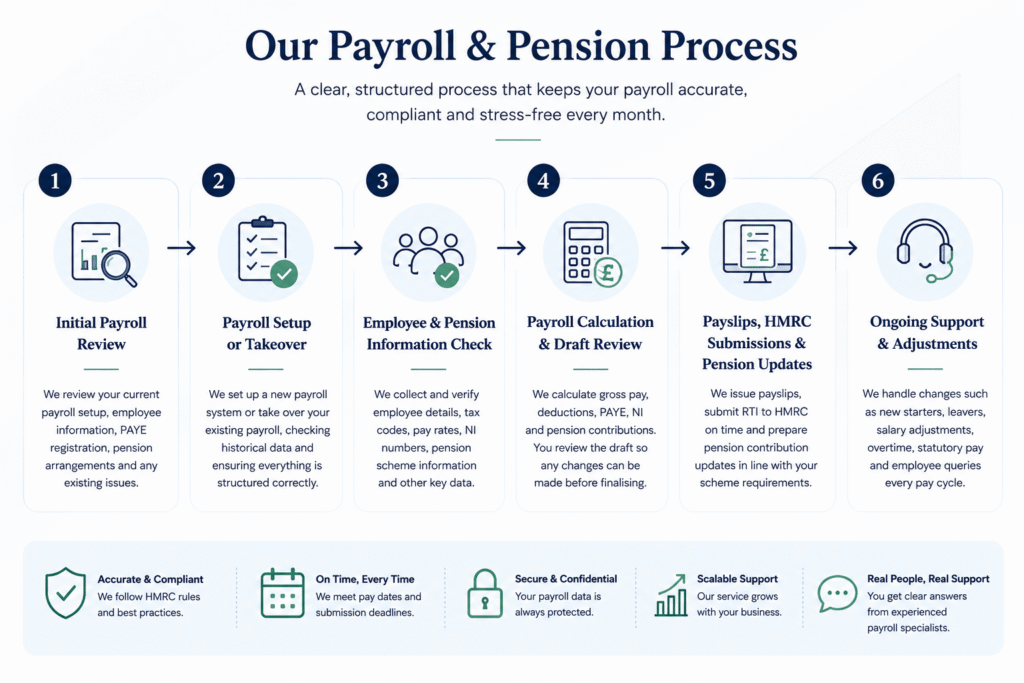
One thing businesses often appreciate is simply having a clearer structure around payroll responsibilities.
In practice, payroll tends to run more smoothly when there is a defined process for:
- employee changes;
- cut-off dates;
- overtime approvals;
- pension contribution reviews;
- director adjustments;
- and final payroll sign-off.
For example, problems commonly appear when employee information arrives after payroll has already been prepared. Another recurring issue is businesses making late changes without fully understanding how those changes affect PAYE submissions or pension reporting.
Good payroll administration is partly technical, but it is also procedural.
The businesses with the fewest payroll issues are usually the ones where payroll responsibilities, approvals and timelines are clearly controlled.
What Payroll Costs Usually Depend On
The cost of payroll and pension services varies less by “software package” and more by operational complexity.
A business with four salaried employees paid monthly is very different from a company managing weekly payroll, overtime, pension changes, starters, leavers and multiple pay structures.
Pricing is usually influenced by:
- employee numbers;
- pay frequency;
- pension requirements;
- existing payroll quality;
- industry complexity;
- and whether payroll needs correction before ongoing processing can begin.
Businesses sometimes underestimate how much time is spent cleaning historical payroll records before a stable ongoing process can actually start.
That initial correction stage is often where the real value appears.
Estimate payroll and pension services pricing in the UK with a transparent cost structure. Our payroll accounting services include employee payroll processing, auto-enrolment pension compliance, and HMRC submissions. Ideal for UK businesses seeking low-cost payroll and pension services without sacrificing accuracy or compliance.
Service Cost Estimation
Select the service category below to calculate the estimated cost of either accounting & tax services or forms and submissions.
Select Required Services / Forms
Select one or more services/forms to receive an accurate cost estimate. You can adjust your selection at any stage.
How would you like to engage our services?
Please select whether you require a one-off service or ongoing monthly support.
Contract Duration
Your cost estimate
Apply now and get 10% OFF
Submit your request today and receive an exclusive 10% discount on your selected service.
All prices are estimates. To receive a personalised quote, please fill out the form or contact us.
Ready to get started?
Get professional support from experienced UK accountants
Why Payroll Issues Escalate Faster Than Expected
Payroll mistakes tend to repeat automatically.
If an incorrect pension setting remains active for six months, the issue does not stay isolated to one payslip. It compounds across every payroll cycle afterwards.
The same applies to PAYE errors, incorrect employee classifications, outdated payroll settings or incomplete records carried over from previous years.
By the time the business notices the issue, untangling the history can become far more difficult than correcting the original mistake would have been.
This is one reason businesses often seek external payroll support after periods of rapid growth, staff turnover or accounting transitions.
Payroll Data Is Often More Important Than Businesses Realise
Payroll affects far more than salaries.
It influences management reporting, pension records, bookkeeping accuracy, year-end accounts, director remuneration planning and sometimes even lending or funding discussions where payroll liabilities need to be evidenced properly.
When payroll records become inconsistent, the wider accounting picture often becomes unreliable as well.
That is why businesses eventually move away from “getting payroll done somehow” towards building a payroll process that remains stable as the company evolves.
Examples of Payroll Situations We Help Resolve
Growing Business Moving Away From Manual Payroll
A London-based startup initially managed payroll internally while employing only a handful of staff. As the company expanded, payroll changes started happening informally through emails and spreadsheets, creating confusion around pension deductions and reporting deadlines.
We helped restructure the payroll process, implement clearer approval stages and stabilise monthly reporting. The business reduced internal payroll administration time significantly and gained better visibility over staffing costs.
Construction Company With Payroll Reporting Gaps
A regional construction business experienced recurring inconsistencies between payroll reports, pension submissions and bookkeeping records after several years of rapid growth.
The underlying issue was not one major mistake. Different payroll adjustments had gradually been handled differently by different staff members over time.
After reviewing the reporting structure and rebuilding parts of the payroll process, the company achieved more consistent reporting and reduced the number of staff payroll queries each month.
Pensioners Payroll & Multi-Income PAYE Issues
A charity employing part-time pensioners needed support with pensioners payroll, PAYE treatment and payroll administration involving workers receiving income from multiple sources.
The difficulty was not processing payroll itself. The difficulty was maintaining consistency across tax treatment, records and employee communication where income situations varied considerably between staff members.
Why Businesses Choose Audit Consulting Group

Businesses usually come to us because they want payroll handled with more structure, visibility and consistency.
Some clients need ongoing outsourced payroll management. Others need help repairing a process that has gradually become unreliable after years of internal workarounds, rushed reporting or fragmented systems.
We support businesses with payroll processing, workplace pension administration, PAYE compliance, payroll setup and reporting support across different stages of business growth.
Importantly, payroll work is reviewed in the context of the wider business rather than treated as an isolated monthly task. That matters because payroll decisions regularly affect bookkeeping, pension records, director remuneration, tax reporting and internal financial visibility at the same time.
Clients also value having direct communication with people who understand how payroll issues actually develop operationally — not simply how software processes numbers.
Questions Businesses Commonly Ask Before Changing Payroll Provider
Can you take over payroll from another accountant or provider?
Yes. In many cases, the first stage involves reviewing the current payroll setup, checking historical reports and identifying whether there are inconsistencies that need correcting before the ongoing process is transferred.
Do small businesses really need outsourced payroll?
Not always. Some smaller businesses manage payroll internally successfully for a long time. The decision usually depends more on complexity, reporting confidence, staffing changes and internal capacity than on company size alone.
Can payroll software replace external payroll support?
Software helps significantly, but software still depends on correct setup, good internal processes and accurate reporting decisions. Most serious payroll problems we see happen around process failures rather than system failures.
What happens if payroll records are already inconsistent?
That situation is more common than many businesses realise. Payroll can usually be stabilised, but the first step is understanding how far the inconsistencies extend across reporting, pension records and PAYE submissions.
Can you help with payroll pension and auto-enrolment obligations?
Yes. We support businesses with workplace pension administration, contribution calculations, payroll pension reporting and ongoing auto-enrolment responsibilities.
Get Payroll & Pension Support That Scales With the Business
Payroll becomes significantly easier to manage when the structure behind it is stable.
If your payroll process is becoming difficult to control, heavily dependent on internal workarounds or increasingly time-consuming as the business grows, it may be the right time to review how the payroll function is actually operating.
Audit Consulting Group supports UK businesses with payroll and pensions, payroll processing, PAYE administration, pension scheme management and outsourced payroll support across different stages of growth.
Call us today at +44 7386 212550
Email: auditconsultinguk@gmail.com