
CIC & Charity Accounting Services UK
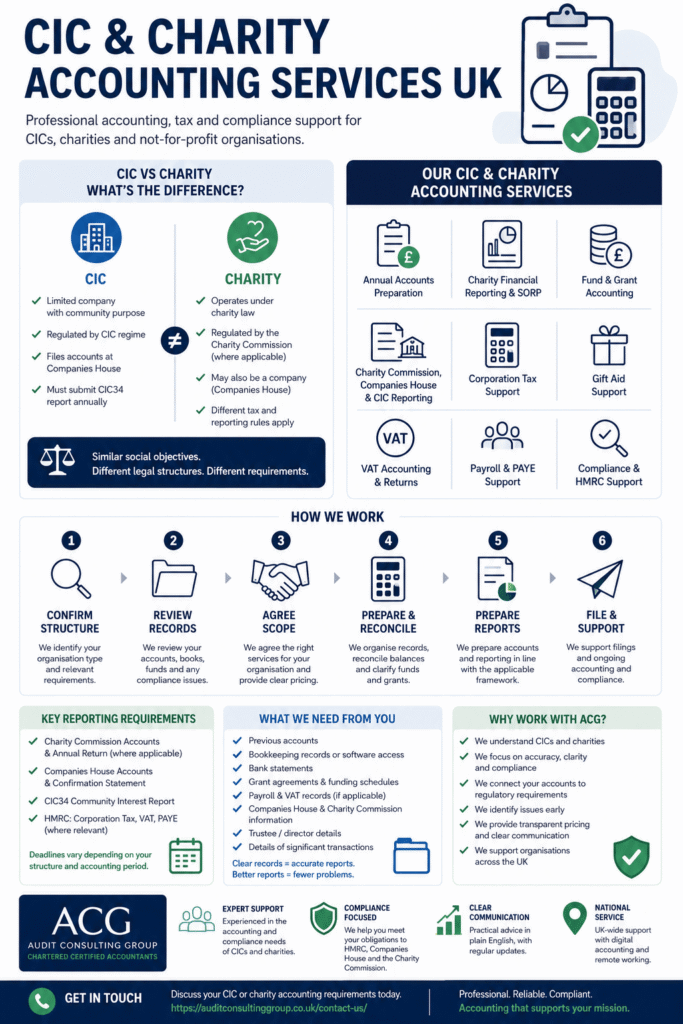
Audit Consulting Group provides professional accounting support for UK charities, Community Interest Companies (CICs), charitable companies and Charitable Incorporated Organisations (CIOs). Our work can cover annual accounts, bookkeeping, fund and grant accounting, SORP reporting where applicable, Charity Commission and Companies House requirements, CIC34 reporting, Corporation Tax, VAT, payroll and related compliance work.
Leave your details and our team will get back to you shortly.
CICs and charities can both operate for community or social purposes, but they are different legal structures with different accounting, tax and regulatory requirements. We begin by establishing what type of organisation you operate, which reporting framework applies and what condition the underlying accounting records are in.
CIC & Charity Accounting Support
Charity and CIC accounting often goes beyond producing a year-end profit and loss account. The records may need to distinguish between different funds, grants and projects, support annual reporting, and remain consistent with information submitted to HMRC, Companies House, the Charity Commission or the Office of the Regulator of Community Interest Companies.
Our CIC and charity accounting services can include:
- annual accounts preparation;
- charity financial reporting;
- Community Interest Company accounting;
- bookkeeping and reconciliations;
- restricted and unrestricted fund accounting;
- grant income and expenditure tracking;
- Charity Commission reporting support;
- Companies House accounts and filing support;
- CIC34 reporting support;
- Corporation Tax compliance where applicable;
- Gift Aid support for eligible charities;
- VAT accounting and returns where relevant;
- payroll and PAYE support; and
- preparation for independent examination or audit where required.
CIC vs Charity: Why the Accounting Requirements Differ
A CIC and a registered charity may pursue similar social or community objectives, but they are not interchangeable structures.
A Community Interest Company is a limited company created to operate for community benefit. It is subject to company law and the CIC regulatory framework, including the statutory asset lock and annual community interest reporting requirements. A CIC does not become a charity simply because it has a social purpose.
A charity operates within charity law and may be regulated by the Charity Commission in England and Wales. Depending on its legal form, a charity can also have Companies House and HMRC obligations.
The distinction affects annual accounts, tax treatment, Gift Aid, regulatory reporting and the information that needs to be maintained throughout the year.
Which Accounting and Reporting Framework Applies?
Before preparing accounts, it is important to identify the organisation itself. The reporting position can differ between:
- a CIC limited by guarantee;
- a CIC limited by shares;
- a Charitable Incorporated Organisation;
- a charitable company limited by guarantee;
- an unincorporated charity; and
- a charity operating with a trading subsidiary.
The legal structure determines which regulators are involved and helps establish the appropriate accounting framework, filing obligations and year-end reporting requirements.
Annual Accounts & Charity Financial Reporting
 We prepare annual accounts according to the organisation’s legal structure, accounting framework and reporting obligations.
For charities where the relevant requirements apply, the accounts may include:
- Statement of Financial Activities (SOFA);
- balance sheet;
- cash flow statement where required;
- notes to the accounts;
- restricted and unrestricted fund disclosures;
- trustee-related disclosures;
- related-party disclosures;
- grant and income disclosures; and
- financial information supporting the trustees’ annual report.
For CICs, the annual accounts follow the accounting requirements applicable to the company. The CIC34 community interest report is a separate but connected part of the annual reporting process.
Charities SORP 2026
Charities preparing accrual accounts and falling within the relevant requirements may need to follow the Charities Statement of Recommended Practice. Charities SORP 2026 applies to reporting periods beginning on or after 1 January 2026. Earlier reporting periods may fall under the preceding SORP framework.
SORP can affect the treatment and presentation of income, grants, funds, trustee transactions, related parties, reserves and other information within the financial statements.
A CIC does not become subject to charity SORP simply because it operates for community benefit. Its reporting framework should be considered separately.
Statement of Financial Activities and Disclosures
Where SORP applies, the Statement of Financial Activities brings together income, expenditure, gains, losses and movements between the relevant fund categories.
The year-end presentation depends heavily on the quality of the underlying bookkeeping. If restricted income, programme expenditure or fund transfers have not been recorded clearly during the year, additional reconciliation may be required before the accounts can be completed.
Independent Examination and Audit
Whether a charity requires an independent examination or statutory audit depends on factors including its legal structure, income, assets and the accounting period concerned.
Reporting thresholds and statutory requirements should be checked for the relevant period rather than relying on an historic figure or assuming one threshold applies to every charity.
If external examination or audit is required, properly reconciled accounts, fund schedules and supporting records can make the process significantly easier to manage.
Fund & Grant Accounting
Restricted, Unrestricted and Designated Funds
 Fund accounting is one of the areas that most clearly distinguishes charity accounting from ordinary commercial bookkeeping.
Depending on the organisation and its funding arrangements, records may need to distinguish between restricted funds, unrestricted funds, designated funds, endowment funds and transfers between them.
A recurring practical issue is that total income and expenditure in the bookkeeping may be correct while the records do not explain which money was restricted or which costs relate to a particular fund. Reconstructing that position at year end can require significant additional work.
Grant Income and Expenditure
Grant accounting also depends on the underlying funding arrangement. A grant should not automatically be treated in a particular way simply because it is described as grant income.
We may need to review:
- grant agreements;
- funding conditions;
- restrictions on use;
- project expenditure;
- amounts received in advance;
- unspent balances; and
- reports already provided to funders.
Keeping this information connected to the accounting records creates a clearer trail for annual reporting and fund reconciliation.
Charity Commission, Companies House & CIC Reporting
Charity Commission Reporting
Registered charities may have annual reporting obligations to the Charity Commission, including accounts and Annual Return requirements depending on their circumstances.
Where this forms part of the agreed scope, we can support preparation of the accounting information required for the submission and help ensure that the figures used for regulatory reporting are consistent with the underlying accounts.
Companies House Reporting
Charitable companies and CICs are companies and therefore also have Companies House obligations. Depending on the organisation, this can include annual accounts and Confirmation Statement requirements.
Where an organisation reports to more than one body, the accounting information should be coordinated rather than treated as a series of unrelated filings.
CIC Annual Accounts and CIC34 Reporting
Community Interest Companies must prepare and file annual accounts in accordance with the requirements applicable to them. A CIC must also submit a CIC34 community interest company report with its annual accounts.
The CIC34 provides information about how the company has pursued its community purpose and can include matters such as stakeholder involvement, directors’ remuneration, transfers of assets and dividends where relevant.
Our CIC accounting services can support the financial information required for the annual accounts and help coordinate this with the organisation’s annual CIC reporting responsibilities.
Tax, Gift Aid, VAT & Payroll
Corporation Tax for CICs and Charities
A common misunderstanding is that CIC status provides the same tax treatment as charitable status. It does not.
A CIC is generally within the Corporation Tax regime applicable to companies. Its actual tax position depends on the activities carried out and the relevant circumstances.
Charities operate under a different tax framework. Certain income and gains may qualify for charitable tax exemptions where the relevant conditions are met, but charitable status does not remove every HMRC obligation.
Gift Aid
Eligible charities may be able to register for and claim Gift Aid where HMRC requirements are met. Claims need appropriate donor information, declarations and supporting records.
A CIC cannot claim Gift Aid simply because it operates for community benefit. CIC status and charitable status should therefore be distinguished before Gift Aid is included in fundraising or financial planning assumptions.
VAT for CICs and Charities
The VAT position of a CIC or charity depends primarily on the activities and transactions involved rather than on the organisation’s name or social purpose alone.
Relevant issues can include VAT registration, taxable and exempt income, business and non-business activities, partial exemption, grant-funded activities and input VAT recovery.
Where VAT is relevant, we can review it alongside the wider accounting records so that the VAT treatment is consistent with how the organisation actually operates.
Payroll & PAYE
Charities and CICs employing staff can have PAYE, National Insurance, RTI and workplace pension responsibilities in the same way as other UK employers.
There can also be an accounting dimension. Salary and employment costs may need to be allocated between projects, grants, charitable activities or funds, particularly where funders require evidence of how staff costs have been used.
What We Need From You
The information required depends on the scope of work and the condition of the existing records. Typical items can include:
- previous annual accounts;
- bookkeeping records or accounting software access;
- bank statements;
- grant agreements and funding schedules;
- restricted fund records;
- supplier and expense documentation;
- payroll information;
- VAT records where relevant;
- Companies House information;
- Charity Commission information;
- trustee or director details; and
- information about significant or unusual transactions.
If the bookkeeping is incomplete, we first establish what needs to be corrected or reconstructed before the annual accounts or regulatory reporting can be completed.
If you already have your latest accounts, bookkeeping records and year-end details available, contact Audit Consulting Group so we can establish the appropriate scope for the organisation.
How Our CIC & Charity Accounting Service Works
1. Confirm the Organisation Structure
We identify whether the organisation is a CIC, CIO, charitable company, unincorporated charity or another structure and establish which accounting and reporting requirements are relevant.
2. Review the Current Accounting Position
We review the year end, previous accounts, bookkeeping records, funds, grants and any known filing or compliance issues.
3. Agree the Scope of Work
The engagement may involve year-end accounts only or a wider combination of bookkeeping, fund reconciliation, Corporation Tax, VAT, payroll and filing support. The scope and fee are agreed around the work actually required.
4. Prepare and Reconcile the Records
Where necessary, bookkeeping differences are investigated, balances are reconciled and fund or grant information is organised before the reporting work is completed.
5. Prepare the Accounts and Reporting Information
The accounts are prepared using the framework applicable to the organisation, together with any related reporting information included in the engagement.
6. Support Filing and Ongoing Accounting
Depending on the agreed service, we can support relevant annual filings and continue with bookkeeping, payroll, VAT or other accounting work after the year-end process.
Common CIC & Charity Accounting Problems
 Many year-end problems originate earlier in the bookkeeping process. They only become obvious when the accounts or regulatory returns need to be prepared.
Common issues can include:
- restricted and unrestricted income recorded together;
- grant expenditure that cannot easily be matched to the relevant funding;
- missing related-party information;
- accounts prepared using the wrong reporting assumptions;
- Charity Commission and Companies House information that does not align;
- CIC34 preparation left until the accounts filing deadline;
- VAT treatment applied without considering the underlying activity;
- Gift Aid records that do not adequately support a claim;
- payroll costs allocated incorrectly between projects or funds; and
- bookkeeping records that have not been reconciled regularly.
Identifying these issues before the reporting deadline gives more time to investigate missing information and resolve inconsistencies.
Trustee & Director Responsibilities
Trustees and CIC directors remain responsible for their organisations even where accounting work is outsourced.
For charities, trustees need appropriate oversight of the organisation’s finances, assets, records and reporting. CIC directors have company-law responsibilities alongside requirements specific to the CIC structure.
Our role is to support accurate accounting, reporting and filing within the agreed scope. Professional support does not transfer the trustees’ or directors’ underlying legal responsibilities to the accountant.
Filing Deadlines & Reporting Timelines
There is no single filing timetable that applies to every CIC and charity. The relevant deadlines depend on the organisation’s legal form, regulator and tax position.
- registered charities may have Charity Commission accounts and Annual Return deadlines;
- companies, including CICs and charitable companies, have Companies House accounts deadlines;
- CIC34 reporting is coordinated with the CIC’s annual accounts;
- companies may have Confirmation Statement obligations; and
- HMRC deadlines may apply separately for Corporation Tax, VAT and PAYE.
Where several obligations apply, working backwards from the relevant deadlines is usually more practical than treating each filing independently at the last moment.
Practical CIC & Charity Accounting Scenarios
The following examples illustrate the type of accounting issues that can arise. They are not presented as specific client results or guarantees of regulatory outcomes.
Grant-Funded Charity With Mixed Funds
A charity receives several restricted grants alongside unrestricted donations and trading income, but the bookkeeping does not clearly separate the funding streams.
The accounting work would involve reviewing grant terms, reconciling expenditure and establishing a clearer restricted and unrestricted fund position for the annual accounts. The operational outcome is a clearer reporting trail that can be reconciled back to the underlying records instead of reconstructing every fund from one combined income-and-expenditure figure at filing time.
CIC Preparing Annual Accounts and CIC34
A CIC has up-to-date day-to-day bookkeeping but needs its annual accounts completed alongside the information required for the CIC34 report.
Coordinating the accounts and CIC reporting creates one annual reporting workflow, allowing the underlying financial information to be reviewed before the annual accounts and related community interest report are submitted.
Growing Charity With Changing Reporting Requirements
A charity’s income and activities have expanded significantly compared with the previous accounting period.
The year-end review establishes which accounting framework and external scrutiny requirements apply before the accounts are finalised. The practical outcome is greater clarity over the reporting work required before the organisation approaches its filing deadline.
CIC & Charity Accounting Fees
The cost of CIC accounting services or charity accounting services depends on the organisation’s activity and records rather than legal status alone.
Fee factors can include:
- organisation type and year end;
- annual income and transaction volume;
- number of bank accounts;
- number of restricted or designated funds;
- grant-funded projects;
- quality of existing bookkeeping;
- VAT registration;
- payroll requirements;
- annual accounts requirements;
- independent examination or audit requirements;
- outstanding filings; and
- historic accounting records that need correction.
Some organisations require only annual accounts and filing support. Others need an ongoing package covering bookkeeping, payroll, VAT, fund reporting and year-end accounts. We establish the scope before confirming the appropriate fee.
Accounting Records, Funding & Due Diligence
Clear accounting records are useful beyond statutory filing. Trustees, directors, banks, grant providers and other stakeholders may need to understand where funding came from and how resources were used.
Well-structured records can help explain restricted funding, project expenditure, unrestricted resources, reserves and grant balances and make annual financial information easier to reconcile back to the underlying bookkeeping.
Good accounting cannot guarantee funding, banking approval or a particular due diligence outcome, but it can make the organisation’s financial position easier to demonstrate and support.
Why Work With Audit Consulting Group?
 Effective CIC and charity accounting starts with understanding the organisation rather than applying a standard limited-company process to every client.
We establish the scope from the organisation’s actual legal structure, records and reporting requirements rather than assuming every CIC or charity needs the same accounting package.
Our approach focuses on:
- identifying the legal structure before preparing the accounts;
- reviewing funds and grants rather than treating all income identically;
- connecting annual reporting to the underlying bookkeeping;
- considering Charity Commission, Companies House, CIC and HMRC requirements where relevant;
- identifying missing records or reconciliation issues before year end wherever possible;
- agreeing the scope of work clearly; and
- providing ongoing accounting support where required.
We support charities and CICs across the UK using digital accounting records and remote communication, so the service is not limited to organisations located near our office.
Frequently Asked Questions About CIC & Charity Accounting
What is the difference between a CIC and a charity?
A CIC is a limited company designed to operate for community benefit and is subject to the CIC regulatory framework. A charity operates under charity law. Their accounting, tax and regulatory requirements are therefore not identical.
Is a CIC a registered charity?
No. A Community Interest Company is not itself a registered charity. It is a company with a specific community-interest structure and regulatory framework.
Does a CIC have to register with the Charity Commission?
A CIC is regulated through the CIC regime rather than becoming a Charity Commission registered charity simply because it operates for community benefit. Where organisations form part of a wider group, the legal status of each entity should be considered separately.
Does a CIC need to file annual accounts?
Yes. A CIC is a company and must prepare and file annual accounts according to the requirements applicable to it.
What is a CIC34 report?
The CIC34 is the annual community interest company report filed with a CIC’s accounts. It provides information about how the company has pursued its community purpose and other matters required by the CIC reporting framework.
Do CICs follow Charities SORP?
Not simply because they are CICs. A CIC is not a charity. Its accounts are prepared under the accounting requirements applicable to its company structure, while charity SORP applies to charities falling within the relevant framework.
Does a CIC pay Corporation Tax?
A CIC does not receive a general Corporation Tax exemption because it has community objectives. Its tax position should be considered according to its activities and circumstances under the company tax regime.
Can a CIC claim Gift Aid?
A CIC cannot claim Gift Aid simply because it is a CIC. Gift Aid is available to eligible charities and other qualifying organisations that meet HMRC requirements.
Do charities pay Corporation Tax?
Charities can qualify for exemptions on certain income and gains where the relevant conditions are met, but they can still have Corporation Tax and other HMRC reporting obligations depending on their activities.
What is restricted fund accounting?
Restricted funds are resources that must be used for a specified purpose because of the terms attached to them. The accounting records need to distinguish those funds so that their income, expenditure and remaining balances can be reported appropriately.
Does every grant create a restricted fund?
Not necessarily. The accounting treatment depends on the terms and nature of the funding. Grant agreements and any restrictions or conditions should be reviewed rather than assuming that every grant is treated in the same way.
What is Charities SORP 2026?
Charities SORP 2026 is the current Statement of Recommended Practice for relevant charity reporting periods beginning on or after 1 January 2026. It provides accounting and reporting guidance for charities preparing accounts within the applicable framework.
When does a charity need an independent examination or audit?
This depends on the charity’s legal structure, income, assets, accounting period and other relevant requirements. Current thresholds and rules should be checked for the specific reporting period rather than relying on an historic figure.
Can you help with Charity Commission and Companies House filings?
Yes. Where these filings are included in the agreed scope, we can support preparation of the accounting and reporting information required for the relevant submissions.
Can you take over incomplete CIC or charity bookkeeping?
Yes. We can review existing records, identify reconciliation or fund-accounting gaps and agree the catch-up work required before ongoing accounting or year-end reporting begins.
Can the service include VAT, payroll and ongoing bookkeeping?
Yes. Where relevant, the scope can include VAT, payroll, PAYE and ongoing bookkeeping alongside annual accounts and regulatory reporting support.
How much do CIC and charity accounting services cost?
Fees depend on the organisation’s structure, transaction volume, funds, grants, bookkeeping condition and reporting requirements. We normally review the scope before confirming the appropriate fee.
Discuss Your CIC or Charity Accounting Requirements
 If your organisation needs help with CIC annual accounts, charity accounts, SORP reporting, restricted funds, grant accounting, CIC34 reporting, bookkeeping or related tax and compliance work, Audit Consulting Group can review the current accounting position and establish the appropriate scope.
Tell us your organisation type, accounting year end, approximate income, current bookkeeping position and any upcoming filing deadlines so that we can discuss the support required.
Contact Audit Consulting Group to discuss your CIC or charity accounting requirements.