
HMRC Penalty Appeal UK – Professional Help Appealing HMRC Penalties
Leave your details and our team will get back to you shortly.
Received a penalty notice from HMRC? Audit Consulting Group provides professional HMRC penalty appeal support for individuals, sole traders, contractors and UK businesses challenging Self Assessment, VAT, PAYE, CIS and Corporation Tax penalties.
We review the penalty notice, identify the relevant appeal route, consider the grounds available, organise supporting evidence and prepare the appeal for submission to HMRC. Where agreed, we can also deal with HMRC correspondence and explain the next procedural step if the initial appeal is rejected.
An appeal does not guarantee that a penalty will be cancelled or reduced. The outcome depends on the type of penalty, the applicable rules, the circumstances and the evidence available. The aim is to present the relevant facts clearly and follow the correct HMRC procedure within the applicable deadline.
Can You Appeal an HMRC Penalty?
Many HMRC penalties carry a right of appeal. Depending on the penalty, the grounds may involve a reasonable excuse, an incorrect penalty decision, an HMRC administrative issue, a genuine system failure or another circumstance relevant to the rules under which the penalty was issued.
The starting point is the notice itself. Before preparing an appeal, it is important to establish what HMRC has penalised, the tax or reporting obligation involved, the date of the notice, the relevant period and the deadline for challenging the decision.
If you are unsure whether you can appeal a penalty with HMRC, we can review the notice and circumstances before substantive appeal work begins.
HMRC Penalties We Can Help You Appeal
 HMRC penalties can arise for different reasons, and the appeal route is not identical in every case. Our support can cover penalties connected with late filing, late submission, late payment and other tax-compliance failures.
Self Assessment Penalty Appeals
We can assist with Self Assessment appeals against penalties, including late filing and late payment penalties where there are grounds for challenge.
VAT Penalty Appeals
VAT penalties can arise under the late submission points regime, late payment rules and other VAT requirements. We can review the relevant VAT periods, submission history and circumstances behind the failure before preparing an appeal against a VAT penalty.
PAYE Penalty Appeals
Employers can receive penalties connected with PAYE and Real Time Information reporting. An appeal may require review of payroll records, Full Payment Submission information, HMRC messages and evidence showing when the relevant submission was made.
CIS Penalty Appeals
Contractors operating under the Construction Industry Scheme can face penalties when required monthly CIS returns are submitted late. We can review the affected periods and help prepare an appeal against CIS late filing penalties where the facts support a challenge.
Corporation Tax Penalty Appeals
Companies can receive penalties when a Company Tax Return is filed after its deadline. We can review the filing history, notice, relevant dates and circumstances before preparing an appeal against a Corporation Tax penalty.
The correct appeal route depends on the penalty involved, so a generic appeal letter is rarely the best starting point.
Missed the Appeal Deadline? Late HMRC Penalty Appeals
Missing the normal appeal deadline does not necessarily mean that every appeal route has ended.
HMRC may consider a late appeal in appropriate circumstances, but the delay itself normally needs to be explained. Relevant questions can include why the appeal was not made on time, when the circumstances causing the delay ended and how quickly action was taken afterwards.
If your appeal deadline has already passed, the late-appeal position should be considered alongside the underlying penalty rather than ignored.
Reasonable Excuse for HMRC Penalties
A reasonable excuse is a common basis for challenging certain HMRC penalties. It generally involves circumstances that prevented a person or business from meeting an obligation despite taking reasonable care.
Depending on the facts, relevant circumstances may include:
- Serious illness or an unexpected hospital stay
- Bereavement around the relevant deadline
- Computer, software or system failure
- Problems with an HMRC online service
- Fire, flood, theft or another serious disruption
- Unexpected postal delays
- Incorrect HMRC information or an administrative issue
- Certain disability or mental-health related circumstances affecting the ability to comply
These situations do not automatically result in a penalty being cancelled. HMRC considers the facts of the particular case, how the event affected the obligation and what happened once the problem could reasonably be dealt with.
What Usually Does Not Make a Strong Reasonable Excuse?
An appeal is generally weaker where the explanation is simply that the deadline was forgotten, the obligation was misunderstood or another person was expected to deal with it without reasonable steps being taken to check that the filing or payment had been completed.
Lack of funds on its own will not necessarily establish a reasonable excuse either, although the circumstances behind a payment failure may still need to be considered.
The distinction matters because an appeal should address the reason for the actual compliance failure rather than provide a general account of difficulties that were unrelated to the penalty.
What Evidence Can Support an HMRC Penalty Appeal?
A penalty appeal is normally stronger when the explanation is supported by relevant evidence. What is useful depends on the grounds being relied upon, but documents may include:
- The HMRC penalty notice or decision letter
- Tax return or submission confirmations
- Payment confirmations and bank records
- Medical or hospital documentation
- Evidence of an IT or software outage
- Screenshots of submission or system errors
- HMRC correspondence or relevant call records
- Postal or delivery evidence
- Correspondence with an accountant, bookkeeper or payroll provider
- A clear chronology of the relevant events
The objective is not to send HMRC every document available. The evidence should support the explanation being made and help establish what happened, when it happened and how it affected the obligation.
Who May Need HMRC Penalty Appeal Support?
 Penalty appeal support may be useful for:
- Individuals facing Self Assessment penalties
- Sole traders who filed or paid tax late
- VAT-registered businesses with submission or payment penalties
- Employers dealing with PAYE or RTI penalties
- CIS contractors with late monthly returns
- Limited companies facing Company Tax Return filing penalties
- Directors dealing with several HMRC notices
- Businesses where the circumstances span several filing periods
Professional support can be particularly useful where several penalties have accumulated, the appeal deadline is close or the available evidence needs to be organised into a coherent submission.
Self Assessment Penalty Appeals
Self Assessment penalties can arise for both late filing and late payment. For late filing, an initial £100 penalty can apply once a return is late, with additional penalties potentially arising as the delay continues.
Late payment operates separately, so it is important to distinguish a penalty for failing to submit the return from a penalty connected with unpaid tax.
Where there is a reasonable excuse or another valid basis for challenge, we can help prepare a Self Assessment appeal against penalties, including an appeal against a late filing penalty. If the underlying issue also requires wider filing support, our Self Assessment services may also be relevant.
The review normally considers the filing deadline, when the return was actually submitted, the dates of the circumstances relied upon and the evidence supporting the explanation.
VAT Penalty Appeals
For VAT accounting periods covered by the current late-submission regime, late returns operate through a points-based system. A business receives a penalty point for a late VAT Return until it reaches the threshold applicable to its filing frequency.
Once the threshold is reached, a £200 financial penalty can apply. A further £200 penalty can arise for each subsequent late submission while the business remains at the threshold.
An appeal against a VAT penalty may therefore require review of the business’s wider submission history rather than a single return in isolation. Relevant evidence can include filing records, software logs, MTD submission receipts and documentation showing when a technical problem was identified and corrected.
VAT late payment is dealt with separately from late submission, so the notice should be checked to establish exactly which penalty is being challenged.
PAYE Penalty Appeals
PAYE penalties can arise where required payroll information is not submitted correctly or on time. Where an employer uses Real Time Information, the filing record can be important to establishing what HMRC expected and what was actually submitted.
A review may involve the relevant Full Payment Submission, other RTI records where applicable, payroll software confirmations, HMRC correspondence and the timeline around the filing failure.
We can help assess whether there are grounds to appeal a PAYE penalty and prepare the submission around the relevant reporting issue.
CIS Penalty Appeals
Contractors under the Construction Industry Scheme are required to submit monthly returns where applicable. Late returns can lead to penalties, and several notices can accumulate when more than one monthly return is affected.
Where a contractor wants to know how to appeal a CIS late filing penalty, the first step is to establish which returns were late, when they were eventually submitted and what caused the failure.
If several penalties arose from the same underlying event, the full timeline should usually be reviewed so that the appeal position remains consistent across the affected months.
Corporation Tax Penalty Appeals
Late filing penalties for Company Tax Returns changed for filing dates on or after 1 April 2026. A return filed late can attract a £200 flat-rate penalty, with a further £200 where it remains outstanding for more than three months.
For repeated late filing across successive accounting periods, the flat-rate amounts can increase to £1,000 and £2,000 respectively. Longer delays can also lead to tax-related penalties based on unpaid Corporation Tax.
An appeal against a Corporation Tax penalty should therefore begin with the filing deadline, actual submission date, penalty notice and previous filing history, together with the circumstances relied upon for the appeal.
Corporation Tax penalties issued by HMRC should not be confused with separate late accounts penalties that may arise through Companies House.
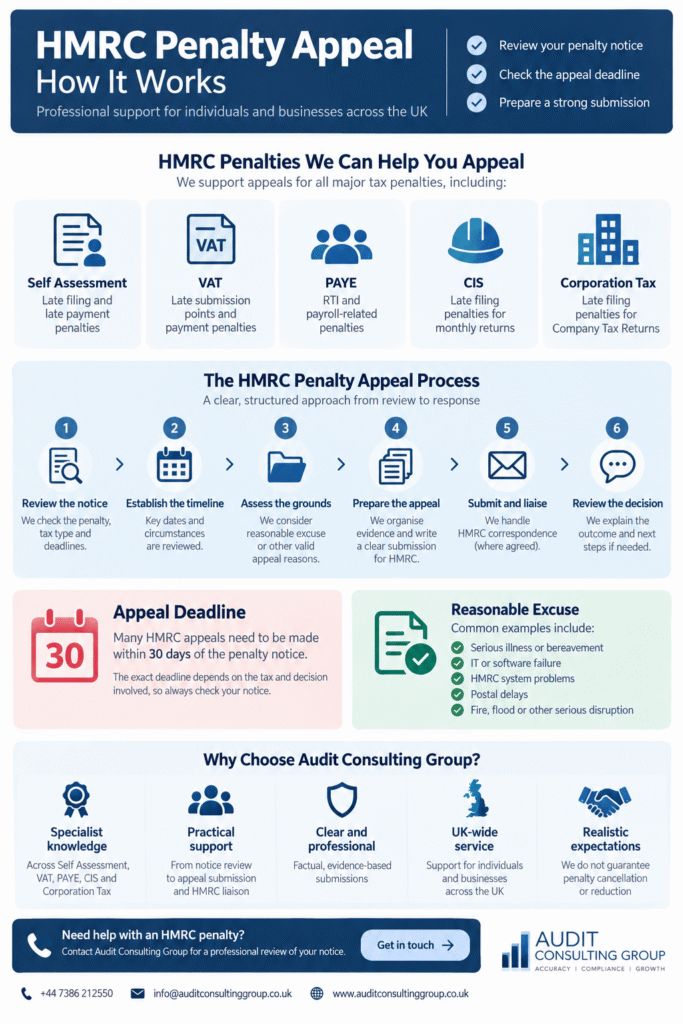
How the HMRC Penalty Appeal Process Works
1. Review the Penalty Notice
 We start with the actual notice, the tax involved, the penalty amount, the relevant period and the appeal instructions provided by HMRC.
2. Establish the Timeline
The key dates are mapped out: the original filing or payment deadline, what happened around that date, when any problem ended and when the outstanding obligation was eventually completed.
3. Assess the Grounds
The circumstances are considered against the relevant penalty rules. Where reasonable excuse is relied upon, the explanation should connect directly to the failure that triggered the penalty.
4. Gather Supporting Evidence
Relevant documents are identified and factual gaps are addressed before the appeal is prepared. Where evidence is unavailable, it is better to understand that limitation than to make assumptions.
5. Prepare the Appeal
The appeal is structured around the penalty, relevant facts, grounds and evidence. A concise factual explanation is usually more useful than a generic request asking HMRC to be lenient.
6. Submit and Deal With HMRC Correspondence
Where submission and HMRC liaison are included in the agreed scope, we can deal with the appeal and relevant follow-up correspondence.
7. Review HMRC’s Decision
Once HMRC responds, the decision can be reviewed and the next available procedural step considered where necessary.
What Makes an HMRC Penalty Appeal Stronger?
There is no particular wording that guarantees an HMRC appeal will succeed. Stronger submissions tend to connect the obligation, the circumstances that prevented compliance and the supporting evidence in a clear chronology.
A well-prepared appeal should normally make it possible to understand:
- What filing, payment or reporting obligation applied
- What deadline applied
- What caused the failure
- How that event prevented compliance
- What evidence supports the explanation
- When the problem ended
- What action was taken afterwards
The appeal should address the penalty HMRC actually issued. A broad explanation of unrelated financial or operational difficulties may add little if it does not explain the failure that gave rise to the notice.
What Happens After an HMRC Penalty Appeal Is Submitted?
HMRC considers the appeal and may request further information before reaching a decision. There is no single response time for every penalty appeal, and the process can vary according to the tax involved, complexity of the facts and whether additional evidence is needed.
HMRC may accept the appeal, reject it or issue a response that requires further consideration. Copies of the appeal and supporting evidence should be retained, and subsequent correspondence should be monitored for any further deadline.
Do You Have to Pay the Penalty While Appealing?
The position varies according to the penalty and HMRC procedure involved. It should not be assumed that submitting an appeal automatically pauses every payment or collection requirement.
In some circumstances, leaving a penalty unpaid while an appeal is unresolved can have interest consequences if the appeal is unsuccessful. The particular notice and applicable HMRC guidance should therefore be checked before deciding how payment will be handled.
What If HMRC Rejects Your Appeal?
An initial rejection does not necessarily end all available appeal rights. Depending on the decision, it may be possible to request an HMRC review or take the matter to the independent First-tier Tribunal.
At that point the dispute becomes more formal. HMRC’s reasoning, the evidence already provided and the relevant rules should be examined before deciding whether further action is appropriate.
HMRC Review and First-tier Tribunal
Where a review is available, it provides a further examination of the disputed decision within HMRC by an officer who was not responsible for the original decision.
Where the relevant appeal rights permit it, a case may instead or subsequently proceed to the First-tier Tribunal. Tribunal proceedings are separate from the initial penalty appeal and may require a more detailed assessment of the evidence and legal position.
Any HMRC review or tribunal-related support that goes beyond the original appeal should be agreed separately so that the scope of work is clear.
Practical HMRC Penalty Appeal Scenarios
The following are illustrative examples of situations in which professional appeal support may be useful. They are not descriptions of specific clients and do not indicate that HMRC will reach the same outcome in another case.
Self-Employed Individual With a Late Tax Return
A sole trader receives a Self Assessment late filing penalty after a serious medical issue prevented completion of the return around the deadline.
The work would involve establishing the relevant dates, when the individual became able to deal with the return, when it was subsequently filed and what medical evidence is available.
The practical outcome is a structured evidence pack and a clear chronology that explains the connection between the medical circumstances and the missed filing deadline.
VAT-Registered Business With a Software Submission Problem
A VAT-registered business believes a return was sent through its accounting software but later discovers that the submission was not successfully received and a penalty point or financial penalty has arisen.
The review could include submission receipts, software logs, screenshots, communication with the software provider and evidence showing when the problem was identified and corrected.
The resulting appeal can then distinguish a documented technical problem from a return that was simply left outstanding.
CIS Contractor With Several Late Returns
A contractor receives several CIS penalty notices after monthly returns were filed late during a prolonged operational disruption.
Rather than treating each month as an unrelated event, the affected filing periods, underlying circumstances and recovery timeline can be reviewed together.
This provides a consistent factual position across the relevant penalties and identifies which evidence genuinely supports the explanation for each affected return.
Why Choose Audit Consulting Group for HMRC Penalty Appeal Support?
A penalty appeal requires more than a generic letter asking HMRC to cancel a charge. The notice needs to be understood, the applicable deadline checked and the explanation connected to the relevant facts and evidence.
Our approach focuses on:
- Reviewing the actual HMRC penalty notice
- Identifying the relevant tax and penalty regime
- Establishing a clear timeline of events
- Assessing reasonable excuse where relevant
- Identifying supporting evidence
- Preparing a structured appeal submission
- Keeping the explanation factual and professionally presented
- Explaining the available next step if HMRC rejects the appeal
We do not promise that HMRC will cancel or reduce a penalty. Our role is to prepare a properly supported appeal based on the facts, applicable procedure and evidence available.
What Documents Should You Send Us?
To assess an HMRC penalty efficiently, send as much of the following as you have available:
- A copy or clear photograph of the penalty notice
- The date shown on the notice
- The tax involved, such as Self Assessment, VAT, PAYE, CIS or Corporation Tax
- The penalty amount
- The original filing or payment deadline
- The actual filing or payment date, if completed
- A short explanation of what happened
- Relevant HMRC correspondence
- Documents or records supporting the explanation
If the appeal deadline is approaching, send the penalty notice first rather than delaying contact while trying to assemble every supporting document. The deadline can then be checked and the evidence requirements considered against the circumstances of the case.
HMRC Penalty Appeal FAQ
Can I appeal an HMRC penalty?
Many HMRC penalties carry appeal rights. Whether there are reasonable grounds for challenge depends on the penalty, circumstances and evidence available.
How long do I have to appeal an HMRC penalty?
Many HMRC appeals normally have a 30-day time limit. Check the specific notice because the deadline and appeal route depend on the decision involved.
Can I appeal after the 30-day deadline?
A late appeal may be possible in appropriate circumstances. The reason for the delay and how quickly action was taken once the problem ended can be relevant.
What is a reasonable excuse for an HMRC penalty?
A reasonable excuse generally involves circumstances that prevented compliance despite reasonable care. Serious illness, bereavement and genuine IT or HMRC system problems can be relevant, but HMRC considers each case on its facts.
What evidence do I need for an HMRC penalty appeal?
Evidence depends on the grounds relied upon. It may include medical documents, filing receipts, payment records, IT evidence, HMRC correspondence, screenshots and documents supporting the chronology of events.
Can I appeal a £100 Self Assessment late filing penalty?
Yes, an initial Self Assessment late filing penalty can be appealed where there is a valid basis for challenge, such as a reasonable excuse or an error in the penalty decision.
Can I appeal a late payment penalty?
Late payment penalties can carry appeal rights. The relevant payment dates and circumstances should be reviewed separately from any late filing issue.
Can I appeal VAT penalty points or a VAT late submission penalty?
VAT late-submission penalty points and associated financial penalties can be challenged where appropriate grounds exist. The affected VAT periods and submission history are important to the review.
Can I appeal a PAYE penalty?
Yes. PAYE penalty appeals may require payroll, RTI and HMRC submission evidence to establish what happened around the relevant reporting deadline.
Can CIS late filing penalties be appealed?
Yes. Where several CIS returns are involved, it is often useful to review the complete sequence of filing dates and the circumstances affecting each period.
Can I appeal a Corporation Tax late filing penalty?
Yes. The relevant filing deadline, actual submission date, previous filing history and grounds for appeal should all be considered.
Can I appeal an HMRC penalty online?
Some penalties can be appealed using HMRC online services, while others use a different route. Follow the instructions on the particular penalty notice.
Do I need to pay the penalty before appealing?
The position depends on the penalty and applicable procedure. Do not assume that submitting an appeal automatically suspends payment or collection requirements.
How long does HMRC take to respond to a penalty appeal?
There is no single response time for every case. Timescales vary according to the tax, complexity of the appeal, whether HMRC requests further information and HMRC workloads.
What happens if HMRC rejects my appeal?
Depending on the decision, an HMRC review or appeal to the First-tier Tribunal may be available. The next step should be considered in light of HMRC’s reasoning and the evidence already provided.
Can an accountant appeal an HMRC penalty for me?
An authorised tax agent can assist with many HMRC penalty appeals and communicate with HMRC where the appropriate authority and agreed service scope are in place.
How much does HMRC penalty appeal support cost?
Fees depend on the number and type of penalties, complexity of the facts, available evidence and level of HMRC correspondence required. We review the case before confirming the scope and fee.
Official HMRC Penalty Appeal Resources
HMRC provides official guidance on penalty appeals, reasonable excuses and individual penalty regimes:
- Appeal against an HMRC tax decision or penalty
- HMRC guidance on reasonable excuses
- Self Assessment penalties
- VAT late submission penalty points and penalties
- Company Tax Return late filing penalties
- First-tier Tribunal tax appeals
How to Reduce the Risk of Future HMRC Penalties
 Once an appeal has been dealt with, it is worth considering why the penalty arose in the first place.
- Maintain clear filing and payment deadline reminders
- Keep accounting and tax records up to date
- Check that online submissions have actually been accepted
- Retain filing confirmations and payment evidence
- Maintain reliable access to accounting software and HMRC services
- Respond promptly to HMRC notices
- Seek support early where a filing problem cannot be resolved internally
Where penalties have arisen repeatedly, improving the underlying compliance process can be as important as dealing with the individual notice.
Next Steps if You Have Received an HMRC Penalty
Our HMRC penalty appeal service is available remotely to individuals and businesses throughout the UK. Documents and supporting evidence can normally be reviewed electronically, with communication handled by phone, email or online meeting where appropriate.
If you want us to review a penalty, send the notice as early as possible together with a brief explanation of what happened.
We will need to understand the penalty type, notice date, amount, relevant filing or payment deadline, whether the underlying obligation has now been completed and what supporting evidence is available.
Once the position is clear, we can confirm the proposed scope for preparing your HMRC penalty appeal and any additional HMRC correspondence required.
Contact Audit Consulting Group about your HMRC penalty appeal
+44 7386 212550
info@auditconsultinggroup.co.uk
HMRC Penalty Appeal Services Cost in the UK
Use our calculator to estimate the cost of professional support with an HMRC penalty appeal. The final fee depends on the type and number of penalties, the complexity of the circumstances, the evidence available and whether additional HMRC review or escalation work is required.
Service Cost Estimation
Select the service category below to calculate the estimated cost of either accounting & tax services or forms and submissions.
Select Required Services / Forms
Select one or more services/forms to receive an accurate cost estimate. You can adjust your selection at any stage.
How would you like to engage our services?
Please select whether you require a one-off service or ongoing monthly support.
Contract Duration
Your cost estimate
Apply now and get 10% OFF
Submit your request today and receive an exclusive 10% discount on your selected service.
All prices are estimates. To receive a personalised quote, please fill out the form or contact us.
Ready to get started?
Get professional support from experienced UK accountants