
CIS Registration UK – HMRC Registration for Contractors & Subcontractors
Leave your details and our team will get back to you shortly.
If you work in the UK construction industry or pay subcontractors for construction work, you may need to register for CIS with HMRC. The correct registration depends on whether you operate as a contractor, subcontractor or both.
Audit Consulting Group provides professional CIS registration services in the UK for self-employed construction workers, sole traders, limited companies and businesses engaging subcontractors. We can help identify the appropriate registration route, prepare the information required by HMRC and explain the responsibilities that follow once the CIS position is established.
Getting the registration itself right is only part of the process. Contractors may also need to verify subcontractors, make and report deductions and submit CIS returns, while subcontractors need to understand how deductions are recorded and later reconciled through their tax affairs.
What Is CIS Registration?
The Construction Industry Scheme (CIS) is an HMRC system governing certain payments from contractors to subcontractors carrying out construction work.
Under CIS, contractors may have to verify subcontractors with HMRC before paying them and deduct tax from qualifying payments. The deduction is treated as an advance payment towards the subcontractor’s tax and National Insurance position rather than a separate tax charge.
For subcontractors, registering under CIS normally allows contractors to apply the standard registered deduction rate once the subcontractor has been successfully verified. Contractors have different responsibilities because they are responsible for operating the scheme on payments they make.
Do You Need to Register for CIS?
Whether CIS registration is required depends primarily on your role.
CIS Contractors
A business will generally need to consider contractor registration where it pays subcontractors for construction work. CIS can also apply to businesses that are not primarily construction businesses where their construction expenditure brings them within HMRC’s deemed contractor rules.
Once operating as a CIS contractor, the responsibilities can extend beyond registration to subcontractor verification, deduction calculations, payment statements, record keeping and monthly CIS returns.
CIS Subcontractors
A subcontractor carrying out construction work can register under CIS so that contractors can verify their status with HMRC. Where a subcontractor is registered and successfully verified, the standard CIS deduction rate will normally apply unless HMRC confirms Gross Payment Status.
Where the subcontractor is not registered or cannot be verified for the standard rate, a higher deduction rate may apply.
Businesses Acting as Both
Some construction businesses are both contractors and subcontractors. For example, a limited company may undertake work for a larger contractor while also using its own subcontractors on part of the project.
In this situation, both sides need to be considered. CIS deducted from the company’s incoming payments is different from its responsibility to verify and make deductions from subcontractors it pays.
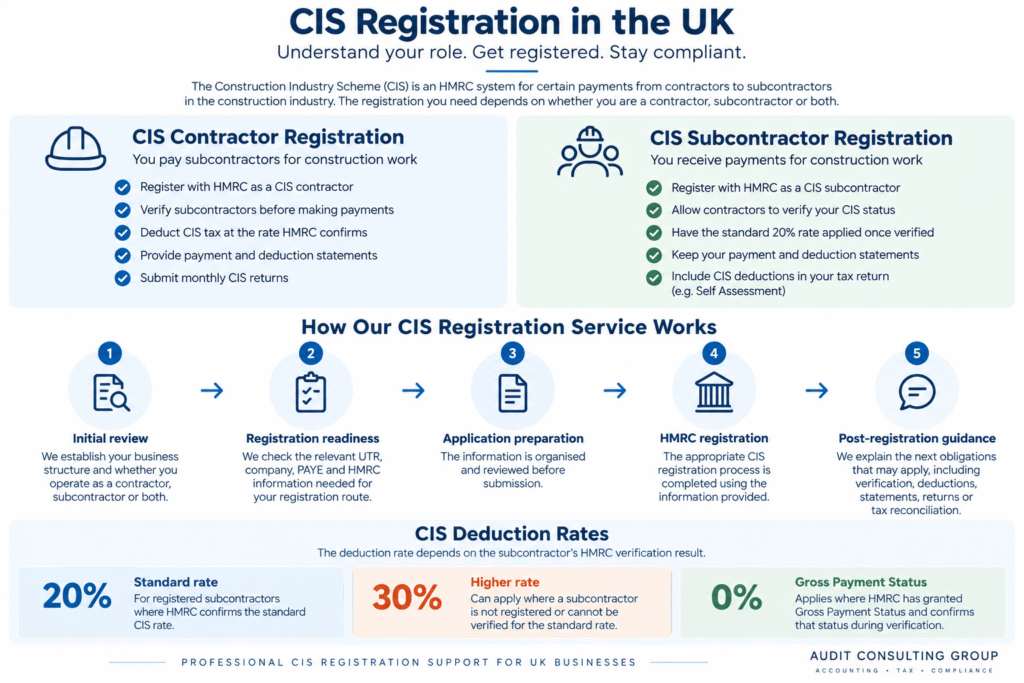
Contractor vs Subcontractor CIS Registration
If You Are a Contractor
- You pay subcontractors for qualifying construction work.
- You may need to register with HMRC as a CIS contractor.
- You normally need to verify subcontractors before applying the correct deduction treatment.
- You may need to make CIS deductions and provide payment and deduction statements.
- You normally have ongoing CIS reporting responsibilities after registration.
If You Are a Subcontractor
- You receive payments for construction work from contractors.
- You can register with HMRC as a CIS subcontractor.
- Your contractor can then verify your CIS status.
- CIS deductions suffered should be supported by appropriate deduction statements.
- The deductions are later taken into account through the relevant tax process.
The distinction matters because CIS contractor registration does not create the same obligations as CIS subcontractor registration. Registering under the wrong role can create problems later when payments and returns begin.
CIS Registration for Contractors

If your business starts paying subcontractors for construction work, registering for CIS as a contractor is usually part of setting up the correct HMRC reporting process.
The practical workflow normally goes beyond registration:
- Register the business under the appropriate contractor route.
- Verify subcontractors with HMRC before applying CIS deductions.
- Deduct CIS tax at the rate HMRC confirms where deductions are required.
- Provide statements showing the payment and deduction information.
- Submit CIS returns for the relevant reporting periods.
For businesses taking on subcontractors for the first time, it is useful to establish the CIS process before payments begin rather than treating registration and monthly reporting as separate last-minute tasks.
CIS Registration for Subcontractors
CIS registration for subcontractors is particularly relevant to sole traders and self-employed people carrying out construction work for contractors.
The usual sequence is straightforward in principle: establish the correct tax registration and UTR, complete CIS subcontractor registration, allow the contractor to verify the CIS status and retain the payment and deduction statements issued during the year.
Those deductions then form part of the subcontractor’s wider tax position. For individuals operating as sole traders, CIS deductions are normally considered when the Self Assessment position is calculated rather than being treated as the final tax liability.
Registration therefore affects the rate at which contractors may deduct tax from payments, but it does not remove the need to maintain accurate income and expense records or deal with the relevant tax return.
CIS Registration for Limited Companies
A limited company can register for CIS as a contractor, subcontractor or both, depending on how it operates.
A construction company that pays subcontractors may need contractor registration. A company carrying out subcontracted construction work for another contractor may register as a subcontractor so it can be verified under CIS. Some companies need both positions because they receive CIS payments and make CIS payments within the same business.
For a limited company, CIS should also be considered alongside its wider employer and tax responsibilities. PAYE, payroll, Corporation Tax and CIS are separate obligations even though transactions from each system eventually feed into the company’s accounting records.
CIS Registration for Sole Traders and Self-Employed Workers
Sole traders and self-employed construction workers commonly register as CIS subcontractors when they begin working for contractors operating under the scheme.
HMRC generally needs the individual’s tax identity and business information to connect the CIS registration to the correct taxpayer record. This is why the Unique Taxpayer Reference (UTR) is particularly important.
If a sole trader later starts paying other subcontractors, their role may change. They may then have contractor obligations as well as their existing subcontractor position.
CIS Deduction Rates: 20%, 30% and Gross Payment Status
The deduction rate applied by a contractor depends on the subcontractor’s HMRC verification result.
- 20% deduction is normally used for registered subcontractors where HMRC confirms the standard CIS rate.
- 30% deduction can apply where a subcontractor is not registered or cannot be verified for the standard rate.
- 0% deduction applies where HMRC has granted Gross Payment Status and confirms that status during verification.
Registering under CIS does not automatically give a subcontractor Gross Payment Status. Gross Payment Status has separate eligibility, turnover and compliance requirements and should be considered as a separate application.
CIS Registration Requirements and Information Needed
The exact CIS registration requirements depend on the applicant’s legal structure and whether registration is being completed as a contractor, subcontractor or both.
Typical information can include:
- Unique Taxpayer Reference (UTR);
- National Insurance number for an individual where relevant;
- business or trading name;
- company registration details for a limited company;
- business address and contact details;
- Government Gateway information where relevant;
- date the business started or expects to start construction activity;
- confirmation of whether the business operates as a contractor, subcontractor or both.
Contractor registration may also involve the employer PAYE position. This is one reason it is useful to establish the business structure and intended construction relationships before starting the HMRC registration process.
Do You Need a UTR to Register for CIS?
 A UTR is normally central to CIS subcontractor registration because HMRC uses it to identify the taxpayer and connect the CIS status to the appropriate tax record.
If you are starting self-employment and do not yet have the necessary tax registration or UTR, this may need to be dealt with before the CIS registration can be completed correctly.
The precise route depends on whether you are a sole trader, partnership or limited company, so it is important not to use another individual’s or business’s UTR simply to move the registration forward.
CIS Registration and PAYE
CIS and PAYE are related in some construction businesses, but they are not the same system.
PAYE is used for employees and payroll reporting. CIS deals with qualifying construction payments made to subcontractors.
A CIS contractor may need an employer PAYE scheme as part of the contractor registration and administration process even where the business’s main reason for registration is paying subcontractors. A business that also employs staff will have separate payroll obligations for those employees.
Correct worker status remains important. A person should not simply be treated as a CIS subcontractor because that is administratively convenient. The actual working relationship and HMRC employment-status rules need to support the treatment used.
How Our CIS Registration Service Works
- 1. Initial review – we establish your business structure and whether you operate as a contractor, subcontractor or both.
- 2. Registration readiness – we check the relevant UTR, company, PAYE and HMRC information needed for your registration route.
- 3. Application preparation – the information is organised and reviewed before submission.
- 4. HMRC registration – the appropriate CIS registration process is completed using the information provided.
- 5. Post-registration guidance – we explain the next obligations that may apply, including verification, deductions, statements, returns or tax reconciliation.
If you are unsure whether you should register as a contractor, subcontractor or both, you can tell us how your business works, who pays you and whether you also pay other construction workers. We can use that information to identify the appropriate registration route before the application begins.
What Happens After CIS Registration?
Registration does not complete every CIS responsibility. What happens next depends on which side of the scheme you operate.
After Subcontractor Registration
Your contractors can verify your CIS status with HMRC before making qualifying payments. Where deductions are made, you should receive payment and deduction statements and keep them with your accounting and tax records.
The figures should be reconciled against your own invoices and income records rather than assuming every deduction reported by a contractor is automatically correct.
After Contractor Registration
The business needs a repeatable process for verifying subcontractors, determining the HMRC deduction rate, calculating relevant deductions and completing the required monthly reporting.
This operational stage is where CIS mistakes frequently occur. A business can be correctly registered but still have compliance problems if subcontractors are not verified, deduction rates are applied incorrectly or returns are missed.
Contractor Verification and CIS Deductions
Before making relevant payments, a contractor normally verifies each subcontractor with HMRC. HMRC then confirms the deduction treatment to use.
The contractor should retain the verification information and make deductions from the appropriate part of the subcontractor’s payment rather than simply applying a percentage to every amount on an invoice without considering the CIS rules.
Good records matter because the contractor needs to be able to connect each payment, deduction, verification and statement to the correct subcontractor.
CIS Monthly Returns and Payment Statements
Contractors generally have ongoing CIS reporting responsibilities after registration. These responsibilities can include reporting payments and deductions through monthly CIS returns and issuing the relevant payment and deduction statements to subcontractors.
The monthly reporting cycle is distinct from the initial HMRC CIS registration. Registration establishes the position; the reporting process keeps the scheme operating afterwards.
A contractor should therefore have a clear monthly routine for subcontractor information, verification, payments, deductions, statements and HMRC reporting rather than relying on the registration alone.
Registering as Both Contractor and Subcontractor
It is possible for the same business to operate on both sides of CIS.
A subcontracting company might receive £10,000 from a larger contractor with CIS deducted, while in the same month paying its own subcontractors for labour. The incoming deduction and the company’s outgoing contractor obligations are separate records and should not be mixed together.
Recognising this dual role at registration stage makes it easier to establish the correct bookkeeping and CIS reporting process from the outset.
Common CIS Registration Problems
Many CIS problems begin with assumptions made before registration rather than problems with the HMRC form itself.
- registering under the wrong contractor or subcontractor role;
- starting work without the UTR or tax registration needed for subcontractor registration;
- assuming CIS and PAYE are interchangeable;
- expecting ordinary CIS registration to provide Gross Payment Status automatically;
- using inconsistent business or company details;
- assuming registration removes the need for monthly contractor compliance;
- failing to distinguish employees from genuine subcontractors;
- not keeping deduction statements or verification records.
How Long Does CIS Registration Take?
HMRC processing can vary according to the type of registration, the information available and whether additional checks are needed. For that reason, fixed processing times should not be treated as guaranteed.
If CIS registration is likely to be required, it is usually better to address it before the business reaches the point where contractors are trying to verify you or subcontractor payments already need to be processed.
Practical CIS Registration Scenarios
The following examples are illustrative scenarios designed to show how different CIS registration situations can work. They are not claims about specific Audit Consulting Group clients and do not imply a particular HMRC outcome.
Self-Employed Subcontractor Starting Construction Work

A self-employed plasterer begins taking work from building contractors but has not yet registered as a CIS subcontractor. Without the appropriate HMRC registration and verification, contractors may have to apply the higher CIS deduction treatment.
The practical work is to confirm the tax registration and UTR, complete the subcontractor CIS registration and make sure the individual understands how contractor verification and deduction statements work.
Operational outcome: the subcontractor is ready to be verified under the appropriate CIS status and can keep the resulting deduction records for the later Self Assessment reconciliation.
Limited Company Becoming a CIS Contractor
A small building company begins using subcontractors for the first time. Its immediate issue is not simply registration; it also needs a working process for verifying those subcontractors and reporting payments afterwards.
The contractor registration position is established, the relevant HMRC and PAYE information is reviewed and the business is guided through the responsibilities that follow.
Operational outcome: the company moves from registration into a defined verification, deduction, statement and monthly reporting process rather than treating CIS as a one-off application.
Business Operating as Both Contractor and Subcontractor
A construction company works for larger contractors while using its own subcontractors on individual projects. CIS deductions may therefore appear on income received at the same time as the company has obligations on payments it makes.
The two roles are identified separately so the incoming deductions, subcontractor verification records, outgoing CIS deductions and monthly contractor reporting can be recorded coherently.
Operational outcome: the business has a clearer audit trail and avoids treating incoming CIS deductions as if they automatically satisfy its separate contractor obligations.
Why Choose Audit Consulting Group for CIS Registration?
CIS registration is usually most straightforward when the role of the business is established before the application begins. Our work focuses on the practical details needed to make that distinction and prepare the registration appropriately.
- support for CIS contractors and subcontractors;
- registration guidance for sole traders and limited companies;
- review of UTR, PAYE and HMRC registration information where relevant;
- clear explanation of the difference between registration and ongoing CIS obligations;
- guidance on verification, deductions and reporting after registration;
- ongoing CIS support available separately where required.
This allows the registration service to remain clearly scoped. If you only need help registering, the engagement can focus on registration. If you also need monthly CIS returns, payroll, Self Assessment or wider accounting support, those requirements can be considered separately.
What You’ll Need to Get Started
Before starting your CIS registration, it is useful to have the following information available where applicable:
- your UTR;
- National Insurance number;
- business or company name;
- company registration details;
- business and trading address;
- Government Gateway information;
- details of your construction activities;
- confirmation of whether you pay subcontractors, receive construction payments or do both;
- PAYE information where contractor registration requires it.
If some of this information is not available, the first step is to identify what needs to be established before the CIS registration can proceed.
Frequently Asked Questions About CIS Registration
Who needs to register for CIS?
Businesses paying subcontractors for qualifying construction work generally need to consider CIS contractor registration. Subcontractors can register so contractors can verify them and apply the appropriate CIS deduction treatment.
Is CIS registration mandatory for subcontractors?
CIS registration does not work in exactly the same way for contractors and subcontractors. Contractors can have mandatory scheme obligations, while an unregistered subcontractor may instead be subject to the higher CIS deduction rate when paid by a contractor.
How do I register for CIS with HMRC?
The registration route depends on whether you are a contractor or subcontractor and on your legal structure. Relevant HMRC and tax information should be established before completing the application.
Can I register for CIS online?
HMRC provides online registration routes for CIS in appropriate circumstances. The specific process differs between contractor and subcontractor registrations.
Can a limited company register for CIS?
Yes. A limited company can operate as a CIS contractor, subcontractor or both depending on the construction work it undertakes and the subcontractors it pays.
Can a sole trader register for CIS?
Yes. Self-employed sole traders carrying out construction work can register as CIS subcontractors where appropriate.
Can I register for CIS without a UTR?
A UTR is normally required for CIS subcontractor registration. If you do not yet have the relevant tax registration, that may need to be dealt with first.
Do CIS contractors need PAYE?
The contractor registration process can involve the employer PAYE system, but CIS and employee payroll remain separate responsibilities. A business employing staff must also consider its normal PAYE payroll obligations.
Can I register as both a CIS contractor and subcontractor?
Yes. This is common where a construction business undertakes subcontract work for larger contractors while also paying its own subcontractors.
What happens if a subcontractor is not CIS registered?
Where a subcontractor cannot be verified for the standard registered rate, the contractor may have to use the higher CIS deduction rate in accordance with HMRC’s verification result.
Why am I having 30% deducted under CIS?
A 30% deduction can apply where HMRC does not confirm the subcontractor for the standard registered CIS rate. Registration and successful verification should be considered to establish the correct position.
How do I get the 20% CIS deduction rate?
A subcontractor normally needs to be appropriately registered and then verified by the contractor. HMRC’s verification result tells the contractor which deduction treatment to use.
What is Gross Payment Status?
Gross Payment Status allows qualifying subcontractors to receive eligible CIS payments without the standard CIS deduction. It has separate eligibility and compliance requirements and is not automatically granted through ordinary CIS registration.
What information is required for CIS registration?
The information varies by business type but commonly includes a UTR, identity or company details, business information, contact details and information about whether the applicant operates as a contractor, subcontractor or both.
How long does CIS registration take?
HMRC processing times vary. The registration should therefore be planned before it becomes urgent rather than relying on a guaranteed number of days.
What happens after I register for CIS?
Subcontractors may need to be verified by contractors and keep deduction statements. Contractors have wider ongoing obligations, which may include verification, deductions, statements and monthly CIS returns.
Is CIS registration the same as submitting CIS returns?
No. Registration establishes the contractor or subcontractor position with HMRC. CIS returns are part of the ongoing reporting responsibilities that can follow contractor registration.
How much does CIS registration support cost?
The fee depends on the registration route and whether additional CIS, PAYE, Self Assessment or accounting work is required. Standalone CIS registration can be scoped separately from ongoing compliance work.
Next Steps
If you need to register for CIS in the UK, tell us whether you work as a contractor, subcontractor or both, your business structure and whether you already have the relevant UTR and HMRC details.
We can review the position, identify the appropriate registration route, prepare the information required and explain the practical CIS responsibilities that follow registration.
Contact Audit Consulting Group to discuss CIS registration for your business.
CIS Registration Services Cost in the UK
Calculate the cost of CIS registration support for your circumstances. The service can cover the appropriate contractor or subcontractor registration route, preparation of the required HMRC information and guidance on the next CIS steps.
If you also require contractor verification, monthly CIS returns, payroll, Self Assessment or other ongoing support, these services can be scoped separately so that the work included is clear before you proceed.
Service Cost Estimation
Select the service category below to calculate the estimated cost of either accounting & tax services or forms and submissions.
Select Required Services / Forms
Select one or more services/forms to receive an accurate cost estimate. You can adjust your selection at any stage.
How would you like to engage our services?
Please select whether you require a one-off service or ongoing monthly support.
Contract Duration
Your cost estimate
Apply now and get 10% OFF
Submit your request today and receive an exclusive 10% discount on your selected service.
All prices are estimates. To receive a personalised quote, please fill out the form or contact us.
Ready to get started?
Get professional support from experienced UK accountants