
SA1 Form UK – How to Register for Self Assessment & Get a UTR
Leave your details and our team will get back to you shortly.
Reviewed internally by the Audit Consulting Group Personal Tax & HMRC Compliance Team
At Audit Consulting Group, we regularly help individuals across the UK register correctly for Self Assessment, resolve UTR issues, respond to HMRC notices, and avoid registration mistakes that later create filing or penalty problems.
The Self Assessment SA1 form is used to register with HM Revenue & Customs (HMRC) when you need to file a Self Assessment tax return but are not already registered and do not yet have a Unique Taxpayer Reference (UTR).
For many people, the SA1 is the first real interaction they have with the UK Self Assessment system. It is commonly used by landlords, company directors, individuals with untaxed income, people receiving foreign income, higher earners, and taxpayers who need to report income outside standard PAYE employment.
One important detail is often misunderstood from the beginning: the SA1 is not always the correct registration route for everyone.
If you are starting self-employment as a sole trader, HMRC may expect you to register through the self-employed registration route rather than using a general SA1 registration. Choosing the wrong route is one of the most common reasons why UTR delays and HMRC confusion happen later.
We regularly speak with people who submitted an SA1, waited several weeks, and then discovered they still needed to complete additional HMRC registration steps because the original route was not fully appropriate for their situation.
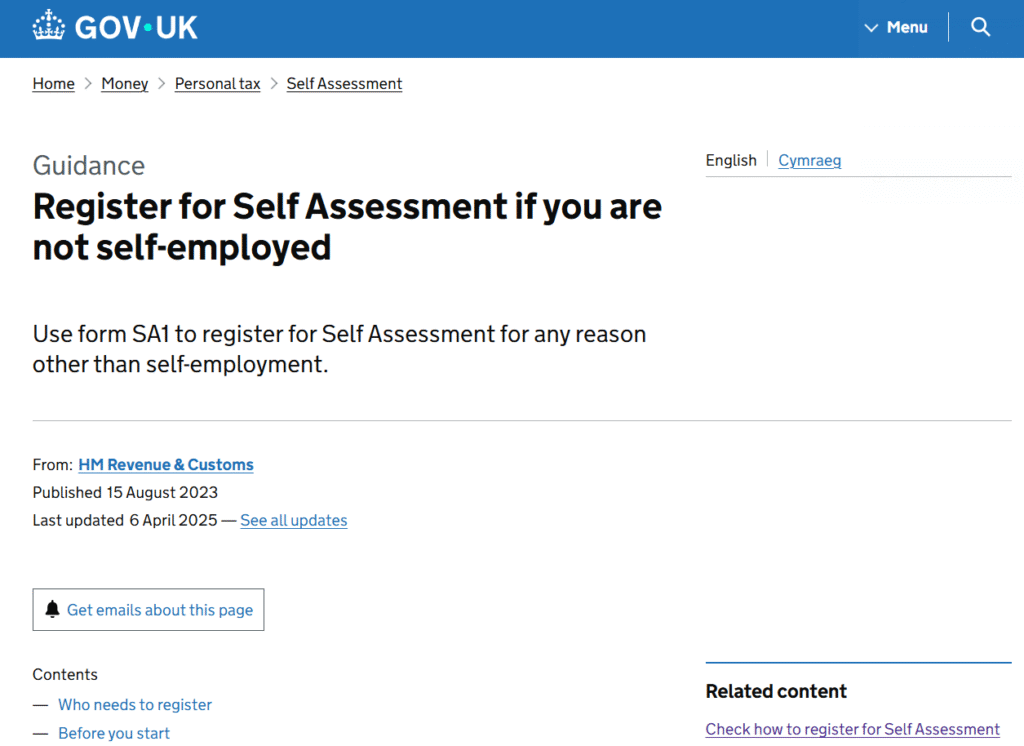
What Is the SA1 Form?
The form SA1 HMRC is a registration form used when someone needs to enter the Self Assessment system but is not currently registered.
Once HMRC processes the registration, they normally issue a UTR number, which is required before a Self Assessment tax return can be filed.
One of the most common misunderstandings we see is people confusing the SA1 with the actual tax return itself.
The SA1 is only the registration stage.
The actual Self Assessment tax return is generally submitted using the SA100 form. Meanwhile, the SA302 is often used later as proof of declared income for mortgage applications or lender checks.
This matters because many people believe they have “completed their tax return” after submitting the SA1, when in reality they have only entered the Self Assessment system and still need to submit the actual return before the filing deadline.
The SA1 form is generally used to:
Register for Self Assessment, request a UTR number, notify HMRC that a tax return may be required, and explain the reason why the taxpayer needs to enter the Self Assessment system.
Get your Unique Taxpayer Reference (UTR) through the correct HMRC registration route to avoid unnecessary delays and filing issues later.
Who Usually Needs the SA1 Form?
The SA1 HMRC form is commonly used by people who are not self-employed but still need to register for Self Assessment because of untaxed income or reporting obligations.
In practice, this often includes landlords, company directors, individuals with dividend income, people receiving foreign income, taxpayers with investment income, or individuals earning income that is not fully taxed through PAYE.
Landlords are one of the most common examples. Someone may begin renting out a property and assume that because the income is relatively small or because the mortgage is expensive, no registration is needed yet. However, HMRC may still expect Self Assessment registration depending on the circumstances.
Company directors can also become confused. Being a director alone does not always automatically create a filing obligation, but directors with dividends, benefits, untaxed income, expenses or additional income sources may need to register.
We also regularly see confusion involving side income. Some taxpayers earn money through online platforms, freelance projects, overseas income, or occasional consulting work and assume HMRC will automatically calculate the tax through PAYE. In reality, Self Assessment registration may still be required.
Self-employed individuals should be careful before automatically choosing SA1.
If you are registering as a sole trader or starting self-employment, HMRC may expect self-employed registration instead. Using the wrong registration route can delay the UTR process and create confusion around National Insurance records or future tax filings.
Guidance on Self Assessment registration: https://www.gov.uk/register-for-self-assessment

When SA1 Is Not the Correct HMRC Route
One of the biggest practical mistakes people make is assuming the SA1 works for every Self Assessment situation.
It does not.
If you are starting self-employment, registering a partnership, dealing with CIS subcontractor income, or already had a UTR in the past, another HMRC route may be more appropriate.
We regularly help people who accidentally create duplicate Government Gateway accounts or duplicate HMRC registration requests because they are unsure whether they already existed within the Self Assessment system years earlier.
Another surprisingly common issue involves HMRC letters being sent to old addresses. A taxpayer may think HMRC never responded to the registration, while HMRC believes correspondence has already been issued successfully.
January is also one of the busiest periods for Self Assessment support. During peak filing season, delays become more common because many people suddenly realise they needed a UTR earlier and left registration too late.
Before submitting the SA1 form, it is worth checking whether you are:
- registering as not self-employed but needing Self Assessment;
- starting self-employment as a sole trader;
- already registered but missing your old UTR;
- responding to an HMRC notice to file;
- trying to correct a previous registration problem;
- dealing with foreign income or side income for the first time.
How to Complete the SA1 Self Assessment Form
The SA1 Self Assessment form itself is relatively straightforward, but the details entered still matter because HMRC uses the information to set up your Self Assessment record correctly.
You will usually need to provide your name, address, date of birth, National Insurance number, contact details, and the reason you need to register.
The explanation given to HMRC should be accurate and specific.
For example, “rental income from UK property”, “foreign income”, “company director receiving dividends”, or “untaxed income not collected through PAYE” gives HMRC more useful context than vague wording such as “tax return needed”.
Once the registration is processed, HMRC normally issues a UTR number. This number is required before your first Self Assessment tax return can be submitted.
In practice, delays are not unusual.
We often see UTR delays where taxpayers moved home recently, entered incorrect personal details, used a different address from earlier HMRC records, created duplicate registrations, or selected the wrong registration route entirely.
Another issue people often miss is that receiving the UTR does not complete the process automatically. Many taxpayers still need to activate online access and later submit the actual SA100 tax return before the filing deadline.
SA1 Registration Deadlines
The standard deadline to register for Self Assessment is 5 October following the end of the tax year in which the filing obligation began.
For example, if you first received untaxed rental income during the 2024/25 tax year, registration would normally be expected by 5 October 2025.
Many people do not intentionally ignore the deadline. More commonly, they simply do not realise their income created a reporting obligation.
We regularly speak with individuals who assumed PAYE covered everything, did not realise dividend income or foreign income needed reporting, or believed that because they “made very little”, Self Assessment was unnecessary.
Registration delays can later lead to filing delays, which then create penalty risks if the tax return itself is submitted late.
What Happens If Your UTR Does Not Arrive?
After submitting SA1, many people expect their UTR number to arrive quickly. Sometimes it does. Sometimes it does not.
Missing UTRs are more common than many taxpayers expect.
In some cases, HMRC needs additional checks. In others, an older UTR already exists, the registration details do not match historical records, or correspondence has been sent to an old address.
We also occasionally see situations where clients created multiple Government Gateway accounts accidentally while trying to track their registration progress online, which can create additional confusion later.
If your UTR has not arrived and the filing deadline is approaching, it is important not to ignore the issue. HMRC may still expect the tax return once you are within Self Assessment.
We regularly help clients trace existing UTRs, correct registration problems, communicate with HMRC, and prepare the Self Assessment return once access to the record is restored.
Common SA1 Registration Mistakes
Most SA1 problems are not caused by the form itself being difficult. The real problems usually start with misunderstanding how the registration process works.
Some people register too late. Others use SA1 when self-employed registration was more appropriate. Some taxpayers accidentally apply for a second UTR even though HMRC already issued one years earlier.
We also regularly see situations where clients do not realise they still need to complete the actual SA100 tax return after receiving the UTR.
Another issue involves foreign income misunderstandings. Some taxpayers assume that because income was earned overseas, HMRC does not need to know about it. In reality, UK tax residency and reporting rules can still create Self Assessment obligations.
We have also seen cases where CIS subcontractors used the wrong registration route entirely, leading to delays with both tax records and National Insurance processing.
In situations where HMRC issues a notice to file, ignoring the letter is rarely the best approach. Even where a tax return may not ultimately be required, the notice itself usually still needs to be addressed properly.
Example Cases – Real SA1 Registration Problems
Landlord Registration Delay
A client began receiving rental income from a second property but assumed tax registration would only become necessary once the profit increased significantly. By the time they contacted us, the 5 October registration deadline had already passed and the UTR had still not arrived. We helped complete the correct registration process, communicate with HMRC, and prepare the first Self Assessment return before further compliance issues developed.
Old UTR Already Existed
Another client submitted a brand-new SA1 registration because they believed they had never used Self Assessment before. HMRC records showed a UTR had actually been issued many years earlier at a previous address. The duplicate registration created delays instead of solving the issue. We helped trace the old UTR, update HMRC records, and restore access correctly.
Director with Dividend Income
A company director contacted us after receiving dividends while assuming PAYE covered all tax reporting automatically. After reviewing the situation, we confirmed that Self Assessment registration was required, assisted with the SA1 process, and later prepared the first tax return to ensure the dividend income was reported correctly.
Practical Tips Before Submitting SA1
Before submitting the SA1 form, check whether you already had a UTR in the past. Creating duplicate registrations is far more common than people realise.
Make sure your address history, National Insurance number, and reason for registration are accurate. Even small inconsistencies can slow down the registration process.
If you recently moved address, changed name, became a company director, started receiving rental income, or began earning foreign income, the registration explanation should reflect the actual situation clearly.
It is also important to remember that registration itself is only the beginning. Once the UTR arrives, you may still need to activate online access, calculate tax liabilities, prepare records, and submit the actual Self Assessment return correctly.
FAQ – Self Assessment SA1
Do I need SA1 if I already have a UTR?
Usually no. If HMRC already issued a UTR previously, you often need to reactivate or recover the existing record rather than create a new SA1 registration.
What if I lost my old UTR?
In many cases, the existing UTR can still be traced through HMRC records. Applying for a second UTR unnecessarily can sometimes delay the process further.
Should landlords use SA1?
Many landlords use SA1 to enter Self Assessment, particularly where rental income is not already being reported elsewhere. However, the correct route still depends on the wider tax situation.
Do company directors always need Self Assessment?
Not always. Some directors may not need a tax return if there is no additional reportable income outside PAYE. However, directors receiving dividends, untaxed income, rental income, foreign income or benefits may still need to register.
What happens if HMRC sends a notice to file?
It is important not to ignore the notice. HMRC may issue penalties if the filing obligation is not dealt with properly, even where the taxpayer later believes a return should not have been required.
How long does it take to receive a UTR?
In straightforward cases, the UTR may arrive within a few weeks. However, delays can happen if HMRC needs additional checks or if older records already exist.
Can Audit Consulting Group help with SA1 registration?
Yes. We help clients complete SA1 registrations, trace missing UTRs, resolve HMRC registration issues, and prepare Self Assessment tax returns correctly.
Why Choose Audit Consulting Group?
At Audit Consulting Group, we understand that the SA1 Self Assessment form is often only the start of a wider HMRC compliance process.
Our team regularly helps landlords, company directors, individuals with foreign income, side income earners, and taxpayers dealing with UTR delays or HMRC registration problems.
We assist clients daily with:
- SA1 Self Assessment registration;
- UTR tracing and UTR applications;
- landlord Self Assessment registration;
- director tax registration support;
- foreign income and untaxed income guidance;
- Self Assessment tax return preparation;
- HMRC letters and compliance support.
Many clients contact us after discovering that a small registration issue has already created delays, confusion, or filing concerns. In practice, resolving those problems early is usually far easier than trying to fix penalties or compliance issues later.
Contact Audit Consulting Group today and we’ll help make your SA1 registration and Self Assessment process accurate, clear and fully compliant with HMRC requirements.
SA1 Self Assessment Registration Services Cost UK
Register for Self Assessment in the UK with expert support from Audit Consulting Group.
We help individuals complete SA1 registration forms correctly, identify the proper HMRC registration route, resolve UTR problems, and avoid delays that later affect tax return filing.
Our affordable SA1 registration services are designed to help you register properly, stay compliant with HMRC, and move confidently into the Self Assessment system.
Service Cost Estimation
Select the service category below to calculate the estimated cost of either accounting & tax services or forms and submissions.
Select Required Services / Forms
Select one or more services/forms to receive an accurate cost estimate. You can adjust your selection at any stage.
How would you like to engage our services?
Please select whether you require a one-off service or ongoing monthly support.
Contract Duration
Your cost estimate
Apply now and get 10% OFF
Submit your request today and receive an exclusive 10% discount on your selected service.
All prices are estimates. To receive a personalised quote, please fill out the form or contact us.
Ready to get started?
Get professional support from experienced UK accountants