
CIS Gross Payment Status UK: Apply for Gross Payment Status
Leave your details and our team will get back to you shortly.
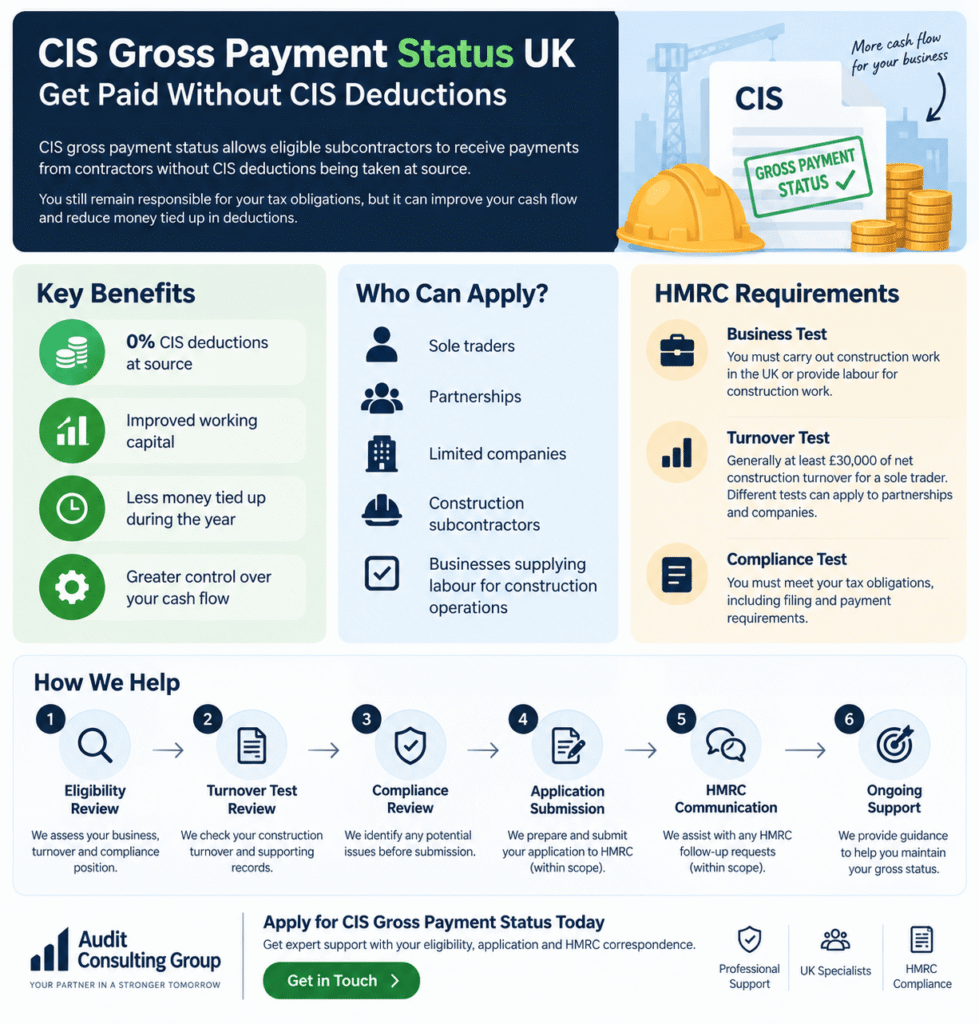
CIS gross payment status allows eligible subcontractors in the UK construction industry to receive payments from contractors without CIS deductions being taken at source. Instead of the standard 20% deduction that normally applies to registered subcontractors under net payment status, an approved subcontractor receives the relevant payment without a CIS deduction and deals with its tax liabilities through the appropriate tax process.
Audit Consulting Group supports sole traders, subcontractors, partnerships and limited companies that want to apply for CIS gross payment status. We can review eligibility, assess construction turnover, check relevant tax compliance, prepare the application information and deal with HMRC questions within the agreed scope.
For many applicants, the key issue is not simply how to complete a CIS gross payment status application, but whether the business is likely to meet HMRC’s business, turnover and compliance tests before the application is submitted.
What Is CIS Gross Payment Status?
Under the Construction Industry Scheme (CIS), contractors normally make deductions from payments to subcontractors and pass those deductions to HMRC.
For a subcontractor that is registered for CIS but does not have gross payment status, the standard deduction rate is usually 20%. An unregistered subcontractor can generally be subject to a higher deduction rate.
With gross payment status, a contractor normally pays the subcontractor without making a CIS deduction from the relevant payment.
This does not make the income tax-free. Gross payment status changes how CIS deductions are dealt with at source; the subcontractor remains responsible for its tax obligations through the appropriate system, including Self Assessment, Corporation Tax or other relevant liabilities depending on the business structure.
CIS Gross Payment Status vs Net Payment Status
CIS Net Payment Status
Under net payment status, contractors generally deduct 20% from relevant payments to CIS-registered subcontractors. Those deductions are passed to HMRC and taken into account against the subcontractor’s tax liabilities.
- 20% is normally deducted from the relevant amount for a registered subcontractor;
- the contractor reports and pays the deduction to HMRC;
- the subcontractor receives less cash at the point of payment;
- the deduction is dealt with through the relevant tax process.
CIS Gross Payment Status
With gross payment status, contractors normally make the relevant payment without deducting CIS tax at source.
- the subcontractor receives the relevant payment gross;
- there is no standard 20% CIS deduction from that payment;
- the business remains responsible for its tax liabilities;
- HMRC requirements must continue to be met to retain gross payment status.
The commercial difference is therefore mainly about when money leaves the business, rather than whether tax is ultimately due.
Who Can Apply for CIS Gross Payment Status?
You may be able to register for CIS gross payment status if you operate as a subcontractor within the Construction Industry Scheme and meet HMRC’s conditions.
- self-employed CIS subcontractors;
- sole traders carrying out construction work;
- limited company subcontractors;
- partnerships operating within construction;
- construction businesses supplying labour for construction operations.
You can apply for gross payment status when registering as a CIS subcontractor or, if you are already registered under net payment status, apply to move from net to gross once the relevant conditions are met.
CIS Gross Payment Status Requirements

HMRC considers several conditions when assessing CIS gross payment status eligibility. The three central areas are the business test, turnover test and compliance test.
Business Test
The business must carry out construction work in the UK or provide labour for construction work and meet the relevant HMRC business requirements. The business should also be operated through a bank account.
Turnover Test
The applicant must have sufficient net construction turnover. The figure HMRC considers is not necessarily the same as the total value of invoices raised by the business.
Compliance Test
HMRC also considers whether the applicant has managed relevant tax obligations properly. Filing or payment problems can affect an application even where the turnover requirement is met.
Before an HMRC gross payment status application is submitted, these areas should be considered together. Passing the turnover test alone does not establish that the business will satisfy every condition.
How Is Net Construction Turnover Calculated?
One of the most common mistakes when businesses apply for gross payment status under CIS is using total sales or total invoice value as the turnover-test figure.
For this purpose, HMRC generally considers construction turnover excluding VAT and the direct cost of materials.
A subcontractor may therefore have invoiced more than £30,000 during the relevant period but still need to check whether its net construction turnover meets the required level after VAT and qualifying materials are excluded.
If you are unsure whether your turnover calculation is likely to meet HMRC’s test, we can review the figures and supporting records before the application is submitted.
CIS Gross Payment Status Compliance Test
The compliance test is a central part of HMRC’s assessment. Gross payment status is intended for businesses that meet the relevant tax compliance requirements, not simply businesses with sufficient construction turnover.
Depending on the applicant and its obligations, HMRC may consider matters such as:
- Self Assessment returns;
- Corporation Tax returns;
- CIS returns where applicable;
- PAYE obligations where applicable;
- tax payments and relevant payment deadlines;
- existing HMRC compliance issues.
A late filing or payment does not mean every application will automatically have the same outcome. The nature, timing and compliance history need to be considered against HMRC’s applicable rules.
CIS Gross Payment Status for Sole Traders
A self-employed construction subcontractor can apply for CIS gross payment status where the relevant HMRC requirements are met.
For a sole trader, particular attention should be given to net construction turnover, Self Assessment compliance, tax payments and the records supporting construction income and materials.
Gross status can be attractive to sole traders who regularly have 20% deducted from contractor payments, but the additional cash retained during the year should not be treated as extra profit. Future tax liabilities still need to be planned for.
CIS Gross Payment Status for Limited Companies
A limited company can apply for gross payment status where it operates as a CIS subcontractor and satisfies HMRC’s relevant tests.
The turnover test for a company can require more analysis than the sole trader test because the applicable calculation may depend on relevant persons connected with the company or an alternative turnover test.
The company’s wider compliance position can also matter. Relevant Corporation Tax, PAYE and CIS obligations should therefore be considered before the application is made.
What Evidence May HMRC Require?
The information needed depends on the business and the application. Supporting records may be relevant to establish construction activity, turnover and compliance.
- sales invoices and construction contracts;
- bank statements showing business transactions;
- records of materials charged to construction work;
- accounts or bookkeeping records supporting turnover;
- company, partnership or sole trader tax information;
- CIS records;
- information requested by HMRC during its checks.
Good records matter beyond the application stage. HMRC can check information supporting gross payment status after an application has been accepted.
Common Reasons Gross Payment Status Applications Have Problems
A gross payment status application can run into difficulties where the business does not meet one of the relevant tests or where the information submitted does not reflect its actual records.
- net construction turnover below the applicable requirement;
- turnover calculated using the wrong figures;
- late or outstanding tax returns;
- tax payment or compliance problems;
- inconsistent application information;
- insufficient evidence of construction activity;
- business records that do not support the figures used in the application;
- applying before the relevant conditions are met.
A pre-application review cannot guarantee HMRC approval, but it can identify issues that are visible from the available records before submission.
How to Apply for CIS Gross Payment Status
A subcontractor can apply for gross payment status as part of CIS registration or apply after registration if it already operates under net payment status.
An application requires information that allows HMRC to assess the relevant conditions. HMRC may make further checks or request additional evidence depending on the circumstances.
For businesses looking at how to apply for CIS gross payment status online, the practical first step should still be to establish eligibility. Submitting an online application does not change the underlying business, turnover or compliance tests.
Our CIS Gross Payment Status Application Service

1. Eligibility Review
We review the business structure, CIS position, construction activity and the main HMRC conditions relevant to the application.
2. Turnover Test Review
We review construction turnover and the treatment of relevant materials so the application is based on an appropriate turnover calculation.
3. Compliance Review
Relevant filing and payment history is considered before submission so issues can be identified early.
4. Application Preparation and Submission
We prepare the relevant application information and, where included within the agreed scope, submit the CIS gross payment status application to HMRC.
5. HMRC Communication
If HMRC requests further information during the application process, we can assist with the response and supporting documentation within the agreed scope.
6. Post-Approval Guidance
Once gross payment status is granted, we can explain the importance of maintaining the relevant tax compliance because HMRC can review whether the conditions continue to be met.
How Long Does a Gross Payment Status Application Take?
There is no single processing time that applies to every application. Timing depends on HMRC processing, the applicant’s circumstances and whether additional checks or supporting evidence are required.
The HMRC decision stage is outside the adviser’s control, so businesses should avoid treating an estimated processing period as a guaranteed approval date.
If gross payment status is important for an upcoming contract, it is sensible to consider the application before the expected start of the work rather than assuming the status can be obtained immediately.
What Happens After HMRC Approves Gross Payment Status?
Once HMRC grants gross payment status, contractors should verify the subcontractor’s CIS status when required and make payments in accordance with the status returned by HMRC.
The subcontractor receives relevant payments without the standard CIS deduction at source, but remains responsible for its tax affairs. Money that would previously have been deducted under CIS may later be needed for Self Assessment, Corporation Tax or other liabilities.
HMRC Post-Acceptance Checks
Approval should not be treated as the end of HMRC’s interest in the application. HMRC can carry out checks after gross payment status has been granted to confirm that information used in the application, including turnover figures, is supported by the business’s records.
Supporting documents should therefore be retained and the turnover calculation should be based on actual records rather than estimates designed simply to reach the eligibility threshold.
Maintaining CIS Gross Payment Status
Gross payment status is an ongoing compliance position rather than a one-off registration. Once approved, filing and payment compliance remain important.
- submitting Self Assessment or Corporation Tax returns when due;
- meeting CIS filing obligations;
- maintaining PAYE compliance where applicable;
- meeting relevant payment deadlines;
- keeping reliable accounting and construction records;
- responding to HMRC correspondence promptly.
HMRC Annual Review of Gross Payment Status
HMRC reviews businesses with gross payment status to establish whether they continue to meet the required conditions.
A business that qualified when it first applied can later put its status at risk through compliance failures. If HMRC identifies a problem, the business should establish which requirement has not been met and respond according to the notice and applicable deadline.
Can HMRC Remove Gross Payment Status?

Yes. HMRC can withdraw gross payment status where the required conditions are no longer met.
Problems can arise from late tax returns, missed CIS or PAYE obligations, payment failures, incorrect information or other relevant compliance issues identified by HMRC.
Where HMRC decides after an annual review that the conditions are not met, it normally writes to the subcontractor explaining the decision. The date on the notice and any available appeal period should be checked carefully.
Appealing a Gross Payment Status Refusal or Withdrawal
If HMRC refuses an application or decides to withdraw existing gross payment status, there may be a right to appeal depending on the decision and circumstances.
For withdrawal following an HMRC annual review, the appeal deadline is generally 30 days from the notice. The notice itself should be checked because it explains the decision and the applicable next steps.
An appeal should address the actual reason for HMRC’s decision, which may involve compliance history, filing or payment issues, turnover evidence or other information relevant to the applicable test.
If gross payment status is ultimately cancelled, restrictions can apply before a fresh application can be made. A refusal or withdrawal notice should therefore be dealt with promptly rather than treating reinstatement as automatic.
Practical CIS Gross Payment Status Scenarios
The following examples are illustrative and are not descriptions of specific Audit Consulting Group clients. They do not imply that HMRC will reach the same decision in another case.
Sole Trader Unsure Whether Turnover Qualifies
A self-employed subcontractor has construction invoices above £30,000 but has also charged significant amounts for materials.
The invoices and materials records need to be reviewed to establish the relevant net construction turnover before the application is made. This avoids relying on total invoice value where it may not represent the figure used for HMRC’s turnover test.
Limited Company Considering Gross Payment Status
A limited company works mainly as a subcontractor and regularly has CIS deductions made from contractor payments.
Before applying for gross status, the relevant company turnover test and tax compliance position need to be reviewed, including Corporation Tax, PAYE and CIS obligations where applicable.
Gross Payment Status at Risk After an HMRC Notice
A subcontractor already has gross payment status but receives an HMRC notice following a compliance issue.
The immediate priority is to identify what HMRC says has failed, establish the relevant deadline and determine whether an appeal or another response is appropriate. This is different from simply submitting a new gross payment status application.
CIS Gross Payment Status and VAT Reverse Charge
CIS gross payment status and the VAT domestic reverse charge are separate issues.
Gross payment status determines whether CIS deductions are made from relevant payments to the subcontractor. VAT treatment is determined under VAT rules and, where applicable, the domestic reverse charge rules for building and construction services.
A business should not assume that obtaining gross payment status changes whether VAT or the domestic reverse charge applies to a particular supply.
Why Use Audit Consulting Group for Gross Payment Status Support?
The application itself is only one part of the process. The more important work can be establishing whether the business meets HMRC’s requirements before information is submitted.
Our support focuses on construction activity, business structure, turnover calculation, relevant tax compliance, supporting records and HMRC correspondence.
We do not guarantee that HMRC will approve an application. The decision belongs to HMRC and depends on the applicant meeting the relevant requirements. Our role is to help the business understand those requirements, prepare the application information and address issues that can reasonably be identified from the available records.
Frequently Asked Questions – CIS Gross Payment Status UK
What is CIS gross payment status?
CIS gross payment status allows an approved subcontractor to receive relevant construction payments without the standard CIS deduction being made at source.
What is CIS net payment status?
Under net payment status, a contractor normally deducts 20% from the relevant amount paid to a CIS-registered subcontractor and passes the deduction to HMRC.
How do I apply for CIS gross payment status?
You can apply when registering as a CIS subcontractor or after registration if you currently operate under net payment status. HMRC will assess whether the relevant business, turnover and compliance requirements are met.
Can I apply for CIS gross payment status online?
HMRC provides routes for applying for gross payment status. Applying online does not remove the requirement to satisfy HMRC’s eligibility tests.
What are the CIS gross payment status requirements?
The central requirements include the business test, turnover test and compliance test. The exact assessment depends on the applicant’s business structure and circumstances.
What turnover do I need for gross payment status?
A sole trader generally needs at least £30,000 of net construction turnover under the individual turnover test. Different calculations can apply to companies and partnerships, so their applicable turnover test should be checked before applying.
Does VAT count towards the gross payment status turnover test?
VAT is generally excluded when calculating net construction turnover for the turnover test.
Are materials deducted when calculating construction turnover?
The direct cost of materials is generally excluded when determining net construction turnover for the gross payment status test. Records should support the amounts being treated as materials.
Can a sole trader apply for gross payment status?
Yes. A sole trader operating as a CIS subcontractor can apply where the relevant HMRC conditions are met.
Can a limited company apply for gross payment status?
Yes. A limited company subcontractor can apply, but the applicable turnover calculation and the company’s wider compliance position should be considered.
Can a new business apply for gross payment status?
A newer business may be able to apply where it can satisfy the relevant HMRC requirements. Its construction activity, turnover evidence and compliance position will need to support the application.
Does gross payment status mean I do not pay tax?
No. Gross payment status means CIS deductions are not made at source from relevant payments. It does not remove the business’s underlying tax liabilities.
How long does it take to get CIS gross payment status?
Processing times vary. HMRC may need to carry out checks or request additional information, so businesses should not rely on a fixed approval period.
Does HMRC review gross payment status every year?
HMRC carries out annual reviews of businesses with gross payment status to assess whether the requirements continue to be met.
Can HMRC remove gross payment status?
Yes. Gross payment status can be withdrawn if HMRC determines that the relevant conditions are no longer satisfied.
Can I appeal if HMRC removes my gross payment status?
There can be a right to appeal. For a withdrawal following an annual review, the appeal deadline is generally 30 days from the notice. The specific HMRC decision and notice should be checked.
Does CIS gross payment status affect VAT reverse charge?
Gross payment status and the VAT domestic reverse charge are separate regimes. Gross status does not by itself determine the VAT treatment of a construction supply.
Can Audit Consulting Group apply for gross payment status for me?
We can review eligibility, prepare relevant application information, support submission within the agreed scope and assist with HMRC follow-up where required.
Apply for CIS Gross Payment Status
If you are currently having CIS deductions made from contractor payments and want to establish whether your business qualifies for gross payment status, the first step is to review the business, turnover and compliance requirements.
If you have already received an HMRC refusal or a notice affecting existing gross payment status, the notice and deadline should be reviewed before deciding on the next step.
Audit Consulting Group can help assess your CIS gross payment status eligibility, prepare the application and deal with relevant HMRC follow-up within the agreed scope.
Gross Payment Status Application Services Cost UK
The cost of professional support with a CIS gross payment status application depends on the work required. A straightforward application may involve an eligibility review, turnover assessment and submission support, while cases involving compliance problems, HMRC correspondence, refusal or withdrawal may require additional work.
Use our calculator to estimate the cost of CIS gross payment status application support. Where additional tax compliance or appeal work is required, the scope and fee can be confirmed separately.
Service Cost Estimation
Select the service category below to calculate the estimated cost of either accounting & tax services or forms and submissions.
Select Required Services / Forms
Select one or more services/forms to receive an accurate cost estimate. You can adjust your selection at any stage.
How would you like to engage our services?
Please select whether you require a one-off service or ongoing monthly support.
Contract Duration
Your cost estimate
Apply now and get 10% OFF
Submit your request today and receive an exclusive 10% discount on your selected service.
All prices are estimates. To receive a personalised quote, please fill out the form or contact us.
Ready to get started?
Get professional support from experienced UK accountants