
Making Tax Digital for Construction & CIS Contractors
Leave your details and our team will get back to you shortly.
Making Tax Digital is changing how many self-employed construction workers and CIS subcontractors keep records and report their income to HMRC.
For construction businesses, preparing for MTD can involve more than choosing accounting software. CIS deductions, stage payments, retentions, materials, site expenses, subcontractor payments and, where relevant, VAT Domestic Reverse Charge transactions all need to be recorded consistently within the wider bookkeeping and tax process.
Audit Consulting Group provides professional MTD for construction support for CIS subcontractors, self-employed construction workers, contractors and construction businesses. We can help establish whether Making Tax Digital applies to you, review your current records, implement an appropriate digital bookkeeping process and support ongoing reporting where required.
What Is Making Tax Digital for Construction Businesses?
Making Tax Digital (MTD) is HMRC’s framework for moving tax record keeping and reporting into compatible digital systems.
For an individual within MTD for Income Tax, this means using compatible software to create and maintain digital records of relevant self-employment and property income and expenses, send quarterly updates to HMRC and complete the wider tax return process through compatible software.
Construction businesses can also encounter MTD through VAT. MTD for VAT and MTD for Income Tax are separate regimes, so the requirements depend on the legal structure, income sources and VAT position of the business.
Does MTD Apply to CIS Contractors and Subcontractors?
Being registered under the Construction Industry Scheme does not automatically mean that every CIS contractor or subcontractor must use MTD for Income Tax.
MTD for Income Tax primarily affects individuals with qualifying self-employment and property income above the relevant threshold. This can include self-employed builders, electricians, plumbers, plasterers, carpenters and other construction subcontractors operating as sole traders.
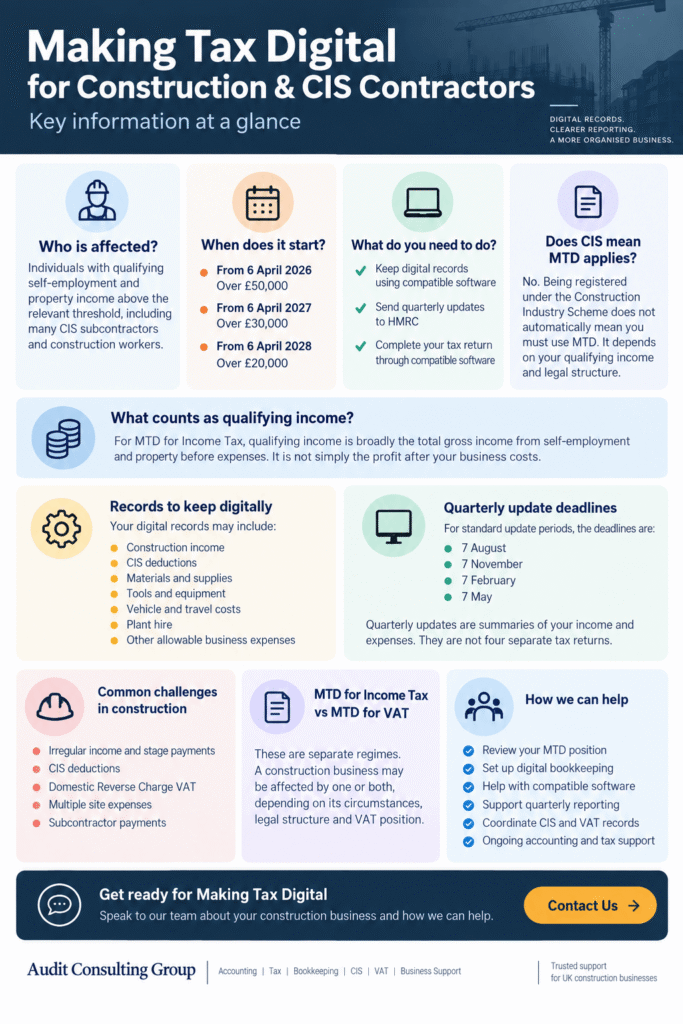
From 6 April 2026, MTD for Income Tax applies to individuals within scope whose qualifying income is more than £50,000. The threshold is being extended in stages:
- From 6 April 2026: qualifying income over £50,000.
- From 6 April 2027: qualifying income over £30,000.
- From 6 April 2028: qualifying income over £20,000.
The applicable start date is generally determined using qualifying income from an earlier tax year rather than simply looking at turnover at the point you begin using MTD. This makes it important to review the correct income period before deciding when the rules apply.
If you are unsure whether you fall within MTD for Income Tax, we can review your business structure, qualifying income and existing record-keeping process before recommending what needs to change.
What Counts as Qualifying Income for a CIS Worker?
For MTD for Income Tax, qualifying income is broadly the total gross income from self-employment and property before expenses. It is not simply the taxable profit remaining after tools, materials, travel and other allowable business costs have been deducted.
This distinction matters for CIS subcontractors because the amount arriving in the bank account may already have had CIS deductions taken from it.
For example, if a contractor deducts CIS before making payment, the lower bank receipt should not automatically be treated as the subcontractor’s gross income. The underlying construction income and CIS deduction need to be recorded separately and consistently.
If you have more than one self-employment business or also receive property income, those income sources can also affect the total qualifying income used to determine whether MTD applies.
MTD for Sole Traders and Self-Employed CIS Subcontractors

Self-employed CIS subcontractors are one of the construction groups most likely to be affected by MTD for Income Tax.
Once within the regime, the main operational change is that the bookkeeping needs to support digital reporting throughout the year rather than being reconstructed only when the Self Assessment return is due.
Depending on your work, records may need to capture:
- gross construction income;
- CIS deductions;
- materials and supplies;
- tools and equipment;
- vehicle and travel costs;
- plant hire;
- other business expenses.
We can help organise the bookkeeping process so the information needed for quarterly MTD updates is captured consistently during the year.
MTD for Limited Construction Companies
A limited company should not assume that MTD for Income Tax applies to the company simply because it operates within CIS.
MTD for Income Tax concerns qualifying income received by individuals from self-employment and property. A limited company’s Corporation Tax position is different.
The company’s CIS status also does not, by itself, determine whether its directors personally fall within MTD for Income Tax. Their individual circumstances and qualifying income would need to be considered separately.
A construction limited company may, however, have separate digital reporting responsibilities, particularly if it is VAT registered and therefore within MTD for VAT. It may also operate CIS as a contractor, subcontractor or both.
MTD for Income Tax vs MTD for VAT
This is one of the most common areas of confusion for construction businesses.
MTD for Income Tax concerns digital records and reporting for qualifying self-employment and property income received by individuals.
MTD for VAT concerns VAT-registered businesses and their digital VAT records and VAT Return submissions through compatible software.
A construction business may therefore be affected by one regime without being affected by the other, or may need a bookkeeping system capable of supporting both.
Where VAT and CIS are both involved, the accounting treatment needs to keep the different elements of each transaction clear rather than treating CIS deductions and VAT as part of the same calculation.
Why Construction Businesses Face Unique MTD Challenges
Construction businesses often deal with irregular income cycles and payment structures that make digital reporting more involved than it is for a straightforward service business.
Common complexities include:
- stage payments;
- retentions;
- CIS deductions;
- Domestic Reverse Charge VAT;
- multiple site expenses;
- materials and plant costs;
- payments to subcontractors.
A workable MTD process therefore needs to reflect how the construction business actually operates. Simply connecting software to HMRC does not resolve inaccurate or incomplete bookkeeping underneath it.
How CIS Deductions Work Under MTD

CIS deductions function as advance payments towards tax rather than ordinary business expenses.
For a subcontractor, this creates an important distinction between the gross value of construction income, the CIS deduction made by the contractor and the net amount actually received.
The records should allow these amounts to be reconciled rather than treating the bank receipt as the entire transaction.
We can structure bookkeeping systems to capture CIS statements and deductions alongside the underlying income records, supporting both quarterly reporting and the later year-end tax reconciliation.
What Construction Records Need to Be Kept Digitally?
Where MTD for Income Tax applies, compatible software is used to create and maintain digital records of relevant self-employment income and expenses.
For construction businesses, these records may include:
- sales and construction income;
- CIS deductions suffered;
- materials purchases;
- tools and equipment costs;
- plant hire;
- site and business travel costs;
- other allowable business expenses;
- records supporting quarterly income and expense totals.
Invoices, receipts and CIS statements remain important supporting documents. The relevant transaction information also needs to be maintained through the digital record-keeping process where MTD applies.
Construction Expenses and MTD

Construction businesses often incur sector-specific costs that become difficult to analyse if records are updated irregularly.
These may include plant hire, tools and equipment, site travel, safety equipment, materials, vehicle costs and subcontractor-related expenditure.
MTD increases the importance of keeping these transactions organised throughout the year because quarterly reporting is generated from the underlying records.
The tax treatment still depends on the normal tax rules. Recording an expense in MTD-compatible software does not automatically make it an allowable deduction.
MTD Software for CIS Contractors and Subcontractors
If you are required to use MTD for Income Tax, you or your agent need compatible software capable of maintaining the required digital records and sending the relevant information to HMRC.
For a CIS subcontractor, software selection should take account of more than whether the product can connect to HMRC. The system should also work with the practical bookkeeping requirements of the business, including construction income, CIS deductions and business expenses.
Useful functionality may include:
- bank transaction feeds;
- receipt and invoice capture;
- income and expense categorisation;
- CIS-related bookkeeping functionality;
- VAT functionality where relevant;
- quarterly MTD submissions;
- year-end tax return functionality or a suitable connection to software that supports it.
We can review your existing system and establish whether it is suitable before recommending changes. In some cases, improving the bookkeeping workflow may be more important than changing software entirely.
Can You Use Spreadsheets for MTD?
Using a spreadsheet does not necessarily mean that all existing records need to be replaced.
Where spreadsheets form part of the MTD process, they may need to work with compatible software or bridging software and maintain the required digital links between relevant records and submissions.
Whether this is practical depends on transaction volume and complexity. A CIS sole trader with relatively few monthly transactions may have very different requirements from a contractor managing several projects, subcontractors and VAT reporting.
How Quarterly MTD Updates Work
Quarterly updates are summaries of business income and expenses generated from digital records. They are not four separate tax returns.
For MTD for Income Tax, compatible software totals the relevant digital records and sends the required quarterly information to HMRC.
For standard update periods, the deadlines are:
- 7 August;
- 7 November;
- 7 February;
- 7 May.
The updates are cumulative from the beginning of the tax year to the end of the relevant update period. Full accounting and tax adjustments are not normally required before each quarterly update is submitted.
After the tax year, the wider tax return process still needs to be completed through compatible software, including reviewing the year’s information and dealing with relevant adjustments, reliefs and other income.
Project-Based Income, Stage Payments and Retentions
Construction firms often manage several projects at the same time, each with different revenue, cost and payment patterns.
Stage payments and retentions can make bank transactions alone an unreliable basis for understanding project performance or preparing tax records.
A structured bookkeeping system can provide clearer visibility over project income, site expenses, labour costs, materials purchases, amounts received and transactions affected by CIS deductions.
This supports MTD reporting while also making the underlying bookkeeping more useful for day-to-day business decisions.
Subcontractor Payments and CIS Records
Construction contractors paying subcontractors have CIS responsibilities that sit alongside, rather than being replaced by, Making Tax Digital.
Records may need to distinguish subcontractor labour, materials where relevant, CIS deductions withheld, verification information and payment and deduction statements.
A business operating as both contractor and subcontractor may therefore have CIS deductions coming into the business while also having separate contractor obligations for payments made to others.
CIS, MTD and Construction VAT
VAT adds another layer to construction bookkeeping, particularly where the Domestic Reverse Charge applies.
MTD-compatible VAT records may need to reflect standard-rated construction supplies, Domestic Reverse Charge transactions, zero-rated or reduced-rate work where applicable, and input VAT on eligible purchases such as materials and plant hire.
CIS and VAT should not be treated as interchangeable calculations. The appropriate treatment depends on the nature of the transaction, the parties involved and the underlying tax rules.
Domestic Reverse Charge and Digital Records
The VAT Domestic Reverse Charge can apply to certain construction services and changes which party accounts for the VAT.
Where it applies, the accounting system needs to record the transaction correctly so the VAT Return reflects the required treatment rather than processing the transaction as an ordinary VAT payment.
For businesses dealing with both CIS and MTD for VAT, consistent coding helps reduce mismatches between invoices, bookkeeping records and VAT reporting.
How Our MTD for Construction Service Works
1. Review Your MTD Position
We establish whether you operate as a sole trader, limited company, contractor, subcontractor or a combination of these, and identify which MTD requirements may apply.
2. Review Existing Records and Software
We look at how construction income, CIS deductions, expenses, VAT and other relevant transactions are currently recorded and whether the existing software supports the required process.
3. Establish the Digital Bookkeeping Process
Where changes are needed, we help organise the bookkeeping structure and compatible software workflow around the transactions the business actually handles.
4. Prepare for Quarterly Reporting
Records are maintained and reviewed so the information required for quarterly updates can be produced from the digital bookkeeping system.
5. Support Ongoing Reporting
Depending on the agreed scope, support can include bookkeeping, quarterly MTD updates, VAT reporting and related construction accounting requirements.
Moving from Existing Bookkeeping to MTD
Moving to MTD does not necessarily mean abandoning every existing process.
The first step is to establish what records already exist, whether the current software is suitable and where gaps exist in the digital record chain.
For construction clients, common transition issues include CIS statements being stored separately from bookkeeping records, personal and business transactions being mixed together, receipts held only on paper or messaging apps, and project costs recorded without consistent categories.
Addressing these gaps before reporting deadlines usually makes the ongoing MTD process easier to manage.
Common MTD Problems for Construction Businesses

Construction businesses can run into difficulties because several reporting systems may interact with the same underlying transactions.
- recording only the net amount received after CIS deductions;
- missing or incomplete CIS deduction records;
- incorrect Domestic Reverse Charge VAT coding;
- mixing personal and business expenditure;
- delayed recording of income and expenses;
- inconsistent treatment of materials and subcontractor payments;
- software that does not support the required MTD workflow;
- waiting until a quarterly deadline to organise the underlying records.
The objective is not simply to send data to HMRC. The records feeding the submission need to be organised well enough for the figures to be reliable and reconcilable.
MTD Compliance Risks and Penalties
Missing MTD obligations can create filing and payment consequences, although the penalty position depends on the type of failure and the relevant tax year.
MTD for Income Tax uses a points-based late submission regime. For the 2026 to 2027 tax year, however, HMRC has confirmed that penalty points will not be issued for late quarterly updates.
This does not remove the requirement to maintain digital records or send the quarterly updates. Outstanding updates still need to be dealt with as part of completing the wider MTD reporting process.
Late tax payments can have separate consequences, so filing obligations and payment obligations should not be treated as the same issue.
What Construction Businesses Often Underestimate About MTD
The HMRC submission itself is often not the most difficult part.
The greater challenge is maintaining usable records throughout the quarter when income is irregular, CIS deductions appear separately from gross invoices, receipts come from several sites and VAT treatment varies between transactions.
A weak bookkeeping process does not become reliable simply because it has been connected to MTD-compatible software.
For that reason, our work focuses on the underlying record-keeping process as well as the submission requirement.
Practical MTD Scenarios in Construction
The following examples are illustrative and are intended to show how different MTD situations may work in practice. They are not claims about individual Audit Consulting Group clients or guaranteed HMRC outcomes.
Self-Employed CIS Subcontractor
A self-employed subcontractor receives payments from several contractors with CIS deductions already taken. Materials and tools are purchased throughout the year, but historically the records have only been organised when the Self Assessment return is due.
The work involves moving towards regular digital bookkeeping that separately captures gross income, CIS deductions and business expenses so quarterly information can be generated from the records.
Operational outcome: gross CIS income, deductions and expenses are recorded separately within a consistent digital workflow, giving the subcontractor clearer records for quarterly updates and the year-end tax process.
Construction Sole Trader Approaching the MTD Threshold
A builder’s qualifying income is approaching the threshold for a future MTD start date. The existing bookkeeping process is reviewed before the first mandatory reporting period rather than waiting until quarterly submissions become due.
Operational outcome: the MTD start date and software readiness are considered in advance, allowing record-keeping changes to be introduced before they become time-critical.
VAT-Registered Construction Business
A construction business already uses MTD-compatible software for VAT and deals with Domestic Reverse Charge transactions.
Its existing MTD for VAT setup does not automatically determine whether MTD for Income Tax applies to the business owner or another individual connected with the company.
Operational outcome: VAT MTD and Income Tax MTD responsibilities are assessed separately, reducing the risk of assuming that one digital reporting regime automatically satisfies the other.
Why Choose Audit Consulting Group for MTD Construction Support?
Construction accounting requires an understanding of more than the software connection to HMRC. CIS, VAT, subcontractor payments, construction expenses and business structure all affect how the bookkeeping process should be organised.
Our support can include:
- reviewing whether MTD requirements apply;
- structuring CIS income and deduction records;
- digital bookkeeping setup;
- MTD-compatible software implementation and support;
- construction expense categorisation;
- quarterly MTD reporting support;
- VAT and Domestic Reverse Charge bookkeeping support where relevant;
- ongoing accounting and tax support where agreed.
The scope can be limited to MTD preparation and setup or extended to ongoing bookkeeping and reporting, depending on what the business actually needs.
What You’ll Need to Get Started
The exact information required depends on the business, but it is useful to have:
- your UTR and relevant HMRC details;
- details of your business structure;
- recent Self Assessment information where relevant;
- an indication of annual self-employment and property income;
- existing bookkeeping records;
- CIS deduction statements;
- business bank records;
- details of your current accounting or bookkeeping software;
- VAT information if the business is VAT registered.
We can then identify what is already suitable, which MTD rules are relevant and what needs to change before the first required reporting period.
Frequently Asked Questions — MTD for Construction & CIS
Does MTD apply to CIS subcontractors?
It can. Being registered as a CIS subcontractor does not automatically bring you into MTD for Income Tax. The rules depend on whether you are an individual with qualifying self-employment or property income above the applicable threshold.
When did MTD for Income Tax start?
MTD for Income Tax became mandatory from 6 April 2026 for individuals within scope with qualifying income over £50,000. The threshold is scheduled to extend to qualifying income over £30,000 from April 2027 and over £20,000 from April 2028.
Is the MTD threshold based on profit?
No. Qualifying income is broadly based on gross self-employment and property income before expenses rather than taxable profit after expenses.
Do CIS deductions reduce my qualifying income?
CIS deductions should not simply be treated as reducing the underlying gross construction income for this purpose. The income and the deduction need to be recorded separately.
Does MTD for Income Tax apply to a limited company?
MTD for Income Tax is focused on qualifying self-employment and property income received by individuals. A limited company has a separate Corporation Tax position, although it may have MTD for VAT obligations if VAT registered.
Is MTD for VAT the same as MTD for Income Tax?
No. They are separate digital reporting regimes. A construction business may have obligations under one or both depending on its circumstances.
Do I need MTD software for CIS?
If you are required to use MTD for Income Tax, you or your agent need compatible software capable of maintaining the necessary digital records and making the relevant HMRC submissions. The software should also fit the practical requirements of your construction bookkeeping.
Can I use a spreadsheet for MTD?
Potentially. A spreadsheet can form part of an MTD process where it works with compatible software and the required digital links are maintained.
Are quarterly MTD updates tax returns?
No. Quarterly updates are summaries generated from digital records. The wider tax return process remains a separate year-end requirement within MTD for Income Tax.
What are the quarterly MTD deadlines?
For standard update periods, the quarterly deadlines are 7 August, 7 November, 7 February and 7 May.
Can an accountant manage MTD submissions for me?
Yes. An authorised agent can support clients with MTD processes and submissions using compatible software, subject to the agreed scope of work and appropriate HMRC authorisation.
How do CIS deductions work with MTD?
The bookkeeping should distinguish gross construction income, the CIS deduction and the net payment received. This helps maintain a clearer record of both business income and tax already deducted.
Does Domestic Reverse Charge VAT still matter under MTD?
Yes. Where the Domestic Reverse Charge applies, transactions still need the appropriate VAT treatment and digital coding. MTD does not replace the underlying VAT rules.
Are there exemptions from MTD for Income Tax?
In some circumstances, an individual may be exempt from MTD for Income Tax, including where HMRC accepts that they are digitally excluded. Exemption depends on the specific circumstances and should not be assumed simply because using digital systems is inconvenient.
What happens if I miss an MTD quarterly update?
MTD for Income Tax uses a points-based late submission regime. HMRC has confirmed that penalty points will not be issued for late quarterly updates during the 2026 to 2027 tax year, although the reporting requirement itself still applies.
How much does MTD support for construction cost?
The cost depends on the condition of your existing records, transaction volume, software requirements, whether CIS and VAT are involved, and whether you require setup-only or ongoing bookkeeping and quarterly reporting support. We can confirm the scope and fee after reviewing your requirements.
Ready to Prepare Your Construction Business for MTD?
If you operate in construction or under CIS and are unsure whether Making Tax Digital applies to you, the first step is to establish your business structure, qualifying income and current record-keeping position.
Audit Consulting Group can help review your MTD position, organise digital bookkeeping, implement a suitable software workflow and support quarterly reporting where required.
Contact our team to discuss Making Tax Digital for your construction business.