
Companies House Identity Verification Application Form
Leave your details and our team will get back to you shortly.
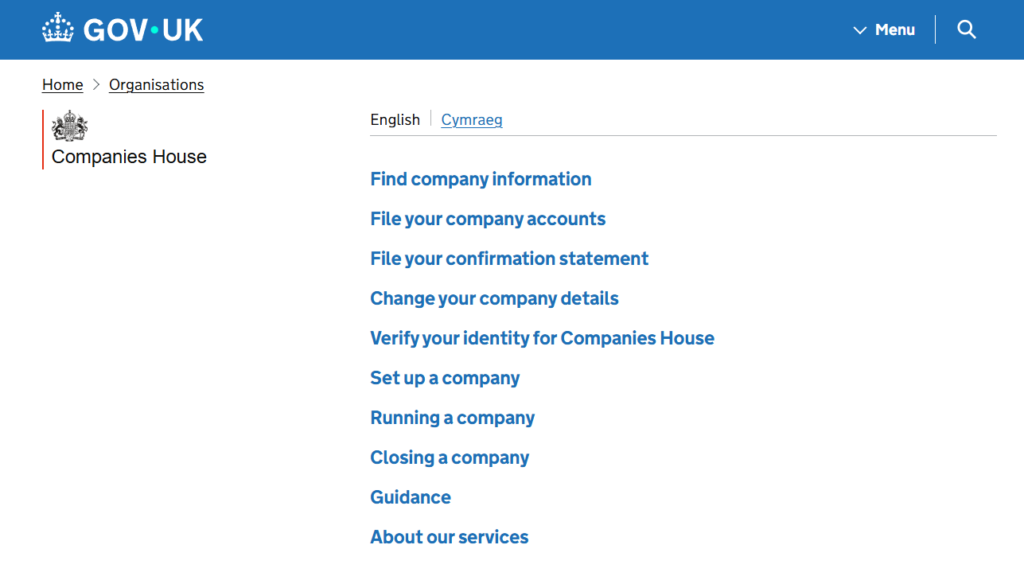
Preparing for a Companies House identity verification application is often much easier when the required information and supporting documents are organised before the process begins.
While identity verification is designed to confirm the identity of individuals connected to UK companies, many application delays occur because applicants start the process without first checking whether their documentation, personal details and company records are consistent.
This page explains what the Companies House Identity Verification Application involves, who may need to complete it, what information should be prepared in advance and what applicants commonly overlook before starting the verification process.
Whether you are a company director, Person with Significant Control (PSC), LLP member, company founder or overseas business owner, understanding the application requirements beforehand can help reduce delays and make the process more straightforward.
Need guidance before starting your application?
Audit Consulting Group can assist with document preparation, Companies House compliance support and identity verification guidance.
What Is the Companies House Identity Verification Application?
The Companies House Identity Verification Application forms part of wider corporate transparency reforms intended to improve the reliability and accuracy of information held on the Companies House register.
The objective is to verify the identity of individuals connected to UK companies and ensure that information associated with directors, Persons with Significant Control and other relevant individuals can be linked to a genuine and identifiable person.
Depending on your role, identity verification may be required before carrying out certain Companies House activities or continuing to act in a position connected with a UK company.
Although the application process itself is generally straightforward, applicants who prepare their documentation in advance typically experience fewer delays and fewer requests for additional information.
Who Needs to Complete a Companies House Identity Verification Application?
The requirement may apply to a range of individuals connected with UK companies.
You may need to complete a Companies House Identity Verification Application if you are:
- a company director;
- a newly appointed director;
- a Person with Significant Control (PSC);
- an LLP member or designated member;
- an individual incorporating a UK company;
- a beneficial owner of a UK business;
- an overseas director of a UK company;
- an authorised representative involved in certain company filings;
- an individual responsible for maintaining specific Companies House records.
The requirement is determined primarily by your relationship to the company rather than your nationality or country of residence. Overseas directors and beneficial owners may therefore still need to complete identity verification even if they have never lived in the United Kingdom.
Where a company has multiple directors or several PSCs, separate verification requirements may apply to each individual.
Why Preparation Matters Before Starting an Application
One of the most common misconceptions is that identity verification simply involves uploading a passport and waiting for approval.
In practice, many delays are caused by relatively minor issues that could have been identified before the application started. These issues often include outdated proof of address documents, differences between company records and identity documents, expired identification or supporting information that has not been updated.
Applicants who review their documents before starting the process are generally better positioned to complete verification efficiently and avoid avoidable delays.
Preparation is particularly important for overseas applicants, individuals connected with multiple companies and anyone whose personal information has changed recently.
Information You Should Prepare Before Starting
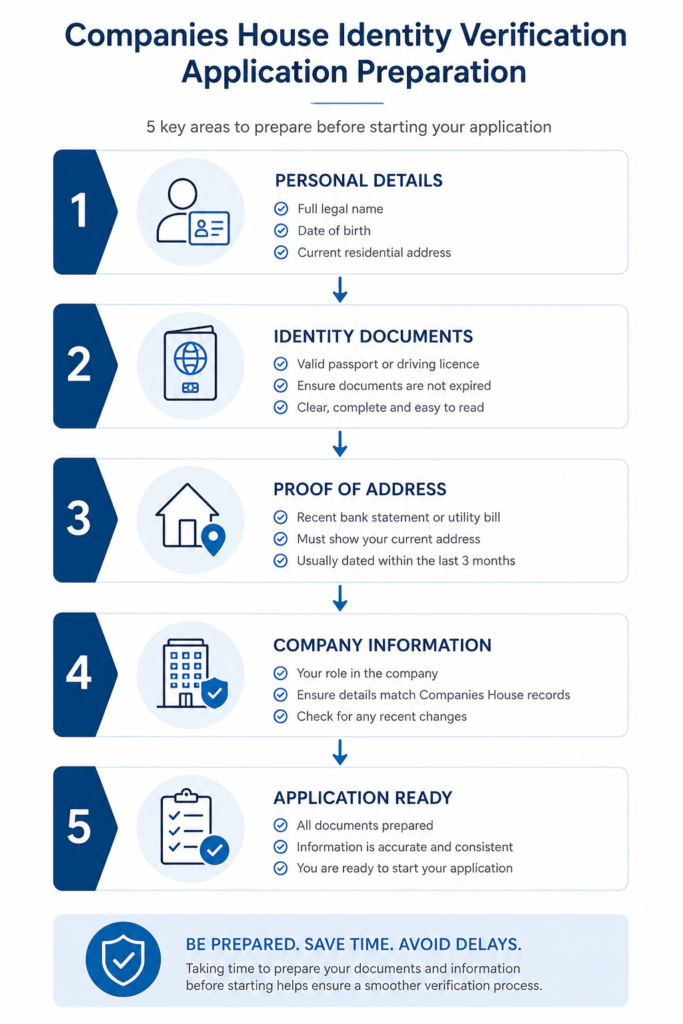
Before beginning a Companies House Identity Verification Application, it is sensible to gather the key information likely to be required during the process.
Although requirements can vary depending on the verification method used, applicants should generally be prepared to provide:
- their full legal name;
- date of birth details;
- current residential address information;
- valid identification documents;
- proof of address where required;
- details that match existing company records;
- supporting documentation for recent changes of name or address.
If you are already connected with a company, reviewing the information currently held on Companies House records before starting the application can be worthwhile. Small inconsistencies often become easier to resolve when identified early.
Applicants who have recently moved address, renewed identification documents, changed their name or updated company records should pay particular attention to consistency across all supporting information.
Information Required Before Completing the Application
Many applicants focus on the documents required for identity verification but pay less attention to the information they may need to provide during the application itself.
Before starting the process, it can be helpful to ensure you have access to:
- your full legal name exactly as shown on identity documents;
- current residential address details;
- historical information where relevant to identity verification checks;
- details connected to your role within a company;
- information associated with existing Companies House records;
- supporting documentation explaining any discrepancies.
Preparing this information in advance can help make the application process smoother and reduce the likelihood of interruptions caused by missing or inconsistent information.
For applicants involved with multiple companies, it is often worth checking that information held across different company records remains consistent before beginning verification.
Companies House Identity Verification Document Checklist
Before starting your application, it is worth reviewing your documentation carefully. Most verification issues arise not because the applicant is ineligible, but because supporting information is incomplete, outdated or inconsistent.
While the exact requirements may vary depending on the verification route used, most applicants should expect to provide evidence confirming both identity and, where applicable, residential address details.
Documents commonly used during identity verification may include:
- a valid passport;
- a valid UK driving licence;
- an international driving licence where applicable;
- proof of residential address;
- a recent bank statement;
- a utility bill showing the current address;
- supporting evidence of a name change where relevant;
- additional documentation requested during verification.
Document quality matters. Images should be clear, complete and easy to read. Cropped pages, poor lighting, blurred images or missing information are among the most common reasons applications require additional review.
Before beginning verification, applicants should ensure that documents remain valid, information is current and all supporting evidence is readily available.
Application Requirements for Company Directors
Company directors are among the groups most commonly required to complete identity verification.
Before starting an application, directors should ensure that their personal details align with information already connected to the company. Even relatively small differences can sometimes result in additional checks.
Directors should review:
- their full legal name;
- current residential address details;
- date of birth information;
- passport or driving licence validity;
- any recent changes to personal information;
- existing Companies House records where applicable.
Where a director has recently changed address, renewed identification documents or updated personal information, checking company records beforehand can help identify inconsistencies before verification begins.
Application Requirements for Persons with Significant Control (PSCs)
Persons with Significant Control (PSCs) may also need to complete identity verification depending on their relationship with the company.
Because PSCs are often connected to ownership and control structures, it is important that personal information remains accurate and consistent across relevant records.
Before applying, PSCs should consider:
- whether ownership information remains accurate;
- whether identity documents remain valid;
- whether company records reflect current personal details;
- whether supporting evidence is available where required;
- whether information is consistent across multiple companies if applicable.
Individuals connected to several companies may find it useful to review how their details appear across each organisation before beginning the verification process.
Application Requirements for LLP Members
Members and designated members of Limited Liability Partnerships may also be required to complete identity verification depending on their position and responsibilities.
Although the core verification principles are similar to those that apply to company directors, LLP members should ensure that the information used during verification accurately reflects the records associated with the LLP.
Before starting an application, LLP members should review:
- personal identification documents;
- current address information;
- their recorded role within the LLP;
- recent updates to personal information;
- supporting evidence where appropriate.
Where changes have occurred recently, addressing inconsistencies before starting the application is often considerably easier than resolving them later.
Application Requirements for Overseas Applicants
Overseas directors, beneficial owners and PSCs connected to UK companies may also need to complete identity verification.
Although the overall objective remains the same, overseas applicants often face additional practical challenges because documentation issued outside the UK may follow different formats, naming conventions and address structures.
Before beginning an application, overseas applicants should review:
- passport validity;
- proof of address documentation;
- name consistency across documents;
- whether supporting evidence may be required;
- whether company records reflect current personal details.
One of the most common causes of delays for overseas applicants involves differences between information shown on identity documents and information recorded on company records. These differences may be relatively minor but can still result in additional review.
Careful preparation before starting the application process often reduces delays and helps avoid requests for further information.
When Additional Supporting Documents May Be Required
Some applicants may need to provide additional supporting evidence beyond standard identity and address documentation.
This may be relevant where:
- a name has changed following marriage or another legal process;
- multiple versions of a name appear across records;
- an address has changed recently;
- historic company information differs from current documentation;
- additional evidence is required to explain inconsistencies.
Providing supporting evidence early often helps avoid unnecessary delays and reduces the likelihood of requests for clarification later in the verification process.
Preparing for a Smoother Verification Experience
A useful approach before beginning identity verification is to review all supporting documents together and ask a simple question:
Do all of these documents clearly identify the same individual using consistent information?
If the answer is yes, the application process is usually much more straightforward. If inconsistencies exist, identifying them before submission often saves time and reduces frustration later.
For many applicants, the most effective preparation step is not gathering more documents but ensuring that the documents already available are accurate, current and consistent.
Common Reasons Companies House Identity Verification Applications Are Delayed
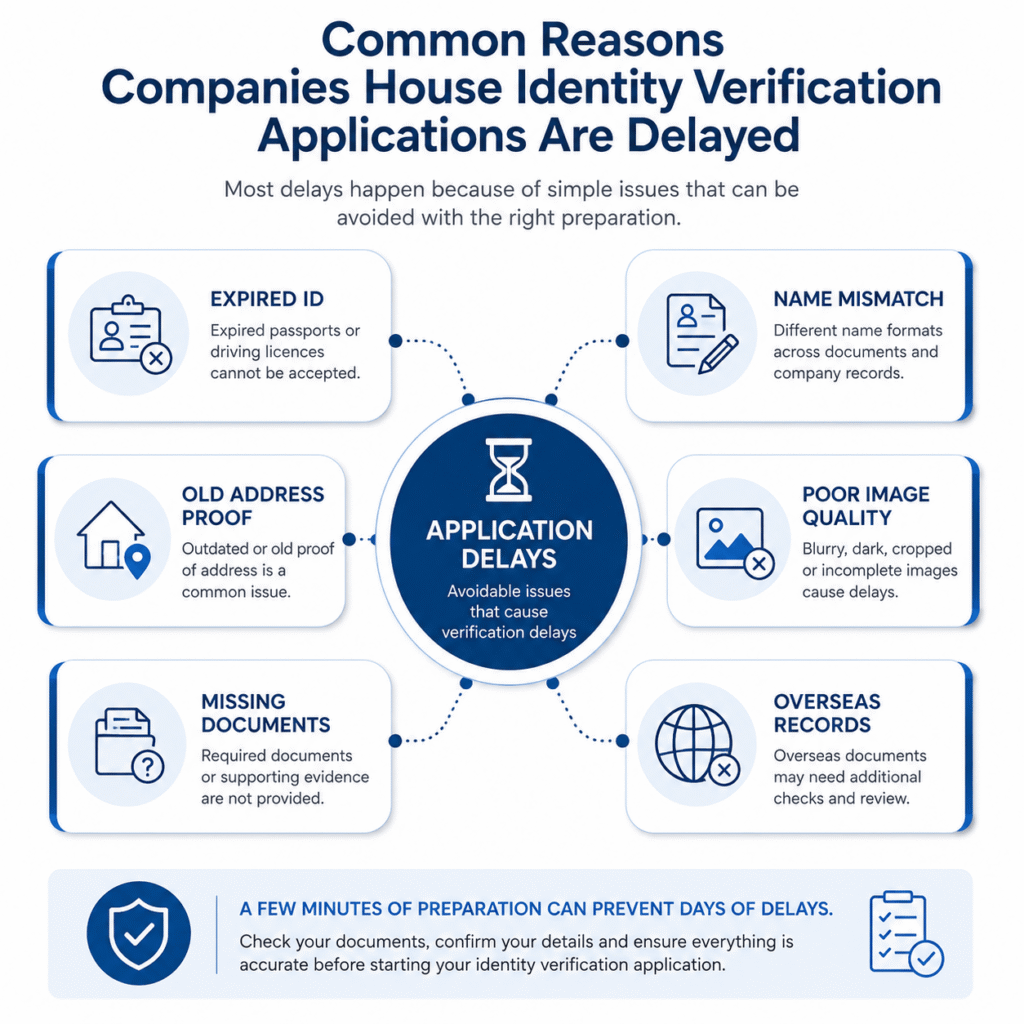
Most verification delays occur because of documentation or information issues rather than eligibility concerns.
In many cases, the applicant is fully entitled to complete identity verification, but the application requires additional review because supporting information is incomplete, inconsistent or difficult to verify.
Some of the most common reasons applications are delayed include:
- expired passports or driving licences;
- outdated proof of address documents;
- poor-quality document images;
- cropped or incomplete documents;
- different name formats across records;
- recent address changes not reflected consistently;
- missing supporting evidence;
- failed biometric checks;
- overseas documentation requiring additional review.
Many of these issues can be identified before the application process begins. A short review of documentation and company records often prevents significantly longer delays later.
What Information May Be Requested During Verification?
Applicants often focus on identity documents but underestimate the importance of the supporting information that may be requested during the verification process.
Although requirements may vary depending on the verification route used, applicants should generally be prepared to confirm information such as:
- full legal name;
- date of birth;
- current residential address;
- previous address information where relevant;
- details associated with a company role;
- information connected to existing Companies House records;
- supporting evidence explaining discrepancies.
Having this information readily available before starting verification can make the process considerably smoother and reduce the likelihood of delays caused by missing information.
Applicants connected to multiple companies should pay particular attention to consistency across different records, especially where company information has been updated at different times.
Application Preparation Checklist
Before beginning a Companies House Identity Verification Application, it is often worth carrying out a final review.
A few minutes spent checking information beforehand can help avoid requests for clarification and reduce the likelihood of delays.
- Confirm that your identity documents remain valid.
- Check that names appear consistently across all documents.
- Review your current residential address information.
- Ensure proof of address documentation is up to date.
- Check that document images are clear and readable.
- Prepare evidence supporting any recent name changes.
- Review existing Companies House records where applicable.
- Gather additional supporting documents if inconsistencies exist.
- Check that personal details match company records.
- Ensure all documents are readily available before starting verification.
This checklist will not guarantee a particular outcome, but it can help reduce avoidable problems that commonly delay applications.
Identity Verification and Wider Companies House Responsibilities
Identity verification should not be viewed as a standalone requirement.
For directors, PSCs and LLP members, it forms part of a broader Companies House compliance framework that includes maintaining accurate company records and ensuring that statutory information remains up to date.
Successful verification confirms identity, but it does not replace wider responsibilities associated with running or managing a UK company.
Individuals connected to UK companies should continue to ensure that information recorded at Companies House remains accurate and that future changes are reported where required.
What Happens After Identity Verification?
Once identity verification has been completed, individuals should continue to monitor and maintain the accuracy of information connected to their company records.
Depending on the circumstances, future responsibilities may still include:
- updating director information when changes occur;
- maintaining accurate PSC records;
- submitting a Confirmation Statement when required;
- ensuring company records remain accurate and current;
- meeting ongoing Companies House obligations;
- filing Annual Accounts where applicable;
- meeting relevant Corporation Tax responsibilities.
Identity verification helps strengthen transparency and accuracy, but maintaining compliant company records remains an ongoing responsibility.
Frequently Asked Questions
Do all company directors need to complete identity verification?
Requirements depend on the applicable Companies House rules and an individual’s relationship with the company. Directors should review current requirements to determine whether identity verification applies to them.
Can overseas directors complete a Companies House Identity Verification Application?
Yes. Overseas directors and beneficial owners connected to UK companies may still be required to complete identity verification, even if they do not live in the United Kingdom.
What documents are usually required?
Most applicants will need valid identity documents and, in some circumstances, proof of address. Additional supporting evidence may also be required where information differs across records.
What if my documents contain different versions of my name?
Differences between documents and company records may require additional review or supporting evidence. It is generally advisable to identify these issues before beginning the application process.
Can proof of address documents cause delays?
Yes. Outdated, incomplete or unclear proof of address documentation is one of the more common reasons applications require additional review.
What happens if information does not match Companies House records?
Inconsistencies do not necessarily prevent identity verification, but they may lead to additional checks or requests for clarification.
Does identity verification replace other Companies House obligations?
No. Directors, PSCs and other company officers remain responsible for maintaining accurate company records and meeting ongoing Companies House requirements.
Need Help Preparing Your Companies House Identity Verification Application?
Many applicants are able to complete the verification process without difficulty once the required information and supporting documents have been prepared correctly.
However, uncertainty often arises where company records do not match identity documents, proof of address information has changed recently, overseas documentation is involved or supporting evidence is required to explain discrepancies.
Preparing these issues in advance can help reduce delays and make the verification process more straightforward.
Audit Consulting Group provides practical guidance for directors, Persons with Significant Control, LLP members, company founders and overseas applicants who need support understanding Companies House identity verification requirements.
Our team can assist with:
- reviewing application requirements;
- checking supporting documentation;
- identifying potential inconsistencies before submission;
- guidance on identity and address evidence;
- Companies House compliance support;
- related company administration requirements.
If you are preparing to complete a Companies House Identity Verification Application and would like guidance before starting, our team will be happy to assist.
Speak with Audit Consulting Group today.
+44 7386 212550
info@auditconsultinggroup.co.uk
Service Cost Estimation
Select the service category below to calculate the estimated cost of either accounting & tax services or forms and submissions.
Select Required Services / Forms
Select one or more services/forms to receive an accurate cost estimate. You can adjust your selection at any stage.
How would you like to engage our services?
Please select whether you require a one-off service or ongoing monthly support.
Contract Duration
Your cost estimate
Apply now and get 10% OFF
Submit your request today and receive an exclusive 10% discount on your selected service.
All prices are estimates. To receive a personalised quote, please fill out the form or contact us.
Ready to get started?
Get professional support from experienced UK accountants