
Construction Bookkeeping Services for UK Contractors, Builders & Construction Companies
Leave your details and our team will get back to you shortly.
Running a construction business becomes financially complicated much faster than most owners expect.
At the beginning, many contractors manage with spreadsheets, basic bookkeeping software or a mixture of invoices, receipts and bank statements handled internally. That may work while projects are smaller and the business is relatively straightforward. The problems usually begin once several sites, subcontractors, payroll obligations and VAT deadlines start overlapping at the same time.
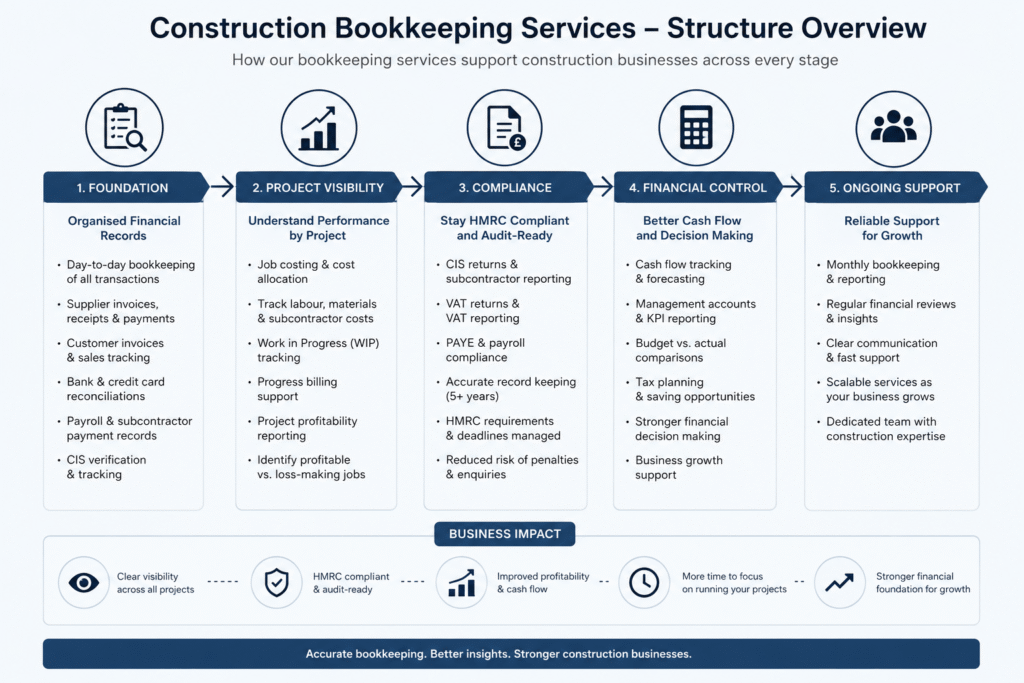
At Audit Consulting Group, we provide specialist construction bookkeeping services for UK contractors, builders, developers and growing construction companies that need more than basic bookkeeping support. Our systems are designed to help construction businesses improve financial visibility, maintain HMRC compliance and understand what is actually happening financially across their projects.
Many of the construction firms we work with are not failing businesses. In fact, they are often growing quickly. The challenge is that financial systems have not evolved at the same pace as the business itself. Directors start losing visibility over project profitability, supplier liabilities, CIS deductions, VAT exposure and future cash flow because the internal processes that once worked are no longer capable of handling the complexity of the operation.
Why Construction Bookkeeping Is Different From Standard Bookkeeping
Construction finances rarely move in a clean, predictable way.
A retail business may sell products daily with relatively stable reporting cycles. Construction businesses operate very differently. Revenue can arrive in stages, retention payments may remain outstanding for months and labour expenses can fluctuate dramatically across multiple projects. One delayed customer payment can affect payroll, suppliers and subcontractor obligations almost immediately.
This is why proper bookkeeping for construction companies requires much more than recording transactions. A reliable bookkeeping system must help directors understand project profitability, cash flow exposure, supplier liabilities, VAT obligations and subcontractor costs in real operational terms.
Without that visibility, many construction businesses end up making important decisions based purely on bank balances rather than accurate financial reporting.
Who Our Construction Bookkeeping Services Are Designed For
We support a wide range of construction businesses across the UK, from sole contractors and subcontractors through to larger multi-site construction companies.
Some clients come to us because bookkeeping has fallen behind after rapid growth. Others are dealing with inconsistent reporting, CIS administration problems or poor visibility over project profitability. In many cases, the business itself is performing well operationally, but the financial systems behind it have not kept pace with the growth of the company.
Our clients include building contractors, roofing firms, developers, electrical contractors, plumbing companies, groundworks businesses and construction firms managing multiple active projects simultaneously.
Common Financial and HMRC Problems Construction Businesses Face
One of the biggest misconceptions in construction is assuming that turnover growth automatically means stronger finances.
In reality, many construction businesses become less financially stable as they grow because reporting structures become increasingly fragmented. We regularly see situations where profitable projects are quietly losing margin because labour allocation, supplier invoices or subcontractor costs are not being tracked accurately enough.
Cash flow pressure is another major challenge. Construction businesses often need to cover payroll, subcontractors and suppliers weeks before receiving staged payments from clients. Without reliable bookkeeping and forecasting, directors can quickly lose visibility over future liabilities and VAT exposure.
CIS compliance also creates significant pressure for many firms. Subcontractor verification, deduction tracking and monthly reporting obligations become difficult to manage once the volume of projects and subcontractors increases.
Construction Industry Scheme (CIS) Compliance
Construction businesses operating in the UK must comply with the HMRC Construction Industry Scheme (CIS), which governs how contractors manage payments to subcontractors.
In practice, CIS reporting often becomes disorganised when businesses scale quickly. New subcontractors may be added without proper verification, payroll and bookkeeping records stop aligning correctly and deduction reporting becomes inconsistent between systems.
Our construction bookkeeping services help contractors maintain clearer CIS processes through structured bookkeeping, subcontractor payment reconciliation and organised reporting systems that support ongoing HMRC compliance.
Job Costing and Project Profitability
 One of the biggest differences between ordinary bookkeeping and professional construction bookkeeping is project-level financial visibility.
Many contractors know the total turnover of the business but still struggle to identify which projects are genuinely producing healthy margins. That usually happens because labour, materials, subcontractor expenses and equipment costs are not being allocated accurately between projects.
Our bookkeeping systems help construction businesses monitor financial performance across individual jobs so directors can understand where profitability is improving, where margins are being lost and which projects are creating the strongest financial returns.
This type of visibility becomes increasingly important once construction companies begin managing several active projects simultaneously.
Bookkeeping for Contractors and Construction Companies
Different construction businesses require different levels of bookkeeping support.
A sole contractor may simply need organised bookkeeping, CIS tracking and clearer reporting. A larger construction company operating several projects at once often requires more advanced financial structures involving payroll integration, management reporting, forecasting and project profitability analysis.
We tailor our support around how the business actually operates rather than applying identical bookkeeping processes to every client.
For many firms, one of the biggest improvements comes from moving away from reactive bookkeeping and towards a structured financial reporting environment where directors can review reliable numbers regularly instead of trying to rebuild financial visibility retrospectively.
When Construction Businesses Outgrow Spreadsheets
Spreadsheets themselves are not necessarily the problem. Many successful construction businesses begin that way.
The issue appears once projects, subcontractors and reporting obligations increase beyond the point where manual systems remain reliable. We regularly see situations where financial records exist across several different spreadsheets maintained by different staff members, creating inconsistencies, duplication and reporting delays.
At that stage, project profitability becomes difficult to measure accurately in real time, VAT calculations rely heavily on manual adjustments and subcontractor reconciliation starts becoming increasingly time-consuming.
This is usually the point where construction businesses benefit from moving towards more structured cloud bookkeeping systems with integrated reporting and automated financial workflows.
Construction Bookkeeping Software We Support
 We work with cloud accounting platforms including Xero, QuickBooks Online and FreeAgent, alongside construction-focused systems such as Tradify, SimPRO, Buildertrend and Fonn.
However, software alone does not solve reporting problems.
One of the most common issues we see is businesses using accounting software that has never been structured properly for construction-specific reporting. Financial data technically exists inside the system, but directors still cannot clearly understand project profitability, future cash flow exposure or subcontractor liabilities.
We help businesses structure these systems properly so financial reporting becomes genuinely useful operationally rather than existing purely for compliance purposes.
Typical Fees and Construction Bookkeeping Pricing Expectations
The cost of construction bookkeeping services depends heavily on how the business operates internally.
A contractor managing one or two projects with a relatively small transaction volume will naturally require a very different bookkeeping structure compared to a larger construction company operating multiple active sites, payroll systems and complex CIS reporting simultaneously.
Pricing is usually influenced by factors such as project volume, subcontractor activity, payroll complexity, reporting requirements and the condition of the existing bookkeeping records.
Some businesses simply need ongoing monthly bookkeeping support. Others require more advanced reporting structures involving project profitability analysis, forecasting, management accounts and financial cleanup work after periods of rapid growth or disorganised bookkeeping internally.
Because construction businesses vary significantly operationally, we provide tailored quotes based on the real structure of the business rather than generic bookkeeping packages.
How Our Construction Bookkeeping Process Works
Most construction businesses approach us once bookkeeping and reporting have started becoming difficult to manage internally.
In many cases, the company has grown gradually over several years without formal financial systems evolving alongside the operational side of the business. Directors often reach the point where bookkeeping becomes reactive rather than controlled, reporting visibility weakens and financial decisions start relying too heavily on assumptions instead of accurate reporting.
Our process normally begins with a detailed discussion about how the business currently manages bookkeeping, CIS reporting, payroll, invoicing and project tracking.
We then review the existing systems, identify where reporting issues are developing and build a more structured bookkeeping workflow around how the business actually operates day-to-day.
Depending on the situation, this may involve bookkeeping reconciliation, CIS restructuring, cloud accounting setup, project-level reporting implementation or improving the relationship between payroll, bookkeeping and management reporting.
The objective is not simply to maintain bookkeeping records. It is to create a financial reporting structure that supports clearer operational control as the business continues growing.
Documents and Information We Typically Require
The exact documentation required depends on the complexity of the business and the level of support involved.
Most construction bookkeeping projects involve reviewing bank statements, supplier invoices, sales invoices, subcontractor payment records, CIS information, payroll data and existing accounting software where applicable.
If project-level reporting already exists, we also review job costing information and operational reporting structures to understand how financial visibility is currently being managed internally.
Importantly, bookkeeping records do not need to be perfectly organised before approaching us. Many construction businesses come to us during periods of rapid growth or after internal reporting has already become difficult to manage. Part of our role is helping businesses restore structure and clarity where financial records have become fragmented over time.
Who Works on Your Construction Bookkeeping
Construction bookkeeping often requires coordination across several financial areas rather than a single generic administrator handling everything independently.
Depending on the structure of the business, support may involve bookkeeping specialists, CIS reporting support, payroll coordination, VAT oversight and accountant review where required.
Our team understands the operational realities construction businesses face, including staged payments, subcontractor-heavy operations, fluctuating project costs and multi-site reporting complexity.
That practical understanding becomes particularly important when bookkeeping records are being used to support real business decisions rather than simply satisfy compliance obligations.
What Construction Businesses Often Underestimate
Many construction firms underestimate how quickly weak bookkeeping starts affecting wider business performance.
The consequences are rarely limited to compliance alone.
Poor reporting visibility can affect project pricing, hiring decisions, supplier relationships, VAT forecasting, tender confidence and overall business planning. In some cases, businesses continue growing operationally while financial control quietly weakens underneath the surface.
We regularly see directors relying on turnover growth as a sign of financial health while project profitability is gradually becoming less consistent due to weak reporting structures and delayed financial visibility.
By the time these issues become obvious, financial cleanup is often far more time-consuming than if proper bookkeeping systems had been introduced earlier.
Real Client Examples
Roofing Contractor – Manchester
A roofing contractor managing several concurrent projects was relying heavily on spreadsheets and delayed supplier reconciliation. VAT deadlines were becoming increasingly stressful and project profitability was largely estimated rather than measured properly.
After implementing our cloud-based construction bookkeeping services, the business gained significantly clearer visibility over supplier costs, VAT obligations and project-level reporting.
Result: cash flow improved by approximately 30%, VAT submissions became more controlled and future project pricing became more accurate.
Construction Firm – Surrey
A construction company operating four active sites simultaneously struggled to understand which projects were genuinely profitable because reporting was inconsistent between payroll, bookkeeping and subcontractor records.
We implemented structured project tracking, CIS integration and management reporting across all sites.
Outcome: directors gained much stronger financial visibility, internal administration reduced substantially and reporting confidence improved during commercial tenders.
Electrical Contractor – Liverpool
An electrical contractor dealing with large volumes of receipts and subcontractor paperwork needed a more organised bookkeeping process without expanding internal admin staffing.
We introduced mobile document capture, weekly reconciliation processes and clearer reporting structures.
Result: bookkeeping became significantly more organised while reducing administrative pressure internally.
Financial Reporting for Construction Businesses
Good bookkeeping should provide practical operational insight, not simply satisfy compliance requirements.
Our reporting structures help construction businesses monitor project profitability, supplier liabilities, subcontractor exposure, cash flow pressure and overall financial performance more consistently.
Depending on the structure of the business, reporting may include management accounts, forecasting, project profitability analysis, work-in-progress reporting and director-level financial summaries designed to support operational decision-making more effectively.
The aim is to help business owners identify financial issues before they escalate rather than after profitability has already been affected.
Communication and Ongoing Reporting Support
One of the biggest frustrations many construction business owners experience with bookkeeping providers is delayed communication and poor reporting visibility.
Financial reports lose much of their value if directors only receive them long after operational decisions have already been made.
Our approach focuses on maintaining clearer communication and more consistent reporting processes so clients have better visibility over project profitability, VAT exposure, subcontractor liabilities and overall financial performance throughout the year.
We also understand that many business owners prefer straightforward financial explanations rather than technical accounting language. Reporting discussions therefore focus on helping directors understand what the numbers actually mean operationally for the business rather than simply presenting raw financial data.
Construction Financial Record Requirements in the UK
Construction businesses must maintain accurate accounting records in accordance with HMRC regulations.
This includes maintaining documentation relating to project expenses, supplier invoices, subcontractor payments, payroll records, VAT transactions and CIS deductions.
HMRC generally requires businesses to retain accounting records for at least five years after the relevant Self Assessment deadline.
Accurate bookkeeping not only supports compliance but also reduces stress during HMRC reviews, VAT inspections or CIS investigations.
Why Construction Businesses Choose Audit Consulting Group
Construction businesses often choose us because we understand the operational realities behind construction finance rather than approaching bookkeeping as generic admin work.
Our team works with contractors dealing with project-based cash flow pressure, subcontractor-heavy operations, CIS complexity and multi-site reporting challenges.
Clients value having access to structured bookkeeping systems, responsive communication and financial reporting that is genuinely useful operationally instead of simply being produced for compliance reasons.
FAQ: Bookkeeping for Construction Companies
Do you handle CIS returns?
Yes. We assist with subcontractor verification, CIS deductions, monthly returns and CIS reporting support.
Can you track profitability by project?
Yes. We help construction businesses implement project-level reporting so directors can monitor margins and financial performance more accurately.
Do you support Xero and QuickBooks?
Absolutely. We work with Xero, QuickBooks Online and various construction-focused integrations.
Can you help if bookkeeping is behind?
Yes. Many construction firms approach us after periods of rapid growth or inconsistent internal bookkeeping processes. We can help organise, reconcile and rebuild financial records where required.
Do you only work with larger construction companies?
No. We support sole contractors, subcontractors, SMEs and larger construction firms across the UK.
Ready to Improve Your Construction Financial Systems?
Strong construction businesses need reliable financial systems behind the operational side of the company.
At Audit Consulting Group, we help contractors and construction companies build clearer bookkeeping structures, improve project reporting, maintain HMRC compliance and gain better visibility over profitability and cash flow.
Whether you need bookkeeping for contractors, ongoing construction bookkeeping services, CIS support, project profitability reporting or help transitioning away from unreliable spreadsheets, our team is ready to support your business.
Contact Audit Consulting Group to discuss your bookkeeping requirements and build a stronger financial foundation for your construction business.
Construction Bookkeeping Services Cost Estimation
Estimate construction bookkeeping costs with a calculator designed for contractors and construction companies. This construction accounting pricing tool considers job costing, subcontractor payments, payroll bookkeeping, and project-based accounting. Understand the real cost of construction bookkeeping services before outsourcing.
Content reviewed for financial accuracy and construction accounting compliance.
Author:
Iryna Shmulenko
Chief Executive Officer – Audit Consulting Group
Iryna specialises in accounting compliance, construction industry bookkeeping, and financial reporting systems for UK businesses. Her team supports contractors, developers, and construction firms with structured financial management and HMRC-compliant bookkeeping solutions.
Official sources:
Service Cost Estimation
Select the service category below to calculate the estimated cost of either accounting & tax services or forms and submissions.
Select Required Services / Forms
Select one or more services/forms to receive an accurate cost estimate. You can adjust your selection at any stage.
How would you like to engage our services?
Please select whether you require a one-off service or ongoing monthly support.
Contract Duration
Your cost estimate
Apply now and get 10% OFF
Submit your request today and receive an exclusive 10% discount on your selected service.
All prices are estimates. To receive a personalised quote, please fill out the form or contact us.
Ready to get started?
Get professional support from experienced UK accountants