
HMRC SA300 Form – Self Assessment Statement of Account Explained
Leave your details and our team will get back to you shortly.
The SA300 HMRC form, often searched for as the SA300 form, is a Self Assessment Statement of Account issued by HM Revenue & Customs. It records activity on your Self Assessment account, including tax charges, payments and credits, amounts becoming due and the resulting balance.
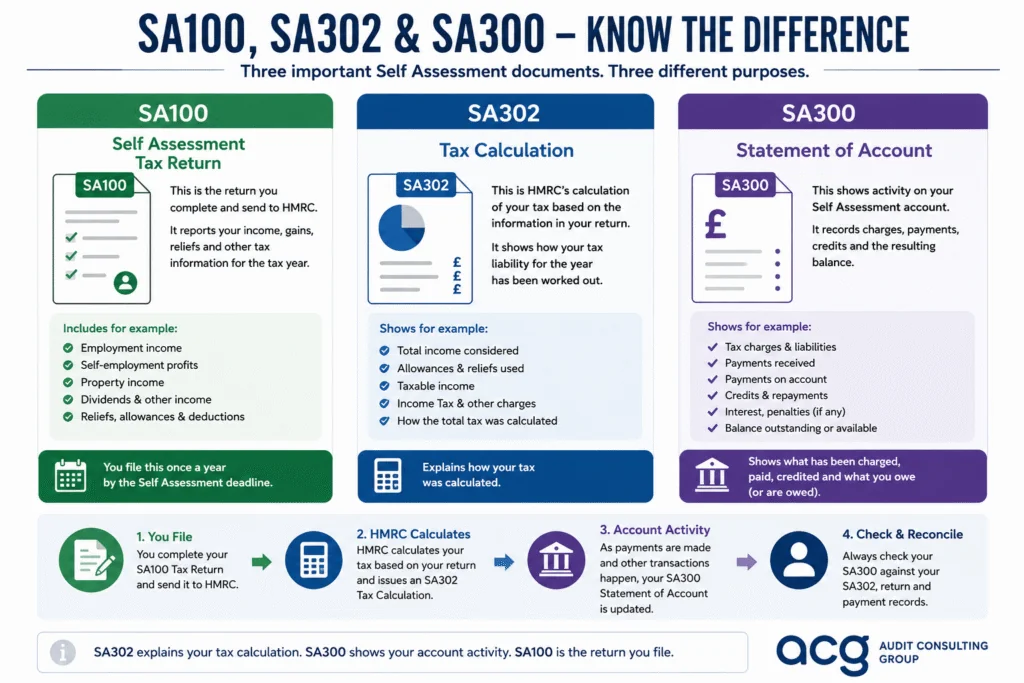
The HMRC SA300 is different from an SA302 Tax Calculation. An SA302 explains how your Self Assessment tax liability has been calculated. An SA300 shows what has been charged to your account, what HMRC has received or credited and what remains outstanding or available as a credit.
If the balance on your SA300 does not match your records, a payment appears to be missing, or you are unsure why HMRC says an amount is due, the statement should be checked alongside your tax return, tax calculation, payment records and relevant HMRC correspondence.
Official HMRC Self Assessment guidance
What Is an HMRC SA300 Form?
The SA300 HMRC document is a Statement of Account rather than a tax return that you complete and submit. It reflects transactions recorded on your Self Assessment account and helps you see how HMRC has arrived at the current balance.
Although people commonly search for an SA300 tax form, its purpose is not to calculate your taxable income. Depending on activity on the account, an SA300 may show:
- Self Assessment tax charges;
- payments received by HMRC;
- payments on account;
- balancing payments;
- credits or repayments;
- interest and penalties where applicable;
- amounts currently outstanding;
- amounts becoming due and relevant payment dates.
For wider support with returns and Self Assessment matters, see our Personal Tax & Self Assessment service.
SA300 vs SA302 – What Is the Difference?
The distinction between SA300 and SA302 matters because they answer different questions.
SA300 – Statement of Account
The HMRC SA300 records transactions on your Self Assessment account. It can show liabilities charged to the account, payments received, payments on account, credits, interest, penalties and the resulting balance.
SA302 – Tax Calculation
The SA302 is a Tax Calculation. It provides a breakdown of how the tax liability has been calculated from the information reported through Self Assessment.
In practical terms, if you want to understand how your tax was calculated, the SA302 and underlying return are relevant. If the calculation appears correct but the amount showing on your HMRC account does not, the SA300 and account transactions need to be checked.
SA300, SA100 and SA302 – Understanding the Documents
Self Assessment involves several documents that serve different purposes:
- SA100 – the main Self Assessment Tax Return used to report relevant income, gains, reliefs and other tax information;
- SA302 – the Tax Calculation showing how the Self Assessment tax liability has been calculated;
- SA300 – the Statement of Account recording charges, payments, credits and the resulting balance.
Where partnership income is involved, the partnership normally has its own Partnership Tax Return obligations, while individual partners report their share of partnership income through their own Self Assessment where required. The SA300 form should not be confused with a Partnership Tax Return or partnership tax calculation notes.
When Might You Receive an SA300 HMRC Statement?
An SA300 HMRC statement may be generated as activity takes place on your Self Assessment account. For example, you may need to review your account when a tax liability or payment on account becomes due, after making a payment, following an amendment or HMRC adjustment, or when interest, penalties, credits or repayments affect the balance.
The timing of an SA300 should not be confused with the Self Assessment filing deadline. What matters is the activity recorded on the account and the due dates attached to the relevant liabilities.
You can access HMRC online services through HMRC online services.
Where Can You Find Your SA300?
If you manage Self Assessment online, relevant account information can be viewed through your HMRC online account. This allows you to check balances, payments and amounts becoming due without relying solely on a paper statement.
If HMRC has issued an HMRC SA300 by post, keep it with your Self Assessment records. Where there is a discrepancy, compare it with your tax return, tax calculation, payment confirmations and subsequent HMRC correspondence rather than looking at the statement in isolation.
Can You Download an SA300 Form PDF?
People searching for an SA300 form PDF sometimes expect a blank form that can be downloaded, completed and sent to HMRC. That is not the normal purpose of SA300.
The SA300 is a Statement of Account produced in connection with your Self Assessment account. If you need to establish your current position, check the information available through your HMRC online account and any statements or correspondence HMRC has issued to you.
Understanding Your SA300 Statement of Account
The balance alone may not explain why HMRC says a particular amount is due. The transactions behind that balance need to be considered together.
Tax Due
Your account can show Self Assessment liabilities arising from your tax position. If you need to understand how the underlying liability was calculated, review the relevant tax return and tax calculation rather than relying on the SA300 alone.
Payments Already Made
Payments received and correctly allocated by HMRC should be reflected on the account. If you have paid HMRC but the balance has not changed as expected, check the payment date, amount and reference before assuming the tax return itself is wrong.
Payments on Account
Payments on account are advance payments towards a future Self Assessment tax bill. They are a common reason why an amount becoming due can be higher than a taxpayer expected.
Depending on your circumstances, a January payment can include both a balancing payment for the previous tax year and the first payment on account towards the next tax year. A second payment on account may then become due later in the year.
Interest and Penalties
Interest or penalties added to the account should be distinguished from the underlying tax liability. If you believe a penalty has been charged incorrectly or you have grounds to challenge it, our Appeal Against Penalties service may be relevant.
Credits and Repayments
A Self Assessment account can also contain credits arising from payments, adjustments or repayments. A credit does not necessarily mean that the full amount is immediately repayable, particularly where it is being held or allocated against another amount becoming due.
Example of an SA300 HMRC Statement
Imagine a self-employed taxpayer has a Self Assessment position showing tax due of £4,500. HMRC has already recorded £3,000 in payments against the account, leaving £1,500 outstanding.
The SA300 HMRC statement may therefore show the £4,500 charge, the £3,000 already paid or credited and the £1,500 remaining balance, together with the relevant payment date.
The statement tells you what is recorded on the account. If you need to understand how the £4,500 liability itself was calculated, the underlying Self Assessment return and tax calculation should also be reviewed.
Common Issues with the SA300 HMRC
An unexpected SA300 balance does not automatically mean HMRC has calculated your tax incorrectly. The difference may relate to how payments, credits or other transactions have been recorded on the account.
Common issues include:
- misunderstanding payments on account;
- a payment not appearing or not being allocated as expected;
- using an incorrect payment reference;
- confusing the tax calculation with the account balance;
- an amended return changing the liability;
- interest or penalties increasing the amount outstanding;
- a credit being allocated against another amount due;
- HMRC records not matching the taxpayer’s payment history.
Payment Made but Not Showing on Your SA300
If you have paid HMRC but the payment does not appear to be reflected in your Self Assessment balance, check the payment before changing anything on the tax return.
Review the date the payment left your account, the amount paid, the payment method, the reference used and your bank or card confirmation. These details can then be compared with the transactions showing in your HMRC Self Assessment account.
A payment allocation problem and an incorrect tax return are different issues. Amending a correct return will not normally resolve a payment that has been incorrectly referenced or allocated.
What to Do if Your SA300 Is Wrong
If the HMRC SA300 does not match what you expect, first establish whether the discrepancy relates to the underlying tax liability or to activity on the Self Assessment account.
- Compare the statement with the relevant Self Assessment return and tax calculation.
- Check balancing payments and payments on account.
- Match payments recorded by HMRC against your payment confirmations.
- Review interest, penalties, credits, repayments and adjustments.
- Check whether the return was amended or HMRC subsequently changed the account.
- Contact HMRC if an entry cannot be reconciled or appears incorrect.
If the underlying tax return itself contains an error, it may need to be amended subject to the applicable Self Assessment rules and time limits. Do not amend a return solely because an account payment appears to be missing.
How Audit Consulting Group Can Help with SA300 Issues
Audit Consulting Group can help when you are unsure why an SA300 form shows a particular balance or when your HMRC account does not reconcile with your own records.
The first step is usually to establish what HMRC has recorded and compare it with the underlying documents. Depending on the issue, our work can include reviewing the SA300 or online Self Assessment statement, checking the relevant tax return and calculation, reconciling payments, reviewing payments on account and identifying interest, penalties, credits or other entries affecting the balance.
Where authorised and within the agreed scope, we can also assist with HMRC correspondence and help determine whether the issue relates to the account itself or whether the underlying tax return requires attention.
If the issue concerns preparation or correction of the return, our Tax Return service may also be relevant.
Practical SA300 Scenarios
A Larger January Bill Than Expected
A self-employed taxpayer expects to pay only the remaining tax for the previous year but sees a larger amount becoming due. The account also includes a first payment on account towards the following tax year.
Reviewing the statement alongside the tax calculation separates the balancing payment from the advance payment. This explains why the amount payable can be higher than the taxpayer initially expected without indicating an error in the underlying return.
A Payment Does Not Appear as Expected
A taxpayer has evidence that a payment was made, but the Self Assessment balance remains higher than expected. Before considering an amendment to the return, the payment date, amount and reference should be compared with the transactions recorded by HMRC.
This helps identify whether the problem relates to payment allocation rather than the tax calculation.
An Amended Return Changes the Account
A Self Assessment return is amended after the original submission. The revised liability changes the charges recorded on the account, so the previous statement no longer reflects the latest position.
In this situation, the updated calculation, account transactions and payments need to be considered together to establish the revised amount due or credit position.
What Taxpayers Often Underestimate About SA300
The figure shown as outstanding is the result of activity on the Self Assessment account. It is not simply a repeat of one figure from the tax return.
Tax charges, payments on account, payments received, amendments, interest, penalties and credits can all affect the balance. This is why comparing an SA300 only with the amount you remember from your return may not explain a difference.
It is also important to identify the cause before taking corrective action. A payment allocation problem may require a different approach from an incorrect tax calculation, and an amended return may change both the liability and the account balance.
SA300 and Proof of Income
An SA300 is primarily a Statement of Account and should not automatically be treated as proof of income.
If you need evidence for a mortgage, loan or another financial application, the organisation requesting the documents may instead ask for an SA302 Tax Calculation and supporting HMRC tax-year information. Requirements can differ between lenders and other organisations, so check exactly which documents they require.
FAQ – HMRC SA300 Form
What is an SA300 form?
The SA300 form is commonly used to refer to HMRC’s Self Assessment Statement of Account. It records charges, payments, credits and the resulting account balance rather than being a tax return for you to complete.
Is SA300 the same as SA302?
No. The SA300 is a Statement of Account, while the SA302 is a Tax Calculation. The SA302 explains how the tax liability was calculated; the SA300 shows activity and the resulting balance on the Self Assessment account.
Can I download an SA300 form PDF?
The SA300 is not normally a blank form that taxpayers download, complete and submit. If you are looking for an SA300 form PDF, first check your HMRC Self Assessment account and the statements or documents HMRC has issued to you.
Where can I find my SA300?
Relevant Self Assessment account information can be available through your HMRC online account. If HMRC has issued a paper statement, keep it with your tax records.
Does everyone receive a paper SA300?
Not necessarily. Taxpayers who manage Self Assessment online can access relevant account balances and transaction information through HMRC’s digital services.
Why does my SA300 show payments on account?
Payments on account are advance payments towards a future Self Assessment tax bill. Where they apply, they can appear alongside a balancing payment and increase the total amount becoming due.
What if a payment is missing from my SA300?
Check the payment date, amount, reference and payment confirmation against the transactions recorded by HMRC. If the payment cannot be reconciled, HMRC may need to review or trace how it has been allocated.
Is the SA300 proof of income?
The SA300 is primarily an account statement. For a mortgage or another financial application, you may instead be asked for an SA302 Tax Calculation and supporting HMRC information. Always check the specific requirements of the organisation requesting the evidence.
What if my SA300 balance is incorrect?
First determine whether the difference comes from the underlying tax calculation or from payments, credits, interest, penalties or other account transactions. The appropriate action depends on the source of the discrepancy.
Can Audit Consulting Group help with SA300 HMRC issues?
Yes. We can review the SA300 HMRC statement and relevant Self Assessment records, help identify discrepancies, explain the account position and assist with HMRC correspondence where this falls within the agreed scope.
SA300 Statement Review Services Cost in the UK
The cost of professional help with an SA300 HMRC form depends on what needs to be reviewed. A straightforward check of a statement and payment history may require less work than a case involving several tax years, amended returns, missing payments, penalties, interest or extensive HMRC correspondence.
Audit Consulting Group can review the available records and confirm the appropriate scope before more extensive work is undertaken.
Service Cost Estimation
Select the service category below to calculate the estimated cost of either accounting & tax services or forms and submissions.
Select Required Services / Forms
Select one or more services/forms to receive an accurate cost estimate. You can adjust your selection at any stage.
How would you like to engage our services?
Please select whether you require a one-off service or ongoing monthly support.
Contract Duration
Your cost estimate
Apply now and get 10% OFF
Submit your request today and receive an exclusive 10% discount on your selected service.
All prices are estimates. To receive a personalised quote, please fill out the form or contact us.
Ready to get started?
Get professional support from experienced UK accountants
Need Help Understanding Your HMRC SA300?
If your SA300 balance does not match your records or you are unsure why HMRC says an amount is due, it is useful to have the relevant documents available before the review begins. These may include your SA300 or online statement, Self Assessment return, tax calculation, payment confirmations and relevant HMRC correspondence.