
Hospitality Accountants UK – Accounting Services for Restaurants, Hotels & Hospitality Businesses
Leave your details and our team will get back to you shortly.
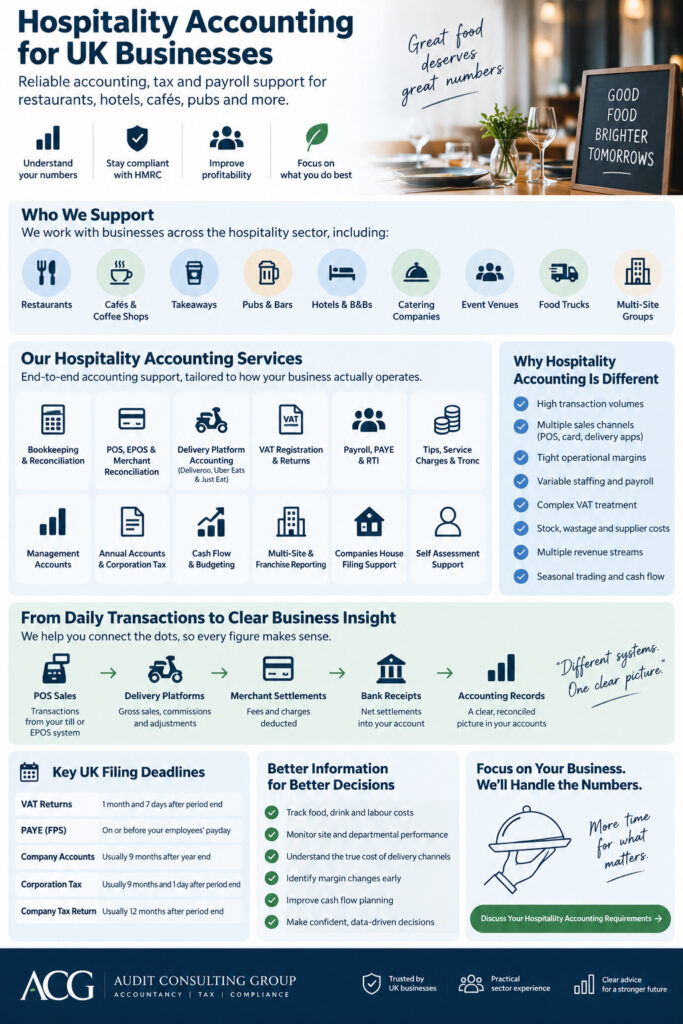
Hospitality accounting has its own pressures. Restaurants, hotels, cafés, pubs, takeaways and catering businesses can process hundreds or thousands of transactions while managing changing staff costs, stock, wastage, supplier payments, VAT and several different sales channels at the same time.
Audit Consulting Group provides hospitality accounting services for UK businesses that need reliable bookkeeping, VAT, payroll, management accounts, annual accounts, Corporation Tax and ongoing financial reporting. The accounting is built around how the business actually operates rather than treated as a year-end exercise.
For an independent restaurant that may mean reconciling the till, card processor and delivery platforms every month. For a hotel, the challenge may be separating room, food, bar and event revenue while keeping payroll and VAT records consistent. A growing hospitality group may need comparable reporting across several sites.
Who We Support in the Hospitality Sector
Our hospitality accountants work with businesses across the food, drink and accommodation sectors, including restaurants, cafés, coffee shops, takeaways, pubs, bars, hotels, B&Bs, catering companies, event venues, ghost kitchens, food trucks, franchises and multi-site hospitality groups.
The accounting requirements can be very different. A takeaway trading heavily through Deliveroo, Uber Eats and Just Eat does not have the same reconciliation issues as a hotel with accommodation, restaurant, bar and event revenue. The bookkeeping and reporting structure should reflect those differences.
Why Hospitality Accounting Is Different
 Hospitality combines high transaction volumes with tight operational margins. Sales may pass through an EPOS system, card processor, delivery platform and bank account before they appear in the accounts. The amount recorded as customer sales is therefore not always the amount eventually received into the bank.
At the same time, food and drink margins can move because of supplier price changes, wastage, stock discrepancies, portion control or pricing. Payroll can change every period because of variable hours, overtime, split shifts, seasonal staff and employee turnover.
VAT adds another layer. The treatment can depend on what is sold and how it is supplied, so hospitality bookkeeping needs enough transaction detail to support the VAT treatment used in the return.
What Our Hospitality Accounting Services Include
Our accounting services for hospitality businesses can cover the day-to-day records as well as periodic reporting and statutory compliance. Businesses can engage us for an ongoing accounting scope or for specific areas such as bookkeeping, VAT, payroll or management accounts, depending on what is required.
- hospitality bookkeeping and bank reconciliation;
- POS, EPOS and merchant settlement reconciliation;
- Deliveroo, Uber Eats, Just Eat and other delivery-platform accounting;
- VAT registration, returns and ongoing VAT support;
- hospitality payroll, PAYE and RTI reporting;
- accounting and payroll support for tips and service charges;
- management accounts and performance reporting;
- annual accounts and Corporation Tax;
- Self Assessment support where relevant to owners or sole traders;
- cash-flow and budgeting support;
- multi-site and franchise reporting;
- Companies House filing support where applicable.
Hospitality Bookkeeping and POS Reconciliation
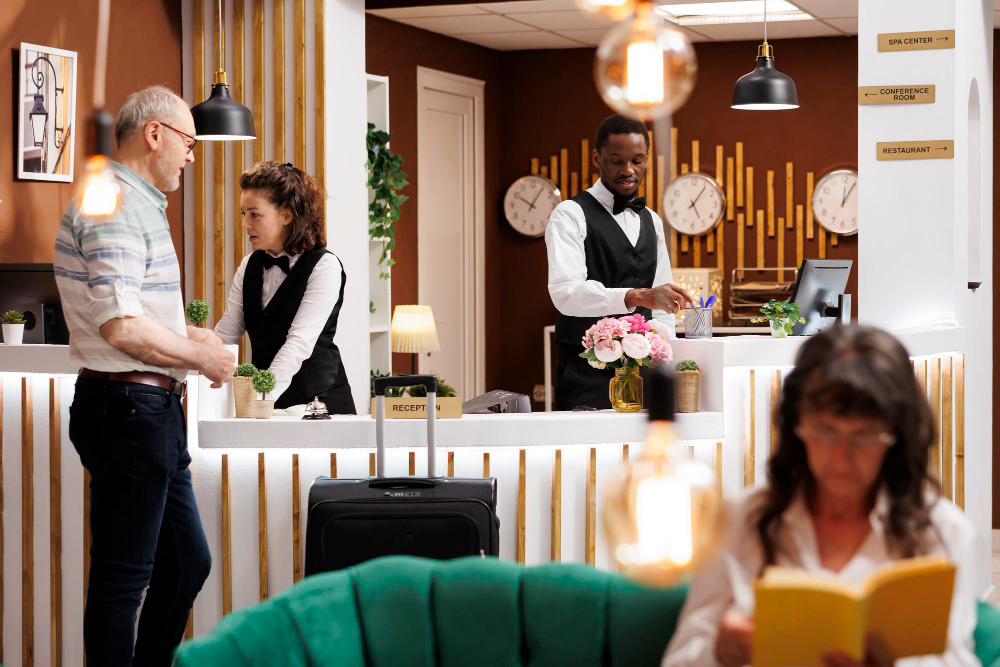 Reliable hospitality bookkeeping starts with understanding how a sale moves through the business. A transaction may be recorded by the till, processed by a card provider and settled into the bank later, with processing charges deducted along the way.
Where the figures do not reconcile, simply posting the bank receipt as revenue can hide the difference between gross sales and the costs deducted before settlement.
Our hospitality bookkeeping services can include sales and bank reconciliation, supplier invoices, merchant fees, delivery-platform settlements, VAT coding, payroll-related entries, stock-related accounting records and management reporting.
Where appropriate, records can be reconciled against systems such as Square, Clover, Toast, Lightspeed and other EPOS platforms. The aim is a clear trail from operational sales data through to the accounting records and bank.
Accounting for Deliveroo, Uber Eats and Just Eat
Delivery platforms are a common source of reconciliation problems for restaurants, takeaways and cafés.
Suppose a platform reports £10,000 of customer orders. The restaurant may receive substantially less into its bank account because commissions, fees, refunds, promotions or other adjustments have been deducted. Recording only the net settlement as sales can therefore understate revenue and make it harder to understand the true cost of that sales channel.
A proper reconciliation separates gross sales from platform commissions, refunds and other adjustments before matching the final settlement to the bank. VAT treatment also needs to be considered from the underlying transactions rather than inferred from the net cash received.
This gives the business a clearer picture of both revenue and the cost of generating sales through third-party platforms.
VAT Accounting for Hospitality Businesses
VAT is one of the areas where apparently small operational differences matter. Hospitality records may need to distinguish between food consumed on the premises, hot takeaway food, qualifying cold takeaway food, alcoholic drinks, other beverages, catering supplies, accommodation and mixed transactions.
It is therefore risky to assume that every food or drink transaction receives the same VAT treatment.
Our hospitality VAT support can include registration, return preparation, bookkeeping reviews, corrections and ongoing accounting support. Where a transaction is unusual or its treatment is uncertain, the facts should be reviewed rather than relying on a broad rule for the entire sector.
For businesses submitting standard quarterly VAT Returns, the online filing and payment deadline is usually one calendar month and seven days after the end of the VAT accounting period. Businesses using special VAT arrangements can have different deadlines, so the actual due date should be checked for the business.
Hospitality Payroll, Tips, Service Charges and Tronc
 Hospitality payroll rarely stays identical from one pay period to the next. Variable hours, overtime, split shifts, part-time employees, seasonal workers and frequent starters or leavers all affect processing.
Payroll support can cover PAYE calculations, RTI submissions, holiday pay, starters and leavers, payroll reconciliation, workplace pension information and the payroll treatment of tips and service charges where relevant.
A Full Payment Submission is normally sent to HMRC on or before the employee’s payday. That makes timely and accurate employee information particularly important in businesses where hours change frequently.
Tips, Service Charges and Tronc
Tips and service charges need careful treatment because the PAYE and National Insurance position can depend on how the money is collected, controlled and distributed.
A tronc can be used to distribute tips, gratuities or service charges among employees, but the name given to the arrangement does not determine its tax treatment. How the arrangement operates, including who controls allocation, matters.
Where tips represent a significant part of employee remuneration, it is better to establish a consistent payroll and record-keeping process than to rely on manual adjustments at the end of each pay period.
Management Accounts, Food Costs and Hospitality KPIs
Year-end accounts answer important statutory questions, but they may arrive too late to explain why a restaurant’s margin changed three months ago.
Management accounts for hospitality businesses can bring together sales, food and drink purchases, payroll and overheads while the information is still operationally useful. Depending on the quality of the underlying data, reporting can track gross profit, food cost, drink cost, labour cost, stock movements, overheads, cash flow and performance by site.
For example, rising revenue does not automatically mean that profitability has improved. Sales can increase while food costs, delivery commissions and labour costs rise even faster.
Menu Costing and Margin Visibility
Menu pricing is an operational decision, but the accounts can provide useful evidence behind it. If ingredient costs rise while selling prices remain unchanged, the gross margin can deteriorate even when customer volumes are stable.
Consistent purchasing and stock records make it easier to identify movements in food and drink costs. Management can then investigate whether the cause is supplier pricing, wastage, portion control, product mix or another operational factor rather than discovering the movement only at year end.
Hospitality Accounting KPIs: Example Monthly Figures
The figures below illustrate how management accounts can turn hospitality accounting data into useful operating information. They are examples only, not recommended industry targets. Actual margins and cost structures vary significantly by business model, location, pricing, staffing and sales mix.
| Hospitality KPI | Example Monthly Figure | Example Calculation | What It Can Help Show |
|---|---|---|---|
| Total Revenue | £100,000 | Total recorded sales for the period | Provides the starting point for analysing costs, margins and sales-channel performance. |
| Food & Drink Cost | £31,000 | £31,000 ÷ £100,000 = 31% | Shows how much of revenue is being absorbed by food and drink purchases before other operating costs. |
| Gross Profit | £69,000 | £100,000 − £31,000 = £69,000 | Helps management monitor the relationship between selling prices and direct food and drink costs. |
| Gross Profit Margin | 69% | £69,000 ÷ £100,000 × 100 | Can highlight movements caused by supplier prices, menu pricing, product mix, portion control or wastage. |
| Payroll Cost | £32,000 | £32,000 ÷ £100,000 = 32% | Shows how staffing expenditure is moving relative to revenue. |
| Delivery-Platform Sales | £20,000 | £20,000 ÷ £100,000 = 20% | Shows how much of total revenue is generated through third-party delivery channels. |
| Delivery Platform Fees | £5,000 | £5,000 ÷ £20,000 = 25% | Illustrates the direct cost associated with the delivery sales channel before considering other costs. |
| Other Operating Costs | £24,000 | Rent, utilities, insurance, software and other overheads | Helps explain the difference between gross profit and the operating result. |
| Illustrative Operating Result | £8,000 | £100,000 − £31,000 − £32,000 − £5,000 − £24,000 | Demonstrates why increasing sales alone does not necessarily produce the same increase in profit. |
Important: These figures are illustrative only. Hospitality businesses can have materially different cost structures, and individual KPIs should be interpreted in the context of the business and the quality of the underlying accounting and operational data.
Accountants for Restaurants, Cafés, Pubs and Takeaways
Restaurants and food businesses combine several accounting challenges in one operation: frequent transactions, stock, labour, VAT, card processing and increasingly third-party delivery sales.
Our restaurant accountants support restaurants, cafés, pubs, bars and takeaway businesses with the accounting and compliance work relevant to their operation.
Useful reporting should help management understand questions such as whether POS sales reconcile to the bank, how much revenue is generated through delivery platforms, what those channels cost, how labour is moving relative to sales and whether food or drink margins are changing.
For pubs and bars, drink stock, card takings, payroll and VAT can be particularly important. For takeaways, delivery-platform reconciliation may be the more significant issue. The accounting should follow the commercial reality of the business rather than force every hospitality operator into the same reporting structure.
Accountants for Hotels and Accommodation Businesses
Hotels often operate several revenue streams under one business. Room sales may sit alongside restaurant, bar, event, meeting-room and other guest revenue.
Our accountants for hotels can structure the records so those activities remain understandable rather than being absorbed into one undifferentiated sales figure. Depending on the systems available, this may include room revenue, booking-platform settlements, OTA commissions, deposits and refunds, food and beverage operations, payroll, VAT and departmental reporting.
For hotel groups, consistency between locations matters. Using comparable accounting categories makes it easier to review individual properties and consolidated results on the same basis.
Accountants for Catering and Food & Drink Businesses
Catering businesses often have a different cash cycle from restaurants because revenue can be linked to events rather than regular daily trading. Deposits may be received well before an event, with the balance collected later, while food, staff, transport, venue or equipment costs arise at different stages.
We support caterers, event food businesses, food trucks and other food and drink businesses with bookkeeping, VAT, payroll, accounts and relevant tax compliance. The records should make it possible to understand the timing of income and expenditure rather than simply the final bank movement.
Cash Flow, Stock and Supplier Management
A hospitality business can be profitable on paper and still face cash-flow pressure. Wages, rent, utilities, suppliers, VAT and PAYE fall due on different dates, while trading may fluctuate significantly by weekday, season or event calendar.
Periodic reporting can bring together upcoming tax liabilities, supplier balances, payroll commitments and expected cash receipts. It does not remove the underlying commercial pressures, but it can make them visible earlier.
Stock also needs operational discipline. Accounting data can highlight unusual cost movements, but reliable stock counts, purchasing controls and wastage records still need to come from the business itself.
Multi-Site and Franchise Hospitality Accounting
When a hospitality business expands, inconsistent bookkeeping between locations quickly becomes a reporting problem. One site may record delivery commissions separately while another nets them against sales; one may split food and drink purchases while another posts both to the same account.
A consistent chart of accounts can standardise how revenue, food and drink purchases, labour, delivery fees, rent, utilities and other operating costs are recorded. This supports consolidated accounts while preserving the ability to compare individual locations.
For franchise businesses, the accounting structure can also reflect relevant franchise reporting requirements where these form part of the agreed scope.
Annual Accounts, Corporation Tax and Companies House
Hospitality limited companies still have the same core statutory accounting and tax obligations as other UK companies. The difference is that high-volume operational records often need considerable reconciliation before those year-end figures can be relied upon.
Our support can include annual accounts, Corporation Tax calculations, Company Tax Return preparation and Companies House filing support. Where the bookkeeping has been maintained consistently throughout the year, year-end work is usually more straightforward than when sales, payroll, VAT and bank differences have been left unresolved.
Key UK Filing and Payment Timelines
- VAT Returns: for standard quarterly returns, filing and payment are usually due one calendar month and seven days after the VAT period ends.
- PAYE reporting: an FPS is normally submitted to HMRC on or before employees are paid.
- Private company annual accounts: after the first accounts, these are normally due to Companies House nine months after the financial year ends.
- Corporation Tax: for companies that are not subject to the instalment-payment regime, payment is usually due nine months and one day after the Corporation Tax accounting period ends.
- Company Tax Return: normally due 12 months after the end of the Corporation Tax accounting period.
First accounts, unusual accounting periods, larger companies and particular VAT or payment arrangements can follow different rules. The applicable dates should therefore be confirmed for the individual business rather than relying only on a general timetable.
Key UK Accounting and Tax Deadlines for Hospitality Businesses
| Accounting or Tax Requirement | Typical Deadline | Example | Why It Matters |
|---|---|---|---|
| VAT Return | Usually 1 calendar month and 7 days after the end of the VAT period | VAT period ends 31 March → typical online deadline 7 May | The VAT Return and electronic payment are normally due by the applicable deadline. |
| Full Payment Submission (FPS) | Normally on or before employees are paid | Employees paid 30 September → FPS normally submitted by 30 September | Particularly important for hospitality businesses with variable hours, overtime and frequent payroll changes. |
| PAYE & National Insurance Payment | Usually by the 22nd of the following tax month when paying electronically | PAYE relating to the tax month ending 5 September → electronic payment normally due by 22 September | Late payment can result in interest and potentially late-payment penalties. |
| Annual Accounts – Private Company | Normally 9 months after the financial year end after the first accounts | Year end 31 December 2026 → typical Companies House deadline 30 September 2027 | Late filing can result in automatic Companies House penalties. |
| Corporation Tax Payment | Usually 9 months and 1 day after the end of the Corporation Tax accounting period for companies outside the instalment-payment regime | Accounting period ends 31 December 2026 → typical payment deadline 1 October 2027 | Corporation Tax is normally payable before the Company Tax Return filing deadline. |
| Company Tax Return (CT600) | Normally 12 months after the end of the Corporation Tax accounting period | Accounting period ends 31 December 2026 → typical filing deadline 31 December 2027 | The return reports the company’s taxable profit and Corporation Tax position to HMRC. |
| Confirmation Statement | Usually within 14 days after the end of the company’s review period | If the review period ends 10 October → filing would normally be due by 24 October | Keeps the company’s Companies House information up to date. |
| Self Assessment | Online return normally due by 31 January following the end of the relevant tax year | 2026/27 tax year → online filing deadline normally 31 January 2028 | Can be relevant to sole traders, partners and business owners with personal tax reporting requirements. |
Note: These are general UK deadlines. First company accounts, unusual accounting periods, VAT schemes, large-company Corporation Tax rules and individual circumstances can produce different filing or payment dates.
Starting or Buying a Hospitality Business
A new restaurant or hotel has different accounting priorities from an established business being acquired.
For a start-up, the early work may involve the business structure, bookkeeping setup, VAT and PAYE registration where applicable, payroll, accounting software and the way POS or other sales information will reach the accounts.
An acquisition can require a different review because there may already be employees, accounting records, assets, supplier arrangements and tax registrations in place. Historical records and the proposed transaction structure may also affect what accounting or tax work is required.
CIS and Hospitality Refurbishment Work
Restaurants and hotels frequently refurbish kitchens, bars, rooms and other premises. Construction Industry Scheme obligations do not arise merely because a hospitality business pays a contractor, but some construction arrangements can require the position to be considered.
Where relevant, we can review the accounting and CIS implications of the arrangement and provide appropriate support within the agreed scope. For most hospitality businesses this remains a secondary issue rather than part of routine monthly accounting.
What Hospitality Business Owners Often Underestimate
Bank receipts are not always sales. Delivery platforms and merchant processors may deduct charges before settlement, so net cash receipts can conceal both gross revenue and the cost of the sales channel.
Higher sales do not necessarily mean higher profit. Food costs, payroll, delivery commissions, wastage and overheads can rise faster than revenue.
VAT depends on transaction detail. Similar-looking food and drink sales can have different VAT consequences depending on what is supplied and the circumstances.
Year-end figures cannot replace timely management information. If the objective is to manage margins, labour or site performance, the reporting needs to arrive while management can still act on it.
How Our Hospitality Accounting Process Works
1. Understand How the Business Operates
We start with the practical setup: locations, sales channels, POS systems, delivery platforms, bank and merchant accounts, employees, VAT status and existing accounting software.
2. Review the Existing Records
For an established business, the next step is to understand the condition of the bookkeeping and identify unreconciled sales, bank, VAT or payroll items that may affect ongoing work.
3. Agree the Scope and Responsibilities
The engagement may cover bookkeeping, VAT, payroll, management accounts, annual accounts, Corporation Tax or a combination of these. We also establish who provides each category of information and how frequently it is required.
4. Establish the Working Process
POS reports, invoices, delivery statements, payroll information and bank records need a consistent route into the accounting process. Where possible, this is established before regular reporting begins.
5. Reconcile and Maintain the Records
Transactions are processed according to the agreed frequency, with queries raised where an item cannot be reliably classified or reconciled from the available information.
6. Complete Agreed Reporting and Compliance Work
Where included in the engagement, VAT Returns, payroll submissions, management accounts, annual accounts and tax returns are prepared according to the agreed scope and relevant deadlines.
What We Need From Your Hospitality Business
The exact information depends on the work required. Typically, we may need access to bank information, POS reports, merchant statements, delivery-platform statements, sales reports, supplier invoices, payroll data and relevant VAT records.
When taking over an established business, previous accounts, tax returns and relevant HMRC or Companies House correspondence may also be required. If management reporting includes stock or location-level analysis, reliable operational data needs to be supplied by the business as well.
Regular access to complete records usually produces a cleaner accounting process than trying to reconstruct several months of activity immediately before a filing deadline.
Hospitality Accounting Software and Systems
Most hospitality businesses do not operate from one system. Sales may originate in an EPOS platform, online orders may sit with delivery providers, payments may pass through merchant processors, payroll may use separate software and the final accounts may be maintained in Xero, QuickBooks or another accounting platform.
The important question is not how many systems the business uses. It is whether the figures can be traced and reconciled between them.
Where integration is practical, it can reduce manual work. Where it is not, a controlled reconciliation process may be more reliable than adding another piece of software simply for the sake of automation.
Practical Hospitality Accounting Scenarios
The examples below illustrate common accounting situations rather than individual client case studies. Actual work and outcomes depend on the records, systems and circumstances of each business.
Restaurant Using Several Delivery Platforms
Starting problem: the restaurant’s Deliveroo, Uber Eats and Just Eat reports show gross customer sales that do not match the amounts reaching the bank.
Accounting work: sales reports are reconciled to commissions, refunds and other platform adjustments before the net settlements are matched to the bank.
Practical outcome: gross sales and platform deductions are recorded separately, each settlement can be traced to the bank, and management can see the cost of the delivery channels independently from customer revenue.
Hotel With Several Revenue Streams
Starting problem: room, restaurant, bar and event income are being reported together, making departmental performance difficult to interpret.
Accounting work: the accounting structure separates relevant revenue and cost categories and supports periodic management reporting alongside VAT, payroll and statutory accounts.
Practical outcome: separate revenue categories can be reviewed by management where the source systems contain sufficient data, rather than relying on one combined sales figure.
Growing Café Group
Starting problem: several locations use inconsistent expense categories, making monthly site comparisons unreliable.
Accounting work: a consistent chart of accounts and reconciliation process is applied across the locations.
Practical outcome: sales, food costs, labour and major overhead categories are recorded on a consistent basis, making site-to-site reporting easier to interpret.
How Much Does a Hospitality Accountant Cost?
The cost of a hospitality accountant depends more on the volume and complexity of the accounting than on the business label itself.
A single café with one bank account, a small payroll and clean monthly records requires a different level of work from a multi-site restaurant group using several POS systems, delivery platforms and merchant accounts.
Important fee drivers include transaction volume, number of employees, payroll frequency, VAT requirements, number of sites, delivery channels, management-reporting requirements and the condition of the existing bookkeeping.
Businesses with unreconciled historical records may also require catch-up or corrective work before reliable ongoing bookkeeping can begin. We establish the required scope and fee before substantive work starts.
Service Cost Estimation
Select the service category below to calculate the estimated cost of either accounting & tax services or forms and submissions.
Select Required Services / Forms
Select one or more services/forms to receive an accurate cost estimate. You can adjust your selection at any stage.
How would you like to engage our services?
Please select whether you require a one-off service or ongoing monthly support.
Contract Duration
Your cost estimate
Apply now and get 10% OFF
Submit your request today and receive an exclusive 10% discount on your selected service.
All prices are estimates. To receive a personalised quote, please fill out the form or contact us.
Ready to get started?
Get professional support from experienced UK accountants
Choosing Accounting Support for a Hospitality Business
When comparing providers, price is only one part of the decision. It is useful to establish what is actually included in the quoted service and who is responsible for the operational work behind the figures.
A hospitality business should understand whether the proposed service includes POS and bank reconciliation, delivery-platform settlements, VAT Returns, payroll, management reporting and year-end accounts, or whether some of those items are charged and managed separately.
It is also worth clarifying how often records will be reviewed, what information the business must provide, how accounting queries are handled and whether the provider can work with the systems already used by the business.
If your POS reports, delivery-platform settlements and bank receipts do not reconcile cleanly, reviewing that flow of information is often a useful starting point before changing software or adding more reporting.
Why Choose Audit Consulting Group for Hospitality Accounting?
Good hospitality accounting depends on understanding what sits behind the numbers. A difference between sales and the bank may be a merchant settlement issue rather than missing revenue. A falling gross margin may reflect supplier costs, wastage or product mix. A payroll increase may be caused by seasonal staffing or overtime rather than an accounting error.
Our approach is to connect bookkeeping, VAT, payroll, management reporting and year-end compliance so that the records can be reconciled and understood as a whole.
We also set clear expectations about the information needed from the business. Accounting can identify unusual movements and inconsistencies, but the quality of the reporting ultimately depends on reliable operational records being supplied on time.
Frequently Asked Questions About Hospitality Accounting
What does a hospitality accountant do?
A hospitality accountant can handle bookkeeping, VAT, payroll, management accounts, annual accounts, Corporation Tax and financial reporting while accounting for sector-specific issues such as POS systems, delivery platforms, stock, tips, variable staffing and multiple revenue streams.
Do you provide accounting services for restaurants?
Yes. Our accounting services for restaurants can include bookkeeping, POS and delivery-platform reconciliation, VAT, payroll, management accounts, annual accounts and tax compliance depending on the agreed scope.
Do you provide accounting for hotels?
Yes. We support hotels and accommodation businesses with room and booking-platform revenue, food and beverage operations, payroll, VAT, management reporting, annual accounts and relevant tax compliance.
Do you work with cafés, pubs, bars and takeaways?
Yes. We support cafés, coffee shops, pubs, bars, takeaways and other food and drink businesses. The accounting scope is adapted to the way the individual business trades.
Can you reconcile Deliveroo, Uber Eats and Just Eat?
Yes, where the necessary reports and accounting information are available. The reconciliation can separate gross sales, commissions, refunds and other adjustments before matching the net settlement to the bank.
Can you work with our POS or EPOS system?
That depends on the system and the accounting setup. Where integration is suitable it can form part of the workflow; otherwise POS reports can be reconciled against the accounting records and bank transactions.
Do you work with Xero and QuickBooks?
Yes. We can work with accounting platforms such as Xero and QuickBooks where they are appropriate to the client’s accounting setup.
How does VAT work for restaurants and takeaways?
VAT treatment can depend on both the product and the circumstances in which it is supplied. Eat-in sales, hot takeaway food, qualifying cold takeaway food, alcohol and other drinks can have different VAT consequences, so the underlying transaction needs to be considered.
When is a VAT Return due?
For standard VAT accounting periods, the online return and payment are usually due one calendar month and seven days after the period ends. Different arrangements can have different deadlines, so the business should confirm its actual due date.
Can you manage hospitality payroll?
Yes. Payroll support can include PAYE, RTI reporting, variable hours, overtime, holiday pay, starters and leavers and seasonal workers within the agreed service.
When does payroll need to be reported to HMRC?
An employer normally reports employee pay and deductions through a Full Payment Submission on or before the employee’s payday, unless a specific exception applies.
Can you help with tips and service charges?
Yes. We can review the accounting and payroll treatment based on how tips and service charges are collected, controlled and distributed. The tax and National Insurance treatment depends on the actual arrangement.
What is a tronc?
A tronc is an arrangement for distributing tips, gratuities or service charges among employees. The payroll treatment depends on how the arrangement operates, including who controls the allocation.
Can you provide management accounts for a restaurant or hotel?
Yes. Management accounts can be prepared at an agreed frequency and may include revenue, gross profit, labour costs, overheads, cash flow and other useful reporting categories where the underlying data is reliable.
Can accounting help us monitor food and labour costs?
Yes. Accounting and management reports can track purchases, payroll expenditure and related percentages. Accurate stock, employee and operational data from the business is still necessary for meaningful analysis.
Do you support multi-site hospitality businesses?
Yes. A consistent accounting structure can be used across several locations to support consolidated reporting and more reliable site-by-site comparisons.
Can you take over from our current accountant?
Yes. The first step is to understand the current accounting setup, services required and condition of the records. Relevant handover information can then be requested as appropriate.
What information will you need from us?
This depends on the scope, but common records include bank information, POS reports, merchant statements, delivery-platform statements, supplier invoices, payroll information, VAT records and previous accounts and tax returns where applicable.
How much does a hospitality accountant cost?
Fees depend on factors such as transaction volume, payroll size, VAT requirements, number of locations, accounting systems, condition of the bookkeeping and reporting frequency. The scope and fee should be agreed before substantive work begins.
Discuss Your Hospitality Accounting Requirements
If you run a restaurant, hotel, café, pub, takeaway, catering company or another UK hospitality business, tell us how the business operates and where you need accounting support.
A useful starting point is the number of locations, approximate monthly transaction volume, number of employees, VAT status, POS and delivery platforms used, accounting software and whether you need bookkeeping, payroll, management accounts, annual accounts or tax support.
Audit Consulting Group
+44 7386 212550
info@auditconsultinggroup.co.uk