
MTD Penalties UK: Making Tax Digital Penalty Appeals & Resolution
Leave your details and our team will get back to you shortly.
Making Tax Digital introduces digital record-keeping and reporting requirements for affected taxpayers, but the penalty position depends on the obligation involved, the filing frequency, the tax regime and the deadline that was missed.
If you have received an HMRC MTD penalty, accumulated penalty points, missed an MTD submission or discovered problems with previous digital filings, Audit Consulting Group can review the position and help determine the appropriate next steps.
Our support can include reviewing penalty notices, checking filing and payment history, assessing whether an appeal may be appropriate, correcting underlying reporting issues, dealing with HMRC correspondence and helping restore an organised compliance process.
Received an MTD Penalty? What to Do First
An MTD penalty notice should be considered alongside the underlying filing or payment obligation. Before deciding whether to appeal or correct a submission, it is important to establish what HMRC says was late or incorrect, which reporting period is affected and which penalty regime applies.
Start by checking the HMRC notice, the original deadline, the actual submission date, any payment due and previous penalty points or late filings. If circumstances prevented you from meeting the obligation, keep any evidence that may support an explanation or potential appeal.
Filing penalties and payment penalties are separate issues. Resolving one does not necessarily resolve the other, and an appeal against a penalty does not remove an outstanding filing requirement.
What Our MTD Penalty and Compliance Resolution Service Includes
Our work depends on what has actually gone wrong. A single late submission with complete records is different from several reporting periods affected by incomplete bookkeeping, software problems or missed payments.
Depending on the circumstances, support may include:
- reviewing HMRC penalty notices and penalty points;
- checking the relevant submission and payment history;
- identifying which MTD penalty rules apply;
- assessing potential reasonable excuse grounds;
- preparing and submitting a penalty appeal where appropriate;
- reviewing evidence supporting an appeal;
- correcting underlying VAT or Income Tax reporting issues where required;
- reviewing historical digital records and submissions;
- investigating software, submission or digital record problems;
- liaising with HMRC within the agreed scope;
- helping establish a more reliable process for future MTD obligations.
The first objective is to understand why the penalty or compliance issue arose. From there, we can establish whether the work involves an appeal, correction, outstanding filing, payment issue or wider compliance recovery.
Who We Help With MTD Penalties
MTD penalty support may be relevant to VAT-registered businesses, sole traders and landlords affected by Making Tax Digital for Income Tax, as well as businesses dealing with historical digital filing or record-keeping problems.
We can also assist where a taxpayer is unsure why a penalty point has been issued, needs to understand whether an appeal may be appropriate, or has discovered that the penalty notice is only one part of a wider compliance problem.
How MTD Penalties Work
Making Tax Digital penalties can arise from different compliance failures. A taxpayer may have a late submission problem, a late payment problem, an error in information already filed or an issue with the digital records supporting a submission.
These should not be treated as interchangeable. Submitting information late and paying tax late, for example, can create separate consequences even where both relate to the same reporting period.
The rules also need to be considered separately for VAT and Making Tax Digital for Income Tax.
MTD Late Submission Penalties
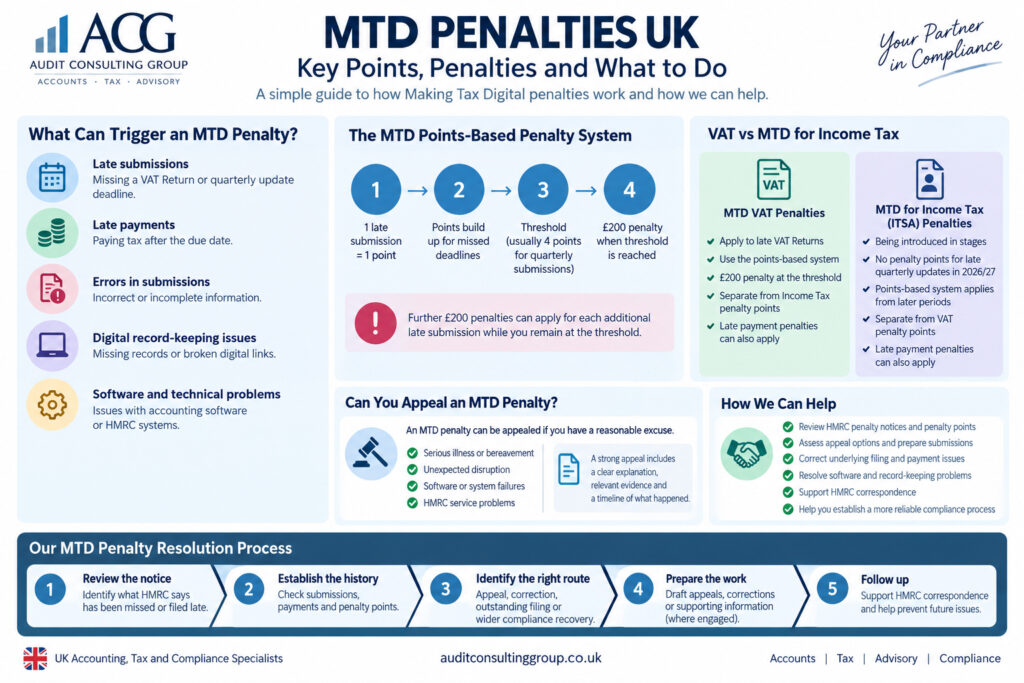
MTD late submission penalties use a points-based approach for relevant obligations. A missed relevant submission deadline can result in a penalty point rather than an immediate financial penalty each time.
Once the applicable points threshold is reached, a financial penalty can arise. Further late submissions while the taxpayer remains at the threshold can result in additional penalties.
The threshold depends on the filing frequency for the relevant obligation, so the submission type and reporting cycle need to be established before interpreting a penalty notice.
The MTD Points-Based Penalty System

Under the points-based system, a relevant late submission can result in a penalty point. The point total is tracked against the relevant obligation.
For quarterly submission obligations within the regime, the late submission penalty threshold is generally four points. When the threshold is reached, a £200 penalty can apply. A further £200 penalty can arise for subsequent late submissions while the taxpayer remains at the threshold.
Penalty points do not necessarily disappear after the next filing. Expiry and resetting of the points total depend on the taxpayer’s compliance position and whether the relevant conditions have been met.
For someone who has missed more than one deadline, reviewing the submission history is therefore more useful than looking only at the latest notice.
MTD Late Submission Penalty Points and Thresholds
| Submission Frequency | Penalty Point Threshold | Penalty at Threshold | Further Late Submissions at Threshold |
|---|---|---|---|
| Annual | 2 points | £200 | Further £200 penalty for each subsequent late submission |
| Quarterly | 4 points | £200 | Further £200 penalty for each subsequent late submission |
| Monthly | 5 points | £200 | Further £200 penalty for each subsequent late submission |
For example, a business submitting quarterly VAT Returns normally reaches the penalty threshold at 4 points. Reaching the threshold can result in a £200 penalty, with a further £200 penalty for each subsequent late submission while the business remains at the threshold.
MTD VAT Penalties
MTD VAT penalties are particularly relevant to businesses filing VAT Returns regularly. Late VAT submissions can generate penalty points under the late submission penalty regime.
Once the applicable threshold is reached, a £200 financial penalty can arise, with further £200 penalties possible for additional late submissions while the business remains at the threshold.
A VAT-registered business can also face separate consequences where the VAT liability itself is paid late. In that situation, both the filing history and payment position may need attention.
A VAT-related review may therefore cover the affected VAT Returns, submission dates, payment history, accounting records and HMRC correspondence rather than the penalty notice alone.
MTD for Income Tax and ITSA Penalties
MTD for Income Tax penalties need to be considered separately from VAT penalties. Making Tax Digital for Income Tax is being introduced in stages, and taxpayers entering the regime need to understand both their digital reporting obligations and the penalty rules that apply.
For taxpayers required to use MTD for Income Tax from 6 April 2026, HMRC has specific transitional treatment for quarterly updates during the 2026/27 tax year. Penalty points are not issued for late quarterly updates during 2026/27.
That does not mean the quarterly updates can be ignored. Required quarterly updates still need to be completed before the relevant tax return can be submitted, while other filing and payment obligations continue to apply.
From later periods, relevant late quarterly updates can fall within the points-based late submission penalty system. For quarterly obligations, the threshold is generally four points. Reaching that threshold can result in a £200 penalty, followed by further £200 penalties for subsequent missed relevant deadlines while the taxpayer remains at the threshold.
This distinction matters when reviewing MTD ITSA penalties or an appeal against an MTD ITSA penalty. The tax year, submission type and reason for the penalty should be established before deciding what action is appropriate.
MTD VAT Penalties vs MTD for Income Tax Penalties
VAT and MTD for Income Tax sit within related digital compliance frameworks, but their penalty positions should not be combined into one penalty history.
MTD VAT vs MTD for Income Tax Penalties
| Penalty Rule | MTD VAT | MTD for Income Tax |
|---|---|---|
| Quarterly penalty point threshold | 4 points | 4 points |
| Penalty when threshold is reached | £200 | £200 |
| Further late submission at threshold | Further £200 penalty | Further £200 penalty |
| Penalty points shared between VAT and Income Tax? | No | No |
| Late quarterly updates in 2026/27 | Normal VAT rules continue to apply | No penalty points for late quarterly updates during 2026/27 |
| Late payment penalties | Can apply separately | Can apply separately under the applicable MTD Income Tax penalty regime |
VAT and MTD for Income Tax penalty points are tracked separately. A taxpayer who has penalty points for VAT does not automatically carry those points across to their MTD for Income Tax obligations.
This distinction is particularly important for a taxpayer who has both VAT and MTD for Income Tax obligations.
MTD Late Payment Penalties
Submitting a return or update on time does not necessarily prevent penalties if the tax itself is paid late.
MTD late payment penalties are separate from late submission penalty points. The consequences depend on the amount outstanding, how long it remains unpaid and the circumstances of the payment position. Late payment interest may also apply.
Where both filing and payment are overdue, each issue needs to be addressed on its own terms.
VAT Late Payment Penalties: Key Time Limits and Rates
| How Late Is the Payment? | First Late Payment Penalty | Second Late Payment Penalty | What This Means |
|---|---|---|---|
| Up to 15 days overdue | No first late payment penalty | None | Paying in full within this period avoids a late payment penalty, although late payment interest can still apply |
| 16–30 days overdue | 3% of the VAT outstanding at the end of day 15 | None | The first late payment penalty applies from day 16 |
| 31 days or more overdue | 3% of the VAT outstanding at day 15 plus 3% of the amount still outstanding at day 30 | 10% per year, calculated daily on the outstanding balance from day 31 | The longer the VAT remains unpaid, the greater the potential late payment penalty |
Late payment interest is separate from these penalties and can run from the first day the VAT payment is overdue until the outstanding amount is paid in full.
Errors in Digital Submissions

A submission can be made on time and still contain incorrect information. This is different from a late filing problem and may require a correction rather than a penalty appeal.
Common issues include incorrect VAT treatment, duplicate transactions, missing income or expenses, incorrect adjustments and figures that do not reconcile with the accounting records.
The correction route depends on the tax, the nature of the error and the circumstances in which it arose. Historical errors should be reviewed before figures are simply changed in a later reporting period.
Digital Record-Keeping and Digital Link Problems
Making Tax Digital is not only about submitting information electronically. Relevant taxpayers also need to consider the digital records and processes behind those submissions.
Problems can arise where bookkeeping is incomplete, transaction records are missing, information has been transferred incorrectly or required digital links are not working as intended.
In those circumstances, correcting the underlying records may need to come before correcting the submission. Filing revised information without first understanding the bookkeeping position can simply carry the same problem forward.
Why Businesses Receive HMRC MTD Compliance Warnings
HMRC correspondence may identify a missed deadline, penalty point, outstanding filing, payment issue or another compliance concern.
The important point is to establish exactly what the notice relates to. A financial amount shown on a letter may be only one part of the position if a return, quarterly update, payment or record-keeping issue remains unresolved.
Can You Appeal an MTD Penalty?
Depending on the circumstances, an MTD penalty can be appealed. An appeal should normally address why the relevant obligation was missed and whether there was a reasonable excuse under HMRC’s rules.
Potential circumstances may include serious illness, bereavement, unexpected disruption, certain software or system failures, or problems with HMRC’s online services. Whether a particular situation amounts to a reasonable excuse depends on the facts and evidence.
Disagreeing with the penalty by itself is not enough. A credible appeal needs to explain what happened, when it happened and how those circumstances affected the taxpayer’s ability to meet the obligation.
How the MTD Penalty Appeal Process Works
Where an appeal appears appropriate, we first review the penalty notice and the obligation behind it. Filing dates, payment history, previous penalty points and the sequence of events may all be relevant.
We then consider the potential appeal grounds and supporting evidence. Where engaged to prepare the appeal, the submission should explain the relevant facts clearly rather than relying on generic reasonable-excuse wording.
HMRC will consider the appeal and decide whether the penalty should remain, be changed or be cancelled. An appeal does not guarantee that HMRC will remove a penalty, which is why the facts, timeline and evidence matter.
Reasonable Excuse and Supporting Evidence
A reasonable excuse is assessed according to the circumstances that prevented the taxpayer from meeting the relevant obligation. A difficult event does not automatically determine the outcome.
Depending on the circumstances, evidence might include medical or other supporting documents, software error messages, screenshots, correspondence with a software provider or adviser, evidence of HMRC service problems, filing confirmations or records showing what action was taken once the problem could reasonably be addressed.
The strongest approach is usually to build the explanation around a clear timeline and available evidence rather than trying to fit the circumstances into generic appeal wording.
Correcting Digital Submission Errors
 If the underlying problem is an inaccurate filing rather than simply a late submission, the correction process needs to reflect the type of tax and the nature of the error.
The work may involve reviewing the original figures, reconciling them with accounting records, quantifying the difference and identifying the appropriate correction route.
For VAT, for example, the way an error is corrected depends on the circumstances and value of the error. Historical adjustments should therefore be reviewed before being included in a later VAT Return.
Fixing Historical MTD Filing Issues
Where more than one reporting period has been affected, correcting only the latest filing may leave earlier problems unresolved.
A historical compliance review can establish which submissions are missing or late, what has already been reported, whether the underlying bookkeeping supports those figures, what remains unpaid and which periods still require correction or further action.
The aim is to establish a reliable current position rather than making isolated changes without understanding how the affected periods connect.
Disclosure and MTD Compliance Recovery
Where errors have resulted in an incorrect tax position, an appropriate disclosure or correction route may need to be considered. The correct approach depends on the tax involved, the nature of the error, how it arose and the relevant HMRC rules.
A disclosure is not a generic way to remove a penalty. The priority is to correct the tax position accurately, provide the required information and address any associated penalty considerations on their own facts.
Where appropriate, we can help review the underlying records, quantify relevant differences and prepare information required for the applicable correction or disclosure process.
Resolving Software and MTD Submission Problems

Some HMRC MTD problems are technical rather than accounting errors. Software may fail to submit, a configuration may be incorrect or bridging software may not transfer information as expected.
The first question is whether the problem affected only the submission process or also affected the figures being reported. A failed transmission with otherwise correct records requires a different response from an MTD error caused by inaccurate bookkeeping or incorrect data transfer.
Where software, accounting records and the submission itself are all involved, each part needs to be checked before deciding how to correct the position.
What We Need to Review an MTD Penalty
The HMRC penalty notice is normally the starting point. A brief explanation of what happened and the affected tax or reporting period will help establish what else needs to be reviewed.
Depending on the issue, we may also need HMRC correspondence, filing confirmations, payment information, VAT Returns or relevant Income Tax records, bookkeeping records, software error messages and evidence supporting any potential reasonable excuse.
Not every case requires every document. Once the notice and circumstances have been reviewed, the required evidence and records can be narrowed down.
How Our MTD Penalty Resolution Process Works
- 1. Review the notice. We identify what HMRC says has been missed, filed late or otherwise affected.
- 2. Establish the history. We check the relevant submission, payment and penalty information.
- 3. Identify the appropriate route. This may involve an appeal, correction, outstanding filing, payment action or a combination of steps.
- 4. Prepare the agreed work. Where engaged to do so, we prepare the relevant appeal, correction or supporting information.
- 5. Deal with follow-up. We can support relevant HMRC correspondence and identify process changes that may reduce the risk of the same problem recurring.
The scope depends on the condition of the underlying records. A single late submission with clear bookkeeping is usually a different exercise from several periods involving incomplete records and missed filings.
Practical MTD Penalty Scenarios
VAT-Registered Business With Repeated Late Returns
Illustrative scenario: A VAT-registered SME has accumulated late submission penalty points after several VAT Returns were filed after their deadlines. The work would begin by establishing the points position, identifying outstanding VAT Returns or payments and reviewing HMRC correspondence. Any potential appeal grounds would be considered separately from the work required to bring the VAT position up to date.
The practical outcome is a clearer picture of the existing penalty position and the steps needed to restore an organised VAT filing process.
Self-Employed Individual Entering MTD for Income Tax
Illustrative scenario: A self-employed individual entering MTD for Income Tax is uncertain about quarterly updates and receives HMRC correspondence after missing a reporting obligation. The tax year and exact obligation would need to be identified first because the treatment of late quarterly updates during 2026/27 differs from the later points-based position.
The immediate objective is to establish what remains outstanding and what reporting process will be required going forward.
Business With Software and Historical Filing Problems
Illustrative scenario: A business discovers that software problems and incomplete bookkeeping have affected several digital reporting periods. Correcting the latest submission alone may not establish the correct overall position.
The work would involve identifying affected periods, reconciling available records with what has already been reported and establishing which corrections or submissions remain necessary. This gives the business a defined recovery plan instead of dealing with each HMRC notice in isolation.
Preventing Further MTD Penalties
Resolving an existing penalty is only part of the work if the same filing process remains in place.
Future compliance is usually more reliable where bookkeeping is kept up to date, filing dates are monitored, responsibility for submissions is clear and records are reconciled before information is filed. HMRC correspondence and outstanding tax payments should also be reviewed promptly rather than left until the next reporting period.
The right process depends on why the original problem occurred. An isolated missed deadline requires a different response from recurring late submissions caused by incomplete records or an unreliable reporting workflow.
What Businesses Often Underestimate About MTD Penalties
A penalty notice is often treated as a standalone problem. In practice, it may be evidence of a wider filing, payment, bookkeeping or software issue.
Businesses also sometimes assume that appealing the penalty and correcting the underlying obligation are the same task. They are not. An appeal may address whether a penalty should stand, while an outstanding or inaccurate submission may still need separate action.
Understanding that distinction early can prevent time being spent on the wrong part of the problem.
Why Audit Consulting Group?
MTD penalty work can involve more than the amount shown on an HMRC notice. The filing history, tax regime, payment position, digital records and reason for the compliance failure may all affect what needs to happen next.
Audit Consulting Group can support businesses and individuals with MTD penalty notice reviews, penalty points, appeal preparation where appropriate, historical filing reviews, VAT and digital reporting corrections, software and record issues, and relevant HMRC correspondence within the agreed engagement.
Before work begins, we establish the scope: which periods are affected, what records are available and whether the immediate priority is an appeal, correction, outstanding filing or broader compliance recovery. This keeps the work focused on the actual problem rather than applying the same response to every MTD notice.
Frequently Asked Questions About MTD Penalties
What are MTD penalties?
MTD penalties can arise from relevant late submission, late payment or other compliance failures connected with digital tax obligations. The rules depend on the tax and obligation involved.
How do MTD penalty points work?
A relevant late submission can result in a penalty point. Once the applicable threshold is reached, a £200 financial penalty can arise, with further £200 penalties possible for subsequent late submissions while the taxpayer remains at the threshold.
How many MTD penalty points can I get before a fine?
The threshold depends on filing frequency. For quarterly obligations within the points-based regime, the threshold is generally four points.
Are MTD VAT penalty points separate from Income Tax penalty points?
Yes. VAT and MTD for Income Tax obligations have separate penalty points totals.
Are there penalties for late MTD for Income Tax quarterly updates in 2026/27?
HMRC states that penalty points are not issued for late MTD for Income Tax quarterly updates during the 2026/27 tax year. Required quarterly updates still need to be completed before the relevant tax return is submitted.
Can an MTD penalty be appealed?
Potentially. Whether an appeal is appropriate depends on the reason for the missed obligation and whether the circumstances support a reasonable excuse under HMRC’s rules.
What can count as a reasonable excuse?
This depends on the facts. Serious illness, bereavement, unexpected disruption and certain technical or HMRC service problems may be relevant, but each case is considered according to its circumstances and supporting evidence.
Can you appeal an MTD ITSA penalty?
Where an appeal right exists, the penalty can be reviewed to determine whether there are appropriate grounds to challenge it. The exact obligation and tax year should be checked first.
Does appealing a penalty fix the underlying late filing?
No. A penalty appeal and the underlying filing obligation are separate matters. Any outstanding submission or inaccurate record may still need to be corrected.
What happens if I pay VAT or Income Tax late?
Late payment consequences are separate from late submission penalty points. Late payment penalties and interest may apply depending on the circumstances and how long the tax remains unpaid.
Can previous MTD filing errors be corrected?
Potentially, yes. The appropriate correction route depends on the tax, the type and value of the error and the affected reporting periods.
Can software problems support an MTD penalty appeal?
Technical problems may be relevant in some circumstances, but the facts and evidence need to be reviewed. A software problem does not automatically mean HMRC will accept an appeal.
What documents do you need to review an MTD penalty?
The HMRC notice is normally the starting point. Depending on the issue, we may also need filing records, payment information, accounting records, correspondence, software evidence and documents supporting any reasonable excuse.
Can you deal with HMRC on my behalf?
Where included within the engagement and appropriate authorisation is in place, we can support relevant communication with HMRC concerning the matter being handled.
Ready to Resolve an MTD Penalty or Compliance Issue?
If you have received an HMRC MTD penalty, penalty point or compliance notice, send us the notice together with a brief explanation of what happened and the relevant filing period.
We can review the issue, identify the applicable penalty or reporting position and explain the work required. Depending on the circumstances, this may involve an appeal, correction, outstanding filing, historical review or wider MTD compliance support.
Contact Audit Consulting Group to discuss your MTD penalty, appeal or Making Tax Digital compliance issue.