
Maternity Allowance Application Support UK – Help With Your MA1 Claim
Leave your details and our team will get back to you shortly.
If you are pregnant and do not qualify for Statutory Maternity Pay (SMP), you may be able to claim Maternity Allowance instead. Applications can become more complicated when you have changed jobs, recently stopped working, are self-employed, work irregular hours or run your own limited company.
Audit Consulting Group provides professional Maternity Allowance application support for UK claimants. We help review your work history, calculate the relevant test period, check earnings information, organise supporting evidence and prepare the MA1 Maternity Allowance form.
Our role is to help make sure the information in your application is accurate, consistent and supported by the available records. The final decision about eligibility, payment rate and duration is made by the Department for Work and Pensions (DWP).
Maternity Allowance Application Support UK
A Maternity Allowance claim is not always just a matter of completing the MA1 form. Depending on your circumstances, the application may require a careful review of employment dates, self-employment, earnings, National Insurance records and an employer’s decision that you are not entitled to SMP.
Our support can include reviewing your 66-week test period, checking work and earnings information, reviewing employment and self-employment history, considering the position where SMP has been refused, helping with the MA1 form and organising supporting documents before submission.
We can also help you understand requests for further information from DWP where they relate to the financial records, dates or documents used in your claim.
What Is Maternity Allowance?
 Maternity Allowance is a UK government payment for some people who take time away from work to have a baby but cannot receive Statutory Maternity Pay from an employer.
You may be able to apply if you are employed but do not qualify for SMP, are self-employed, have recently stopped working, have moved between different jobs or do unpaid work for your spouse’s or civil partner’s business and meet the relevant conditions.
Depending on the basis of the claim, Maternity Allowance can be payable for up to 39 weeks. A different 14-week entitlement can apply in certain cases involving unpaid work for a self-employed spouse or civil partner.
Maternity Allowance vs Statutory Maternity Pay
One of the first questions is whether you should receive Statutory Maternity Pay from an employer or apply for Maternity Allowance through DWP.
Statutory Maternity Pay
SMP is normally paid through an employer where the relevant employment, continuity and earnings conditions are met. Eligibility depends on factors including how long you have worked for that employer and your earnings during the qualifying period.
If your employer decides that you are not eligible for SMP, they should normally explain why and provide an SMP1 form. This can be important evidence when you make a Maternity Allowance claim.
Maternity Allowance
Maternity Allowance is claimed from DWP rather than paid through your employer. It is particularly relevant to self-employed people, people who recently stopped working and employees who do not meet the SMP conditions.
Being refused SMP does not automatically mean that you are not entitled to maternity-related financial support. Your circumstances can still be considered under the separate Maternity Allowance rules.
Who Can Apply for Maternity Allowance?
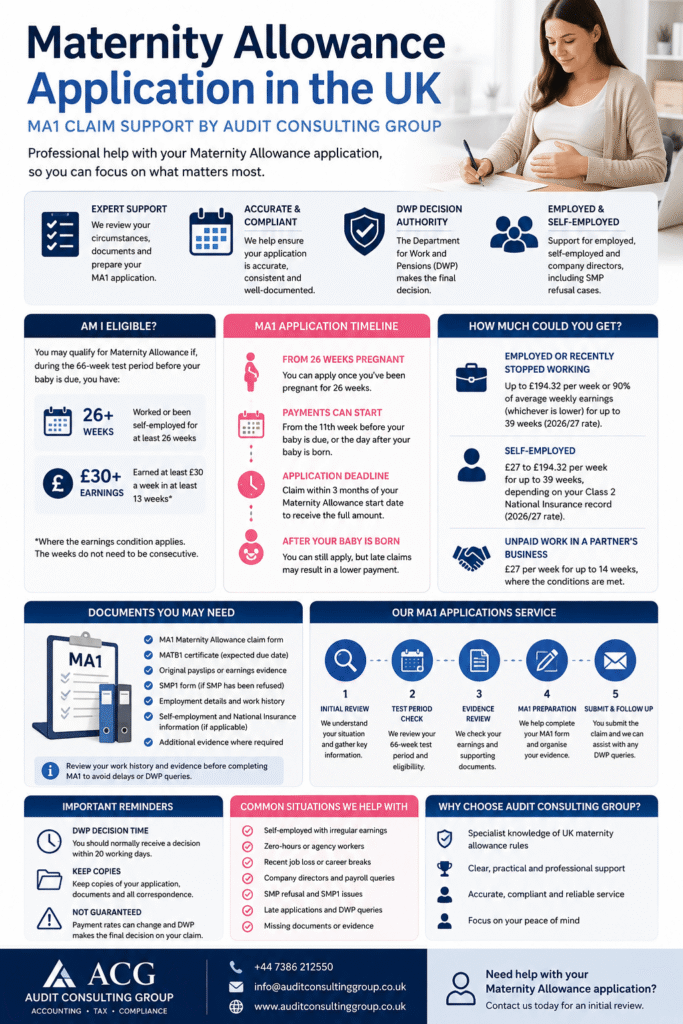
Maternity Allowance eligibility depends on your work and earnings history. For many claimants seeking up to 39 weeks of Maternity Allowance, two important elements are the 66-week test period and the work and earnings conditions within it.
You may qualify where, during the relevant 66 weeks before your baby is due, you have:
- been employed or self-employed for at least 26 weeks; and
- earned at least £30 a week in at least 13 weeks, where the earnings condition applies.
The weeks do not necessarily have to be consecutive. This is important for people with irregular work patterns, temporary jobs, agency work, zero-hours contracts or gaps between jobs.
The 66-Week Maternity Allowance Test Period
 The 66-week test period is one of the areas where applicants frequently need help. The dates are based on the week your baby is due, so using the wrong starting or ending point can affect the information entered on the MA1 form.
When reviewing the test period, we may need to bring together employment start and end dates, periods of self-employment, different employers, agency or zero-hours work, gaps in employment and the earnings evidence that supports the claim.
Having changed jobs or stopped working does not necessarily prevent a claim. The important question is whether your circumstances meet the relevant conditions within the test period.
Maternity Allowance for Self-Employed Applicants
A self-employed Maternity Allowance application requires particular care because the payment rate can depend on your self-employment and National Insurance position.
For the maximum amount available to an eligible self-employed claimant, current rules look at whether you were registered with HMRC as self-employed for at least 26 weeks within the 66-week period and whether Class 2 National Insurance contributions were paid for at least 13 weeks.
If your National Insurance position does not initially support the higher rate, HMRC may contact you about paying voluntary Class 2 contributions where the rules allow this. The effect depends on your individual record, so an additional payment should not be assumed to be available or automatically increase the award.
For self-employed clients, we can also check that information used for the Maternity Allowance application is consistent with available HMRC and Self Assessment records where relevant.
Maternity Allowance for Limited Company Directors
Running your own limited company does not automatically mean that you should apply for Maternity Allowance as a self-employed person.
A director may also be an employee of their company, so the SMP position should normally be considered first. This can require a review of PAYE records, salary actually paid through payroll, employment history and earnings during the relevant SMP period.
Where SMP is not available, it may then be appropriate to consider Maternity Allowance.
This distinction matters because salary, dividends and self-employment are not interchangeable. The route used should reflect the claimant’s actual employment and payroll position rather than simply the fact that they own a company.
How Much Maternity Allowance Could You Get?
 The amount depends on why you qualify and, in some cases, your earnings or National Insurance record.
Employed or recently stopped working
For 2026/27, eligible claimants can receive up to £194.32 per week or 90% of average weekly earnings, whichever is lower, for up to 39 weeks.
Self-employed
For 2026/27, eligible self-employed claimants can receive between £27 and £194.32 per week for up to 39 weeks. The amount depends on the relevant Class 2 National Insurance record.
Unpaid work in a spouse’s or civil partner’s business
A different entitlement can apply if you regularly undertake unpaid work for a self-employed spouse or civil partner and the relevant conditions are met. This can provide £27 per week for up to 14 weeks.
Maternity Allowance rates can change, so the rate applicable to your claim should always be checked against current DWP guidance.
When Can You Apply for Maternity Allowance?
You can normally make a Maternity Allowance application once you have been pregnant for 26 weeks.
Payments can start at any time between the 11th week before your baby is due and the day after your baby is born.
Starting the preparation process early gives you more time to obtain documents such as MATB1, payslips and SMP1 and to resolve inconsistencies before the claim is sent.
Maternity Allowance Application Deadline and Late Claims
To receive the full amount you are entitled to, you should normally make the claim within 3 months of your Maternity Allowance start date.
A late application may still be possible, but waiting beyond the relevant time limit can mean losing part of the amount that could otherwise have been paid.
Can I apply after my baby is born?
Yes. A Maternity Allowance claim can be made after your baby is born, but the timing rules still apply. If you are already late, the first step is to establish the relevant dates rather than assume that no claim can be made.
What Documents Do I Need for a Maternity Allowance Application?
The exact evidence depends on your circumstances. A claim commonly requires:
- the MA1 Maternity Allowance claim form;
- evidence of your baby’s expected due date, normally including your MATB1 certificate;
- original payslips or other required earnings evidence;
- an SMP1 form where an employer has decided that you do not qualify for SMP;
- relevant employment information;
- self-employment and National Insurance information where applicable;
- additional evidence where your circumstances require it.
A common problem is starting the MA1 before the underlying records have been gathered. Reviewing the work history and evidence first makes it easier to spot differences between dates, earnings and documents before they result in avoidable DWP questions.
How to Complete the MA1 Maternity Allowance Form
The MA1 form asks for information about your pregnancy, employment, self-employment, earnings and other circumstances relevant to the claim.
Before completing it, the important preparation work is to establish the expected week of childbirth, calculate the test period, build an accurate work-history timeline, identify the relevant earnings evidence and check the SMP position where applicable.
MATB1, SMP1 and other supporting documents should then be matched to the information entered on the form.
We can work through the MA1 with you and explain what information is required. You remain responsible for confirming that the information is correct and for signing and submitting your claim.
Can You Apply for Maternity Allowance Online?
The MA1 form is available through GOV.UK and can be completed on a computer, but the current process should not be confused with a fully online DWP claim.
Current GOV.UK guidance allows you to print the form and fill it in, complete it on a computer and then print it, or order a paper form if you cannot print one. The completed claim and supporting evidence are then sent to the address shown on the form.
If you search for a Maternity Allowance application online, use the current GOV.UK form and instructions rather than relying on an unofficial or outdated version.
How Our Maternity Allowance Application Service Works
1. Initial review
We start with the key facts: your expected due date, current work status, recent employment and self-employment history, whether an employer has considered your SMP entitlement and whether the MA1 has already been started or submitted.
2. Test period and eligibility review
We establish the relevant 66-week period and review the available work history against the applicable conditions. More complex cases may involve several employers, irregular work, self-employment or periods when you were not working.
3. Earnings and evidence
Relevant earnings records and supporting documents are reviewed and any obvious gaps or inconsistencies identified before the application is prepared.
4. MA1 preparation
We help prepare the Maternity Allowance claim form using the reviewed information and organise the supporting evidence so the dates and figures can be followed clearly.
5. Submission and DWP follow-up
You confirm, sign and submit the application. If DWP later requests further information, we can help you understand the request and prepare relevant financial records, documents or a factual explanation within the agreed scope of our service.
How Long Does a Maternity Allowance Application Take?
Current GOV.UK guidance states that you should normally receive a decision on a Maternity Allowance claim within 20 working days.
This is a decision timeframe rather than a guaranteed payment date. A claim can take longer where information is missing, DWP requests further evidence or an issue needs clarification.
Delays can arise from missing earnings evidence, unclear employment dates, an incomplete SMP position, questions about self-employment or National Insurance, or differences between the MA1 and the supporting records.
How Do I Check My Maternity Allowance Application?
There is not necessarily a real-time online tracking system for a Maternity Allowance claim.
Keep a copy of the MA1, supporting evidence, the date the claim was sent and any correspondence received from DWP. If the normal decision period has passed, use the current DWP Maternity Allowance contact details on GOV.UK to ask about progress.
If DWP has contacted you or the application appears delayed, we can review the information submitted and any correspondence to identify whether a financial figure, date or document may need clarification.
What If DWP Asks for More Evidence?
A request for further information does not by itself mean that a Maternity Allowance application will be refused.
DWP may need clarification about employment dates, earnings, SMP, self-employment or National Insurance before making a decision. Any response should be consistent with the information already submitted.
We can assist with reviewing the request, identifying relevant financial or employment records, checking dates and figures and preparing a clear factual response for you to submit.
What Happens After DWP Makes a Decision?
If the claim is accepted, the decision should explain the amount awarded, the payment period and the relevant start date. Where the underlying work history or earnings were complicated, it can be useful to compare the decision with the information submitted.
If DWP decides that you are not entitled to Maternity Allowance, or you believe information has been misunderstood, read the decision carefully and check the applicable challenge procedure and deadline.
Audit Consulting Group can help review the financial records, calculations and documents relevant to the decision. Formal welfare-rights representation, mandatory reconsideration or appeal advice may require specialist support depending on the circumstances and scope of the case.
How Maternity Allowance Affects Other Benefits
Maternity Allowance can interact with other benefits. In particular, it is normally taken into account as income for Universal Credit, so it can affect the amount of Universal Credit payable.
Other benefit interactions depend on the claimant’s circumstances and the benefit involved. Where detailed welfare-benefits advice is required, specialist welfare-rights support may be appropriate.
Common Maternity Allowance Application Problems
Many claims are straightforward. Others become more difficult because the applicant’s work history or evidence does not fit neatly into the MA1 form.
- several employers during the 66-week test period;
- zero-hours or agency work;
- recent redundancy or job loss;
- gaps between jobs;
- a combination of employment and self-employment;
- irregular self-employed income;
- uncertainty about Class 2 National Insurance;
- an employer refusing SMP;
- missing SMP1 or earnings evidence;
- a company director unsure whether SMP or Maternity Allowance is the appropriate route;
- a late Maternity Allowance application;
- DWP requesting additional evidence.
The practical solution is usually to establish the correct dates and figures, identify the supporting evidence and make sure the explanation is consistent across the form and documents.
Practical Maternity Allowance Scenarios
The examples below illustrate common situations and the type of review that may be required. They are practical scenarios rather than claims about individual clients or guaranteed DWP outcomes.
Self-employed claimant with irregular earnings
A self-employed claimant has worked through much of the 66-week test period but has irregular income and is unsure about their National Insurance position.
Work required: establish the self-employment period, review the Class 2 position, check the test-period dates and organise the information required for MA1.
Practical outcome: the 66-week work history is reconstructed, the relevant National Insurance position is identified and the application can be prepared from documented information rather than estimates.
Zero-hours worker refused Statutory Maternity Pay
A worker on a zero-hours contract has received an SMP1 because the employer says the SMP conditions are not met, but the worker has employment with varying hours across the wider Maternity Allowance test period.
Work required: review SMP1, map the relevant employment weeks and identify the payslips needed for the earnings test.
Practical outcome: the relevant 26-week work history and supporting earnings evidence are identified before the MA1 is completed.
Director of a small limited company
A company director receives salary through PAYE as well as dividends and is unsure whether they should be treated as employed or self-employed for maternity-payment purposes.
Work required: review the payroll and salary history, consider the SMP position first and separate salary evidence from dividend income.
Practical outcome: the appropriate SMP or Maternity Allowance route is identified before the application is prepared, reducing the risk of using the wrong employment status or earnings figures.
Why Choose Audit Consulting Group for Maternity Allowance Support?
Our service focuses on the parts of a Maternity Allowance application where financial records, payroll information and accurate dates can make a practical difference.
Depending on the case, this may involve employment history, self-employment records, earnings evidence, National Insurance information, payroll records for company directors, SMP1, MA1 information and DWP correspondence.
We do not decide whether DWP will approve a claim and we do not promise a particular payment rate or outcome. Our objective is to help prepare the application from clear, consistent information and make sure you understand what is being submitted.
Maternity Allowance Application Support Cost UK
The cost depends on the complexity of the application and the work required.
A straightforward application with a clear work history and complete documents will usually require less work than a case involving mixed employment and self-employment, a company-director payroll position, overseas work, missing records or an existing DWP query.
We agree the scope and fee before substantive work begins so you know what assistance is included.
Frequently Asked Questions About Maternity Allowance Applications
What is a Maternity Allowance application?
It is a claim to DWP for Maternity Allowance. It is generally relevant to people who cannot receive Statutory Maternity Pay from an employer, including many self-employed claimants and people who have recently stopped working.
How do I apply for Maternity Allowance?
You normally apply using the MA1 Maternity Allowance claim form and provide the supporting evidence required for your circumstances.
When can I apply for Maternity Allowance?
You can normally make a claim once you have been pregnant for 26 weeks. Payments can start from the 11th week before your baby is due.
What is the 66-week test period?
It is the period used to consider relevant employment or self-employment before the baby is due. For many claimants, eligibility includes having worked or been self-employed for at least 26 weeks within this period.
Do the 26 weeks of work have to be consecutive?
No. The relevant weeks do not normally have to be consecutive, so changes of employer and gaps in work do not automatically prevent a claim.
Which 13 weeks of earnings count?
For claimants subject to the earnings test, earnings from 13 weeks within the relevant test period are used. Those weeks do not have to be consecutive, and the evidence should be selected in line with the applicable DWP rules.
Can I claim Maternity Allowance if I recently stopped working?
Potentially, yes. You do not necessarily need to be working when you make the claim. Your work history within the relevant test period is important.
Can self-employed women claim Maternity Allowance?
Yes, if the relevant conditions are met. For self-employed claimants, the Class 2 National Insurance record can also affect the weekly payment rate.
How does Class 2 National Insurance affect Maternity Allowance?
The Class 2 National Insurance record can affect the amount paid to an eligible self-employed claimant. In some circumstances HMRC may provide an opportunity to make voluntary Class 2 contributions where the rules permit this.
Can a limited company director claim Maternity Allowance?
Potentially, but SMP eligibility should normally be considered first. A director working through their own company may be an employee for this purpose, so payroll and salary records need to be reviewed before the appropriate route is identified.
What if my employer says I do not qualify for SMP?
Ask the employer for the reason and the appropriate SMP1 form. Not qualifying for SMP does not automatically mean that you cannot qualify for Maternity Allowance.
Do I need an SMP1 for Maternity Allowance?
If you were employed and your employer has decided that you are not entitled to Statutory Maternity Pay, SMP1 is normally important supporting evidence for the Maternity Allowance claim.
What documents are needed for Maternity Allowance?
Depending on the claim, you may need MA1, MATB1 or other evidence of the expected due date, original payslips or other earnings evidence, SMP1 and information relating to employment, self-employment or National Insurance.
Can I apply for Maternity Allowance after my baby is born?
Yes, but the claim time limit still matters. A delayed application can result in losing part of the amount that might otherwise have been payable.
What is the Maternity Allowance application deadline?
To receive the full amount you are entitled to, you should normally claim within three months of your Maternity Allowance start date.
Can I apply for Maternity Allowance online?
The MA1 form can be completed on a computer and then printed, but current GOV.UK guidance does not describe the standard claim as an end-to-end online submission. Follow the current GOV.UK instructions for completing and sending MA1.
Where do I send my Maternity Allowance application?
Send the completed claim using the current address shown on the MA1 form. Using the current GOV.UK version helps avoid relying on outdated submission details.
How long does a Maternity Allowance application take?
Current GOV.UK guidance states that you should normally receive a decision within 20 working days. This is not a guaranteed payment date, and claims requiring further information can take longer.
Can I track my Maternity Allowance application?
There is not necessarily a real-time online tracking service. Keep copies of your claim and supporting evidence and contact the relevant DWP Maternity Allowance service if the normal decision period has passed.
Will Maternity Allowance affect Universal Credit?
Maternity Allowance is normally taken into account as income for Universal Credit, so it can affect the amount of Universal Credit payable.
What if DWP refuses my Maternity Allowance application?
Read the decision carefully and check the stated reason, evidence and applicable challenge deadline. We can assist with reviewing relevant financial records, calculations and documentation. Formal mandatory reconsideration, appeal or welfare-rights representation may require specialist support.
Can I still qualify if my baby is stillborn or dies after birth?
Maternity Allowance may still be available where a baby is stillborn from the 24th week of pregnancy or is born alive and later dies, subject to the relevant eligibility and evidence requirements. These situations should be handled using the current DWP rules and appropriate medical or registration evidence.
Do you decide whether I qualify for Maternity Allowance?
No. DWP makes the final decision about entitlement, payment rate and duration. We provide application, calculation and documentation support within the agreed scope of our service.
Official Maternity Allowance Guidance
For current eligibility rules, payment rates, the MA1 form and application instructions, refer to the official GOV.UK Maternity Allowance guidance.
You can also review the official GOV.UK guidance on how to claim Maternity Allowance before submitting your application.
Need Help With Your Maternity Allowance Application?
If you are unsure about the 66-week test period, earnings, self-employment, SMP1, National Insurance or the information required for MA1, Audit Consulting Group can help you organise the position before the claim is submitted.
If you have already applied and DWP has requested further financial information or supporting documents, we can also help review what has been submitted and prepare the relevant records or factual explanation within the agreed scope.
For an initial review, send your expected due date, current employment status, whether SMP has been refused, whether MA1 has already been started or submitted, and the earnings records you currently have.
+44 7386 212550
info@auditconsultinggroup.co.uk
Audit Consulting Group – Maternity Allowance application and MA1 support for employed and self-employed claimants across the UK.
Maternity Allowance Application Support Cost Calculator
Use our calculator to review the indicative cost of Maternity Allowance application support. Final fees depend on the complexity of your work history, records and the assistance required.
Service Cost Estimation
Select the service category below to calculate the estimated cost of either accounting & tax services or forms and submissions.
Select Required Services / Forms
Select one or more services/forms to receive an accurate cost estimate. You can adjust your selection at any stage.
How would you like to engage our services?
Please select whether you require a one-off service or ongoing monthly support.
Contract Duration
Your cost estimate
Apply now and get 10% OFF
Submit your request today and receive an exclusive 10% discount on your selected service.
All prices are estimates. To receive a personalised quote, please fill out the form or contact us.
Ready to get started?
Get professional support from experienced UK accountants