
CIS Refunds & Reclaims UK – Claim Your CIS Tax Refund
If tax has been deducted from your payments under the Construction Industry Scheme, you may be entitled to a CIS tax refund or have CIS deductions available to offset against your tax liabilities. Audit Consulting Group helps self-employed subcontractors, partnerships and limited companies review CIS deductions, identify the correct HMRC claim route and prepare their CIS refund claim.
Leave your details and our team will get back to you shortly.
The process is different for a self-employed subcontractor and a limited company. Sole traders and partners normally deal with CIS deductions through Self Assessment. Limited companies generally report CIS deductions suffered through their PAYE payroll scheme and may be able to reclaim an eligible balance after the end of the tax year.
We can review your CIS records, reconcile deductions and prepare the appropriate submission without making assumptions about how much HMRC will ultimately repay.
CIS Refund & Reclaim Service UK
CIS deductions are advance payments towards tax rather than the final calculation of your tax liability. Contractors normally deduct CIS tax from payments to subcontractors and report those deductions to HMRC.
The standard deduction rate is generally 20% for subcontractors registered for CIS and successfully verified by the contractor. A 30% rate can apply where the subcontractor cannot be verified at the standard rate. Subcontractors with gross payment status can receive qualifying payments without CIS deductions.
Depending on your circumstances, deductions may exceed the tax ultimately due or may be available to offset against relevant liabilities. This can result in a CIS refund or credit.
Our CIS refund and reclaim support can include reviewing payment and deduction statements, reconciling deductions from multiple contractors, preparing relevant Self Assessment information, checking company PAYE and EPS reporting and dealing with HMRC queries relating to the claim.
Who Can Claim a CIS Refund?
A CIS refund claim may be relevant if you operate as a self-employed CIS subcontractor, a partner in a partnership working under CIS, or a UK limited company that has suffered CIS deductions.
Having CIS deducted does not automatically mean that a cash refund is due. The outcome depends on the taxpayer’s wider position, the deductions that can be supported and any liabilities against which HMRC may apply the available credit.
CIS Refund for Self-Employed Subcontractors
If you are self-employed, CIS deductions suffered during the tax year are normally reported through your Self Assessment tax return.
Your tax calculation considers your taxable business profit, allowable expenses, relevant allowances and other parts of your tax position. CIS tax already deducted by contractors is then credited against the resulting liability.
If eligible CIS deductions and other payments exceed the amount ultimately due, HMRC may make a repayment, subject to its checks and any other amounts due.
We can review your CIS statements alongside your income and expense records, prepare the relevant Self Assessment information and make sure the CIS deductions being reported can be reconciled to the records available.
CIS Refund for Limited Companies
CIS refunds for companies follow a different process from refunds for sole traders.
If your limited company works as a subcontractor and contractors deduct CIS from payments made to it, those deductions are commonly referred to as CIS suffered. The company normally reports CIS suffered through its PAYE payroll reporting, including the Employer Payment Summary where applicable.
During the tax year, eligible CIS deductions suffered can be taken into account against relevant PAYE liabilities. Where an eligible balance remains after the end of the tax year, the company may be able to reclaim it from HMRC.
Reclaiming CIS Suffered for a Limited Company
Before preparing a limited company CIS reclaim, the underlying records and filings need to be checked. HMRC expects the relevant payroll and tax information to have been submitted before a repayment claim is made.
This can include relevant Full Payment Submissions and Employer Payment Summaries, monthly CIS returns where the company also operates as a contractor, and Company Tax Returns that are due.
We may also need to review:
- CIS payment and deduction statements;
- PAYE records and payroll submissions;
- the amount of CIS suffered during the relevant tax year;
- figures already reported to HMRC;
- existing HMRC liabilities;
- differences between accounting, payroll and contractor records.
This reconciliation is particularly important where the company has worked for several contractors or where the CIS figures recorded internally do not immediately agree with payroll submissions or the evidence available.
CIS suffered should not simply be deducted from Corporation Tax through the company’s Corporation Tax return. Limited-company CIS deductions follow the relevant PAYE and HMRC reclaim process.
How Much CIS Refund Could I Get?
There is no standard or guaranteed CIS refund amount. For a self-employed subcontractor, the final position can depend on total CIS deductions, taxable business profit, allowable expenses, other income, tax already paid and outstanding HMRC liabilities.
For a limited company, the position can depend on CIS suffered, PAYE liabilities, payroll reporting, the amounts HMRC can verify and other liabilities on the company’s tax account.
A reliable claim therefore starts with the records rather than a percentage-of-turnover refund estimate. We review the available information and relevant tax or payroll position before determining the amount that should be reported or reclaimed.
What Documents Do I Need for a CIS Refund?
 CIS Payment and Deduction Records
 CIS Payment and Deduction Records
The documents required depend on whether you are self-employed or operate through a limited company. Useful records commonly include:
- monthly CIS payment and deduction statements from contractors;
- records of business income;
- records supporting allowable expenses where relevant;
- your UTR and relevant taxpayer details;
- business bank statements where required to reconcile the records;
- PAYE and payroll information for limited companies;
- EPS and relevant FPS records for company CIS suffered claims;
- previous submissions or HMRC correspondence where a claim has already been made.
If several contractors deducted CIS from your payments, their statements should be brought together and reconciled so that deductions are not missed, duplicated or claimed using unsupported figures.
What If I Don’t Have All My CIS Statements?
Missing CIS statements should be dealt with before unsupported deductions are submitted to HMRC. Contractors are required to provide payment and deduction statements where CIS deductions have been made.
If a statement is missing, the first step is normally to ask the contractor for a replacement. If you cannot obtain the necessary statement, the available records and HMRC options should be reviewed rather than simply estimating the tax deducted.
Bank transactions, invoices and accounting records can help establish what happened, but they should not be used to invent CIS deductions without an appropriate basis.
How to Claim a CIS Refund
Self-Employed Subcontractors
For a sole trader, CIS deductions are normally dealt with through Self Assessment. The business income and allowable expenses are calculated, eligible CIS deductions are reported and the resulting tax position determines whether additional tax is due or a repayment may arise.
Limited Companies
A company normally reports CIS suffered through its payroll scheme. Relevant PAYE reporting needs to be complete and the CIS suffered figures should agree with supporting records before an eligible year-end balance is reclaimed from HMRC.
HMRC Checks
HMRC can compare the deductions claimed with information available from contractors and its own records. It may ask for evidence or clarification where figures do not match or further verification is required.
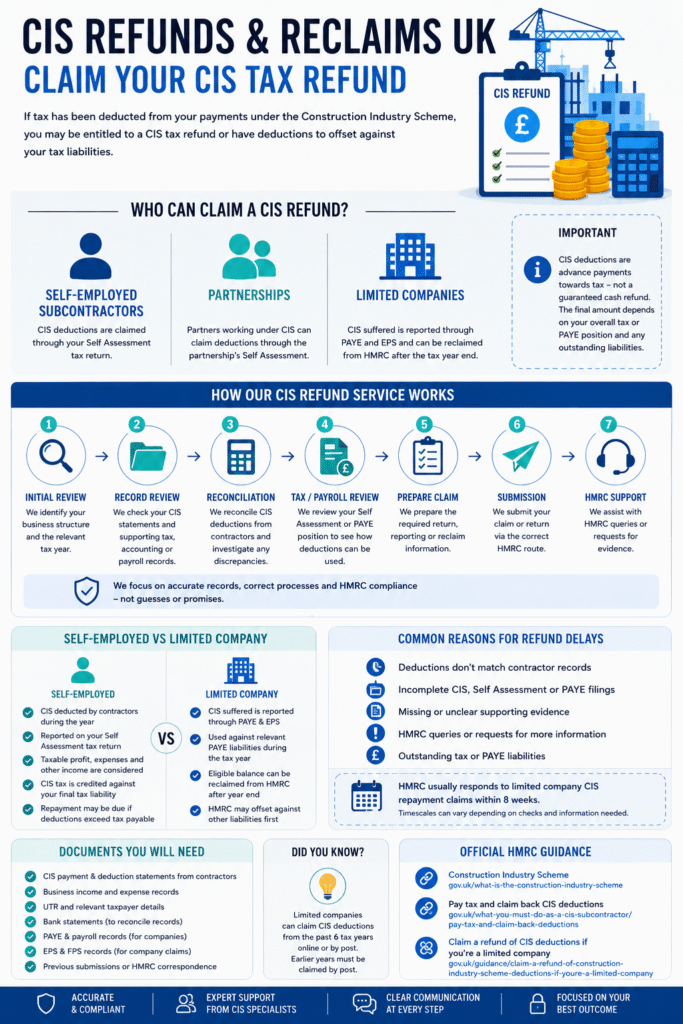
How Our CIS Refund Service Works
Our role is not simply to enter a refund figure. We first establish how the deductions arose, which HMRC route applies and whether the amount can be supported.
- Initial review: we establish whether the claim relates to an individual, partnership or limited company and identify the relevant tax year.
- Record review: we check available CIS statements and supporting tax, accounting or payroll information.
- Reconciliation: deductions are compared with the records available for the claim and obvious discrepancies are investigated.
- Tax or payroll review: we consider the relevant Self Assessment or PAYE position.
- Claim preparation: the appropriate return, reporting or reclaim information is prepared.
- Submission: the relevant filing or claim is submitted through the appropriate HMRC route.
- HMRC queries: where included within the agreed scope, we can assist with questions or evidence requests relating to the submission.
If you already have your CIS payment and deduction statements, send them to us with the tax year involved and tell us whether you operate as a sole trader, partnership or limited company. That is usually enough for us to start assessing the appropriate route and scope of work.
CIS Refund Delayed? Why HMRC May Be Checking Your Claim
A delayed CIS refund does not necessarily mean the claim has been rejected. The useful starting point is to establish when the claim was submitted, what amount was claimed and whether HMRC has requested anything further.
A CIS refund delay can arise because deductions claimed do not match information reported by contractors, CIS records are incomplete, Self Assessment information is outstanding, PAYE or EPS reporting needs attention, company filings are incomplete, or HMRC requires additional evidence.
HMRC may also have an outstanding liability to deal with before releasing a repayment.
If you are trying to chase a CIS refund, repeatedly submitting the same figures is not necessarily the right solution. First establish whether the claim is awaiting processing, whether HMRC is checking evidence or whether the credit has been applied against another liability.
How Long Does a CIS Refund Take?
There is no single CIS refund timescale that applies to every type of claim.
For limited-company CIS deduction repayment claims, HMRC currently states that it will usually respond within eight weeks. This should not be treated as a guarantee that every repayment will be paid within eight weeks. Queries, missing filings, discrepancies or requests for supporting evidence can extend the process.
Self Assessment repayment times can also vary according to the return, the taxpayer’s circumstances and any HMRC checks.
Audit Consulting Group can prepare and submit the relevant information once the required records are available, but HMRC controls its own processing and repayment times.
What Happens After You Claim Your CIS Refund?
After submission, HMRC may compare the deductions claimed with contractor records and other information held on its systems. It can ask for supporting evidence where necessary.
For limited companies, available CIS credits may first be used against relevant outstanding liabilities, including overdue PAYE or Corporation Tax. Where an eligible balance remains, it may be repaid. Depending on the circumstances and HMRC process being used, a company may also request that remaining deductions are used towards VAT or upcoming Corporation Tax.
If HMRC questions or adjusts the amount claimed, the underlying CIS statements, payroll records, tax filings and other evidence should be reviewed before deciding what action to take.
Common CIS Refund Problems
Many CIS refund problems arise from record-keeping and reporting rather than from the basic right to receive credit for tax deducted.
- Missing CIS statements: deductions cannot be fully reconciled to contractor evidence.
- Several contractors: payments and deductions from different sources have not been combined correctly.
- Incorrect figures: accounting records, contractor statements and reported amounts do not agree.
- Self Assessment errors: CIS deductions or business figures have been reported incorrectly.
- Limited-company PAYE issues: CIS suffered has not been reflected correctly through the relevant payroll reporting.
- Incomplete filings: required payroll, CIS or tax submissions are still outstanding.
- Existing liabilities: an expected cash refund is reduced because HMRC uses available credit against tax owed.
- Evidence requests: HMRC requires further information before accepting the amount claimed.
Resolving these issues usually starts with reconciling the records and identifying the source of the difference rather than automatically submitting the same claim again.
Practical CIS Refund Scenarios
The following examples illustrate common CIS refund situations and the type of work that may be required. They are practical scenarios rather than claims about individual client results.
Self-Employed Bricklayer with CIS Deductions
A self-employed bricklayer has CIS deducted by contractors throughout the year. The payment and deduction statements need to be matched to business income, while allowable expenses are considered separately when calculating taxable profit through Self Assessment.
Work required: reconcile the CIS statements, prepare the business figures and report supported deductions through the tax return.
Practical outcome: all available contractor statements are accounted for once, supported CIS credit is included in the tax calculation and the resulting position can be submitted without relying on an estimated refund figure.
 Electrician Working for Several Contractors
 Electrician Working for Several Contractors
An electrician works across several construction projects and receives deduction statements from multiple contractors. Some payments appear in the bank records but the supporting CIS statements are incomplete.
Work required: consolidate the available statements, identify missing evidence, investigate inconsistent figures and prepare the supported tax information.
Practical outcome: deductions from different contractors are reconciled into one supported record, reducing the risk of omissions, duplicate entries or unsupported amounts.
Limited Company with CIS Suffered
A construction company works as a subcontractor and has CIS deducted from payments it receives. It also operates PAYE and has reported payroll during the year.
Work required: compare CIS suffered with contractor statements and payroll reporting, review the relevant EPS and other filings and establish whether an eligible balance remains after the year-end position is considered.
Practical outcome: the company’s CIS suffered is reconciled to the available payroll and contractor records and the claim follows the appropriate PAYE/HMRC route rather than being incorrectly treated as a Corporation Tax deduction.
CIS Refunds from Previous Tax Years
Previous-year CIS issues should be reviewed according to the type of taxpayer and the period involved.
For limited companies, HMRC currently allows claims for CIS deductions from the past six tax years to be made using its available online or postal claim routes. Claims relating to earlier tax years need to be made by post. The supporting records and required filings should still be checked before a historical claim is submitted.
For self-employed subcontractors and partnerships, older CIS deductions interact with the Self Assessment rules for the relevant period. The available route can depend on whether a tax return needs to be filed, corrected or dealt with through another HMRC procedure.
Why Choose Audit Consulting Group for CIS Refund Support?
CIS refund work often involves more than submitting a number to HMRC. The deductions need to be supported and the correct process depends on how the subcontractor operates.
Our approach focuses on distinguishing between self-employed and limited-company claim routes, reconciling CIS records, checking how deductions interact with Self Assessment or PAYE and identifying discrepancies before submission where possible.
Where agreed as part of the work, we can also assist with relevant HMRC questions after submission.
Related support is available for Self Assessment, CIS compliance, bookkeeping, payroll and HMRC correspondence where those services are relevant to the underlying position.
CIS Refund & Reclaim Services Cost in the UK
The cost of preparing a CIS refund or reclaim depends on the type and complexity of the work required.
Important factors include whether you operate as a sole trader, partnership or limited company, the number of tax years and contractors involved, the quality of the records, whether Self Assessment preparation is required, whether company payroll reporting needs to be reviewed and whether HMRC has already raised a query.
Where previous submissions need investigation or CIS figures do not reconcile, additional work may be required before a reliable claim can be prepared. We clarify the expected scope before proceeding so you understand what is included.
Frequently Asked Questions About CIS Refunds & Reclaims
 How do I claim a CIS refund?
 How do I claim a CIS refund?
If you are self-employed, CIS deductions are normally claimed through your Self Assessment tax return. Limited companies generally report CIS suffered through PAYE and EPS before using the appropriate HMRC reclaim process for an eligible remaining balance.
Who qualifies for a CIS refund?
Self-employed subcontractors, partners and limited companies that have suffered CIS deductions may be able to receive credit for those deductions. Whether a cash refund is due depends on the overall tax or PAYE position and any liabilities HMRC needs to take into account.
How do I claim my CIS refund online?
The online route depends on how you operate. Self-employed subcontractors normally report CIS deductions through Self Assessment. Limited-company claims follow the relevant CIS, PAYE and HMRC company reclaim process.
How long does a CIS refund take?
Timescales vary. For limited-company CIS deduction repayment claims, HMRC currently says it will usually respond within eight weeks, but this is not a guaranteed payment deadline. Self Assessment repayments and claims requiring additional checks can follow different timescales.
Why is my CIS refund taking so long?
HMRC may be verifying deductions, comparing figures with contractor information, checking tax or payroll filings, requesting evidence or applying available credit against outstanding liabilities. The first step is to establish the status of the existing claim and whether HMRC has asked for anything further.
Can limited companies claim a CIS refund?
Yes. A limited company that has suffered CIS deductions may be able to use those deductions against relevant PAYE liabilities and reclaim an eligible remaining balance through the appropriate HMRC process.
How do I reclaim CIS suffered for a limited company?
CIS suffered is normally reported through the company’s payroll scheme, including EPS reporting where applicable. Before a year-end reclaim, relevant FPS and EPS submissions should be complete, together with required CIS returns where the company also acts as a contractor and Company Tax Returns that are due.
Can I claim CIS deductions through my Corporation Tax return?
No. A limited company should not simply deduct CIS suffered from its Corporation Tax liability through the Corporation Tax return. The deductions follow the relevant PAYE and HMRC reclaim procedure.
Can HMRC use my CIS refund against other tax I owe?
Yes, HMRC can use available CIS credits against relevant outstanding liabilities. For limited companies this can include overdue PAYE or Corporation Tax before an eligible remaining balance is repaid.
What if I don’t have my CIS statements?
Ask the relevant contractor for replacement payment and deduction statements first. If they cannot be obtained, the available evidence and HMRC options should be reviewed before unsupported figures are included in a claim.
Can I claim CIS deductions from multiple contractors?
Yes, provided the deductions are eligible and supported. Statements from multiple contractors should be reconciled so deductions are not omitted or counted more than once.
What expenses can reduce my tax as a self-employed subcontractor?
Allowable business expenses can reduce taxable business profit where they meet the relevant tax rules. This is part of the Self Assessment calculation and is separate from establishing the CIS deductions already suffered.
What if my contractor deducted CIS at 30%?
A 30% deduction can apply where a subcontractor cannot be verified at the standard CIS deduction rate. The deductions actually suffered still need to be supported and reported through the appropriate tax or company process.
Can I claim a CIS refund from previous years?
Potentially. For limited companies, HMRC currently permits claims for CIS deductions from the past six tax years through its online or postal routes, while earlier years need to be claimed by post. For self-employed subcontractors, the available route depends on the relevant Self Assessment period and whether a return or correction is required.
Can I claim a CIS refund by post?
Yes in certain circumstances. The appropriate route depends on whether the claimant is self-employed, a partnership or a company and which tax year is involved.
Can an accountant claim my CIS refund for me?
An authorised agent can assist with relevant CIS refund work, subject to the appropriate HMRC authorisation and the type of filing or claim required.
What happens if HMRC questions or reduces my CIS refund?
HMRC may request evidence or explain why its records support a different figure. CIS statements, tax records, payroll submissions and other relevant evidence should be reviewed before responding. Any available review or appeal route depends on the type of HMRC decision made.
Do I need a UTR to claim CIS deductions?
A UTR is an important part of CIS and Self Assessment records. The precise information required depends on whether the claim is being made by an individual, partnership or company.
Can a limited company reclaim CIS if it has no PAYE scheme?
This needs specific review because limited-company CIS suffered is normally reported through the PAYE process. The company’s circumstances should be checked to establish the appropriate HMRC procedure rather than assuming a standard repayment route applies.
Is a CIS refund guaranteed if tax has been deducted?
No. CIS deductions are advance payments towards tax, but a cash refund depends on the taxpayer’s final position, relevant liabilities, supporting records and HMRC’s processing of the claim.
Official HMRC Guidance on CIS Refunds
HMRC publishes guidance explaining the Construction Industry Scheme, how subcontractors account for deductions and how limited companies can claim back CIS deductions.
Construction Industry Scheme – GOV.UK
Pay tax and claim back CIS deductions – GOV.UK
Claim a refund of CIS deductions if you’re a limited company – GOV.UK
Need Help Claiming Your CIS Refund?
If CIS has been deducted from your payments, the first question is not simply how much you can reclaim. It is whether the deductions are supported, which claim route applies and how they interact with your wider Self Assessment or PAYE position.
Audit Consulting Group can review your CIS records, identify the appropriate reclaim process and prepare the relevant submission.
If you already have your CIS payment and deduction statements, send them together with the tax year involved and confirm whether you operate as a sole trader, partnership or limited company.
Get your CIS records reviewed and establish the correct refund or reclaim route before submitting the figures to HMRC.
CIS Refund & Reclaim Services Cost Calculator
Calculate the cost of CIS refund and reclaim support in the UK. The scope can vary depending on whether the work involves Self Assessment, limited-company CIS suffered, PAYE reporting, missing records, previous tax years or an existing HMRC query.
Service Cost Estimation
Select the service category below to calculate the estimated cost of either accounting & tax services or forms and submissions.
Select Required Services / Forms
Select one or more services/forms to receive an accurate cost estimate. You can adjust your selection at any stage.
How would you like to engage our services?
Please select whether you require a one-off service or ongoing monthly support.
Contract Duration
Your cost estimate
Apply now and get 10% OFF
Submit your request today and receive an exclusive 10% discount on your selected service.
All prices are estimates. To receive a personalised quote, please fill out the form or contact us.
Ready to get started?
Get professional support from experienced UK accountants