
Verify Your Identity for Companies House
Leave your details and our team will get back to you shortly.
If you are a company director, Person with Significant Control (PSC), LLP member or individual responsible for filing information with Companies House, identity verification may now be a mandatory part of your compliance obligations.
The introduction of identity verification is one of the most significant Companies House reforms in recent years. Designed to improve corporate transparency and reduce misuse of UK companies, the new requirements affect millions of directors, beneficial owners and business representatives across the UK and overseas.
While the requirement itself may appear straightforward, many applicants discover that practical challenges arise quickly. Documents may not meet verification standards, names may not match across records, overseas documentation may require additional review and biometric checks do not always succeed on the first attempt.
Audit Consulting Group provides professional Companies House identity verification support for UK residents, overseas directors, PSCs, company founders, LLP members and authorised representatives. We help clients understand the requirements, prepare suitable documentation and complete the verification process efficiently while reducing the risk of avoidable delays.
Whether you are forming a new company, managing an existing business or preparing for future Companies House compliance requirements, identity verification should be completed correctly from the outset.
Need assistance with Companies House identity verification?
Our team can explain the requirements, review your documents and guide you through the process from start to finish.
What This Companies House Identity Verification Service Includes
Many people assume identity verification is simply a matter of uploading a passport. In reality, the process often involves document validation, compliance checks, identity matching, address verification and ensuring that information aligns with Companies House requirements.
Our service is designed to help individuals and businesses navigate the process confidently while avoiding common mistakes that can lead to delays or rejected applications.
Depending on your circumstances, support may include:
- Companies House identity verification for directors;
- verification support for Persons with Significant Control (PSCs);
- identity verification for LLP members;
- support for overseas directors and beneficial owners;
- document suitability reviews before submission;
- AML and KYC compliance checks where required;
- guidance on acceptable identity and address documentation;
- support with biometric verification requirements;
- assistance with complex ownership structures;
- verification support for company formation clients;
- guidance on next steps after successful verification.
The objective is not simply to complete a verification requirement. The objective is to ensure that the process is completed accurately, efficiently and in a way that supports wider Companies House compliance obligations.
Why Companies House Identity Verification Matters
 Identity verification forms part of wider reforms introduced through the Economic Crime and Corporate Transparency Act. These reforms are intended to improve the reliability of information held on the Companies House register and make it more difficult for individuals to misuse UK corporate structures.
For business owners, directors and PSCs, this means identity verification is becoming an important part of maintaining compliance and ensuring that company information remains accurate.
The requirement can affect an individual’s ability to:
- incorporate a new company;
- accept a director appointment;
- act as a Person with Significant Control;
- submit certain Companies House filings;
- manage company information on the register;
- act on behalf of a company in certain circumstances;
- maintain ongoing Companies House compliance.
Many directors focus on the verification itself. However, the wider consideration is ensuring that identity verification does not delay important company activities such as incorporations, appointments, confirmation statements or statutory filings.
Who Needs to Verify Their Identity for Companies House?
The requirement applies to a broad range of individuals connected to UK companies. It is not limited to newly incorporated businesses or newly appointed directors.
You may need to complete identity verification if you are:
- a company director;
- a newly appointed director;
- a Person with Significant Control (PSC);
- an LLP member or designated member;
- an individual incorporating a UK company;
- a beneficial owner of a UK company;
- an overseas director of a UK company;
- an individual filing information on behalf of a company;
- an accountant, adviser or authorised representative involved in company filings.
The requirement is based primarily on your relationship to the company rather than your country of residence. As a result, overseas directors and beneficial owners may still be required to complete identity verification even if they have never lived in the UK.
For companies with multiple directors, several PSCs or more complex ownership structures, planning verification requirements in advance can help prevent delays later.
Common Client Problems and Compliance Risks
Most identity verification difficulties arise from practical issues rather than deliberate non-compliance.
In many cases, the applicant has valid documentation but encounters problems because documents are unclear, information does not match exactly or additional evidence is required.
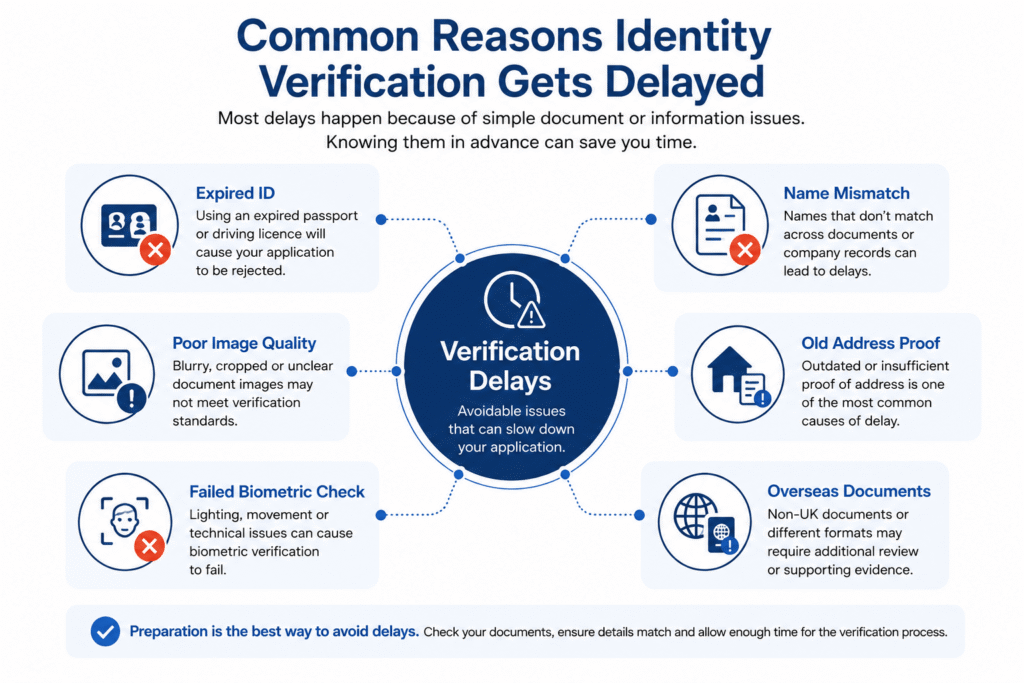
Some of the most common issues include:
- expired passports or driving licences;
- poor quality document images;
- cropped or partially visible documents;
- different name formats across records;
- outdated proof of address documentation;
- failed biometric checks;
- overseas documentation that requires additional review;
- uncertainty regarding acceptable documents;
- attempting verification shortly before important filing deadlines.
One practical issue we regularly see involves directors whose Companies House records do not perfectly match their identity documentation. This may occur because of middle names, recent address changes, alternative spellings or historical company records that have never been updated. The discrepancy may appear minor but can create delays if not identified early.
Another common issue affects overseas directors. A document may be entirely legitimate in the country where it was issued but still require additional assessment because the format differs significantly from standard UK documentation.
The earlier these issues are identified, the easier they are usually to resolve.
What Clients Often Underestimate
Identity verification is often viewed as a simple administrative requirement. In practice, many applicants underestimate how closely documentation is assessed and how important consistency becomes throughout the process.
For example, a passport may be valid, but if company records contain a shortened version of the name, supporting information may need to be reviewed. Similarly, proof of address documents that appear acceptable at first glance may not always satisfy verification requirements if they are outdated, incomplete or inconsistent.
Timing is another factor that is frequently overlooked.
Many directors only start the verification process when they are ready to form a company, submit a filing or update company information. If a verification issue arises at that stage, other compliance activities may also be delayed.
For this reason, many businesses prefer to address identity verification well before critical Companies House deadlines or corporate transactions.
Companies House Identity Verification and Wider Corporate Compliance
Identity verification should not be viewed as an isolated requirement.
For directors and business owners, it forms part of a wider compliance framework that may include company formation, confirmation statements, annual accounts, Corporation Tax obligations and maintaining accurate Companies House records.
Although verification confirms the identity of individuals connected to a company, directors remain responsible for ensuring that company information is accurate and that statutory obligations continue to be met.
This is one reason many clients choose to deal with identity verification alongside broader compliance matters rather than treating it as a standalone administrative task.
Companies House Identity Verification Requirements
The practical requirements for Companies House identity verification depend on the individual’s role, location and the type of company activity involved. A UK-based director with standard documentation may have a relatively straightforward route. An overseas PSC, a beneficial owner with non-UK documents or a director with mismatched records may require a more careful review before verification can be completed.
Most applicants will need to confirm their identity using official documentation and, where required, complete biometric or manual verification checks. The aim is to confirm that the individual connected to the company is identifiable and that their details are consistent with the information being submitted or held on the Companies House register.
In practical terms, the process may involve:
- confirming the role you hold within the company;
- checking whether identity verification is required before appointment, incorporation or filing;
- reviewing identity documents before submission;
- checking proof of address where required;
- completing biometric or manual verification checks;
- submitting confirmation through the appropriate route;
- keeping suitable records of the completed verification.
The exact route may vary depending on Companies House requirements, the available documents and whether verification is completed directly or through an Authorised Corporate Service Provider.
What Documents Are Usually Needed?
 Most applicants will need a valid identity document. This is usually a passport or driving licence, although the appropriate document may depend on the verification method and the applicant’s circumstances.
Proof of address may also be required. This is often where delays occur, particularly for overseas applicants or individuals whose address details have changed recently.
Documents commonly reviewed during the process may include:
- a valid passport;
- a valid UK or international driving licence;
- proof of residential address;
- a bank statement, utility bill or similar address document;
- supporting evidence where a name has changed;
- additional documentation for overseas applicants or complex cases.
The document itself is only one part of the assessment. The quality of the image, the consistency of the information and the suitability of the document for the verification route all matter.
Common document issues include glare, cropped images, expired ID, unclear addresses, different spelling across records, missing middle names or documents that do not show enough information to complete the check. These issues are often avoidable if the documents are reviewed before submission.
Companies House Verification for Overseas Directors
Overseas directors and non-UK beneficial owners often face additional challenges when completing Companies House identity verification.
The requirement may still apply even if the individual has never lived in the UK. What matters is the connection to the UK company, such as acting as a director, controlling shares, holding voting rights or exercising significant influence.
Issues commonly arise because overseas documents do not always follow UK-style formats. Address documents may look different, naming conventions may vary, and certain documents may require additional assessment before they can be used confidently.
Common difficulties for overseas applicants include:
- non-UK proof of address not matching expected verification formats;
- documents issued in different languages or structures;
- facial recognition or biometric checks failing;
- passport names not matching Companies House records exactly;
- no UK address history;
- uncertainty about which documents are acceptable;
- communication delays caused by time zones or document availability.
In these situations, the most valuable part of the process is often the pre-submission review. Identifying a likely issue before submission is usually faster than trying to correct a rejected verification attempt afterwards.
Audit Consulting Group supports overseas directors, PSCs and beneficial owners who need to verify their identity for a UK company while based outside the UK.
Typical Pricing and Fee Expectations
Pricing for Companies House identity verification support should reflect the complexity of the work involved rather than simply the act of checking a document.
A straightforward UK-based applicant with clear documentation will usually require less review time than an overseas director with non-standard proof of address, previous failed verification attempts or ownership structures involving several companies.
The fee may depend on factors such as:
- whether the applicant is based in the UK or overseas;
- the type of identity documents available;
- whether proof of address needs additional review;
- whether biometric verification is suitable;
- whether manual verification is required;
- whether previous verification attempts were rejected;
- whether multiple directors or PSCs need verification;
- whether the process is linked to company formation or urgent filings.
For many clients, the value of the service is not only speed. It is the reduction of avoidable errors, clearer understanding of requirements and confidence that the verification process is being handled in a structured way.
Audit Consulting Group provides fee information before work begins, based on the applicant’s role, location and document situation.
How Long Does the Verification Process Take?
 The time required depends on the complexity of the case and the quality of the documents available.
For straightforward applicants with suitable documents, identity verification can often be completed quickly once the correct information has been provided. Where documents are unclear, expired, inconsistent or issued overseas, additional review may be needed before the process can be completed safely.
Timeframes may be affected by:
- document quality;
- availability of suitable proof of address;
- biometric check success;
- manual review requirements;
- name or address mismatches;
- previous rejected attempts;
- the number of people requiring verification.
If identity verification is required before a company formation, director appointment, confirmation statement or statutory filing, it is sensible to begin the process early. A minor document issue can become more disruptive if discovered close to a deadline.
Deadlines, Timing and Companies House Compliance
Identity verification is closely connected to wider Companies House compliance. It may affect whether a director, PSC or authorised individual can complete certain actions without delay.
Verification may be relevant before or during:
- company incorporation;
- director appointment;
- PSC registration or updates;
- confirmation statement filing;
- changes to company records;
- filings submitted by an agent;
- ongoing company compliance activity.
Completing identity verification does not remove other statutory responsibilities. Companies may still need to file accounts, confirmation statements, company updates and other required information on time.
For businesses already managing bookkeeping, annual accounts, Corporation Tax, payroll, VAT or management reporting responsibilities, identity verification should be treated as part of the wider compliance calendar rather than a disconnected administrative task.
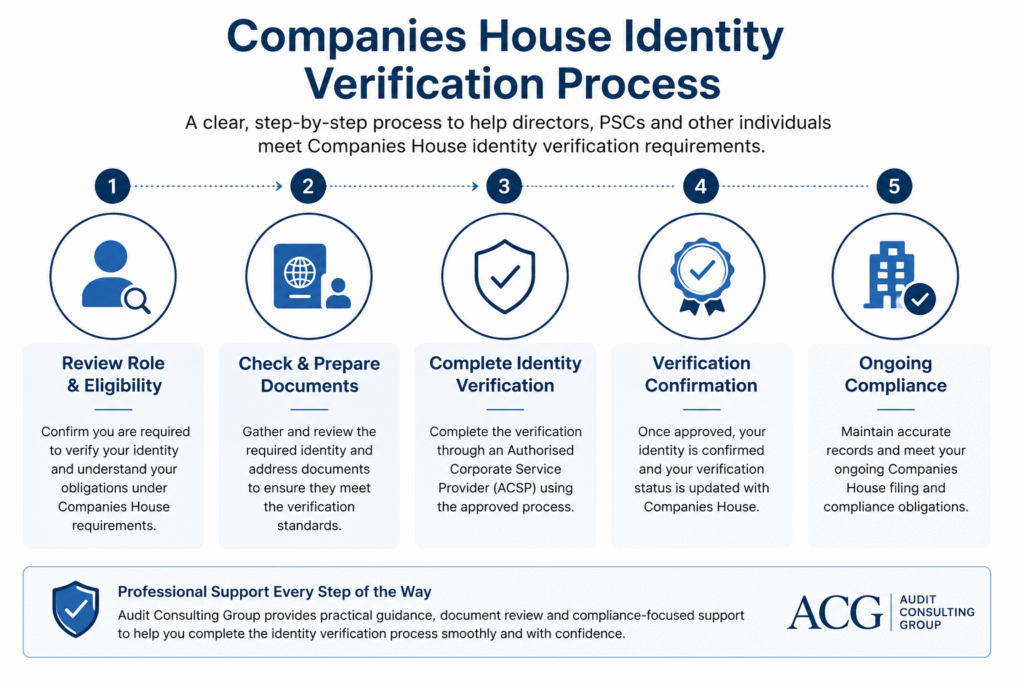
How the Companies House Identity Verification Process Works
Although the requirement is new for many directors and business owners, the process itself becomes much easier when approached in a structured way. Most verification issues are not caused by complicated regulations. They are usually caused by incomplete documentation, inconsistent information or uncertainty about the correct verification route.
For that reason, successful identity verification often starts with preparation rather than submission.
Step 1 – Understanding Your Position
The first stage is confirming how the Companies House identity verification requirement applies to you.
A newly appointed director, an existing PSC, an overseas beneficial owner and a company founder may all need verification, but the practical requirements can differ depending on the role involved.
At this stage, we review:
- your relationship to the company;
- whether identity verification is required;
- the timing of any planned filing or appointment;
- whether additional compliance considerations apply;
- the most appropriate verification route.
This early review often prevents delays later in the process.
Step 2 – Document Review
Before verification takes place, identity documents should be assessed carefully.
Many rejected applications originate from issues that could have been identified within minutes before submission.
During the document review stage, attention is given to:
- document validity;
- name consistency;
- proof of address suitability;
- image quality;
- expiry dates;
- potential compliance concerns;
- overseas document considerations.
For overseas applicants, this stage is often particularly important because document formats and address evidence may differ from UK norms.
Step 3 – Identity Verification
Once the documentation has been reviewed, the verification process itself can proceed.
Depending on the circumstances, this may involve:
- digital verification;
- biometric identity checks;
- manual review procedures;
- additional compliance checks where required.
The objective is to establish identity accurately while ensuring that the verification route remains appropriate for the individual circumstances.
Step 4 – Confirmation and Record Management
After successful verification, confirmation should be retained alongside other important company records.
For many businesses, this becomes part of a wider compliance framework that includes Companies House filings, director records, confirmation statements and other statutory obligations.
Good record management may seem like a minor administrative point, but it often becomes important later when ownership changes, directors are appointed or compliance records need to be reviewed.
Direct Verification vs Using an Authorised Corporate Service Provider
Individuals generally have two options when completing identity verification.
They may verify directly through the available government process or they may complete verification through an Authorised Corporate Service Provider (ACSP).
Both approaches are legitimate. The most suitable route depends on the applicant’s circumstances, confidence with compliance processes and the complexity of the case.
Direct Verification
Some directors and business owners prefer to complete the process independently.
This may work well where:
- documentation is straightforward;
- the applicant is UK-based;
- there are no name or address discrepancies;
- the individual is comfortable managing the process.
However, direct verification can become more challenging where documents require interpretation, previous attempts have failed or overseas documentation is involved.
Verification Through an ACSP
An Authorised Corporate Service Provider can support the verification process within the relevant compliance framework.
This often provides additional reassurance because documentation can be reviewed before submission and potential issues can be identified earlier.
Verification through an ACSP is frequently chosen by:
- overseas directors;
- Persons with Significant Control;
- first-time company founders;
- beneficial owners;
- professional advisers;
- clients with previous verification issues;
- businesses managing multiple directors.
For many applicants, the benefit is not simply convenience. It is reducing uncertainty and avoiding preventable delays.
Why Similar Identity Verification Applications Often Go Wrong
One of the most useful lessons from real-world verification work is that applications rarely fail because of major compliance problems.
More often, they fail because of small issues that nobody identified early enough.
Examples include:
- passport names that differ slightly from company records;
- proof of address documents that are older than expected;
- poor-quality images;
- documents uploaded in the wrong format;
- failed biometric checks;
- incomplete supporting information;
- records that were never updated following a change of address.
In many cases, the applicant is fully eligible to complete verification. The difficulty lies in presenting the information in a way that satisfies the verification requirements.
This is particularly common where businesses have been operating for years and company records contain information that no longer perfectly reflects the current position.
Practical Guidance Before Starting Verification
There are several steps that can reduce the likelihood of delays.
Before beginning the process, it is often sensible to check:
- that identity documents remain valid;
- that names match company records;
- that proof of address is current and readable;
- that document images are clear;
- that any previous name changes can be evidenced if required;
- that overseas documents can be supported appropriately.
These checks may seem basic, but they are responsible for preventing a significant proportion of avoidable verification problems.
Accounting Firms, Agents and Multi-Director Verification Projects
The new verification requirements affect not only company directors but also many professional advisers who support companies with compliance obligations.
Accountants, company formation agents and professional service providers may need efficient processes for managing identity verification across multiple clients.
For firms handling numerous directors, the challenge is often organisational rather than technical.
A structured verification process can help:
- reduce administrative burden;
- maintain consistent compliance records;
- minimise delays;
- improve document management;
- support future Companies House requirements.
Many practices are now integrating identity verification into broader compliance workflows alongside company formation, confirmation statements, annual accounts and corporate record maintenance.
What Happens After Identity Verification?
Completing identity verification is an important milestone, but it is not the end of the compliance journey.
Directors and PSCs remain responsible for ensuring that company information held at Companies House remains accurate and up to date.
Depending on the circumstances, businesses may still need to manage:
- director appointments and resignations;
- confirmation statements;
- annual accounts filings;
- changes to Persons with Significant Control;
- company address updates;
- Corporation Tax obligations;
- other statutory reporting requirements.
Identity verification confirms who the individual is. It does not replace wider Companies House responsibilities or ongoing corporate compliance obligations.
For this reason, many business owners view identity verification as one part of a broader compliance framework rather than a standalone administrative task.
Directors should also ensure that future changes to company information are reflected accurately and promptly. Identity verification supports transparency, but maintaining accurate records remains an ongoing responsibility throughout the life of the company.
Why Businesses Choose Audit Consulting Group
Companies House identity verification is ultimately a compliance process, but for many clients the real value comes from reducing uncertainty and avoiding delays.
Most people only need to complete identity verification occasionally. As a result, they are often unfamiliar with the requirements, unsure which documents are acceptable and uncertain about what happens if something goes wrong.
Audit Consulting Group supports clients through the process with practical guidance, document review and compliance-focused support. Rather than simply checking documents, we help clients understand the wider context, identify potential issues before submission and complete verification with confidence.
Clients choose our team because we offer:
- support for UK and overseas applicants;
- guidance for directors, PSCs and beneficial owners;
- document review before submission;
- support with complex ownership structures;
- assistance with rejected or delayed verification attempts;
- clear communication throughout the process;
- support that aligns with wider Companies House compliance obligations.
Many clients also work with us on company formation, bookkeeping, annual accounts, Corporation Tax, VAT and other compliance matters, allowing identity verification to be handled within a broader business support framework.
Practical Examples and Compliance Outcomes
Overseas Director Preparing for an Urgent Filing
A director based outside the UK needed identity verification completed before a planned Companies House filing. Previous attempts had stalled because the supporting documents did not align fully with existing company records.
Following a review of the documentation and verification route, the discrepancies were identified and corrected before submission. Verification was completed successfully and the company was able to proceed with its planned filing timetable.
After reviewing the documentation and selecting a more suitable verification route, the discrepancies were resolved before the planned filing deadline. Verification was completed successfully, allowing the company to proceed with its filing obligations without interruption.
New Company Founder Requiring Verification Before Incorporation
A first-time business owner was preparing to form a UK company but was unsure how the new identity verification requirements applied.
After reviewing the planned company structure and supporting documents, the verification process was completed before incorporation activities progressed.
Verification was completed before incorporation activities began, helping the founder avoid delays during the company registration process and providing clarity regarding future Companies House obligations.
Accounting Practice Managing Multiple Directors
An accountancy firm needed assistance coordinating identity verification for several directors across different client companies.
Rather than dealing with each case independently, a structured approach was implemented that standardised document collection, improved record management and reduced administrative duplication.
The structured process reduced administrative duplication, improved document consistency and provided clearer oversight across multiple director verification requirements.
Business Impact and Compliance Benefits
Successful identity verification helps businesses avoid more than immediate compliance issues.
When managed correctly, it can support:
- timely company incorporations;
- director appointments;
- Companies House filings;
- confirmation statement submissions;
- corporate record accuracy;
- ongoing compliance planning;
- reduced administrative disruption.
While verification itself is only one requirement, delays in completing it can have wider operational consequences. This is why many businesses choose to address identity verification proactively rather than waiting until a filing deadline approaches.
Communication, Deadlines and Ongoing Support
Clients often have questions that extend beyond the verification process itself.
They want to understand how the requirement affects future filings, whether additional actions are needed and how identity verification fits within their wider Companies House responsibilities.
Throughout the process, we provide guidance on:
- document requirements;
- verification routes;
- expected timelines;
- common causes of rejection;
- future compliance considerations;
- record-keeping expectations;
- related Companies House obligations.
Where appropriate, identity verification support can be coordinated alongside other business compliance services to help reduce administration and maintain consistency across company records.
Frequently Asked Questions
Is Companies House identity verification mandatory?
For many directors, Persons with Significant Control and other individuals connected with UK companies, identity verification is becoming a mandatory compliance requirement under Companies House reforms.
Can overseas directors complete identity verification?
Yes. Overseas directors and beneficial owners can complete identity verification, although additional document review may sometimes be required depending on the circumstances.
Can I complete verification myself?
In some situations, yes. However, many applicants choose to use an Authorised Corporate Service Provider where they would like additional support, document review or assistance with more complex cases.
What documents are usually required?
Most applicants will require a valid identity document and, in some cases, proof of address. The exact documentation can vary depending on the verification route and individual circumstances.
How long does the process take?
Timeframes depend on document quality, applicant circumstances and whether additional review is required. Straightforward cases are often completed much faster than those involving overseas documents or information discrepancies.
What happens if my application is rejected?
A rejected application will usually need to be corrected and resubmitted. Common reasons include document quality issues, expired identification, failed biometric checks or inconsistencies between records.
Does identity verification replace other Companies House obligations?
No. Directors and PSCs remain responsible for meeting all other applicable Companies House and corporate compliance obligations.
Do Persons with Significant Control need to verify their identity?
Yes. PSCs are among the groups that may be required to complete identity verification under the Companies House reforms.
Verify Your Identity for Companies House with Confidence
If you need assistance with Companies House identity verification, Audit Consulting Group can help you understand the requirements, prepare suitable documentation and complete the process efficiently.
Our service is suitable for:
- company directors;
- Persons with Significant Control;
- overseas directors;
- beneficial owners;
- LLP members;
- company founders;
- accountants and agents;
- businesses managing multiple verifications.
Clear guidance. Practical support. Compliance-focused assistance.
Call: +44 7386 212550
Email: info@auditconsultinggroup.co.uk
Contact Audit Consulting Group to discuss your Companies House identity verification requirements and take the next step with confidence.
Companies House Identity Verification Service Cost
The cost of Companies House identity verification support depends on the complexity of the case, the number of individuals requiring verification and whether additional review is required for overseas documentation or previous rejected applications.
Simple UK-based cases are generally more straightforward, while complex ownership structures, overseas applicants and urgent compliance situations may require additional review and support.
Audit Consulting Group provides transparent pricing before work begins, allowing clients to understand the scope of support required and the expected process from the outset.
Service Cost Estimation
Select the service category below to calculate the estimated cost of either accounting & tax services or forms and submissions.
Select Required Services / Forms
Select one or more services/forms to receive an accurate cost estimate. You can adjust your selection at any stage.
How would you like to engage our services?
Please select whether you require a one-off service or ongoing monthly support.
Contract Duration
Your cost estimate
Apply now and get 10% OFF
Submit your request today and receive an exclusive 10% discount on your selected service.
All prices are estimates. To receive a personalised quote, please fill out the form or contact us.
Ready to get started?
Get professional support from experienced UK accountants