
UK Regulatory Compliance & Authority Mapping Services for Businesses
Understanding which UK regulatory authorities apply to your business is not always straightforward. The UK does not have one regulator covering every company. Obligations are divided between different authorities and usually depend on what your business actually does, how it operates, who its customers are and which activities it carries out.
Audit Consulting Group provides UK regulatory compliance services for startups, limited companies, SMEs, international founders and growing businesses that need a clearer understanding of their regulatory position. We help map relevant authorities, identify potential compliance requirements, review supporting information and set out practical next steps.
The objective is not to create unnecessary compliance work. It is to establish which requirements genuinely need attention now, what could become relevant as the business develops and where specialist advice may be required.
Leave your details and our team will get back to you shortly.
What Our UK Regulatory Compliance Service Covers
Regulation in the UK is generally driven by activities and obligations rather than simply by an industry label. Two companies operating in the same sector can face different regulatory requirements because they handle customers, payments, personal data, premises or services differently.
Our regulatory compliance assessment can help establish:
- which UK regulatory authorities may be relevant to your activities,
- why a particular authority or requirement may apply,
- whether registration, authorisation, licensing, notification or general compliance obligations need further consideration,
- which documentation or internal controls may be expected,
- where there appear to be gaps in the current compliance position,
- which changes to the business model could create additional obligations,
- what practical actions should be prioritised next.
Where a question requires legal advice, regulated financial-services advice or a formal interpretation of a regulatory perimeter, we identify that boundary rather than presenting an initial compliance review as a definitive legal conclusion.
Who Needs Regulatory Compliance Support?
New UK businesses and startups
If you are preparing to trade, it can be useful to consider your UK business regulatory requirements before operations begin. Registrations, licences, data protection requirements or sector-specific obligations can be harder to address once contracts, payment flows and customer processes are already established.
Growing or changing businesses
A business that was correctly structured when it launched may face different requirements after introducing new services, changing how customers pay, entering another market, hiring employees or working with new types of clients.
International founders and overseas companies entering the UK
Regulatory assumptions from another jurisdiction do not necessarily transfer to the UK. We can review proposed UK activities and identify the authorities and compliance areas that should be considered as part of market entry.
Agencies, intermediaries and platforms
Businesses operating between clients and third-party providers can have less obvious regulatory boundaries. Contracts, payment handling, customer relationships and the actual services performed often matter more than labels such as “agency”, “platform” or “consultancy”.
Businesses facing questions from banks or commercial partners
Banks, payment providers, investors and business partners may ask who regulates your business, whether authorisation or licensing is required and what compliance controls are in place. A clear factual position can make these due diligence discussions easier to manage.
Businesses preparing for registration, licensing or authorisation
Before starting an application, it is important to understand what the requirement relates to and whether the proposed activities actually fall within the relevant framework.
How We Map Your Regulatory Position
A useful regulatory mapping exercise starts with the business model rather than a list of regulators.
We look at the products or services supplied, customer types, contractual relationships, payment flows, use of personal data, employees, premises and the jurisdictions involved. We then identify activities that may create different regulatory or compliance considerations.
The review can distinguish between:
- requirements that appear relevant now,
- questions requiring further specialist confirmation,
- authorities that do not appear directly relevant to the current model,
- future triggers that could change the position as the business grows.
The result is a clearer compliance map and an actionable set of priorities rather than an indiscriminate list of every UK regulator.
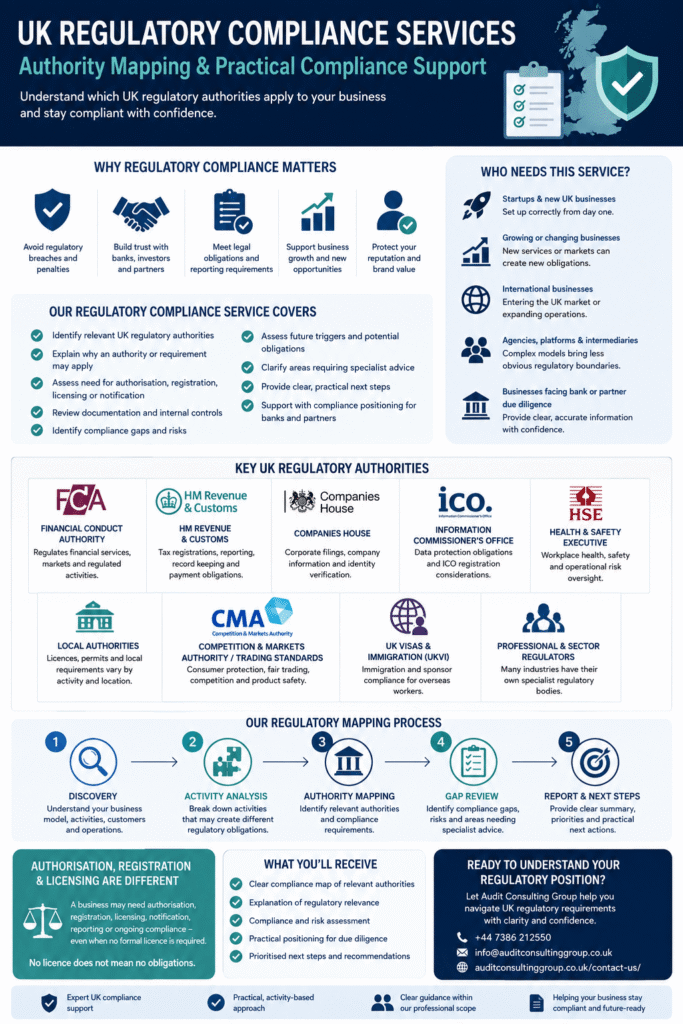
Authorisation, Registration, Licensing and General Compliance Are Not the Same

One common source of confusion is treating every regulatory obligation as a licence.
Depending on the activity, a business may require formal authorisation, registration with an authority, a local or sector-specific licence, a notification, periodic reporting, statutory filings or ongoing compliance with particular rules.
A business can therefore have significant UK regulatory requirements even when it does not need a traditional licence. For example, a company may have Companies House filing and identity verification obligations, HMRC tax responsibilities, data protection requirements or workplace safety duties.
This distinction also matters when responding to banks, customers and partners. Saying that a business is simply “regulated” or “unregulated” can be too broad if several different types of obligation apply.
Major UK Regulatory Authorities Businesses Commonly Encounter
There are numerous UK regulatory bodies and government authorities. Not all will apply to a particular business. The bodies below are some of those commonly encountered when reviewing a UK compliance position.
Financial Conduct Authority (FCA)
The FCA regulates specified financial services, markets and regulated activities. Whether FCA authorisation or another regulatory route needs consideration depends on the activities being performed rather than simply the company name or broad industry description.
Where a business model may involve regulated financial activity, we can assist with initial activity mapping and identify the questions that need further investigation. A definitive FCA perimeter conclusion may require specialist regulatory or legal advice.
HM Revenue & Customs (HMRC)
HMRC is relevant through tax registrations, reporting, record keeping and payment obligations. Depending on the business, this may include Corporation Tax, VAT, PAYE, Self Assessment, CIS and other tax responsibilities.
These are not necessarily licensing requirements, but failure to register, report or maintain adequate records can create significant compliance issues.
Companies House
UK companies have ongoing Companies House obligations covering corporate information, annual filings and transparency requirements. Directors and people with significant control may also have identity verification obligations.
These responsibilities form part of ongoing corporate compliance and should not be considered only when annual accounts are due.
Information Commissioner’s Office (ICO)
Businesses processing personal information need to understand their responsibilities under UK data protection rules. Depending on the organisation and its activities, this can include considering whether the ICO data protection fee applies.
Customer records, employee information, marketing databases and other personal data can make data protection relevant to businesses across many sectors.
Health & Safety Executive (HSE)
The HSE oversees workplace health and safety across many industries. The practical obligations depend on the workplace, employees, equipment, operational risks and activities being carried out.
Local Authorities and Councils
Councils can be responsible for licences, permits and local requirements affecting premises and specific activities. Requirements can therefore vary by both activity and location.
Competition and Markets Authority (CMA) and Trading Standards
Consumer protection, fair trading, competition and product-related rules can affect businesses selling goods or services to consumers. Trading Standards may also be relevant to product safety and marketing practices.
UK Visas & Immigration (UKVI)
Businesses employing or sponsoring workers from overseas can have separate immigration and sponsor compliance responsibilities. These should be considered separately from the company’s accounting and tax obligations.
Professional and Sector-Specific Regulators
Some professions and activities have their own specialist business regulatory bodies. A proper assessment therefore needs to consider the sector and services actually provided rather than relying only on the major authorities listed above.
When More Than One Authority Applies
 It is common for a business to deal with several authorities at the same time. A limited company might have corporate obligations to Companies House, tax responsibilities to HMRC, data protection responsibilities involving the ICO, employment-related duties and separate sector-specific requirements.
Registration with one authority does not normally satisfy obligations administered by another. This becomes especially important when a company adds a new activity while continuing its existing business.
Regulatory Information for Banks, Payment Providers and Business Partners
Regulatory questions do not always come directly from a regulator. They frequently arise during commercial due diligence.
A bank, payment provider, investor, marketplace or business partner may ask:
- who regulates your business,
- whether FCA authorisation is required,
- whether you hold licences relevant to your activities,
- which authorities you are registered with,
- what compliance procedures you maintain.
These questions need accurate answers. Describing the business as regulated when it is not can be problematic, while simply stating that it is “unregulated” may fail to explain registrations and compliance obligations that do apply.
Our regulatory compliance support can help organise the factual position, identify relevant evidence and prepare the business to answer reasonable due diligence questions more clearly.
Why Businesses Get Confused About UK Regulators

Regulatory mistakes often begin with a reasonable but incorrect assumption.
- Copying a competitor’s regulatory position without comparing the underlying activities.
- Believing that no licence means there are no compliance obligations.
- Applying to an authority before establishing whether the application is required.
- Using website wording that suggests activities the business does not actually perform.
- Failing to reconsider the position after introducing a new service or payment model.
- Giving banks or partners an oversimplified answer about regulatory status.
Generic guidance can highlight possible issues, but it rarely reflects the complete operating model of a particular business. That is why the underlying facts matter.
What Audit Consulting Group Delivers
Our UK regulatory compliance support is designed to turn uncertainty into a structured set of practical actions.
Regulatory mapping
We review business activities and identify authorities and compliance areas that appear relevant, together with potential future triggers.
Explanation of regulatory relevance
We explain which aspect of the business creates the potential connection with a particular requirement or authority.
Compliance and risk review
We identify obvious gaps, unresolved questions and areas where additional documentation, registration or specialist input may be needed.
Practical compliance positioning
Where appropriate, we help organise the factual description of the business and its compliance position for operational and due diligence purposes.
Prioritised next steps
Depending on the agreed scope, the output may include a written summary covering relevant authorities, potential obligations, documentation gaps, future triggers and recommended actions.
What Documents and Information Do We Need?
The quality of a regulatory compliance assessment depends on understanding how the business works in practice.
We may ask for:
- a description of products and services,
- website and marketing materials,
- customer types and locations,
- details of payment flows,
- information about intermediaries or third-party providers,
- key contracts or terms where relevant,
- existing registrations, licences or authorisations,
- correspondence from regulators, banks or partners,
- details of planned new services or markets.
A website alone is rarely enough to establish the full position. Two businesses can describe themselves similarly online while operating very differently behind the scenes.
How Our Regulatory Compliance Assessment Works
Step 1 – Discovery and business model review
We establish what the business does, who it serves and how the main transactions and operational processes work.
Step 2 – Activity-based analysis
We separate the business model into activities that may create different regulatory or compliance considerations.
Step 3 – Authority mapping
We identify the UK regulatory authorities and obligations that may be relevant to those activities.
Step 4 – Compliance gaps and specialist questions
We distinguish practical compliance actions from issues that require further legal, regulated or sector-specific advice.
Step 5 – Written conclusions and next steps
Depending on the agreed service, we provide a structured summary and discuss the actions that should be considered next.
What Businesses Often Underestimate
The most important regulatory issue is not always an obvious failure to obtain a licence. Smaller operational changes can alter the compliance position without attracting immediate attention.
A new payment flow, use of an intermediary, collection of additional customer data, hiring employees, moving into new premises, serving different customers or launching another service can all create new questions.
Businesses also sometimes focus on the regulator and overlook the underlying evidence. Registrations and compliance statements need to be supported by accurate information, suitable procedures and, where relevant, accounting, tax and corporate records.
For that reason, the regulatory position is worth reconsidering when the business model materially changes rather than only after a bank or authority raises a question.
What We Can and Cannot Confirm
Audit Consulting Group provides accounting, tax and business compliance support. We do not present general compliance guidance as legal advice.
Within the agreed scope, we can review business activities, map potentially relevant authorities, identify compliance questions, review available documentation and help organise practical next steps.
We do not guarantee that a regulator will accept a particular interpretation or application, and we do not provide regulated financial advice or legal opinions where appropriately authorised specialist advisers are required.
Where an issue falls outside our professional scope, we identify it so that suitable specialist advice can be obtained before the business relies on a conclusion.
Practical Regulatory Scenarios
Online business considering possible FCA requirements
An online service introduces a payment, referral or intermediary arrangement and becomes unsure whether the change creates FCA considerations.
The review starts with how the service works: who contracts with the customer, how funds move and which party performs each activity. The practical outcome is a clearer list of regulatory questions and an understanding of whether specialist FCA perimeter advice should be obtained before implementation.
Overseas founder entering the UK market
An international founder understands the framework in their home jurisdiction but is unsure how the proposed UK operation interacts with HMRC, Companies House, ICO, local or sector-specific requirements.
A structured assessment separates immediate company and tax compliance from activity-specific issues and provides a more useful launch checklist for the UK operation.
Agency expanding the services it performs for clients
An agency starts with straightforward consultancy and later takes responsibility for additional processes, customer interactions or payments on behalf of clients.
Reviewing the expanded model helps identify whether the original compliance assumptions remain appropriate and which contractual or regulatory boundaries need further investigation before the new process becomes routine.
Why Use Audit Consulting Group for Regulatory Compliance Support?
Regulatory guidance is most useful when it connects compliance requirements to the practical operation of the business.
Our approach focuses on understanding the activities first, distinguishing between formal authorisation and wider compliance obligations, reviewing the evidence behind the business’s position and identifying which actions can be handled within our scope.
Where a specialist legal or regulated opinion is needed, that distinction is made clear. Where the issue is practical corporate, accounting, tax or business compliance, we focus on helping the business organise the information and next steps properly.
This approach can be particularly useful before a bank review, new service launch, UK market entry or commitment of time and cost to a regulatory application.
Frequently Asked Questions About UK Regulatory Compliance
How do I know which UK regulator applies to my business?
The starting point is usually the activities your business performs rather than its company name or broad sector. Products and services, customer types, payment flows, use of personal data, premises and other operational factors can all affect which authorities and requirements are relevant.
Is every UK business regulated?
Not every business requires sector-specific authorisation or a licence, but most companies have statutory or compliance obligations. These can involve Companies House, HMRC, data protection, employment, health and safety, consumer protection or other requirements.
Can multiple UK regulatory authorities apply to one business?
Yes. Corporate, tax, data protection and sector-specific obligations can all apply to the same business and should be considered separately.
Does “no licence required” mean my business is not regulated?
No. A formal licence is only one type of regulatory requirement. Registration, notification, reporting, record keeping, conduct rules or other statutory obligations may still apply.
What is the difference between authorisation, registration and licensing?
They are different regulatory mechanisms and should not be treated as interchangeable. The requirement depends on the relevant authority, legislation and business activity.
Does my business need FCA authorisation?
This depends on the activities being carried out and the circumstances in which they are performed. We can assist with initial activity mapping, but a definitive FCA regulatory-perimeter conclusion may require specialist regulatory or legal advice.
Do I need to register with the ICO?
This depends on how your organisation processes personal information and whether an exemption applies. Businesses should consider both their wider data protection duties and whether the ICO data protection fee is relevant.
Can a bank ask who regulates my business?
Yes. Banks, payment providers and commercial partners may ask about regulatory status during onboarding or ongoing due diligence. The response should accurately distinguish formal regulatory status from other registrations and compliance obligations.
Can regulation change as my business grows?
Yes. New activities, markets, customer types, payment structures, premises, employees and commercial relationships can change the compliance position.
Can you review our regulatory position before we launch a new service?
Yes. An initial review can map the proposed activities, identify potential authorities and highlight questions that should be resolved before launch. Where specialist authorisation, legal or regulatory advice is required, this can be identified before implementation.
Can Audit Consulting Group communicate with regulators?
Depending on the authority, issue and agreed scope, we may assist with factual documentation and appropriate correspondence. We confirm the available support after reviewing the specific requirement.
Is regulatory compliance guidance legal advice?
No. Our service provides professional accounting, tax and business compliance guidance within our scope. Matters requiring legal opinions, specialist regulatory interpretation or regulated financial advice should be referred to appropriately qualified advisers.
Can you guarantee that a regulator will agree with the assessment?
No. Regulatory decisions and interpretations ultimately sit with the relevant authorities and, where applicable, the courts. Our role is to provide a structured assessment based on the information available and identify where further specialist confirmation is necessary.
What information should I send for an initial review?
A description of the business model, services, customer types and payment flows is a useful starting point. If a bank, partner or regulator has already raised a question, send the relevant correspondence together with details of existing registrations, licences or authorisations.
UK Regulatory Compliance Assessment Cost & Pricing
The cost of a UK regulatory compliance assessment depends on the complexity of the business and the scope of the review.
A business carrying out one straightforward activity will usually require a different level of work from a platform operating several services, handling payments, working across jurisdictions or facing questions involving multiple authorities.
Factors affecting the scope can include the number and complexity of activities, the authorities potentially involved, specialist financial-services questions, documents requiring review, existing correspondence, jurisdictions involved and the level of written analysis or follow-up support required.
We review the initial requirement before confirming the scope and fee so that you understand what the assessment covers and which matters, if any, require separate specialist advice.
Service Cost Estimation
Select the service category below to calculate the estimated cost of either accounting & tax services or forms and submissions.
Select Required Services / Forms
Select one or more services/forms to receive an accurate cost estimate. You can adjust your selection at any stage.
How would you like to engage our services?
Please select whether you require a one-off service or ongoing monthly support.
Contract Duration
Your cost estimate
Apply now and get 10% OFF
Submit your request today and receive an exclusive 10% discount on your selected service.
All prices are estimates. To receive a personalised quote, please fill out the form or contact us.
Ready to get started?
Get professional support from experienced UK accountants
Ready to Understand Your UK Regulatory Position?
If you are unsure which UK regulatory authorities apply to your business, whether a new activity creates additional compliance requirements or how to answer regulatory questions from a bank or business partner, send us an outline of the business model and the issue you need to resolve.
Audit Consulting Group can review the position, identify the main regulatory and compliance questions and provide practical next steps within the agreed scope.
Phone: +44 7386 212550
Email: info@auditconsultinggroup.co.uk
Contact Audit Consulting Group to discuss regulatory compliance, authority mapping and business compliance support.