
HMRC VAT7 Form – Cancel Your VAT Registration in the UK
Leave your details and our team will get back to you shortly.
The form VAT7, also known as the HMRC VAT7 form, is used in certain circumstances to cancel a VAT registration in the UK. Depending on why the registration is ending, you may be able to cancel VAT registration online or you may need to complete and send the VAT7 form to HMRC by post.
VAT deregistration is not simply a matter of closing the VAT account. Before applying, it is important to consider whether cancellation is compulsory or voluntary, the correct cancellation date, outstanding VAT returns, VAT on stock and assets, and whether any VAT still needs to be reclaimed.
Audit Consulting Group can assist with the VAT deregistration process, from reviewing eligibility and the appropriate cancellation route through to HMRC VAT7 form preparation, final VAT obligations and HMRC correspondence.
What Is the VAT7 Form?
The form VAT7 is HMRC’s paper form for cancelling a VAT registration where the postal cancellation route applies. It may also be referred to as the VAT7 form UK, VAT7 deregistration form or VAT deregistration form VAT7.
A business may need or want to cancel its VAT registration because it has stopped making taxable supplies, ceased trading, changed legal status in circumstances requiring a new VAT registration number, sold the business without transferring the existing VAT number, or because taxable turnover is expected to remain below the voluntary deregistration threshold.
For broader support with VAT registration, returns and compliance, see our VAT Services.
When Must or Can You Cancel VAT Registration?
VAT deregistration can be compulsory or voluntary. The distinction matters because it can affect both eligibility and the effective cancellation date.
Compulsory VAT Deregistration
You normally need to tell HMRC when you are no longer eligible to remain VAT registered. This may apply where the business has stopped trading, stopped making taxable supplies or another change has ended the requirement or entitlement to remain registered.
If you become ineligible to remain registered, HMRC generally requires notification within 30 days.
Voluntary VAT Deregistration
If the business remains eligible to be VAT registered but its taxable turnover is expected to remain below the current VAT deregistration threshold of £88,000, it may be possible to ask HMRC to cancel the registration voluntarily.
Expected taxable turnover should be considered realistically. HMRC may look at why turnover has fallen and whether the reduction reflects the continuing level of taxable activity rather than a short-term interruption or a planned cessation of taxable supplies.
Who Should Use the HMRC VAT7 Form?
The HMRC VAT7 form is relevant where cancellation needs to be made by post rather than through HMRC’s online VAT service.
This can include certain situations involving:
- a change in the legal status of the business where a new VAT registration number is required;
- the sale of a business where the existing VAT registration number is not being transferred;
- the disbanding of a VAT group where additional VAT group documentation may also be required;
- the cessation of trading following liquidation.
In other circumstances, VAT deregistration may be available online. The route should be checked before submission rather than assuming that every cancellation is handled in the same way.
VAT7 Form Online or VAT7 Paper Form?
Businesses often search for a VAT7 form online, but form VAT7 is principally the paper route used where HMRC requires postal cancellation.
Online VAT cancellation is available in a number of situations, including some cases where the business has stopped trading, stopped making taxable supplies or is applying for voluntary deregistration because taxable turnover is below the relevant threshold.
Where the online route is not available, a VAT7 paper form may need to be completed and sent to HMRC. Establishing the correct route first helps avoid delays and unnecessary correspondence.
Where to Download the VAT7 Form
The current VAT7 form download should be obtained directly from GOV.UK. If you need a VAT7 form PDF, form VAT7 PDF or a printable VAT7 form, using the latest HMRC version is important because older copies may contain outdated instructions or postal details.
Access the current GOV.UK VAT cancellation guidance and VAT7 form.
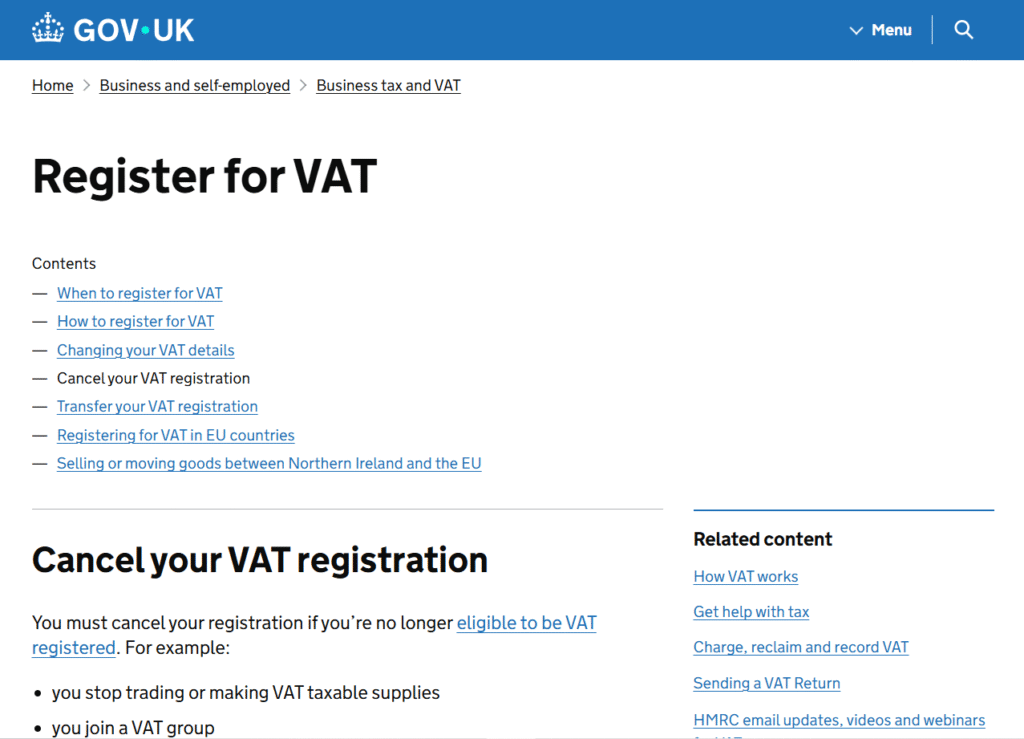
Where HMRC provides a fillable paper form, complete the required information before printing and follow the instructions shown on the current version.
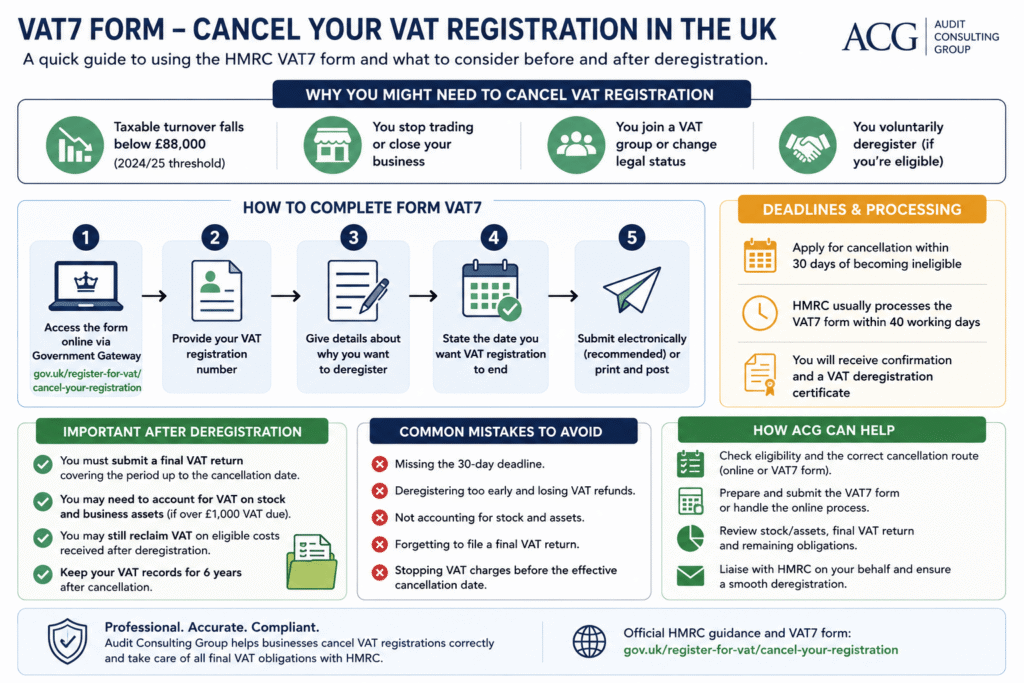
How to Complete Form VAT7
The VAT form VAT7 asks HMRC for enough information to identify the registration, understand why it should end and establish the appropriate cancellation date.
Before completing the form, it is useful to have:
- your VAT registration number;
- business and contact details;
- the reason for VAT deregistration;
- the relevant date of cessation, change or requested cancellation;
- details of any change in legal status or ownership where applicable;
- information about remaining stock and business assets;
- details of outstanding VAT returns or VAT liabilities.
The cancellation date is particularly important because it determines the period covered by the final VAT return and when VAT should cease to be charged under the registration.
Where to Send the VAT7 Form
If you need to submit a VAT 7 form by post, print the completed form and send it, together with any additional forms required for your circumstances, to the HMRC address shown on the current VAT7 form.
If you are checking where to send VAT7 form, use the address on the latest HMRC document rather than an address copied from an older website or saved form.
VAT Deregistration Date – When Does VAT Registration End?
The effective cancellation date depends on why the VAT registration is ending.
Where cancellation is compulsory, the date may relate to when the business stopped making taxable supplies, ceased trading, changed legal status or another event brought the VAT registration requirement to an end.
For voluntary cancellation, the effective date is generally the date agreed with HMRC from the application date onwards rather than a date chosen retrospectively simply because turnover was lower in the past.
The business should continue to account for VAT until the effective cancellation date confirmed by HMRC.
VAT7 Deadline and HMRC Processing Time
If the business becomes ineligible to remain VAT registered, HMRC normally expects notification within 30 days.
HMRC currently indicates that confirmation of VAT deregistration will usually be issued within 40 working days, although processing can take longer during busy periods or where further information is required.
Until HMRC confirms the position, the business should not assume that its VAT obligations have ended.
What Happens After VAT Deregistration?
Once HMRC confirms the cancellation, several practical VAT matters may remain. VAT should stop being charged from the official cancellation date, but outstanding returns, liabilities and final adjustments still need to be dealt with.
Final VAT Return
HMRC normally requires a final VAT return covering the period up to and including the official cancellation date.
The return should reflect the VAT position for that period, including relevant output VAT, recoverable input VAT and any necessary deregistration adjustments. Outstanding returns from earlier periods should also be completed rather than assuming cancellation closes them automatically.
You should not normally delay the final return simply because some supplier invoices have not yet arrived. In qualifying circumstances, there may still be a route for reclaiming VAT after deregistration.
VAT on Stock and Business Assets
VAT may need to be accounted for on certain stock and business assets held at the cancellation date where VAT was reclaimed, or could have been reclaimed, when those assets were acquired.
HMRC’s current rule is that a deregistration adjustment is not normally required where the total VAT due on the relevant stock and assets would be £1,000 or less.
Relevant items can include stock, equipment, furniture, commercial vehicles, computers and, in some cases, interests in land. Businesses holding significant stock or assets should review the potential VAT cost before choosing the timing of voluntary deregistration.
VAT Claims After Registration Is Cancelled
Cancellation does not automatically mean every later VAT invoice is lost. A supplier invoice relating to the period before deregistration may arrive after the final VAT return has been submitted.
HMRC has procedures for dealing with certain VAT amounts that become reclaimable, or become due, after registration has been cancelled. The treatment depends on the underlying transaction and timing.
Where this is relevant, our VAT Reclaim & Refunds service may also be useful.
Records and Other Practical Consequences
VAT records normally need to be retained for 6 years after cancellation. HMRC can also re-register a business if it later determines that the VAT registration should not have been cancelled.
If your business has an EORI number linked to the VAT registration, deregistration may also affect that EORI. Importers and exporters should check whether a separate EORI or other customs arrangements will still be needed before cancellation is completed.
Common Mistakes with the VAT7 Form
- Missing the 30-day notification requirement after becoming ineligible to remain VAT registered.
- Using the wrong cancellation route by submitting VAT7 where online cancellation applies, or trying to cancel online where HMRC requires a paper form.
- Choosing the wrong cancellation date and stopping VAT accounting too early.
- Assuming voluntary VAT deregistration can automatically be backdated.
- Failing to review stock and business assets that may create a final VAT liability.
- Forgetting the final VAT return or earlier outstanding VAT returns.
- Stopping VAT charges before the effective cancellation date.
- Ignoring unpaid VAT or post-deregistration VAT adjustments.
- Using an outdated VAT7 form PDF or old HMRC postal information.
How Audit Consulting Group Can Help with Form VAT7
Completing the HMRC VAT7 form is only one part of a VAT deregistration. Before submitting anything, it is sensible to establish whether the cancellation is compulsory or voluntary, whether VAT7 or the online route is appropriate, and what VAT consequences remain after the registration ends.
Our work can cover the full process where required:
- reviewing eligibility for VAT deregistration;
- checking whether the application should be made online or using the VAT7 deregistration form;
- reviewing the proposed cancellation date;
- preparing the relevant cancellation information;
- reviewing potential VAT on stock and assets;
- checking outstanding and final VAT return requirements;
- identifying VAT that may still be reclaimable after deregistration;
- assisting with HMRC correspondence where authorised;
- reviewing HMRC’s cancellation confirmation and any remaining VAT obligations.
For wider professional support, see our VAT Deregistration and VAT Compliance & Advisory services.
Practical VAT7 Examples
Small Business Below the Deregistration Threshold
A VAT-registered small business expects its taxable turnover to remain below the voluntary deregistration threshold. Before cancelling, it should consider the forecast turnover, remaining stock and assets, input VAT recovery and whether staying registered still makes commercial sense.
The practical outcome should be a clear decision on whether voluntary deregistration is appropriate, followed by the correct HMRC cancellation route and a properly completed final VAT position.
Business Has Stopped Trading
A business stops trading but its VAT registration remains active. The cancellation process should establish the correct cessation date, bring outstanding VAT returns up to date and ensure that the final return covers the correct period.
The objective is not simply to close the VAT account but to leave the VAT record consistent with what actually happened in the business.
Sole Trader Incorporates a Limited Company
A sole trader transfers activity to a new limited company. The VAT treatment depends on how the business is transferred and whether the existing VAT registration number is being retained.
Submitting form VAT7 without first considering the wider registration position can result in unnecessary re-registration work or incorrect VAT treatment. The registration and cancellation steps should therefore be coordinated.
What Businesses Often Underestimate About VAT Deregistration
The form itself is rarely the most difficult part. The greater risk is assuming that VAT obligations end as soon as a cancellation request is submitted.
The effective date, final VAT return, stock and asset adjustments, outstanding liabilities and VAT invoices received after deregistration can all affect the final position. A business with significant stock, equipment or recent capital expenditure may have a very different deregistration outcome from a business with few assets and little input VAT history.
For voluntary deregistration, there is also a commercial question. Remaining VAT registered may still be useful where customers are mainly VAT registered and the business has significant recoverable input VAT. For a consumer-facing business with limited VAT-bearing costs, deregistration may have a different commercial effect.
FAQ – VAT7 Form
What is a VAT7 form?
The VAT7 form is HMRC’s paper form used in certain circumstances to cancel a UK VAT registration. Some businesses can cancel online instead.
Can I complete the VAT7 form online?
VAT cancellation can be completed online in some circumstances. Where HMRC requires a postal application, a VAT7 paper form must be used instead.
Where can I download the VAT7 form?
The current VAT7 form download is available through GOV.UK. Businesses needing a VAT7 form PDF or printable form should use the latest HMRC version.
Where do I send the VAT7 form?
A completed VAT 7 form by post should be sent to the HMRC address shown on the current form, together with any additional documentation required for the circumstances.
What is the VAT deregistration threshold?
The current voluntary VAT deregistration threshold is £88,000 of taxable turnover. HMRC considers expected taxable supplies when assessing voluntary cancellation.
How long does VAT deregistration take?
HMRC currently indicates that cancellation confirmation is usually issued within 40 working days, although it can take longer where further checks or information are required.
Can VAT deregistration be backdated?
The effective date depends on why registration is being cancelled. Compulsory cancellation may relate to the date the relevant change occurred. Voluntary cancellation should not be assumed to be available retrospectively and normally takes effect from the application date or a later agreed date.
Do I need to file a final VAT return after deregistering?
Yes. HMRC normally requires a final VAT return covering the period up to and including the official cancellation date.
Do I need to account for VAT on stock and assets?
Potentially. VAT may need to be accounted for on certain stock and assets where VAT was reclaimed or could have been reclaimed and the total VAT due on those items exceeds £1,000.
When should I stop charging VAT?
You should stop charging VAT from the effective cancellation date confirmed by HMRC, not simply from the date the application is submitted.
What happens if I do not cancel the VAT registration correctly?
If the registration remains active, the business may continue to have VAT return and payment obligations. Failure to notify HMRC when cancellation is compulsory can also create compliance issues.
Can Audit Consulting Group handle the HMRC VAT7 form?
Yes. We can review the deregistration position, determine the appropriate cancellation route, assist with the hmrc vat7 form or online process, and help address final VAT obligations and HMRC correspondence within the agreed scope.
VAT7 Form Submission Services Cost & Pricing in the UK
Deregistering from VAT using the VAT7 form can be straightforward where the facts are clear, but the amount of work varies significantly between businesses.
A simple cancellation involving one VAT registration, no outstanding returns and limited stock or assets will usually require less work than a case involving a legal status change, business transfer, multiple outstanding VAT periods, significant assets or additional HMRC correspondence.
Audit Consulting Group can review the position first and confirm the appropriate scope before work begins.
Service Cost Estimation
Select the service category below to calculate the estimated cost of either accounting & tax services or forms and submissions.
Select Required Services / Forms
Select one or more services/forms to receive an accurate cost estimate. You can adjust your selection at any stage.
How would you like to engage our services?
Please select whether you require a one-off service or ongoing monthly support.
Contract Duration
Your cost estimate
Apply now and get 10% OFF
Submit your request today and receive an exclusive 10% discount on your selected service.
All prices are estimates. To receive a personalised quote, please fill out the form or contact us.
Ready to get started?
Get professional support from experienced UK accountants
Need Help Cancelling Your VAT Registration?
If you are considering VAT deregistration, send us your VAT registration details, the reason you want or need to cancel, recent taxable turnover and any relevant HMRC correspondence. We can review whether VAT7 or another cancellation route is appropriate and confirm the next steps.
Contact Audit Consulting Group about VAT7 and VAT deregistration