
ILR & British Citizenship Support
Leave your details and our team will get back to you shortly.
Audit Consulting Group helps individuals and business owners prepare clear, organised documentation when moving from ILR to British citizenship. Our support is focused on practical preparation, document checks, application readiness and reducing avoidable administrative issues before submission.
Applying for British citizenship after ILR can feel straightforward at first, but many applicants underestimate the detail required around residence history, absences, identity evidence, tax records, employment information and supporting documents. We help you approach the ILR British citizenship application in a structured way, so the information you submit is consistent, complete and properly reviewed.
This page provides general information only and should not be treated as immigration legal advice. Eligibility and document requirements depend on individual circumstances and current Home Office rules. Where immigration legal advice is required, applicants should speak with an appropriately authorised adviser.
What Our ILR and British Citizenship Support Includes
This service is designed for people who already hold Indefinite Leave to Remain and want help preparing to apply for British citizenship with ILR. We do not guarantee Home Office outcomes, processing times, eligibility or fee levels. Where specialist immigration legal advice is required, you should speak with an appropriately regulated immigration adviser or solicitor.
Our work focuses on practical application preparation, including:
- reviewing whether key eligibility points appear to be met before you proceed;
- helping you understand common ILR to British citizenship requirements;
- checking the documents required for British citizenship after ILR;
- organising residence, employment, tax and identity evidence;
- reviewing gaps, inconsistencies or missing information before submission;
- helping business owners and self-employed applicants prepare supporting financial records;
- explaining the likely cost of applying for British citizenship after ILR, including Home Office fees and related expenses;
- supporting applicants who need accounting, tax, payroll or company records as part of their evidence pack.
Who This Service Is For
 Our support is suitable for applicants who want a careful, document-led review before applying for British citizenship after ILR. It is particularly useful where the applicant’s situation includes business ownership, self-employment, company directorships, mixed employment history or tax records that need to be presented clearly.
- ILR holders preparing for naturalisation as a British citizen;
- applicants unsure how long they must hold ILR before applying;
- self-employed individuals who need tax and income records organised;
- company directors who need Companies House, payroll or dividend records reviewed;
- employees with complex work history or multiple employers;
- applicants with significant travel history who need absence records checked;
- spouses or civil partners of British citizens reviewing different timing rules;
- families preparing more than one citizenship application.
Common Problems Before Applying for British Citizenship After ILR
Many ILR holders delay their application because they are unsure whether their documents are strong enough. Others apply too quickly and only later realise that dates, absences or tax records needed closer attention.
Common issues include:
- unclear evidence of residence in the UK during the qualifying period;
- incorrect assumptions about the 12-month ILR requirement;
- confusion around the rules for spouses or civil partners of British citizens;
- missing travel dates or incomplete absence calculations;
- tax returns not matching income stated elsewhere;
- Companies House records showing outdated directorship or company information;
- employment records, payslips or P60s not readily available;
- uncertainty about referees and identity documentation;
- old addresses, names or dates being inconsistent across records.
These issues do not always prevent an application, but they should be identified before submission. A careful review helps you understand what may need correcting, explaining or evidencing more clearly.
Eligibility for British Citizenship After ILR
The eligibility for British citizenship after ILR depends on your personal circumstances. In general, many applicants need to have held ILR for at least 12 months before applying. However, people married to or in a civil partnership with a British citizen may be able to apply as soon as they have ILR, subject to meeting the relevant requirements.
Typical requirements for British citizenship after ILR may include:
- being aged 18 or over;
- holding Indefinite Leave to Remain, settled status or another qualifying form of settlement;
- meeting residence requirements for the relevant qualifying period;
- not exceeding permitted absences from the UK;
- being physically present in the UK on the required date at the start of the qualifying period;
- meeting good character requirements;
- meeting English language requirements, unless exempt;
- passing the Life in the UK Test, unless exempt;
- intending to continue living in the UK, depending on the application route.
Rules can change and individual circumstances matter. Before relying on any requirement, applicants should check current Home Office guidance or obtain professional immigration advice where needed.
Documents Required for British Citizenship After ILR
The documents required for British citizenship after ILR vary depending on employment status, residence history, family circumstances and the route being used. The aim is to evidence identity, lawful residence, settlement status, language ability, knowledge of life in the UK and relevant personal history.
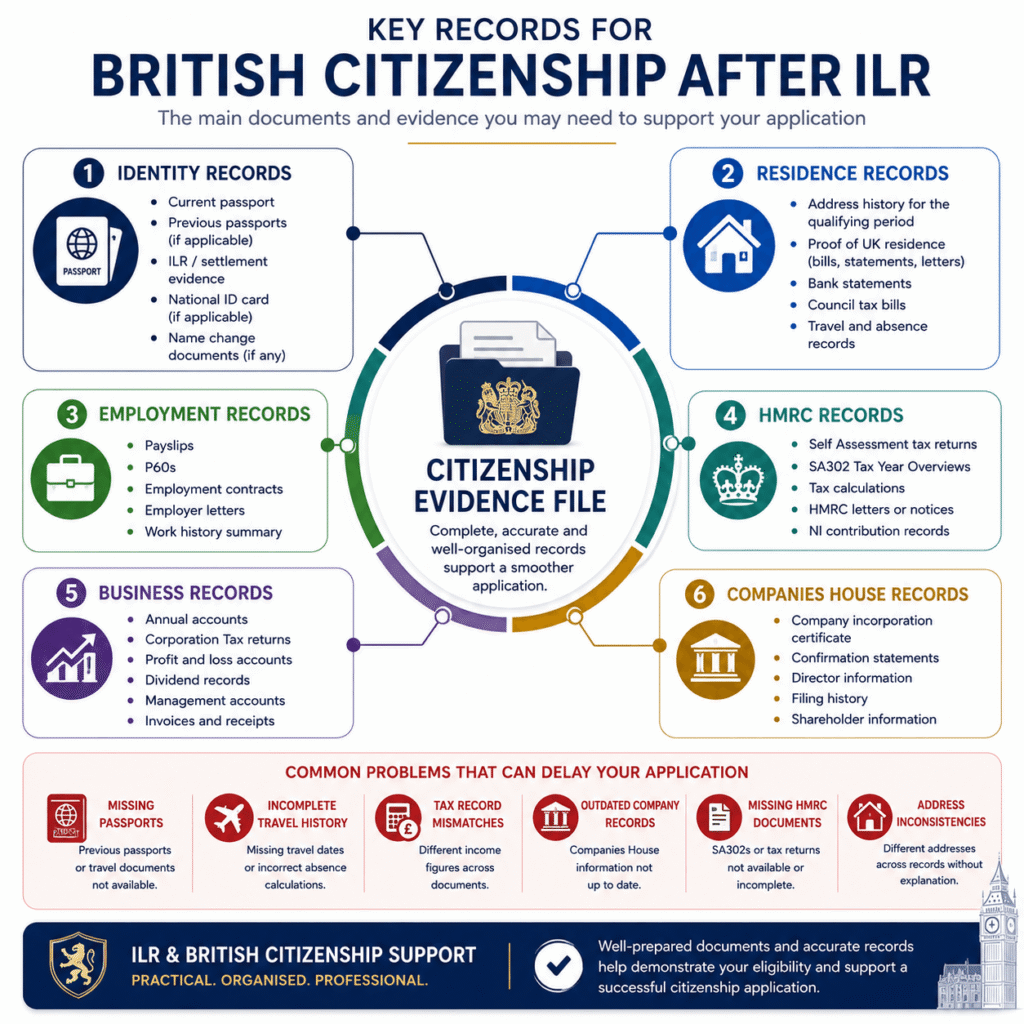
Common documents may include:
- current passport and previous passports covering the qualifying period;
- Biometric Residence Permit, eVisa or digital proof of ILR, where applicable;
- ILR confirmation or settlement evidence;
- Life in the UK Test pass reference;
- English language evidence or exemption evidence;
- proof of residence in the UK;
- employment records such as payslips, P60s or employer letters;
- Self Assessment support records such as tax returns, SA302s or HMRC tax calculations for self-employed applicants, landlords or directors where relevant;
- company accounts, Corporation Tax records or Companies House information for directors;
- PAYE records, employer evidence or payslip information where employment history needs to be supported, with payroll services available where records need organising;
- marriage or civil partnership certificate where applying as the spouse or civil partner of a British citizen;
- referee information;
- travel history and absence records;
- address history and evidence explaining name changes, address changes or unusual gaps where relevant.
For business owners and self-employed applicants, financial records often need more attention. If accounts, tax returns, payroll records, bookkeeping or Companies House filings are not up to date, it may be sensible to address those issues before making the citizenship application. Audit Consulting Group can assist with accounting, tax, payroll, bookkeeping services and compliance records that may support the preparation of a well-organised application file.
Types of Support Available
Application Readiness Review
 We review your circumstances at a practical level and identify obvious gaps in documents, dates, tax records or supporting evidence. This can be useful before you decide whether you are ready to submit.
Document Preparation Support
We help organise the evidence normally required for an ILR British citizenship application, including identity records, residence evidence, HMRC records, employment information and company documents where relevant.
Self-Employed and Company Director Support
Applicants who run a business often need more than a simple passport and residence review. We can help prepare accounting records, tax returns, company accounts, dividend records, payroll information and Companies House documents so they are consistent and accessible.
Absence and Residence Review
We can help you compile travel history and check whether UK absences need closer attention. We do not make legal decisions on eligibility, but we can help you identify areas that may require immigration advice before applying.
Post-Review Action Plan
Where records are incomplete, we provide a practical action list. This may include obtaining HMRC documents, updating company filings, requesting employer letters, locating old passports or checking Home Office guidance on a specific issue.
ILR to British Citizenship Fee and Cost Expectations
The ILR to British citizenship fee includes the Home Office application fee and may include additional costs such as biometric enrolment or appointment charges where applicable, document translation, English language testing, replacement documents or professional support. Home Office fees and related service charges can change periodically, so applicants should always check the current official fee before applying.
The cost of British citizenship after ILR can therefore vary depending on:
- whether one person or several family members are applying;
- whether documents need certified translation;
- whether tax returns, accounts or company records need updating first;
- whether specialist immigration advice is required;
- whether priority services or paid biometric appointments are used, if available;
- the level of professional document preparation support required.
Our fees are quoted after we understand the complexity of your records and the support you need. A straightforward document review is usually lower cost than a case involving self-employment, company accounts, missing tax filings or several years of travel reconstruction.
Deadlines, Timelines and Practical Timing
British citizenship applications are not usually driven by the same fixed filing deadlines as tax returns or Companies House filings. Timing still matters. Applying too early, submitting with incomplete evidence or failing to deal with unresolved compliance issues can create avoidable stress.
Before applying, applicants should consider:
- the date ILR was granted;
- whether 12 months with ILR is required in their case;
- the qualifying residence period;
- the date they were physically present in the UK at the start of that period;
- total absences from the UK;
- any long absences that may need explanation;
- whether tax filings and company records are current;
- passport validity and availability of previous passports;
- time needed to obtain HMRC, employer or overseas documents.
If you are self-employed or a company director, it is sensible to review HMRC and Companies House records well before starting the application. Delays often come from missing paperwork, unclear tax records, outdated ID documents, unexplained absences or inconsistent employment history, not from the application form itself.
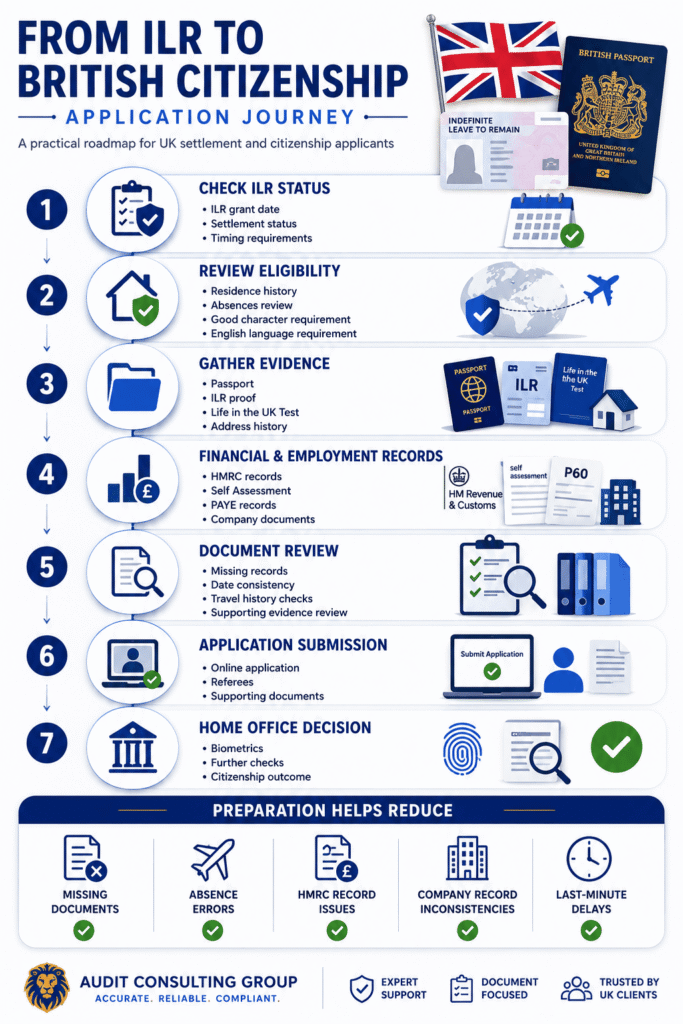
How the Process Works
We keep the process structured and practical. The aim is to identify what is ready, what is missing and what may need specialist review before submission.
- Initial discussion: we ask about your ILR date, residence history, employment status, business interests and intended application timing.
- Document checklist: we provide a tailored list based on your circumstances, including accounting or tax records where relevant.
- Record review: we check the documents you provide for completeness, consistency and obvious gaps.
- Accounting and tax support: where required, we help prepare or organise Self Assessment, company accounts, payroll or HMRC documents.
- Issue summary: we explain what appears complete and what may need further evidence, correction or immigration advice.
- Final preparation: once documents are in order, we help you prepare a clean evidence pack for the application process.
Who Handles the Work
Your support is handled by professionals familiar with UK tax records, business documentation, HMRC correspondence, Companies House filings and compliance administration. This is particularly important where citizenship evidence overlaps with financial or business records.
For immigration law questions, we may recommend that you speak with a suitably regulated immigration adviser or solicitor. We do not present general document support as a substitute for regulated legal advice.
HMRC, Companies House and Financial Records
Not every British citizenship application needs detailed accounting records. However, for self-employed people, landlords, contractors and company directors, financial compliance can become relevant very quickly.
Depending on your situation, useful records may include:
- Self Assessment tax returns;
- SA302 tax calculations and tax year overviews;
- company accounts;
- Corporation Tax returns;
- PAYE and payroll records;
- dividend vouchers;
- director loan account information;
- Companies House confirmation statements;
- VAT returns, where relevant;
- bookkeeping reports from Xero, QuickBooks, FreeAgent or other systems.
If these records are inconsistent, late or incomplete, it is usually better to deal with the issue before applying. Citizenship applications require honesty and accuracy; trying to reconstruct information at the last minute often increases risk. Where unclear HMRC correspondence, tax arrears, late filings or disputed records need attention, our HMRC support may help organise the position before the application file is finalised.
Client Types We Commonly Support
- self-employed professionals applying for citizenship after ILR;
- company directors with active UK limited companies;
- CIS subcontractors with tax deduction records;
- landlords with rental income and Self Assessment obligations;
- employees with several jobs or changing employers;
- families preparing linked applications;
- entrepreneurs whose business and personal records overlap;
- applicants who need help reconciling HMRC records with application details.
What Applicants Often Underestimate
The most underestimated part of applying for British citizenship with ILR is not usually the form. It is the background evidence.
Applicants often discover late in the process that an old passport is missing, a tax return was filed using an old address, travel dates were not recorded, or a company filing has not been updated. None of these points should be ignored. Some may be simple to resolve. Others may need explanation or professional advice.
Good preparation means checking the supporting records before the application is started, not after a problem appears.
Why ILR British Citizenship Applications Can Go Wrong
Applications can run into difficulty when the evidence does not support the information entered on the form. A date may be wrong by a few days. A period abroad may be forgotten. Income may be described differently from HMRC records. A company may still show a role that the applicant thought had ended.
These are practical problems, but they can have serious consequences if they affect eligibility, good character assessment or credibility. A document-led review helps reduce avoidable inconsistencies, although it cannot guarantee the outcome of any Home Office decision.
Strategic Guidance Before You Apply
Before moving from ILR to British citizenship, it is worth taking a step back and checking the whole picture. This is especially true if your work, business or tax position has changed during the qualifying period.
- Check the exact ILR grant date and whether you need to wait 12 months.
- Review absences before paying the application fee.
- Make sure HMRC filings are complete and accurate.
- Confirm Companies House records are up to date if you are a director.
- Prepare explanations for unusual gaps, changes or inconsistencies.
- Do not rely on memory where documents can confirm the position.
This kind of preparation can save time and reduce uncertainty. It also helps you decide whether to proceed now or obtain further advice first.
Choosing the Right Support
 Some applicants only need to read the Home Office guidance carefully and gather standard documents. Others need more structured help because their records are complex or incomplete.
You may benefit from professional support if:
- you are unsure whether you meet the requirements for British citizenship after ILR;
- you have travelled frequently or lived outside the UK for extended periods;
- you are self-employed and need tax records organised;
- you run a limited company and need business records checked;
- you have missing documents or inconsistent dates;
- you want a practical review before paying the Home Office fee;
- you need to understand the likely cost of applying for British citizenship after ILR.
Practical Outcomes of Good Preparation
Good preparation does not guarantee approval. It does, however, help applicants submit clearer information, avoid obvious document gaps and understand issues before they become urgent.
Typical practical outcomes include:
- better organised residence and travel records;
- clearer evidence packs for self-employed applicants;
- updated HMRC and Companies House documents before application;
- fewer last-minute requests for missing paperwork;
- better understanding of application costs and timing;
- clearer identification of points requiring legal advice.
Client Scenarios and Compliance Outcomes
Self-Employed Applicant With Missing Tax Records
A self-employed consultant wanted to apply for British citizenship after ILR but could not locate several years of tax evidence. We helped identify the relevant Self Assessment records, obtain HMRC tax calculations and organise income evidence into a clear document pack. The practical outcome was a more complete application file and a better understanding of which records supported the applicant’s work history.
Company Director Preparing an ILR British Citizenship Application
A limited company director had personal income from salary and dividends, but the company’s filing history needed checking. We reviewed Companies House records, company accounts, payroll information and dividend documentation. Before the applicant proceeded, outdated company records were identified and addressed where appropriate. This reduced inconsistency between business records and the information intended for the citizenship application.
Applicant With Frequent Travel History
An applicant who travelled regularly for work was unsure whether their absences affected eligibility for British citizenship after ILR. We helped compile passport stamps, travel records and a date summary. The applicant was then able to review the absence position more clearly and seek immigration advice on specific eligibility points before deciding whether to submit.
Family Reviewing Citizenship Costs
A family preparing several applications wanted to understand the overall cost of British citizenship after ILR. We helped them separate Home Office fees, possible biometric costs, translation expenses and professional support fees. The outcome was a clearer budget and a more realistic timeline for gathering documents before applying.
What Happens After Submission
After an application is submitted, the Home Office process may include biometric enrolment, document upload, further checks and communication about the decision. Processing times can vary. Applicants should monitor official correspondence carefully and keep copies of all submitted documents.
If further information is requested, it is important to respond accurately and within the required timeframe. Where the request involves immigration law or eligibility interpretation, you should consider regulated immigration advice.
Communication and Ongoing Support
We keep communication practical. You will know what documents are needed, which records appear incomplete and what steps remain outstanding. Where your citizenship preparation overlaps with tax, bookkeeping, payroll or company compliance, we can also help bring those records into better order.
For clients who continue running a UK business, we can provide ongoing support with Self Assessment, bookkeeping, annual accounts, Corporation Tax, VAT returns, payroll and Companies House compliance after the citizenship application stage.
Why Clients Choose Audit Consulting Group
Applicants choose Audit Consulting Group when they want careful, organised and commercially realistic support rather than rushed form-filling. Our background in UK accounting, tax and compliance is particularly useful where personal immigration evidence connects with HMRC, business or Companies House records.
- practical document review focused on accuracy and consistency;
- experience with self-employed, director and business-owner records;
- clear explanation of fees, documents and likely preparation steps;
- support with HMRC and Companies House records where relevant;
- professional caution where immigration legal advice may be needed;
- structured communication without unnecessary pressure.
Frequently Asked Questions
Can I apply for British citizenship after ILR?
Many ILR holders can apply for British citizenship once they meet the relevant naturalisation requirements. In many cases, applicants must hold ILR for 12 months before applying, although spouses or civil partners of British citizens may be treated differently. You should check the current Home Office rules for your circumstances.
What are the ILR to British citizenship requirements?
Typical requirements include holding ILR or settled status, meeting residence and absence rules, satisfying good character requirements, passing the Life in the UK Test and meeting English language requirements unless exempt. The exact requirements depend on the application route.
What documents are required for British citizenship after ILR?
Common documents include passports, proof of ILR, residence evidence, Life in the UK Test confirmation, English language evidence, referee details and employment or tax records where relevant. Self-employed applicants and company directors may need additional HMRC or company documents.
How much does British citizenship after ILR cost?
The cost includes the Home Office application fee and may also include biometric appointments, translations, test fees and professional support. Fees change, so applicants should check the current Home Office fee before applying.
Can I apply for British citizenship with ILR immediately?
Some applicants must wait 12 months after receiving ILR. If you are married to or in a civil partnership with a British citizen, different timing rules may apply. The correct timing depends on your circumstances and the current rules.
Do I need tax records for a British citizenship application?
Not always, but tax records can be important for self-employed applicants, company directors, landlords and people whose employment or income history needs evidence. HMRC records should be accurate and consistent with the information provided in the application.
Can tax irregularities affect my application?
Tax issues may be relevant where they affect good character, credibility or the consistency of the information provided. Applicants with late filings, unpaid HMRC liabilities, unclear income records or unresolved correspondence should consider addressing those issues before applying and obtaining regulated immigration advice where needed.
Can you guarantee my British citizenship application will be approved?
No. No responsible adviser should guarantee a Home Office decision. Our role is to help with preparation, document organisation and compliance-related records. Eligibility decisions are made by the Home Office.
Do you provide immigration legal advice?
Our service focuses on document preparation, accounting records, tax evidence and application readiness. Where legal interpretation or regulated immigration advice is required, we may recommend speaking with an appropriately regulated immigration adviser or solicitor.
Speak to Audit Consulting Group
If you are preparing an ILR to British citizenship application and want your documents, tax records or business evidence reviewed before submission, Audit Consulting Group can help you approach the process in a structured and careful way.
Contact us to discuss your circumstances, the documents you already have and the support you may need before applying for British citizenship after ILR.