
VAT registration services for UK businesses
VAT registration is not just an HMRC application. The timing of registration, taxable turnover, effective registration date and VAT accounting method can affect pricing, bookkeeping, cash flow and the first VAT return. Audit Consulting Group provides professional VAT registration services for UK businesses, including limited companies, sole traders, contractors, startups and overseas businesses with UK VAT obligations.
We can review whether registration is compulsory or voluntary, prepare the information required by HMRC, submit the application, support relevant HMRC queries and help you organise the accounting process that follows registration.
Leave your details and our team will get back to you shortly.
VAT Registration Services for UK Businesses
If you need to register for VAT in the UK, the application itself is only one part of the work. Before submission, the business should understand why it is registering, when registration should take effect and whether the figures and trading activity described to HMRC are supported by its records.
Our VAT registration service can include:
- reviewing VAT-taxable turnover and the registration position;
- considering whether registration is mandatory or voluntary;
- reviewing the proposed effective date of registration;
- considering the practical implications of available VAT accounting schemes;
- organising the information and documents required for the application;
- preparing and submitting the VAT registration application to HMRC;
- supporting relevant HMRC enquiries within the agreed scope;
- monitoring the registration process;
- helping prepare invoicing and bookkeeping for VAT reporting;
- providing guidance on the transition to VAT returns and Making Tax Digital.
The aim is not simply to obtain a VAT number. The registration should reflect how the business actually trades, and the bookkeeping process should be ready for the obligations that arise from the effective date of registration.
Do You Need to Register for VAT?

For many UK-established businesses, compulsory VAT registration is triggered when VAT-taxable turnover exceeds the current £90,000 registration threshold.
The threshold is measured on a rolling 12-month basis rather than simply by reference to the accounting year. That means a business can become liable to register at any point during the year as turnover develops.
There is also a separate forward-looking test. If a business expects its VAT-taxable turnover to exceed £90,000 within the relevant 30-day period, registration may be required even before the historic rolling turnover has crossed the threshold.
This is particularly important for businesses experiencing rapid growth or taking on a substantial new contract. Waiting until annual accounts are prepared can mean the relevant VAT registration date has already passed.
Different rules may apply in other situations, including for certain businesses established outside the UK that make taxable supplies in the UK. In those cases, the standard threshold should not automatically be assumed to determine the position.
Mandatory and Voluntary VAT Registration
Mandatory VAT registration
Compulsory VAT registration applies when the relevant HMRC conditions are met. For many UK businesses, the key questions are whether taxable turnover has exceeded £90,000 over the relevant rolling 12-month period or whether it is expected to exceed the threshold within the applicable 30-day forward-looking period.
Businesses approaching the threshold should monitor turnover regularly. It is much easier to prepare pricing, invoicing and bookkeeping before registration becomes urgent than to reconstruct the position afterwards.
Voluntary VAT registration
A business below the compulsory threshold may still be able to apply for voluntary VAT registration. That can make commercial sense, but registration should not automatically be viewed as an advantage.
A business with significant VAT-bearing expenditure may benefit from recovering eligible input VAT. Registration can also make sense where most customers are VAT-registered businesses and are able to recover VAT themselves.
The other side of the decision matters just as much. Registration introduces VAT return, digital record-keeping and invoicing obligations. A business selling mainly to consumers may also need to decide whether VAT is added to existing prices or absorbed within current margins.
Our VAT Registration Service: What We Handle
Reviewing the registration position
We start with the business rather than the form. That normally means understanding what you sell, when trading began, taxable turnover to date, expected growth and the reason registration is being considered.
Where compulsory registration may apply, the turnover history and proposed registration date need particular attention. Where registration is voluntary, we look at the commercial reasoning before an effective date is selected.
Preparing the VAT application
We organise and review the information required for the application. This may include business details, tax references, turnover, banking information, trading activity and other supporting information relevant to the circumstances.
Considering the VAT accounting approach
VAT registration and the way VAT is accounted for are related but separate issues. Depending on eligibility and circumstances, a business may need to consider standard VAT accounting or schemes such as Cash Accounting, Annual Accounting or the Flat Rate Scheme.
The right approach depends on the business model. A scheme should not be chosen simply because it appears administratively easier.
Submitting the application and dealing with HMRC
Once the position and information are ready, we prepare and submit the VAT registration application through the appropriate HMRC route.
HMRC can request further information before completing a registration. Where this happens, we can help review the request, organise relevant supporting information and respond within the scope of our engagement.
Preparing for the first VAT period
VAT obligations do not necessarily begin on the date the VAT number arrives. They arise from the effective registration date. That distinction matters where sales and purchases occur while the application is still being processed.
We therefore consider invoicing, bookkeeping and digital records as part of the registration process rather than leaving them until the first VAT return becomes due.
How the VAT Registration Process Works
1. Review business activity and taxable turnover
We establish what the business supplies, when trading started, its taxable turnover and whether any transactions require additional VAT consideration.
2. Establish whether registration is compulsory or voluntary
If registration is mandatory, the timing and effective date become important. If it is voluntary, the commercial consequences should be considered before the application is submitted.
3. Collect and review the required information
Company or personal details, tax information, banking information, turnover and business activity are organised and checked for consistency.
4. Consider the VAT accounting setup
Where relevant, we consider whether a VAT accounting scheme is appropriate and how VAT should be configured in the bookkeeping process.
5. Submit the application to HMRC
The application is prepared using the information provided and submitted through the appropriate HMRC registration service.
6. Respond to further HMRC enquiries if required
Some applications are completed without additional questions. Others require evidence or clarification about trading, turnover, business activities or the information supplied.
7. Prepare the business for VAT reporting
Once registration is confirmed, invoice templates, VAT coding, accounting records and the first return period should be reviewed so the business can move into ongoing VAT reporting without unnecessary reconstruction.
HMRC processing times vary. A straightforward application may progress without further enquiries, while another business may be asked for additional evidence. Our focus is on preparing a coherent application and responding promptly where further information is requested rather than promising a fixed approval date.
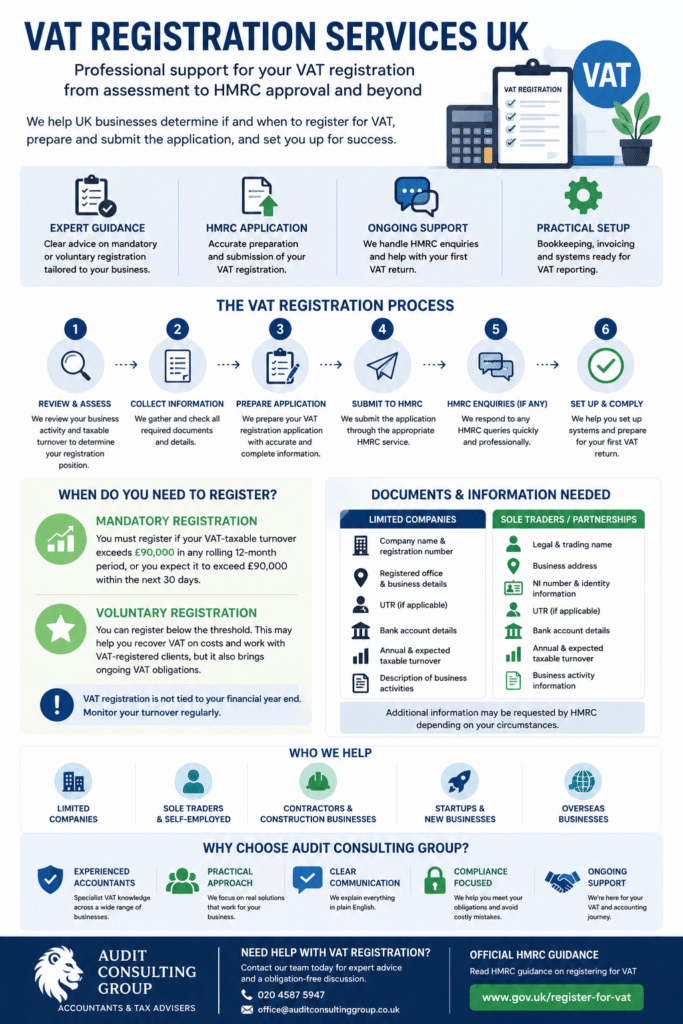
Documents and Information Required for VAT Registration
The information required to apply for VAT registration varies according to the business structure and circumstances. Preparing it before the application begins makes it easier to identify inconsistencies and avoid unnecessary delays.
Limited companies
- company name and company registration number;
- registered office and business details;
- Unique Taxpayer Reference where applicable;
- business bank account information;
- annual turnover and expected taxable turnover;
- a clear description of the company’s activities;
- relevant tax registration information where requested;
- additional information where the ownership or trading structure is more complex.
Sole traders and partnerships
- legal and trading name;
- business address;
- National Insurance number where applicable;
- identity information;
- Unique Taxpayer Reference where applicable;
- business bank details;
- annual and expected taxable turnover;
- business activity information;
- relevant Self Assessment or partnership information.
HMRC can ask for additional documents depending on the application. The documentation stage therefore needs to reflect the actual business rather than a generic checklist.
VAT Registration Services by Business Type

VAT registration for limited companies
We provide VAT registration for limited companies ranging from newly incorporated businesses preparing to trade through to established companies approaching or already over the VAT threshold.
A new company may be deciding whether voluntary VAT registration makes sense before significant sales begin. An established company may instead need to establish the date on which compulsory registration arose and whether previous invoices or transactions need to be reviewed.
Registration should also fit with the company’s wider accounting records. VAT, Corporation Tax, bookkeeping and payroll are separate obligations, but they frequently rely on the same underlying transactions being recorded correctly.
VAT registration for sole traders and self-employed businesses
Sole trader VAT registration follows the same fundamental VAT rules, but the commercial consequences can differ substantially between businesses.
A consultant selling mainly to VAT-registered companies may experience registration very differently from a retailer or tradesperson selling predominantly to private customers. We help sole traders consider the threshold, voluntary registration, documentation requirements and the impact on pricing and administration.
VAT registration for new companies and startups
Incorporating a company at Companies House does not automatically create a VAT registration requirement. VAT depends on taxable activity and the circumstances of the business.
Startups considering voluntary registration should also consider expenditure incurred before registration. Subject to the relevant rules, some VAT on qualifying pre-registration costs may be recoverable, but good invoices and records are essential.
VAT registration for contractors and construction businesses

Construction businesses may need to consider how VAT interacts with CIS and the domestic reverse charge. The accounting setup matters because sales invoices, subcontractor invoices, labour, materials and VAT coding need to be handled consistently.
We support builders, contractors and subcontractors with VAT registration and practical accounting changes that may be required afterwards. Businesses operating under both systems can also review our CIS and VAT reverse charge support.
VAT registration for overseas businesses
Businesses established outside the UK can face different registration rules from UK-established businesses. In particular, the standard VAT registration threshold should not automatically be assumed to apply to a non-established business making taxable supplies in the UK.
The nature of the supply, the customer, the place of supply and the way goods or services enter the UK can all affect the position. Overseas registrations should therefore be reviewed on their actual facts before an application is submitted. Businesses with wider cross-border transactions may also need international VAT support.
VAT Registration Cost and Pricing in the UK
HMRC does not charge a standard fee simply for submitting a VAT registration application. The cost of using a professional VAT registration service relates to the assessment, preparation, checking, submission and support provided around the application.
The professional fee can vary according to the work involved. Relevant factors can include whether registration is mandatory or voluntary, whether the business may already be late, the legal structure, overseas transactions, the complexity of the activities and whether HMRC requests further information.
Our VAT registration service can include review of the VAT position, preparation of the application, submission to HMRC, communication within the agreed scope and practical guidance on the move into VAT accounting.
Service Cost Estimation
Select the service category below to calculate the estimated cost of either accounting & tax services or forms and submissions.
Select Required Services / Forms
Select one or more services/forms to receive an accurate cost estimate. You can adjust your selection at any stage.
How would you like to engage our services?
Please select whether you require a one-off service or ongoing monthly support.
Contract Duration
Your cost estimate
Apply now and get 10% OFF
Submit your request today and receive an exclusive 10% discount on your selected service.
All prices are estimates. To receive a personalised quote, please fill out the form or contact us.
Ready to get started?
Get professional support from experienced UK accountants
If you are unsure whether registration is already required or whether voluntary VAT registration would make commercial sense, the position can be reviewed before an application is submitted.
Effective Date of VAT Registration and Late Registration
The effective date of VAT registration is one of the most important parts of the process because VAT obligations can apply from that date even if HMRC issues the VAT number later.
If a business should already have registered, submitting an application now does not automatically remove the earlier VAT liability. The business may need to establish when the obligation arose, calculate VAT from the relevant date and review sales, purchases and invoices for the affected period.
This can be awkward where customers have already been invoiced without VAT or where the bookkeeping system was not set up to record VAT from the correct date.
Where late registration may be an issue, the turnover history and effective date should be reviewed before the application is submitted rather than selecting a date without supporting records.
What Happens After VAT Registration?
Receiving a VAT number is the beginning of the reporting process, not the end of the work.
The business will need to understand its effective date, when VAT applies to sales, how VAT invoices should be prepared, how input and output VAT are recorded, which VAT return periods HMRC has allocated and how digital records will be maintained.
The first VAT return deserves particular attention. Transactions from the effective date need to be captured even where some of them occurred before the VAT number was physically received. Opening VAT balances and eligible pre-registration expenditure may also need review.
Businesses that want support with ongoing reporting can use our VAT return preparation and submission support.
Reclaiming VAT on costs incurred before registration
Subject to the relevant conditions, businesses may be able to recover VAT on certain qualifying purchases made before registration.
The commonly relevant limits are up to four years for qualifying goods still held or used by the business at registration and up to six months for qualifying services. Those time limits do not make every expense automatically recoverable. The expenditure must meet the VAT conditions and appropriate evidence should be retained.
Common VAT Registration Problems
Most problems are not caused by the length of the application form. They arise because the information submitted does not properly match the way the business trades or the records available to support it.
- using an incorrect or poorly supported effective date;
- monitoring turnover annually instead of on a rolling basis;
- confusing total income with VAT-taxable turnover;
- providing an unclear description of business activities;
- registering voluntarily without considering customer pricing;
- selecting a VAT scheme without reviewing whether it suits the business;
- submitting inconsistent banking, tax or company information;
- failing to prepare the bookkeeping system for VAT;
- assuming VAT obligations begin only when the VAT number arrives.
A request for additional information from HMRC does not automatically mean the registration has failed. The important point is that any response is accurate, supported by the business records and consistent with the application already submitted.
What Businesses Often Underestimate About VAT Registration
VAT registration is sometimes treated as an administrative formality. For a trading business, it is really a change to the finance process.
Sales invoices, purchase invoices, bookkeeping categories, VAT codes and accounting software all need to work together. If they do not, the first VAT return can become a reconstruction exercise.
Businesses also tend to focus heavily on reclaiming VAT on expenditure. That can be valuable, but the customer side is equally important. A consumer-facing business may need to absorb VAT within existing prices or increase prices. A business selling mainly to VAT-registered customers may have more flexibility.
The strongest VAT setup therefore connects registration with the way the business actually sells, buys, invoices and keeps records.
Practical VAT Registration Scenarios
A growing limited company approaching the threshold
A company experiencing steady monthly growth may cross the VAT threshold partway through its financial year. The practical work is to review rolling taxable turnover, identify a supportable registration date and prepare invoicing and bookkeeping before VAT reporting begins.
The outcome is a controlled transition into VAT rather than discovering the position after the registration date has already passed.
A startup considering voluntary registration
A startup may have significant early expenditure while turnover remains below the compulsory threshold. The decision involves looking at eligible VAT-bearing costs, customer type, expected turnover, pricing and the administrative implications of registration.
The useful outcome is a documented decision based on the business model rather than registering solely because some input VAT might be recoverable.
A construction contractor moving into VAT
A contractor becoming VAT registered may also need to change invoice treatment, VAT coding and bookkeeping because of the domestic reverse charge and its interaction with CIS.
Addressing registration and accounting setup together reduces the risk that the first VAT return has to be reconstructed later from invoices and bank transactions.
Who Handles the VAT Registration Work?
VAT registration work is handled within Audit Consulting Group’s accounting and tax function. The work is based on the information and records supplied by the client, with the registration position, supporting information and practical VAT setup considered before submission.
Where a case involves additional complexity, such as overseas trading, construction VAT, late registration or uncertainty over the effective date, the relevant issues are identified before the application is treated as routine.
This matters because an apparently simple VAT registration can create wider bookkeeping, Corporation Tax, payroll or CIS questions once the business activity is understood properly.
Post-Registration VAT Support
After registration, Audit Consulting Group can continue supporting the business with VAT bookkeeping, VAT returns, Making Tax Digital, accounting software setup and ongoing VAT compliance work.
For businesses using Xero, QuickBooks or similar software, the setup should include more than switching on a VAT feature. VAT codes, invoice treatment, opening balances and the VAT control account need to reflect what is actually happening in the business.
Businesses that need regular financial record keeping can also use our bookkeeping services to support VAT reporting and wider accounting requirements.
Where relevant, ongoing support can also cover construction VAT, international VAT matters and VAT deregistration when circumstances later change.
Why Businesses Use Audit Consulting Group for VAT Registration
Businesses looking for a VAT registration company or VAT registration consultant often want more than someone to enter information into an HMRC form. The registration position, effective date and accounting consequences should make sense before submission.
Our approach combines the application with the practical issues around it: turnover review, documentation, HMRC communication, pricing implications, bookkeeping readiness and the move into ongoing VAT reporting.
We work with limited companies, sole traders, contractors, construction businesses, professional service firms, e-commerce businesses, startups and other SMEs requiring UK VAT registration support.
Frequently Asked Questions About VAT Registration

When do I have to register for VAT in the UK?
For many UK-established businesses, compulsory registration applies when VAT-taxable turnover exceeds £90,000 over the relevant rolling 12-month period. A separate rule applies where taxable turnover is expected to exceed £90,000 within the applicable 30-day period. Different rules can apply in some other circumstances.
Can I register for VAT before reaching the threshold?
Yes. Voluntary VAT registration may be available below the compulsory threshold. Whether it is beneficial depends on factors such as your customers, VAT-bearing expenditure, pricing and the administrative responsibilities created by registration.
How do I apply for VAT registration in the UK?
Most businesses can apply through HMRC’s online VAT registration service. You can apply yourself or appoint professional support to review the position, prepare the information and handle the application.
What documents are required for VAT registration?
The exact requirements depend on the business structure and circumstances. Typical information can include company or personal details, tax references, business bank information, annual turnover, expected taxable turnover and a description of the business activities.
How do I register a limited company for VAT?
A limited company will normally need its company registration information, tax details, bank information, turnover figures and business activity details. We can support VAT registration for a limited company and the accounting setup required afterwards.
How do I register for VAT as a sole trader?
A sole trader can normally use HMRC’s online VAT registration service. The application may require National Insurance, UTR, identity, bank, turnover and business activity information. We provide VAT registration help for sole traders and self-employed businesses where professional support is required.
How long does VAT registration take?
HMRC processing times vary. Some applications are completed without further questions, while others require additional checks or supporting information. Businesses should therefore avoid planning on the basis of a guaranteed number of working days.
How much does VAT registration cost?
HMRC does not charge a standard application fee for VAT registration itself. Professional fees relate to reviewing the position, preparing and submitting the application and providing the agreed level of support around registration.
Do I need a VAT registration company or can I apply myself?
You can apply yourself if the registration position is clear and you are comfortable preparing the information required by HMRC. Businesses often use a VAT registration consultant where the effective date, voluntary registration decision, overseas activity, late registration or post-registration accounting requires more consideration.
Can I reclaim VAT on purchases made before registration?
Potentially. Subject to the relevant rules, VAT may be recoverable on certain qualifying goods and services acquired before registration. Appropriate VAT invoices and supporting business records should be retained.
What happens if I register for VAT late?
If the business should already have registered, HMRC may treat the registration as effective from the date the obligation arose. This can create VAT liabilities for an earlier period and may have penalty implications depending on the circumstances.
What happens after I become VAT registered?
You will need to apply VAT correctly from the effective registration date, maintain appropriate records, prepare VAT returns and meet the applicable digital record-keeping requirements. Invoicing and bookkeeping should be adjusted accordingly.
Is VAT registration compulsory for every limited company?
No. Incorporation at Companies House does not automatically make a company VAT registered. VAT registration is administered by HMRC and depends on the company’s taxable activities, compulsory registration rules or a decision to register voluntarily.
HMRC VAT Registration Information
Businesses that want to review the official process can use the HMRC guidance on registering for VAT. Official guidance should be considered alongside the facts of the individual business, particularly where registration dates, overseas activities or non-standard VAT arrangements are involved.
Need Help With VAT Registration?
If you need to apply for VAT registration in the UK, are approaching the VAT threshold, may already have crossed it or are considering voluntary registration, Audit Consulting Group can review the position and support the application process.
We can help establish the registration position, organise the required information, submit the application, support relevant HMRC enquiries and prepare the bookkeeping and invoicing process for VAT reporting.