
Household Payroll Service UK for Nannies & Domestic Employees
Leave your details and our team will get back to you shortly.
Employing someone to work in your home can create many of the same payroll responsibilities faced by a business employer. Whether you employ a nanny, carer, housekeeper, cleaner, gardener, personal assistant or another domestic employee, you may need to deal with PAYE registration, payroll calculations, Real Time Information (RTI), payslips, workplace pension duties and employee leaving documentation.
Audit Consulting Group provides a practical household payroll service for private employers across the UK. We support families setting up payroll for the first time, households moving from another payroll provider and employers who need help reviewing previous payroll or HMRC reporting problems.
Our role goes beyond producing a payslip. We help organise the payroll process, explain what information is required and manage the agreed payroll administration throughout the employment relationship.
Household Payroll for Private Employers in the UK
Hiring domestic staff often starts informally. A nanny may initially work a few days each week. A carer may begin supporting a relative for limited hours. A cleaner or housekeeper may gradually take on a more regular role.
What families do not always expect is how quickly an informal arrangement can become an employment relationship with payroll responsibilities.
Once someone is genuinely employed by the household, PAYE and payroll obligations may arise even where there is only one employee. Being a private individual rather than a company does not automatically remove responsibilities relating to PAYE, RTI reporting, payslips, workplace pensions and employee leaving documentation.
Who Needs a Household Payroll Service?
A household employer payroll service may be useful where a private individual or family directly employs domestic staff and does not want to manage payroll administration themselves.
We can support payroll arrangements involving:
- nannies and live-in nannies;
- carers and personal care workers;
- housekeepers and cleaners;
- gardeners;
- personal assistants and drivers;
- other household staff;
- several domestic employees working for the same household.
The correct payroll approach depends on the actual working arrangement. Someone who is genuinely self-employed is treated differently from an employee, so simply describing a domestic worker as self-employed does not in itself determine their employment status or remove employer responsibilities.
What Is Included in Our Household Payroll Service?
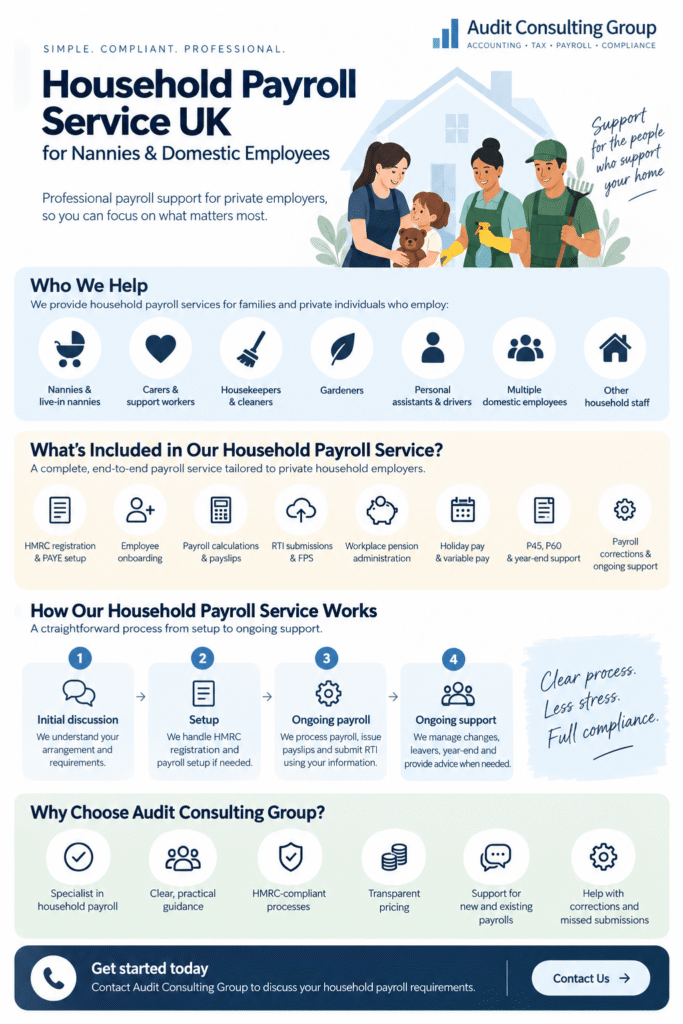
Our household employee payroll service can cover the practical payroll work required from initial setup through to regular payroll, year-end administration and employee leavers.
Depending on your circumstances and agreed service scope, support can include:
- HMRC employer registration and PAYE setup;
- employee onboarding and starter payroll information;
- regular payroll calculations and digital payslips;
- PAYE and National Insurance calculations;
- RTI and Full Payment Submission reporting;
- workplace pension assessment and payroll administration;
- holiday pay and variable-pay calculations;
- payroll adjustments and corrections;
- employee leaver processing and P45 preparation;
- P60 and year-end payroll support;
- review of previous payroll records where problems have developed.
Before payroll begins, we confirm the scope of work so you know what is included and whether additional work is required for PAYE registration, historic corrections or pension administration.
What Is a Household Employee Payroll Service?

A household employee payroll service helps a private household manage payroll for employees working in or around the home.
The calculations may be similar to other PAYE payrolls, but the employer’s experience is often very different. Many household employers have never run payroll before and may be unfamiliar with tax codes, RTI reporting, pension notices, holiday calculations or HMRC employer accounts.
A useful payroll service for household employees therefore needs to do more than calculate wages. It should give the employer a clear process for reporting changes in hours, pay, leave and employment circumstances so the payroll can be kept up to date.
Why Household Payroll Can Become More Complicated Than Expected
A household may employ only one person, yet the payroll can still change considerably during the year.
A nanny might work longer hours during school holidays. A carer may take on overnight shifts. A housekeeper may change working days. An employee’s tax code can change, while a change in earnings or age can affect workplace pension duties.
Another common source of confusion is the difference between gross salary and net pay. A family may agree a take-home amount without initially considering the wider employer cost, which can include employer National Insurance and employer pension contributions where applicable.
Holiday pay, statutory payments, overtime, irregular hours and payroll corrections can also become harder to manage when changes are agreed informally but the payroll records are not updated at the same time.
How Our Household Payroll Service Works
We start by understanding the employment arrangement. This normally means confirming the employee’s details, start date, salary or hourly rate, working pattern, pay frequency, available starter or tax information, pension position and whether the household is already registered with HMRC as an employer.
If PAYE registration is required, we can assist with the employer registration and payroll setup before regular payroll reporting begins.
For each agreed pay period, we process the payroll using the information supplied, prepare payslips and deal with the relevant RTI reporting. If hours, overtime, bonuses or other payments vary, these can be reflected using the information provided for that payroll period.
When an employee leaves, the final payroll and leaving information need to be handled correctly. Employers must provide a P45 to an employee when they leave. Year-end payroll responsibilities can also include providing a P60 to employees who meet the relevant requirements.
If you already employ domestic staff but are unsure whether the payroll has been set up correctly, we can review the available records before agreeing the next steps.
Nanny Payroll Service UK
Nannies are one of the most common types of domestic employee for whom families need professional payroll support. A specialist nanny payroll service UK needs to account for the realities of childcare employment rather than assuming every pay period will look the same.
Nanny payroll can involve changing hours during school holidays, overtime, babysitting, irregular working patterns, salary reviews, holiday pay and changes to the employment arrangement.
Families also frequently ask whether a nanny’s salary should be agreed on a gross or net basis. Clarifying this at the outset matters because the employer’s total payroll cost can be higher than the employee’s take-home pay once employer National Insurance and any applicable employer pension contributions are considered.
Our household payroll services for nannies can include PAYE setup, payroll calculations, payslips, RTI reporting, pension assessment, payroll changes, leaver processing and year-end support.
Payroll Services for Carers and Support Workers
Payroll services for carers can involve different practical issues from nanny payroll, particularly where care is provided through changing shifts, overnight support or several carers working for the same household.
Clear payroll records become especially important when employees work different hours or family members coordinate the employment arrangement on behalf of the person receiving care. Changes to hours, overtime, holiday pay and pension eligibility may all affect the payroll as the arrangement develops.
Payroll for Housekeepers, Cleaners, Gardeners & Other Domestic Staff
Private households can also have payroll responsibilities for housekeepers, cleaners, gardeners, personal assistants, drivers and other domestic employees.
Whether PAYE obligations apply depends on the real working relationship rather than the job title alone. Where the worker is an employee and PAYE requirements apply, the household may need to register as an employer, operate payroll and meet HMRC reporting responsibilities.
Our payroll for domestic staff support can be used for one employee or for households employing several people in different roles.
PAYE, RTI & Pension Responsibilities for Domestic Staff

PAYE Registration for Household Employers
Many household employers have never registered for PAYE and are unsure whether the same HMRC processes used by business employers apply to them.
If employer registration is required, we can support the PAYE setup and establish the payroll information needed before regular reporting begins. This is particularly useful where the employee has already started work or payments have begun and the household is unsure what should have been reported.
RTI and Full Payment Submissions
Employing only one person does not automatically remove RTI responsibilities. Where PAYE payroll is being operated, relevant payroll information generally needs to be reported to HMRC through RTI, including the appropriate Full Payment Submission.
Late or missing submissions can result in HMRC correspondence and may require previous payroll records to be reviewed before corrections are made. If your household has already missed payroll reporting, it is usually better to establish what has and has not been submitted before trying to correct individual figures in isolation.
Workplace Pension Duties
Household employers can also have workplace pension duties. Eligibility depends on the employee’s circumstances, including age and earnings, and the position can change during employment.
For example, an employee who did not initially meet the automatic-enrolment criteria may later do so after their earnings increase. Payroll and pension administration therefore need to reflect current circumstances rather than relying indefinitely on the position at the employee’s start date.
Gross vs Net Pay, Irregular Hours & Holiday Pay
Gross vs Net Pay for Household Employees
One of the most important points to clarify when employing domestic staff is whether salary is being discussed on a gross or net basis.
Gross salary is pay before PAYE and employee deductions. Net pay is the amount the employee receives after the relevant deductions. The household’s total employment cost can be higher again because employer National Insurance and employer pension contributions may apply.
Agreeing the basis of pay clearly before employment begins reduces the risk of misunderstandings and unexpected employer costs later.
Irregular Hours, Overtime & Holiday Pay
Domestic staff do not always work fixed hours. Nannies may work additional days during school holidays, carers may cover overnight shifts and housekeepers may increase or reduce working days depending on the household’s needs.
Variable payroll can be managed, but accurate information needs to reach the payroll provider in time. Hours worked, overtime, additional payments and relevant leave should be recorded consistently rather than reconstructed months later, particularly where holiday calculations or pension contributions are affected by changing earnings.
Can We Take Over an Existing Household Payroll?
Yes. You do not need to be setting up payroll for the first time to use our service.
Where payroll is already being managed elsewhere, we can review the available records and establish the information needed to continue from the correct position. This can include employee details, year-to-date pay and tax figures, payroll reports, HMRC information, pension records and previous submissions.
If there are missing periods, inconsistent figures or unresolved payroll issues, these should be identified before the payroll simply continues as though nothing happened.
Payroll Corrections & Missed RTI Submissions
Sometimes a household employer only discovers a payroll problem after receiving HMRC correspondence, changing payroll providers or reviewing records at year end.
The appropriate correction depends on what should have been reported, what has already been submitted and which pay periods are affected. A useful starting point is therefore to reconstruct the payroll position from the available records rather than changing figures without understanding the reporting history.
We can review the information available and identify the payroll periods, payments and submissions that need attention. Where a correction is required, the work and fee will depend on the extent and condition of the historic records.
Employee Starters, Leavers, P45s, P60s & Payslips
New employees need to be added to payroll using the relevant starter information. If a new employee does not have a P45, other starter information may be required so the employer can operate payroll appropriately.
Employees and workers are generally entitled to an itemised payslip on or before payday. A household employer should therefore not treat payslips as optional simply because the employment takes place in a private home.
When an employee leaves, the final payroll and leaving date need to be processed correctly, the relevant information reported through payroll and the employer must give the employee a P45.
At the end of the tax year, a P60 must be provided to employees who are working for the employer on 5 April, subject to the applicable payroll requirements.
Employment Allowance and Household Employers
Household employers should not assume that operating PAYE automatically means they can claim Employment Allowance against employer National Insurance.
In general, liabilities arising from employing someone for personal, household or domestic work, such as a nanny or gardener, are excluded from Employment Allowance. There are specific exceptions for certain care and support workers, so the position should be checked against the actual employment circumstances rather than assumed as part of payroll setup.
What Information Do We Need to Set Up Household Payroll?
The exact requirements depend on the employment arrangement, but setup will commonly require:
- details of the household employer;
- employee personal details;
- employment start date;
- salary or hourly rate;
- agreed pay frequency and normal working pattern;
- P45 or appropriate starter information where available;
- pension information where relevant;
- previous payroll records if we are taking over an existing scheme.
If payroll has already been running, we may need additional records to establish what has previously been paid and reported before taking over or making corrections.
Practical Household Payroll Scenarios
The following are illustrative scenarios showing the types of payroll situations private employers can encounter. They are not presented as client case studies.
Live-In Nanny With Changing Hours
Starting position: A household employs a live-in nanny whose hours change significantly during school holidays. Fixed monthly assumptions no longer reflect the actual working arrangement.
Payroll work required: The employer needs a consistent process for providing variable hours and additional payments before each payroll, while keeping PAYE, payslips and pension assessment aligned with the current information.
Practical outcome: Each pay period can be processed using current payroll inputs rather than outdated working hours, giving both employer and employee clearer records of pay and deductions.
Household With Missed Payroll Reporting
Starting position: A private employer has been paying a domestic employee but later discovers that some payroll reporting was missed or may have been handled incorrectly.
Payroll work required: Previous pay periods, payments and available HMRC reporting records need to be reviewed before deciding what corrections are appropriate.
Practical outcome: The employer obtains a documented starting position for correcting historic payroll and a clearer basis for ongoing submissions, rather than carrying unresolved discrepancies into future pay periods.
Family Employing Several Carers
Starting position: A family directly employs several carers working different shifts. Hours and additional payments vary, and manual payroll administration has become difficult to reconcile.
Payroll work required: Payroll information needs to be organised by employee and pay period, with changing hours and additional payments supplied consistently before processing.
Practical outcome: The household has a repeatable payroll process for several employees, clearer employee-level records and a more organised basis for RTI reporting and payslips.
Typical Household Payroll Pricing
The cost of a household payroll service depends on the number of employees, payroll frequency, pension requirements, changing hours, historic correction work and whether HMRC employer registration is needed.
Indicative pricing can include:
- Onboarding and HMRC employer registration: from £60;
- Monthly payroll per employee: typically £25–£40;
- Payslip-only processing: from £10 per payslip;
- Pension auto-enrolment administration: from £15 per month;
- Year-end reconciliation and P60/P45 support: case dependent.
A nanny payroll service cost, for example, may differ between a household with one employee on a fixed monthly salary and a household with variable hours, pension administration or historic payroll corrections.
Before work begins, we confirm the service scope and whether additional setup, PAYE registration, pension or correction work is required.
What You Still Need to Do as the Household Employer
Outsourcing payroll does not transfer every employer responsibility to the payroll provider.
We rely on the household to provide accurate and timely information about changes affecting payroll. This can include:
- hours worked and overtime;
- salary or hourly-rate changes;
- additional payments;
- holiday and relevant absences;
- new employees and employee leaving dates;
- changes affecting pension or payroll records.
The household remains responsible for making payments to employees and HMRC when due. A well-run payroll therefore depends on a simple but important discipline: changes need to be communicated before the payroll is processed, not reconstructed several months afterwards.
How to Choose a Household Payroll Provider

For a straightforward household payroll, basic payslip processing may be enough. For a household with changing hours, pension duties, several employees or historic reporting problems, the ability to deal with the wider payroll process becomes more important.
When comparing a household payroll provider, check whether the service covers the areas you actually need, such as:
- HMRC employer and PAYE setup;
- RTI reporting;
- pension auto-enrolment administration;
- variable hours and irregular pay;
- employee starters and leavers;
- P45 and P60 administration;
- payroll corrections and previous-period reviews;
- clear pricing and service scope.
It is also worth establishing how payroll changes are communicated, when information needs to be supplied and what happens if a previous payroll problem is discovered. These practical details often matter more than the headline price alone.
Why Use Audit Consulting Group for Household Payroll?
Most household employers do not want to spend their evenings learning PAYE rules, checking RTI submissions or interpreting payroll and pension notices. They want a clear process and someone who understands what needs to happen when circumstances change.
Audit Consulting Group can support household employers with payroll setup, PAYE administration, regular payroll calculations, RTI reporting, payslips, pension administration, payroll corrections, employee leavers and year-end processes.
We can work with households starting from scratch, employers moving from another household payroll provider and families who need to establish what has happened in an existing payroll before moving forward.
Where your needs extend beyond domestic payroll, our wider Payroll Services can provide further information about Audit Consulting Group’s payroll support.
Common Household Payroll Questions
Do I need payroll for a nanny?
If your nanny is your employee and PAYE requirements apply, you may need to register as an employer and operate payroll. The position depends on the actual employment and payment arrangements rather than the job title alone.
Do I need to register as an employer if I only employ one person?
Potentially, yes. Having only one household employee does not by itself remove PAYE responsibilities. The registration position should be checked against the employee’s circumstances and payments.
Can I run household or nanny payroll myself?
Yes. Some household employers manage payroll themselves using payroll software. The practical challenge is usually not producing one payslip, but keeping PAYE, RTI, pension duties, changing hours, starters, leavers and corrections organised throughout the year.
What does a household payroll service include?
A service can include employer registration, PAYE setup, payroll calculations, payslips, RTI submissions, pension assessment, payroll changes, P45s, P60s and year-end administration. The exact scope should be agreed with the provider.
How much does a nanny payroll service cost?
The price depends on the service level, number of employees, pay frequency, pension administration and whether corrections or employer registration are required. Our indicative household payroll pricing is shown above.
Can you take over an existing nanny or household payroll?
Yes. Existing payroll can be transferred, although previous records and year-to-date figures normally need to be reviewed so the new provider can establish the correct starting position.
Can you help if payroll submissions were missed?
We can review the available payroll information and identify what appears to have been missed or reported incorrectly. The correction required depends on the pay periods involved and information already submitted to HMRC.
What happens if a nanny or carer has irregular hours?
Irregular hours can be processed through payroll, but accurate hours and any additional payments need to be supplied for each relevant pay period.
Should a nanny salary be agreed gross or net?
The basis should be made clear before employment begins. A net-pay arrangement can expose the employer to additional costs because the employee’s take-home amount does not represent the household’s total employment cost.
Does my nanny or household employee need a workplace pension?
Household employers can have workplace pension duties. Whether an employee must be automatically enrolled depends on the applicable age and earnings criteria, and the position can change if their circumstances or earnings change.
Do household employees receive payslips?
Employees and workers are generally entitled to an itemised payslip on or before payday. Employing someone in a private home does not in itself remove that requirement.
What happens when my nanny or domestic employee leaves?
The final payroll and leaving date need to be processed correctly, relevant information reported through payroll and the employer must provide the employee with a P45.
Do household employees receive a P60?
An employer must provide a P60 to employees who are working for them on 5 April and meet the relevant payroll requirements. It summarises pay and deductions for the tax year.
Can a household employer claim Employment Allowance?
Ordinary domestic employment, such as employing a nanny or gardener for personal or household work, is generally excluded from Employment Allowance. Specific exceptions can apply to certain care and support workers, so eligibility should be checked against the actual circumstances.
What information do you need to start household payroll?
We normally need employer and employee details, employment start date, salary or hourly rate, pay frequency, working arrangements and available P45 or starter information. Pension information and previous payroll records may also be required.
Getting Started with Household Payroll
Getting started usually begins with a review of who you employ, how they are paid, when the employment started and whether PAYE registration or an existing payroll is already in place.
If you already employ a nanny, carer, housekeeper, cleaner, gardener or another domestic employee, we can review the available information and establish what is needed to set up, take over or organise the payroll. If historic issues are identified, these can be scoped separately before ongoing payroll continues.
Contact Audit Consulting Group to discuss your household payroll requirements.
Household Payroll Services Cost & Pricing UK
Audit Consulting Group provides household payroll support for UK private employers, including PAYE registration, RTI submissions, payslips, workplace pension administration, payroll corrections, P45s, P60s and ongoing payroll for domestic employees.
The appropriate service depends on the number of employees, payroll frequency, pension requirements, variable pay and whether historic payroll records need to be reviewed.
Service Cost Estimation
Select the service category below to calculate the estimated cost of either accounting & tax services or forms and submissions.
Select Required Services / Forms
Select one or more services/forms to receive an accurate cost estimate. You can adjust your selection at any stage.
How would you like to engage our services?
Please select whether you require a one-off service or ongoing monthly support.
Contract Duration
Your cost estimate
Apply now and get 10% OFF
Submit your request today and receive an exclusive 10% discount on your selected service.
All prices are estimates. To receive a personalised quote, please fill out the form or contact us.
Ready to get started?
Get professional support from experienced UK accountants