
Payroll Services for UK Businesses
Leave your details and our team will get back to you shortly.
Practical payroll support, PAYE reporting and workplace pension management for businesses that need payroll handled properly as they grow.
Most payroll problems do not begin with a major mistake.
Usually, the process simply becomes more complicated than the original setup was designed to handle.
A business hires more staff. Different pay arrangements appear. Pension duties increase. Someone internally keeps payroll moving each month while balancing several other responsibilities at the same time.
For a while, the process still works.
Then small inconsistencies begin creeping in quietly behind the scenes. Payroll reports stop matching accounting records properly. Employee changes arrive late. Pension deductions raise questions nobody can answer confidently. Directors start relying heavily on software outputs without fully trusting the underlying numbers anymore.
That stage is more common than many businesses realise.
At Audit Consulting Group, we provide payroll services UK businesses use to manage payroll processing, PAYE administration, employee payroll reporting, workplace pensions and ongoing payroll compliance more reliably as operational pressure increases.
Some clients need fully managed payroll support. Others need help stabilising a process that has gradually become difficult to control internally.
In practice, payroll problems are rarely only about payroll.
They affect bookkeeping accuracy, pension records, employee trust, management reporting and the wider visibility business owners have over staffing costs.
Payroll Usually Becomes Difficult Gradually
Very small businesses can often manage payroll internally for a period of time without major issues.
One or two employees. Fixed salaries. Limited pension administration. Minimal reporting pressure.
Growth changes the environment quickly.
Additional employees create more moving parts behind the scenes. Overtime, bonuses, holiday pay, statutory sick pay, maternity pay, pension auto-enrolment and changing tax codes all increase the amount of coordination required each pay cycle.
Most payroll systems still appear functional during this stage, which is why businesses often underestimate how much manual correction work has quietly started building underneath the surface.
One employee adjusts payroll spreadsheets before submission. Someone double-checks pension deductions manually because previous reports did not reconcile properly. Payroll approvals happen through rushed emails late in the evening before payday.
Over time, these workarounds become the actual payroll process.
That is usually the point where businesses start looking for more structured payroll support.
What Businesses Actually Need From Payroll Support
Some employers only need reliable monthly payroll processing and PAYE submissions.
Others need much more than that.
They may need pension administration cleaned up after inconsistent reporting, support transitioning away from manual payroll systems or better visibility over staffing costs across different departments.
For growing businesses, payroll support often becomes less about “running payroll” and more about creating a process that remains stable when staffing changes, reporting pressure increases or multiple people become involved internally.
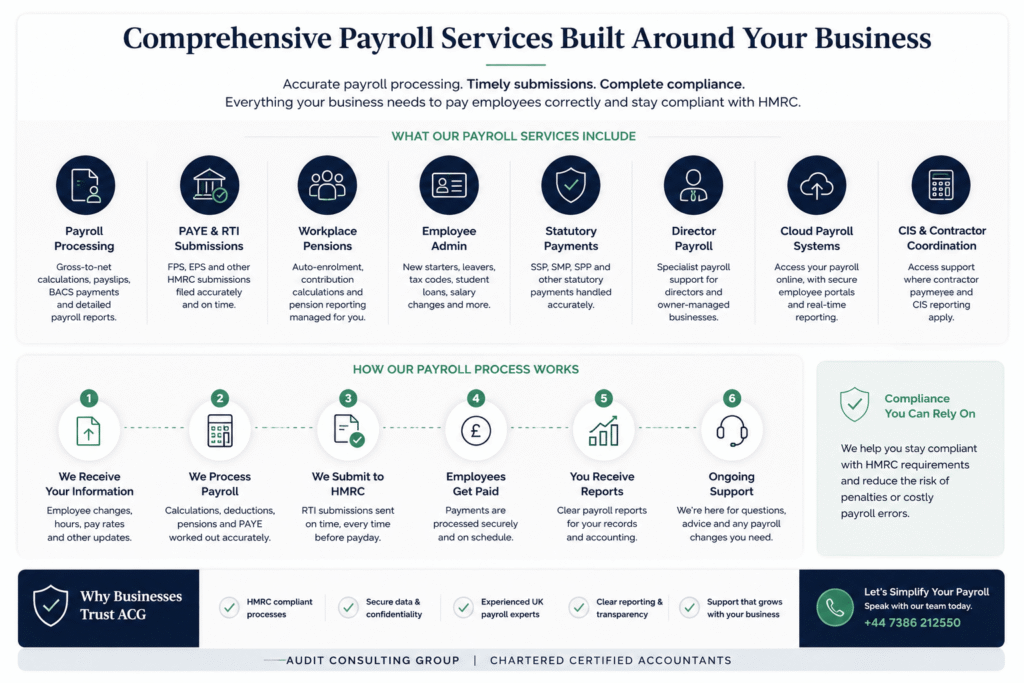
Our payroll support can include:
| Payroll Area | Support Provided |
| Payroll Processing | Gross-to-net calculations, payslips, payroll reports and employee payment administration |
| PAYE & RTI Reporting | HMRC submissions, FPS/EPS filing and payroll compliance support |
| Workplace Pensions | Auto-enrolment support, contribution calculations and pension administration |
| Employee Changes | New starters, leavers, tax code updates and salary adjustments |
| Statutory Payments | SSP, SMP, SPP and other statutory payroll responsibilities |
| Director Payroll | Payroll support for owner-managed businesses and directors |
| Cloud Payroll Systems | Online payroll systems, employee portals and payroll reporting access |
| CIS & Contractor Coordination | Payroll coordination where CIS reporting or contractor arrangements affect payroll administration |
We also support businesses looking for managed payroll services, complete payroll and accounting services, payroll service solutions and more operationally structured payroll management.
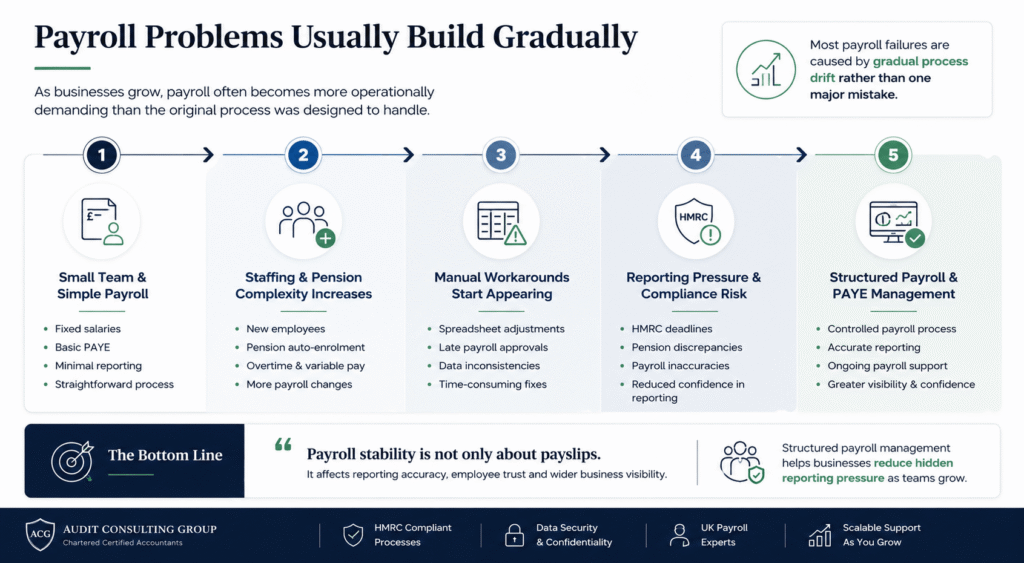
Where Payroll Problems Usually Start
Payroll failures are rarely caused by one dramatic error.
Most problems develop gradually because payroll processes evolve informally as the business changes.
Employee information arrives late. Pension settings are never reviewed after salary increases. Payroll reports are copied from older templates nobody fully understands anymore. Internal staff create workarounds to keep payroll moving because there is not enough time to rebuild the process properly.
 The business continues operating, but confidence in the payroll data slowly weakens.
By the time directors notice the issue, the payroll process may technically still function — yet internal staff are spending hours every month manually correcting inconsistencies behind the scenes.
That operational drift is one of the biggest reasons businesses eventually outsource payroll.
Payroll Software Helps — But It Does Not Remove Risk
Many employers assume payroll software automatically guarantees compliance.
In reality, software only processes the information it receives.
If employee data is incomplete, pension settings are outdated or payroll approvals happen too late, even good systems can still produce unreliable reporting.
We regularly see businesses using modern cloud payroll systems while relying heavily on manual corrections each month because the process surrounding the software is unstable.
The software matters.
But the operational discipline around the software matters far more.
Good payroll management depends on accurate information, clear deadlines, reliable review procedures and proper visibility over what is actually being submitted to HMRC.
Payroll Timelines, Deadlines & HMRC Expectations
 Payroll is heavily deadline-driven.
Employees expect to be paid accurately and on time. HMRC expects RTI submissions on or before payday. Pension contributions need to be processed correctly and within the required reporting periods.
One of the biggest operational problems businesses face is not usually the payroll calculation itself. It is the timing around the process.
Employee changes arrive late. Overtime is confirmed at the last minute. Pension adjustments are communicated after payroll has already been prepared. Directors request payroll changes too close to submission deadlines.
These situations create rushed corrections, inconsistent records and avoidable payroll pressure.
Clear timelines and internal deadlines usually make payroll significantly more stable.
What Information Is Usually Needed for Payroll
Accurate payroll depends on accurate information.
Most payroll issues become harder to resolve later because key employee or reporting data was incomplete from the start.
Businesses typically need employee names, addresses, National Insurance numbers, tax code information, pay rates, pension scheme details, start dates, payroll frequencies and records of bonuses, overtime or statutory pay adjustments.
Where payroll is being transferred from another provider, we may also need historical payroll reports, year-to-date payroll figures, pension contribution records and HMRC reference details before the process can be reviewed properly.
When records are inconsistent, part of the initial work often involves rebuilding visibility over what has actually been submitted historically.
Who Oversees Payroll Work
One thing businesses often value is knowing payroll is being reviewed by people who understand how payroll connects with wider accounting and operational reporting.
Payroll does not sit in isolation. It affects bookkeeping, pension administration, management accounts, staffing costs and sometimes director remuneration planning at the same time.
That is why payroll problems can become surprisingly difficult to untangle once inconsistencies spread across several reporting cycles.
Our role is not simply processing payroll data. It is helping businesses maintain a payroll structure that continues making sense operationally as the company evolves.
Payroll, PAYE & Workplace Pension Compliance
Payroll compliance is broader than simply sending RTI submissions to HMRC.
Employers also need accurate PAYE calculations, correct National Insurance treatment, reliable employee records, workplace pension administration and payroll reporting that still makes sense several months later when someone reviews it again.
One overlooked payroll issue can repeat across multiple reporting cycles if the underlying setup is wrong.
That is why many payroll problems become expensive gradually rather than immediately.
We help businesses manage payroll processing services in a way that supports stronger reporting discipline, cleaner records and more reliable payroll visibility over time.
Different Businesses Experience Payroll Pressure Differently
 A consultancy with fixed monthly salaries experiences payroll differently from a hospitality business managing shift patterns, overtime and frequent staff turnover.
Construction companies often need payroll coordinated alongside CIS and contractor arrangements. Ecommerce businesses sometimes struggle once warehouse staff, admin teams and management payroll all start operating differently from one another.
Smaller owner-managed businesses may mainly need reliable director payroll and employee payroll services. Larger organisations often need more visibility across departments, pension reporting and staffing costs.
This is why generic payroll packages can become limiting as businesses evolve.
The payroll structure needs to reflect operational reality rather than forcing every employer into the same process.
Why Businesses Outsource Payroll
Businesses rarely outsource payroll because everything is running perfectly internally.
Usually, outsourcing becomes necessary after payroll has already started creating friction.
Perhaps too much payroll knowledge sits with one employee. Perhaps reporting takes several days every month because information arrives inconsistently. Sometimes directors simply no longer trust the payroll numbers enough to feel comfortable approving submissions without additional checking.
Outsourced payroll management often provides more than administrative support.
It creates structure.
That structure helps businesses reduce reporting pressure, improve payroll consistency, strengthen compliance processes and remove hidden operational fragility that built up gradually over time.
What Employers Often Underestimate
Employers usually underestimate how sensitive payroll becomes once teams start expanding.
If a supplier payment is delayed, the issue may be frustrating. If payroll is wrong, employees notice immediately.
Payroll also affects wider business reporting far more than many owners expect. Payroll figures influence pension records, bookkeeping accuracy, staffing cost visibility and management reporting at the same time.
When payroll records stop being reliable, confidence in the wider financial reporting often weakens as well.
That is one reason payroll problems tend to create more operational stress than businesses initially anticipate.
What Happens After Payroll Is Set Up
Payroll is not something businesses “finish”.
Once the system is in place, the real challenge becomes maintaining consistency as employees change, reporting requirements evolve and the business continues growing.
New starters join. Staff leave. Pension contributions change. Tax codes update. Departments expand. Directors adjust remuneration. Payroll reports need to continue matching the wider accounting records month after month.
Ongoing payroll support helps businesses maintain stability as these operational changes continue over time.
Communication & Payroll Reporting Process
Clear communication is one of the most underestimated parts of payroll management.
Many payroll problems begin because information arrives too late or responsibilities are unclear internally.
Good payroll processes usually involve agreed submission deadlines, structured approval stages and clear communication around employee changes, overtime, pension adjustments and payroll queries before the payroll run is finalised.
Where communication improves, payroll accuracy usually improves with it.
Real Payroll Examples
Small Business Moving Away From Spreadsheet Payroll
A café business in East London initially managed payroll internally while employing only a small team. Once staffing levels increased, overtime adjustments and pension deductions started creating regular reporting inconsistencies.
The payroll technically still worked, but managers were manually checking deductions and correcting figures late each month before payday.
We helped stabilise the payroll process, introduce clearer approval stages and reduce the amount of manual correction work happening behind the scenes.
Agency Business With Remote Staff & Contractors
A growing agency needed better separation between employee payroll, contractor payments and pension reporting after the company expanded beyond its original internal processes.
The issue was not simply producing payslips. The business had lost visibility over how payroll information connected with wider reporting and staffing costs.
After restructuring parts of the payroll workflow, management gained clearer reporting and fewer month-end payroll adjustments.
Construction Business With Reporting Gaps
A construction company experiencing rapid hiring growth had developed several inconsistent payroll processes internally across different teams.
Different payroll adjustments were being handled differently depending on who processed them each month, which gradually created reporting inconsistencies between payroll, CIS and bookkeeping records.
We helped standardise the payroll structure and improve payroll visibility across the wider reporting process.
Payroll Services Pricing & Cost in the UK
The cost of payroll services usually depends less on software and more on operational complexity.
A small monthly payroll with a few salaried employees is very different from weekly payroll involving overtime, pension changes, statutory pay, multiple departments or ongoing payroll corrections.
Pricing is normally influenced by employee numbers, pay frequency, pension administration requirements, payroll complexity and whether historical payroll cleanup work is required before the ongoing process becomes stable.
Many businesses underestimate how much time is spent fixing inconsistent payroll records before a reliable long-term payroll structure can properly begin.
Estimate payroll services costs in the UK with transparent and affordable pricing. Our payroll services cover employee payroll processing, HMRC submissions, PAYE calculations and ongoing payroll compliance support for UK businesses.
Service Cost Estimation
Select the service category below to calculate the estimated cost of either accounting & tax services or forms and submissions.
Select Required Services / Forms
Select one or more services/forms to receive an accurate cost estimate. You can adjust your selection at any stage.
How would you like to engage our services?
Please select whether you require a one-off service or ongoing monthly support.
Contract Duration
Your cost estimate
Apply now and get 10% OFF
Submit your request today and receive an exclusive 10% discount on your selected service.
All prices are estimates. To receive a personalised quote, please fill out the form or contact us.
Ready to get started?
Get professional support from experienced UK accountants
Why Businesses Choose Audit Consulting Group
Businesses usually come to us because they want payroll handled with more structure, visibility and consistency.
Some clients need ongoing managed payroll services. Others need help stabilising payroll after years of internal workarounds, rushed reporting or inconsistent processes.
We support businesses with payroll processing, workplace pensions, PAYE administration, cloud payroll systems and operational payroll support across different stages of business growth.
Importantly, payroll work is reviewed within the context of the wider business rather than treated as an isolated monthly admin task.
That matters because payroll decisions often affect bookkeeping, pension reporting, staffing costs and management visibility at the same time.
Questions Businesses Commonly Ask About Payroll Services
Can you take over payroll from another provider?
Yes. In many cases, the first stage involves reviewing the existing payroll setup, checking previous reports and identifying inconsistencies before the ongoing process is transferred.
Do small businesses need outsourced payroll support?
Not always. Some businesses manage payroll internally successfully for years. The decision usually depends more on operational complexity, staffing changes and reporting confidence than company size alone.
Can payroll software replace payroll support?
Software helps significantly, but most serious payroll issues develop around process weaknesses rather than software failure.
Do you support workplace pensions and auto-enrolment?
Yes. We support workplace pension administration, payroll pension reporting and ongoing pension contribution management alongside payroll processing.
Can you support cloud payroll systems?
Yes. We support cloud payroll systems, employee payroll reporting access and payroll management processes across a range of business structures.
Speak With Audit Consulting Group
If payroll is becoming difficult to control internally, increasingly time-consuming or dependent on too many manual workarounds, it may be the right time to review how the payroll process is actually operating.
Audit Consulting Group supports UK businesses with payroll services, payroll processing, PAYE administration, workplace pensions, managed payroll services and ongoing payroll compliance support.
Contact Audit Consulting Group today to discuss your payroll requirements.