
Retirement Tax Planning UK – Tax Planning Advice for Retirement
Leave your details and our team will get back to you shortly.
Retirement tax planning is about understanding how pensions, savings, investments, property income and other sources of income interact for tax purposes before and during retirement. The order and timing in which income is taken can affect Income Tax, Capital Gains Tax, pension allowances and, increasingly, Inheritance Tax considerations.
Audit Consulting Group provides retirement tax planning advice for UK individuals, couples and business owners who want a clearer view of their future tax position. We review the tax consequences of different income sources and help clients understand how withdrawals, disposals and other financial decisions may affect their overall tax liability.
Our work focuses on tax and retirement planning. Where a client also needs regulated investment advice, pension product recommendations or advice on investment suitability, this should be provided by an appropriately authorised financial adviser.
What Our Retirement Tax Planning Service Includes
Retirement rarely involves one source of income. A useful tax review therefore looks at the wider position rather than considering a pension withdrawal in isolation.
Depending on your circumstances, our retirement tax planning services can include:
- reviewing current and expected retirement income;
- pension tax planning and the tax consequences of different withdrawal levels;
- reviewing State Pension alongside private pension income;
- considering ISA, investment and pension withdrawals from a tax perspective;
- reviewing rental and other taxable income;
- considering Capital Gains Tax where investments, property or other assets may be sold;
- reviewing pension contributions and relevant pension tax allowances before retirement;
- considering the tax consequences of a business exit or share disposal;
- reviewing Inheritance Tax considerations as part of wider retirement planning;
- modelling how different sources of income may interact with Income Tax bands and allowances;
- coordinating tax work with a client’s financial adviser, solicitor or other professional where appropriate.
The objective is not simply to minimise tax in a single year. Decisions made shortly before or after retirement can affect several future tax years, so planning needs to consider timing, flexibility and the client’s wider tax position.
Who May Benefit From Retirement Tax Planning?
 Professional retirement tax planning can be particularly useful if you:
- are within approximately 5 to 10 years of retirement;
- have one or more private or workplace pensions;
- are already retired and drawing taxable pension income;
- have substantial pension savings and want to understand future withdrawal taxation;
- own rental property;
- hold investments outside ISAs or pensions;
- receive dividends or other investment income;
- are a company director or business owner preparing for retirement;
- expect to sell a business, shares, property or investments;
- have several sources of retirement income that need to be considered together;
- want to understand how retirement decisions may affect your estate and potential Inheritance Tax exposure.
You do not need to wait until you stop working. In many cases, tax planning before retirement provides more options because pension contributions, asset disposals, business decisions and the timing of future income can be considered before retirement begins.
What Is Retirement Tax Planning?
Retirement tax planning is the process of reviewing how your income, pensions, savings, investments and other assets may be taxed as you approach and move through retirement.
It can include questions such as:
- How much taxable pension income should I take in a particular tax year?
- How will my State Pension affect my overall taxable income?
- What happens if a pension withdrawal moves me into a higher Income Tax band?
- Should ISA funds and taxable pension income be considered together?
- What are the tax consequences if I sell investments or property?
- How do pension contributions before retirement interact with pension allowances?
- How might my pension and other assets affect future Inheritance Tax planning?
A good retirement tax strategy considers these issues together rather than treating each tax independently.
Tax Planning Before, At and During Retirement
Tax Planning Before Retirement
The years before retirement can be important for tax planning because you may still have employment or business income and may be making pension contributions. This is also the stage at which future pension income, State Pension entitlement, investments and other assets can be mapped together.
For business owners, this period may also involve planning around a future company or business exit.
Tax Planning When You Retire
The transition into retirement can create several tax decisions in a relatively short period. Salary may stop, pension income may begin, tax-free pension cash may be taken and investment or property income may continue.
Rather than assuming that a particular withdrawal strategy is automatically tax-efficient, the different income sources should be modelled together.
Tax Planning During Retirement
Tax planning during retirement remains relevant because income requirements, tax rules, pension values, investments and family circumstances can change. A strategy that was appropriate when retirement began may need to be reviewed later.
This is particularly important where a retiree has flexible pension drawdown, investments, rental income or assets that may eventually be sold.
How Retirement Income Is Taxed in the UK
Retirement itself does not create a separate Income Tax regime. Tax depends on the type and amount of income received.
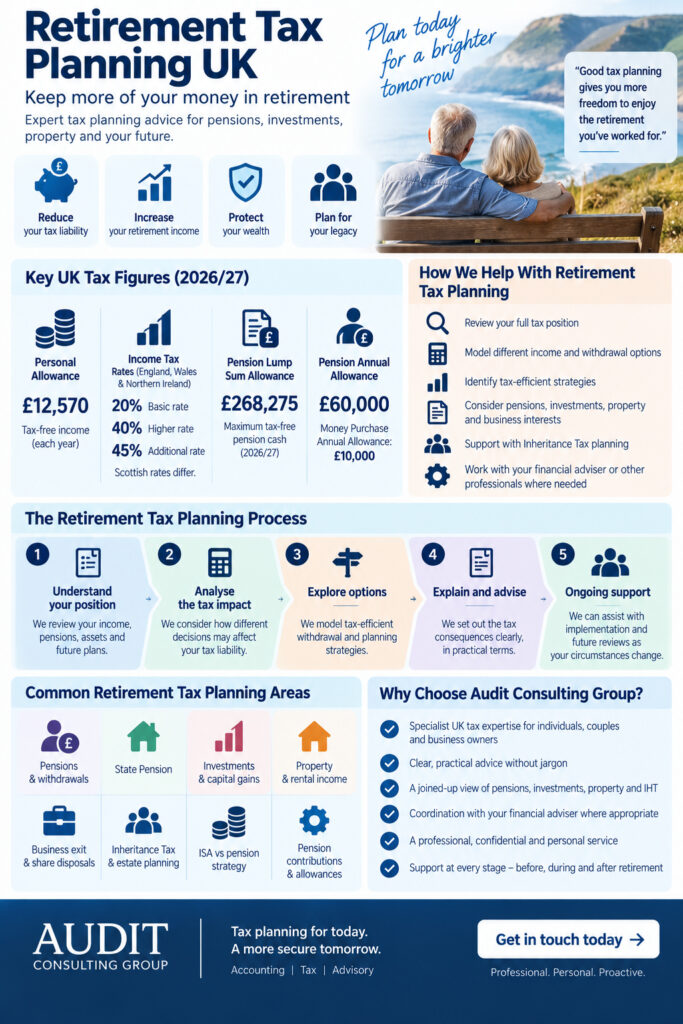
For the 2026/27 tax year, the standard Personal Allowance is £12,570. For taxpayers in England, Wales and Northern Ireland, taxable income above the Personal Allowance can fall within the 20% basic, 40% higher or 45% additional rate bands. Scottish Income Tax uses different bands and rates for relevant income.
The Personal Allowance begins to reduce where adjusted net income exceeds £100,000. It is reduced by £1 for every £2 above that level and can be eliminated completely when income reaches £125,140.
That interaction can make the timing and size of pension withdrawals particularly important for individuals whose total income approaches these levels.
Key UK Retirement Tax Planning Figures for 2026/27
| Tax / Allowance | 2026/27 Figure | When It Matters in Retirement | Planning Consideration |
|---|---|---|---|
| Personal Allowance | £12,570 | Applies to taxable income including pension income, State Pension and other relevant income | Several retirement income sources can collectively use the Personal Allowance. |
| Basic Rate Income Tax | 20% | For England, Wales and Northern Ireland, generally applies to taxable income from £12,571 to £50,270 where the standard Personal Allowance is available | Larger pension withdrawals can use the remaining basic-rate band. |
| Higher Rate Income Tax | 40% | Generally applies from £50,271 to £125,140 in England, Wales and Northern Ireland | A large pension withdrawal can move part of retirement income into the higher-rate band. |
| Additional Rate Income Tax | 45% | Generally applies above £125,140 in England, Wales and Northern Ireland | Large withdrawals or several income sources in the same tax year can materially change the tax position. |
| Personal Allowance Taper Starts | £100,000 | The Personal Allowance reduces by £1 for every £2 of adjusted net income above this level | Retirement withdrawals around this level require particular care because the Personal Allowance begins to reduce. |
| Personal Allowance Reduced to £0 | £125,140 | Standard Personal Allowance can be fully withdrawn at this income level | The interaction between pension withdrawals and other taxable income becomes especially important. |
| Pension Lump Sum Allowance | £268,275 | Limits the standard amount of tax-free pension lump sums that can normally be taken across pensions | The commonly quoted 25% tax-free pension cash is subject to the available Lump Sum Allowance and any protected allowance. |
| Pension Annual Allowance | £60,000 | Relevant to pension contributions before and around retirement | The available allowance can be lower where tapering or other restrictions apply. |
| Money Purchase Annual Allowance | £10,000 | Can apply after certain flexible pension benefits have been accessed | Important for people who begin drawing a pension but continue making pension contributions. |
| Tapered Annual Allowance Threshold Income | £200,000 | Relevant when determining whether the pension Annual Allowance may be tapered | Higher earners should not automatically assume the full £60,000 Annual Allowance is available. |
| Tapered Annual Allowance Adjusted Income | £260,000 | Forms part of the tapered Annual Allowance test | Pension contribution planning for higher-income individuals may require a separate calculation. |
| Capital Gains Tax Annual Exempt Amount | £3,000 | Relevant where investments, property or other chargeable assets are disposed of | Retirement may coincide with asset sales, making CGT part of the wider tax planning exercise. |
| Main Individual CGT Rates | 18% / 24% | Apply to relevant gains from 6 April 2026 depending on available basic-rate band and taxable income | Income and capital disposals in the same tax year can interact when determining the CGT rate. |
Note: Income Tax bands differ for Scottish taxpayers. Pension allowances can also vary because of individual circumstances, previous pension access and protected allowances.
Pension Tax Planning and Tax-Efficient Withdrawals
Pension tax planning involves more than deciding when to start taking pension benefits. A withdrawal from a defined contribution pension can increase taxable income for the year and potentially affect the rate of tax applying to other income.
A large one-off withdrawal may therefore have a different tax result from spreading taxable withdrawals across several tax years. The appropriate approach depends on the individual’s wider financial circumstances, income requirements and pension arrangements.
For tax planning purposes, we may consider:
- existing salary or business income before retirement;
- State Pension income;
- private and workplace pension income;
- rental income;
- dividend and savings income;
- capital disposals;
- the Personal Allowance and applicable tax bands;
- other relevant allowances and tax rules.
The aim of tax-efficient retirement withdrawal planning is to understand the tax consequences before significant withdrawals are made, rather than discovering the impact after the tax year has ended.
Tax-Free Pension Cash and the Lump Sum Allowance
You can usually take up to 25% of pension benefits as tax-free cash, but the amount that can be taken tax-free is subject to pension lump sum allowances.
For 2026/27, the standard Lump Sum Allowance is £268,275. Some individuals may have a protected allowance that changes the amount available to them.
This means that describing pension withdrawals simply as “25% tax-free” can be misleading for larger pension arrangements or where tax-free pension benefits have already been taken from other schemes.
The former Lifetime Allowance was abolished from 6 April 2024. Retirement planning now needs to consider the current lump sum allowance framework rather than relying on the previous Lifetime Allowance rules.
Pension Withdrawal Example
 Consider an individual with a defined contribution pension worth £600,000.
Twenty-five per cent of £600,000 is £150,000. If the individual has sufficient remaining Lump Sum Allowance and no other relevant restriction, that amount may potentially fall within the tax-free pension cash available.
The remaining pension is not automatically taxed immediately. Tax generally arises as taxable benefits are withdrawn.
If the individual takes significant taxable pension income in one tax year, some of that income may fall into higher Income Tax bands. Taking different amounts over different tax years can produce a different tax result.
This example is illustrative only. Actual pension taxation depends on the pension arrangement, benefits already taken, available allowances and the individual’s wider circumstances.
Example: How Different Pension Withdrawals Can Affect Income Tax
The simplified examples below assume an individual in England, Wales or Northern Ireland has £20,000 of other taxable retirement income in 2026/27 and then takes an additional taxable pension withdrawal. They assume the standard £12,570 Personal Allowance and no other deductions, reliefs or special circumstances.
| Other Taxable Income | Taxable Pension Withdrawal | Total Income | Income Above £12,570 Personal Allowance | Highest Income Tax Band Reached | Approx. Income Tax* |
|---|---|---|---|---|---|
| £20,000 | £0 | £20,000 | £7,430 | 20% Basic Rate | £1,486 |
| £20,000 | £10,000 | £30,000 | £17,430 | 20% Basic Rate | £3,486 |
| £20,000 | £20,000 | £40,000 | £27,430 | 20% Basic Rate | £5,486 |
| £20,000 | £30,000 | £50,000 | £37,430 | 20% Basic Rate | £7,486 |
| £20,000 | £40,000 | £60,000 | £47,430 | 40% Higher Rate | £11,432 |
| £20,000 | £50,000 | £70,000 | £57,430 | 40% Higher Rate | £15,432 |
| £20,000 | £80,000 | £100,000 | £87,430 | 40% Higher Rate | £27,432 |
| £20,000 | £90,000 | £110,000 | £102,430 before Personal Allowance taper adjustment | 40% Higher Rate + Personal Allowance taper | Approx. £33,432 |
*Illustrative calculation only. The examples simplify the tax position and do not include Scottish Income Tax, savings or dividend income, pension tax-free cash, Marriage Allowance, Blind Person’s Allowance, other reliefs or individual tax-code adjustments. Actual pension withdrawal taxation depends on the taxpayer’s full circumstances.
Pension Contributions and Annual Allowance Before Retirement
For people still earning before retirement, pension contributions can form part of the tax planning discussion.
The standard pension Annual Allowance for 2026/27 is £60,000. The amount available can be lower in some circumstances, including for certain higher-income individuals or where pension benefits have already been flexibly accessed.
Where the Money Purchase Annual Allowance applies, the allowance for relevant money purchase pension contributions is £10,000 for 2026/27.
Higher earners can also be affected by the tapered Annual Allowance. For 2026/27, the relevant tests include threshold income above £200,000 and adjusted income above £260,000.
Pension contribution planning should therefore be based on the individual’s actual pension and income position rather than assuming that the standard £60,000 allowance is available in every case.
State Pension and Other Taxable Retirement Income
The UK State Pension is taxable income even though tax is not normally deducted directly from the State Pension payment itself.
For someone receiving State Pension alongside private pension income, employment income, rental income or other taxable income, all relevant sources need to be considered when estimating the overall Income Tax position.
This is one reason retirement income tax planning should look beyond the pension pot itself. Several individually manageable sources of income can collectively move a taxpayer into a different tax band.
Investment Tax Planning in Retirement
Investments outside tax-exempt wrappers can create dividend, savings and Capital Gains Tax considerations during retirement.
For the 2026/27 tax year, the Capital Gains Tax annual exempt amount for most individuals is £3,000. For gains made from 6 April 2026, the main individual CGT rates are 18% to the extent gains fall within the available basic rate band and 24% above it, although particular rules and reliefs can affect the final position.
Timing can therefore matter where investments or other chargeable assets are being sold around retirement. The gain itself, other taxable income and available losses or reliefs may all need to be considered.
Our role is to review the tax consequences of investment income and disposals. Recommendations about which investments to buy, sell or hold for investment reasons require appropriate financial advice.
Property Income and Retirement Tax Planning
Rental income does not stop being taxable when a landlord retires. Pension income, State Pension and property profits may all contribute to the individual’s taxable income for the year.
A landlord approaching retirement may therefore need to consider both ongoing rental taxation and the potential tax consequences of any future property disposal.
Property decisions should not be made solely to obtain a particular tax result. Where a disposal is already being considered, however, understanding the potential Income Tax and Capital Gains Tax consequences before completion can help avoid unexpected liabilities.
Business Owners Approaching Retirement or Exit
Retirement can be more complex for company directors and business owners because retirement planning may coincide with a business sale, share disposal, company restructuring, dividend payments or pension contributions.
The timing of these events can create several tax consequences within the same period. Depending on the circumstances, the review may need to consider:
- salary and dividends before retirement;
- pension contributions;
- the tax treatment of a business or share disposal;
- Capital Gains Tax and potentially available reliefs;
- cash or investments retained outside the business;
- future retirement income;
- estate and succession considerations.
Where retirement depends on a significant business transaction, planning should normally begin before the transaction is completed rather than after the proceeds have already been received.
Inheritance Tax and Retirement Planning
Inheritance Tax can become increasingly relevant as retirement planning moves from generating income to considering how remaining assets may eventually pass to family or other beneficiaries.
The tax position can involve property, investments, cash, business assets, lifetime gifts and, increasingly, pension arrangements.
Retirement tax planning should not assume that an asset is outside an estate without checking the rules applying at the relevant time.
How the April 2027 Inheritance Tax Changes Affect Pensions
A significant change is due to apply to deaths on or after 6 April 2027. Under legislation introduced through Finance Act 2026, most unused pension funds and pension death benefits will be brought within the value of a deceased person’s estate for Inheritance Tax purposes.
This is important because pensions have historically been treated differently from many other estate assets. Retirement strategies that were developed partly around leaving pension wealth untouched for inheritance purposes may therefore need to be reviewed in light of the new rules.
There are exceptions and detailed administrative rules, so the effect should be considered in the context of the individual’s pension arrangements, estate and intended beneficiaries rather than applying a single assumption to every pension.
For individuals with significant pension savings and wider estates, the 2027 change makes coordination between retirement income planning and estate tax planning increasingly important.
Retirement Tax Planning vs Financial Advice
Tax planning and regulated financial advice are related but different services.
A retirement tax accountant or tax adviser can analyse how pension withdrawals, investment income, capital disposals, property income and other financial events interact with the tax system. This can include modelling the tax consequences of different levels or timings of income.
Investment recommendations, pension transfers, product selection and advice about whether a particular investment is suitable for you can fall within regulated financial advice.
Where both are required, the most effective approach can be for the tax adviser and appropriately authorised financial adviser to work from the same underlying information while remaining responsible for their respective areas.
Common Retirement Tax Planning Mistakes
- taking a large taxable pension withdrawal without considering the Income Tax band it may fall into;
- assuming all pension cash can automatically be taken 25% tax-free without considering the Lump Sum Allowance;
- forgetting that State Pension forms part of taxable income;
- considering pension income without rental, dividend or investment income;
- selling investments without reviewing potential Capital Gains Tax first;
- assuming the standard pension Annual Allowance applies in every case;
- making retirement decisions based on outdated Lifetime Allowance rules;
- failing to review the effect of the April 2027 Inheritance Tax changes on pensions;
- waiting until after a business sale or major asset disposal before reviewing the tax position;
- treating a retirement strategy as permanent rather than reviewing it when circumstances or tax rules change.
How Our Retirement Tax Planning Process Works
1. Understand Your Retirement Position
We establish your expected retirement date, current income, pensions, investments, property, business interests and other relevant assets or income sources.
2. Review the Current Tax Position
We consider how the different income sources are currently taxed and identify areas where future withdrawals or transactions could materially change the tax position.
3. Model Relevant Retirement Tax Scenarios
Where appropriate, we compare the tax consequences of different income levels, pension withdrawals or transaction timings. The purpose is to understand the tax effect rather than predict investment performance.
4. Explain the Tax Planning Options
We explain the tax consequences, relevant allowances and practical considerations so that the client can make informed decisions. Where financial or legal advice is also required, this can be coordinated with the appropriate professional.
5. Implementation and Ongoing Tax Support
Depending on the agreed scope, we can support relevant tax calculations, reporting and future reviews as circumstances and tax rules change.
What Information We Need to Review Your Retirement Tax Position
A useful retirement tax review starts with the complete income and asset picture. Depending on the scope of the work, we may ask for:
- your age and expected retirement date;
- recent pension statements and approximate pension values;
- details of pension benefits already taken;
- your State Pension forecast;
- current employment, self-employment or company income;
- salary and dividend information where you are a company director;
- ISA and other investment values;
- rental income and property information;
- details of assets you expect to sell;
- expected annual retirement income requirements;
- relevant tax returns and HMRC information;
- an outline of significant estate assets where IHT is within the agreed planning scope.
You do not necessarily need every document before making an initial enquiry. A summary of the main figures is usually enough to establish the likely scope of the tax review.
Practical Retirement Tax Planning Scenarios
The following examples illustrate the type of tax issues that can arise. They are not client case studies and do not represent guaranteed tax outcomes.
Couple Approaching Retirement With Pensions and ISAs
A married couple approaching retirement have several workplace and personal pensions, ISA savings and different expected State Pension start dates.
The tax review maps the expected income sources by tax year and examines how different levels of taxable pension withdrawals interact with each person’s Personal Allowance and Income Tax bands. ISA withdrawals can also be considered as part of the wider cash-flow discussion because they have a different UK tax treatment from taxable pension income.
The outcome is a clearer view of the tax consequences of different withdrawal patterns and the information the couple can use alongside their wider financial planning.
Business Owner Preparing for Retirement
A company director expects to retire following a future disposal of the business. The individual also has pension savings and investments outside the company.
The tax review considers salary and dividend income, pension contribution rules where relevant, the tax consequences of the proposed disposal and how future retirement income may interact with the proceeds.
The commercial benefit is better visibility before several potentially significant taxable events occur close together.
Retired Landlord With Pension and Property Income
A retired landlord receives State Pension, private pension income and rental profits and is considering selling one property.
The review considers the combined Income Tax position and separately models the potential Capital Gains Tax implications of the proposed disposal using the relevant information.
This provides a more complete tax picture than reviewing pension income or the property disposal independently.
What Clients Often Underestimate About Retirement Tax Planning
One of the most common misconceptions is that retirement automatically means a lower tax rate. It may, but the result depends on the amount and type of income received.
A person can stop receiving a salary but begin receiving State Pension, private pension withdrawals, rental profits and investment income. A large one-off pension withdrawal or asset disposal can also make one tax year look very different from the next.
Another issue is timing. Tax planning carried out after a pension withdrawal, business disposal or investment sale can explain the resulting liability, but some planning options may only have been available before the transaction occurred.
How Much Does Retirement Tax Planning Cost?
The cost of retirement tax planning advice depends on the complexity of the position and the amount of modelling or specialist review required.
A relatively focused review of pension and other retirement income is different from a case involving several pensions, rental properties, investment portfolios, a business disposal and Inheritance Tax considerations.
Factors affecting the scope and fee can include:
- the number and type of pensions;
- the number of income sources;
- whether investment or property disposals are expected;
- whether a business exit is involved;
- whether multiple tax years need to be modelled;
- whether estate and Inheritance Tax considerations form part of the scope;
- the quality and completeness of the information available;
- whether coordination with other professional advisers is required.
Before substantive planning work begins, the scope should be clear enough for both sides to understand what is being reviewed and what the resulting work will cover.
Service Cost Estimation
Select the service category below to calculate the estimated cost of either accounting & tax services or forms and submissions.
Select Required Services / Forms
Select one or more services/forms to receive an accurate cost estimate. You can adjust your selection at any stage.
How would you like to engage our services?
Please select whether you require a one-off service or ongoing monthly support.
Contract Duration
Your cost estimate
Apply now and get 10% OFF
Submit your request today and receive an exclusive 10% discount on your selected service.
All prices are estimates. To receive a personalised quote, please fill out the form or contact us.
Ready to get started?
Get professional support from experienced UK accountants
Why Choose Audit Consulting Group for Retirement Tax Planning?
Retirement tax planning often sits across several areas of personal taxation. Pension income can interact with State Pension, property profits, dividends, capital gains and other income, while decisions about larger assets can have consequences beyond a single tax year.
Our approach is to review these interactions rather than treating each tax issue in isolation. We explain the tax position in practical terms, identify the information and assumptions used and distinguish tax analysis from areas that require regulated financial or legal advice.
Where appropriate, we can also coordinate tax work with a client’s existing financial adviser, solicitor or other professional so that the different elements of retirement planning are considered consistently.
Frequently Asked Questions About Retirement Tax Planning
What is retirement tax planning?
Retirement tax planning reviews how pensions, State Pension, investments, property and other sources of income may be taxed before and during retirement. It can also consider the tax consequences of withdrawals, asset disposals and estate planning decisions.
When should I start retirement tax planning?
Planning can be useful several years before retirement because decisions about pension contributions, business exits and future income may need to be considered before employment or business activity stops. It can also remain useful after retirement has already begun.
Do I pay tax on pension income?
Taxable pension income is generally subject to Income Tax. The amount actually payable depends on total taxable income and the allowances and tax bands applying to the individual.
Is the State Pension taxable?
Yes. State Pension counts as taxable income, although tax is not normally deducted directly from the State Pension payment itself.
How much of my pension can I take tax-free?
You can usually take up to 25% of pension benefits as tax-free cash, subject to the available Lump Sum Allowance and the rules applying to your pension. The standard Lump Sum Allowance for 2026/27 is £268,275, although some individuals may have protected allowances.
What happened to the Lifetime Allowance?
The Lifetime Allowance was abolished from 6 April 2024. The current pension tax framework includes the Lump Sum Allowance and Lump Sum and Death Benefit Allowance, so older retirement plans referring to the Lifetime Allowance may need to be reviewed.
Should I take my 25% tax-free pension cash immediately?
There is no universal answer. The tax-free treatment is only one factor. Cash requirements, pension rules, other assets and wider financial planning should also be considered. Advice about the suitability of a particular pension withdrawal strategy may require regulated financial advice as well as tax analysis.
Can pension withdrawals push me into a higher tax band?
Yes. Taxable pension withdrawals are added to other taxable income, so a sufficiently large withdrawal can cause part of the individual’s income to fall within a higher Income Tax band.
Should I use my ISA before my pension?
There is no automatic order that is right for everyone. ISA withdrawals and taxable pension withdrawals have different tax treatments, but the appropriate sequence depends on the individual’s wider circumstances and financial objectives.
What is the pension Annual Allowance?
The standard pension Annual Allowance for 2026/27 is £60,000, but a lower allowance can apply in certain circumstances, including where the tapered Annual Allowance or Money Purchase Annual Allowance applies.
What is the Money Purchase Annual Allowance?
The Money Purchase Annual Allowance can restrict tax-relieved contributions to defined contribution pensions after certain types of flexible pension access. For 2026/27, the MPAA is £10,000.
Do I pay Capital Gains Tax in retirement?
Retirement does not itself provide an exemption from Capital Gains Tax. CGT may arise when chargeable assets are disposed of and gains exceed available allowances after considering relevant losses and reliefs.
How are pensions changing for Inheritance Tax in April 2027?
For deaths on or after 6 April 2027, most unused pension funds and pension death benefits will be brought within the value of the deceased person’s estate for Inheritance Tax purposes. Exceptions and detailed rules apply, so existing pension estate planning may need to be reviewed rather than assuming all pension wealth remains outside the estate.
Can you help with tax planning if I am already retired?
Yes. Post-retirement tax planning can still be relevant where you have flexible pension withdrawals, investments, rental income, capital disposals or changing estate-planning considerations.
Can you advise me which investments or pension products to choose?
Our retirement planning work focuses on taxation. Recommendations about specific investments, pension products, pension transfers or investment suitability can require regulated financial advice and should be provided by an appropriately authorised adviser.
Can you work with my financial adviser?
Yes. Tax analysis can be coordinated with an existing financial adviser or other professional where appropriate, while each adviser remains responsible for their own area of advice.
How much does retirement tax planning cost?
The fee depends on the scope and complexity of the review. A focused pension income tax review will generally require less work than planning involving multiple pensions, property, investments, a business exit and estate tax considerations.
Do I need to provide all my documents before contacting you?
No. For an initial discussion, approximate pension values, expected retirement date, main income sources and a brief explanation of the tax questions are normally enough to establish what information will be required for a detailed review.
Start With a Review of Your Retirement Tax Position
If you are approaching retirement or already drawing retirement income, send us a short summary of your position. Useful starting information includes your age, expected retirement date, approximate pension values, other major income sources or assets and the main tax questions you want reviewed.
We can then establish the appropriate scope of the retirement tax planning work and identify the information needed for a more detailed tax review.
The purpose is to give you a clearer understanding of how your retirement income and major financial decisions interact with the UK tax system, while keeping tax advice appropriately separated from regulated investment and pension product advice.