

24/7 Company Formation in the UK: Same-Day Options, Costs & Requirements
Quick answer: You can prepare an application to register a UK limited company online at any time. However, 24/7 company formation or 247 company formation does not mean that Companies House approves applications around the clock or guarantees incorporation within 24 hours. Standard electronic applications are normally processed within 24 hours; an eligible same-day software incorporation service is also available on working days, subject to its 3pm cut-off. The current Companies House incorporation fee is £100 online, or £156 for the same-day software route. Professional assistance costs extra. Identity verification, the company’s ownership details and its registered office must be dealt with correctly before filing.
This practical guide covers UK company formation, the company registration process, documents and requirements, fees, non-resident founders, potential delays and what to do after Companies House issues the certificate of incorporation. It explains how to set up a limited company in the UK, rather than promising instant registration or replacing individual legal or tax advice.
Leave your details and our team will get back to you shortly.
What Does 24/7 Company Formation Mean?
If you are comparing incorporation with trading as an individual, our self-employed registration information explains the separate route.
The expressions 24/7 company formation, 247 company formation and round-the-clock formation services usually describe access to an online company formation service at any time of day. Founders can gather information, complete digital questionnaires and, depending on the provider, prepare an electronic application outside normal office hours. The registrar’s decision is a separate step. A 24-hour company formation service may accept instructions outside business hours, but the formation of a company is only complete once Companies House issues its certificate of incorporation.
Company formation in the UK creates a legal entity once Companies House accepts its incorporation. For a typical private company limited by shares, the company is separate from its shareholders. Directors run the company; shareholders own shares; and people with significant control (PSCs) must be identified and reported. Forming a company is different from registering as a sole trader, opening a bank account or registering for VAT.
Searches for UK company formation, British company formation or company registration generally point towards the same broader topic. The useful question is not which expression a provider uses, but which legal structure, filing route and ongoing obligations apply to your circumstances.
Can You Form a UK Company in 24 Hours?
For a straightforward online application, Companies House says incorporation is normally completed within 24 hours, but some applications take longer. A provider cannot guarantee an approval time. A name requiring additional checks, missing verification information or unusual share arrangements may delay the result.
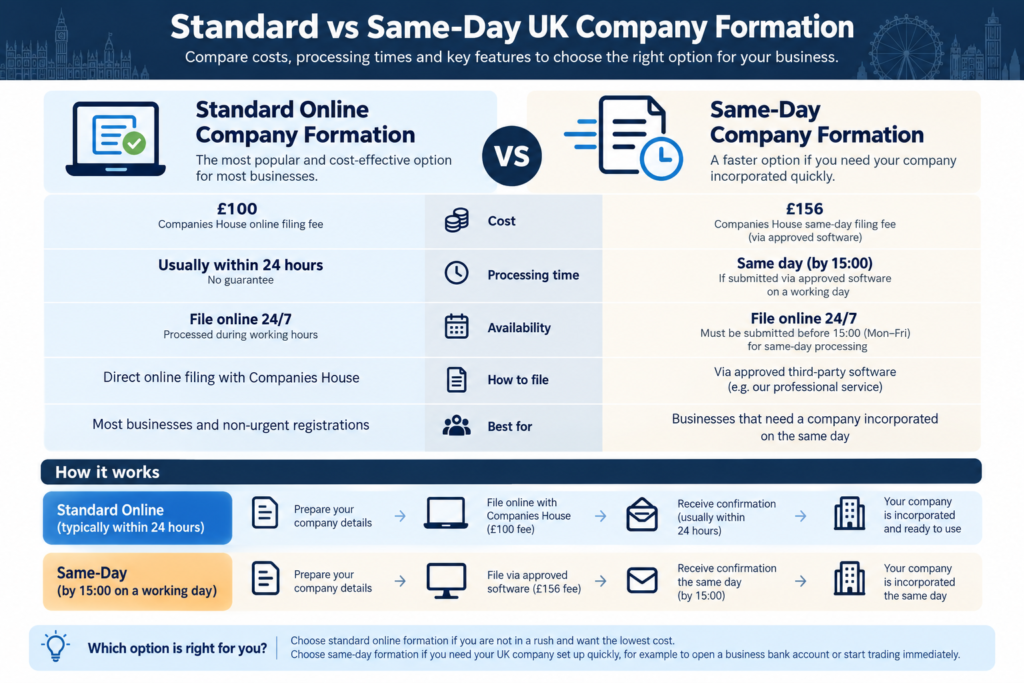
Same-day company formation versus standard online filing
Same day company formation UK and same day company registration UK are distinct from a provider accepting instructions 24/7. Companies House offers a same-day incorporation route through compatible software, with an application deadline of 3pm Monday to Friday and a higher fee. The standard GOV.UK web incorporation service does not offer same-day incorporation. A software filing received after the cut-off, on a non-working day, or requiring additional examination should not be treated as guaranteed for that day.
| Route | Companies House fee | Timing and availability | Best suited to |
|---|---|---|---|
| Standard online incorporation | £100 | Normally within 24 hours; not guaranteed | Straightforward registrations without a same-day requirement |
| Standard software incorporation | £100 | Normally within 24 hours; not guaranteed | Applicants or agents using filing software |
| Same-day software incorporation | £156 | Apply by 3pm Monday–Friday; subject to conditions and review | Eligible urgent incorporations |
| Paper incorporation | £124 | Slower manual processing; check current guidance | Cases requiring an appropriate paper route |
These are Companies House fees, not ACG service prices. Check the current Companies House fee schedule and incorporation guidance before filing.
Someone searching fast company formation UK, urgent company formation UK or company formation today should prepare the details first, confirm the filing route and avoid making commercial commitments dependent on an unconfirmed incorporation date.
UK Company Formation Requirements: Before You Apply
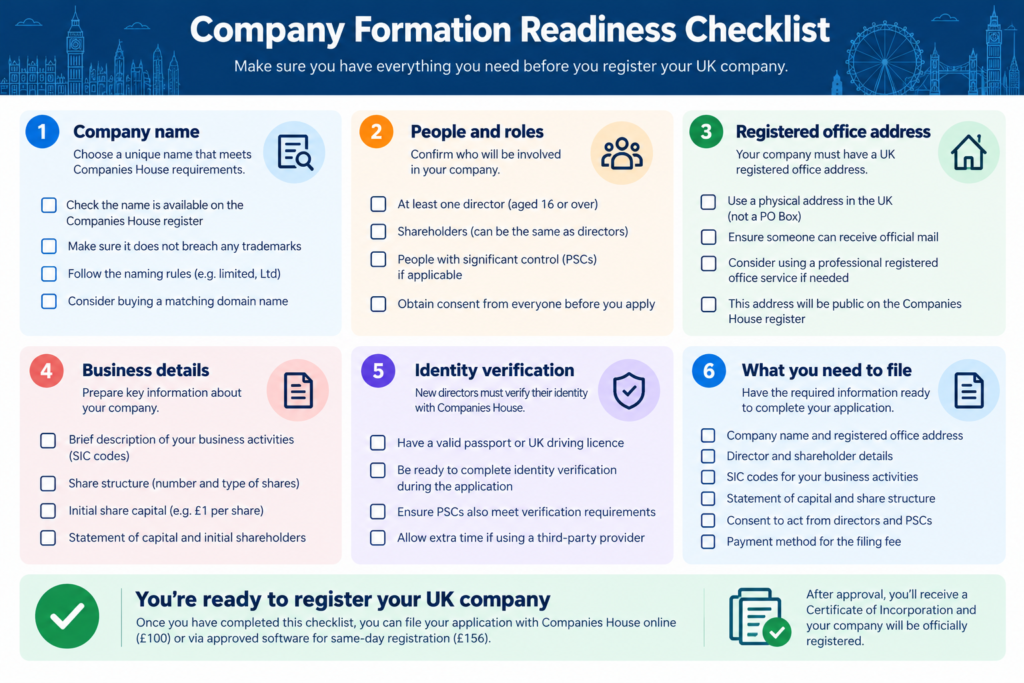
 Before starting limited company formation UK, decide the legal structure and collect accurate information. For a conventional private company limited by shares, the core checklist is: For a new company formation, treat the checklist as a preparation tool rather than a substitute for the official incorporation application.
- Proposed company name, checked against Companies House restrictions and potential trade mark conflicts.
- UK registered office in the appropriate jurisdiction and a registered email address.
- Director names and required personal particulars; at least one individual director is needed.
- Shareholders, initial shareholdings and share classes.
- People with significant control and their nature of control.
- Relevant Companies House identity verification and personal codes.
- Appropriate articles of association and, where applicable, a memorandum of association.
- Statement of capital, where applicable, and confirmation of lawful purpose.
- SIC codes describing the company’s intended activities.
- A plan for bookkeeping, tax and compliance after incorporation.
An UK company formation checklist is most useful when it distinguishes filing details from separate services. A business bank account, VAT number and PAYE reference are not prerequisites for every incorporation application.
How to Register a Limited Company in the UK: Step-by-Step
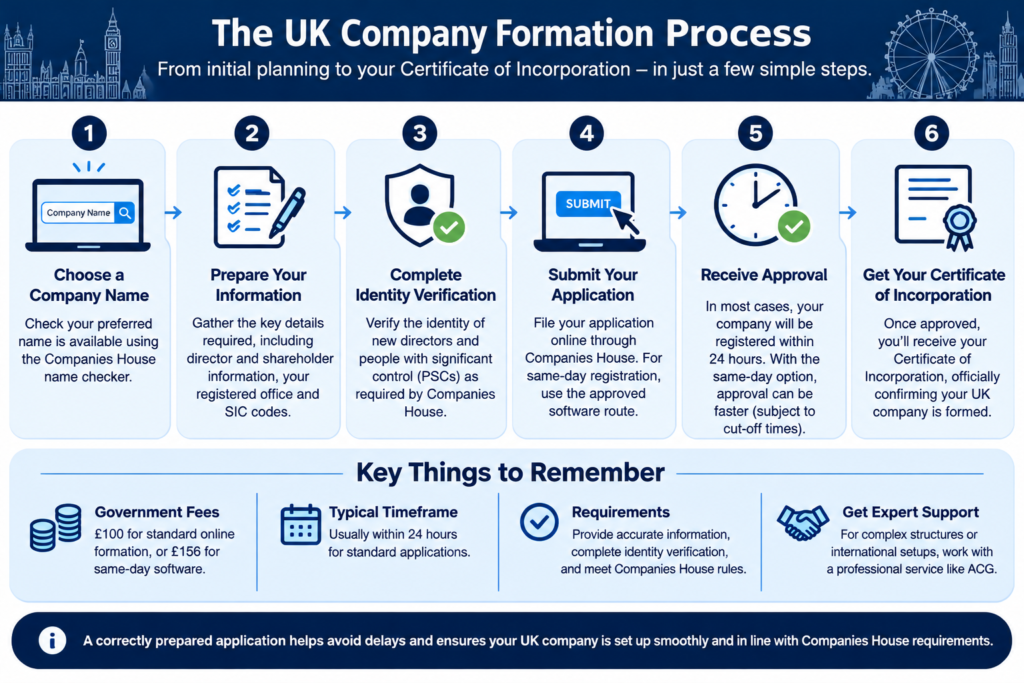
The company formation process UK begins with business decisions, not with clicking ‘submit’. The sequence below explains how to register a company in the UK using a typical electronic route. This UK company incorporation process also applies to many straightforward online company registration applications, although the details vary by legal structure.

Step 1 — Choose the legal structure and company name
Most small trading companies use a private company limited by shares. Check the proposed name against Companies House naming rules and relevant intellectual property rights. A name appearing available on the register is not necessarily safe to use as a brand.
Step 2 — Decide who will direct and own the company
Identify directors, shareholders and PSCs. A shareholder may also be a director, but the roles are not interchangeable. Agree share percentages and any different share rights before registration. An incorrect initial allocation can be expensive or awkward to change later.
Step 3 — Arrange the registered office and email address
The company needs an appropriate registered office in the relevant UK jurisdiction. It must be an address where documents delivered to the company can be acknowledged and brought to the company’s attention. A registered email address is also required and is not displayed publicly. Think carefully before using a home address because registered office details are public.
Step 4 — Choose SIC codes and articles
Select SIC codes that reflect the intended business activities. Consider whether model articles are suitable or tailored articles are needed, particularly where investors, different share classes or restrictions are contemplated.
Step 5 — Complete identity verification
Directors must satisfy the applicable Companies House identity verification rules. Each verified individual receives a personal code used to connect their identity to relevant company roles. PSCs have their own code-submission requirements and deadlines. See the detailed section below.
Step 6 — Review and submit the incorporation application
Check spelling, dates, control details, addresses, share allocations and the registered company name. File through the appropriate GOV.UK company registration service or eligible software route and pay the relevant fee.
Step 7 — Receive and review the certificate of incorporation
When approved, Companies House issues a Certificate of Incorporation confirming the company number and incorporation date. Check the public register and your company documents for errors. Then complete the relevant post-incorporation steps.
What Documents and Details Does Companies House Need?
People searching for UK company formation documents or company registration documents UK often expect a fixed pack of paperwork. In practice, standard online incorporation mainly requires accurate information entered into the application, while supporting documents may be needed depending on the company name, structure, verification route or special circumstances. A company formation checklist for the UK should also flag when proposed names, ownership arrangements or special articles need extra review.
| Information or document | Why it matters | Always required in the same form? |
|---|---|---|
| Company name and registered office | Identifies the legal entity and official correspondence address | Core incorporation details |
| Director details | Identifies who manages the company | Required for each director |
| Shareholder and statement-of-capital information | Records ownership and initial shares | Relevant to companies limited by shares |
| PSC information | Discloses significant ownership or control | Must be assessed and reported under applicable rules |
| Articles of association | Governs internal company rules | Required; model articles may be used where suitable |
| Identity verification and personal code | Connects verified individuals to roles | Applicable according to role and filing rules |
| Supporting evidence for a name or special structure | Addresses additional Companies House requirements | Conditional |
| Bank statements, lease or business plan | May be requested by banks or other providers | Not universal Companies House incorporation documents |
Do not confuse documents needed to register a company with the later due-diligence documents required to open a business bank account, obtain a merchant account or establish a registered-office service.
Companies House Identity Verification for Directors and PSCs
For a dedicated explanation of the verification process, see our Companies House identity verification service page. The service description does not by itself establish ACSP authorisation.
Identity verification is a material part of Companies House company registration. Since 18 November 2025, people becoming directors must verify their identity and supply the relevant Companies House personal code when incorporating or being appointed. PSCs also need to verify and provide their personal code in a role-specific 14-day window. For a person becoming a PSC after 18 November 2025, the code may be provided when added to the register or within 14 days afterwards. Existing PSCs who are also directors, and existing PSCs who are not directors, follow different windows linked to the confirmation statement or birth month. Always check the applicable dates on the Companies House register.
Individuals can generally verify directly through GOV.UK One Login or through an Authorised Corporate Service Provider (ACSP). A personal code belongs to the individual, not to the company. A director who is also a PSC must link their verified identity to both roles separately. Someone serving as director of multiple companies normally verifies once and uses that code for the relevant roles.
A founder planning online company formation UK should complete verification early enough to avoid delays, particularly when using a same-day service. Do not publish or casually share personal codes. Refer to Companies House personal code guidance and PSC verification requirements for the current process.
For assistance with the wider registration process, see ACG’s Company Formation service. Identity verification through an authorised provider must only be offered where the provider has the necessary status.
How Much Does Company Formation Cost in the UK?
For professional assistance, see our company formation services and request a quotation that separates the statutory filing fee from the adviser’s charges.
The UK company formation costs depends on the official filing route and whether professional support or additional services are purchased. The current Companies House online incorporation fee is £100; same-day software incorporation is £156; paper incorporation is £124. These amounts do not include accounting, registered-office services, banking support or advice. When comparing company formation UK cost estimates, check whether the quoted amount includes the Companies House fee, registered-office provision and any optional advisory work.
The price of a company formation service UK may cover basic submission only or include ownership review, articles, identity-verification assistance where authorised, statutory documents or post-formation guidance. Compare the scope rather than treating all UK company formation services as equivalent.
Illustrative comparison: A founder filing directly online pays the applicable £100 Companies House fee. Another founder may choose professional assistance and pay a separate adviser fee plus the Companies House charge, depending on the agreed quotation. A same-day route costs more at Companies House and still does not guarantee acceptance if checks are required.
Which Company Formation Route Should You Choose?
Company formation UK online can be a straightforward self-service task for a single shareholder-director who understands the requirements. Professional support becomes more valuable where the ownership structure, overseas circumstances or tax setup needs consideration. If you are comparing UK company setup options, first decide whether you need basic incorporation, a faster eligible filing route or help with a more complex ownership structure.
| Approach | What the founder controls | Potential benefit | Main limitation |
|---|---|---|---|
| Direct GOV.UK registration | Information, filing and payment | No separate formation-agent fee | Founder must make and check decisions |
| Same-day software registration | Preparation and choice of eligible software route | Can meet an urgent timetable | Cut-off, extra fee and no unconditional approval guarantee |
| Professional formation assistance | Provides instructions and approves proposed setup | Help with structure, preparation and related obligations | Additional cost; adviser cannot override registrar checks |
Searches such as company formation services, company incorporation services and company registration services UK usually have stronger purchasing intent. This guide explains the choices; the separate ACG UK Company Formation service provides the commercial route.
Limited Company, LLP or Sole Trader?
A limited company formation creates a company, but not every UK business uses the same structure. The right choice depends on owners, liability, investment plans, tax and governance. Business formation in the UK can mean incorporating a company, establishing an LLP or starting to trade as a sole trader; these are not interchangeable legal processes.
| Structure | Separate legal entity? | Typical use | Important distinction |
|---|---|---|---|
| Private company limited by shares (Ltd) | Yes | Trading companies and startups | Shareholders own shares; directors manage |
| Private company limited by guarantee | Yes | Certain community and membership organisations | Guarantors rather than conventional share ownership |
| Limited liability partnership (LLP) | Yes | Some professional and jointly owned businesses | Different governance and tax treatment |
| Sole trader | No separate company | Individual trading activity | Not incorporated at Companies House as a limited company |
| Public limited company (PLC) | Yes | Larger companies meeting additional conditions | Additional capital and governance requirements |
The phrase ltd company formation UK usually refers to a private company limited by shares. A founder moving from sole trader to limited company should not assume that the new company automatically takes over existing contracts, licences or tax registrations.
UK Company Formation for Non-Residents
Company formation in UK for non residents is generally possible. A UK limited company director or shareholder does not ordinarily have to live in the UK or hold British citizenship simply to take that role. However, the company must meet the applicable registered-office, disclosure and identity requirements. Remote company formation and business setup in the UK should therefore be planned alongside practical banking and cross-border compliance requirements.
Someone researching UK company formation for foreigners, company registration UK non resident or register a UK company from abroad should assess several separate questions:
- Where will the company’s registered office be located, and can official correspondence be handled reliably?
- Can the directors and PSCs complete the necessary identity checks?
- Where will strategic decisions and day-to-day management take place?
- Will the business need a UK bank account or payment provider, and what checks will that provider impose?
- What are the Corporation Tax, VAT and overseas tax consequences of the actual operations?
- Are there immigration, sector-licensing or employment matters separate from incorporation?
Remote company formation does not confer a visa, establish UK personal residence or guarantee a particular tax residence result. It also does not guarantee a bank account. A UK-registered company can have cross-border obligations that require advice in more than one jurisdiction.
Illustrative scenario: A software consultant living abroad forms a UK company to serve British customers. The incorporation can be completed electronically if the filing conditions are met, but banking, invoicing, VAT and where the company is managed remain separate issues. Those outcomes depend on the facts, not merely the incorporation certificate.
Registered Office, Company Address and Bank Account
A registered office is the official address shown on the Companies House register. It must be an appropriate address in the relevant UK jurisdiction; it is not automatically a staffed trading location. The company must also supply a registered email address, which is not public. For company formation UK address requirements, distinguish the public registered office from any separate correspondence, service or trading address.
Searches for company formation UK with bank account often combine two different processes. A company can be incorporated without already holding a business bank account. Banks and payment providers separately assess beneficial owners, identification, expected transactions, business model, country connections and source of funds. Some founders can begin applications quickly after incorporation; others face longer reviews or may not meet a provider’s criteria.
Do not describe a bank account as ‘included’ unless the service genuinely provides that benefit and any eligibility conditions are made clear.
Why Is Company Registration Delayed?
A fast company registration UK application can still be delayed by correctable mistakes. Before resubmitting, identify whether the issue concerns the registrar, the formation agent or an unrelated third party such as a bank. A company setup UK timetable should allow for checks rather than assume that every online application will be approved immediately.
| Problem | Likely effect | Practical response |
|---|---|---|
| Director personal code missing or incorrect | Filing cannot proceed as intended | Verify identity and check code/details |
| Company name needs review | Extra Companies House checks | Check naming rules and supporting evidence |
| PSC information incomplete | Questions about ownership or control | Recheck the ownership and control analysis |
| Inconsistent names, dates or addresses | Rejection or follow-up | Compare information against verified records |
| Complex shares or tailored articles | Longer preparation or examination | Obtain suitable legal/company-secretarial input |
| Same-day cut-off missed | Same-day service unavailable for that submission | Plan around 3pm weekday deadline |
| Bank account not yet approved | Operational delay after incorporation | Treat banking as a separate workstream |
The goal is not merely instant company formation UK. It is a company that is correctly registered and usable for its intended business.
What to Do After Incorporation
Good records matter from the first transaction; our bookkeeping services explain the support available.
annual accounts are a separate statutory obligation after incorporation.
Our Corporation Tax guidance covers related HMRC obligations.
VAT registration is a separate process and is not automatic on incorporation.
If PAYE is required, payroll services may help with the ongoing reporting.
Companies must also keep their confirmation statement obligations under review.
A certificate of incorporation is the start of company compliance, not the end. Depending on activities and circumstances, the directors should address:
Corporation Tax and HMRC
The GOV.UK online company-registration route can register the company for Corporation Tax, and offers optional PAYE registration. Other filing routes may require separate HMRC steps; check the actual registration confirmation and tell HMRC when the company starts business activity as required. Check what HMRC has recorded and any further notification or filing obligations when trading begins. Do not assume incorporation alone resolves every tax issue.
Accounting records and annual accounts
Maintain transaction records from the beginning and plan for annual accounts, Corporation Tax returns and other filings. Poor records in the first year create unnecessary problems later.
VAT registration
VAT registration is a separate question. The company may need to register depending on its taxable supplies, turnover and other circumstances. See ACG VAT Registration Services if you need help assessing the position.
PAYE and payroll
If the company pays employees or directors through payroll, PAYE registration and reporting may be required. Some online formation journeys offer optional PAYE registration, but this is not automatically appropriate for every company.
Confirmation statements and Companies House changes
Companies must maintain accurate Companies House records and submit required annual and event-driven filings. Changes to directors, PSCs, registered office and other particulars may trigger reporting obligations.
Three Practical Company Formation Scenarios
Example 1 — Freelancer needs a company for a contract
A UK-based consultant expects a new customer contract next week. The consultant is the sole proposed director and shareholder, has an appropriate registered office and has completed identity verification. A standard online application may be sufficient; an eligible same-day route is an option if timing is genuinely critical. The client contract should not be treated as signed by a company until the entity legally exists and the contracting arrangements are correct.

Example 2 — Overseas founder launching an eCommerce business
A founder based outside the UK wants a British company and online payment processing. Incorporation can be handled remotely, but a registered office, verified identities, payment-provider onboarding and VAT analysis may all need separate attention. Fast incorporation does not mean instant merchant-account approval.
Example 3 — Two founders expecting an investor
Two founders intend to issue ordinary shares now and raise investment later. They should agree share percentages, voting rights and future dilution expectations before filing. An extra day of preparation may prevent later legal work to correct an unsuitable share structure.
All three scenarios are illustrative, not real ACG client cases or guarantees of a particular result.
Frequently Asked Questions About 24/7 Company Formation
Can I register a limited company on the same day?
Possibly. Companies House offers an eligible same-day software route for applications submitted by 3pm Monday–Friday. The registrar may still need further checks; approval is not guaranteed.
Is it worth paying extra for a same-day company registration service?
Only if the timing has real commercial value and the application is ready. Compare the additional fee with the consequences of waiting for the standard route, which is normally processed within 24 hours.
Can I get same-day company registration in the UK as a non-resident?
Non-resident status alone does not automatically prohibit incorporation. However, identity checks, ownership details, filing eligibility and other requirements must be satisfied; banking and overseas tax matters remain separate.
How much does it cost to register a company in the UK?
The current Companies House fee is £100 online, £156 for same-day software incorporation and £124 on paper. Adviser fees and optional services are additional.
Do I need a UK address to register a limited company?
The company needs an appropriate registered office in the relevant UK jurisdiction. Its directors and shareholders do not necessarily need to live there.
What is a Companies House personal code?
It is an individual identifier issued after successful identity verification. Directors and PSCs use it to connect their verified identity to relevant company roles.
Can I form a UK company without a business bank account?
Yes. Incorporation and banking are separate processes. You can arrange banking after the company exists, subject to the provider’s checks.
Can I set up a limited company myself?
Yes. The official GOV.UK service allows eligible founders to apply directly. Consider professional advice if ownership, articles, cross-border issues or tax consequences are complex.
What is the difference between company registration and company incorporation?
In this context, both generally refer to creating a company through Companies House. Incorporation is the legal event that creates the entity; a certificate confirms it.
What documents will I receive after incorporation?
The Certificate of Incorporation confirms the company number and date. The formation arrangements may also provide copies of articles, share certificates and other records, depending on the service and circumstances.
Can a foreigner be a director of a UK limited company?
Generally, UK nationality or residence is not a universal requirement to be a director. The company and individual must still comply with the applicable legal and identity requirements.
Does 24/7 company formation mean Companies House is open all night?
No. It usually describes the ability to prepare or submit instructions online at any time, not a guarantee that Companies House will approve an application overnight.
Does company formation automatically register me for VAT?
No. VAT registration is a separate process and depends on the company’s activities and circumstances.
How do I check whether my company name is available?
Search the Companies House register and review naming restrictions. Also check relevant trade marks before adopting the name commercially.
How quickly can I start trading after registration?
A company legally exists once incorporated, but it may need banking, contracts, records, tax registrations, licences or other practical arrangements before particular activities can begin.
Final Pre-Filing Checklist
Before submitting a UK company registration application, confirm that the company name is appropriate, directors and shareholders have agreed their roles, PSCs are correctly identified, the registered office is suitable, the registered email address is available, SIC codes are accurate, articles and share allocations are appropriate, required identities have been verified and the filing route and fee are understood. After approval, review the certificate, set up accounting records and assess HMRC, VAT, PAYE and ongoing Companies House obligations.
Official Companies House and GOV.UK Sources
Regulatory details and fees reviewed on 16 October 2026. Check current official guidance before submitting an application.