

Bookkeeping Services for Small Businesses: A Practical UK Guide
Bookkeeping rarely fails in one dramatic moment. It usually drifts. A supplier invoice sits in an inbox. A card payment is posted to the wrong category. A director pays for something personally and forgets to record it. VAT is treated as a cash-flow cushion rather than a tax liability. Payroll journals are entered late, or not at all. None of these errors looks serious in isolation, but together they can distort profit, weaken tax planning, create HMRC problems and leave owners making decisions from unreliable numbers.
For small businesses in the UK, bookkeeping is not just administration. It is the financial infrastructure behind VAT returns, payroll reporting, Self Assessment, Corporation Tax, management accounts, finance applications, director decisions and, in some sectors, CIS compliance. Good bookkeeping does not make a weak business strong by itself, but poor bookkeeping can make a sound business look confused, underperforming or non-compliant.
This guide explains what bookkeeping services for small businesses actually involve, where the risks sit, how different business types need different levels of support, and what owners should understand before deciding whether to keep records in-house, outsource bookkeeping, or use a hybrid approach.
Leave your details and our team will get back to you shortly.
What bookkeeping really means for a UK small business
Bookkeeping is often described as recording income and expenses. That definition is technically correct, but too narrow to be useful. In practice, bookkeeping is the process of turning business activity into reliable financial records that can be used for compliance, reporting and decision-making.
For a small UK business, that may include recording sales invoices, purchase invoices, bank transactions, card payments, receipts, payroll entries, VAT movements, CIS deductions, director loan transactions, stock adjustments, accruals, prepayments and reconciliations. The exact scope depends on the business model. A sole trader with a handful of monthly transactions does not need the same bookkeeping structure as a VAT-registered construction company using subcontractors, payroll and staged project billing. This is why small business bookkeeping should be judged by complexity as much as turnover.
The practical test is simple: can the records support the decisions and filings the business is required to make? If the answer is no, the bookkeeping is not doing its job, even if the software appears tidy.
Why small business bookkeeping has become more demanding
Several changes have raised the standard expected from small business records. Cloud accounting software has made bookkeeping faster, but it has also created a false sense of security. Bank feeds, receipt apps and automated rules can reduce manual work, yet they do not remove the need for judgement. Software can suggest a category; it cannot always know whether an expense is allowable, whether VAT should be claimed, whether a payment relates to payroll, or whether a director loan account is being affected.
HMRC’s digital direction has also changed expectations. Making Tax Digital for VAT already requires many VAT-registered businesses to keep digital records and submit VAT returns through compatible software. Further digital reporting developments continue to shape how businesses prepare and maintain their records. Even where a business is not yet within a specific digital regime, poor record keeping can still affect tax accuracy, enquiry risk and year-end efficiency.
Companies House obligations add another layer for limited companies. Bookkeeping is not the same as preparing statutory accounts, but statutory accounts rely heavily on the quality of the underlying records. If transactions are incomplete, unreconciled or misclassified, the year-end accounts process becomes slower, more expensive and more exposed to correction.
The hidden cost of “basic” bookkeeping
Some small businesses only look for basic bookkeeping: bank categorisation, invoice entry and monthly reconciliation. That may be enough for a simple business with low transaction volume and no VAT, payroll, CIS, stock or finance reporting needs. The risk is assuming that basic bookkeeping is suitable for every small business simply because the company is small.
A business can be small and still be technically complex. A self-employed consultant may only need light bookkeeping and annual Self Assessment support. A sole trader retailer may need stock awareness, cash handling controls and VAT treatment. A limited company with two directors may need payroll journals, dividend records, director loan tracking and Corporation Tax-ready records. A construction business may need CIS deductions, subcontractor verification, reverse charge VAT awareness and project-level cost visibility.
Basic bookkeeping becomes expensive when it misses the details that later need to be reconstructed. The apparent saving can be lost through year-end clean-up work, VAT corrections, payroll adjustments or delayed accounts.
What professional bookkeeping services usually include
Bookkeeping services vary widely. Some providers handle only transaction processing. Others combine bookkeeping with accounting, VAT, payroll, management accounts and tax coordination. The difference matters because a small business rarely experiences bookkeeping as a standalone function. It connects with nearly every financial obligation the business has.
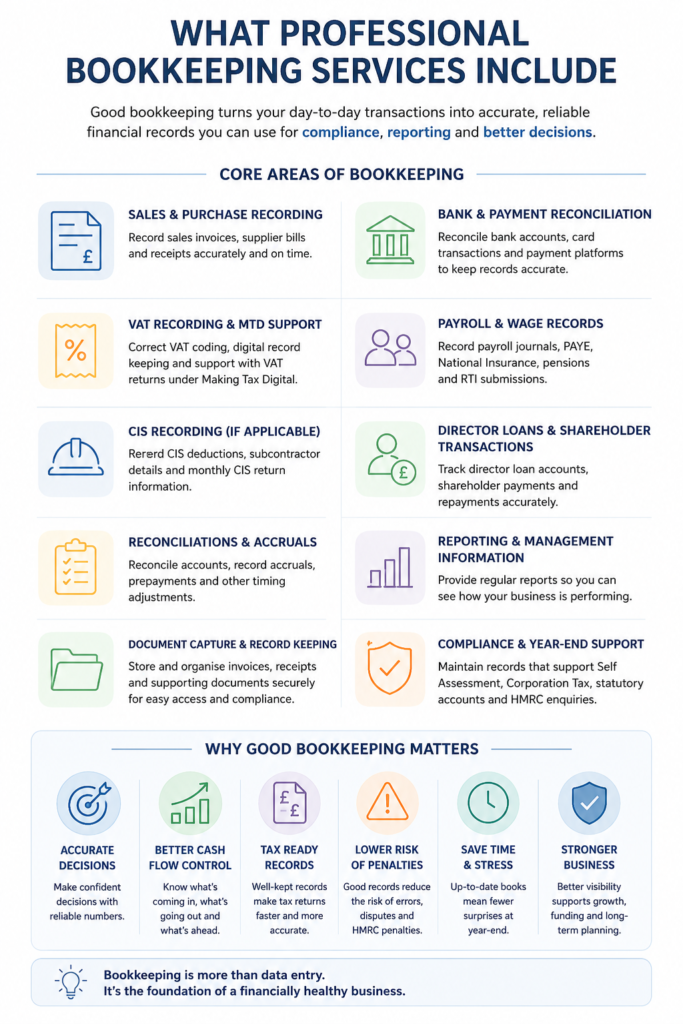
A well-structured bookkeeping service may include:
- sales invoice recording and debtor monitoring;
- supplier invoice processing and creditor tracking;
- bank, card and payment platform reconciliation;
- receipt capture and document matching;
- VAT coding and VAT return preparation support;
- payroll journals and wage-related reconciliations;
- CIS deduction recording where relevant;
- director loan account tracking;
- basic balance sheet reconciliations;
- monthly or quarterly reporting;
- year-end preparation for accountants and tax advisers.
The stronger bookkeeping setups do not simply record what happened. They make it easier to spot what has not been recorded, what looks unusual, and what needs attention before a deadline.
Where bookkeeping goes wrong in real businesses
The most common bookkeeping problems are not always caused by negligence. They often come from unclear responsibility. The owner assumes the bookkeeper is checking tax treatment. The bookkeeper assumes the accountant will correct entries at year-end. The accountant assumes the business has retained receipts. Payroll is run separately, but the payroll journals are never posted into the accounts. VAT is submitted from software, but nobody checks whether old bank rules are coding costs incorrectly.
This creates a gap between activity and accountability. The software may show reconciled transactions, but reconciled does not always mean correct. A bank reconciliation confirms that transactions have been matched to the bank statement. It does not prove that each item has been treated correctly for VAT, Corporation Tax, Self Assessment or management reporting.
Another frequent problem is using the same bookkeeping approach after the business has changed. A system that worked for a sole trader can become weak after incorporation. A spreadsheet that worked before VAT registration may become risky once VAT reporting starts. A simple cash-based approach may no longer be enough once the business introduces credit terms, payroll, stock, finance agreements or subcontractors.
VAT: the area where small errors multiply quickly
VAT is one of the strongest arguments for disciplined bookkeeping. VAT errors are rarely limited to one transaction. If a bank rule has been set incorrectly, the same mistake may repeat across dozens of entries. If supplier invoices are missing, input VAT may be underclaimed or claimed without proper evidence. If sales are recorded on the wrong basis, output VAT may be misstated.
Small businesses often misunderstand the difference between having a VAT number, charging VAT, reclaiming VAT and submitting a VAT return. They are related, but each has its own rules. The bookkeeping system needs to reflect the VAT scheme being used, such as standard VAT accounting, cash accounting or the flat rate scheme where applicable. It also needs to handle partial exemptions, reverse charge VAT or imports if those issues arise.
Construction businesses face particular complications because domestic reverse charge VAT can apply to certain construction services. If the bookkeeping process treats all invoices in the same way, VAT returns can become inaccurate even though the income and cost totals look reasonable.
CIS and construction bookkeeping require tighter controls
Construction bookkeeping is not simply ordinary bookkeeping with more invoices. The Construction Industry Scheme creates additional record-keeping demands for contractors and subcontractors. Contractors may need to verify subcontractors, deduct CIS tax, submit monthly CIS returns and provide payment and deduction statements. Subcontractors need accurate records of CIS suffered so that deductions are correctly reflected in their tax position.
Problems often appear when CIS deductions are treated as general expenses, ignored until year-end, or recorded inconsistently across projects. This can affect cash-flow visibility and tax reporting. For limited companies, CIS suffered may interact with Corporation Tax and payroll liabilities in ways that require careful reconciliation. Businesses in the sector often need more specific construction bookkeeping processes because subcontractors, retentions, staged billing and reverse charge VAT can all affect the records.
Project-based work also needs cost discipline. Without reliable job-level records, a construction business may know its bank balance but not which projects are profitable. That distinction matters when margins are tight, materials fluctuate and payment terms stretch across weeks or months.
Payroll bookkeeping is more than wages paid
 Payroll and bookkeeping are often handled in separate systems, but the accounting records still need to reflect payroll correctly. Gross wages, employer National Insurance, employee deductions, pension contributions, PAYE liabilities and net pay should be posted in a way that makes sense on the profit and loss account and balance sheet.
A common weakness is recording only the net wage payments from the bank. That may keep the bank reconciliation tidy, but it does not give a proper picture of employment costs or payroll liabilities. If PAYE and pension amounts are not tracked correctly, the business may struggle to understand what is owed, what has been paid, and whether payroll costs are being reported accurately.
This becomes more important as a business grows. A company taking on its first employee may cope with informal records for a short time, but payroll bookkeeping needs structure once staff numbers, pension duties, benefits, overtime or irregular pay patterns are involved.
Sole traders, self-employed workers and limited companies need different records
Not every small business needs limited company-style bookkeeping. A sole trader’s records support Self Assessment and income tax reporting. A limited company’s records support statutory accounts, Corporation Tax, director loan accounts, dividends, payroll and Companies House filing obligations. The bookkeeping method should reflect that legal structure.
For self-employed individuals, the priority is usually clear income records, allowable business expenses, mileage or travel evidence, invoices, receipts and bank separation where possible. The business owner and the business are not legally separate in the same way as a company, but poor separation of personal and business spending still creates confusion.
For sole traders, bookkeeping can look simple until VAT registration, finance applications or business growth enter the picture. Lenders, landlords, grant bodies or commercial partners may ask for clearer figures than a tax return summary provides.
For limited companies, the record keeping burden is heavier. Directors need to understand that company money is not personal money. Payments to directors may be salary, dividends, reimbursed expenses, loan account movements or something else entirely. Incorrect classification can create tax and reporting issues later.
Cloud bookkeeping: useful, but not self-correcting
 QuickBooks, Xero and other cloud accounting platforms have improved small business bookkeeping significantly. They make it easier to connect bank feeds, capture receipts, raise invoices, automate reminders, monitor debtors and collaborate with accountants. Used well, they reduce delays and improve visibility.
The mistake is treating cloud bookkeeping software as a substitute for financial judgement. Automated rules can be too broad. Receipt scanning can misread VAT. Bank feeds can duplicate transactions or disconnect. Payment processors can create timing differences between sales, fees and bank receipts. Software can make poor records look organised.
The best results usually come from combining software discipline with human review. That means setting up the chart of accounts properly, agreeing coding rules, reviewing exceptions, reconciling control accounts and checking reports for commercial sense rather than just technical completion. Businesses using cloud systems often benefit from clear Xero bookkeeping workflows or, where relevant, structured QuickBooks bookkeeping processes rather than relying on automation alone.
Outsourced bookkeeping, in-house bookkeeping or hybrid support?
The right model depends on transaction volume, complexity, internal skills and the importance of timely reporting. There is no universal answer.
In-house bookkeeping can work well where a business has regular transactions, a capable administrator and clear oversight from an accountant. It gives the business immediate access to records and can be cost-effective. The weakness is that small internal teams may lack technical confidence around VAT, payroll, CIS or year-end adjustments.
Outsourced bookkeeping can bring structure, continuity and technical review, especially where the business owner does not have time to manage records properly. It can also reduce reliance on one internal person. The risk is poor communication: if the business does not provide documents promptly or explain unusual transactions, the outsourced bookkeeper may still be working with incomplete information.
A hybrid model is common. The business raises sales invoices and uploads receipts, while an external bookkeeper handles reconciliations, VAT preparation, payroll journals and reporting. This often works well for small businesses that want control over day-to-day activity without carrying the full technical burden internally.
What affects bookkeeping cost in the UK?
Bookkeeping cost is usually driven less by business size and more by workload and complexity. A low-turnover business with hundreds of small transactions may need more bookkeeping time than a higher-turnover consultancy with a few invoices per month.
The main cost drivers include:
- number of monthly transactions;
- quality and completeness of records;
- VAT registration and VAT scheme;
- payroll size and frequency;
- CIS requirements;
- number of bank accounts, cards and payment platforms;
- use of stock, projects or departments;
- frequency of reporting;
- amount of catch-up or correction work needed;
- software setup and migration requirements.
The cheapest bookkeeping arrangement is not always the lowest monthly fee. If records are incomplete, reports are unreliable or year-end corrections are extensive, the total cost can be higher than expected. A better question is whether the bookkeeping process produces records that are accurate enough, soon enough, for the decisions and filings the business depends on. This is why bookkeeping costs are better assessed against workload, complexity and review requirements than against transaction numbers alone.
What should be agreed before bookkeeping starts?
 Small businesses often begin bookkeeping support informally, then run into problems because nobody has defined the scope. A clear bookkeeping contract or engagement agreement helps prevent misunderstandings. It should explain what work is included, what the business must provide, how often records will be updated, who reviews VAT treatment, who handles payroll, what deadlines apply, and how queries will be managed.
This is not just administrative protection. It affects quality. If receipt uploads are late, bank feeds are disconnected or sales invoices are raised outside the agreed system, the bookkeeping output will suffer. A good agreement makes responsibilities visible before the first deadline is missed.
For businesses using a bookkeeping contract template, the template should be adapted carefully. Generic wording may not reflect VAT, payroll, CIS, software access, confidentiality, data protection or reporting expectations. The practical details matter more than polished legal language.
The monthly bookkeeping workflow that usually works best
A reliable bookkeeping process has rhythm. Leaving everything until year-end creates avoidable pressure and weakens the usefulness of the records. Monthly bookkeeping is not always necessary for every micro-business, but once VAT, payroll, staff, credit terms or regular supplier payments are involved, monthly discipline usually pays for itself.
A practical monthly workflow often looks like this:
- collect sales invoices, purchase invoices, receipts and bank data;
- check bank feeds and import missing transactions;
- match receipts and invoices to payments;
- code income and expenses consistently;
- reconcile bank accounts, credit cards and payment platforms;
- post payroll journals and reconcile PAYE or pension liabilities;
- review VAT treatment before the return period closes;
- check aged debtors and creditors;
- review unusual balances, director transactions or suspense items;
- produce a short management summary where useful.
The point is not to create bureaucracy. The point is to catch small issues while they are still easy to resolve. A missing invoice from last week is usually simple to find. A missing invoice from eleven months ago may require guesswork, supplier chasing and year-end adjustments.
Management accounts and the move from compliance to control
Bookkeeping starts with compliance, but its value increases when the records support management accounts. A profit and loss report produced six months after year-end may satisfy a filing requirement, but it is too late to help with pricing, staffing, cash flow or tax planning.
Management accounts do not need to be elaborate for every small business. Even a simple monthly or quarterly pack can reveal trends that a bank balance hides: gross margin movement, rising overheads, slow-paying customers, seasonal pressure, payroll cost as a percentage of turnover, or project profitability.
This is where bookkeeping quality becomes strategic. If the records are inconsistent, management accounts become misleading. If costs are coded properly, accruals are sensible and reconciliations are current, the business owner can make decisions with more confidence.
Record keeping: what HMRC expects in practical terms
HMRC expects businesses to keep adequate records to support tax returns and VAT returns. The exact records depend on the business, but typically include sales invoices, purchase invoices, receipts, bank statements, payroll records, VAT records, CIS records where relevant, mileage logs, import and export documents where applicable, and evidence for claims made in tax filings.
The issue is not only whether a transaction happened. The business needs evidence of what it was, when it happened, who it involved and how it was treated. A bank payment alone may not be enough to support VAT recovery or demonstrate the business nature of an expense.
Record retention periods vary depending on business type and tax area, so owners should avoid deleting digital records too quickly. Cloud accounting systems help, but they do not remove the need to keep source documents and maintain access to them.
Companies House and director responsibilities
For limited companies, bookkeeping feeds directly into statutory accounts and confirmation of the company’s financial position. Directors remain responsible for ensuring that proper accounting records are kept, even if bookkeeping is delegated to an employee, bookkeeper or accountant.
This is a point some directors underestimate. Delegation does not remove responsibility. If company records are incomplete, if director withdrawals are unclear, or if accounts cannot be prepared from the books, the issue sits with the company and its directors. Professional support can reduce risk, but it cannot replace the need for directors to understand the basics of what is being recorded and why.
Good bookkeeping also helps avoid awkward year-end conversations. Director loan balances, dividends, expenses and payroll should not be reconstructed from memory after the accounts year has closed.
Red flags that bookkeeping is no longer under control
Bookkeeping problems often show themselves before a deadline fails. The warning signs are usually visible in the records or in the owner’s behaviour around the records.
- VAT returns are prepared at the last minute every quarter.
- Bank reconciliations show old unreconciled items.
- Receipts are stored across emails, bags, phones and paper folders.
- Payroll costs in the accounts do not match payroll reports.
- Director withdrawals are posted inconsistently.
- Supplier balances include amounts that were paid months ago.
- The profit figure changes significantly after year-end corrections.
- The owner does not trust the reports and relies only on the bank balance.
- There is a suspense account that keeps growing.
- VAT codes are applied by old software rules nobody reviews.
None of these automatically means the business is in serious trouble. They do mean the bookkeeping process needs attention before errors become harder to unwind.
How different sectors change the bookkeeping approach
Sector matters. A professional services firm may need careful time billing, debtor control and expense classification. A retail business may need stock, cash handling and payment platform reconciliation. A construction company may need CIS, reverse charge VAT awareness and project costing. A real estate business may need property-level income and cost tracking, loan interest analysis, service charge treatment and capital versus revenue expenditure distinctions.
Using a generic bookkeeping setup for a sector-specific business can obscure the information that matters most. The chart of accounts, reporting categories and document workflow should be designed around how the business actually earns money, incurs costs and meets its compliance obligations.
Choosing a bookkeeping service: questions worth asking
Before choosing a bookkeeping service, small business owners should look beyond price and software familiarity. The quality of the relationship often depends on how clearly the provider understands the business model and the compliance environment around it.
Useful questions include:
- Will the bookkeeping be done monthly, quarterly or annually?
- Who checks VAT treatment before returns are submitted?
- How are payroll journals posted and reconciled?
- Can CIS be handled if the business works in construction?
- How are director loan accounts monitored?
- What reports will be provided, and how often?
- Who deals with bookkeeping queries and missing documents?
- Which cloud accounting software will be used?
- How is catch-up bookkeeping priced?
- What happens at year-end before accounts and tax returns are prepared?
The answers should be specific. Vague assurances are less useful than a clear explanation of workflow, responsibility and review points.
The decision is really about risk, time and visibility
Small business bookkeeping is often treated as a cost decision, but it is better understood as a balance between risk, time and visibility. Doing everything personally may save fees, but it can absorb owner time and increase the chance of technical mistakes. Outsourcing everything may improve consistency, but only if the business provides information promptly. Software automation may speed up processing, but only if the setup is reviewed and maintained.
The right bookkeeping service should match the business’s current complexity while leaving room for growth. A simple setup is sensible for a simple business. A more structured approach becomes necessary when VAT, payroll, CIS, stock, finance reporting, multiple income streams or limited company obligations enter the picture.
Practical takeaways for UK small businesses
Good bookkeeping is not about producing perfect records for their own sake. It is about creating financial information that is accurate, timely and useful enough to support compliance and decision-making.
- Small does not always mean simple. VAT, payroll, CIS, directors’ transactions and sector-specific issues can make a small business technically demanding.
- Software is not a control system by itself. QuickBooks, Xero and similar tools need proper setup, review and consistent use.
- VAT needs particular care. Repeated coding errors can affect several returns before anyone notices.
- Payroll should be reflected properly in the books. Net wage payments alone do not show the full employment cost or liabilities.
- Limited company directors remain responsible. Delegating bookkeeping does not remove the duty to keep proper accounting records.
- Monthly discipline prevents year-end reconstruction. The longer records are left, the more expensive and uncertain corrections become.
- Cost should be judged against usefulness. Cheap bookkeeping that requires heavy correction may not be cheap overall.
Final expert perspective
Bookkeeping is most valuable when it is treated as part of the business’s operating system rather than a back-office chore. For a UK small business, it connects directly with tax filings, VAT returns, payroll records, Companies House accounts, finance conversations and management decisions.
The businesses that benefit most from bookkeeping support are not always the largest. They are often the ones where the owner needs clearer numbers, where compliance has become more demanding, or where growth has made informal processes unreliable. A good bookkeeping process does not remove every uncertainty, but it reduces avoidable confusion. It gives the business a cleaner financial memory, and that is often the difference between reacting late and managing with intention.