

Can You File Company Accounts Yourself or Do You Need an Accountant?
For a small limited company, the question often starts with cost. If the company has only a few transactions, no employees and straightforward income, it can feel reasonable to ask: can you file company accounts yourself rather than paying an accountant?
The short answer is yes, in some cases. A company director can prepare and file limited company annual accounts without appointing an accountant, provided the accounts are accurate, meet the relevant reporting requirements and are submitted on time. Companies House does not require every small company to use an accountant.
The more useful answer is less tidy. Filing company accounts is not only an upload exercise. It involves understanding what needs to be reported, which version of the accounts is required, how the figures connect to bookkeeping records, what must also be reported to HMRC, and where director responsibility begins and ends. For some companies, doing it yourself is realistic. For others, the apparent saving can disappear quickly if the accounts are wrong, incomplete or inconsistent with the company’s Corporation Tax position.
What “filing company accounts yourself” actually involves
Limited company accounts are not the same as a personal tax return, and they are not simply a summary of money received and money spent. A company is a separate legal entity. Its accounts need to show a financial picture of that entity for the accounting period. Readers who need broader context may find it useful to understand what is usually involved in annual accounts preparation before deciding whether to handle the process internally.
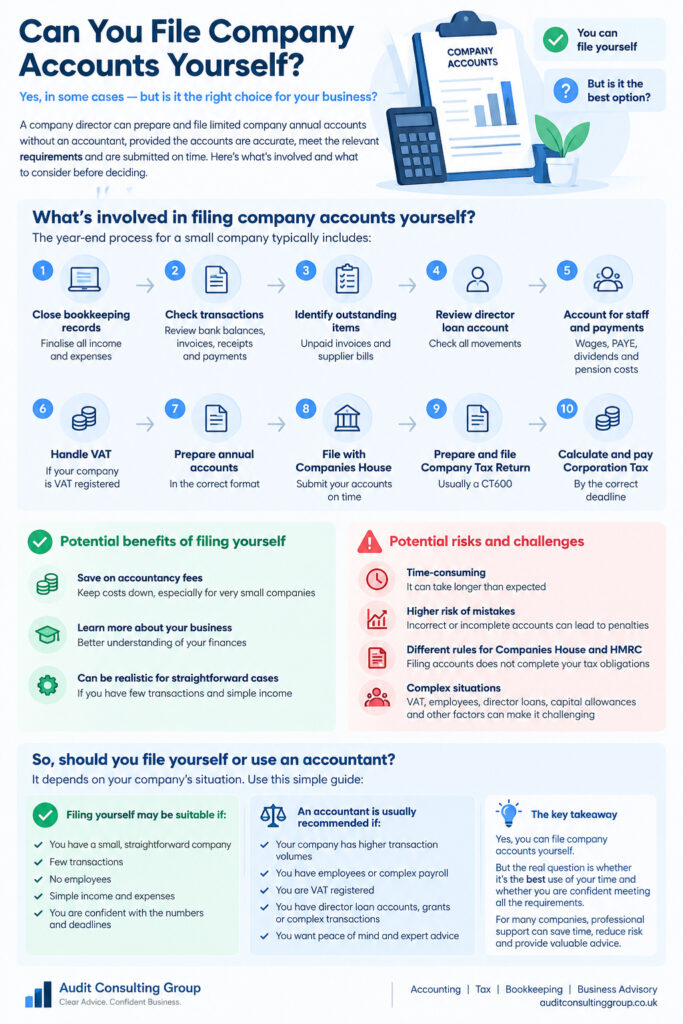
For a typical small company, the year-end process may involve:
- closing the bookkeeping records for the financial year;
- checking bank balances, invoices, receipts and payments;
- identifying unpaid sales invoices and supplier bills;
- reviewing director loan account movements;
- accounting for wages, PAYE, dividends and pension costs where relevant;
- dealing with VAT, if the company is VAT registered;
- preparing annual accounts in the correct format;
- filing accounts with Companies House;
- preparing and filing a Company Tax Return with HMRC;
- calculating and paying Corporation Tax by the correct deadline.
Some of these tasks overlap, but they are not identical. A common mistake is to think that filing at Companies House settles the company’s tax affairs. It does not. Companies House and HMRC are separate bodies with separate filing requirements, different purposes and different deadlines.
Companies House accounts and HMRC tax returns are not the same thing
This is where many first-time directors become unstuck. Companies House is mainly concerned with the public company record. HMRC is concerned with tax. The same underlying bookkeeping feeds both, but the filings are different.
Companies House accounts may be abbreviated or simplified depending on the size and status of the company. Small companies and micro-entities may be able to file reduced information compared with larger companies. The eligibility rules matter, and they can change with company size, group structures and other circumstances.
HMRC requires a Company Tax Return, usually including a CT600 and supporting computations. The tax return is where accounting profit is adjusted for Corporation Tax purposes. Not every accounting expense is treated in the same way for tax. Capital allowances, disallowable expenditure, losses, related-party transactions and director remuneration can all affect the final tax position. This is why Corporation Tax returns should not be treated as a duplicate of the Companies House accounts.
A company can therefore appear to have “filed its accounts” but still have an incomplete compliance position if the Corporation Tax return has not been dealt with properly.
Can you file company accounts online?
Yes, you can file company accounts online. Companies House provides online filing routes for eligible companies, and accounting software may also allow digital filing where the accounts are prepared in a compliant format. For directors focused specifically on the Companies House process, Companies House accounts filing is the statutory filing side of the wider year-end process. HMRC Corporation Tax filing is also completed online, usually through approved software.
The online filing process can make the mechanics feel simple. That is useful, but it can also create a false sense of security. Software can help produce a document; it does not necessarily confirm that the accounting treatment is right, that the director loan account has been understood, that dividends are lawful, or that tax adjustments have been made correctly.
For very simple companies, online filing can be manageable. For companies with VAT, payroll, stock, finance agreements, subcontractors, multiple directors or irregular bookkeeping, the difficulty is usually not pressing the submit button. The difficulty is knowing whether the figures being submitted are reliable.
When doing your own limited company accounts may be realistic
There are situations where a director may sensibly prepare and file accounts without an accountant, particularly where the company is dormant or has extremely limited activity. A dormant company that has had no significant accounting transactions may have a much simpler filing requirement than an active trading company.
A do-it-yourself approach may also be realistic where the company:
- has a very low number of transactions;
- keeps complete bookkeeping records throughout the year;
- has no employees or only very simple payroll arrangements;
- is not VAT registered;
- does not operate within CIS;
- has no stock, loans, grants or complex assets;
- has a single director-shareholder with straightforward drawings and dividends;
- has no unusual expenses or overseas transactions;
- uses reliable accounting software and understands the year-end adjustments required.
Even then, “simple” needs careful interpretation. A company with only a few bank transactions can still have a director loan issue. A company with no employees can still have dividend paperwork problems. A low-turnover company can still make mistakes with expenses, capital items or Corporation Tax treatment. More detailed guidance on limited company annual accounts can help directors understand what sits behind the year-end figures.
Where directors tend to underestimate the work
The most common misunderstanding is that the accounts are only a compliance formality. In practice, year-end accounts test the quality of the bookkeeping done during the year. If the bookkeeping is incomplete, the accounts become a reconstruction exercise.
Small companies often run into problems because records are kept in a mixture of bank feeds, spreadsheets, email invoices, personal payments and memory. That may feel manageable month to month, but it creates uncertainty at year end. The accountant’s work, in those cases, is not just preparing accounts. It is untangling the record.
Typical friction points include personal costs paid from the company bank account, business expenses paid personally by the director, missing receipts, unclear transfers, duplicate invoices, old unpaid balances and incorrect VAT coding. None of these is unusual. The problem is that each one affects the reliability of the accounts.
The director remains responsible, even if software is used
Accounting software has improved the accessibility of company filing, but it has not removed director responsibility. Directors are responsible for ensuring that the company keeps adequate accounting records and files required documents accurately and on time.
Software can automate bank imports, invoice matching and basic reports. It may also produce accounts in a format that can be submitted online. What it cannot always do is judge context. It may not know whether a payment to a director should be treated as salary, reimbursement, dividend, loan repayment or a director loan advance. It may not know whether a piece of equipment should be expensed or capitalised. It may not know whether VAT was claimed on something where input tax recovery is restricted.
This distinction matters. The fact that a system allows a filing does not mean the accounting conclusion behind the filing is correct.
The Companies House side: deadlines, formats and public record implications
Companies House filing is often treated as an administrative task, but it has consequences. Late filing can lead to penalties, and persistent filing failures can create wider compliance problems. Accounts also form part of the public company record, so errors may be visible to lenders, suppliers, credit agencies and potential investors.
For a private company, the first accounts are normally due 21 months after incorporation. Later accounts are usually due nine months after the company’s financial year end. These timelines can vary in specific circumstances, so directors should always check the company’s own filing date rather than relying on a general rule.
The content of the accounts depends on the company’s size and eligibility. Micro-entity accounts are simpler, but they are not a free pass to ignore accounting principles. Small company accounts provide more detail. Some companies may need more extensive disclosures. Dormant accounts follow their own logic. Filing the wrong type of accounts can create avoidable corrections and confusion. Where presentation, notes or statutory format are a concern, statutory accounts preparation becomes part of the compliance question, not just an administrative preference.
| Requirement | Typical Deadline | Example | Filed / Paid To | What It Covers |
|---|---|---|---|---|
| First Annual Accounts | Usually 21 months after incorporation | Company incorporated 15 January 2026 → first accounts normally due around 15 October 2027* | Companies House | The company’s first statutory accounts |
| Subsequent Annual Accounts | Usually 9 months after the financial year end | Year end 31 March 2026 → accounts normally due by 31 December 2026 | Companies House | Annual statutory accounts for the financial year |
| Corporation Tax Payment | Usually 9 months and 1 day after the accounting period ends | Period ending 31 March 2026 → Corporation Tax normally due 1 January 2027 | HMRC | Payment of Corporation Tax due for the accounting period |
| Company Tax Return (CT600) | Usually 12 months after the accounting period ends | Period ending 31 March 2026 → CT600 normally due by 31 March 2027 | HMRC | Company Tax Return, tax computations and supporting information |
| VAT Returns | Usually 1 month and 7 days after the VAT period ends | VAT quarter ending 31 March → return and payment normally due 7 May | HMRC | VAT due or reclaimable for the relevant VAT period |
| Confirmation Statement | At least once every 12 months | Normally based on the company’s individual review period | Companies House | Confirms key company information held on the public register |
*Deadlines can vary depending on the company’s circumstances and accounting reference date. Always check the company’s specific Companies House and HMRC deadlines.
The HMRC side: Corporation Tax is where “simple accounts” often stop being simple
Corporation Tax is one of the main reasons directors who ask “can I file my own company accounts?” later decide they need help. The accounting profit shown in the accounts is not automatically the taxable profit. Adjustments may be needed before the Corporation Tax liability is calculated.
Common areas that require judgement include:
- capital allowances on equipment, vehicles and other assets;
- entertaining and other non-deductible costs;
- home office and travel expenses;
- accruals, prepayments and deferred income;
- bad debts and doubtful debts;
- pension contributions;
- loss relief;
- director loan account balances;
- transactions with connected parties.
The Corporation Tax payment deadline is also different from the filing deadline. In many cases, the tax is due nine months and one day after the end of the accounting period, while the Company Tax Return is due 12 months after the end of that period. This catches out directors who assume tax is paid only when the return is filed.
VAT, payroll and CIS can change the answer quickly
A company with VAT, payroll or CIS obligations is rarely just “a small company with accounts to file”. Each system creates its own records, reconciliations and reporting risks.
VAT errors can flow directly into the year-end accounts. Misposted VAT, unpaid VAT liabilities, incorrectly claimed input tax or inconsistent turnover figures can create mismatches between VAT returns, bookkeeping records and annual accounts. If the company uses Making Tax Digital software, the record trail matters even more.
Payroll adds another layer. Salaries, PAYE, National Insurance, pension contributions and director remuneration need to be reflected correctly. A director who takes a mixture of salary, dividends and reimbursements needs clean records showing what each payment represents. Without that separation, the year-end accounts may be technically possible but commercially unreliable.
CIS can also complicate the picture. Contractors and subcontractors need accurate records of deductions, verification, statements and suffered CIS tax. Companies in construction often discover that year-end accounts depend heavily on whether CIS records have been maintained properly throughout the year, not merely gathered after the year has closed.
Dividends and director loan accounts are frequent trouble spots
Owner-managed companies often blur the line between business cash and personal income. That is understandable in day-to-day life, especially in small companies where the director is also the shareholder and main worker. From an accounting perspective, the distinction is crucial.
Dividends are distributions of profit. They should be supported by sufficient distributable reserves and properly documented. If a director simply transfers money to themselves whenever cash is available, those payments are not automatically dividends. They may be salary, expenses, loan repayments, dividends or director loan account drawings depending on the facts and records.
An overdrawn director loan account can have tax consequences and may require disclosure. It can also affect how the accounts look to lenders or other stakeholders. This is one of the areas where a company with apparently simple trading activity can become more complex than expected.
A practical comparison: doing it yourself versus using an accountant
The decision is not really between “free” and “paid”. It is between taking responsibility for the technical and practical work yourself or paying for professional judgement, review and preparation. The right answer depends on the company’s complexity, the director’s confidence and the quality of the records.
- Doing it yourself may suit: dormant companies, very small companies with clean records, directors with accounting knowledge, and companies with minimal tax complexity.
- Professional support is usually safer where: the company is VAT registered, runs payroll, operates CIS, has several directors, pays dividends regularly, owns significant assets, has loans, holds stock, trades internationally or has poor bookkeeping history.
- A hybrid approach may work where: the director handles bookkeeping during the year but asks an accountant to prepare or review the annual accounts and Corporation Tax return.
The hybrid model is common because it keeps the director close to the numbers while reducing the risk of year-end errors. It also tends to work well where bookkeeping software is used consistently but tax treatment still needs professional interpretation.
| Company Situation | Typical Complexity | DIY Difficulty | Key Issue to Consider | Professional Review |
|---|---|---|---|---|
| Dormant company | 1 / 5 | Low | Correct dormant status and filing requirements | May not always be necessary |
| Very small company with few transactions | 1–2 / 5 | Low | Accurate bookkeeping and correct expense treatment | Optional depending on circumstances |
| Active company with regular transactions | 2–3 / 5 | Moderate | Reconciliations, year-end adjustments and Corporation Tax | Worth considering |
| Company paying regular dividends | 3 / 5 | Moderate | Distributable profits, documentation and director payments | Often useful |
| VAT-registered company | 3–4 / 5 | Moderate–High | VAT reconciliation, input tax and turnover consistency | Often useful |
| Company running payroll | 3–4 / 5 | Moderate–High | PAYE, National Insurance, pensions and payroll journals | Often useful |
| Company operating CIS | 4 / 5 | High | CIS deductions, verification, statements and reconciliation | Strongly worth considering |
| Overdrawn director loan account | 4 / 5 | High | Tax consequences, disclosure and correct classification | Strongly worth considering |
| Stock, significant assets or finance agreements | 4 / 5 | High | Valuation, depreciation, capital allowances and liabilities | Strongly worth considering |
| International transactions | 4–5 / 5 | High | Foreign currency, tax treatment and cross-border considerations | Usually advisable |
| Incomplete or unreconciled bookkeeping | 5 / 5 | Very High | Accounts may require reconstruction before filing | Usually advisable |
The complexity ratings above are an illustrative guide rather than a statutory classification. The actual level of work depends on the company’s transactions, records and circumstances.
What most filing mistakes have in common
Most errors do not happen because directors are careless. They happen because company accounts rely on several systems lining up: bookkeeping, bank records, invoices, payroll, VAT, Corporation Tax and Companies House filing. If one part is weak, the weakness travels.
A bank balance that has not been reconciled can affect cash and expense figures. A VAT return posted incorrectly can affect turnover and liabilities. A payroll journal omitted from the accounts can understate employment costs. A dividend treated as a general expense can distort both profit and tax. A director loan account ignored during the year can become difficult to interpret later.
The issue is rarely one isolated number. It is the chain of assumptions behind that number.
Questions to ask before deciding to file yourself
Before filing your own limited company accounts, it is worth asking a few practical questions. They are not designed to make the process sound harder than it is; they reveal whether the company’s records are strong enough to support a reliable filing.
- Can you reconcile every company bank account to the bookkeeping records at year end?
- Do you know which payments to directors were salary, dividends, expenses or loans?
- Are all sales invoices, supplier bills and receipts available?
- Have VAT returns been reconciled to the accounts, where applicable?
- Are payroll figures correctly recorded and matched to HMRC submissions?
- Do you understand which expenses are deductible for Corporation Tax?
- Have you considered accruals, prepayments, depreciation and capital allowances?
- Do you know the Companies House filing deadline and the Corporation Tax payment deadline?
- Would the accounts still make sense if reviewed six months later by a lender, adviser or HMRC?
If these questions feel straightforward, filing yourself may be possible. If several of them expose uncertainty, the risk is not just non-compliance. It is making decisions based on accounts that do not accurately describe the business.
The cost question: accountant fees versus long-term value
For a micro company, accountancy fees can feel disproportionate, especially in the early stages of trading. That concern is legitimate. A company with modest income must watch costs carefully.
The value of an accountant, however, is not limited to submitting forms. Good year-end work can identify bookkeeping errors, prevent incorrect tax treatment, clarify director drawings, ensure the correct accounts format is used, reduce deadline stress and produce figures that are more useful for decision-making. It can also help directors understand profit, tax, cash flow and remuneration more clearly.
That does not mean every company needs the same level of support. A dormant company and a growing VAT-registered trading company do not need identical input. The sensible question is not “do I need an accountant for a limited company?” in the abstract. It is “what level of accounting judgement does this company’s activity require?”
Red flags that professional help may be sensible
Some situations should make directors pause before attempting to file alone. They do not always mean the accounts are impossible to handle internally, but they do suggest that mistakes could be more expensive than expected.
- Bookkeeping has not been maintained during the year.
- The company bank account includes frequent personal spending.
- VAT returns do not match the bookkeeping reports.
- Payroll has been run but not posted into the accounts properly.
- Dividends have been taken without paperwork or profit checks.
- The director loan account may be overdrawn.
- The company has bought vehicles, equipment or other significant assets.
- There are loans, finance agreements or grants.
- The company works in construction and CIS deductions are involved.
- Previous accounts were filed late or corrected after submission.
These are not rare edge cases. They are ordinary features of small company life. What matters is whether the records are good enough to support the correct treatment.
What a well-run year-end process looks like
A smooth filing process usually starts long before the accounts deadline. The best year-end work is often uneventful because the bookkeeping has been kept under control during the year.
A practical workflow might include reconciling bank accounts monthly, keeping digital copies of invoices and receipts, reviewing VAT return figures before submission, posting payroll journals regularly, documenting dividends at the time they are declared, and checking director loan movements before the year end rather than after it.
At year end, the company can then move from bookkeeping to accounts preparation with fewer surprises. Closing balances can be checked. Debtors and creditors can be reviewed. Accruals and prepayments can be considered. Fixed assets can be assessed. Corporation Tax adjustments can be prepared. Only after that does filing become the final step.
This is why the question “can you file company accounts yourself?” is partly a question about systems. A director with disciplined records is in a very different position from one trying to rebuild the year from bank statements and old emails.
How business growth changes the decision
A company may start simple and become less simple without the director noticing. Taking on staff, registering for VAT, bringing in another shareholder, buying equipment, working with subcontractors or seeking finance can all change the accounting burden.
Growth also changes the audience for the accounts. At the beginning, accounts may be seen only as a filing requirement. Later, they may be read by mortgage lenders, banks, investors, suppliers or potential buyers. The accounts then become part of the company’s commercial credibility, not just its compliance record.
This does not mean every growing company needs heavy advisory work. It does mean that the quality of the accounts becomes more important as the company takes on more obligations and more stakeholders.
So, do you need an accountant for a limited company?
There is no legal rule that every limited company must appoint an accountant. If you understand the requirements, keep accurate records and can prepare compliant accounts and tax filings, you can file company accounts yourself.
For a dormant company or a very simple micro-entity, that may be a reasonable choice. For an active trading company, especially one with VAT, payroll, CIS, dividends, assets or irregular bookkeeping, an accountant’s role is less about convenience and more about judgement.
The decision should be based on risk, complexity and confidence rather than habit. If the company’s affairs are genuinely straightforward and the director understands the filing obligations, self-filing can work. If the accounts require interpretation, reconstruction or tax judgement, professional support is usually the more prudent route.
Key practical takeaways
- You can file company accounts yourself in the UK, but you remain responsible for accuracy and deadlines.
- Companies House accounts and HMRC Corporation Tax returns are separate filings with different purposes.
- Online filing makes submission easier, but it does not guarantee the figures are correct.
- VAT, payroll, CIS, dividends and director loan accounts often create complexity beyond basic bookkeeping.
- Good records throughout the year make self-filing more realistic; poor records make year-end filing harder and riskier.
- The right decision depends on the company’s activity, not just its size.
A final perspective for directors weighing up the choice
Filing your own company accounts is possible. For the right company, with clean records and a director who understands the responsibilities, it can be a practical and cost-conscious decision.
The danger lies in treating the accounts as a formality. Limited company annual accounts sit at the intersection of bookkeeping, tax, Companies House compliance, director responsibility and business decision-making. The filing itself may take minutes; getting to figures that are accurate, consistent and defensible can take far longer.
A sensible director does not need to outsource everything by default. Nor should they assume that small means simple. The better approach is to look honestly at the company’s records, obligations and future plans, then decide whether self-filing gives enough confidence. If it does, proceed carefully. If it does not, the value of an accountant may lie less in filing the accounts and more in preventing the wrong accounts from being filed in the first place.