

Dormant Company Accounts: Filing Requirements and Deadlines
A dormant company can look administratively simple from the outside. No trading, no invoices, no payroll activity, no obvious tax work. Yet the company still exists on the Companies House register, and that means directors still have filing responsibilities.
The difficulty is that “dormant” is often used casually. A director may mean the company has not made sales. Companies House may mean there have been no significant accounting transactions. HMRC may have a separate view for Corporation Tax. A bank account may still be open. A subscription may still be running. A forgotten confirmation statement may still be due.
Leave your details and our team will get back to you shortly.
That is why dormant company accounts deserve more attention than they usually receive. The filing itself is often straightforward. The judgement behind it is where mistakes happen.
What dormant company accounts actually mean
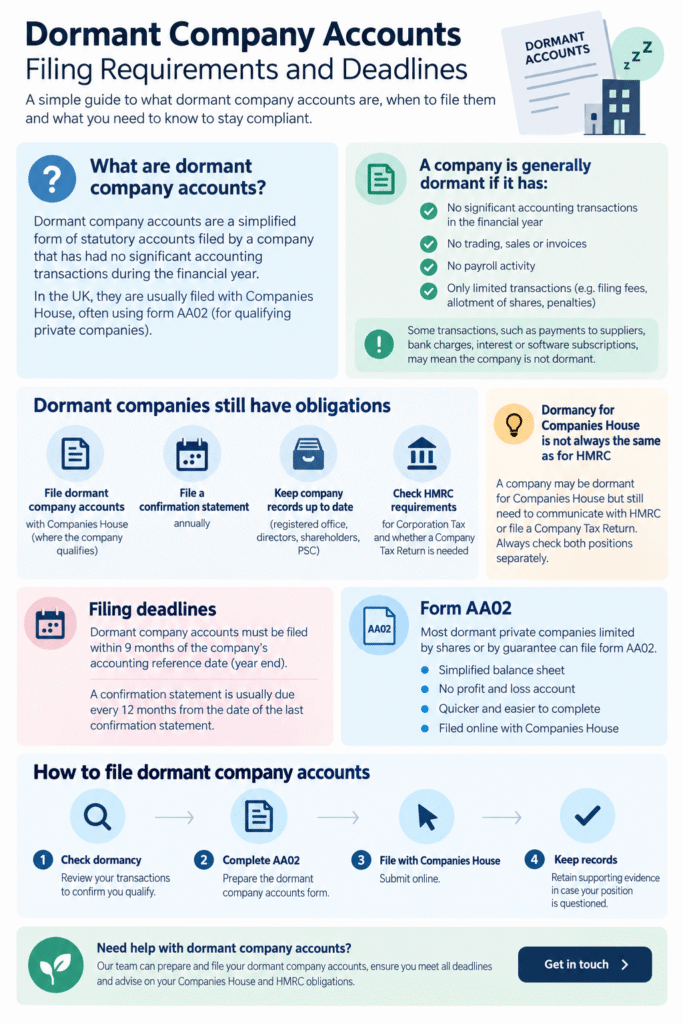
Dormant company accounts are a simplified form of statutory accounts filed by a company that has had no significant accounting transactions during the financial year. In the UK, they are normally filed with Companies House, often using form AA02 for private companies limited by shares or by guarantee where the company qualifies.
For Companies House purposes, a company is generally dormant if it has had no significant accounting transactions in the relevant accounting period. Certain transactions are normally disregarded, such as payment for shares taken by subscribers when the company was formed, filing fees paid to Companies House, and penalties for late filing of accounts.
That definition is narrower than some directors expect. A company can feel inactive but still fail the dormant test if it has paid suppliers, received income, paid bank charges, earned interest, made loan movements, paid software subscriptions, or made other transactions through its accounts.
Does a dormant company need to file accounts?
Yes. A dormant company still needs to file accounts with Companies House unless it has been dissolved. Dormancy does not remove the company from the statutory filing regime. It simply changes the type of accounts that may be filed.
This is one of the most common misunderstandings around dormant company accounts UK requirements. Directors sometimes assume that because the company has not traded, there is nothing to submit. Companies House takes a different view: if the company remains registered, annual filing obligations continue.
The usual annual obligations include:
- filing dormant company accounts with Companies House where the company qualifies as dormant;
- filing a confirmation statement;
- keeping company records up to date, including registered office, directors, shareholders and persons with significant control;
- checking whether HMRC expects a Company Tax Return or has confirmed the company is treated as dormant for Corporation Tax.
The accounts and the confirmation statement are separate filings. Filing one does not satisfy the other.
Companies House dormancy is not always the same as HMRC dormancy
Companies House and HMRC are looking at related but different issues. Companies House is concerned with statutory reporting under company law. HMRC is concerned with tax activity, especially whether the company is within the charge to Corporation Tax and whether a Company Tax Return is required.
A company may be dormant for Companies House but still need to communicate with HMRC. For example, a newly formed company that has not started trading may need HMRC to be told that it is dormant for Corporation Tax. In other cases, HMRC may issue a notice to deliver a Company Tax Return. If that notice is issued, it should not simply be ignored because the company has not traded.
Directors often discover the difference only after receiving reminders or penalties. The practical lesson is simple: Companies House dormant company accounts deal with one obligation; HMRC dormancy and Corporation Tax filing obligations need to be checked separately.
The dormant company accounts filing deadline
The deadline for filing dormant company accounts depends on whether it is the company’s first set of accounts or a later annual filing.
For a private limited company, annual accounts are usually due at Companies House within nine months of the accounting reference date. For first accounts, the deadline is normally 21 months after incorporation. Where first accounts cover a period longer than 12 months, the deadline can be 21 months after incorporation or three months after the accounting reference date, whichever is later.
This first-year rule catches out new companies. A director may form a company, leave it inactive, and assume nothing is due until trading begins. Companies House will still expect accounts based on the company’s accounting reference date and statutory timetable.
If dormant company accounts are filed late, Companies House can issue late filing penalties. The fact that the company did not trade does not normally remove the penalty. Repeated late filing can also create reputational and administrative problems, especially where the company may later be used for trading, financing, contracting or restructuring.
Dormant Company Accounts: Key Filing Requirements at a Glance
| Requirement | What You Need to Know | Typical Deadline / Action |
|---|---|---|
| Dormant company accounts | A dormant company normally still needs to file annual accounts with Companies House even if it has not traded. | Usually within 9 months of the accounting reference date for a private limited company. |
| First company accounts | New companies must still file their first accounts even where they have remained dormant since incorporation. | Normally 21 months after incorporation, subject to the statutory first-accounts rules. |
| Form AA02 | AA02 may be used for simple dormant company accounts where the company qualifies for the dormant filing route. | File with Companies House before the relevant accounts deadline. |
| Confirmation statement | This is a separate Companies House filing and is not replaced by dormant company accounts. | Must be filed separately when due. |
| HMRC / Corporation Tax | Companies House dormancy does not automatically mean HMRC treats the company as dormant for Corporation Tax. | Check whether HMRC has been informed and whether a Company Tax Return is required. |
| Company records | Directors should retain supporting records such as bank statements, shareholder records, Companies House filings and HMRC correspondence. | Keep records up to date throughout the dormant period. |
| Late filing | Dormant status does not normally remove the risk of Companies House late filing penalties. | File before the statutory deadline to avoid penalties. |
What has to be included in dormant company accounts?
Dormant accounts are simpler than full trading accounts, but they are not meaningless forms. They usually show a basic balance sheet and required statements confirming the company’s dormant status and entitlement to file dormant accounts. The precise presentation depends on the company type and circumstances.
For a straightforward dormant private company limited by shares, the accounts often show share capital and any unpaid share capital, with little else. But even a small movement in the company’s bank account can change the position. If a company has an active bank account, directors should check whether bank charges, interest, transfers or payments have occurred during the period.
Good record keeping still matters. A dormant company should retain evidence supporting its dormant status, including bank statements, incorporation documents, shareholder records, Companies House filings and any correspondence with HMRC. If the company has never opened a bank account, that is usually easier to evidence than a company with an account that has occasional movements.
How to file dormant company accounts
For many simple dormant companies, filing can be completed online through Companies House. The AA02 dormant company accounts route is commonly used where the company is eligible and the accounts are genuinely dormant.
The practical workflow is usually:
- confirm the accounting period and filing deadline;
- review whether the company had any significant accounting transactions;
- check bank accounts, payment platforms, director loan movements and subscriptions;
- confirm share capital and shareholder details;
- prepare the dormant accounts in the required format;
- file the accounts with Companies House before the deadline;
- separately check confirmation statement and HMRC obligations.
The filing process is not usually the hard part. The risk lies in filing dormant accounts when the company was not actually dormant. That can create an inaccurate public record and may need correction later.
Where directors most often get it wrong
Dormant company accounts requirements are often misunderstood because the word “dormant” sounds like a business description rather than a technical filing status. In practice, the following issues cause many of the errors.
Assuming no sales means dormant
No sales is not the same as no significant accounting transactions. A company may have no customers but still have expenses, loan transactions, bank activity, professional fees, domain renewals or software costs. Those movements can mean the company is not dormant for Companies House accounts purposes.
Leaving a bank account open without checking it
A dormant company with an open bank account is not automatically a problem, but the statements should be reviewed. Bank charges and interest can be enough to disturb the dormant position. Small amounts are still accounting transactions.
Confusing accounts with the confirmation statement
The confirmation statement confirms company information held by Companies House. It is not a substitute for accounts. A dormant company normally has to file both, even though the content and purpose are different.
Ignoring HMRC because Companies House accounts were filed
Filing dormant accounts at Companies House does not automatically settle Corporation Tax administration. HMRC may still expect a response, particularly if a notice to file has been issued. A company can avoid unnecessary friction by ensuring HMRC’s records match the company’s actual status.
Using dormant status after activity has restarted
A company that begins trading, receives income, pays expenses or enters into commercial transactions is unlikely to remain dormant. From that point, the accounting and tax position should be reassessed. There may be Corporation Tax, VAT, payroll, bookkeeping and director loan account implications depending on what has changed.
Practical examples that show the difference
Consider a company formed for a future consultancy project. It has issued shares on incorporation, opened no bank account, entered no contracts and made no payments. In that case, dormant accounts may be appropriate, assuming there are no other transactions.
Now consider a similar company that has paid for a website domain, accounting software and a business bank account fee, even though no client invoices have been raised. Commercially, the director may think of the company as not yet trading. For Companies House accounts, those expenses are likely to mean the company is not dormant.
A third example is a company that has stopped trading but still has a bank balance, occasional bank charges and a director loan account being adjusted. It may be inactive in an everyday sense, but not dormant for filing purposes. It may need micro-entity or other small company accounts rather than dormant accounts.
These distinctions matter because Companies House filings create a public record. If accounts are filed on the wrong basis, correcting the position later can be more time-consuming than getting the classification right at the outset.
Corporation Tax, VAT and payroll implications
Dormant company accounts sit within a wider compliance picture. A company can be dormant for one purpose but still have related obligations that need closing down, suspending or monitoring.
For Corporation Tax, HMRC may need to be told that the company is dormant. If the company previously traded, the cessation date, final accounting period, tax return position and any outstanding liabilities should be considered. A company that has never traded is usually simpler, but HMRC records should still be checked.
VAT can create a separate issue. If a company is VAT registered but no longer trading, it may still have a VAT filing position to manage unless registration has been cancelled or HMRC has agreed the relevant position. Nil VAT returns can still be due while registration remains active.
Payroll has similar practical consequences. A company with a PAYE scheme may need to submit final payroll returns, close the scheme or continue making nil submissions depending on the circumstances. Dormant accounts do not automatically close PAYE responsibilities.
CIS may also be relevant for companies in construction that have stopped operating. If contractor or subcontractor activity has ceased, the company’s CIS position should be reviewed rather than assumed inactive without formal housekeeping.
Why dormant status should be managed, not guessed
Dormancy is not just a label used to reduce filing work. It is a factual position that should be supported by the company’s records. For owner-managed companies, this can be awkward because business and administrative activity often starts before trading income appears.
Pre-trading expenditure is a common example. A director may incorporate a company, pay for branding, buy a laptop, subscribe to software and prepare a website before any revenue is generated. From a tax and accounting perspective, that activity may be relevant. From a Companies House dormant accounts perspective, it may mean dormant filing is no longer appropriate.
Another grey area is money introduced by directors. If funds are paid into the company bank account, moved out again, or used to meet costs, those entries may need proper accounting treatment. They should not be ignored simply because the business has not yet started selling.
The cleanest dormant companies are usually those with no bank account, no contracts, no expenses and no financial movements beyond the permitted formation-related entries. Once administration becomes active, the company may still be non-trading, but that is not always the same as dormant.
Record keeping for a dormant company
A dormant company should still maintain enough records to explain its position. The burden is lighter than for an active trading company, but it does not disappear.
Useful records include:
- Companies House authentication details and filing confirmations;
- the company’s accounting reference date and filing deadline;
- share capital and shareholder records;
- bank statements, or confirmation that no bank account exists;
- HMRC correspondence about Corporation Tax status;
- VAT, PAYE or CIS closure confirmations where relevant;
- board or director notes recording the decision to keep the company dormant.
These records help prevent practical problems later. If the company is reactivated, sold, closed or used for a new project, a clear dormant history makes the transition easier.
What happens if the company starts trading again?
Once a dormant company starts trading, its compliance profile changes. Directors should not wait until the next accounts deadline to revisit the position. The company may need bookkeeping processes, Corporation Tax registration or reactivation with HMRC, VAT monitoring, payroll setup and proper expense recording.
The date activity begins matters. It can affect the accounting period, tax reporting, VAT registration threshold monitoring and the treatment of early expenses. If the company has been dormant for several years, directors should also check that Companies House records, shareholder details and registered office information are current before commercial activity resumes.
Restarting a company without tidying historic compliance can create avoidable friction. Banks, lenders, investors, suppliers and professional advisers may review the public filing record. Late accounts, inconsistent filings or unexplained dormancy can raise questions even where the underlying business is sound.
Should a dormant company be kept or closed?
Keeping a company dormant can make sense. A company name may be worth protecting. A project may be paused rather than abandoned. A group structure may require a non-trading entity. A director may want the company available for a future contract.
But dormancy is not cost-free. There is still administration, filing discipline and the risk of missed deadlines. If there is no realistic future use for the company, dissolution may be simpler. That decision should be made with care where the company has assets, liabilities, tax history, bank balances, contracts or unresolved shareholder matters.
The better question is not “Can dormant accounts be filed?” but “Does keeping this company on the register still serve a purpose?” If the answer is unclear, the company may drift into repeated compliance work without commercial value.
Director and shareholder tax considerations
Company dormancy does not automatically settle every director or shareholder matter. If dividends, benefits, director loan repayments or other income were received before the company became dormant, individual reporting may still need to be considered. In those cases, company filings should be kept separate from director Self Assessment responsibilities and any related personal tax filing.
This distinction is particularly relevant where a company stopped trading part-way through a tax year. The company may later file dormant accounts for a period with no significant transactions, while the director’s personal tax position still reflects income or benefits from an earlier period.
Key points directors should remember
- A dormant company normally still needs to file accounts with Companies House.
- The dormant company accounts filing deadline is usually nine months after the accounting reference date for private companies, with special rules for first accounts.
- Form AA02 is commonly used for simple dormant company accounts where the company qualifies.
- No trading income does not automatically mean the company is dormant.
- Companies House dormancy and HMRC Corporation Tax dormancy should be checked separately.
- VAT, PAYE and CIS obligations may continue unless properly closed or managed.
- Bank charges, interest, expenses and director loan movements can affect dormant status.
- Good records make dormant filing easier and reduce the risk of incorrect accounts.
A practical closing view
Dormant company accounts are not complicated because the form is long. They become complicated when the company’s real activity does not match the label being used. A company can be quiet, paused, pre-trading or no longer trading without necessarily being dormant for every compliance purpose.
Directors who treat dormancy as an annual check rather than an assumption tend to avoid most problems. Confirm the transactions, check the deadline, separate Companies House from HMRC, and keep enough evidence to support the filing position. That modest discipline is usually enough to keep a dormant company genuinely low-maintenance rather than unexpectedly troublesome.