

First Company Accounts: Deadlines and Filing Requirements
First company accounts are one of the earliest compliance tests for a new UK limited company. They are also one of the easiest to misunderstand, partly because Companies House and HMRC do not use the same filing timetable, and partly because the first accounting period rarely feels as straightforward as later years.
A director may incorporate a company, trade only lightly for the first few months, assume there is little to report, and then discover that the first accounts cover a slightly unusual period. Another director may believe that the company’s confirmation statement, Corporation Tax return and statutory accounts are all part of the same filing exercise. They are connected, but they are not the same obligation.
The practical issue is not simply knowing that accounts must be filed. It is understanding which accounts, for which period, by which deadline, using which records, and with what consequences if the company’s bookkeeping has not kept pace with trading activity.
Leave your details and our team will get back to you shortly.
Why first company accounts are different from later accounts
For most established companies, the accounts cycle becomes predictable. A company has an accounting reference date, prepares annual accounts for a 12-month period, files them with Companies House, and uses accounting records to support the Corporation Tax return submitted to HMRC.
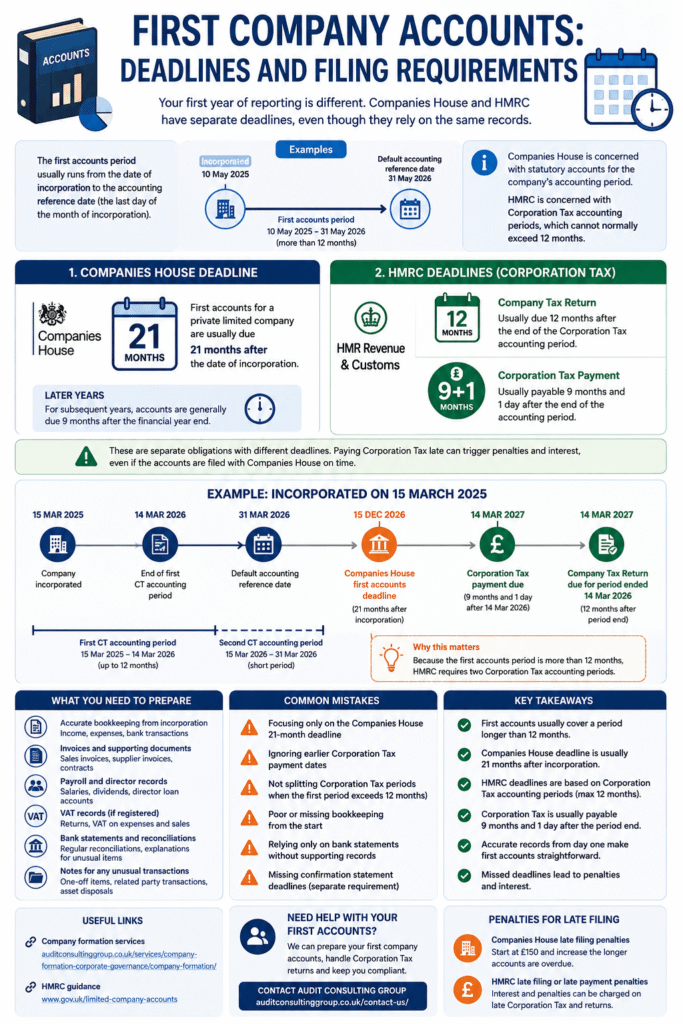
The first year is less tidy. A company’s first accounts usually run from the date of incorporation to the accounting reference date. By default, the accounting reference date is the last day of the month in which the company was incorporated. This often means the first accounts cover more than 12 months.
For example, a company incorporated on 10 May will normally have an accounting reference date of 31 May the following year. Its first accounts will therefore cover the period from 10 May to 31 May — slightly more than 12 months. That small detail matters because Companies House filing rules and HMRC Corporation Tax rules treat the first period differently.
Companies House is concerned with statutory accounts for the company’s accounting period. HMRC is concerned with Corporation Tax accounting periods, which cannot normally exceed 12 months. A first Companies House period of more than 12 months may therefore require more than one Corporation Tax accounting period for HMRC purposes.
The two deadlines directors often confuse
The first filing deadline most directors think about is the Companies House deadline. For a private limited company, first accounts are usually due 21 months after the date of incorporation. This is different from later accounts, which are generally due nine months after the company’s financial year end.
The incorporation date and accounting reference date are set at the formation stage, so early company formation decisions can affect the shape of the first reporting period, even where trading starts later.
The HMRC position is different. A Company Tax Return is usually due 12 months after the end of the Corporation Tax accounting period. Corporation Tax itself is normally payable nine months and one day after the end of the accounting period, although different rules can apply to larger companies.
This creates a common trap: a director may focus on the Companies House deadline and overlook the earlier Corporation Tax payment date. Filing accounts late is one problem. Paying Corporation Tax late is another. They are connected through the same financial information, but they are administered separately.
A simple illustration
Suppose a company is incorporated on 15 March 2025 and has a default accounting reference date of 31 March 2026. The first Companies House accounts would normally cover 15 March 2025 to 31 March 2026. The filing deadline at Companies House would usually be 15 December 2026, being 21 months after incorporation.
For HMRC, the Corporation Tax accounting period may need to be split because it exceeds 12 months. The company may need to deal with one period from 15 March 2025 to 14 March 2026 and another from 15 March 2026 to 31 March 2026. This is not merely an administrative curiosity; it affects Corporation Tax returns, payment timing and the way profits are allocated.
What Companies House expects from first accounts
Companies House accounts are public statutory accounts. The level of detail filed depends on the size and nature of the company, available exemptions and current reporting rules. Small companies and micro-entities may be able to file simpler accounts than larger companies, but “simpler” does not mean informal.
First accounts normally need to include the required statutory information for the relevant period. Depending on the company, this may include a balance sheet, profit and loss account, notes to the accounts and directors’ approval. Some companies may also need a directors’ report. The accounts must be consistent with the company’s accounting records and prepared under the appropriate UK accounting framework.
One area that causes confusion is dormancy. A company that has genuinely not traded and has had no significant accounting transactions may be dormant. But dormancy is often misunderstood. Opening a business bank account, paying suppliers, receiving income, buying equipment, paying software subscriptions or reimbursing expenses can all affect the position. A company is not dormant simply because it has not made a profit.
It is also worth separating accounts from other Companies House filings. A confirmation statement confirms key company information such as officers, registered office, shareholders and SIC codes. It does not replace annual accounts, and filing one does not satisfy the other.
What HMRC expects in the first period
HMRC’s interest is not limited to the accounts filed at Companies House. The company may need to register for Corporation Tax, submit a Company Tax Return and provide computations showing how taxable profit or loss has been calculated.
The tax computation can differ from the accounting profit. Some expenses shown in the accounts may not be deductible for Corporation Tax. Capital expenditure may need to be considered under capital allowance rules. Director loans, pre-trading expenses, home office costs, mileage, entertaining, software, equipment and professional fees all need to be treated correctly rather than simply recorded as “business costs”.
Where the first statutory accounting period is longer than 12 months, HMRC will usually require separate Corporation Tax returns for the relevant accounting periods. This is one of the first points where a new company’s bookkeeping quality becomes visible. If income and expenses are not dated accurately, splitting the period can become more difficult than it should be.
The records that make or break first accounts
First accounts are only as reliable as the records behind them. The early months of a company often involve informal decisions: a founder pays for costs personally, uses an existing laptop, invoices from a temporary template, transfers money between personal and business accounts, or delays opening a dedicated bank account. These situations are common, but they need to be reconstructed carefully.
Useful records usually include:
- business bank statements from the date the account was opened;
- sales invoices and supporting evidence for income received;
- purchase invoices, receipts and supplier statements;
- records of director payments, reimbursements and loans;
- payroll records where salaries have been operated;
- VAT records if the company is VAT registered;
- CIS records if the company operates in construction and falls within the scheme;
- details of equipment, assets and software purchased;
- evidence of share capital introduced at incorporation;
- details of any pre-incorporation or pre-trading expenses claimed through the company.
The list is not glamorous, but it is where many first-year accounts problems begin. Missing invoices, unexplained bank transfers and director-funded costs can delay accounts preparation and create uncertainty around tax treatment.
This is also where management accounts can be useful during the first year. They do not replace statutory accounts, but interim reporting can reveal bookkeeping gaps, VAT exposure, payroll pressure and cash flow issues before the first filing deadline is close.
What new directors most often get wrong
The most common mistake is assuming that incorporation creates a long grace period. It does not. Incorporation starts the statutory clock, even if the company does not begin trading immediately. If the company remains inactive, that still needs to be reflected properly. If it trades informally before systems are in place, that activity still belongs somewhere in the records.
A second mistake is treating Companies House filing as the whole compliance picture. Companies House accounts, the confirmation statement, Corporation Tax registration, Company Tax Returns, VAT returns and PAYE submissions all sit in different parts of the compliance system. Some are annual. Some are quarterly or monthly. Some depend on thresholds or activity. They do not automatically align.
A third mistake is leaving the first accounts until the deadline approaches. The first year often contains the messiest transactions: incorporation costs, founder expenses, equipment purchases, early invoices, irregular income, director loans and sometimes a switch from self-employment to trading through a limited company. Waiting until the final weeks reduces the time available to clarify those issues.
There is also a misunderstanding around “no tax to pay”. A company with a loss, low profit or dormant status may still have filing obligations. No Corporation Tax liability does not automatically remove the requirement to submit the correct return or accounts.
How first accounts interact with payroll, VAT and CIS
First company accounts do not sit in isolation. If the company has operated payroll, salary costs, PAYE liabilities, pension contributions and director remuneration need to be reflected accurately. Director salary decisions made during the first year can affect both the accounts and the director’s personal tax position.
VAT adds another layer. A company may register voluntarily, register because taxable turnover exceeds the threshold, or delay registration because turnover is still uncertain. VAT quarters rarely match the company year neatly. Output tax, input tax, VAT control accounts and any payments to or from HMRC need to reconcile with the bookkeeping records.
CIS can be especially easy to overlook for construction-related companies. A new limited company may act as a subcontractor, contractor or both. CIS deductions suffered or deducted from others affect cash flow, tax records and year-end reporting. If CIS has been handled informally, the first accounts process often reveals mismatches between invoices, payments received and deductions reported.
The director’s responsibility is personal, even when advisers are involved
Directors are responsible for ensuring the company keeps adequate accounting records and files the required documents. An accountant can prepare accounts, advise on treatment and manage filings, but the legal duty does not disappear because work has been delegated.
This distinction matters in the first year because directors may still be learning how limited company administration works. A founder who previously operated as self-employed may be used to a single Self Assessment cycle. A limited company introduces a separate legal entity, separate bank activity, separate tax returns and a different relationship between business money and personal money.
Companies House compliance is also changing, including requirements around Companies House identity verification. Those changes do not remove the accounts filing obligation, but they underline a wider point: directors need to understand company administration as an ongoing responsibility, not a once-a-year task.
Director loan accounts are a frequent example. If a director pays company expenses personally, the company may owe the director. If the director withdraws company funds personally, the director may owe the company. The tax and reporting implications depend on the facts, timing and balances involved. Treating all withdrawals as “wages” or all personal payments as “expenses” can create problems later.
Changing the accounting reference date: useful, but not a fix for poor records
A company can sometimes change its accounting reference date. This may be useful if directors want the year end to align with a group company, a seasonal trading pattern, the tax year, investor reporting or management reporting cycles.
Changing the date should be approached carefully. It may alter filing deadlines, shorten or extend an accounting period and affect how accounts and tax returns are prepared. It should not be used casually as a way to avoid dealing with overdue records. In some cases, it can make the position clearer. In others, it simply moves complexity into a different period.
For a new company, the more useful question is often not “Can we change the year end?” but “Which year end gives the clearest view of performance and the least administrative friction?” That is a business reporting question as much as a compliance question.
Practical scenarios that create first-year filing problems
A company incorporated months before trading starts can create uncertainty around dormancy, pre-trading costs and the start of the Corporation Tax position. If there were bank charges, software costs or professional fees before the first sale, those transactions need to be considered rather than ignored.
A founder moving from self-employed status to a limited company can also create blurred lines. Income earned before incorporation usually belongs to the sole trade. Income earned after the company begins trading may belong to the company. Clients may continue using old payment details, and invoices may be issued under the wrong name during the transition. These details matter for both tax and accounts.
Companies with early growth face a different issue. They may register for VAT, take on staff, use subcontractors, purchase equipment and open multiple payment platforms within the first year. The first accounts then become more than a statutory filing exercise. They become the first proper test of whether the finance process can support the business it is becoming.
Late filing: the real cost is not only the penalty
Companies House late filing penalties are automatic, but the penalty is rarely the only consequence. Late accounts can damage credit applications, investor discussions, supplier onboarding and banking reviews. They can also signal weak internal administration, even where the underlying business is healthy.
HMRC late filing and late payment issues create their own complications. Interest, penalties and correspondence can take management time away from the business. If returns are inaccurate because records were incomplete, amendments may be needed later. A pattern of poor compliance can also make future interactions with tax authorities more difficult than they need to be.
The quieter cost is decision quality. If the first accounts are prepared in a rush, directors may miss the chance to understand margins, cash conversion, tax exposure, payroll cost, VAT pressure and the true financial shape of the business. For a new company, those insights are often more valuable than the filing itself.
A sensible workflow for preparing first company accounts
The best first accounts processes usually start before the year end. That does not mean producing full statutory accounts months early. It means making sure the underlying information will be usable when the time comes.
A practical workflow might involve confirming the accounting reference date, checking whether the company has registered for Corporation Tax, reviewing whether trading has started, reconciling bank accounts, collecting missing invoices, reviewing director payments and identifying VAT, payroll or CIS issues before they become year-end surprises.
After the period end, the bookkeeping should be finalised, accruals and prepayments considered, assets reviewed, payroll and VAT reconciled, director loan balances checked and tax adjustments prepared. The accounts can then be approved and filed, with the Corporation Tax return and computations prepared on the appropriate HMRC basis.
This sequence sounds administrative, but the order matters. Trying to prepare accounts before bank transactions are explained leads to rework. Preparing tax computations before the accounting profit is reliable creates avoidable risk. Filing accounts without understanding director balances can leave directors with questions that emerge only after submission.
What good first-year financial discipline looks like
A well-managed first year does not require a finance department. It does require basic discipline. A separate business bank account, timely invoice capture, regular bank reconciliation and clear treatment of director spending will prevent most avoidable issues.
Management information also has value before statutory accounts are due. A simple profit and loss review during the first year can identify whether the company is approaching the VAT registration threshold, whether payroll costs are sustainable, whether margins are lower than expected, or whether Corporation Tax cash should be set aside. First accounts should not be the first time a director sees the company’s financial position clearly.
For companies seeking funding, applying for credit or planning to hire, this matters commercially. Clean records support better conversations with lenders, investors, landlords, grant providers and suppliers. Statutory compliance and business credibility often overlap more than new directors expect.
Key points directors should check before the first deadline
- Confirm the incorporation date and accounting reference date. These determine the first Companies House period and filing deadline.
- Check the HMRC Corporation Tax position separately. The HMRC accounting period may not match the Companies House period exactly.
- Identify whether the company was dormant, active or pre-trading. The distinction affects accounts and tax treatment.
- Reconcile all bank activity. Unexplained transactions are one of the main causes of delay.
- Review director loans and personal payments. Early founder spending often needs careful classification.
- Check VAT, payroll and CIS records where relevant. These areas can materially affect the accounts.
- Allow time before the deadline. First accounts often require more clarification than later-year accounts.
The wider lesson behind first company accounts
First company accounts are often described as a compliance deadline, but they are also a test of how well a new company has separated its legal, financial and tax identity from its founders. That separation is the point of incorporation. The company is no longer just a trading name or a project; it is a legal entity with records, responsibilities and public filing obligations.
Handled well, the first accounts process gives directors a clearer view of profit, cash flow, tax exposure and operational discipline. Handled poorly, it becomes a rushed reconstruction of bank statements and inbox searches, with deadlines driving decisions that should have been considered earlier.
Companies with unusual first-year circumstances — such as delayed trading, overseas directors, a change from self-employment, early VAT registration, director loan complications or a proposed accounting reference date change — may need to examine the facts before deciding the correct filing approach. In those cases, an individual consultation can be a useful way to clarify the practical position without treating the issue as a generic deadline question.
The most useful approach is neither panic nor complacency. Directors should treat the first accounts as the foundation of the company’s reporting culture. A clean first year makes later filings easier, gives HMRC and Companies House fewer reasons to query the position, and gives the business a stronger base for tax planning, funding, hiring and growth decisions.
For a new limited company, the first filing cycle is rarely just paperwork. It is the point where incorporation becomes real in accounting terms.