

Micro-Entity Accounts Explained: Who Qualifies and What Must Be Filed?
Micro-entity accounts are often described as the simplest form of company accounts in the UK. That description is broadly true, but it can be misleading. The regime reduces public reporting at Companies House; it does not remove the need for proper accounting records, corporation tax work, director judgement or a reliable year-end process.
Leave your details and our team will get back to you shortly.
For small owner-managed companies, contractors, consultants, landlords operating through limited companies and early-stage trading businesses, micro-entity accounts can be entirely appropriate. The difficulty is knowing where the simplification ends. A set of micro-entity accounts may be acceptable for Companies House, but HMRC, lenders, shareholders, software records and internal decision-making can require a fuller view of the business than the public filing suggests.
What micro-entity accounts are actually designed to do
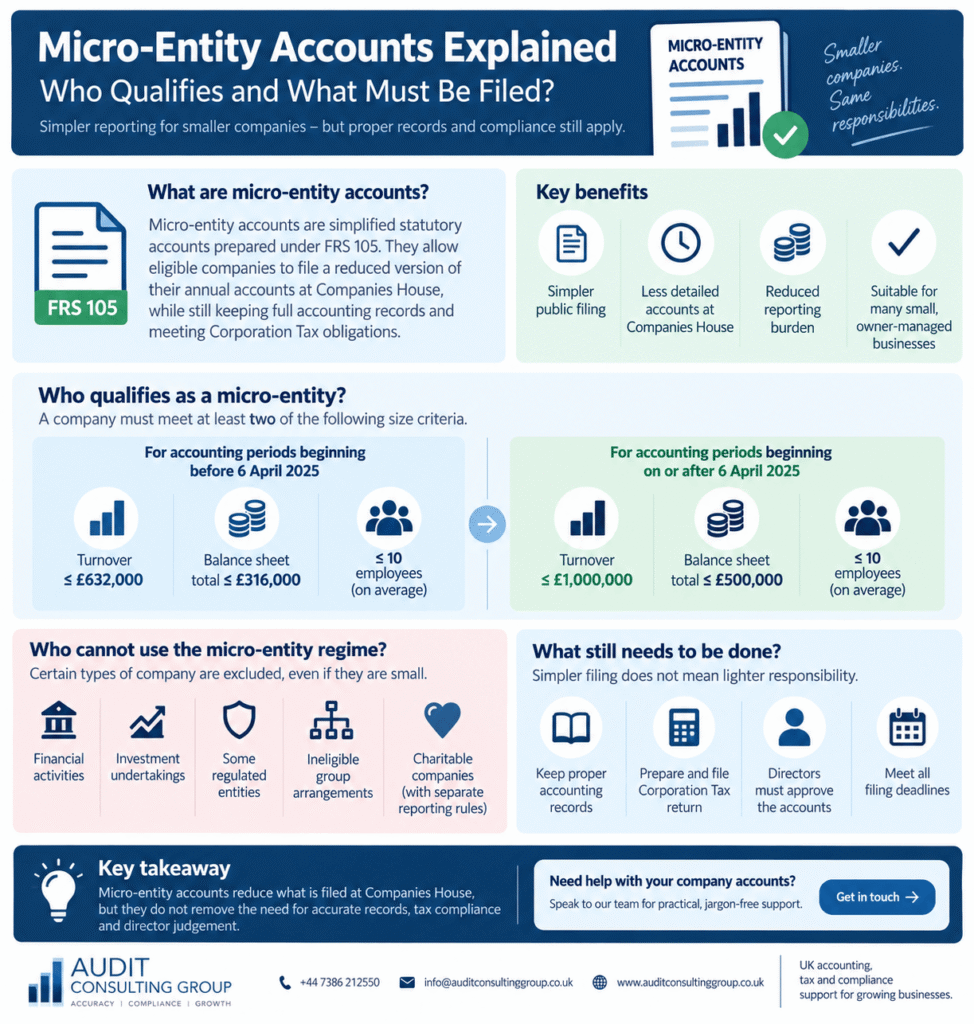
Micro-entity accounts exist to reduce the reporting burden for the smallest limited companies. They are prepared under a simplified accounting framework, usually FRS 105, and they allow eligible companies to file a reduced version of their annual accounts at Companies House.
The key point is that micro-entity accounts are a reporting format, not a relaxation of the obligation to keep proper books. A company still needs accounting records that explain its transactions, assets, liabilities, income and expenditure. Directors still need to approve the accounts. Corporation Tax still needs to be calculated correctly. Deadlines still apply.
In practice, the micro-entity regime mainly affects what appears on the public record. It does not mean the company can ignore bookkeeping discipline during the year or prepare figures from incomplete bank statements shortly before the filing deadline.
Who qualifies as a micro-entity?
A company generally qualifies as a micro-entity if it meets at least two of the relevant size criteria. For accounting periods beginning before the threshold changes introduced for financial years starting on or after 6 April 2025, the commonly applied limits are:
- annual turnover of not more than £632,000;
- balance sheet total of not more than £316,000;
- not more than 10 employees on average.
For financial years beginning on or after 6 April 2025, the UK size thresholds increase. The micro-entity limits become:
- annual turnover of not more than £1 million;
- balance sheet total of not more than £500,000;
- not more than 10 employees on average.
The employee limit remains particularly important. A company with modest turnover can still fall outside the regime if its average headcount is too high. Equally, a company with few employees may fail the test because its turnover or balance sheet has grown beyond the limits.
There are also exclusions. Certain types of company cannot use the micro-entity regime even if they appear small by size. This can include companies involved in financial activities, investment undertakings, some regulated entities and companies that are part of ineligible group arrangements. Charitable companies also have separate reporting requirements and should not assume the micro-entity route is available.
The two-out-of-three test is where mistakes start
The eligibility test sounds simple, but errors are common because directors often focus only on turnover. Turnover is visible. Balance sheet totals are less intuitive. Average employee numbers are sometimes overlooked altogether, especially where a business has part-time staff, fluctuating payroll or seasonal workers.
The balance sheet total is not the company’s cash balance. It broadly reflects total assets before deducting liabilities. A business with stock, debtors, equipment, property, director loan balances or substantial cash reserves may have a balance sheet total that is more significant than the director expects.
Another practical issue is timing. A company may qualify one year and not qualify the next. Growth, asset purchases, recruitment or joining a group can change the position. Directors should not assume that because micro-entity accounts were filed last year, the same basis automatically applies this year.
What has to be filed at Companies House?
For an eligible micro-entity, the public filing at Companies House is usually much shorter than full accounts. Typically, the filed version includes a balance sheet and the required notes or statements. The profit and loss account is not usually placed on the public record for a micro-entity filing.
This is one reason the regime is popular. It provides a degree of commercial privacy for very small companies, particularly where directors do not want turnover, profit margins or administrative expenses visible to competitors, suppliers or customers.
However, the accounts still need to be properly prepared and approved. The balance sheet filed at Companies House is not a casual summary. It is a statutory filing. It should be consistent with the underlying accounting records and with the figures used for Corporation Tax purposes unless there is a clear accounting or tax reason for a difference.
Companies House filing also has its own deadline. Private companies normally have nine months after the accounting reference date to file annual accounts, although the first accounting period can have slightly different timing rules depending on the incorporation date and accounting reference date. Practical guidance on Companies House annual accounts filing can be useful where directors are trying to separate public filing obligations from wider year-end work. Missing the deadline can trigger automatic late filing penalties.
What HMRC expects is not the same as the public filing
A frequent misunderstanding is that the abbreviated Companies House filing is all that exists. HMRC usually requires a Corporation Tax return, accounts and tax computations. Even where the public record contains only a reduced balance sheet, the company still needs enough accounting detail to support taxable profit, disallowable expenses, capital allowances, director remuneration, dividends and any tax adjustments.
HMRC is not assessing the company from the public micro-entity balance sheet alone. The CT600 and supporting computations need to make sense. If the accounting records are thin, the Corporation Tax return becomes harder to support.
This matters particularly for companies with:
- director loans or overdrawn director loan accounts;
- dividends paid during the year;
- asset purchases and capital allowance claims;
- home office, travel or subsistence costs;
- VAT registration or historic VAT issues;
- payroll, benefits or pension obligations;
- CIS deductions suffered or deducted;
- stock, work in progress or deferred income.
For these businesses, micro-entity accounts may still be suitable, but the underlying accounting work cannot be treated as minimal.
Micro-entity accounts and Corporation Tax: the hidden dependency
Micro-entity reporting is often discussed as if it is a Companies House matter only. In real work, the Corporation Tax position is usually where the weaknesses appear.
A set of accounts may be acceptable for statutory filing, but the tax computation requires decisions. Some expenses are not deductible for Corporation Tax. Some timing differences need adjustment. Capital expenditure may not be treated in the same way for tax as it is in the accounts. Director remuneration and dividends need to be distinguished correctly. Loans to participators can create additional tax considerations if not cleared within the required timeframe.
This is why poor bookkeeping during the year can produce problems months later. If a director pays business and personal costs through the same bank account, withdraws money irregularly, labels payments inconsistently or leaves receipts unclassified, the year-end accounts may become a reconstruction exercise rather than an accounting process.
The micro-entity format does not remove those judgement calls. It simply means fewer disclosures may be required in the filed accounts.
What most small companies get wrong
The most common mistake is assuming “micro” means “informal”. The company may be small, but it is still a separate legal entity. Its bank account, invoices, expenses, payroll records, VAT records and director transactions need to be capable of explanation.
Several recurring issues tend to appear in micro-entity accounts:
- Turnover is estimated rather than reconciled. Sales invoices, bank receipts, payment platform reports and VAT returns may not agree.
- Director withdrawals are treated loosely. Payments are recorded as expenses when they may be dividends, salary, loan repayments or director loan movements.
- Dividends are paid without checking distributable profits. A profitable bank balance does not automatically mean lawful reserves exist.
- Payroll is treated as separate from the accounts. PAYE, pension contributions and salary accruals should reconcile to the company records.
- VAT is ignored because the accounts are small. A micro-entity can still be VAT registered or close to the VAT threshold.
- Companies House and HMRC figures drift apart. Differences may be explainable, but unexplained inconsistencies create unnecessary risk.
These are not usually dramatic failures. They are small process weaknesses that accumulate quietly until the filing deadline exposes them.
When micro-entity accounts make sense
Micro-entity accounts are often a good fit for straightforward owner-managed companies with simple trading activity, modest assets and clean records. A consultant billing a handful of clients, a small design studio, a personal service company, a new trading company or a small online business may all qualify, provided the size limits and exclusions are satisfied.
The regime is particularly useful where the owners do not need detailed public disclosure and external stakeholders are limited. If there are no bank facilities, no complex shareholders, no investor reporting requirements and no unusual transactions, micro-entity accounts can be efficient and proportionate.
There is still a judgement point. Some companies qualify as micro-entities but choose to prepare fuller accounts internally because management needs better information. A simplified filing may satisfy Companies House, but it may not help a director understand gross margin, debtor ageing, cash conversion, project profitability or tax reserves.
When a fuller approach may be wiser
Eligibility does not always mean suitability. A company might technically qualify as a micro-entity while still needing more detailed reporting for practical reasons.
A fuller accounts approach may be preferable where the company is seeking finance, preparing for investment, managing multiple revenue streams, carrying stock, working on long-term contracts or planning a sale. Lenders and investors rarely make decisions from a micro-entity balance sheet alone. They usually want profit and loss detail, management accounts, forecasts and explanations of working capital.
Companies with construction sector activity may also need careful treatment. CIS deductions, subcontractor costs and payroll status questions can affect both accounting and tax reporting. A micro-entity filing does not simplify the underlying CIS compliance work.
Similarly, VAT-registered companies need records that support VAT returns as well as annual accounts. VAT errors often arise from timing, mixed personal and business spending, reverse charge transactions, deposits, credit notes or incorrect treatment of expenses. The statutory accounts may be short, but the VAT trail still needs to be defensible.
The filing process in practice
A good micro-entity accounts process normally starts before the year end, not after it. The company should already have clean bookkeeping, reconciled bank transactions, clear invoice records and an understanding of what money taken by directors represents.
At year end, the process usually involves:
- reconciling bank accounts, payment platforms and cash balances;
- checking sales, debtors and unpaid invoices;
- reviewing expenses and identifying non-business or mixed-use costs;
- confirming payroll, PAYE and pension balances;
- reviewing VAT returns against accounting records where relevant;
- checking director loan accounts and dividend paperwork;
- reviewing assets, depreciation and capital allowance treatment;
- preparing statutory accounts and Corporation Tax computations;
- filing accounts with Companies House and the CT600 with HMRC.
For very simple companies, this process can be quick. For companies with messy records, it can become slow and surprisingly judgement-heavy. The deciding factor is rarely the length of the final Companies House filing; it is the quality of the records behind it.
Director responsibilities should not be understated
Directors are responsible for ensuring that the company keeps adequate accounting records and files accounts on time. Outsourcing bookkeeping or accounts preparation can help, but it does not transfer the legal responsibility away from the directors.
This responsibility is particularly relevant for micro-entities because the public filing is so brief. A short balance sheet may give the impression that there is little to approve. In reality, directors should be comfortable that the figures reflect the company’s position and that the accounts are consistent with the company’s records.
There is also a commercial responsibility. Directors make decisions from financial information. If the year-end accounts are treated only as a compliance exercise, the company may miss warning signs: tightening cash flow, rising debtor balances, weak margins, excessive director drawings or tax liabilities building faster than expected.
Common scenarios that need careful judgement
A profitable contractor with irregular withdrawals
A contractor operating through a limited company may qualify easily as a micro-entity. The accounts may appear straightforward: invoices issued, expenses paid, profit taxed. The complication often sits in the director loan account. If the director withdraws funds without payroll or dividend planning, the year-end position can show an overdrawn loan, possible additional tax issues and dividend paperwork prepared after the event rather than at the time decisions were made.
A small company close to the VAT threshold
A company may be well within the micro-entity turnover limits but close to the VAT registration threshold. The director may focus on Companies House eligibility and overlook rolling 12-month VAT turnover. These are separate tests. A company can qualify as a micro-entity and still have a VAT registration obligation.
A growing business with small-company habits
A start-up may qualify as a micro-entity in its first year, then grow quickly. Staff are added, stock increases, software subscriptions multiply and revenue rises. The company may still file micro-entity accounts for one period, but management needs may already have moved beyond the micro format. At that point, monthly or quarterly management accounts may be more valuable than waiting for the statutory accounts months after the year end.
What the accounts do not show publicly can still matter privately
One of the strengths of micro-entity accounts is privacy. One of the weaknesses is that the public record may tell very little about the company’s trading performance. That can be helpful or inconvenient depending on the audience.
Suppliers may struggle to assess creditworthiness from a limited balance sheet. Banks may ask for fuller accounts or management information. Potential buyers, landlords, grant bodies and investors may want profit and loss detail. Even internally, directors may need more than statutory compliance to make sensible decisions.
This is where the distinction between statutory filing and business reporting matters. Micro-entity accounts can be the correct statutory format while management accounts provide the operational detail needed to run the business properly.
Record keeping is the real foundation
Good micro-entity accounts depend on ordinary, unglamorous record keeping. Bank feeds help, but they do not replace judgement. Accounting software can automate posting patterns, but it cannot always determine whether a payment is allowable, private, capital, payroll-related, VATable or part of a director loan movement.
Useful records normally include sales invoices, purchase invoices, receipts, bank statements, payroll reports, VAT returns, loan agreements, dividend vouchers, board minutes where relevant, asset purchase documents and evidence for unusual transactions. If the company has employees, payroll records and pension records need to be retained. If it uses subcontractors, CIS records may be required. If it imports services or goods, VAT treatment can need closer review.
The discipline is not about creating paperwork for its own sake. It is about making the accounts explainable if a question arises later. Reliable small business bookkeeping is often what separates a straightforward micro-entity filing from a difficult year-end reconstruction.
Micro-entity accounts after threshold changes
The increased thresholds for financial years beginning on or after 6 April 2025 will bring more companies into the micro-entity category. That may reduce administrative pressure for some small companies, but it also increases the risk of businesses choosing the smallest filing option without considering whether it gives enough information for tax, finance or management purposes.
A company with turnover approaching £1 million can be operationally more complex than the word “micro” suggests. It may have staff, VAT, finance leases, stock, multiple software systems, overseas suppliers, deferred income or sector-specific compliance requirements. Size thresholds are only one part of the judgement.
The practical question is not simply “Can we file micro-entity accounts?” It is also “Will this reporting basis support the company’s tax position, financing needs, management decisions and future plans?”
Key takeaways for directors
- Micro-entity accounts reduce public reporting, but they do not remove the need for proper accounting records.
- Eligibility depends on meeting at least two of the relevant size criteria and not falling within an excluded category.
- Companies House filing is not the same as HMRC Corporation Tax reporting.
- Micro-entity accounts are prepared under FRS 105 and remain statutory accounts, not informal summaries.
- Director loans, dividends, payroll, VAT and CIS can make a small company more complex than it appears.
- A company may qualify for micro-entity accounts but still benefit from fuller internal reporting.
- Threshold changes from April 2025 expand eligibility, but suitability still requires judgement.
A practical final view
Micro-entity accounts are useful when they are used for the right company and supported by sound records. They offer a proportionate way for very small companies to meet statutory filing requirements without placing unnecessary detail on the public register.
The risk is treating the short filing as proof that the accounting work is simple. Sometimes it is. Often, the visible accounts are only the surface. Beneath them sit Corporation Tax calculations, bookkeeping decisions, payroll records, VAT treatment, director transactions and Companies House compliance.
For directors, the sensible approach is to treat micro-entity accounts as a filing option within the wider framework of limited company annual accounts, not an accounting shortcut. If the company is simple, the regime can work well. If the company is growing, borrowing, employing staff, managing VAT or relying on accurate figures for decisions, the accounts process needs to be strong enough to support more than the minimum public disclosure.