

Monthly Bookkeeping Checklist for UK Small Businesses
Bookkeeping problems rarely arrive as one dramatic failure. More often, they build quietly: a missing receipt here, an unreconciled payment there, a director expense left unexplained, a VAT code applied without much thought. By the time the issue appears in a VAT return, payroll report, Corporation Tax calculation or cash flow forecast, the original transaction may be weeks or months old.
For UK small businesses, a monthly bookkeeping checklist is less about administration for its own sake and more about control. It gives owners, directors and finance teams a rhythm for checking that the records still reflect the business they are actually running. That distinction matters. Software can record transactions, but it does not automatically confirm whether those transactions are complete, correctly classified, supported by evidence or ready for HMRC scrutiny.
A good monthly process should do three things at once: keep the books accurate, protect compliance deadlines and give the business useful information while there is still time to act on it.
Leave your details and our team will get back to you shortly.
Why monthly bookkeeping matters more than year-end tidying
Some small businesses still treat bookkeeping as something to fix at year end. That approach may feel manageable while transaction volumes are low, but it creates avoidable risk. The longer bookkeeping is left unresolved, the harder it becomes to reconstruct what happened. Bank descriptions become less meaningful, missing invoices are harder to chase, and expense decisions are remembered less clearly.
Monthly bookkeeping reduces that uncertainty. It supports regular VAT preparation, cleaner payroll reporting, more reliable management figures and fewer surprises when accounts are prepared. It also helps directors understand cash position, margins, tax liabilities and working capital pressure before those issues become urgent. This is where consistent small business bookkeeping support can be useful, particularly where records have started to depend too heavily on memory or last-minute reconstruction.
The practical value is often strongest in ordinary situations: a supplier invoice duplicated by mistake, a customer payment allocated to the wrong account, a subscription still being paid after cancellation, or a payroll journal posted without matching pension deductions. None of these issues may seem significant on their own. Over a year, they can distort profit, VAT, cash flow and tax planning.
The monthly bookkeeping cycle in a UK small business
A monthly bookkeeping checklist should not be a random list of tasks. It works best as a sequence. The order matters because later checks depend on earlier records being complete.
For example, it is difficult to review profit properly before bank transactions have been reconciled. It is risky to submit a VAT return before checking purchase invoices and VAT treatment. Payroll journals make little sense unless wages, PAYE, National Insurance, pension deductions and employer contributions have been posted consistently.
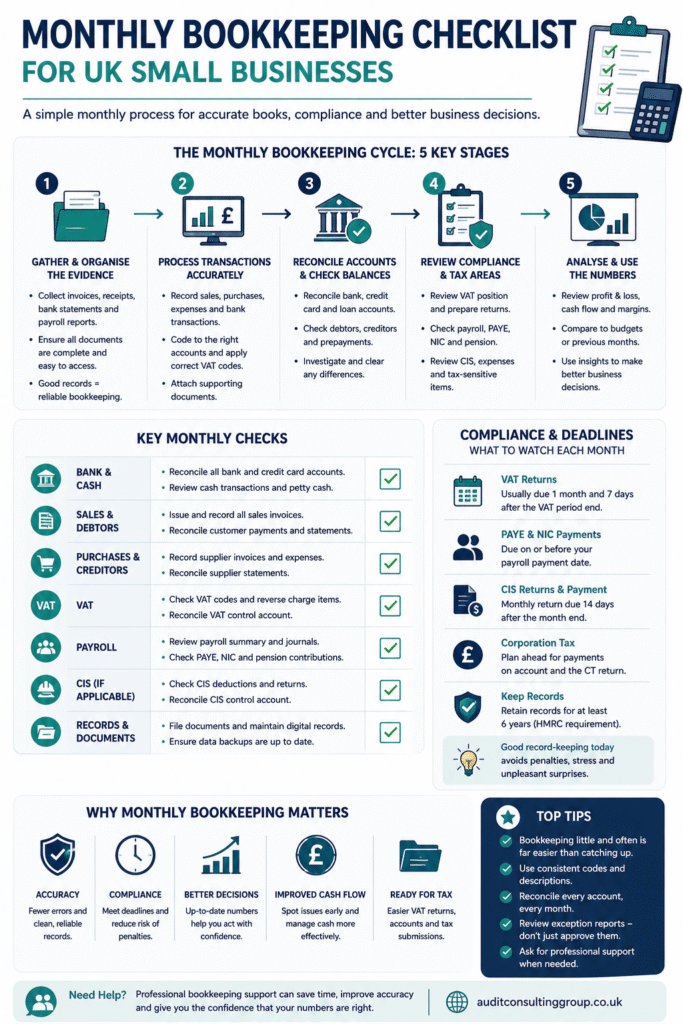
A practical monthly cycle usually moves through five stages:
- collecting and organising source documents;
- processing sales, purchases, expenses and bank transactions;
- reconciling accounts and checking balances;
- reviewing VAT, payroll, CIS and tax-sensitive areas;
- using the figures to understand cash flow, profitability and upcoming obligations.
This does not mean every small business needs a complex finance department. A sole trader with a few monthly transactions will need a lighter process than a VAT-registered construction company with CIS deductions, subcontractors, payroll and multiple bank feeds. The principle is the same: the books should be reviewed often enough that errors are still easy to identify and correct.
Step 1: Gather the evidence before processing the numbers
Monthly bookkeeping should begin with records, not software. Bank feeds are useful, but they are not evidence on their own. HMRC expects businesses to keep proper records to support income, expenses, VAT claims and tax calculations. A transaction appearing on a bank statement does not necessarily explain what it was for, whether it was business-related, or whether VAT was correctly reclaimable.
At the start of each month, collect the documents connected to the previous month’s activity. This usually includes:
- sales invoices issued to customers;
- purchase invoices and supplier statements;
- receipts for card, cash and online purchases;
- bank and credit card statements where feeds are not fully reliable;
- loan, finance or lease statements;
- payroll reports and pension contribution details;
- CIS statements where relevant;
- VAT documentation for imports, reverse charge transactions or unusual supplies.
The quality of the bookkeeping depends heavily on the quality of this evidence. A common weakness in small businesses is that documents sit in too many places: email inboxes, WhatsApp messages, supplier portals, paper files, personal phones and payment apps. The monthly checklist should include a deliberate document sweep so that costs are not missed simply because the receipt never reached the bookkeeping system.
Step 2: Review sales invoices and customer payments
Sales records are not just a measure of turnover. They affect VAT, debtor balances, revenue recognition, cash flow and, for companies, Corporation Tax reporting. A monthly review should confirm that all sales for the period have been recorded and that invoices have been issued where required.
For businesses using cloud accounting software, this means checking that invoices in the system match the work delivered, contracts completed, orders fulfilled or services billed. For cash-based or retail businesses, it means reconciling till reports, payment platforms and merchant receipts against bank deposits.
Customer payments should be matched to the correct invoices. Unallocated receipts deserve attention because they can hide practical problems: duplicate payments, underpayments, payments from related parties, deposits for future work, or income posted directly to sales without an invoice trail.
Small businesses often underestimate how quickly debtor records lose accuracy. A single payment allocated to the wrong customer can make one account appear overdue and another appear overpaid. Monthly review keeps credit control grounded in real information rather than assumptions.
Step 3: Enter purchase invoices and check supplier balances
Purchase invoices should be processed with enough detail to support both management reporting and tax compliance. That means recording the supplier, date, invoice number, net amount, VAT amount where relevant and the correct expense category.
The category matters. A software subscription, subcontractor cost, equipment purchase, repairs bill and director’s personal expense all have different accounting and tax implications. If everything is posted to broad categories such as “general expenses” or “miscellaneous”, the accounts may still balance mathematically, but the business loses meaningful insight. Tax review also becomes harder.
Monthly supplier checks should include reviewing unpaid bills, matching payments, and identifying duplicates. Duplicate supplier invoices are more common than many owners expect, particularly where invoices are emailed to more than one person or where a statement is mistaken for a new invoice.
Supplier statements are useful where a business has regular trade accounts. If the supplier’s balance does not match the bookkeeping records, the difference should be investigated while the transactions are still recent.
Step 4: Reconcile bank accounts, credit cards and payment platforms
Bank reconciliation is one of the most important monthly bookkeeping controls. It confirms that transactions in the accounting records agree with the actual movement of money through the bank. Without reconciliation, reports can look complete while still being wrong.
Each business bank account should be reconciled to the month-end bank balance. Credit cards should be reconciled as well, not treated as an afterthought. Payment platforms such as Stripe, PayPal, SumUp, GoCardless or marketplace accounts may also need separate review because fees, refunds and timing differences can distort income if they are posted incorrectly.
Bank feeds reduce manual work but they do not remove the need for judgement. A feed may import transactions correctly while the bookkeeping treatment remains wrong. For example, a transfer between two business accounts should not be treated as income. A director’s repayment should not be treated as sales. A loan receipt should not be treated as trading income. A card payment to a supplier may need to be matched to an invoice rather than posted again as a new expense.
Monthly reconciliation is where these mistakes are usually caught.
Step 5: Separate business, personal and director transactions
Small business bookkeeping becomes harder when personal and business spending overlap. For sole traders, personal drawings are not business expenses, even though they may appear in the business bank account. For limited companies, director transactions require particular care because the company is legally separate from the director.
A monthly checklist should identify:
- personal costs paid from the business bank account;
- business costs paid personally by the owner or director;
- director withdrawals not processed through payroll or dividends;
- expense reimbursements requiring receipts;
- amounts that may affect the director’s loan account.
Director’s loan account issues often start as small bookkeeping gaps. A director pays for fuel, meals, travel or subscriptions, some business-related and some not. Without a monthly review, the loan account may build up without anyone noticing. That can create tax and reporting implications, especially if balances remain outstanding at the company year end.
The purpose of the monthly process is not to turn every minor transaction into a major investigation. It is to make sure the treatment is clear, supported and not left for year-end guesswork.
Step 6: Check VAT treatment before the return becomes urgent
For VAT-registered businesses, monthly bookkeeping is closely linked to VAT compliance, even where VAT returns are filed quarterly. Leaving VAT checks until the filing deadline increases the risk of rushed decisions and incorrect claims.
Each month, VAT codes should be reviewed for sales and purchases. The checks should focus on areas where mistakes commonly occur:
- claiming VAT without a valid VAT invoice;
- using the wrong VAT rate for goods or services;
- treating exempt, zero-rated and outside-the-scope transactions as if they were the same;
- posting imports or overseas services without considering postponed VAT accounting or reverse charge rules;
- misunderstanding domestic reverse charge VAT in construction;
- claiming VAT on costs with restrictions, such as certain business entertainment expenses.
VAT errors are often not caused by carelessness. They usually arise because the transaction is slightly unusual, the invoice wording is unclear, or the person coding the transaction does not know the business context. A monthly review creates space to ask questions before the VAT return is due.
Businesses using Making Tax Digital-compatible software should also ensure that digital records are complete and that any adjustments are properly documented. The software may produce a VAT return figure, but the business remains responsible for the accuracy of the underlying records.
Step 7: Reconcile payroll postings with HMRC and pension records
Payroll affects more than wages paid to staff. It connects to PAYE, National Insurance, pension contributions, employment costs, director remuneration and cash flow. If payroll is run separately from bookkeeping, the monthly accounts may not reflect the real cost of employment unless payroll journals are posted properly.
A monthly bookkeeping review should check that gross wages, employer National Insurance, pension costs, PAYE liabilities and net wage payments have been recorded. Amounts due to HMRC should agree with payroll reports, and pension deductions should reconcile with pension provider submissions and payments. Where payroll and accounts are handled by different people or systems, dedicated payroll bookkeeping processes help reduce the drift between wage reports, bank payments and bookkeeping entries.
Timing differences are common. Payroll may be processed at the end of the month, wages may be paid a few days later, and PAYE may be paid to HMRC by the relevant deadline. The bookkeeping should reflect those movements accurately rather than simply posting the bank payment as “wages”.
For directors, payroll review also supports wider remuneration planning. Salary, dividends, expenses and director loan movements should not be mixed together casually. They have different accounting and tax treatments.
Step 8: Review CIS deductions if the business works in construction
Construction businesses often need a more detailed monthly bookkeeping checklist because CIS introduces another layer of compliance. Contractors must verify subcontractors, apply the correct deduction rate, submit monthly CIS returns where required and provide deduction statements. Subcontractors need records of deductions suffered so they can be matched against tax liabilities or company PAYE positions.
Monthly bookkeeping should confirm that subcontractor invoices are recorded correctly, labour and materials are separated where needed, and CIS deductions are posted to the correct accounts. VAT treatment should also be considered, particularly where domestic reverse charge rules apply. For businesses operating in this sector, construction bookkeeping often needs to connect CIS records, subcontractor statements, project costs and VAT treatment rather than treating them as separate admin tasks.
A frequent construction-sector problem is treating CIS as a simple deduction from payment without recording the underlying liability properly. That may keep the bank balance accurate, but it can leave HMRC liabilities, subcontractor statements and profit reporting inconsistent.
Step 9: Check cash flow, debtors and creditors while the figures are still useful
Bookkeeping has limited value if it only explains what happened after decisions have already been made. A monthly checklist should include a short review of cash flow and working capital.
This does not need to be elaborate. The key questions are practical:
- Which customers owe money, and how old are the debts?
- Which supplier payments are due soon?
- Are VAT, PAYE, Corporation Tax or Self Assessment liabilities building up?
- Is the business relying on overdrafts, credit cards or director funding?
- Are margins changing because costs have increased?
- Is stock, work in progress or unbilled work tying up cash?
Small businesses can be profitable on paper and still experience cash pressure. Monthly bookkeeping helps identify that gap. If sales are growing but cash is tightening, the issue may be slow customer payment, increased stock holding, higher payroll costs, seasonal VAT liabilities or unmanaged director withdrawals.
The earlier these patterns are visible, the more options the business usually has.
Step 10: Review profit and loss with context, not just totals
A monthly profit and loss report should not be read as a final verdict. It is a working management tool. The figures may include timing differences, accruals not yet posted, seasonal costs or one-off items. Even so, it can highlight changes that deserve attention.
Useful monthly review often focuses on movement rather than absolute numbers. Why did subcontractor costs rise? Why is software spend higher than last month? Why has gross margin shifted? Are travel costs linked to a specific project? Has a new employee cost been fully reflected? Were sales invoices delayed and therefore understated?
For limited companies, monthly profit review also helps directors anticipate Corporation Tax exposure. For sole traders and partners, it can support Self Assessment planning by giving a clearer view of taxable profit as the year progresses. The figures may still need year-end adjustments, but they are far more useful than waiting until after the tax year has closed.
Step 11: Maintain fixed asset, loan and finance records
Not every payment should be treated as a normal expense. Equipment, vehicles, computers, fixtures and certain larger purchases may need to be recorded as fixed assets. Loans, hire purchase agreements and leases may require separate treatment between capital repayments, interest and charges.
Monthly bookkeeping should flag larger or unusual payments so they can be reviewed properly. Posting a vehicle finance payment entirely to motor expenses, for example, may distort both profit and the balance sheet. Treating equipment purchases as everyday expenses may also affect how accounts and tax computations are prepared.
This is one area where a simple checklist can prevent a lot of year-end rework. The bookkeeper does not need to make every final accounting judgement during the month, but they should identify transactions that require review rather than burying them in general overheads.
Step 12: Keep an eye on Companies House and statutory records
Bookkeeping is not the same as company secretarial compliance, but the two often overlap. For limited companies, accurate accounting records support annual accounts, Corporation Tax returns and director responsibilities. Companies House filings rely on the company’s records being coherent and complete.
Monthly checks should consider changes that may affect statutory records or future filings. Examples include new share issues, changes in directors, registered office updates, significant loans, dividends declared, or changes in business activity. These are not always bookkeeping entries alone, but they often appear first through financial transactions.
Dividends deserve particular care. A dividend payment is not simply another bank transfer to a director. It should be supported by appropriate company records and distributable profits. Monthly bookkeeping helps directors see whether the financial position supports proposed drawings, but the decision still requires proper judgement.
Step 13: Close the month rather than leaving it half-finished
The final part of a monthly bookkeeping checklist is a month-end close. In a small business, this does not need to resemble a large corporate finance process. It simply means the month has been reviewed to a sensible standard and known issues have been listed.
A practical month-end close might include:
- bank and credit card accounts reconciled;
- sales invoices reviewed and debtor balances checked;
- supplier invoices posted and creditor balances reviewed;
- VAT codes checked for unusual transactions;
- payroll journals posted and HMRC liabilities reconciled;
- CIS records checked where relevant;
- director transactions reviewed;
- large purchases and finance payments flagged;
- cash flow and tax liabilities reviewed;
- queries documented rather than left unresolved.
The discipline of documenting queries is underrated. A missing receipt, unclear payment or unusual VAT treatment should not disappear into the accounts simply because the month needs closing. A short query list gives the owner, bookkeeper or accountant something concrete to resolve.
Common monthly bookkeeping mistakes that create bigger problems later
Most bookkeeping errors are small at the point they happen. They become expensive when repeated or left unresolved. The most common issues are not usually technical accounting failures; they are process failures.
One frequent mistake is relying entirely on bank feeds. Bank feeds show money movement, not the commercial reason behind that movement. Without invoices, receipts and review, the records may be incomplete even if the bank reconciliation appears tidy.
Another common issue is inconsistent categorisation. If similar costs are posted to different expense headings each month, management reports become unreliable. The business may struggle to compare margins, track overheads or identify cost increases.
VAT errors also build quietly. A wrong VAT code copied from a previous transaction can repeat across months. Supplier invoices without VAT numbers may be used to support claims. Construction businesses may overlook reverse charge rules. Businesses buying overseas services may miss reverse charge considerations.
Payroll can create its own distortions when only net wage payments are posted. That approach misses employer costs and liabilities, making profit appear stronger than it is during the month.
Finally, director transactions often remain unresolved for too long. If dividends, salary, expense reimbursements and personal drawings are not distinguished clearly, the accounts may be difficult to interpret and tax consequences may be missed until late in the year.
What the checklist should look like for different types of small business
There is no single monthly bookkeeping checklist that fits every UK small business perfectly. The right process depends on trading structure, VAT status, payroll, sector, transaction volume and reporting needs.
Sole traders and self-employed businesses
For sole traders, the monthly focus is usually income completeness, allowable expenses, personal drawings, mileage or vehicle costs, and Self Assessment planning. The business should keep clear evidence for expenses and avoid treating personal spending as deductible business costs.
Where income fluctuates, monthly bookkeeping helps estimate tax liabilities before the Self Assessment deadline approaches. It can also support payment on account planning, which is often misunderstood by growing sole traders.
Limited companies
Limited companies need stronger separation between the company and its directors. Monthly checks should include director loan accounts, payroll, dividends, Corporation Tax estimates, VAT where relevant and balance sheet accuracy. The company’s records should support both HMRC reporting and Companies House accounts.
Directors should be cautious about using bookkeeping reports as if they were final distributable profit calculations. Monthly figures are useful, but they may need adjustments before dividend decisions are made.
VAT-registered businesses
VAT-registered businesses benefit from monthly VAT checks even if returns are quarterly. This reduces the pressure of quarter-end review and helps identify coding errors before they affect submitted returns.
Businesses with mixed supplies, imports, exports, construction work or overseas services should be especially careful. VAT treatment depends on the nature of the supply, customer, location and documentation. The monthly process should highlight transactions needing review rather than assuming every item follows the standard rate.
Employers
Employers need bookkeeping that reflects payroll properly. This includes gross pay, deductions, employer National Insurance, pension contributions and payments to HMRC. Staff costs are often one of the largest expenses in a small business, so incomplete payroll posting can seriously distort monthly profit.
Construction businesses
Construction bookkeeping often requires attention to CIS, subcontractor deductions, reverse charge VAT, retentions, project costs and materials. A general bookkeeping checklist may not be enough. Monthly review should connect bookkeeping records with project performance and HMRC obligations.
Using bookkeeping software without losing professional judgement
Xero, QuickBooks and similar platforms can make monthly bookkeeping faster and more transparent. Bank feeds, receipt capture, invoice matching and automated rules all reduce manual effort. Used well, they improve consistency and give business owners better access to current figures. Businesses using Xero may still need disciplined Xero bookkeeping review so that automation supports the records rather than quietly repeating the same coding errors.
The risk is assuming automation equals accuracy. Bank rules can post recurring transactions to the wrong place if the supplier changes what is being billed. Receipt capture tools may misread VAT. Duplicate transactions can appear where invoices and bank payments are both processed incorrectly. A software dashboard may show a profit figure that looks precise but depends on unfinished reconciliation and missing supplier bills.
Good monthly bookkeeping uses software as infrastructure, not as a substitute for review. The most useful systems combine automation with human checks: unusual transactions are flagged, VAT codes are reviewed, bank balances are reconciled and reports are read with knowledge of the business.
A practical monthly bookkeeping checklist
The following checklist gives a workable structure for most UK small businesses. It should be adapted where the business has VAT complexity, CIS obligations, payroll, stock, finance agreements or sector-specific reporting needs.
Every month: core records and reconciliations
- Collect all sales invoices, purchase invoices, receipts and credit notes for the month.
- Download or confirm bank, credit card and loan statements where needed.
- Retrieve invoices from supplier portals and online subscriptions.
- Check that personal payments made on behalf of the business are supported by receipts.
- Store documents in a consistent digital filing system or accounting platform.
- Confirm that all sales for the month have been invoiced or recorded.
- Match customer payments to invoices.
- Review unpaid invoices and aged debtors.
- Post supplier invoices to the correct categories.
- Match supplier payments to bills and check supplier statements.
- Reconcile all business bank accounts, credit cards and payment accounts to the month-end balance.
- Investigate old unreconciled items, unexplained receipts and unclear payments.
Quarterly dependencies: VAT, payroll, CIS and tax-sensitive checks
- Review VAT codes on sales and purchases.
- Check VAT invoices are held for VAT claims.
- Review reverse charge, imports, exports or exempt transactions where relevant.
- Post payroll journals and reconcile PAYE, National Insurance and pension liabilities.
- Check CIS deductions and monthly CIS records where applicable.
- Monitor Corporation Tax or Self Assessment liabilities based on current profit.
- Check upcoming HMRC payment deadlines so cash is not committed elsewhere by mistake.
Before year-end: items to flag early
- Identify large purchases that may need fixed asset treatment.
- Review director loan accounts, drawings or dividends.
- Check loan, lease and finance payments are not being posted entirely as expenses.
- Review profit and loss for unusual movements.
- Check the balance sheet for unexplained balances.
- Prepare a short list of unresolved queries.
- Save monthly reports once the period has been reviewed.
How monthly bookkeeping supports better business decisions
The strongest argument for monthly bookkeeping is not only compliance. It is decision quality. Owners and directors make decisions throughout the year: hiring staff, buying equipment, taking dividends, increasing prices, extending credit to customers, entering leases, bidding for projects or setting money aside for tax. Those decisions are weaker when based on incomplete records.
Clean monthly bookkeeping helps answer questions that matter commercially. Is the business actually making enough margin on its work? Are overheads rising faster than sales? Is cash tied up in debtors? Are tax liabilities being funded as they arise? Is payroll affordable during quieter months? Are directors taking money out faster than profits support?
These questions cannot always be answered perfectly from monthly figures, but they can be answered far better from reviewed records than from a bank balance alone.
Warning signs that the monthly process is not working
A bookkeeping process can look active but still fail to provide control. Warning signs include reconciliations that are months behind, suspense accounts growing, repeated use of vague expense categories, VAT returns prepared in a rush, payroll costs not matching payroll reports, or directors not knowing whether withdrawals are salary, dividends, expenses or loans.
Another warning sign is constant year-end correction. Some adjustments are normal. If the accounts require extensive reconstruction every year, the monthly process is probably not capturing the right information at the right time.
Businesses should also be cautious where only one person understands the bookkeeping process and nothing is documented. If that person is unavailable, deadlines, supplier payments, VAT returns or payroll checks can quickly become difficult to manage.
Building a realistic monthly routine
The best monthly bookkeeping routine is one the business can actually maintain. A checklist that is too complicated will be ignored. A process that is too light will miss important issues. The right balance depends on risk and complexity.
For a small non-VAT-registered sole trader, a monthly routine may take little time: record income, capture expenses, reconcile the bank and review tax estimates. For a limited company with VAT, payroll and several staff, the monthly process needs more structure. For a construction business with CIS and reverse charge VAT, it needs sector-specific checks.
Timing also matters. A useful routine might involve collecting documents weekly, reconciling the bank after month end, reviewing VAT and payroll by a set date, and checking management reports once the records are complete. The key is consistency. If the business waits until every task is urgent, bookkeeping becomes reactive rather than controlled.
Some businesses can manage this internally with a clear owner, sensible software and a documented process. Others reach a point where transaction volume, VAT complexity, payroll, CIS or director reporting makes external bookkeeping services a practical way to keep monthly records reliable without leaving everything until deadlines are close.
Key takeaways for UK small businesses
A monthly bookkeeping checklist should not be treated as a compliance formality. It is a control system for the business. It helps ensure income is complete, expenses are supported, bank accounts reconcile, VAT is reviewed, payroll is reflected correctly and tax liabilities are visible before deadlines arrive.
The most useful monthly routines combine discipline with judgement. They do not rely blindly on software, but they use software well. They do not turn every transaction into a technical debate, but they flag the items that need attention. They do not wait until year end to find out whether the business records make sense.
For UK small businesses, the real benefit is clarity. Clean monthly bookkeeping gives owners and directors a better view of profit, cash, tax exposure and operational pressure. It also reduces the amount of reconstruction needed when VAT returns, payroll filings, annual accounts, Corporation Tax returns or Self Assessment submissions are due.
Final expert perspective
Bookkeeping is often described as record keeping, but that understates its role. In a well-run small business, monthly bookkeeping is the link between daily transactions and informed management. It turns receipts, invoices, wages, VAT codes and bank movements into a financial picture the business can rely on.
The checklist itself is only part of the answer. The real discipline is reviewing the records while they are still fresh, asking the awkward questions early and keeping enough evidence to support the numbers later. That is what separates bookkeeping that merely records activity from bookkeeping that helps a business stay compliant, understand its position and make better decisions throughout the year.