

Outsourced Bookkeeping: Benefits, Costs and When to Outsource
Bookkeeping is rarely the task that causes visible excitement in a growing business. It is also rarely the task that can be ignored for long. The difficulty is that poor bookkeeping often looks manageable until something depends on it: a VAT return, a payroll run, a Corporation Tax calculation, a mortgage reference, a funding application, a management accounts pack, or an HMRC query asking for evidence behind a figure submitted months earlier.
That is why outsourced bookkeeping is not simply an administrative convenience. For UK sole traders, limited companies, contractors, landlords, construction businesses and small employers, it can become part of the financial control system of the business. The question is not only whether outsourcing saves time. The more useful question is whether the current bookkeeping process gives the owner, directors and advisers enough reliable information to make decisions and meet obligations without unnecessary risk.
Leave your details and our team will get back to you shortly.
This article explains what outsourced bookkeeping usually involves, where the real benefits and costs sit, and how to judge the point at which keeping bookkeeping in-house becomes more expensive than it appears.
What outsourced bookkeeping actually means
Outsourced bookkeeping means handing some or all day-to-day financial record keeping to an external bookkeeper, accountant or bookkeeping team. The work may be weekly, monthly, quarterly or arranged around specific compliance cycles. It can be narrow, such as bank reconciliation only, or broader, covering sales invoices, purchase invoices, receipt capture, supplier payments, payroll journals, VAT records and month-end reporting.
In practice, the scope matters more than the label. One business may outsource only basic bookkeeping because the owner still raises invoices and approves payments internally. Another may use outsourced bookkeeping support as part of a wider accounting process, with bookkeeping feeding VAT returns, payroll records, management accounts and year-end accounts preparation.
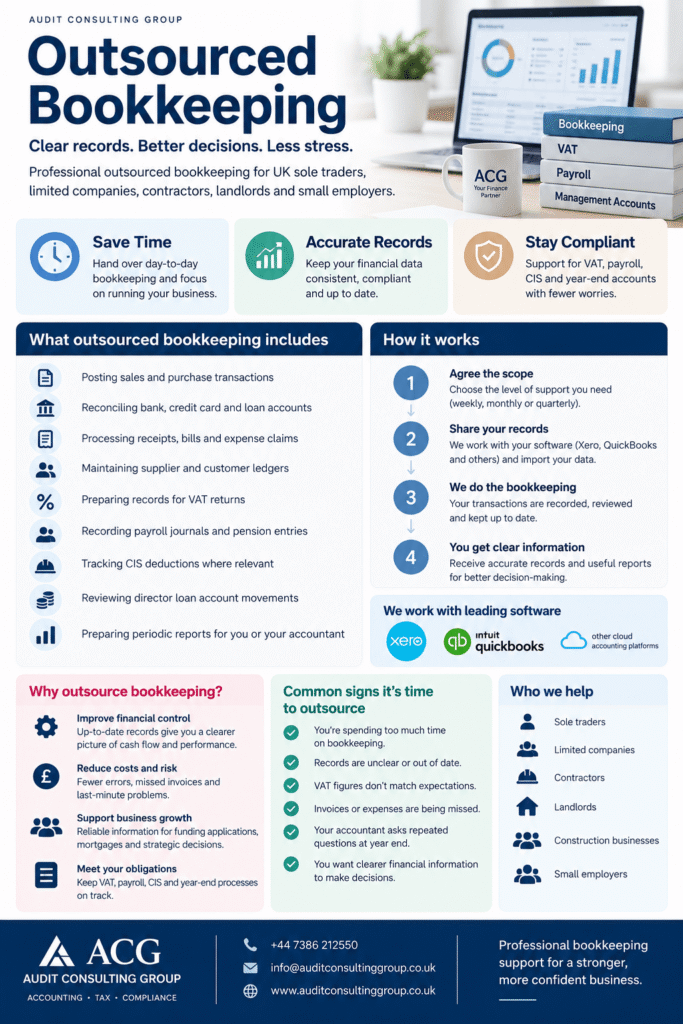
The most common outsourced bookkeeping tasks include:
- posting sales and purchase transactions;
- reconciling bank, credit card and loan accounts;
- processing receipts, bills and expense claims;
- maintaining supplier and customer ledgers;
- preparing bookkeeping records for VAT returns;
- recording payroll journals and pension-related entries;
- tracking CIS deductions where relevant;
- reviewing director loan account movements;
- preparing periodic reports for the owner, directors or accountant.
Cloud accounting software has changed the mechanics. Xero, QuickBooks and similar platforms can import bank feeds, read invoice data and automate parts of coding. But automation has not removed the need for judgement. Software may suggest a category; someone still needs to know whether the treatment is correct, whether VAT has been handled properly, whether a transaction belongs to the business, and whether a director’s payment has tax or reporting implications.
Why bookkeeping becomes a strategic issue earlier than expected
Small businesses often treat bookkeeping as a back-office task until the records start affecting something more serious. The first warning signs are usually practical rather than technical: cash flow feels unclear, VAT figures do not match expectations, invoices are missed, expenses are reconstructed from memory, or the accountant asks repeated questions at year end.
The deeper problem is that bookkeeping sits underneath almost every financial obligation. VAT returns rely on transaction-level accuracy. Payroll reports must align with wage payments, PAYE liabilities and pension deductions. CIS records require careful treatment of contractor deductions and verification evidence. Corporation Tax calculations depend on the completeness and classification of income and expenditure. Self Assessment can be distorted by weak records, especially for sole traders and landlords.
Companies House does not ask for bookkeeping records with the confirmation statement, and HMRC does not review every VAT return manually before it is submitted. That can create a false sense of safety. The records still need to support the figures if questioned later. For limited company directors, the responsibility for adequate accounting records remains with the company, even where the bookkeeping is outsourced.
This is where outsourced bookkeeping can change the quality of financial control. It introduces routine, accountability and review into a process that otherwise tends to happen only when a deadline becomes uncomfortable. For some owners, reviewing wider bookkeeping services also helps clarify which parts of the process are administrative, compliance-related or reporting-led.
The benefits are not just time savings
Time saving is the most obvious benefit of outsourced bookkeeping, but it is not always the most valuable one. A business owner can lose several hours a month posting receipts and reconciling accounts. Yet the larger cost is often the delay, uncertainty and rework created by inconsistent records.
Cleaner information for decisions
Reliable bookkeeping gives the business a clearer view of sales, costs, margins, tax liabilities and cash flow. That does not mean every small business needs a complex management reporting pack. A sole trader may only need a clean profit picture and a sensible estimate of tax due. A VAT-registered company with staff may need more structure: debtor control, supplier balances, payroll costs, VAT exposure and director drawings.
Outsourcing can help establish a regular reporting rhythm. Rather than discovering problems after the year end, the business can see patterns sooner: rising subcontractor costs, slow-paying customers, unclaimed expenses, unexpected VAT liabilities, or overheads that have drifted beyond budget.
Reduced filing pressure
Deadlines are less stressful when the underlying records are already maintained. VAT returns become a review process rather than a reconstruction exercise. Payroll bookkeeping is less likely to leave unexplained wage payments or unmatched PAYE balances. Year-end accounts become easier to prepare because the accountant is working from reconciled records rather than a collection of bank statements, invoices and assumptions.
This is not only about convenience. Rushed bookkeeping shortly before filing deadlines increases the likelihood of coding errors, duplicated expenses, missing sales income and incorrect VAT treatment.
Better use of accounting software
Cloud bookkeeping platforms are powerful only when configured and used properly. Bank rules, chart of accounts design, VAT rates, invoice workflows and reporting categories all affect the usefulness of the system. Poorly set up software can create a polished version of inaccurate records.
An outsourced bookkeeper should not merely “process transactions”. Good bookkeeping includes spotting inconsistencies: a supplier posted to several categories, bank feed gaps, personal expenditure passing through the business account, duplicated invoice numbers, unexplained negative balances, or VAT being claimed where evidence is weak.
Continuity and resilience
In a very small business, bookkeeping knowledge often sits with one person. If that person is the owner, the work competes with sales, operations and customer delivery. If it is an employee, absence or departure can leave the company without a working record-keeping process. Outsourcing can reduce dependency on a single internal person, provided the external process is documented and communication is clear.
Where outsourced bookkeeping costs usually arise
The cost of outsourced bookkeeping in the UK varies widely because the workload varies widely. A clean, low-transaction consultancy using one business bank account is very different from a VAT-registered retailer, a construction company with CIS subcontractors, or a property business with multiple entities and intercompany movements.
Pricing is commonly based on one or more of the following:
- monthly transaction volume;
- number of bank and credit card accounts;
- VAT registration and VAT scheme complexity;
- payroll and pension bookkeeping requirements;
- CIS contractor or subcontractor records;
- number of sales invoices and supplier bills;
- software setup, migration or clean-up work;
- frequency of reporting and review meetings;
- quality of existing records and documentation.
For very small businesses, basic bookkeeping may be a modest monthly cost if records are tidy and transaction volume is low. Costs rise where the bookkeeper must chase missing paperwork, interpret unclear payments, correct historic errors, reconcile multiple accounts or prepare records for more complex VAT, CIS or payroll reporting. More detailed bookkeeping cost considerations usually need to take account of both volume and complexity rather than turnover alone.
The cheapest quote is not always the cheapest outcome. If bookkeeping is processed mechanically without proper review, errors may reappear later as accountancy fees, tax corrections, missed claims, delayed accounts or management time spent resolving queries. Conversely, paying for a comprehensive bookkeeping service that the business does not need can be inefficient. The right cost sits between under-support and over-engineering.
The hidden cost of doing bookkeeping internally
Keeping bookkeeping in-house can be perfectly sensible. Some businesses have a capable finance administrator, simple transactions and good internal discipline. Problems arise when the internal cost is underestimated because it is not shown as a supplier invoice.
Owner-managed businesses often absorb bookkeeping into evenings, weekends or fragmented hours between client work. The direct cost may look like zero, but the trade-off is real. Time spent fixing receipts or reconciling bank accounts may be time not spent pricing work, collecting debts, supervising staff or managing customers.
There is also a quality cost. A non-specialist may do enough to keep the records moving but miss technical points: VAT on mixed-use costs, domestic reverse charge in construction, CIS deductions, allowable versus disallowable expenses, director loan account entries, capital expenditure, payroll journals or personal expenditure through a company account. These issues may be corrected later, but late correction is rarely the most efficient route.
The practical comparison is not “outsourced bookkeeping versus free internal bookkeeping”. It is outsourced bookkeeping versus the true cost of internal time, delays, errors, rework and missed visibility.
When outsourcing starts to make sense
There is no single turnover figure at which outsourcing becomes necessary. A low-margin business with stock, staff and VAT may need structured bookkeeping earlier than a high-margin consultant with ten monthly transactions. The trigger is usually complexity, not size alone.
The records are always behind
If bookkeeping is only updated before a VAT return, Self Assessment deadline or year-end accounts request, the business is operating with outdated information for much of the year. Occasional delay is normal. Persistent delay suggests the process is under-resourced.
VAT is becoming harder to manage
VAT is one of the most common reasons businesses outsource bookkeeping. The VAT return is only as reliable as the underlying transaction treatment. Errors can arise from incorrect VAT codes, missing purchase invoices, claiming VAT without proper evidence, mixing business and personal costs, reverse charge mistakes, or misunderstanding exempt and zero-rated sales.
Making Tax Digital has also increased the need for digital record keeping. Software submission is not the same as accurate VAT accounting. The digital process may satisfy one requirement while still leaving weaknesses in classification and evidence.
Payroll, CIS or subcontractors are involved
Once a business has employees, payroll records must connect with bookkeeping. Wage payments, PAYE, National Insurance, pension deductions and payroll journals should agree with the accounts. If those entries are not posted correctly, staff costs, liabilities and profit can all be distorted.
Construction businesses face an additional layer through CIS. Contractor deductions, subcontractor statements, verification records and monthly CIS returns require consistency. Weak bookkeeping can leave the business with mismatched CIS balances or difficulty proving deductions suffered or deducted.
The accountant spends too much time cleaning records
Some businesses do not realise bookkeeping is weak until the year-end accountant begins asking for missing invoices, unexplained payments, bank statements, loan agreements, payroll reports or VAT workings. If accountancy work regularly includes extensive clean-up, there may be a case for improving bookkeeping earlier in the cycle.
The owner no longer trusts the numbers
A more subtle trigger is loss of confidence. If management accounts are ignored because nobody trusts the bookkeeping, the business loses the benefit of financial reporting. At that point, the issue is not only compliance; it is decision quality.
Situations where outsourcing may not be the right answer yet
Outsourcing is not automatically the best solution. A business with very low transaction volume, organised records and a confident owner may manage basic bookkeeping internally without difficulty. A newly self-employed person may prefer to understand the mechanics before paying for support, especially if the records are simple and the tax position is straightforward.
There are also cases where outsourcing too early can create dependency without improving discipline. If the business does not separate personal and business spending, does not keep invoices, ignores software requests and delays answering queries, an outsourced bookkeeper will still struggle. External support improves a process; it cannot fully compensate for absent internal habits.
A better first step may be to tidy the system: open a separate business bank account, use receipt capture consistently, agree categories, set a monthly bookkeeping day, and decide who is responsible for answering queries. Once those basics exist, outsourcing becomes far more effective.
The businesses most likely to benefit
Outsourced bookkeeping tends to add the most value where record keeping has become operationally important but not large enough to justify a full internal finance team.
For sole traders and self-employed professionals, the benefit is usually simplicity and tax visibility. Good records help estimate profits, set aside money for Self Assessment and avoid the annual scramble for receipts.
For small limited companies, the benefit is broader. Directors need cleaner records for accounts, Corporation Tax, VAT, payroll, dividends, director loan accounts and business planning. The distinction between personal and company money also becomes more important. Company funds are not simply the owner’s personal cash, even where the owner is the only director and shareholder. This is often the point where small business bookkeeping needs more structure than occasional spreadsheet updates.
For construction businesses, bookkeeping often needs to handle CIS, subcontractor costs, materials, retention issues, domestic reverse charge VAT and project-related cost tracking. These are not always complex in theory, but they are easy to mishandle if records are inconsistent.
For real estate and property businesses, bookkeeping may need to track rental income, service charges, repairs, mortgage interest, capital improvements and property-by-property performance. The distinction between revenue expenditure and capital expenditure can matter for tax and reporting.
For businesses using Xero or QuickBooks, outsourcing can be especially useful where the software exists but is not producing reliable information. The issue is often not the platform but the workflow around it. Businesses already using cloud systems may also need to review whether their Xero bookkeeping setup supports accurate coding, VAT records and reporting.
What most businesses get wrong about outsourced bookkeeping
The most common misunderstanding is that outsourcing removes responsibility. It does not. A limited company’s directors remain responsible for ensuring adequate accounting records are kept. A sole trader remains responsible for the accuracy of tax returns. A VAT-registered business remains responsible for VAT submissions. Outsourcing can improve the quality of records and reduce administrative burden, but it does not transfer all accountability away from the business.
Another misunderstanding is that a bookkeeper can fix everything from bank feeds alone. Bank data is useful, but it rarely tells the full story. A payment to a supplier does not prove what was bought. A card transaction does not show whether VAT can be claimed. A transfer between accounts may be harmless or may conceal an unrecorded loan, director withdrawal or repayment. Source documents still matter.
There is also confusion between bookkeeping and accounting. Bookkeeping records transactions and maintains the financial data. Accounting interprets that data for accounts, tax, reporting and advice. In smaller firms the same professional team may provide both, but the functions are not identical. Good bookkeeping makes accounting work more reliable. Weak bookkeeping makes accounting more expensive and more dependent on assumptions.
How to assess outsourced bookkeeping costs properly
A sensible cost assessment should look beyond the monthly fee. The real question is what level of financial control the business receives for that cost.
Useful questions include:
- What exactly is included each month?
- How often will bank accounts be reconciled?
- Who is responsible for uploading receipts and invoices?
- Will VAT records be reviewed before submission?
- Are payroll journals included or excluded?
- How are CIS deductions handled?
- Will the bookkeeper query unusual transactions?
- What reports will be provided, and how often?
- Is software subscription included separately?
- What happens if records are behind or need clean-up?
These questions matter because two bookkeeping quotes can look similar while covering very different levels of responsibility. One may include reconciliations, VAT review, reporting and queries. Another may include data entry only. Neither model is wrong, but the business should know which one it is buying.
The implementation process is where success is usually decided
Outsourced bookkeeping works best when implementation is treated as a process rather than a handover of a messy inbox. The first stage is usually diagnostic: what software is used, which bank accounts exist, how sales are raised, how expenses are approved, whether VAT applies, whether payroll or CIS records need to be integrated, and how far behind the existing bookkeeping is.
From there, the workflow should be agreed. A practical outsourced bookkeeping process usually defines:
- how receipts and purchase invoices are captured;
- who approves unclear transactions;
- how often reconciliations are completed;
- what cut-off dates apply each month or quarter;
- how VAT, payroll and CIS information is exchanged;
- what reports the business receives;
- how errors or missing documents are escalated.
Clear boundaries prevent frustration. If the bookkeeper is expected to code transactions but not chase suppliers, that should be known. If the owner must upload receipts by the fifth working day, that should be agreed. If VAT returns require approval before submission, the approval process should be built into the timetable.
The businesses that get the most value from outsourcing are usually not those with perfect records. They are the ones willing to create a repeatable routine.
Compliance implications that deserve more attention
Bookkeeping is not the same as compliance, but compliance depends on bookkeeping. The connection is particularly visible in five areas.
VAT
VAT errors often begin at transaction level. Common problems include using the wrong VAT rate, claiming VAT on missing invoices, confusing zero-rated and exempt supplies, overlooking reverse charge rules, or failing to reconcile VAT control accounts. For VAT-registered businesses, regular bookkeeping review reduces the chance of discovering issues only after returns have been submitted.
CIS
Construction Industry Scheme records need careful tracking because deductions affect both tax suffered and tax payable. Contractors must account for deductions from subcontractors correctly. Subcontractors need records to support deductions suffered. Poor bookkeeping can make CIS balances difficult to reconcile with HMRC records.
Payroll
Payroll figures should not sit separately from the accounts. Net wage payments, PAYE, National Insurance, pension deductions and employer pension contributions need to be reflected accurately. If payroll bookkeeping is neglected, staff costs and liabilities may be misstated.
Corporation Tax and Self Assessment
Tax calculations are only as good as the records behind them. Missing income, duplicated costs, unsupported expenses, incorrect capital treatment and personal expenditure in business accounts can all distort profit. For limited companies, this affects Corporation Tax and potentially director loan accounts. For sole traders and self-employed individuals, it feeds directly into Self Assessment.
Companies House and director responsibilities
Companies House filings may not require detailed bookkeeping attachments, but statutory accounts depend on underlying records. Directors are expected to ensure the company keeps adequate accounting records. Outsourcing can support that obligation, but directors still need enough oversight to understand what is being submitted on the company’s behalf.
Technology helps, but it does not replace judgement
Automation has made bookkeeping faster. Receipt scanning, bank feeds, supplier rules and invoice recognition reduce manual entry. AI-assisted features will continue to improve. Yet the more automated the process becomes, the more important review can become.
Automation is good at repetition. It is less reliable with context. It may not know that a hotel cost relates partly to personal travel, that a supplier invoice includes both standard-rated and zero-rated items, that a payment to a director should not be treated as an ordinary expense, or that a construction invoice falls within domestic reverse charge rules.
The future of outsourced bookkeeping is therefore unlikely to be purely manual processing. It is more likely to combine software efficiency with human review, exception handling and advisory interpretation. For business owners, that changes the buying decision. The question becomes: is the provider simply operating software, or are they maintaining the integrity of the records?
Red flags before choosing a bookkeeping arrangement
Some warning signs suggest that a bookkeeping arrangement may create problems later:
- fees quoted without asking about transaction volume, VAT, payroll, CIS or software;
- no clear explanation of what is included and excluded;
- no process for missing invoices or unclear payments;
- over-reliance on bank feeds without source documents;
- no timetable for reconciliations or reporting;
- unclear responsibility for VAT review and submission;
- little interest in how the business actually operates;
- no discussion of director loan accounts in owner-managed companies.
A good bookkeeping process does not need to be elaborate. It does need to be specific. Ambiguity is usually where errors, duplicated work and disappointment enter the relationship.
A practical decision framework
The decision to outsource bookkeeping should be based on workload, complexity, internal capability and the value of better information. A small business may not need comprehensive monthly reporting, but it does need records that are current enough and accurate enough for its obligations.
Outsourcing is usually worth serious consideration where:
- bookkeeping is regularly delayed;
- VAT returns are stressful or uncertain;
- the business has employees, pensions or CIS responsibilities;
- year-end accounts require substantial clean-up;
- the owner spends high-value time on low-value administration;
- management decisions are being made without reliable figures;
- cash flow, debtors or margins are difficult to monitor;
- software is in place but not being used consistently.
Keeping bookkeeping internal may remain sensible where transaction volume is low, the records are simple, software is used properly and deadlines are met without strain. A hybrid approach can also work: the business handles invoice raising and receipt capture, while an external bookkeeper manages reconciliations, review and reporting.
What to prepare before outsourcing
Preparation reduces cost and improves the first few months of the relationship. Before handing over bookkeeping, the business should gather basic information: bank accounts, credit cards, loan accounts, VAT registration details, payroll reports, CIS records where relevant, software access, historic accounts, and any known unreconciled periods.
It also helps to decide who inside the business will answer bookkeeping queries. Outsourcing fails when nobody owns the communication. The external bookkeeper may process and review the records, but they still need context from someone who understands the transactions.
For limited companies, directors should also review how personal spending, dividends, salary, expenses and director loans are currently handled. These areas often create avoidable confusion if they are not discussed at the outset.
Key takeaways
- Outsourced bookkeeping is most valuable when it improves control, not merely when it reduces administration.
- The true cost of in-house bookkeeping includes owner time, rework, late corrections and poor financial visibility.
- VAT, payroll, CIS, Corporation Tax and Self Assessment all depend on accurate transaction records.
- Cloud software improves efficiency, but it does not remove the need for review and judgement.
- Directors remain responsible for adequate company records even where bookkeeping is outsourced.
- The best outsourcing arrangements have clear scope, deadlines, responsibilities and communication routines.
- Outsourcing is not always necessary, but it becomes more compelling as transaction volume, compliance obligations and decision-making needs increase.
Final perspective
Outsourced bookkeeping should not be judged only by whether someone else can post transactions more cheaply. That is a narrow view of the function. The stronger case is about rhythm, reliability and interpretation: records kept regularly, errors spotted earlier, filings supported by evidence, and financial information that the business can actually use.
For some businesses, basic internal bookkeeping will remain enough. For others, especially those dealing with VAT, payroll, CIS, multiple income streams, property activity or growing company obligations, the risks of informal record keeping become harder to justify. The right moment to outsource is usually before the records become a problem, but after the business understands what it wants the bookkeeping process to achieve.
Good bookkeeping does not make a business successful on its own. It does, however, make the financial reality harder to ignore — and that is often where better decisions begin.