

Xero Bookkeeping for Small Businesses: How Cloud Accounting Works
Small business bookkeeping used to be treated as a back-office chore: receipts in a drawer, bank statements downloaded at month end, spreadsheets adjusted just before a VAT return or accounts deadline. That model has become increasingly difficult to defend. Not because every business needs sophisticated finance software, but because UK compliance, tax reporting and day-to-day decision-making now depend much more heavily on timely, accurate records.
Leave your details and our team will get back to you shortly.
Xero sits at the centre of that shift for many UK small businesses. It is not simply a digital ledger. Used properly, it becomes the working finance record for sales, purchases, bank movements, VAT, payroll data, supplier balances, customer debt and management reporting. Used poorly, it can still produce misleading figures, duplicated transactions, incorrect VAT treatment and an uncomfortable amount of clean-up work at the end of the year.
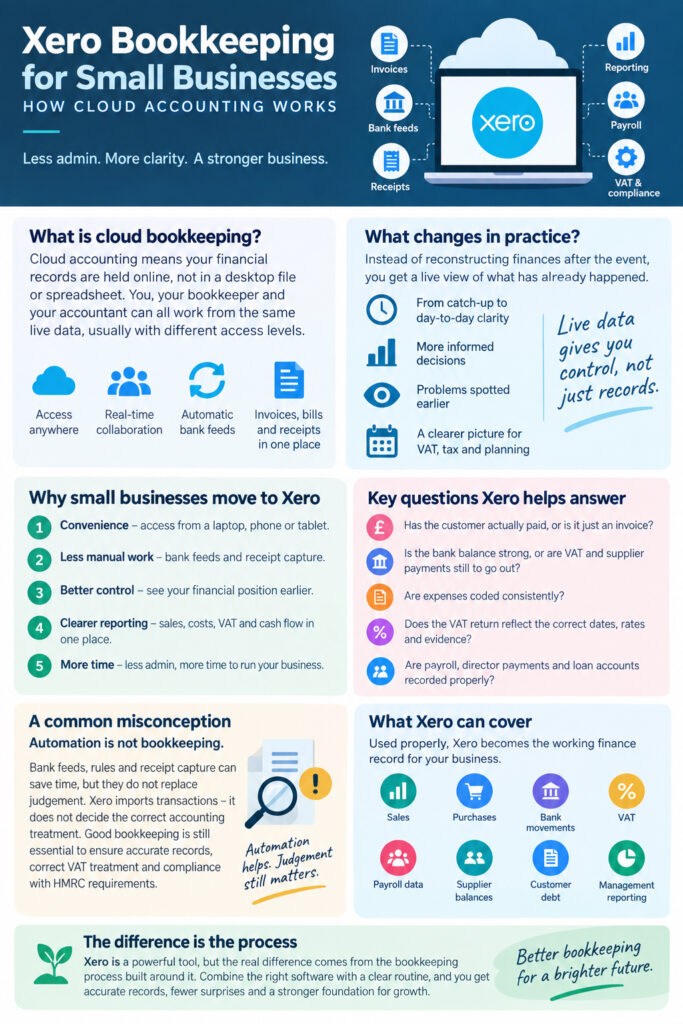
The difference is rarely the software itself. It is the bookkeeping process built around it.
What cloud bookkeeping actually changes
Cloud accounting means the bookkeeping records are held online rather than in a desktop file or isolated spreadsheet. The business owner, bookkeeper and accountant can work from the same live data, usually with different access levels. Bank transactions can feed into the system automatically. Sales invoices can be issued from the software. Purchase bills and receipts can be uploaded, coded and matched to payments.
That sounds simple, but the practical change is significant. Instead of reconstructing the financial position after the event, the business can maintain a live view of what has already happened. This changes the rhythm of bookkeeping from periodic catch-up to continuous record keeping.
For a small business, that shift affects several ordinary but important questions:
- Has the customer actually paid, or has the invoice only been raised?
- Is the bank balance strong because profit is strong, or because VAT and supplier payments have not yet gone out?
- Are expenses being coded consistently enough for meaningful reporting?
- Does the VAT return reflect the correct dates, rates and evidence?
- Are payroll journals, director payments and loan account movements being recorded properly?
Xero can help answer those questions earlier. It does not answer them automatically without good bookkeeping discipline. This is why cloud accounting for small businesses works best when the software is paired with a clear operating routine, not treated as a replacement for one.
Why small businesses move to Xero
The most obvious reason is convenience. A cloud system can be accessed from a laptop, phone or tablet. Receipts can be uploaded close to the point of purchase. Bank feeds reduce manual entry. Invoices can be issued without building a template in Word or Excel.
But the stronger reason is control. Small businesses often operate with narrow margins, irregular cash flow, changing supplier costs and limited administrative time. A bookkeeping delay of four or six weeks can hide problems that would have been manageable if spotted earlier. Good small business bookkeeping is therefore less about producing tidy records after the event and more about keeping the business’s financial position understandable while decisions are still being made.
For example, a construction subcontractor may appear profitable on completed jobs while CIS deductions, materials costs and delayed customer payments create pressure in the bank account. A small retailer may see revenue growth but lose margin through stock purchases, card processing fees and unclaimed input VAT. A consultant may keep accurate sales records but fail to separate personal drawings, reimbursed expenses and company costs cleanly enough for year-end accounts.
Xero does not remove those commercial realities. It makes them more visible if the system is configured and maintained properly.
The common misconception: automation is not bookkeeping
One of the most persistent misunderstandings about Xero bookkeeping is that bank feeds and rules can replace judgement. They cannot.
Bank feeds import transactions. They do not decide the correct accounting treatment. Bank rules can speed up recurring entries, but a poorly designed rule can repeat the same mistake hundreds of times. Receipt capture can reduce missing paperwork, but it does not confirm whether the expense is allowable, whether VAT is recoverable, or whether the document is sufficient evidence for HMRC purposes.
A fuel receipt, for instance, may require different treatment depending on the vehicle, business use, VAT evidence and whether the business applies any specific mileage or expense policy. A payment to a director may be salary, dividend, reimbursement, loan repayment or a director’s loan account movement. A subcontractor payment may carry CIS implications. Software can record the entry, but it cannot understand the full business context unless the bookkeeping process captures it.
This is where small businesses often get caught. They believe the books are current because the bank feed has been reconciled. In reality, the records may only be superficially matched.
How Xero bookkeeping works in practice
A well-run Xero bookkeeping process usually starts with the chart of accounts. This is the structure behind the records: sales categories, expense categories, assets, liabilities, tax accounts and capital accounts. If the chart is too vague, the reports become unhelpful. If it is too detailed, bookkeeping becomes slow and inconsistent. The right structure depends on the business model, VAT position, reporting needs and future accounts preparation.
The bank feed is then connected so transactions appear in Xero. Each transaction must be reconciled against an invoice, bill, receipt, transfer or accounting entry. This is where bookkeeping quality matters. A card payment to a supplier might be materials, software, travel, repairs, subcontractor cost or something else entirely. Regular payments can be automated to some extent, but exceptions need review.
Sales invoices can be raised directly in Xero, helping the business track unpaid invoices and payment history. Purchase bills can be entered from supplier documents and matched when paid. Receipt capture tools can support evidence retention, although businesses should still maintain clear records and avoid relying on bank descriptions alone.
For VAT-registered businesses, transactions must be coded with the correct VAT treatment. Standard-rated, zero-rated, exempt, outside the scope and reverse charge entries can have different effects. The VAT return produced by Xero is only as reliable as the coding behind it. Making Tax Digital has reinforced the need for digital records and digital submission, but it has not removed the need to understand VAT categories.
Payroll adds another layer. Wages, PAYE, National Insurance, pension deductions, employer costs and net pay movements need to be reflected correctly in the accounts. If payroll is processed separately and not posted into Xero accurately, profit figures and liabilities can be distorted. The same applies to CIS deductions in construction, where amounts withheld and suffered need careful treatment.
Where the setup or monthly process needs more structured review, Xero bookkeeping support can help clarify how transactions should be captured, reconciled and reported inside the software without turning the system into a parallel spreadsheet exercise.
Where small business bookkeeping goes wrong
Most bookkeeping failures are not dramatic. They build quietly through small inconsistencies.
A business owner may reconcile every bank transaction but leave supplier bills unentered, meaning liabilities are missing. Another may raise sales invoices but not allocate payments correctly, so customer balances become unreliable. A VAT code may be applied out of habit rather than based on the invoice. A director may pay personal costs from the business account, intending to sort them out later, only for the records to become unclear by year end.
These issues matter because bookkeeping sits upstream from several compliance and reporting obligations. Annual accounts, Corporation Tax returns, Self Assessment entries for sole traders or partners, VAT returns, payroll records and management accounts all depend on the quality of the underlying data.
Common Xero bookkeeping errors include:
- treating bank reconciliation as the same thing as full bookkeeping;
- using broad categories such as “general expenses” too often;
- claiming VAT without valid VAT evidence;
- posting loan repayments, drawings or dividends incorrectly;
- duplicating income by entering invoices and also coding bank receipts as sales;
- failing to reconcile payment processors such as Stripe, PayPal or card merchant accounts;
- leaving suspense account balances unresolved;
- not reviewing aged debtors and creditors for old or incorrect balances;
- ignoring payroll journals or posting net wages only;
- using bank rules without reviewing whether they remain appropriate.
The software will often continue to run despite these issues. The problem may only become obvious when accounts are prepared, a VAT return looks unusual, cash flow does not match reported profit, or HMRC asks for supporting records.
VAT and Making Tax Digital: useful automation, real responsibility
Xero is widely used for VAT reporting because it can maintain digital records and submit VAT returns under Making Tax Digital. For small businesses, this can be a major improvement over spreadsheet-based processes. It reduces rekeying, creates a clearer audit trail and allows VAT reports to be reviewed before submission.
However, MTD does not mean the VAT return is automatically correct. The business remains responsible for keeping accurate records and submitting accurate returns. Xero can calculate based on the transactions entered, but it cannot know if an invoice has been miscoded, if a supplier document is invalid, if a mixed-use expense has been treated too generously, or if a reverse charge has been missed.
This is particularly relevant for businesses dealing with construction services, property costs, imports, international services, partial exemption, deposits, refunds or unusual one-off transactions. Even small businesses can encounter complex VAT treatment without realising it.
A sensible process includes regular VAT control checks, review of unusual transactions, comparison of VAT reports against expectations, and clear retention of supporting documents. Leaving VAT review until the submission deadline increases the chance of rushed decisions and unexplained balances.
Cash flow visibility is not the same as profit
One of Xero’s strongest benefits is improved cash flow visibility. Business owners can see bank balances, unpaid invoices, upcoming supplier bills and recent spending patterns more easily than with traditional bookkeeping.
Still, cash and profit are often confused. A business can have cash in the bank because it has collected VAT, delayed paying suppliers, received a loan, taken customer deposits or not yet paid PAYE. It can also be profitable on paper while struggling to collect invoices or fund stock purchases.
Good Xero bookkeeping helps separate these issues. It shows what belongs to the business and what is owed to HMRC, suppliers, employees, lenders or directors. It also supports better management accounts, because income and costs can be reviewed in the right period rather than only when cash moves.
For growing businesses, this distinction becomes more important. Hiring staff, registering for VAT, taking on premises, using finance, working with subcontractors or expanding into multiple sales channels all increase the gap between simple bank monitoring and proper financial control.
| Item | Amount | Effect on available cash | What Xero should show |
|---|---|---|---|
| Current bank balance | £30,000 | Starting position | Reconciled bank account balance |
| VAT collected and potentially due | £4,800 | -£4,800 | VAT liability |
| Supplier bills awaiting payment | £6,200 | -£6,200 | Aged creditors / accounts payable |
| PAYE and National Insurance due | £2,100 | -£2,100 | Payroll tax liability |
| Upcoming pension payments | £600 | -£600 | Pension liability |
| Loan repayment due | £1,500 | -£1,500 | Loan liability / repayment |
| Customer deposit relating to future work | £3,000 | -£3,000 | Correctly classified customer payment |
| Illustrative cash remaining after these commitments | £11,800 | £18,200 below the bank balance | Requires the underlying bookkeeping to be current |
Illustrative example only. Actual liabilities, payment dates and available cash will depend on the individual business and its circumstances.
Industry differences matter more than software adverts suggest
Xero is flexible, but the bookkeeping requirements of a café, construction contractor, landlord, agency, consultant and online retailer are not the same.
A construction business may need CIS tracking, subcontractor records, reverse charge VAT awareness, retention treatment and project-level cost visibility. In these cases, construction bookkeeping has to deal with more than ordinary sales and purchase coding, because subcontractor deductions, project costs and VAT treatment can all affect the reliability of the records.
A property business may need to separate repairs from improvements, track rental income by property, manage loan interest and retain documentation for capital expenditure. A retail or e-commerce business may need to reconcile card takings, platform fees, refunds, stock purchases and marketplace settlements. A professional services company may care more about work in progress, recurring invoices, director remuneration and debtor control.
The practical lesson is straightforward: Xero should be configured for the way the business actually operates. A default set-up may be enough for very simple activity, but it can become restrictive or misleading as transactions become more varied.
Director responsibilities and record keeping
For limited companies, bookkeeping is not merely an administrative preference. Directors are responsible for ensuring adequate accounting records are kept. Those records support the preparation of statutory accounts, Corporation Tax returns and filings with Companies House and HMRC.
Cloud bookkeeping can make that responsibility easier to manage because records are more accessible and evidence can be attached to transactions. But directors still need to ensure the information is complete and accurate. If personal and business spending are mixed, if dividends are recorded without reference to distributable profits, or if loans to directors are not monitored, the bookkeeping can create tax and company law issues later.
Sole traders and self-employed individuals face different reporting obligations, but the same principle applies: records must be good enough to support tax returns and explain business income and expenses. Xero can provide structure, but it does not replace the need for disciplined record keeping.
The implementation phase is where quality is won or lost
Moving to Xero is not only a software subscription decision. The opening setup determines how reliable the records will be.
A proper implementation normally considers opening balances, bank accounts, VAT scheme, invoice templates, chart of accounts, user permissions, payroll integration, CIS requirements, payment services, reporting categories and document capture. If the business is migrating from spreadsheets or another system, historic balances need to be checked rather than imported blindly.
Opening balances are a common source of future problems. If debtors, creditors, VAT, bank balances, loans or director accounts are wrong at the start, the new system may appear untidy for months. Users then lose confidence in reports and start relying on separate spreadsheets, which defeats the purpose of moving to cloud accounting.
Training also matters. A business owner does not need to become an accountant, but they should understand enough to avoid damaging the records: how to upload receipts, what not to post manually, how to deal with transfers, when to ask before coding a transaction, and why bank reconciliation should not be rushed.
What a good monthly Xero routine looks like
The most reliable Xero bookkeeping tends to follow a steady monthly rhythm rather than a frantic quarterly or annual clean-up. The exact routine depends on the business, but the core disciplines are familiar.
- Bank feeds are reviewed and reconciled with supporting invoices, bills or receipts.
- Sales invoices are checked against payments, credit notes and overdue balances.
- Supplier bills are entered or reviewed so liabilities are not missed.
- Receipt capture and document storage are checked for gaps.
- VAT coding is reviewed, particularly for unusual or high-value transactions.
- Payroll, pension and PAYE entries are posted and reconciled where relevant.
- CIS deductions are reviewed for construction-related businesses.
- Suspense, director loan and inter-account transfer balances are cleared or explained.
- Profit and loss, balance sheet, aged debtors and aged creditors are reviewed for obvious inconsistencies.
This routine does not have to be bureaucratic. In a small, simple business it may be light. In a growing or VAT-registered business, it should be more structured. The point is not to produce perfect reports for their own sake; it is to prevent small bookkeeping issues becoming compliance problems or management blind spots.
Employers also need the bookkeeping to agree with payroll records. Gross wages, PAYE, National Insurance, pension deductions, employer contributions and net pay should not sit outside the accounts or be posted only as bank payments. Where staff costs are material, payroll bookkeeping becomes part of the monthly control process rather than an afterthought.
| Bookkeeping task | Suggested frequency | Approx. reviews per year | What to check | Risk if left too long |
|---|---|---|---|---|
| Bank feed reconciliation | Weekly | 52 | Payments, receipts, transfers and duplicates | Unreconciled or incorrectly coded transactions accumulate |
| Sales invoice review | Weekly | 52 | Paid, overdue and incorrectly allocated invoices | Aged debtors may become unreliable |
| Supplier bill review | Weekly or monthly | 12–52 | Missing bills, payment allocation and VAT evidence | Costs and liabilities may be understated |
| Receipt and document check | Weekly | 52 | Missing receipts and supporting documents | Expenses may lack adequate evidence |
| Payroll reconciliation | Monthly | 12 | Gross pay, PAYE, NI, pensions and net pay | Payroll liabilities and staff costs may be misstated |
| VAT coding review | Monthly / before each VAT return | 4–12 | VAT rates, evidence, reverse charge and unusual transactions | Incorrect VAT may flow into the return |
| Balance sheet review | Monthly | 12 | VAT, PAYE, loans, debtors, creditors and director balances | Errors can remain hidden despite a reasonable P&L |
| Year-end readiness review | Annually | 1 | Outstanding balances, evidence and reconciliation completeness | More year-end adjustments and clean-up may be required |
What owners should review before relying on the numbers
Xero reports can look polished even when the underlying data is weak. Before relying on profit, VAT or cash flow figures, business owners should look for warning signs.
Large suspense account balances usually mean transactions have been parked rather than properly analysed. Old unpaid invoices may indicate allocation errors or poor credit control. Negative liabilities, unexplained VAT movements, duplicated sales, unreconciled bank lines and persistent differences between payroll records and accounts all deserve attention.
Another useful test is whether the balance sheet makes sense. Small business owners often focus only on the profit and loss report, but the balance sheet reveals many bookkeeping weaknesses: incorrect loans, unpaid taxes, asset balances, debtor and creditor positions, and money owed to or from directors. If the balance sheet is ignored, errors can sit quietly for a long time.
Choosing the right level of bookkeeping support
Not every small business needs the same level of external support. Some owners can manage day-to-day entries themselves with periodic review. Others benefit from outsourced bookkeeping so they can focus on operations while the routine records, reconciliations and review points are handled more consistently. Businesses with payroll, VAT, CIS, property income, stock, finance agreements or multiple payment platforms usually need more structure than a very simple sole trader.
The decision should be based less on business size and more on complexity, risk and the value of timely information. A low-turnover business with several compliance complications may need closer bookkeeping attention than a higher-turnover business with simple transactions and strong internal processes.
Cost is part of the decision, but poor bookkeeping has its own cost: delayed accounts, higher year-end correction work, uncertain VAT returns, unreliable management information and avoidable stress around deadlines. The cheapest process is not always the lowest-cost process over a full financial year.
| Business profile | Illustrative transactions per month | Bank / payment accounts | Typical review frequency | Key bookkeeping requirements | Complexity |
|---|---|---|---|---|---|
| Simple sole trader | 10–30 | 1 | Monthly | Bank reconciliation, expenses, invoices and document capture | Low |
| Active sole trader | 30–100 | 1–2 | Monthly | Reconciliation, expenses, debtor review and tax records | Low–Medium |
| Small limited company | 50–150 | 2–3 | Monthly | Bank reconciliation, payroll entries, director transactions and balance sheet review | Medium |
| VAT-registered company | 75–250 | 2–4 | Monthly + VAT review | VAT coding, MTD records, reconciliations, invoices and supporting evidence | Medium–High |
| Construction business with CIS | 100–300 | 2–4 | Weekly / monthly | CIS, subcontractors, VAT, project costs, payroll and supplier reconciliation | High |
| E-commerce business | 200–1,000+ | 3–6+ | Weekly / monthly | Payment gateways, marketplace settlements, refunds, fees, VAT and stock-related records | High |
| Growing multi-channel company | 500–2,000+ | 4–10+ | Weekly + month-end review | Multiple reconciliations, payroll, VAT, accruals, debtors, creditors and management reporting | Very High |
The transaction volumes above are illustrative examples rather than fixed thresholds. Bookkeeping complexity depends on the nature of transactions, VAT, payroll, CIS, stock, finance arrangements, payment platforms and reporting requirements.
Where Xero fits within wider accounting and tax work
Xero bookkeeping is the foundation, not the finished building. The data it holds supports VAT returns, payroll reporting, management accounts, year-end accounts, Corporation Tax, Self Assessment and sometimes lending applications or investor discussions. If the bookkeeping is weak, every later stage requires more adjustment and interpretation.
For accountants, good Xero records make it easier to identify meaningful issues rather than spend time reconstructing basic transactions. For business owners, they reduce the gap between operational activity and financial understanding. For HMRC compliance, they help preserve the audit trail behind submitted figures.
This is why cloud bookkeeping should not be treated as an isolated admin task. It sits in the middle of the business’s financial ecosystem.
Practical takeaways for small businesses using Xero
Xero can be highly effective for small business bookkeeping, but its value depends on the quality of setup, coding, review and supporting documentation. The software is strongest where the business has a clear process and weakest where automation is left to run without oversight.
The most useful principles are simple but often neglected:
- Set up the system around the business model, not just the default chart of accounts.
- Keep records current enough to be useful, not merely compliant at year end.
- Review VAT treatment rather than assuming bank rules have handled it correctly.
- Keep evidence attached or easily accessible for expenses and purchases.
- Reconcile payroll, PAYE, pensions and CIS properly where they apply.
- Use the balance sheet as a bookkeeping quality check, not just the profit and loss report.
- Ask for advice before posting unusual transactions, not months afterwards.
A final professional view
Xero has changed small business bookkeeping because it brings financial records closer to daily operations. That is its real strength. It allows owners and advisers to work from a shared, current record rather than a reconstructed history.
But cloud accounting is not a substitute for judgement. A live system can still be wrong. A reconciled bank feed can still hide poor coding. A VAT return can still reflect incorrect assumptions. The businesses that gain most from Xero are usually those that treat it as part of a disciplined finance process rather than a piece of software that quietly solves bookkeeping on its own.
For small businesses, the aim should be practical reliability: records that are current, understandable, supported by evidence and good enough to inform decisions before problems become expensive to untangle.