

CIS Monthly Returns: Deadlines, Filing and Penalties Explained
For contractors in construction, the Construction Industry Scheme is not just a deduction mechanism. It is a monthly reporting discipline. The return tells HMRC who has been paid, what has been deducted, and whether the contractor has applied the CIS rules correctly for that period.
The difficulty is that CIS monthly returns often sit between several parts of the business: site managers approve labour, accounts teams process invoices, payroll may hold worker details, and directors remain responsible for compliance. A return can be late or wrong even where the tax calculation itself looks simple. The usual cause is not ignorance of CIS, but weak information flow.
This guide explains how CIS monthly returns work, the filing deadline, what must be reported, what commonly goes wrong, and how penalties can arise. It is written for UK contractors, construction businesses, finance teams and directors who want a practical understanding of the monthly CIS cycle rather than a surface-level reminder of the rules.
Leave your details and our team will get back to you shortly.
What a CIS monthly return actually confirms
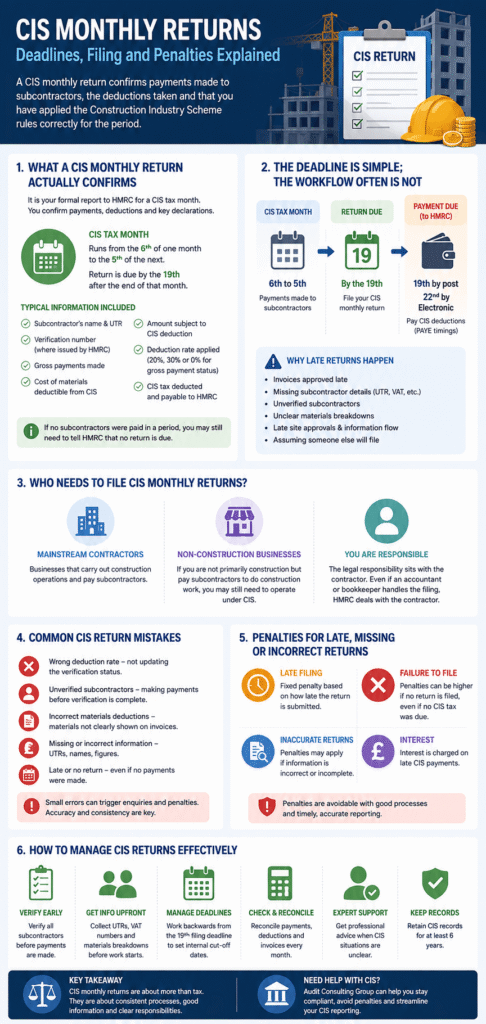
A CIS monthly return is the contractor’s formal report to HMRC for a CIS tax month. It covers payments made to subcontractors within that period and confirms the deductions made under the Construction Industry Scheme. For businesses still building their understanding of the wider rules, broader Construction Industry Scheme guidance can be useful alongside the monthly filing process.
The CIS tax month does not follow the calendar month. It runs from the 6th of one month to the 5th of the next. The return must normally be filed by the 19th after the end of that CIS month. For example, payments made between 6 May and 5 June are reported by 19 June.
The return is not only a list of payments. It also includes declarations that matter. The contractor is confirming that employment status has been considered, that subcontractors have been verified where required, and that the information submitted is complete for the period. Those declarations are often overlooked because the process becomes routine. HMRC does not treat them as routine.
A typical CIS monthly return may include:
- the subcontractor’s name and Unique Taxpayer Reference;
- the verification number, where HMRC has issued one;
- gross payments made in the CIS period;
- the cost of materials where deductible from the CIS calculation;
- the amount subject to CIS deduction;
- the deduction rate applied, usually 20%, 30% or 0% for gross payment status;
- the CIS tax deducted and payable to HMRC.
If no subcontractors were paid in a period, the contractor may still need to tell HMRC that no return is due, depending on how HMRC has the contractor’s CIS record set up. This is a frequent source of avoidable penalties, particularly for businesses with irregular subcontractor use.
The deadline is simple; the workflow often is not
The headline rule is clear: CIS monthly returns are due by the 19th of each month following the CIS tax month. The payment of CIS deductions to HMRC usually follows PAYE payment timings, which may mean the 22nd if paid electronically, or the 19th if paid by post. The filing deadline and the payment deadline are related, but they are not the same obligation.
In practice, late returns rarely happen because someone does not know the date. They happen because the information needed to file confidently is not ready by the date. Missing subcontractor details, disputed invoices, unverified workers, unclear materials breakdowns and late site approvals can all slow the process.
Construction businesses are especially exposed because operational activity often moves faster than administration. A subcontractor may start on site before finance has a full record. A payment may be released before verification has been checked. A director may assume the bookkeeper has filed the return, while the bookkeeper is waiting for clarification from the project manager. None of these issues is unusual. All of them can create CIS risk.
Who needs to file CIS monthly returns?
CIS monthly returns are filed by contractors. Under CIS, a contractor is not only a large construction company. A business may be a mainstream contractor because it carries out construction operations and pays subcontractors. Some non-construction businesses can also become deemed contractors if they spend heavily on construction operations over the relevant period. Where a business is unsure whether its obligations have started, the practical starting point is often CIS registration and contractor setup.
Subcontractors do not file CIS monthly returns for payments they receive. Their concern is different: ensuring deductions are recorded correctly and later reflected in their tax position. For self-employed subcontractors, CIS deductions usually feed into the Self Assessment position. For limited company subcontractors, CIS deductions may interact with Corporation Tax, PAYE liabilities or repayment claims depending on circumstances.
This difference matters because confusion between contractor and subcontractor responsibilities leads to poor record keeping. A subcontractor may assume the contractor’s submission is accurate. A contractor may assume the subcontractor’s invoice has all the information required. HMRC expects the contractor to operate the scheme correctly before payment is made.
The verification step that causes more problems than expected
Before paying a subcontractor under CIS, the contractor should usually verify the subcontractor with HMRC unless they have previously included that subcontractor on a CIS return within the required timeframe. Verification confirms the deduction rate that should be applied.
The outcome may be:
- 20% deduction for a registered subcontractor;
- 30% deduction where HMRC cannot match the subcontractor or they are not registered for CIS;
- 0% deduction where the subcontractor holds gross payment status.
The practical issue is that verification is sometimes treated as a one-off administrative task rather than a control point before payment. If a subcontractor’s details are incomplete, inconsistent or incorrectly recorded, HMRC may return the 30% rate. That can cause friction with the subcontractor and may delay payment. If a contractor applies a lower deduction rate without proper verification, the contractor may be exposed if HMRC later challenges the treatment.
Gross payment status deserves particular care. A subcontractor may tell the contractor they are paid gross, but the contractor should rely on HMRC verification rather than assumption. For subcontractors, gross payment status can be commercially valuable because it improves cash flow. For contractors, it must be evidenced properly within the CIS process.
What should be included in the return?
The monthly return should reflect payments made in the CIS month, not simply invoices received. This distinction can create errors where accounts teams work from invoice dates rather than payment dates. CIS is concerned with payments to subcontractors for construction operations.
The return should separate labour from certain materials costs because CIS deductions are usually calculated on the labour element after allowable materials have been excluded. The materials figure should be supportable. HMRC may question excessive or poorly evidenced materials allocations, especially where they significantly reduce deductions.
Contractors also need to consider whether the work falls within CIS in the first place. Construction operations are broadly defined, but not every payment connected to a construction business is automatically within CIS. Professional services, certain manufacturing activities, and some non-construction supplies may sit outside the scheme. The judgement can be more complicated where a subcontractor provides mixed services.
That is why a clean CIS return depends on bookkeeping detail, not just tax knowledge. The person filing needs to know what was paid, who was paid, what the payment related to, how the invoice was split, whether VAT was involved, and whether the subcontractor was correctly verified.
VAT and CIS: where the numbers get confused
VAT is one of the most common sources of CIS mistakes. CIS deductions are not calculated on VAT. If a VAT-registered subcontractor charges VAT, the CIS deduction applies to the labour amount excluding VAT, after allowable materials are taken into account.
The domestic reverse charge for building and construction services adds another layer. In some supply chains, the subcontractor does not charge VAT in the usual way because the customer accounts for VAT under the reverse charge rules. This can affect how invoices look and how accounting software records the transaction.
The danger is not only an incorrect CIS deduction. A poorly coded invoice may distort VAT returns, CIS returns, job costing and management accounts at the same time. A contractor may think the CIS return has been filed correctly because the deduction rate is right, while the VAT treatment or materials split is wrong in the underlying records.
For construction businesses, CIS and VAT compliance should not be treated as isolated monthly tasks. They often rely on the same invoice data, the same subcontractor records, and the same approval workflow.
Employment status is not solved by filing a CIS return
A recurring misunderstanding is that putting a worker through CIS proves they are self-employed. It does not. CIS deals with tax deductions from payments to subcontractors. It does not determine employment status for employment law, PAYE, National Insurance or wider tax purposes.
Contractors are expected to consider whether the relationship is genuinely one of self-employment. Factors such as control, substitution, financial risk, equipment, integration into the business and mutuality of obligation may all be relevant. The position is fact-specific.
This matters because HMRC can challenge arrangements where individuals are treated as subcontractors under CIS but the working relationship looks more like employment. Filing CIS returns consistently does not remove that risk. In some cases, it may provide HMRC with a clear pattern of payments to review.
The practical lesson is straightforward: CIS administration should sit alongside status review, onboarding controls and contract discipline. A subcontractor should not be pushed through CIS merely because it is administratively convenient.
Penalties for late CIS monthly returns
HMRC can charge penalties where CIS monthly returns are filed late. The penalty structure can escalate the longer the return remains outstanding. A late return may attract an initial fixed penalty, with further penalties if the delay continues.
Common penalty stages include:
- an initial penalty where the return is late;
- a further penalty if the return remains outstanding after two months;
- additional penalties for longer delays;
- tax-geared penalties in more serious or prolonged cases.
The precise penalty position depends on the circumstances and HMRC’s rules at the time. Contractors should not assume a small or nil return is low risk. A nil return can still create a penalty problem if HMRC expected a submission or notification.
There may be grounds to appeal a CIS penalty where there is a reasonable excuse, but HMRC generally expects the contractor to act promptly once the issue is discovered. Administrative oversight, pressure of work or reliance on another person will not automatically be accepted. The stronger appeals tend to be supported by evidence and a clear timeline of events. Readers dealing with notices may need to understand the process around CIS penalties and appeals in more detail.
Incorrect returns can be more damaging than late ones
Late filing is visible and usually dealt with quickly. Incorrect filing can sit unnoticed for longer and become more expensive to unravel.
Examples include applying the wrong deduction rate, omitting subcontractors, claiming unsupported materials deductions, filing payments in the wrong period, or treating non-CIS work as CIS. Some errors are relatively easy to correct. Others affect subcontractor statements, HMRC payment allocations, VAT records and year-end accounts.
An incorrect return may also damage commercial relationships. Subcontractors rely on CIS deduction statements for their own tax records. If statements do not match payments received, they may have problems claiming credit for deductions. For limited company subcontractors, mismatches can delay CIS repayment claims or create additional HMRC queries.
For the contractor, repeated inaccuracies may suggest weak controls. HMRC may pay closer attention where CIS submissions are inconsistent, frequently amended or poorly supported by records.
Monthly CIS statements for subcontractors
Contractors must provide subcontractors with a payment and deduction statement where CIS tax has been deducted. This statement should normally be provided within 14 days of the end of the tax month.
The statement is not a courtesy document. It is part of the subcontractor’s tax evidence. It should show the contractor’s details, subcontractor details, payment amounts, materials where relevant, and the CIS deduction made.
Problems arise where contractors file the HMRC return but do not issue clear statements, or issue statements that do not match the return. Subcontractors may then struggle to reconcile income, deductions and bank receipts. In a sector where subcontractors often work for multiple contractors, poor statements create avoidable friction and can undermine trust.
Record keeping: the part HMRC sees after the return
The CIS return is the monthly output. The records behind it are what support the position if HMRC asks questions.
Contractors should keep records of subcontractor verification, invoices, payment dates, materials breakdowns, deduction calculations, CIS statements and communications relevant to disputed or corrected amounts. These records need to be organised enough to explain how the return was prepared.
A common weakness is that CIS data exists, but not in one place. Verification details may sit in HMRC online services, invoices in accounting software, site approvals in email, and deduction statements in a separate spreadsheet. This can work while volumes are low. It becomes fragile as subcontractor numbers grow or staff change.
Good CIS record keeping is not only about satisfying HMRC. It also helps the business understand labour costs, subcontractor dependency, project margins and cash flow. A return prepared from clean records is usually faster, more accurate and less stressful.
What contractors often get wrong
The same CIS issues appear repeatedly across construction businesses of different sizes. They are rarely dramatic at first. They become serious because they repeat every month.
- Using invoice dates instead of payment dates. This can put payments into the wrong CIS period.
- Verifying subcontractors too late. Payment pressure then forces rushed decisions.
- Assuming CIS registration from a subcontractor’s word. HMRC verification should drive the deduction rate.
- Deducting CIS from VAT-inclusive amounts. CIS should not be calculated on VAT.
- Accepting vague materials figures. Materials deductions should be reasonable and evidenced.
- Ignoring nil periods. No subcontractor payments does not always mean no action is needed.
- Treating CIS as a substitute for employment status review. The two issues are connected, but not the same.
- Leaving CIS to one person without review. If that person is absent or leaves, the control gap appears quickly.
None of these mistakes requires bad intent. Most come from pressure, fragmented information, or a process designed when the business was smaller.
A practical monthly CIS workflow
A reliable CIS process usually starts before the subcontractor is paid, not at the point of filing the return.
First, the business should collect subcontractor details before work begins. This includes the legal name, trading name if different, UTR, National Insurance number or company registration number where relevant, VAT status and bank details. The details should be checked for consistency. Small spelling differences and wrong UTRs can cause verification problems.
Second, the subcontractor should be verified through HMRC where required. The result should be recorded, including the deduction rate and any verification number. Finance teams should avoid relying on informal confirmation from the site or from the subcontractor.
Third, invoices should be reviewed before payment. The review should consider whether the work falls within CIS, whether VAT has been treated correctly, whether materials are separately identified, and whether the deduction calculation is clear. This is where construction finance teams often need input from operational staff because the invoice description may not tell the full story.
Fourth, payments should be posted accurately in the accounting records. The CIS return should be prepared from payment data for the correct CIS tax month. If accounting software is used, the CIS settings should be checked periodically rather than assumed to be correct forever.
Fifth, the monthly return should be reviewed before submission. A review does not need to be bureaucratic. It may simply involve checking that all subcontractor payments for the period are included, deduction rates look sensible, gross and net figures reconcile to payments, and unusual items are explained.
Finally, subcontractor deduction statements should be issued and CIS liabilities paid to HMRC on time. If an error is found later, it should be corrected rather than left to accumulate.
How CIS affects cash flow and management information
CIS is often discussed as compliance, but it also affects cash flow. Contractors deduct tax from subcontractors and pay it to HMRC. Subcontractors receive reduced cash payments unless they have gross payment status. Timing matters for both sides.
For contractors, CIS liabilities can become mixed with PAYE and National Insurance payments. If the business does not monitor those liabilities separately, cash flow forecasts may understate upcoming HMRC payments. This is particularly relevant where subcontractor spend fluctuates sharply from month to month.
For subcontractors, CIS deductions can create a cash flow drag, especially where margins are tight or materials are funded upfront. Self-employed subcontractors may recover excess deductions through Self Assessment, but that does not help immediate working capital. Limited company subcontractors may offset CIS deductions against certain HMRC liabilities or seek repayment, but mismatched records can slow the process.
For directors, CIS information can also reveal operational trends: which projects rely heavily on subcontract labour, where materials allocations are increasing, and whether gross margin assumptions reflect the real labour model. A monthly compliance return can therefore become a useful management signal if the underlying records are reliable.
Limited companies, directors and responsibility
Where the contractor is a limited company, the company is responsible for filing CIS monthly returns correctly. Directors should not assume that outsourcing bookkeeping or payroll removes their oversight responsibility. It may reduce the administrative burden, but the company still needs adequate controls and records.
CIS also links with wider company compliance. The same accounting records may feed into VAT returns, payroll reporting, annual accounts, Corporation Tax computations and management accounts. If CIS data is incomplete or inconsistent, the problem can travel beyond the monthly return.
Companies House does not administer CIS, but directors should understand that poor financial records can affect statutory accounts and broader governance. A business with weak subcontractor records may also struggle to evidence project profitability, creditor balances, HMRC liabilities and year-end accruals.
Correcting CIS return errors
If a CIS return has been filed incorrectly, the right response depends on the nature of the error. Some corrections can be made by amending the return through HMRC’s online service or software. Others may require contact with HMRC, especially if the error affects payment allocations or older periods.
The first step is to identify exactly what went wrong. Was the subcontractor omitted? Was the deduction rate incorrect? Was the payment reported in the wrong month? Were materials overstated? Was VAT included in the CIS calculation? Each error has a different consequence.
Businesses should also consider the subcontractor’s position. If the CIS deduction statement was wrong, the subcontractor may need a corrected statement. If too much CIS was deducted, there may be a commercial issue as well as an HMRC reporting issue. If too little was deducted, the contractor may need to address the shortfall.
Leaving errors until year end is rarely sensible. CIS operates monthly, and late corrections can create confusion across several periods. A short, documented correction process is usually better than a long silence followed by a rushed clean-up.
Reasonable excuse and CIS penalty appeals
HMRC may consider cancelling a CIS penalty if the contractor had a reasonable excuse for missing the deadline and took reasonable care to file as soon as possible after the excuse ended. What counts as reasonable depends on the facts.
Serious illness, unexpected system failures, bereavement or events outside the contractor’s control may be relevant if supported by evidence. Routine workload pressure, misunderstanding the rules, lack of funds or assuming someone else had dealt with the return are less likely to succeed on their own.
A credible appeal should normally explain the timeline, the reason the return was late, what evidence supports that explanation, when the issue was resolved, and what has changed to prevent recurrence. HMRC is more likely to engage with a specific, evidenced appeal than a general complaint that the penalty feels unfair.
Contractors should be careful not to ignore penalty notices. Even where an appeal may be possible, deadlines apply. A penalty that could have been challenged can become harder to deal with if correspondence is missed.
How to reduce CIS filing risk without overcomplicating the process
A good CIS process does not need to be elaborate. It needs to be consistent.
For smaller contractors, a simple monthly checklist may be enough: new subcontractors verified, invoices reviewed, payments reconciled, return filed, statements issued, HMRC payment scheduled. For larger contractors, the process may need clearer segregation between site approval, finance review and final submission.
The key is to build controls around the points where mistakes actually happen. Verification should happen before payment. Materials should be evidenced before deductions are calculated. VAT treatment should be reviewed before invoices are posted. Nil periods should be monitored before HMRC issues a penalty. Subcontractor statements should be issued before queries arrive weeks later.
Software can help, but it is not a substitute for judgement. CIS errors still occur in accounting systems where settings are wrong, subcontractor records are incomplete, or users override rates without understanding the consequence. Automation works best when the underlying process is already clear.
Questions contractors should ask each month
Before filing a CIS monthly return, the following questions can expose most weaknesses:
- Have all subcontractor payments between the 6th and 5th been captured?
- Were all relevant subcontractors verified with HMRC before payment?
- Do deduction rates match HMRC verification results?
- Have VAT and domestic reverse charge issues been treated correctly?
- Are materials deductions supported by invoice detail or other evidence?
- Have any nil periods been notified where required?
- Do CIS deductions reconcile to the amount due to HMRC?
- Have subcontractor deduction statements been prepared and issued?
- Are any unusual payments documented before the return is submitted?
These questions are not designed to slow filing down. They are designed to stop the same avoidable issues from appearing every month.
Key takeaways for contractors and finance teams
CIS monthly returns are due by the 19th after the end of the CIS tax month. That rule is simple, but the quality of the return depends on what happens throughout the month.
The main risks are not limited to late filing. Incorrect deduction rates, weak verification records, poor materials evidence, VAT confusion, missing subcontractor statements and employment status assumptions can all create problems. Some affect HMRC compliance. Others affect cash flow, subcontractor relationships and management information.
Contractors should treat CIS as a monthly control process rather than a last-minute filing task. The return is only the final step. The real compliance work happens when subcontractors are onboarded, invoices are checked, payments are made and records are maintained.
Final expert perspective
CIS monthly filing rewards businesses that keep ordinary records well. It punishes those that rely on memory, informal site communication or year-end clean-ups. The difference is often not technical sophistication; it is timing, ownership and discipline.
For construction businesses, the strongest CIS processes are usually practical rather than complicated. They connect site activity with finance records, verify subcontractors before payment, keep VAT and CIS treatments aligned, and review the return before submission. That approach reduces penalty exposure, improves subcontractor confidence and gives directors a clearer view of what is happening inside the business.
CIS compliance is monthly by design. Treating it as a monthly management habit, not just an HMRC obligation, is where the real value lies.