

CIS Payment and Deduction Statements: Employer and Subcontractor Guide
A CIS payment and deduction statement looks like a simple monthly document. In practice, it often becomes the point where construction payments, tax deductions, bookkeeping records, VAT treatment, subcontractor cash flow and HMRC compliance either line up properly or start drifting apart.
For contractors, the statement is evidence that CIS tax has been deducted and reported correctly. For subcontractors, it is the document that supports their Self Assessment tax return, limited company tax position, CIS refund claim or internal bookkeeping records. If it is missing, inaccurate or issued late, the problem rarely stays confined to one payment run.
Leave your details and our team will get back to you shortly.
The Construction Industry Scheme is already administratively demanding because it sits between tax, payroll-style processes and commercial project work. Payment and deduction statements are one of the few documents both sides rely on. That is why small errors in dates, labour values, materials, verification rates or subcontractor details can create disproportionately large consequences later. Readers needing wider scheme context may find CIS services guidance useful alongside this article.
What a CIS Payment and Deduction Statement Actually Does
Under CIS, a contractor must deduct tax from payments made to subcontractors for construction operations unless the subcontractor has gross payment status. The amount deducted depends on the subcontractor’s HMRC verification result. The contractor then reports those deductions to HMRC through the monthly CIS return and pays the deducted tax across to HMRC.
The payment and deduction statement is the subcontractor’s written record of that transaction. It confirms what was paid, what was deducted, and how the deduction was calculated. It is not merely a receipt. It is the document a subcontractor may need months later when reconciling CIS suffered, preparing accounts, checking HMRC records or explaining why a tax refund is due.
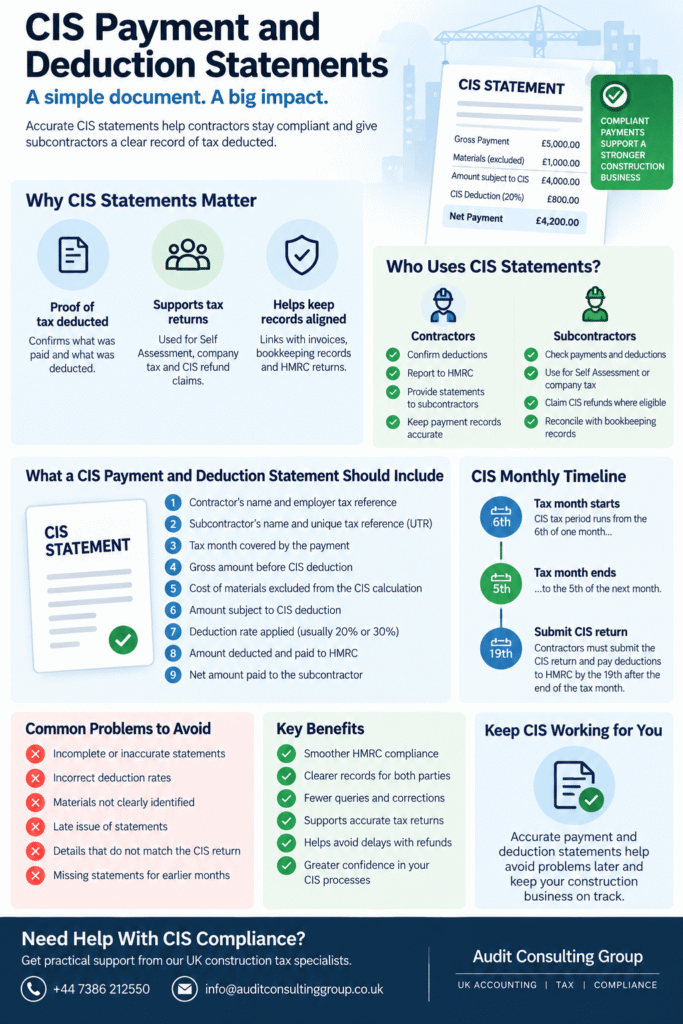
A proper CIS deduction statement should normally show:
- the contractor’s name and employer tax reference;
- the subcontractor’s name and unique tax reference where relevant;
- the tax month covered by the payment;
- the gross amount before CIS deduction;
- the cost of materials excluded from the CIS calculation;
- the amount subject to CIS deduction;
- the deduction rate applied, usually 20% or 30% unless gross payment status applies;
- the amount deducted and paid to HMRC;
- the net amount paid to the subcontractor.
The exact format is less important than the accuracy and completeness of the information. HMRC does not require every contractor to use the same template, but the statement must be clear enough for the subcontractor to understand the payment and for the figures to be traced back to the CIS return.
The Monthly Deadline That Contractors Often Underestimate
CIS works on monthly tax periods running from the 6th of one month to the 5th of the next. Contractors must submit the CIS monthly return to HMRC by the 19th after the end of the tax month. They must also provide deduction statements to subcontractors by the relevant deadline so the subcontractor has a record of tax deducted.
This timetable sounds manageable until it is placed into the rhythm of a construction business. Site managers approve labour. QS teams agree valuations. Accounts staff receive invoices late. Materials may be included on the same invoice as labour. A subcontractor may have been verified under an old trading name. A payment may be made before the paperwork has been checked properly.
The result is a familiar pattern: the CIS return is treated as a month-end admin task rather than a payment control process. By the time the statement is produced, the figures may already have been posted into bookkeeping software, paid through the bank and reported to HMRC. Correcting errors then becomes more awkward than preventing them.
Why Subcontractors Should Not Treat CIS Statements as Optional Paperwork
Subcontractors often notice CIS deduction statements only when something goes wrong: a refund is lower than expected, HMRC’s record does not match their bookkeeping, or an accountant asks for missing months near the Self Assessment deadline. That delay can make reconstruction difficult.
For a sole trader subcontractor, CIS deductions are usually set against the final Income Tax and National Insurance liability through Self Assessment. For a limited company subcontractor, CIS suffered may be offset against PAYE, National Insurance or other liabilities, depending on the company’s position and reporting route. In either case, the statement is the practical evidence behind the claim. The position is often different by structure, so a dedicated CIS for subcontractors resource can help readers separate sole trader, partnership and company considerations.
Bank receipts alone do not prove the CIS deduction. An invoice alone does not prove the contractor reported the deduction. A screenshot from accounting software may help internally, but it is not the same as a contractor-issued CIS payment and deduction statement. If the contractor has deducted 20% from labour and failed to provide a statement, the subcontractor may still be out of pocket while trying to prove what happened.
Where CIS Statements Go Wrong in Real Construction Work
The most common CIS problems are not dramatic. They are ordinary administrative failures that accumulate over time.
Materials are not separated properly
CIS deductions apply to the labour element, not to qualifying materials. Where invoices combine labour and materials without a sensible breakdown, contractors may deduct too much or too little. Some deduct from the full invoice to stay cautious. Others accept unsupported material claims and under-deduct. Both approaches can cause trouble.
Subcontractors should show labour and materials clearly on invoices. Contractors should check whether the materials figure is reasonable and properly evidenced. The payment statement should then show how the CIS calculation was made. A vague line saying “CIS deducted” gives little comfort if the figures are challenged later.
The wrong deduction rate is used
A verified subcontractor is commonly paid under deduction at 20%. An unverified subcontractor may be subject to 30%. A subcontractor with gross payment status may be paid without CIS deduction. These outcomes depend on HMRC verification, not informal assumptions or what happened on a previous project. Where setup is uncertain, CIS registration and verification status need to be dealt with before payment habits become embedded.
Problems arise when contractors reuse old subcontractor records, fail to verify a new trading entity, or assume that a director’s previous status applies to a new limited company. Gross payment status is also not permanent if compliance conditions are not maintained. A payment statement showing the wrong rate may indicate a deeper verification failure.
Payment timing does not match invoice timing
CIS is driven by payments, not simply by invoice dates. If an invoice is raised in one tax month but paid in another, the deduction belongs in the period of payment. This distinction matters for monthly CIS returns and for subcontractor records.
Where accounts teams post invoices by invoice date and CIS returns by payment date, reconciliation can become messy unless the bookkeeping system is set up carefully. This is one reason CIS should not be treated as an isolated compliance task. It has to connect with purchase ledger processing, bank payments and management reporting.
Subcontractor identities are inconsistent
A subcontractor may trade as a sole trader, through a limited company, through a partnership, or under a trading name. Contractors need to verify the correct legal entity. If invoices arrive under one name and payment records sit under another, the CIS statement may become difficult to match to HMRC records.
This issue is particularly common when a subcontractor incorporates partway through the year, changes bank details, or uses a trading name on invoices while HMRC records show the personal or company name. The statement should make clear which entity has been paid and which tax reference was used.
The Contractor’s Position: More Than Producing a Statement
For contractors, issuing CIS payment and deduction statements is part of a broader compliance process. The contractor must decide whether the work falls within CIS, verify the subcontractor where required, calculate the deduction correctly, submit the CIS return, pay deductions to HMRC and keep records.
That creates several operational dependencies. Someone must understand the contract. Someone must distinguish labour from materials. Someone must identify whether the subcontractor is genuinely a subcontractor for CIS purposes. Someone must check that the monthly return agrees to payments made. If these responsibilities are split across site teams, accounts staff and external bookkeepers, gaps can appear quickly.
A sound CIS workflow usually includes:
- verification before the first relevant payment is made;
- clear purchase ledger coding for CIS labour, materials and VAT;
- review of invoices before payment approval;
- monthly reconciliation between CIS returns, bank payments and supplier ledgers;
- timely issue of deduction statements to subcontractors;
- retention of CIS records in case HMRC asks for evidence.
The statement is therefore the visible output of a process. If the process behind it is weak, the statement may look acceptable on paper while the underlying return is wrong. Contractor teams responsible for filing CIS returns need the statement figures and HMRC submission figures to come from the same reconciled payment data.
The Subcontractor’s Position: Protecting Cash Flow and Tax Evidence
For subcontractors, CIS deductions can have a direct cash-flow impact. A 20% deduction from labour may be manageable if records are accurate and tax liabilities are predictable. It becomes more difficult when deductions are inconsistent, statements are missing, or refunds are delayed because figures cannot be supported.
Subcontractors should not wait until the tax year ends to review CIS suffered. A monthly check is usually more effective. The bank receipt, invoice, contractor statement and bookkeeping entry should tell the same story. If they do not, it is easier to query the issue while the contractor’s payment run is still recent.
Useful checks include:
- does the net payment received agree with the statement?
- has CIS been deducted only from labour, not from VAT or qualifying materials?
- does the contractor’s name match the payer in the bank?
- is the deduction rate expected based on verification or gross payment status?
- are all statements saved for the tax year in one place?
This discipline matters for sole traders, partnerships and limited companies in different ways, but the principle is the same: CIS deductions are only useful as tax credits if they can be evidenced and reconciled.
VAT and CIS: The Area Where Errors Often Hide
CIS and VAT interact in ways that can confuse both contractors and subcontractors. CIS deductions should not be calculated on VAT. VAT is dealt with separately according to VAT rules, including the domestic reverse charge where applicable. The CIS calculation focuses on the payment for construction operations after excluding VAT and allowable materials. A separate view of CIS and VAT compliance can be useful where invoice treatment, reverse charge VAT and bookkeeping settings interact.
Confusion commonly appears where invoices show labour, materials and VAT on a single total, or where accounting software applies CIS deductions automatically without the correct settings. If VAT is included in the CIS deduction base, the subcontractor may suffer excessive deduction. If the domestic reverse charge is applied incorrectly, VAT returns may also be wrong.
The payment and deduction statement should make the CIS position understandable, but it does not replace proper VAT treatment on the invoice. A contractor may have a correct CIS deduction and an incorrect VAT treatment, or the other way around. Businesses working across construction projects need both processes to be aligned.
Gross Payment Status Changes the Statement, Not the Responsibility
Subcontractors with gross payment status are paid without CIS deductions, but this does not mean CIS can be ignored. Contractors still need to verify the subcontractor and report payments where required. Subcontractors with gross payment status still need to maintain compliance standards to keep that status.
From a cash-flow perspective, gross payment status can be valuable because the subcontractor retains the full labour payment rather than waiting to offset deductions later. From a compliance perspective, it also increases the importance of timely tax payments, accurate returns and strong bookkeeping. Losing gross payment status can disrupt margins, pricing and working capital, which is why gross payment status should be treated as an ongoing compliance position rather than a one-off approval.
For contractors, the risk is assuming that “gross” means “outside the system”. It does not. The payment still needs to be handled correctly, and records should support why no deduction was made.
What HMRC Is Likely to Care About
HMRC’s interest is usually practical: were subcontractors verified, were deductions calculated correctly, were monthly returns accurate, were deductions paid over, and can the business support the figures? Payment and deduction statements form part of that evidence chain.
HMRC may compare contractor returns with subcontractor claims. If a subcontractor claims CIS suffered that does not appear on HMRC’s record, questions may follow. If a contractor reports deductions but cannot produce clear supporting records, the business may face queries, corrections or penalties depending on the facts.
Not every error indicates deliberate non-compliance. Construction administration is often pressured and imperfect. But repeated late filing, missing statements, poor verification records or unexplained differences between payments and returns can weaken a business’s position if HMRC reviews the account.
Common Misunderstandings About CIS Deduction Statements
Several misunderstandings appear regularly in practice.
“The payslip is the same thing as a CIS statement”
CIS is not PAYE payroll, even though deductions may feel similar. A subcontractor is not receiving a normal employee payslip. The CIS statement must show the construction payment and tax deduction under CIS. Confusing payroll treatment with subcontractor deductions can create employment status, tax and reporting problems.
“If the subcontractor has an invoice, that is enough”
An invoice records what the subcontractor charged. It does not prove what the contractor deducted or reported. The CIS statement records the deduction actually made from the payment.
“The contractor can fix it at year-end”
CIS is reported monthly. Waiting until year-end often means errors are harder to trace, staff have moved on, projects have closed and documents are missing. Some corrections may still be possible, but a monthly process is far safer than an annual rescue exercise.
“CIS deductions automatically mean a refund”
CIS deducted is set against tax liabilities, but the final position depends on profit, expenses, other income, PAYE liabilities, company structure and previous payments on account. A subcontractor may receive a refund, have tax still to pay, or have deductions offset elsewhere. Where repayment evidence is being gathered, the link between statements, HMRC records and CIS refunds and reclaims becomes especially important.
CIS Invoice vs Deduction Statement vs Monthly Return
| Document | What It Shows | Who Prepares It | Why It Matters |
|---|---|---|---|
| Subcontractor Invoice | Charges for construction work, including the breakdown of labour, materials and VAT where applicable | Subcontractor | Provides the starting figures for the payment but does not prove how much CIS tax was deducted or reported to HMRC |
| CIS Payment & Deduction Statement | Gross payment, materials excluded from the CIS calculation, amount subject to CIS, deduction rate, CIS deducted and net payment | Contractor | Provides the subcontractor with evidence of the CIS deduction made from the payment |
| CIS Monthly Return | Payments and CIS deductions reported for subcontractors during the relevant tax month | Contractor | Reports the contractor’s CIS payment and deduction position to HMRC |
| Bank Payment Record | The amount actually transferred between the contractor and subcontractor | Banking/payment records | Helps reconcile the net payment but does not replace a CIS deduction statement |
| HMRC Verification Record | The subcontractor’s verification result and applicable CIS payment status | Contractor verifies with HMRC | Helps establish whether the subcontractor should normally be paid gross or with CIS deducted at the applicable rate |
Good CIS records should connect these documents. The invoice, verification result, payment, deduction statement and monthly CIS return should form a consistent evidence trail. Differences between them should be investigated while the payment period is still recent.
Record Keeping: The Practical Standard Both Sides Need
Good CIS record keeping is not complicated in theory. The difficulty is consistency. Contractors and subcontractors should be able to trace a payment from invoice to bank transaction to CIS statement to HMRC reporting. If any link in that chain is missing, reconciliation becomes unreliable.
Contractors should retain verification records, subcontractor details, invoices, payment records, CIS return submissions and copies of deduction statements. Subcontractors should keep invoices issued, statements received, bank receipts, expense records and any correspondence about deductions.
For limited companies, CIS records also feed into Corporation Tax accounts, payroll liabilities where CIS suffered is offset, and management accounts. For sole traders, they feed into Self Assessment and cash-flow planning. For VAT-registered businesses, the same transaction may also affect VAT return preparation. A weak CIS record can therefore distort more than one compliance area.
How a Sensible CIS Statement Workflow Looks
A practical CIS workflow starts before payment. Waiting until the bank run is ready is too late for proper checking.
First, the contractor should identify whether the work falls within CIS and whether the party being paid is a subcontractor for CIS purposes. The subcontractor should be verified with HMRC before the first payment where required. The invoice should then be reviewed for labour, materials and VAT treatment before approval.
Once payment is made, the CIS deduction should be recorded in the correct tax month. The monthly CIS return should be prepared from payment data rather than from assumptions. The deduction statement should be issued to the subcontractor and saved with the return support. After filing, the contractor should reconcile the CIS liability to the amount paid to HMRC.
Subcontractors should mirror this process from their side. Each statement should be matched to the invoice and bank receipt. Missing statements should be requested promptly. CIS suffered should be recorded separately in bookkeeping records, not buried in general income or expense categories. This makes year-end tax work faster and reduces the risk of under-claiming deductions.
Where Directors and Finance Teams Need to Pay Attention
In smaller construction companies, CIS often sits with whoever has time: a director, office manager, bookkeeper or external accountant. That can work if responsibilities are clear. It fails when everyone assumes someone else has checked the details.
Directors remain responsible for the company’s compliance even where administration is delegated. If CIS returns are late, deductions are wrong or records are incomplete, the explanation that “the bookkeeper dealt with it” may not resolve the issue. Equally, bookkeepers cannot make reliable CIS decisions if project managers approve invoices without labour and materials breakdowns.
The best control is usually procedural rather than dramatic: no subcontractor is paid until verification is complete, no CIS invoice is approved without a breakdown, no monthly return is filed without bank reconciliation, and no tax month is closed until statements have been issued.
Practical Examples That Show the Risk
Consider a subcontractor who invoices £4,000 for labour, £1,000 for materials and VAT is dealt with separately. If the contractor deducts CIS at 20% from the full £5,000 instead of the £4,000 labour element, the subcontractor suffers an £1,000 deduction rather than £800. That £200 difference may be recoverable later, but it affects current cash flow and creates avoidable reconciliation work.
Now consider the opposite problem. A subcontractor includes £2,500 of “materials” on an invoice without evidence, and the contractor accepts it without question. If those costs are not genuinely allowable materials for CIS purposes, the contractor may have under-deducted tax. The contractor, not the subcontractor, carries much of the compliance exposure for operating CIS correctly.
A third example is incorporation. A sole trader subcontractor forms a limited company and starts invoicing through the company. The contractor continues using the old sole trader verification record. The statements are then issued under details that do not match the company’s HMRC position. At year-end, CIS suffered may be difficult to match, and the company may struggle to offset deductions efficiently.
The Strategic Point: CIS Statements Are a Control Document
The strongest construction finance teams do not view CIS deduction statements as clerical paperwork. They treat them as control documents. They prove that money withheld from subcontractors has been calculated, reported and communicated correctly.
That control has commercial value. It reduces disputes with subcontractors. It improves cash-flow forecasting. It helps accountants prepare accounts and tax returns without reconstructing records. It reduces the risk of HMRC correspondence. It gives directors a clearer view of whether construction margins are being reported accurately.
There is also a reputational aspect. Subcontractors remember contractors who issue clear statements promptly and pay consistently. In a sector where working relationships matter, good CIS administration can support trust between commercial teams and the subcontractor base.
Key Points for Contractors
- CIS payment and deduction statements should be issued clearly and on time for relevant subcontractor payments.
- The deduction should be based on the correct labour amount after excluding VAT and allowable materials.
- Verification status should be checked properly, especially for new subcontractors, changed trading structures and gross payment status.
- Monthly CIS returns should reconcile to actual payments, not just invoices received.
- Records should support the full chain from invoice approval to HMRC submission and payment.
Key Points for Subcontractors
- Every CIS deduction should be supported by a contractor-issued statement.
- Statements should be checked against invoices and bank receipts while the payment is still recent.
- Missing or incorrect statements should be queried promptly, not left until tax return preparation.
- CIS suffered should be recorded separately in bookkeeping records.
- Gross payment status improves cash flow but does not remove wider tax compliance responsibilities.
A Final Practitioner View
CIS payment and deduction statements sit in an awkward place: too technical to be casual, too routine to receive enough attention. That is why they cause so many avoidable problems. Contractors may see them as monthly admin. Subcontractors may see them as paperwork to file away. HMRC sees them as part of the evidence that the scheme has been operated correctly.
The businesses that handle CIS well tend to be the ones that connect the process to real operations: who approved the work, what was paid, what part was labour, what was materials, which entity was verified, what was reported, and what evidence exists if someone asks six months later.
A clear CIS statement will not fix weak bookkeeping, poor VAT treatment or late monthly returns. But it will reveal whether those systems are working together. In that sense, it is more than a compliance document. It is a monthly test of whether construction payments are being controlled with enough accuracy for the tax system, the accounts and the people relying on the money.