

CIS Tax Refunds: How to Claim and How Long It Can Take
For subcontractors in the UK construction industry, a CIS tax refund can be a meaningful cash-flow event rather than a small year-end adjustment. The Construction Industry Scheme often means tax is deducted from payments before the subcontractor has had the chance to account for business expenses, allowances, vehicle costs, materials, insurance, tools, accountancy fees and other legitimate deductions.
That is why CIS refunds are common. They are not a loophole, a special grant or a guaranteed bonus from HMRC. They are usually the result of tax being withheld during the year at a rate that does not reflect the subcontractor’s final taxable profit.
Leave your details and our team will get back to you shortly.
The difficulty is that the refund process sits across several practical realities: contractor deduction statements, Self Assessment, bookkeeping records, employment status, VAT treatment, CIS registration, payment timing and HMRC processing behaviour. A clean claim can move relatively smoothly. A claim with missing deduction statements, inconsistent figures or unclear expenses can take much longer.
What a CIS tax refund actually represents
Under CIS, contractors deduct tax from payments made to subcontractors and pass those deductions to HMRC. The standard deduction rate is usually 20% for registered subcontractors and 30% for those who are not properly verified. Broader CIS services usually cover registration, deductions, filings, reclaims and compliance records because each part affects the others in practice.
Gross payment status is different: no deduction is made at source, but the subcontractor remains responsible for reporting and paying tax through the normal channels. It should not be confused with an automatic refund position.
For self-employed subcontractors, CIS deductions are treated as tax already paid. At the end of the tax year, the subcontractor completes a Self Assessment tax return. HMRC compares the CIS tax deducted with the actual tax and National Insurance due after allowable expenses and personal allowances have been considered.
If too much has been deducted, the balance may be refunded. If not enough has been deducted, further tax may be payable. The refund is therefore not calculated simply by adding up CIS deductions. It depends on the wider tax position.
Why CIS refunds are so common in construction
Construction work rarely produces neat accounting records unless the subcontractor has built a process around them. Payments may arrive weekly, fortnightly or irregularly. Materials may be bought personally and recharged later. Fuel, tools and equipment costs may be mixed with personal spending. Work may be split between different contractors, each issuing statements in a different format.
CIS deductions are taken from labour payments before most business costs have been reflected. A subcontractor might have 20% deducted from income throughout the year, even though taxable profit after expenses is significantly lower than gross receipts. That gap is where many CIS tax refunds arise.
Refunds are especially common where a subcontractor has:
- substantial vehicle, fuel or travel costs linked to construction work;
- tool, equipment, protective clothing or insurance costs;
- periods without work during the tax year;
- started self-employment part-way through the year;
- had CIS deducted at 30% due to registration or verification problems;
- worked through several contractors with inconsistent deduction paperwork;
- paid accountancy or bookkeeping costs that are allowable business expenses.
None of these factors automatically creates a refund. They affect the calculation only if they are properly evidenced and correctly reported.
The claim route depends on how the subcontractor operates
The phrase “CIS tax refund” is often used as if every claim follows the same route. In practice, HMRC treats different business structures differently.
Self-employed subcontractors
Most individual subcontractors claim through Self Assessment. CIS deductions are entered on the tax return, alongside turnover, allowable expenses, other income, National Insurance and any payments on account. Once HMRC processes the return, any repayment due can normally be requested through the taxpayer’s HMRC online account or paid to the nominated bank account.
The tax year runs from 6 April to 5 April. A return for the year ending 5 April can usually be filed after the tax year has closed, provided the relevant records are available. Filing early often helps, but only if the figures are complete and reliable. This is where guidance on CIS for self-employed subcontractors can be useful background for understanding how deductions sit within Self Assessment.
Limited company subcontractors
For limited companies, the position is different. CIS deductions suffered by the company are usually offset against PAYE, National Insurance and other payroll liabilities through the company’s employer records. If deductions exceed liabilities, the company may be able to request a repayment from HMRC after the end of the tax year.
This is an area where confusion is common. A company’s CIS deductions are not simply claimed through the director’s personal Self Assessment return. They belong to the company. Director drawings, salary, dividends, Corporation Tax and company accounts sit in separate parts of the compliance picture.
Subcontractors with gross payment status
Subcontractors with gross payment status usually do not suffer CIS deductions at source, so there may be no CIS refund to claim. Their focus is different: accurate profit reporting, timely tax payments and maintaining the compliance record needed to keep gross payment status. Falling behind with returns or payments can put that status at risk.
How to claim a CIS tax refund as a self-employed subcontractor
The practical claim process is straightforward in theory. The problems usually appear in the evidence.
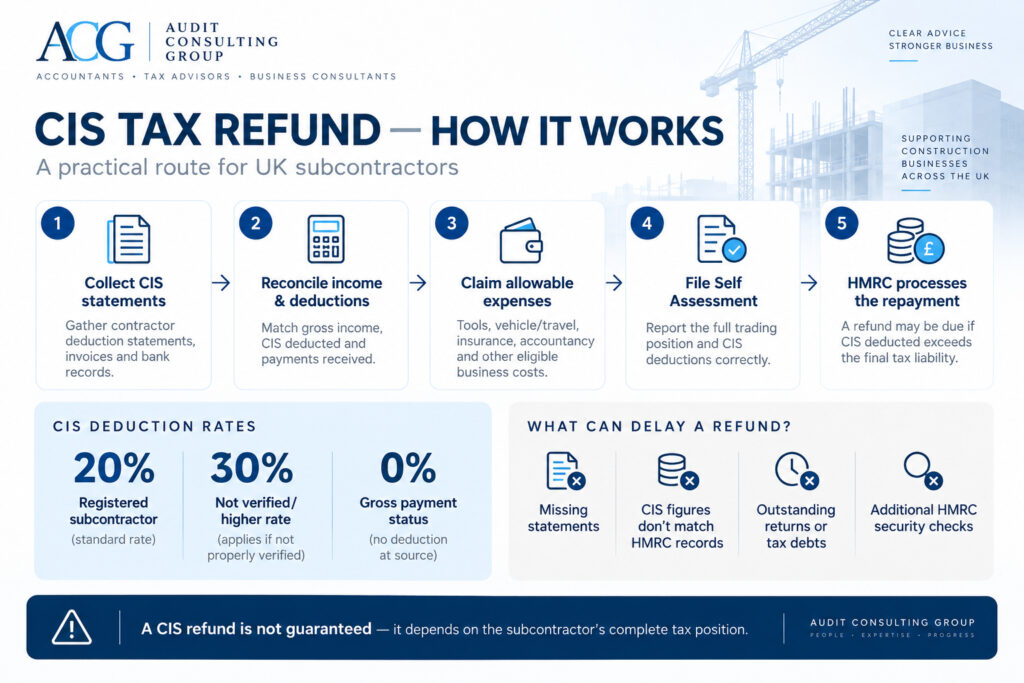
A typical self-employed CIS refund claim involves the following steps:
- collecting CIS deduction statements from each contractor;
- checking that the statements match payments received into the bank;
- calculating total income for the tax year, including non-CIS income if relevant;
- identifying allowable business expenses and keeping supporting records;
- preparing the Self Assessment tax return;
- entering CIS deductions in the correct part of the return;
- submitting the return to HMRC;
- requesting repayment if HMRC calculates that a refund is due.
The most important point is that HMRC does not calculate the refund from deduction statements alone. The tax return must show the full trading position. If income is omitted, expenses are overstated or CIS deductions do not match HMRC’s records, the repayment may be delayed or queried. Readers needing deeper context on the reclaim process may find CIS refunds and reclaims a relevant continuation resource.
What records HMRC expects to see
A credible CIS refund claim should be supported by records that explain both sides of the calculation: income and expenses.
For income, subcontractors should keep CIS deduction statements, invoices, remittance advices, bank statements and records of payments received. Contractor statements matter because they show the gross payment, cost of materials where relevant, CIS deduction and net amount paid. Subcontractor-specific CIS issues are often clearer when the relationship between contractor payments, deduction statements and reporting duties is understood; related guidance on CIS for subcontractors can help frame that wider context.
For expenses, HMRC expects the records to show that costs were incurred wholly and exclusively for the business, or that a reasonable business proportion has been applied where there is mixed use. Common expense categories include tools, protective clothing, public liability insurance, accountancy fees, mobile phone use, vehicle costs, fuel, parking, congestion charges, training directly linked to the trade and certain equipment costs.
Weak record keeping does not always mean a claim fails, but it makes the position harder to defend. Bank transactions without receipts may explain that money was spent, but not always what was bought or whether it was allowable. A box of receipts with no categorisation creates a different problem: evidence exists, but the tax return may still be unreliable if the figures have not been reconciled.
How long a CIS tax refund can take
There is no single refund timescale that applies to every case. A straightforward Self Assessment repayment may be processed within a few weeks after submission, particularly where HMRC’s records match the figures on the return and the repayment request passes automated checks.
In practice, subcontractors often see a wider range. Some repayments arrive quickly. Others take several weeks or longer, especially where HMRC carries out security checks, requests further information, identifies mismatches or has a backlog. Limited company CIS repayment claims can also take longer because HMRC may need to review the company’s PAYE position before releasing funds.
The timing is affected by several factors:
- whether the tax return was filed online or by paper;
- whether the CIS deductions match contractor submissions to HMRC;
- whether bank details have been correctly provided;
- whether HMRC selects the repayment for additional checks;
- whether previous returns are outstanding;
- whether there are other tax debts that HMRC may offset against the refund;
- whether the taxpayer’s identity or repayment details need verification.
A refund being delayed does not automatically mean the claim is wrong. HMRC’s repayment checks are common, particularly around Self Assessment repayments. The practical issue is that poor records make it harder to respond quickly if HMRC asks questions.
Why CIS deduction mismatches slow everything down
One of the most frequent causes of delay is a mismatch between the subcontractor’s records and the contractor’s CIS submissions. A subcontractor may enter CIS deductions based on bank receipts or informal payment messages, while the contractor reports a different gross figure or deduction amount to HMRC.
Sometimes the difference is innocent. A payment near the tax year-end may be allocated to a different period. Materials may have been treated differently. A contractor may have corrected a return later. In other cases, the subcontractor may be missing one or more deduction statements and has estimated the figures.
HMRC tends to rely heavily on the contractor-reported CIS data. If a subcontractor claims deductions that HMRC cannot see, the repayment may be held while the position is checked. This is why deduction statements should be requested during the year, not only after 5 April when the refund is being prepared.
The 20% and 30% deduction issue
A registered subcontractor is usually deducted at 20%. An unregistered subcontractor, or one HMRC cannot verify correctly, may be deducted at 30%. That extra 10% can create a larger refund, but it also signals an administrative problem that should be corrected.
The 30% rate is often caused by missing CIS registration, incorrect Unique Taxpayer Reference details, trading name differences, or verification issues between contractor and subcontractor. Some subcontractors only discover the problem after several payments have been made.
Claiming the refund at year-end may recover overpaid tax, but it does not solve the underlying issue for future payments. If the subcontractor continues to be verified incorrectly, the same cash-flow problem repeats. For anyone working regularly under CIS, registration details are not a minor admin point; they affect take-home cash throughout the year.
| CIS status | Deduction rate | Deduction on £1,000 | Deduction on £5,000 | Deduction on £20,000 | Amount received from £20,000* |
|---|---|---|---|---|---|
| Gross payment status | 0% | £0 | £0 | £0 | £20,000 |
| Registered and verified subcontractor | 20% | £200 | £1,000 | £4,000 | £16,000 |
| Subcontractor subject to the higher CIS rate | 30% | £300 | £1,500 | £6,000 | £14,000 |
| Difference between 20% and 30% | 10 percentage points | £100 | £500 | £2,000 | £2,000 cash-flow difference |
*Simplified illustration based on the stated amount being subject to CIS deduction.
Actual CIS calculations can differ because VAT and qualifying materials are treated separately,
and the final tax liability is determined through the relevant tax reporting process.
Expenses: the area where refunds are won or weakened
CIS refund discussions often focus on deductions, but expenses are just as important. The refund depends on taxable profit, not simply on tax withheld. A subcontractor with accurate expense records may have a very different tax result from someone with the same income and CIS deductions but poor evidence of costs.
There are two common mistakes. The first is underclaiming legitimate expenses because records were not kept. This can reduce a refund or increase the tax due. The second is overclaiming costs that are personal, poorly evidenced or not sufficiently connected to the trade. That can trigger HMRC questions and create exposure later.
Vehicle costs are a frequent example. A subcontractor may use a van for work and personal journeys. The tax treatment depends on the method used, the records kept and the facts of use. Fuel receipts alone do not prove business mileage. A mileage log or consistent travel record gives the claim more substance.
Tools and equipment create another practical issue. Some purchases may be ordinary expenses; others may fall under capital allowances. The distinction matters because the tax return should treat them correctly. A refund claim can still be valid if the distinction is misunderstood, but errors may need correcting if HMRC reviews the return.
VAT and CIS: separate systems that still interact in practice
VAT and CIS are often confused because both can appear on construction invoices, but they are not the same tax. CIS deductions are calculated on labour payments, normally excluding VAT. VAT-registered subcontractors must still account for VAT correctly, even where CIS deductions are being made.
The domestic reverse charge for building and construction services adds another layer. In some supply chains, the customer accounts for VAT instead of the subcontractor charging it in the usual way. This does not remove CIS obligations. It simply changes the VAT accounting treatment. The interaction between CIS and VAT compliance is often where bookkeeping errors become visible.
For refund purposes, poor VAT handling can distort bookkeeping records. If VAT receipts, CIS deductions and net bank receipts are not separated properly, turnover can be overstated or understated. A subcontractor may look as though they earned more or less than they actually did for tax purposes. The result can be a delayed or inaccurate CIS repayment claim.
What contractors and subcontractors often misunderstand
CIS creates responsibilities on both sides of the working relationship. Contractors must verify subcontractors, make deductions where required, file monthly CIS returns and provide deduction statements. Subcontractors must keep their own records, check statements and report income correctly.
A subcontractor should not assume that a contractor’s admin is always correct. Equally, a contractor’s error does not remove the subcontractor’s responsibility to file an accurate tax return. If the deduction statement is missing or wrong, the issue should be raised promptly with the contractor.
Several misunderstandings appear repeatedly:
- believing CIS deductions mean the tax return is already complete;
- assuming every CIS subcontractor will receive a refund;
- claiming CIS deductions from bank deposits without checking gross figures;
- mixing employment income, self-employed income and CIS income incorrectly;
- treating VAT as part of taxable income when it should be separated;
- using the director’s Self Assessment return to claim company CIS deductions;
- waiting until January to reconstruct the previous tax year from memory.
These are not rare technical errors. They are the routine friction points that make CIS compliance more difficult than it first appears.
Filing deadlines and timing decisions
Self Assessment deadlines matter even where a refund is expected. Online tax returns are usually due by 31 January after the end of the tax year. Paper returns have an earlier deadline. Missing filing deadlines can lead to penalties, and late filing may also slow the refund process.
There is often an advantage in preparing the return well before January. A subcontractor who files in May or June may receive a repayment much earlier, provided the figures are complete. However, rushing a return before all contractor statements have been checked can create its own problems.
The better approach is not simply “file as early as possible”. It is to build the records during the year so that early filing becomes realistic. That means saving deduction statements, reconciling payments, keeping receipts, recording mileage and separating personal spending from business costs.
What happens if HMRC checks the claim
HMRC may delay a repayment while it carries out checks. Sometimes the check is a routine security measure. Sometimes HMRC wants to confirm CIS deductions, review expenses or verify repayment details. The taxpayer may be asked to provide evidence before the refund is released.
A measured response is important. Sending incomplete documents, inconsistent explanations or revised figures without context can make the review longer. HMRC generally needs a clear trail: what was earned, what was deducted, what expenses were claimed and how the figures connect to the return.
If HMRC amends the repayment or refuses part of the claim, the next step depends on the reason. Some issues are resolved by providing missing evidence. Others may require a correction to the return. Where penalties are involved, the facts, behaviour and timing matter. A disagreement with HMRC should be handled carefully rather than treated as a routine formality.
Limited companies: why CIS refunds can become a payroll issue
For companies, CIS suffered is closely linked to payroll administration. The company may offset deductions against PAYE and National Insurance liabilities. This means payroll records, Real Time Information submissions and CIS suffered figures need to align.
Problems arise where a company has suffered CIS deductions but has no active PAYE scheme, has not submitted payroll filings correctly, or has director payments that have not been treated consistently. The refund may be technically due, but HMRC may not release it until the company’s employer record is coherent.
There is also a Companies House angle, although Companies House does not process CIS refunds. Company accounts must still reflect income, tax deductions, payroll costs, director remuneration and Corporation Tax correctly. A CIS repayment claim should not sit outside the company’s accounting records as if it were personal money. For owner-managed construction companies, that distinction is easy to blur and expensive to untangle later.
Cash-flow planning: the overlooked side of CIS refunds
Some subcontractors treat the annual refund as part of their expected income. That can be risky. A refund may be delayed, reduced, offset against other HMRC debts or queried. Building personal or business cash flow around a repayment date that HMRC has not confirmed can create pressure, especially around VAT quarters, insurance renewals, van finance, materials and January tax payments.
A CIS refund should be viewed as a reconciliation outcome, not as a guaranteed payment date. If the same large refund arises every year, it may also be worth examining why. The answer may be normal expense levels, but it may also indicate deduction rate issues, poor registration status, inconsistent bookkeeping or business structure questions.
A practical example
Consider a self-employed subcontractor with £48,000 of gross CIS labour income and £9,600 deducted at 20%. During the year, they also incur allowable business expenses for van running costs, tools, insurance, accountancy fees and phone use. Their taxable profit is therefore lower than the gross income figure used for CIS deductions during the year.
Once the Self Assessment return is prepared, HMRC compares the actual Income Tax and National Insurance due with the £9,600 already deducted. If the deductions exceed the final liability, the difference may be repayable. If the expenses are lower than expected, or there is other taxable income, the refund may be smaller. If payments on account are due for the following year, the overall position may also be affected.
The key point is that two subcontractors with identical CIS deductions can receive different refunds because their expenses, income mix, personal allowances and prior tax position are different.
| Calculation item | Illustrative amount | What it means |
|---|---|---|
| Gross CIS labour income | £48,000 | Total CIS income before deductions and allowable business expenses. |
| CIS deducted at 20% | £9,600 | Tax deducted by contractors during the tax year and reported to HMRC. |
| Illustrative allowable business expenses | £12,000 | Example total for qualifying costs such as tools, vehicle use, insurance, phone and accountancy. |
| Illustrative profit before other tax adjustments | £36,000 | £48,000 gross income less £12,000 of illustrative allowable expenses. |
| CIS tax already deducted | £9,600 | This amount is normally credited against the subcontractor’s final tax position. |
| Final Income Tax and National Insurance liability | Calculated through Self Assessment | The actual liability depends on the individual’s full circumstances for the tax year. |
| Potential CIS repayment | £9,600 minus final liability | If CIS deductions exceed the final liability, the difference may be repayable by HMRC. |
Illustrative example only. Actual CIS refunds depend on the subcontractor’s complete tax position,
including allowable expenses, other income, personal allowances, National Insurance,
payments on account and any amounts owed to HMRC.
How to reduce delays before the claim is submitted
The best time to protect a CIS refund claim is during the tax year, not after it has ended. A few habits make a significant difference.
- Keep every CIS deduction statement and check it against bank receipts.
- Ask contractors quickly for missing statements rather than waiting until tax return season.
- Use a separate bank account for business income and expenses where possible.
- Record mileage or vehicle use consistently if claiming business travel costs.
- Keep receipts for tools, materials, insurance, equipment and work-related costs.
- Check CIS registration details if deductions are being made at 30%.
- Separate VAT, CIS deductions and net receipts in the bookkeeping records.
- Do not leave Self Assessment preparation until the filing deadline is close.
These actions do not make HMRC process repayments instantly. They reduce the number of reasons a repayment might be delayed or challenged.
Key takeaways for subcontractors
A CIS tax refund is usually the result of tax deducted during the year exceeding the final tax liability after the full trading position has been calculated. The claim is made through Self Assessment for self-employed subcontractors, while limited companies follow a different route linked to PAYE and company records.
The speed of repayment depends on record quality, HMRC checks, contractor reporting, outstanding tax matters and whether the claim is internally consistent. A clean online Self Assessment claim may be repaid within weeks, but there is no universal timescale and no responsible adviser should promise a fixed HMRC repayment date.
The strongest refund claims tend to have three things in common: accurate CIS deduction records, well-supported expense claims and bookkeeping that separates CIS, VAT, income and business costs properly. The weakest claims tend to rely on estimates, missing statements and assumptions about what HMRC already knows.
Final perspective
CIS refunds are often presented as a simple annual claim, but the underlying process is a test of record keeping. HMRC is not only looking at the amount deducted by contractors. It is assessing the tax return, the evidence behind it and the consistency of the figures across its own records.
For subcontractors, the practical lesson is clear: the refund is earned throughout the year by keeping the right evidence, checking contractor paperwork and treating CIS deductions as part of the wider tax position. A well-prepared claim is not just more likely to be accurate. It is easier to explain if HMRC asks questions, easier to reconcile with future tax planning and less likely to create problems in the next tax year.