

CIS Verification: How to Verify Subcontractors with HMRC in UK
CIS verification is one of those construction tax processes that looks straightforward until it is handled at speed, across multiple sites, with incomplete subcontractor details and payment deadlines already pressing. A contractor may think the key question is simply whether a subcontractor is “registered for CIS”. HMRC’s position is more specific: before paying a subcontractor for construction operations, the contractor must verify that subcontractor and apply the deduction rate HMRC confirms.
The practical difference matters. A subcontractor can be known to the business, recommended by a site manager, already working for another contractor, or even previously paid by the same company. None of that automatically gives the contractor permission to apply the standard CIS deduction rate. Verification is the point at which HMRC tells the contractor whether to pay the subcontractor gross, deduct 20%, or deduct 30%.
Leave your details and our team will get back to you shortly.
For construction businesses, this is not just an admin step. It affects cash flow, subcontractor relationships, monthly CIS returns, bookkeeping accuracy, VAT handling, payroll boundaries and the contractor’s exposure if HMRC later reviews the records. Wider CIS services can be relevant where contractors need to understand how verification fits into the broader Construction Industry Scheme process.
What CIS verification actually does
Under the Construction Industry Scheme, contractors must deduct money from payments to subcontractors and pass it to HMRC, unless HMRC confirms that the subcontractor can be paid gross. CIS applies to many construction operations in the UK, including building work, alterations, repairs, decorating, demolition and certain installation activities. It can apply to companies, partnerships and sole traders acting as contractors or subcontractors.
Verification is the process of checking a subcontractor with HMRC before payment. The contractor provides identifying information about the subcontractor, and HMRC returns the payment status that must be used for CIS purposes.
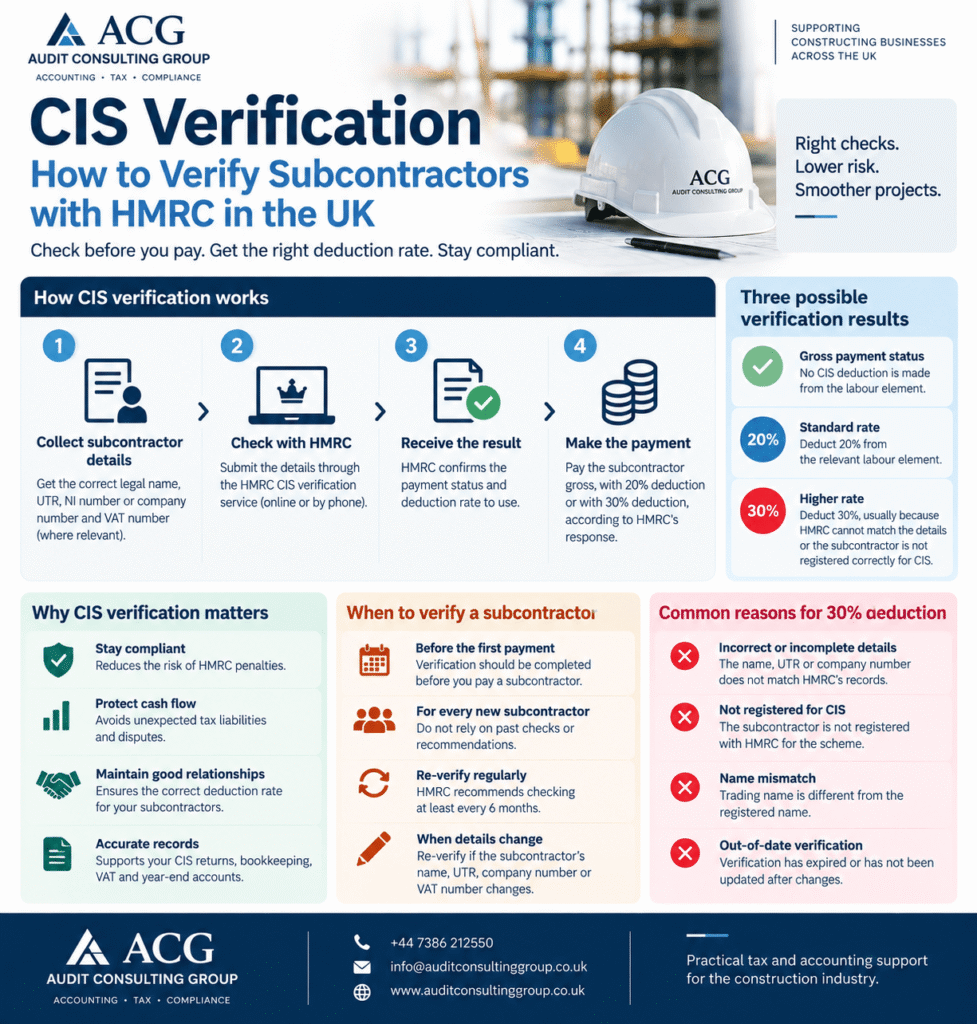
That response normally falls into one of three outcomes:
- Gross payment status: no CIS deduction is made from the labour element of the payment.
- Net payment at the standard rate: CIS is deducted at 20% from the relevant labour element.
- Higher-rate deduction: CIS is deducted at 30%, usually because HMRC cannot match the subcontractor details or the subcontractor is not registered correctly for CIS.
The verification result is not a general certificate of tax compliance. It is an HMRC instruction for how that contractor should treat that subcontractor for CIS deductions. Treating it as a broad approval is a common misunderstanding.
Why the timing is more important than contractors often realise
CIS verification should happen before the contractor makes the first payment to the subcontractor. In practice, the work may have started before accounts or payroll receive the details. Site teams often move faster than administration. A subcontractor might be brought in urgently to keep a programme moving, with tax information requested afterwards.
That creates a problem. CIS does not wait for the business to tidy its paperwork. If payment is made before verification, the contractor may apply the wrong deduction rate. If the contractor deducts too little, HMRC can pursue the contractor for the shortfall. If the contractor deducts too much, the subcontractor may face unnecessary cash-flow pressure and disputes may follow.
The operational lesson is simple but often ignored: CIS verification belongs in the onboarding process, not the payment process. By the time an invoice reaches approval, the business should already know whether the subcontractor is verified, what deduction rate applies, and whether the invoice separates labour, materials and VAT properly.
The details HMRC needs before a subcontractor can be verified
HMRC needs enough information to identify the subcontractor accurately. The exact details depend on whether the subcontractor is a sole trader, partnership or limited company, but the contractor usually needs a combination of trading name, legal name, Unique Taxpayer Reference, National Insurance number for individuals, company registration number for companies and VAT registration number where relevant.
Problems often arise because the name used on site does not match the name held by HMRC. A sole trader may trade under a business name but be registered under their personal name. A limited company may use a shortened trading style on invoices. A partnership may provide one partner’s details instead of the partnership details. These are not just clerical irritations. If HMRC cannot match the information, the contractor may receive a 30% deduction instruction. Subcontractors also need to understand how their own details are held under the CIS rules for subcontractors, because inconsistent information can affect payment outcomes.
Good subcontractor onboarding normally captures:
- the subcontractor’s legal name and trading name;
- business structure, such as sole trader, partnership or limited company;
- UTR and, where relevant, company registration number;
- National Insurance number for sole traders;
- VAT number where the subcontractor is VAT registered;
- bank details and invoice contact details;
- confirmation of the type of work being supplied;
- evidence supporting whether the arrangement belongs within CIS, payroll or another category.
The last point is easily overlooked. CIS verification does not decide employment status. A worker can be verified under CIS and still raise employment status concerns if the working arrangement looks like employment in substance. CIS, payroll and employment status reviews are related but not interchangeable.
How contractors verify subcontractors with HMRC
Contractors usually verify subcontractors through HMRC’s online CIS service or through commercial payroll/accounting software connected to HMRC systems. Larger contractors may handle verification within a broader onboarding workflow, especially where subcontractors are added frequently across multiple projects.
The process is broadly as follows:
- confirm that the business is registered as a contractor for CIS;
- collect the subcontractor’s identifying information before payment;
- submit the verification request to HMRC;
- record the verification number and deduction rate returned by HMRC;
- apply the correct CIS deduction to the labour element of relevant payments;
- include the payment and deduction on the monthly CIS return;
- give the subcontractor a deduction statement where deductions are made.
The verification number should not be treated as a throwaway reference. It is part of the evidence trail. If HMRC later asks why a particular rate was used, the contractor needs to show what details were submitted, what response was received, and how that result was applied to payments.
Gross, 20% or 30%: what the result means in practice
The deduction rate affects both sides of the commercial relationship. A subcontractor with gross payment status receives payment without CIS deductions, subject to the normal invoice treatment for VAT and other charges. A subcontractor verified at the standard rate has 20% deducted from the labour element. If HMRC instructs the higher rate, 30% is deducted.
The higher rate is often the result of a mismatch rather than deliberate non-compliance. That does not make it harmless. A 30% deduction can be severe for subcontractors, particularly smaller self-employed trades with weekly labour costs, materials to buy and limited working capital. Contractors can also face pressure to “sort it out” quickly, especially where the subcontractor believes they are properly registered.
Contractors should be careful here. If HMRC returns a 30% rate, the contractor should not simply override it because the subcontractor insists they are registered. The better approach is to check whether the submitted details were accurate, ask the subcontractor to confirm their CIS registration position with HMRC, and retain evidence of any later verification result if the rate changes.
The invoice problem: labour, materials and VAT
CIS deductions are not made from the full invoice in every case. The calculation usually depends on separating the labour element from materials and other allowable costs. This is where bookkeeping quality becomes central to CIS compliance.
A well-presented subcontractor invoice should clearly show labour, materials and VAT where applicable. If the invoice gives only a single total, the contractor may need to ask for a breakdown before processing payment. Guesswork is risky. Over-deducting can create tension with subcontractors; under-deducting can create an HMRC exposure for the contractor.
VAT adds another layer. CIS deduction is calculated on the relevant amount excluding VAT. Where the domestic reverse charge for building and construction services applies, the VAT treatment may differ from a normal VAT invoice. CIS and VAT are separate regimes, but in construction accounting they often meet on the same invoice. A business that treats them as separate teams’ problems can easily produce inconsistent records. This is why CIS and VAT compliance often need to be considered together in construction finance processes.
Verification is not the same as CIS registration
One persistent misconception is that if a subcontractor says they are “CIS registered”, the contractor has done enough. The contractor still needs to verify the subcontractor unless HMRC’s rules allow reliance on a previous verification in that contractor’s records.
CIS registration is the subcontractor’s position with HMRC. Verification is the contractor checking that position and receiving the deduction instruction. The two are connected, but they are not the same action.
This distinction becomes especially relevant when a subcontractor changes from sole trader to limited company. The individual may have been verified previously, but the new company is a different legal entity. Payments made to the company need to be considered against the company’s details, not the individual’s old record. Similar issues arise when a subcontractor changes trading structure, joins a partnership, changes company name, or supplies invoices from an entity the contractor has not onboarded.
What happens if a subcontractor has worked for the contractor before?
Contractors do not necessarily need to verify the same subcontractor before every payment. Once verified, the subcontractor can generally continue to be paid using that verification result, provided the contractor continues to include them on CIS returns and there is no long break that changes the position under HMRC’s rules.
The practical risk lies in assumptions. A finance team may see a familiar name and assume the subcontractor has been verified. But the familiar name might be a trading name, not the legal entity. A limited company may have been dissolved and replaced. A sole trader may now invoice through a company. A subcontractor may have gross payment status withdrawn by HMRC. If the contractor’s records are not maintained, previous familiarity can become a weak control rather than a useful shortcut.
For contractors with recurring subcontractors, a periodic review of subcontractor master data is sensible. The aim is not to duplicate work unnecessarily, but to catch changes before they affect payments and returns.
Where CIS verification goes wrong
The most damaging CIS errors are rarely dramatic. They are usually ordinary workflow failures repeated over time.
A site manager brings in a subcontractor before finance has collected CIS details. An invoice is approved because the work was completed. The accounts team applies 20% because that is what “usually” happens. Materials are not split out properly. VAT is processed inconsistently. The monthly CIS return is filed based on incomplete records. Months later, HMRC or the subcontractor raises a question, and the business has to reconstruct what should have been clear from the start.
Common failure points include:
- paying subcontractors before verification is completed;
- using trading names instead of legal names for HMRC checks;
- assuming CIS registration means verification is unnecessary;
- applying 20% where HMRC returned 30%;
- deducting CIS from VAT-inclusive amounts;
- failing to separate labour and materials;
- including non-CIS work on CIS returns or excluding CIS work incorrectly;
- not retaining verification numbers and deduction statements;
- treating CIS as a bookkeeping task rather than a contractor compliance obligation.
The final point is important. Bookkeepers and payroll teams may process the data, but the legal and operational responsibility sits with the contractor. Directors and senior managers should understand enough about the process to know where the business is exposed.
Monthly CIS returns depend on the verification trail
CIS verification does not stand alone. It feeds directly into the contractor’s monthly CIS return. The return reports payments made to subcontractors and deductions withheld during the tax month. The deadline is the 19th of the month following the tax month being reported.
If verification records are weak, the monthly return is harder to prepare accurately. If invoices arrive late, labour and materials are unclear, or subcontractor details are incomplete, the return may be rushed or corrected later. Repeated corrections can attract attention, particularly if the pattern suggests weak controls rather than an isolated mistake. Clear monthly CIS filing depends on the verification data being right before the return is prepared.
Contractors also need to provide subcontractors with payment and deduction statements. These statements matter to subcontractors because they support claims for CIS suffered, including through Self Assessment for sole traders or Corporation Tax records for companies. Poor contractor administration can therefore create problems beyond the contractor’s own accounts.
Subcontractor status, employment status and payroll boundaries
Verifying a subcontractor for CIS does not settle whether the person is genuinely self-employed for employment tax purposes. HMRC can still look at the working relationship and consider factors such as control, substitution, mutuality of obligation, financial risk, provision of tools and integration into the business.
This is particularly relevant where a contractor uses individuals regularly, controls their working hours, provides equipment, and treats them in practice like employees while paying them through CIS. Verification does not protect the contractor from employment status issues. It only confirms the CIS deduction rate for that subcontractor.
Construction businesses should avoid using CIS as a convenient alternative to payroll where the underlying arrangement does not support self-employment. The consequences can be broader than CIS, potentially affecting PAYE, National Insurance, holiday pay disputes and wider employment compliance. The practical answer is not to panic over every recurring subcontractor, but to review working arrangements honestly rather than relying on labels.
Limited companies, sole traders and partnerships: why structure changes the check
The subcontractor’s business structure affects the verification details and the records the contractor should keep. Sole traders are usually matched using personal and tax identifiers. Limited companies are separate legal entities, with company registration details and a company UTR. Partnerships have their own tax position and should not be treated as if one partner’s sole trader record automatically covers the partnership.
This matters because construction businesses often deal with people first and entities second. The person who arrives on site may be the same, but the invoice may come from a different entity. For CIS purposes, the payer must look at who is being paid. If the payee changes, the verification position may need to be revisited.
Companies House information can help confirm a limited company’s existence, registered name, company number and filing status, but it does not replace HMRC CIS verification. A company can exist at Companies House and still not be correctly registered or matched for CIS. Conversely, an administrative issue at Companies House may indicate wider record-keeping problems that deserve attention before payments are made.
Record keeping is where CIS compliance is won or lost
HMRC expects contractors to keep adequate CIS records. In practical terms, that means the contractor should be able to trace each payment from subcontractor onboarding through verification, invoice review, deduction calculation, payment, monthly return and deduction statement.
A reliable CIS file will usually include:
- subcontractor onboarding forms or equivalent data capture;
- verification responses and reference numbers;
- contracts, purchase orders or work instructions where available;
- invoices showing labour, materials and VAT treatment;
- calculation of CIS deductions;
- payment records;
- monthly CIS return submissions;
- deduction statements issued to subcontractors;
- notes of any corrections, disputes or HMRC communications.
Digital accounting systems can help, but software does not fix unclear responsibilities. Someone still needs to decide who collects subcontractor details, who checks whether the work falls within CIS, who verifies with HMRC, who reviews invoices, who signs off payments and who files the return. Where those responsibilities are split between site operations, accounts and external advisers, handover discipline matters.
Verification should connect the payment file to the CIS return
The HMRC check is not the end of the process. A useful CIS record shows a chain: who the subcontractor is, what HMRC returned, how the deduction was calculated, what was paid, what statement was issued and how the figures appeared on the monthly return. That chain also helps when CIS and VAT records meet on the same invoice, particularly where domestic reverse charge treatment is in play. Directors and contractors do not need to handle every entry personally, but they do need a process that keeps onboarding evidence, bookkeeping records, payment approvals and CIS submissions aligned.
Why subcontractors should care about the contractor’s verification process
Verification is often described as the contractor’s obligation, which is correct. But subcontractors also have a financial interest in making the process easy. If HMRC cannot match the subcontractor, the contractor may be told to deduct 30%. If invoices do not separate labour and materials, deductions may be calculated unfavourably or payment may be delayed while queries are resolved.
Subcontractors can reduce friction by giving contractors consistent details, using the correct legal entity on invoices, keeping CIS registration up to date and checking that their HMRC record matches the way they trade. Those with gross payment status should be especially careful about compliance, because HMRC can withdraw gross status if conditions are not maintained.
For self-employed subcontractors, CIS deductions are not the final tax calculation. They are advance deductions that are later reconciled through Self Assessment. For limited company subcontractors, CIS suffered may be set against certain tax liabilities through the company’s HMRC records. In both cases, deduction statements are valuable evidence. Missing statements can turn a simple tax reclaim or set-off into a time-consuming exercise.
A practical verification workflow for construction contractors
The strongest CIS processes are not necessarily complicated. They are consistent. A contractor with ten subcontractors can have a better control environment than a larger firm if the steps are clear and followed every time.
A workable process might look like this:
- Before work starts: collect subcontractor details, confirm the contracting entity and consider whether the work falls within CIS.
- Before first payment: verify the subcontractor with HMRC and record the deduction rate and verification number.
- At invoice stage: check that labour, materials and VAT are shown clearly enough to calculate CIS correctly.
- At payment stage: apply the HMRC-confirmed rate to the correct amount and retain the calculation.
- After the tax month ends: prepare and submit the CIS return by the deadline and issue deduction statements.
- Periodically: review subcontractor records for changes in entity, payment status, VAT registration or working arrangements.
The periodic review is where more mature contractors often distinguish themselves. CIS risk does not only arise on the first day of a subcontractor relationship. It can appear later, when the subcontractor incorporates, gains or loses gross payment status, changes VAT position, or begins working in a way that raises employment status questions.
What HMRC is likely to look for
HMRC reviews tend to focus less on whether a business can describe the rules and more on whether the records show the rules were applied. A contractor should be prepared to explain how subcontractors are onboarded, how verification is performed, how deduction rates are applied, how invoices are reviewed and how monthly returns are prepared.
Areas likely to attract questions include payments to unverified subcontractors, repeated use of the wrong deduction rate, missing deduction statements, poor labour and materials breakdowns, inconsistencies between accounting records and CIS returns, and subcontractors treated as self-employed where the working arrangement suggests otherwise.
HMRC may also compare CIS records with VAT returns, payroll records, Corporation Tax accounts and other filings. That is why CIS should not be maintained as a disconnected spreadsheet with no relationship to the rest of the finance function. In a well-controlled business, CIS data should reconcile with supplier ledgers, bank payments, management accounts and tax filings.
The strategic value of getting verification right
CIS verification is sometimes treated as a defensive compliance task: something done to avoid penalties. That is too narrow. A clean verification process improves payment discipline, subcontractor relationships, cash-flow forecasting and the reliability of management information.
Contractors that understand their subcontractor base can see which trades are being used most heavily, where labour costs are rising, which projects rely on gross-paid subcontractors, and where payment disputes are recurring because invoice quality is poor. CIS records, if properly maintained, become part of commercial visibility rather than merely tax administration.
There is also a governance angle. Directors of construction companies do not need to perform every verification personally, but they should know that a robust process exists. Weak CIS controls can create tax liabilities, administrative cost and reputational friction with subcontractors. The risk is rarely confined to one return.
Key points for contractors and subcontractors
CIS verification works best when both sides understand what the process is designed to do. For contractors, it is the HMRC check that determines the deduction rate before payment. For subcontractors, it is a practical reason to keep registration details accurate and invoices clear.
- Contractors should verify subcontractors before making the first payment, not after an invoice has already been approved.
- The deduction rate must follow HMRC’s verification response: gross, 20% or 30%.
- CIS deductions are generally calculated on the relevant labour amount, not simply the full invoice total.
- VAT treatment and CIS treatment need to be consistent, especially where the domestic reverse charge applies.
- Verification does not decide employment status and should not be used as a substitute for payroll assessment.
- Changes in business structure can require fresh attention, even if the same individual continues doing the work.
- Monthly CIS returns depend on accurate verification, invoice and payment records.
- Subcontractors should keep CIS details current and retain deduction statements for tax reporting and reclaims.
A final practitioner view
The businesses that struggle most with CIS verification are not always the ones that ignore the rules. More often, they are businesses where operational decisions happen quickly and the compliance process follows behind. Construction work is arranged on site; finance receives the paperwork later; HMRC expects the tax treatment to have been correct from the start.
That gap between site reality and tax administration is where CIS mistakes usually form. Closing it does not require bureaucracy for its own sake. It requires a disciplined handover between the people who engage subcontractors, the people who approve invoices and the people who file returns.
Used properly, CIS verification is a control point. It confirms the deduction rate, creates an evidence trail, and forces the contractor to identify who is being paid before money leaves the business. Treated casually, it becomes a recurring source of wrong deductions, delayed payments, strained subcontractor relationships and avoidable HMRC queries.
For UK construction businesses, the question is not simply how to verify a subcontractor with HMRC. The better question is whether the business has built verification into the way it actually operates. That is where compliance stops being a month-end scramble and becomes part of a reliable construction finance process.