

How to Register for CIS in the UK: A Practical Guide for Contractors and Subcontractors
The Construction Industry Scheme is often treated as a simple HMRC registration task. In practice, CIS registration is the point where several parts of a construction business start to connect: tax status, payment processes, subcontractor verification, bookkeeping, VAT handling, payroll boundaries and future Self Assessment or Corporation Tax reporting.
That is why CIS causes friction even for capable contractors and subcontractors. The online registration itself may be relatively short. The difficulty lies in knowing which role applies, what HMRC expects afterwards, and how the decision affects cash flow once work starts moving through the scheme.
This guide explains how to register as a CIS contractor or subcontractor in the UK, what HMRC is looking for, where misunderstandings usually arise, and how construction businesses can avoid the administrative problems that tend to surface months later rather than on the day of registration.
Leave your details and our team will get back to you shortly.
What CIS registration actually means
The Construction Industry Scheme applies to construction work in the UK where contractors pay subcontractors. Under CIS, contractors may need to deduct money from subcontractor payments and pass those deductions to HMRC. Subcontractors then usually set those deductions against their tax and National Insurance liabilities. For a wider view of the scheme as a compliance area, Audit Consulting Group’s CIS services resource explains how the different CIS obligations connect.
The key distinction is practical rather than cosmetic:
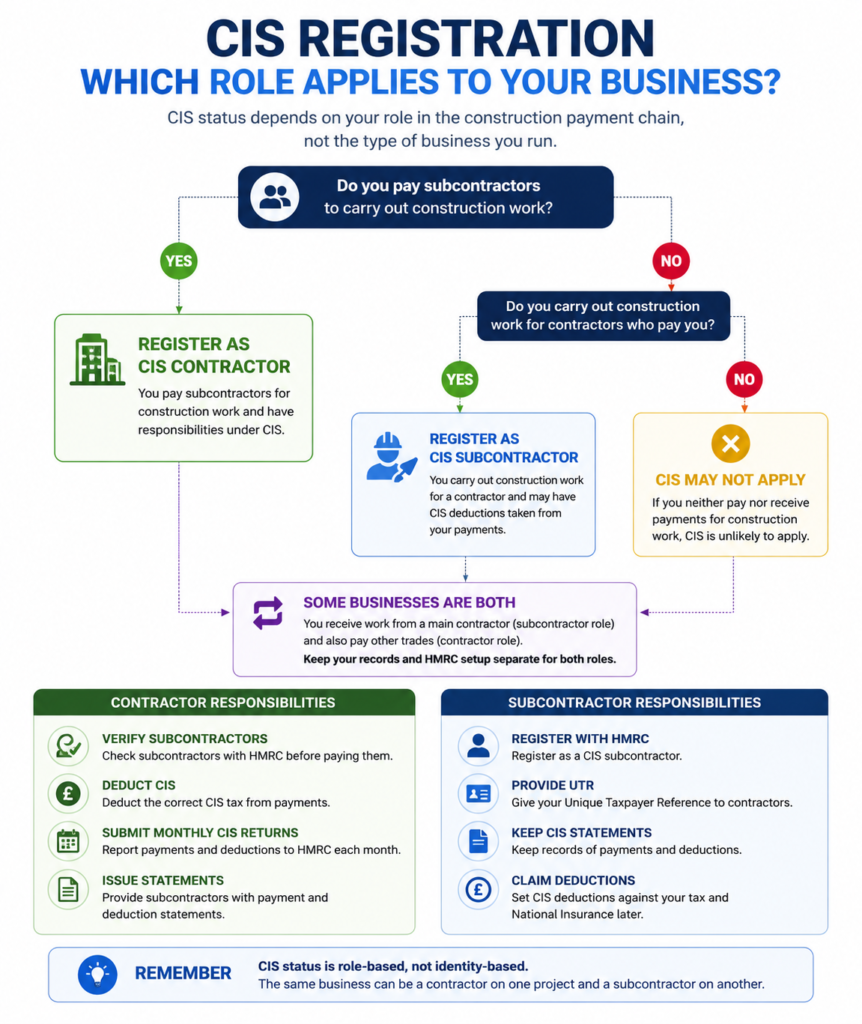
- A CIS contractor pays subcontractors for construction operations and may need to verify them with HMRC, deduct CIS tax, file monthly CIS returns and issue payment and deduction statements.
- A CIS subcontractor carries out construction work for a contractor and may have deductions taken from payments unless registered appropriately with HMRC.
- Some businesses are both because they receive work from main contractors and also pay other subcontractors to complete part of the job.
This last point is where errors often begin. A small limited company may think of itself as “just a subcontractor” because it works for a larger contractor. But if it brings in other trades and pays them for construction work, it may also have contractor responsibilities under CIS.
Why registration status matters before the first payment
CIS is not only about being registered. It affects how money moves through the business.
An unregistered subcontractor can have deductions taken at 30%. A registered subcontractor normally has deductions at 20%, unless 0% gross payment status has been granted. For a sole trader, that may affect weekly cash flow. For a limited company with materials, wages, plant hire and VAT to manage, the difference can be more uncomfortable.
For contractors, the risk is different. If a contractor fails to verify a subcontractor, applies the wrong deduction rate, misses monthly returns or keeps poor records, the problem may not be obvious immediately. It often appears later through HMRC notices, penalty letters, disputed subcontractor statements or bookkeeping that does not reconcile with bank payments.
CIS registration should therefore be treated as part of the operating model, not as a one-off formality.
Who needs to register as a CIS contractor?
You usually need to register as a contractor under CIS if you pay subcontractors to carry out construction work. This applies to mainstream construction businesses such as builders, developers, refurbishment companies and trade contractors.
There is also a less obvious category known as a deemed contractor. A business that is not mainly in construction may still have CIS obligations if it spends heavily on construction operations over a relevant period. This can affect property businesses, facilities groups, public bodies and larger organisations with recurring building or refurbishment projects.
For ordinary construction firms, the trigger is more direct: if you are paying subcontractors for construction work, contractor registration should be considered before payments begin. Waiting until the first monthly return is due is a common way to create avoidable pressure.
Who needs to register as a CIS subcontractor?
You should register as a subcontractor if you carry out construction work for a contractor and want HMRC to recognise you within the scheme. This can apply to sole traders, partnerships and limited companies.
Construction work is interpreted broadly. It may include building, alterations, repairs, decorating, demolition, civil engineering and related operations. Some activities fall outside CIS, and some mixed contracts need careful treatment. A subcontractor working across both construction and non-construction activities should not assume every invoice is treated the same way.
Registration matters because contractors use HMRC’s verification process before paying subcontractors. If HMRC cannot match the subcontractor correctly, the contractor may be instructed to deduct at the higher 30% rate. Subcontractors who need a deeper explanation of deduction treatment and verification can review this guide to CIS for subcontractors.
Before registering: details HMRC will expect
The information required depends on whether the business is a sole trader, partnership or limited company, and whether it is registering as a contractor, subcontractor or both.
Common details include:
- Unique Taxpayer Reference, often called the UTR;
- National Insurance number for sole traders or relevant individuals;
- company registration number for limited companies;
- registered company name and trading name, if different;
- business address and contact details;
- VAT registration details, where applicable;
- PAYE employer reference, if the business already has payroll;
- Government Gateway access for the correct business or tax account;
- the date construction work or subcontractor payments are expected to begin.
Small inconsistencies matter. A contractor may be unable to verify a subcontractor if the trading name, UTR or business structure does not match HMRC’s records. This is not unusual where a tradesperson has recently incorporated, changed trading name, moved address or registered for Self Assessment late. Businesses that want to check the setup route in more detail may find the registration for CIS resource useful alongside HMRC’s own online services.
How to register as a CIS subcontractor
A subcontractor registration is usually handled through HMRC’s online services. The route depends on business structure.
Sole traders
A sole trader normally needs to be registered for Self Assessment and have a UTR before CIS registration can work properly. If the individual is newly self-employed, the Self Assessment registration and CIS position may need to be dealt with together. This is especially relevant for tradespeople who have started work quickly and only later realised the contractor needs CIS verification details. Further context for sole traders is available in this guide to CIS for self-employed workers.
Once registered, the subcontractor gives the contractor the details needed for verification. The contractor then checks the subcontractor with HMRC and applies the deduction rate HMRC provides.
Limited companies
A limited company registering as a CIS subcontractor will need its company UTR and Companies House registration details. Newly incorporated construction companies sometimes overlook that Companies House incorporation and HMRC tax registration are separate processes. A company can exist at Companies House before all HMRC tax services are fully active.
This timing gap can create practical problems if the company starts work immediately after incorporation and expects contractors to verify it without delay.
Partnerships
Partnerships usually need partnership tax details and relevant partner information. The registration should reflect the correct business structure because CIS deductions need to be reported and claimed through the correct tax route later.
How to register as a CIS contractor
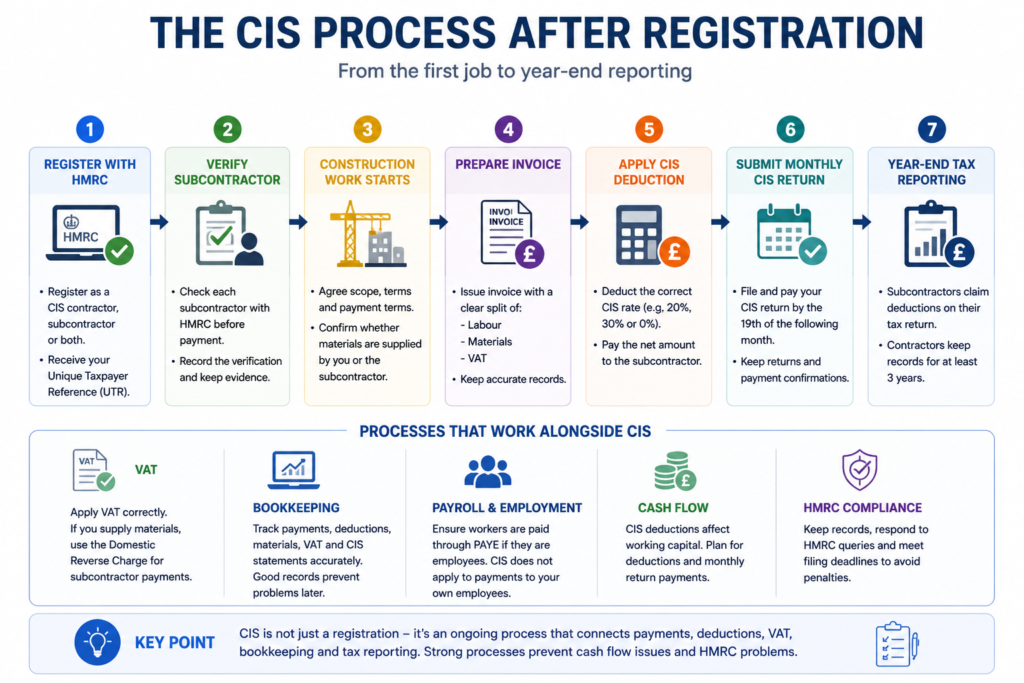
Contractor registration is more operationally demanding because it creates ongoing monthly obligations. A contractor must be set up to verify subcontractors, calculate deductions, submit CIS monthly returns and pay deductions to HMRC.
For a limited company that already runs payroll, CIS deductions are often paid through the same HMRC payment infrastructure used for PAYE and National Insurance. That does not mean CIS is payroll, but the payment deadlines and HMRC account handling can overlap operationally.
A contractor should usually prepare the following before the first subcontractor is paid:
- a process for collecting subcontractor UTRs and business details;
- a method for verifying subcontractors with HMRC before payment;
- a system for separating labour, materials and VAT on invoices;
- bookkeeping categories that distinguish CIS deductions from ordinary supplier payments;
- a monthly review process before CIS returns are submitted;
- a way to issue payment and deduction statements to subcontractors.
The registration is only the starting point. The more important question is whether the contractor’s invoicing and bookkeeping process can support CIS correctly every month. Contractors building that process may also need to understand the practical requirements around filing for CIS.
The businesses that are both contractor and subcontractor
A construction company may be paid by a main contractor under CIS while also paying subcontractors of its own. This dual status is common among small and mid-sized firms that manage projects but still work under larger contractors.
The business may suffer CIS deductions from incoming payments, then deduct CIS from outgoing subcontractor payments. Bookkeeping needs to show both sides clearly. If those amounts are mixed into ordinary income and supplier costs without proper CIS tracking, year-end accounts become harder to prepare and HMRC balances become harder to explain.
This is also where cash-flow assumptions can become misleading. A company may look profitable on paper but have tax withheld from income throughout the year. At the same time, it may be holding deductions from subcontractors that must be paid to HMRC. Treating both as general working capital is a dangerous habit.
Gross payment status: useful, but not automatic
Gross payment status allows a subcontractor to receive payments without CIS deductions. This can be valuable for cash flow, especially where the business has high material costs, employees, VAT payments or tight project margins.
HMRC does not grant gross payment status simply because a subcontractor asks for it. The business normally needs to meet tests around compliance, turnover and business operation. HMRC looks at whether tax returns and payments have been handled properly. A poor filing history can weaken the application, and gross payment status can be withdrawn if compliance conditions are not maintained.
Gross payment status is sometimes misunderstood as a tax saving. It is not. It changes the timing of cash flow. The tax still has to be dealt with through Self Assessment, Corporation Tax or other relevant reporting routes. For some subcontractors, that timing difference is commercially important; for others, it can create a future tax bill that has not been planned for.
VAT and CIS: a frequent source of confusion
CIS and VAT are separate regimes, but they often meet on the same invoice. That is where mistakes become expensive or time-consuming.
CIS deductions are generally calculated on the labour element, excluding VAT and usually excluding qualifying materials. VAT must still be handled under VAT rules, including the domestic reverse charge where it applies to certain construction services between VAT-registered businesses. A more detailed explanation of this overlap is available in the guide to CIS VAT compliance.
A subcontractor invoice may therefore need to show labour, materials, VAT treatment and CIS deduction logic clearly enough for the contractor to process it correctly. If the invoice is vague, the contractor may apply deductions conservatively or delay payment while details are clarified.
VAT registration also affects cash-flow planning. A subcontractor may be suffering CIS deductions while also accounting for VAT, buying materials and paying labour. The combined effect can be very different from looking at CIS in isolation.
Monthly CIS returns and why contractors cannot treat them casually
Once registered as a CIS contractor, the business must usually submit monthly returns to HMRC if it has paid subcontractors within the period. The return reports subcontractor payments, materials and deductions.
The filing cycle is unforgiving because it repeats every month. A contractor may be busy on site, waiting for invoices, dealing with retentions or resolving valuation disputes, but HMRC still expects accurate monthly reporting.
Common weaknesses include:
- verifying subcontractors after payment rather than before payment;
- forgetting to file nil returns where required;
- using the wrong deduction rate after HMRC verification;
- deducting CIS from VAT-inclusive amounts;
- failing to separate materials from labour properly;
- not issuing deduction statements to subcontractors;
- leaving CIS review until year end, when corrections are harder.
These are not always signs of carelessness. Often they reflect a business process that has not caught up with the way the company now operates. A builder who once used one occasional subcontractor may suddenly be running several crews across multiple sites. The CIS process that worked informally at small scale may not survive growth.
Record keeping is where CIS compliance is won or lost
HMRC registration can be completed once. Record keeping has to work every week.
Contractors should retain subcontractor verification records, invoices, payment calculations, deduction statements, monthly returns and evidence of HMRC payments. Subcontractors should retain payment and deduction statements because these support tax returns and CIS reclaim positions.
For sole traders, CIS deductions usually feed into Self Assessment. For limited companies, CIS suffered may be set against certain company liabilities through the appropriate HMRC process. If records are incomplete, claiming relief or repayment becomes slower and more uncertain. Subcontractors dealing with withheld tax should understand how CIS refunds and reclaims are supported by deduction statements and accurate records.
Good bookkeeping also helps identify whether CIS deductions shown by contractors agree with amounts actually received. Discrepancies are not rare. They may arise from invoice timing, contractor processing errors, disputed materials, retentions or statements issued late.
Registration does not decide employment status
One of the more persistent CIS misconceptions is that registering as a subcontractor proves self-employment. It does not.
CIS is a tax deduction scheme for construction payments. Employment status is a separate question. A worker can be registered under CIS and still raise employment status concerns depending on control, substitution, mutuality of obligation, financial risk and the practical working relationship.
Contractors who use CIS as a substitute for payroll thinking can create risk. If someone works like an employee, is managed like an employee and has little commercial independence, CIS registration alone will not make the arrangement robust. Payroll, employment status and CIS should be considered together where labour arrangements are close to the boundary.
Limited companies: Companies House and HMRC do different jobs
For incorporated construction businesses, Companies House and HMRC obligations run alongside each other but do not replace one another.
Companies House deals with company incorporation, confirmation statements, statutory accounts and company records. HMRC deals with Corporation Tax, VAT, PAYE, CIS, Self Assessment for directors where relevant, and other tax services.
A newly formed company may be registered at Companies House but still need to activate the right HMRC services. Directors sometimes assume that forming the company automatically deals with CIS. It does not. If the company will operate in construction as a contractor, subcontractor or both, CIS registration needs separate attention.
Director responsibilities also matter. A company’s CIS failures are not just administrative clutter. They can affect HMRC compliance history, cash-flow forecasting, accounts preparation and the director’s ability to understand the company’s real tax position.
A practical registration workflow
The cleanest CIS registrations usually start with the business model rather than the HMRC form. Before registering, a business should identify how it will actually trade.
- Will it only work for contractors, or will it also pay subcontractors?
- Is the business a sole trader, partnership or limited company?
- Has the UTR been issued and matched to the correct structure?
- Will VAT registration or domestic reverse charge rules affect invoices?
- Will payroll be needed for employees alongside CIS subcontractors?
- Are bookkeeping records ready to track deductions, materials and VAT?
- Is gross payment status commercially useful and realistically achievable?
Once these questions are answered, the registration route becomes clearer. For a subcontractor, the focus is accurate HMRC registration and providing correct details for verification. For a contractor, the focus is registration plus monthly compliance infrastructure.
Businesses that are both should document the two flows separately: CIS suffered on income and CIS deducted from payments to subcontractors. That separation prevents confusion later when preparing accounts, tax returns or repayment claims.
What tends to go wrong after registration
The most serious CIS problems rarely come from not knowing that the scheme exists. They come from small operational gaps that accumulate.
A contractor may register but continue paying subcontractors before verification. A subcontractor may register as self-employed but later incorporate and forget to update the details given to contractors. A company may receive CIS deduction statements but fail to reconcile them against bank receipts. A VAT-registered subcontractor may issue invoices that do not give the contractor enough detail to apply CIS and VAT correctly.
Another common issue is timing. Construction work often moves faster than administration. A subcontractor starts on Monday, submits details on Friday, gets paid the following week, and the contractor tries to tidy up verification afterwards. That sequence may feel normal on site, but it is not a strong compliance process.
For growing firms, the pressure point is usually delegation. Site managers agree labour. Accounts staff receive invoices. Directors approve payments. Bookkeepers prepare returns. If no one owns the CIS process end to end, the business can be technically registered but practically exposed.
CIS penalties, corrections and disputes
HMRC can issue penalties for late CIS returns and may challenge incorrect deductions or missing records. The exact outcome depends on the facts, timing and compliance history, so it is not sensible to treat every mistake as catastrophic. Equally, repeated small failures can become expensive and distracting.
Where an error is identified, the first priority is to understand what happened: incorrect verification, wrong deduction rate, invoice breakdown issue, late filing, payment mismatch or misunderstanding of whether the work fell within CIS. Corrections should be handled with evidence rather than guesswork. Where penalties or disputed HMRC positions arise, guidance on CIS penalties and appeals can help frame the issue more clearly.
Subcontractors may also need to query missing or incorrect deduction statements. This matters because those statements support tax return entries and CIS refund or reclaim positions. A subcontractor who waits until the Self Assessment deadline or company accounts stage may find it harder to obtain clean records from contractors after the event.
How registration affects tax returns and year-end work
CIS does not end with monthly deductions. It feeds into wider tax reporting.
For sole traders, CIS deductions are usually reflected in the Self Assessment tax return. The deductions are not the same as final tax liability; they are payments already withheld that need to be matched against the overall tax position.
For limited companies, CIS suffered can interact with PAYE liabilities and Corporation Tax planning in ways that need careful handling. The bookkeeping must be accurate enough to support the claim or offset. If CIS deductions are posted inconsistently, the year-end position may be unclear even where the underlying work was profitable.
For contractors, CIS returns should agree with bookkeeping records, bank payments and subcontractor statements. If they do not, accounts preparation becomes a reconstruction exercise rather than a review. That increases the risk of missed liabilities, overstated costs or unexplained balances.
Key takeaways for contractors and subcontractors
- CIS registration should match the real trading role: contractor, subcontractor or both.
- A subcontractor needs correct HMRC details so contractors can verify the business and apply the right deduction rate.
- A contractor needs more than registration; it needs a monthly process for verification, deductions, returns and statements.
- Gross payment status improves cash flow for eligible subcontractors but does not remove the underlying tax obligation.
- VAT and CIS should be reviewed together where construction invoices include labour, materials and VAT treatment.
- Companies House incorporation does not automatically register a company for CIS or other HMRC tax services.
- CIS registration does not settle employment status questions.
- Reliable records are essential for CIS refunds, reclaims, tax returns and HMRC enquiries.
A final professional perspective
Registering for CIS is not difficult in the narrow sense. The harder part is building a payment and record-keeping process that still works when projects multiply, subcontractors change, VAT becomes relevant, payroll grows and tax deadlines arrive.
For subcontractors, the practical goal is to avoid unnecessary deductions, preserve evidence and understand how CIS affects tax reporting. For contractors, the goal is to make verification, deductions and monthly filing routine enough that they do not depend on memory or last-minute reconstruction.
The construction businesses that handle CIS well tend not to treat it as a separate compliance chore. They connect it to bookkeeping, invoicing, payroll decisions, VAT treatment, management information and year-end tax planning. That is where registration becomes more than an HMRC checkbox: it becomes part of how the business protects cash flow, reduces disputes and keeps its tax position explainable.