

How Much Does It Cost to Set Up a Limited Company in the UK?
The headline cost of setting up a UK limited company looks deceptively small. Companies House charges a modest incorporation fee, and a company can be formed online quickly if the details are straightforward. That leads some founders to assume the whole exercise is little more than choosing a name, entering a few addresses and receiving a certificate of incorporation.
In practice, the real cost depends on what is meant by “set up”. If the question is only about registering a company at Companies House, the answer is simple. If the question is about creating a company that can trade properly, meet HMRC obligations, issue shares correctly, open a bank account, pay directors or staff, register for VAT where needed, protect a business name and keep compliant records from day one, the answer becomes more layered.
Leave your details and our team will get back to you shortly.
This distinction matters because the cheapest formation route is not always the cheapest way to start a limited company properly. Early shortcuts can create administrative friction months later, especially when accounts, tax returns, payroll, shareholder records or Companies House filings begin to interact.
The basic Companies House cost
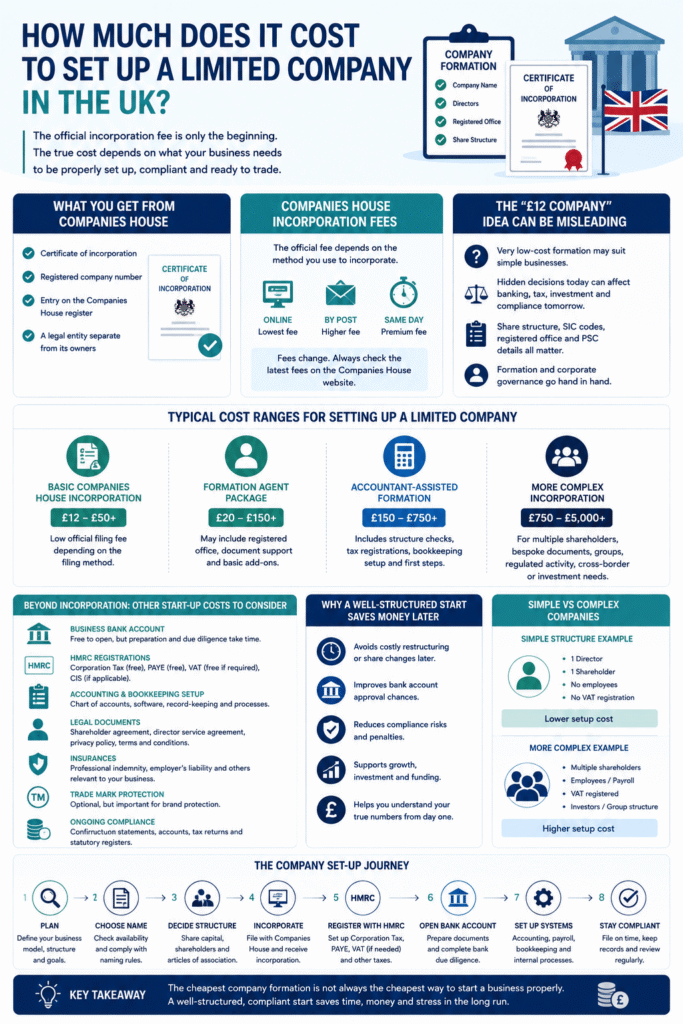
The official incorporation fee is the smallest visible part of the cost. Companies House charges different fees depending on the method used to form the company. Online incorporation is usually cheaper than paper filing, and same-day options cost more. Fees can change, so founders should always check the current Companies House fee schedule before relying on a specific figure.
For a standard private company limited by shares, the core formation cost is usually modest. This normally covers registration of the company itself and results in the company receiving:
- a certificate of incorporation;
- a registered company number;
- entry on the Companies House register;
- a legal existence separate from its owners.
That official fee does not, by itself, deal with the wider practical work. It does not decide whether the share structure is sensible. It does not confirm whether the articles of association are suitable. It does not register the company for taxes. It does not create internal records, issue share certificates, prepare a shareholder agreement or make the business operational.
Why the “£12 company” idea can be misleading
Low-cost company formation is often advertised as though incorporation is the whole process. For some very simple businesses, a basic formation may be adequate at the beginning. A single director, single shareholder consultancy with no employees, no VAT registration and no external investment may not need an elaborate structure on day one.
Even then, there are decisions hidden inside the formation process. The company name, registered office, service addresses, SIC codes, persons with significant control, share capital and articles all create a record that may affect banking, tax administration, future investors, director privacy and compliance work later.
The problem is not that cheap formation is automatically wrong. The problem is that founders often do not know which parts are cheap because they are simple, and which parts are cheap because no one has checked whether they fit the business. This is where company formation and corporate governance should be seen as connected subjects rather than separate administrative tasks.
Typical cost ranges for setting up a limited company
Costs vary depending on complexity, but the following broad ranges are realistic for many UK founders:
- Basic Companies House incorporation: usually a low official filing fee, depending on the filing method.
- Formation agent package: often from a modest fee to a higher fixed package, depending on registered office, document support and add-ons.
- Accountant-assisted formation: commonly higher than a basic filing, but may include practical checks around share structure, tax registrations, bookkeeping setup and first compliance steps.
- More complex incorporation: can cost substantially more where there are multiple shareholders, bespoke articles, shareholder agreements, group structures, regulated activity or cross-border considerations.
A realistic budget should allow not only for incorporation but also for the first layer of operating compliance. A company with employees, VATable sales, construction sector activity, overseas trading, import/export requirements or external shareholders may have costs that go well beyond the filing fee.
What is usually included in a basic formation?
A basic formation normally deals with the minimum information required by Companies House. That usually means the proposed company name, registered office, director details, shareholder details, PSC information, share capital, articles of association and SIC codes.
For a simple company, model articles may be used. These are standard default constitutional rules. They work for many small companies, but they are not designed around every commercial situation. If there are two or more shareholders, unequal investment, different voting expectations, planned investor involvement or family ownership issues, relying on standard documents without thought can create avoidable tension later.
Basic formation also tends to leave several matters for the directors to handle after incorporation. These may include opening a business bank account, registering for Corporation Tax, deciding whether VAT registration is needed, setting up payroll, keeping statutory registers, issuing share certificates and planning the first accounting period.
DIY formation, formation agents and accountant-assisted setup
There are three common routes into incorporation. A founder can form the company directly through Companies House, use a formation agent package, or use accountant-assisted company formation where the filing is considered alongside tax, bookkeeping and compliance setup.
DIY formation can be perfectly adequate where the company is simple and the founder understands the information being submitted. Formation agents can be useful where the founder wants a quick package with registered office options or basic documents. Accountant-assisted setup usually costs more at the start, but may reduce friction where the company will need payroll, VAT monitoring, director remuneration planning, accounting software or more careful ownership records.
The right comparison is not only price. It is whether the chosen route deals with the decisions that matter for the business being created.
The costs that appear after incorporation
The first surprise for new directors is often that a limited company starts creating obligations almost immediately. Some are visible; others sit quietly in the background until a deadline approaches.
Corporation Tax registration
HMRC normally needs to know when the company starts trading. A newly incorporated company is not automatically trading simply because it exists. If it has not yet begun business activity, the position may be different. Once trading begins, Corporation Tax registration and record-keeping become relevant.
The cost here is not usually a large registration fee. The real cost is administrative: setting up accounting records properly, identifying the correct start date, separating personal and business expenditure, and making sure directors understand what the company can and cannot claim.
Bookkeeping and accounting systems
A limited company needs records that support its annual accounts and Corporation Tax return. This is where very low-cost formation can become expensive later. If transactions are mixed with personal spending, invoices are inconsistent, receipts are missing or director payments are not categorised correctly, year-end accounts take longer to prepare and are more likely to need correction.
Cloud bookkeeping software, bank feeds and basic process discipline can prevent much of this. The setup cost is usually modest compared with the time lost reconstructing records after the fact.
Payroll and director pay
Directors often assume they can simply “take money out” because they own the company. In a limited company, money belongs to the company until extracted correctly. Payments may be salary, dividends, expenses, loan repayments or director’s loan account movements. Each has different tax and record-keeping consequences.
If the company pays salaries, payroll may need to be registered and operated under PAYE. Even where a director is the only person paid, the payroll decision should be considered carefully. Costs may include payroll software, accountant support and regular RTI submissions to HMRC.
VAT registration
VAT registration is not part of incorporation. A company may need to register if taxable turnover exceeds the VAT threshold, or may choose voluntary registration in some circumstances. The cost question is not only whether there is a registration fee. It is whether the business has pricing, invoicing, bookkeeping and cash flow processes ready for VAT.
VAT can be especially sensitive for new companies selling to consumers, working with overseas customers or buying significant equipment before income becomes regular. A poor VAT setup can affect margins as much as compliance.
CIS, licences and sector-specific requirements
Construction businesses may need to consider the Construction Industry Scheme. Importers and exporters may need EORI registration. Certain sectors need licences or regulatory approvals before trading. A company can exist legally while still being unable to operate lawfully in a specific activity without further registrations.
This is one reason the cost of setting up a company should be considered in the context of the business model, not just the incorporation form.
Companies House obligations that are easy to underestimate
Companies House is not only involved on formation day. The company must maintain accurate public information and file required documents. The confirmation statement is a common example. It is not the same as annual accounts, and it does not confirm trading profit. It confirms that key company information on the register is accurate or updates it where necessary.
Directors also need to keep an eye on changes that trigger filings. These may include changes to directors, registered office, PSC details, share capital, company name, articles or certain structural matters. Good Companies House filing discipline can prevent practical problems with banks, lenders, investors, suppliers and due diligence checks.
Identity verification requirements are also becoming more significant under Companies House reform. Directors, PSCs and those filing on behalf of companies should expect more formal checks than in the past, including the need to verify your identity for Companies House where the rules apply. This does not necessarily make incorporation difficult, but it makes casual or inaccurate filings less defensible.
Share structure: a small decision with long consequences
Share capital is often treated as a formality during incorporation. It should not be. The number of shares, class of shares, voting rights and ownership percentages shape control, dividend entitlement and future flexibility.
A company with one shareholder may choose a simple structure. A company with co-founders needs more care. If two people own 50% each, what happens if they disagree? If one founder contributes capital and another contributes labour, how should that be reflected? If an investor may enter later, will the original share structure make that process clean or awkward?
The formation cost may increase if professional advice is needed around articles, shareholder agreements or bespoke share rights. That additional cost is often easier to justify before incorporation than after relationships have become strained or external funding is being negotiated under time pressure.
Business name, trading name and trade mark costs
Registering a company name at Companies House does not automatically give broad brand protection. Companies House checks are mainly concerned with whether a name can be registered under company law rules. That is not the same as checking trade mark risk, domain availability, brand confusion or sector reputation.
A company may trade under a different trading name, but this introduces its own practical issues around invoices, bank accounts, contracts and customer communication. If the brand is central to the business, trade mark searches and registration may form part of the genuine setup cost, even though they are not part of incorporation itself.
This is a common area where founders save a small amount at the start and later face rebranding costs, disputes or uncertainty about whether the name they are building value in can be protected.
Registered office and director privacy
A UK limited company needs a registered office address. Some founders use a home address. That may be acceptable in certain cases, but it places the address on the public register and can create privacy concerns.
Using a registered office service usually adds an annual cost. The value depends on the founder’s circumstances. For home-based businesses, landlords, contractors and directors who do not want their residential address easily accessible, it can be a practical expense rather than a cosmetic one.
Directors also provide a service address. Understanding the difference between residential address information, service addresses and registered office details helps avoid accidental disclosure and later correction work.
Opening a company bank account
Bank account costs are not always charged at setup, but the banking process can affect timing. Banks may ask for incorporation documents, director identification, shareholder information, business activity details, proof of address and sometimes evidence of contracts or funding.
A company formed with unclear SIC codes, inconsistent addresses, unexplained ownership or a name that does not match the commercial activity may face avoidable questions. This is not usually a Companies House problem. It is an operational readiness problem.
Founders should allow time for banking checks, particularly where there are overseas directors or shareholders, complex ownership, regulated activity or higher-risk sectors.
Limited company setup costs by scenario
The cost profile changes noticeably depending on the type of business being formed.
Single-director consultancy
This is often the lowest-cost scenario. The company may need basic incorporation, a business bank account, Corporation Tax registration, bookkeeping software and a clear approach to salary, dividends and expenses. VAT may or may not be relevant depending on turnover and client type.
Two-founder business
The filing fee may be the same, but the real setup cost can be higher because ownership and control need more thought. Shareholder agreements, bespoke articles, share certificates and clear records are more important. The cheapest route may leave both founders with a company that exists but lacks a practical governance framework.
Construction company
In addition to incorporation, CIS registration may be needed depending on the role of the company as contractor or subcontractor. Payroll, verification of subcontractors, deduction statements and VAT considerations can become relevant early. The cost of setup should include process design, not just registration.
E-commerce or importing business
VAT, EORI registration, customs records, marketplace reporting and stock accounting may matter from the start. A company can be cheap to form but expensive to untangle if import VAT, duty, sales channels and bookkeeping are not aligned.
Regulated or licensed activity
Some businesses need permissions before they can trade. Formation is only one step. Licensing, regulatory checks, professional registrations or sector approvals may drive the true cost and timeline.
What founders most often get wrong
The most common error is treating incorporation as an isolated administrative task. It is better understood as the first entry in a chain of records that HMRC, Companies House, banks, accountants and sometimes investors will rely on later.
Several mistakes appear repeatedly:
- using a company name without checking broader commercial or trade mark risk;
- issuing shares without thinking through ownership, dividends or future investment;
- assuming Companies House registration automatically deals with HMRC;
- using personal bank accounts for company transactions after incorporation;
- taking money from the company without recording whether it is salary, dividend, expense reimbursement or a loan;
- missing early VAT, CIS or payroll triggers;
- ignoring confirmation statements and statutory records until a deadline arrives;
- choosing SIC codes casually, creating confusion for banks or counterparties.
None of these mistakes is unusual. Most arise because the founder is focused on getting the company live. The difficulty is that limited companies reward clean administration and punish ambiguity later.
How to think about professional support
Professional support is not necessary for every incorporation. Some founders can form a simple company themselves and keep good records. The question is not whether a professional must always be involved. The better question is whether the founder understands the consequences of each formation choice.
Support is more likely to be useful where there are multiple shareholders, planned investment, directors taking pay, VAT exposure, CIS activity, overseas trading, licensing requirements, significant startup costs, intellectual property concerns or any uncertainty over ownership and control.
The cost of advice should be weighed against the cost of later correction. Correcting a poor share structure, reconstructing director loan accounts, amending company records, resolving shareholder misunderstandings or fixing late tax registrations can be more disruptive than setting matters up carefully at the start.
A practical setup checklist
A limited company setup budget should consider more than the Companies House fee. A sensible early checklist includes:
- company name checks, including obvious brand and domain issues;
- registered office and service address decisions;
- director, shareholder and PSC information;
- share structure and articles of association;
- share certificates and statutory registers;
- Corporation Tax registration once trading begins;
- bookkeeping system and bank account setup;
- VAT registration decision and monitoring;
- PAYE registration if salaries are to be paid;
- CIS registration where construction activity requires it;
- EORI registration for relevant import or export activity;
- confirmation statement and accounts deadline tracking;
- document retention and record-keeping processes.
This is not bureaucracy for its own sake. It is the framework that allows the company to trade, report and make decisions without relying on guesswork.
So, how much should you budget?
For a very simple company, the initial cash cost may be low: the Companies House fee, perhaps a formation package, and modest spending on banking and bookkeeping tools. For a company that wants accountant involvement from the beginning, the budget will usually be higher but may include practical tax and compliance setup that a basic filing does not cover.
For companies with co-founders, sector registrations, VAT complexity, payroll, CIS, import/export needs, trade mark concerns or bespoke governance, the setup budget should be treated as a small business infrastructure cost rather than a registration fee.
A useful way to frame the question is this: what must be true for the company to trade cleanly for its first year? The answer will often include Companies House incorporation, but it rarely ends there.
Key takeaways for new directors
The cheapest visible cost of forming a limited company is not the same as the true cost of setting one up properly. The official filing fee creates the company, but the practical work creates a functioning business vehicle.
Directors should pay particular attention to share structure, tax registrations, bookkeeping, payroll decisions, VAT exposure, Companies House filings and sector-specific obligations. These areas are not always expensive at the start, but they become more costly when left unclear.
A limited company can be a flexible and efficient structure for many UK businesses. It also creates legal separation, public filing duties and director responsibilities. The best setup is not necessarily the most elaborate. It is the one that matches the business model, ownership structure and compliance reality from the beginning.
Final perspective
Setting up a limited company in the UK can cost very little if the only objective is incorporation. Setting up a limited company that is ready to trade, keep proper records, pay people correctly, meet HMRC and Companies House obligations, and support future growth requires a wider view.
The founders who tend to avoid problems are not always those who spend the most at formation. They are the ones who understand which decisions are administrative, which are tax-sensitive, which affect control, and which may become difficult to change later. That judgement is where the real value lies.