

People with Significant Control (PSC): A Guide for UK Companies
The people with significant control (PSC) regime is one of the areas of UK company administration that looks straightforward until ownership, investment, family control or group structures become slightly more complicated. A company may know who its shareholders are, who its directors are and who runs the business day to day, yet still misread who must appear on the people with significant control (PSC) register.
That distinction matters. The PSC register is not just a list of shareholders. It is a statutory transparency record designed to show who ultimately owns or controls a UK company. For small owner-managed companies, the answer may be obvious. For companies with multiple shareholders, corporate shareholders, nominee arrangements, trusts, investor rights or informal control arrangements, the answer can require more careful judgement.
Leave your details and our team will get back to you shortly.
This guide explains the persons with significant control (PSC) regime in practical terms: who is a person with significant control, what “significant control” means at Companies House, the person with significant control percentage thresholds, how PSC information is recorded, and why changes to your people with significant control (PSC) information should not be treated as an annual housekeeping task.
What the PSC regime is trying to show
The persons with significant control (PSC) regime was introduced to increase transparency over UK company ownership and control. In broad terms, most UK companies and LLPs must identify the individuals or relevant legal entities that ultimately control them, keep that information in their own statutory records, and file the required PSC information with Companies House.
The people with significant control (PSC) register at Companies House allows the public, lenders, suppliers, professional advisers and public authorities to see who has meaningful control over a company. This is separate from the register of directors and separate from the register of members, although the same person may appear in more than one place.
The regime is based on substance rather than job titles. A director may control the company but does not automatically become a PSC simply by being a director. A shareholder may be a PSC, but not every shareholder is one. A person who owns no shares can still be registrable if they exercise significant influence or control in another way.
Who is a person with significant control?
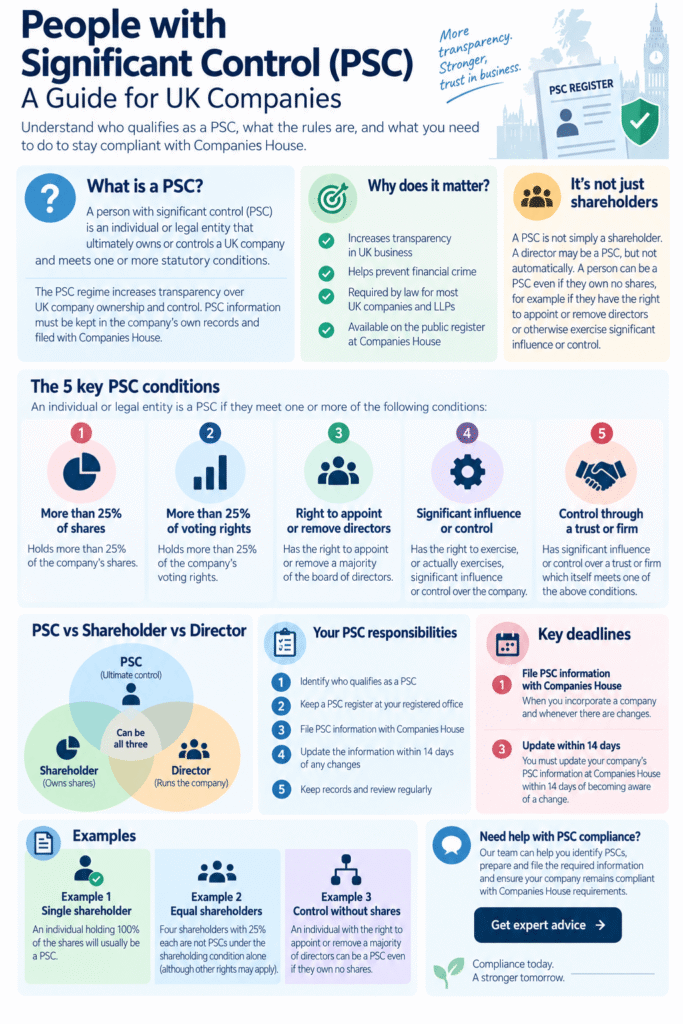
A person with significant control, often shortened to PSC, is usually an individual who meets one or more statutory conditions in relation to a company. The most common route is ownership of shares or voting rights, but the rules also cover rights to appoint or remove directors and wider influence over company decisions.
For most private companies, a person with significant control may be someone who:
- holds more than 25% of the company’s shares;
- holds more than 25% of the company’s voting rights;
- has the right to appoint or remove a majority of the board of directors;
- has the right to exercise, or actually exercises, significant influence or control over the company;
- has significant influence or control over a trust or firm which itself meets one of the above conditions.
The person with significant control percentage point is often where companies start. More than 25% is the key threshold for shares and voting rights. A 25% holding exactly is not enough under those conditions; the holding must be more than 25%. In practice, however, percentage ownership is only part of the analysis. The rights attached to the shares, voting arrangements, shareholders’ agreements and other constitutional documents may alter the position.
Are persons with significant control shareholders?
Some are. Some are not. This is one of the most common misunderstandings in company administration.
In a simple company with two individual shareholders holding 50% each, both will usually be PSCs because each holds more than 25% of the shares and voting rights. In a company with four equal shareholders holding 25% each, none may qualify under the shareholding condition alone, although other rights or arrangements could still make one or more of them PSCs.
A shareholder with 10% of the shares may be a PSC if they hold special veto rights or have the right to appoint the majority of directors. A founder who transferred shares to family members but still controls the strategic decisions may need closer review. An investor may not hold a majority of shares but may have reserved matters that effectively block or determine key decisions.
The PSC analysis therefore asks a more precise question than “who owns shares?” It asks who has meaningful ownership or control under the statutory conditions. This is why PSC work often sits alongside wider shareholder and share capital compliance, especially where share rights, voting rights or statutory records have changed over time.
What “significant influence or control” means at Companies House
The phrase “PSC significant influence or control” can cause uncertainty because it is less mechanical than a share percentage. Companies House filings require a company to state the nature of control, but the underlying judgement often depends on the company’s governing documents and the factual relationship between the parties.
Significant influence or control may exist where a person can direct important company decisions, even without owning more than 25% of the shares. It may arise through rights in the articles of association, a shareholders’ agreement, investment documentation, financing arrangements, family arrangements, or other formal or informal mechanisms.
Examples might include a person who can veto the company’s business plan, prevent changes to senior management, approve or block major expenditure, or control the issue of new shares. Not every consent right creates PSC status. A lender protecting its financial position, for example, is not automatically exercising significant control merely because it has normal commercial protections. The context matters.
This is where companies can drift into unreliable filings. A rushed incorporation may record a simple shareholding answer, while later investment documents create rights that are never considered from a PSC perspective. Conversely, some businesses over-report people as PSCs because they confuse commercial influence, board involvement or family seniority with statutory control.
PSC Conditions: When Does Someone Qualify as a Person with Significant Control?
| PSC Condition | When It Applies | Example |
|---|---|---|
| More than 25% of shares | The person holds more than 25% of the company’s shares. | A shareholder owns 40% of an ordinary share class. |
| More than 25% of voting rights | The person controls more than 25% of the voting rights in the company. | A shareholder has 30% of the voting rights, even if their economic interest is different. |
| Right to appoint or remove directors | The person has the right to appoint or remove a majority of the board of directors. | An investor has contractual rights to appoint most of the company’s directors. |
| Significant influence or control | The person has the right to exercise, or actually exercises, significant influence or control over the company. | A person can veto or determine important strategic company decisions despite owning a smaller shareholding. |
| Control through a trust or firm | The person exercises significant influence or control over a trust or firm that itself meets one of the PSC conditions. | A person controls a trust that holds sufficient rights or ownership in the company to meet a PSC condition. |
Important: A person does not need to meet every condition. Meeting one or more of the statutory PSC conditions may be enough for them to be registrable as a person with significant control.
The company’s own PSC register and the Companies House record
The phrase people with significant control (PSC) register can refer to two connected records. The company must keep its own PSC register as part of its statutory books. Companies House also maintains PSC information on the public register based on filings made by the company.
The company’s internal PSC register should not be treated as a theoretical document. It should reflect the company’s current understanding of who its registrable PSCs are, the nature of their control, and the relevant dates. For companies that have elected to keep certain statutory information at Companies House, the public record takes on a more direct role, but the responsibility to identify and maintain accurate PSC information remains with the company and its officers.
The public people with significant control (PSC) register at Companies House is only as reliable as the filings behind it. If share transfers, allotments, changes to voting rights or new shareholder agreements are not reviewed through the PSC lens, the Companies House record can become outdated even where the company’s accounts and confirmation statement are otherwise filed on time. Accurate Companies House filing depends on the underlying statutory records being kept up to date, not simply on submitting forms when an annual deadline approaches.
Why PSC mistakes often happen after ordinary business changes
PSC problems rarely start with someone deliberately ignoring the rules. More often, they arise because a business change is dealt with in one administrative lane while its PSC consequences sit in another.
A share transfer may be recorded in the register of members but not tested against PSC thresholds. A new investor may be added to the cap table, but the reserved matters in the investment agreement may not be reviewed for significant influence or control. A founder may step back as a director but keep rights that still make them a PSC. A group restructure may replace an individual shareholder with a corporate shareholder, requiring consideration of whether a relevant legal entity is registrable and whether there is an individual further up the chain who must be identified.
These are not rare edge cases. They are common points of friction in growing private companies, family businesses, professional services companies, property companies and businesses preparing for external funding.
Common PSC scenarios in UK companies
Owner-managed companies
For a single-shareholder company, the PSC position is usually simple. The sole shareholder will normally be the person with significant control because they hold more than 25% of shares and voting rights. If they are also the sole director, that does not create a separate PSC condition by itself; it simply reflects the same person’s practical control.
Where a spouse, family member or business partner is added as a shareholder, the PSC position should be reviewed at the same time as the share transfer or allotment. A change from 100% ownership to 50:50 ownership is not merely a tax, dividend or succession planning matter. It changes the company’s statutory control profile.
Companies with several shareholders
A company with several shareholders may find that some, all or none of them meet the PSC percentage conditions. Four shareholders with equal 25% holdings may not pass the “more than 25%” test individually. Three shareholders holding 40%, 35% and 25% would usually have two PSCs under the shareholding condition, not three, unless the 25% shareholder has additional control rights.
Voting rights can also differ from economic rights. If shares carry different voting rights, dividend rights or capital rights, the PSC analysis should not rely only on the number of shares held. A small class of voting shares may carry more control than a larger class of non-voting shares.
Corporate shareholders and group structures
Where a company is owned by another company, the PSC position may involve a registrable relevant legal entity rather than an individual PSC at the immediate level. The analysis depends on whether the corporate shareholder is subject to its own disclosure requirements and where it sits in the ownership chain.
For groups, the practical challenge is not just identifying the correct registrable entity. It is keeping the records aligned when there are reorganisations, new holding companies, intercompany transfers, acquisitions or changes overseas. A UK subsidiary may have a PSC filing obligation even where the underlying commercial decision was taken at group level and the UK company secretary or finance team only receives the final structure chart after the event.
Trusts, partnerships and nominee arrangements
Trusts and nominee arrangements need careful handling. A person may be registrable if they have significant influence or control over a trust or firm which itself meets a PSC condition in relation to the company. The legal owner shown in the register of members may not tell the full control story.
Private companies sometimes use nominee arrangements informally, especially in family or founder-led contexts. That can create a mismatch between the legal shareholder record, beneficial ownership expectations and PSC filings. If the arrangements are undocumented or poorly documented, the compliance issue becomes harder to resolve because the company may not have a clear evidence trail for its PSC conclusions.
What must be recorded for a PSC?
PSC information is not limited to a name. The company must collect, confirm and record prescribed particulars before filing them, subject to the rules on protected information. For an individual PSC, this will typically include their name, service address, country or state of usual residence, nationality, date of birth, usual residential address, the date they became a registrable person, and the nature of their control.
Some of this information appears publicly; some does not. The usual residential address and full date of birth are protected from general public inspection, although certain authorities may access protected information in appropriate circumstances.
The “nature of control” is not a casual description. Companies House filings use statutory categories, such as ownership of more than 25% but not more than 50% of shares, more than 50% but less than 75%, or 75% or more. Similar bands apply to voting rights. The company should therefore know not just that someone is a PSC, but which condition they satisfy and into which band they fall.
Changes to your people with significant control (PSC) information
Changes to your people with significant control (PSC) information should be dealt with promptly. This is an area where some companies still behave as if the confirmation statement is the main annual correction point. That approach is unreliable because PSC changes have their own notification requirements and should not simply wait until the next annual filing cycle.
A company must take reasonable steps to identify its PSCs and keep its PSC information up to date. Where a relevant change occurs, the company must update its own register and notify Companies House within the required timescale. In practice, businesses should treat PSC review as part of the transaction workflow whenever ownership or control changes, including when share ownership transfers alter percentage holdings or voting rights.
Events that may require a PSC review include:
- a transfer of shares;
- an allotment of new shares;
- a share buyback or cancellation;
- changes to voting rights or share classes;
- new or amended shareholders’ agreements;
- appointment rights or veto rights granted to an investor;
- group restructuring or insertion of a holding company;
- changes involving trusts, nominees or beneficial ownership;
- a PSC changing their name, service address or other registrable particulars.
The operational difficulty is that these events are often handled by different people: directors, lawyers, accountants, external investors, company formation agents, bookkeepers or internal finance teams. If nobody owns the statutory compliance checklist, the PSC filing can easily be missed. Where the change affects the public record, updating PSC information should be treated as part of the same workflow as the underlying corporate action.
PSC information and the confirmation statement
The confirmation statement is a useful annual control point, but it is not a substitute for event-driven compliance. Companies House expects companies to confirm that the information on the public register is accurate at the confirmation date. If PSC information changed months earlier, the company should already have dealt with the relevant PSC filing.
This matters because confirmation statement preparation often reveals historic errors. A finance manager or adviser may review the company record and notice that the shareholder structure no longer matches the PSC register. At that point, the company may need to reconstruct dates, review documents and file the appropriate updates. The longer the delay, the more difficult it becomes to evidence what happened and when.
A sensible annual compliance process will therefore include PSC reconciliation, but a stronger process also includes PSC review at the point of each corporate action. The confirmation statement then becomes a verification exercise rather than the first time the issue is considered.
Why Companies House accuracy matters beyond compliance
PSC filings are public. They influence how the company is perceived by banks, investors, suppliers, counterparties and professional advisers. Inaccurate records can create unnecessary friction during lending, due diligence, grant applications, onboarding checks and sale processes.
A bank reviewing a company may compare the PSC register, shareholder records, accounts, group structure chart and identification documents. If those records do not align, the company may be asked for explanations before facilities are approved. During an investment round or sale, PSC inconsistencies can slow due diligence because they suggest wider weaknesses in statutory record keeping.
For small companies, the effect is often practical rather than dramatic. A mismatch may not create a crisis, but it can absorb management time, delay routine processes and raise avoidable questions about governance discipline. Clean PSC records are part of the wider administrative hygiene that makes a company easier to finance, restructure, sell or pass to the next generation.
Where PSC records intersect with tax, accounting and payroll realities
PSC information is mainly a Companies House and statutory record-keeping matter, not an HMRC tax return in itself. Still, ownership and control records often sit close to tax, accounting and payroll issues.
Share transfers may have tax consequences, especially where shares are transferred between connected persons, issued at undervalue, or linked to employment. Dividend planning depends on accurate share ownership records. Corporation Tax computations may need to reflect group relationships, associated companies, loans to participators or close company issues. Payroll and employment tax questions can arise where shares or options are provided to employees or directors.
VAT and CIS will not usually depend directly on PSC status, but poor statutory records often travel with poor operational records. A business that cannot readily evidence ownership changes may also struggle with bookkeeping discipline, director loan account records, subcontractor documentation or VAT audit trails. The PSC register is one part of a wider compliance environment.
This is why treating PSC filings as a narrow Companies House formality can be misleading. The filing itself may be short. The facts behind it may connect to share capital, accounting records, tax positions, director responsibilities and governance documents.
Practical failures that lead to unreliable PSC registers
The most common PSC failures tend to be procedural rather than technical. A company may understand the rules in broad terms but still fail to embed them into its decision-making process.
Typical weak points include:
- updating the register of members but not the PSC register after a share transfer;
- assuming the Companies House record updates automatically when a confirmation statement is filed;
- forgetting to review PSC status after issuing new shares;
- ignoring special voting rights or investor veto rights;
- treating directors as PSCs solely because they manage the company;
- failing to identify the correct registrable entity in a group structure;
- not confirming PSC particulars before filing;
- using outdated addresses or failing to record the correct date of change;
- allowing incorporation data to remain unchanged after the company’s ownership has evolved.
These mistakes are avoidable, but only if PSC compliance is built into the company’s corporate actions rather than left as an annual clean-up exercise.
A practical workflow for maintaining PSC accuracy
A good PSC process does not need to be elaborate. It needs to be consistent. The starting point is to connect PSC review to the events that can change ownership or control.
Before a share issue, transfer or restructure is completed, the company should check the current shareholdings, voting rights and relevant agreements. Once the transaction is agreed, someone should identify whether any PSC is being added, removed or changed, and whether the nature of control has moved into a different statutory band.
After completion, the statutory registers should be updated in the correct order. The register of members, PSC register, board minutes, share certificates, stock transfer forms, Companies House filings and accounting records should tell the same story. Where the transaction has tax consequences, the tax and accounting treatment should be considered separately rather than assumed from the Companies House filing.
For companies with external advisers, the workflow should be clear about responsibility. Lawyers may draft transaction documents. Accountants may advise on tax and accounts. Formation agents may submit filings. Directors remain responsible for ensuring the company complies with its statutory obligations. That division of work needs coordination, especially where the ownership change is commercially sensitive or time pressured.
Questions directors should ask before filing PSC information
Directors do not need to become technical specialists in every aspect of company law, but they should ask disciplined questions before approving PSC filings.
- Does the current PSC register match the register of members?
- Do the voting rights match the share percentages, or are there different share classes?
- Has any person crossed the more than 25%, more than 50% or 75% threshold?
- Does anyone have rights to appoint or remove a majority of directors?
- Do any agreements give a person veto rights over key decisions?
- Is there a trust, nominee, partnership or corporate shareholder in the structure?
- Has the date of the change been evidenced properly?
- Have the PSC’s particulars been confirmed before filing?
- Does the Companies House record align with the company’s own statutory books?
These questions are especially valuable where the company has grown from a simple founder-owned structure into something more layered. Early-stage companies often form quickly with standard share structures. Later, they add investors, family members, holding companies, alphabet shares or employee incentives. The PSC analysis should evolve with that structure.
What companies often underestimate
The difficult part of PSC compliance is not usually filling in the Companies House form. It is reaching the correct conclusion before the form is filed.
Companies often underestimate the importance of dates. The date a person became registrable, ceased to be registrable or changed their nature of control should align with the underlying legal event. If the share transfer was completed on one date, the board approval was on another, and the Companies House filing happened later, the company needs to understand which date is relevant for the PSC change.
They also underestimate the importance of documentation. A company may know informally that a shareholder acts on behalf of someone else, or that a founder retains control despite reduced ownership. If the documents do not support the conclusion, the company may struggle to justify its filing position later.
Finally, companies underestimate how visible PSC errors are. Unlike internal bookkeeping mistakes, PSC information appears on the public register. A competitor, bank, investor, supplier or journalist can see it. That visibility does not mean every error is catastrophic, but it does mean careless filings can create reputational and administrative drag.
The strategic value of clean statutory records
PSC accuracy is often viewed as a compliance obligation, but it also has strategic value. Clean ownership and control records make a business more legible. They help directors understand who has rights, who can approve decisions, who must be consulted, and what the company can do without further consent.
That clarity becomes important during growth. A company preparing for funding will need to explain its cap table and control rights. A company considering a sale will need statutory records that withstand due diligence. A family business planning succession will need the legal ownership position to match the intended control position. A group planning restructuring will need to understand which entities and individuals are registrable at each level.
PSC compliance therefore sits at the junction of governance, transparency and commercial readiness. It is not glamorous administration, but it is part of the infrastructure that allows bigger decisions to happen smoothly.
Key points for UK companies
The people with significant control (PSC) regime asks who ultimately owns or controls the company, not simply who appears most active in the business. For simple companies, the answer may be quick. For companies with changing shareholders, special rights, trusts, corporate shareholders or informal control arrangements, the answer deserves more care.
- A person with significant control (PSC) is commonly someone with more than 25% of shares or voting rights, but other forms of control can also count.
- Persons with significant control are not always shareholders, and shareholders are not always PSCs.
- The people with significant control (PSC) register at Companies House should match the company’s current statutory position.
- PSC significant influence or control may arise from rights or arrangements beyond ordinary share ownership.
- Changes to your people with significant control (PSC) information should be reviewed and filed promptly, not left until the next confirmation statement.
- Share transfers, allotments, investment rights, group restructures and nominee arrangements are common triggers for PSC review.
- Accurate PSC records support wider governance, tax, accounting and due diligence readiness.
Final expert perspective
The PSC regime rewards companies that keep their ownership records joined up. The companies that struggle are usually not those with the most complex structures, but those where share capital, statutory registers, Companies House filings, tax advice and commercial agreements are handled in separate silos.
PSC compliance also fits into wider annual statutory compliance, but it should not be confined to an annual review. The more reliable habit is to ask the control question whenever the company’s ownership, voting rights or governance arrangements change.
A reliable PSC register depends on asking the control question at the right time: before and after ownership changes, not months later when an annual filing is due. For UK companies, that habit is a small administrative discipline with wider benefits. It keeps the public record accurate, reduces avoidable due diligence questions, and gives directors a clearer view of who genuinely controls the company they are responsible for running.