

Registered Office Address: UK Requirements for Limited Companies
A registered office address looks like a small administrative detail until something goes wrong. A Companies House notice is missed. A statutory letter arrives at an old address. A supplier checks the public register and finds different details from those shown on invoices. A director uses a home address during incorporation and later discovers it is publicly searchable.
For a UK limited company, the registered office address is not just a mailing address. It is the company’s official legal address for Companies House purposes and a point of formal contact for government bodies, courts, creditors and other stakeholders. It sits at the intersection of company law, public transparency, record keeping and practical business administration.
Leave your details and our team will get back to you shortly.
This guide explains what a registered office address is, what UK limited companies must do, what tends to be misunderstood, and how address decisions can affect compliance, privacy, operations and wider accounting processes.
What a registered office address actually means
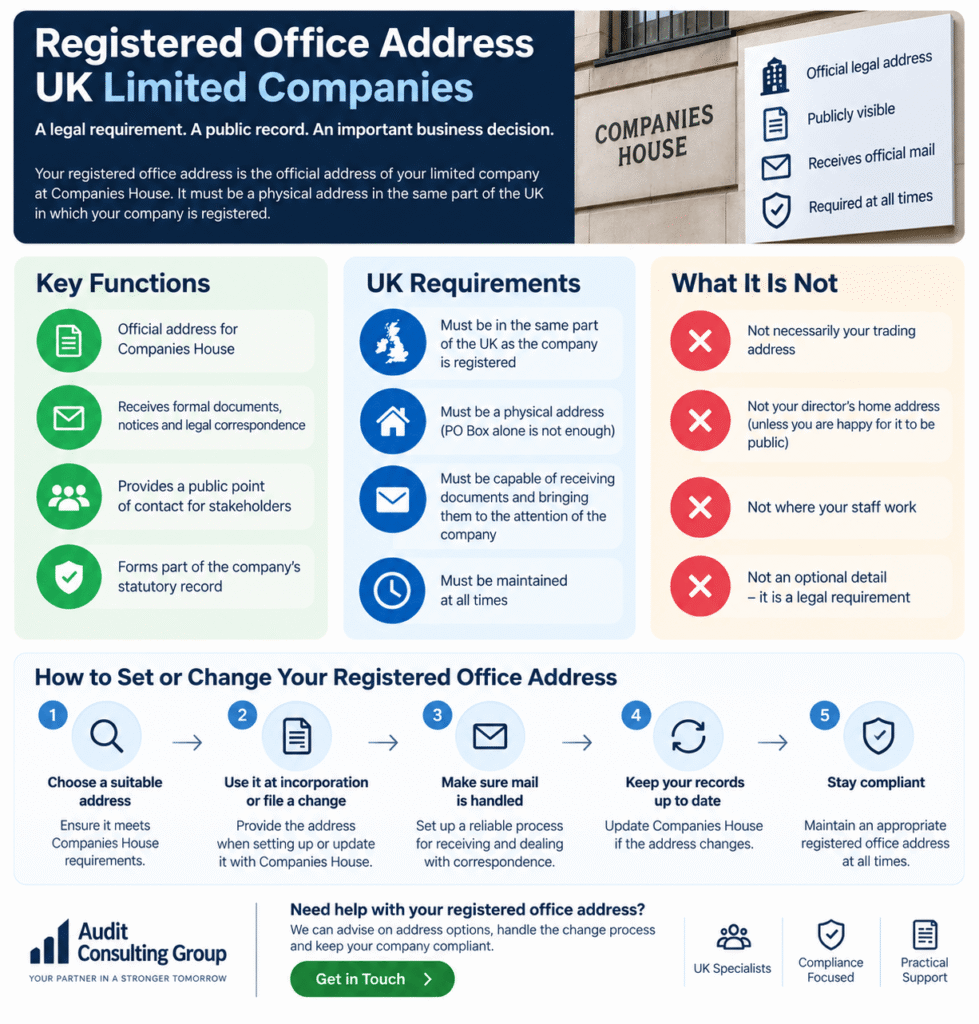
A registered office address is the official address of a limited company or LLP recorded at Companies House. It is the address shown on the public register and the address where official communications may be served on the company.
In practical terms, if someone asks “what is the registered office address of a company?” they are usually referring to the address listed against that company on Companies House. It is not necessarily where the company trades, where staff work, where directors live, or where the finance team keeps its records.
The registered office address in the UK performs several functions:
- It identifies the company’s official location for company law purposes.
- It provides a public address for service of formal documents.
- It gives Companies House and other bodies a recognised point of contact.
- It helps third parties verify the company’s registered details.
- It forms part of the company’s statutory record.
The Companies Act 2006 requires companies to have a registered office at all times. This is not optional and it is not something that can be left unresolved while a business decides where it will operate from.
The UK rules companies need to observe
The registered office address rules in the UK are straightforward in principle but often mishandled in practice. A company must have an appropriate registered office address in the same part of the UK in which it is registered. A company incorporated in England and Wales must maintain its registered office in England and Wales. A Scottish company must have its registered office in Scotland. A Northern Irish company must have its registered office in Northern Ireland.
The address must be capable of receiving documents and bringing them to the attention of someone acting on behalf of the company. That point matters. A prestigious-looking address is not useful if notices are not opened, scanned, forwarded or acted on. Companies House correspondence, HMRC letters, legal notices and other formal communications may all carry deadlines or consequences. Where there is uncertainty, checking whether an address is suitable before relying on it can prevent avoidable administrative problems.
A UK registered office address must also be a physical location. A PO Box alone is generally not sufficient unless it forms part of a full physical address, including a building name or number and postcode. The purpose is accountability: there must be a real address connected to the company’s official record.
Recent Companies House reforms have also increased the emphasis on appropriate addresses. The direction of travel is clear: the register is expected to be more accurate, more reliable and less tolerant of addresses that do not genuinely function as official points of contact.
Registered office address and Companies House
The link between the registered office address and Companies House is central. Companies House records the address, publishes it on the company register and uses it as part of the company’s statutory profile.
The address appears on the public register alongside other company information such as the company number, incorporation date, status, filing history, officers and persons with significant control. Anyone can look it up. That includes customers, suppliers, lenders, landlords, credit agencies, competitors and journalists.
Companies House may send documents to the registered office, including filing reminders and statutory notices. Even where a company uses online filing and digital reminders, the registered office remains legally significant. A director cannot usually rely on “we did not see the letter” as a comfortable explanation if the company failed to maintain a reliable address process.
Changing the registered office address must be filed with Companies House. The change is not simply an internal admin update. Until Companies House records the new address, the old registered office remains the company’s official address on the register. For companies making a formal change, the filing step usually involves updating the address at Companies House so the public record reflects the new registered office.
Registered office address vs business address
The difference between a registered office address and a business address is a common source of confusion. They can be the same, but they do not have to be.
A registered office address is the company’s official address for statutory purposes. A business address is where the business actually operates, trades, meets clients, receives commercial post or manages day-to-day activity.
For example, a consultancy may trade from a coworking space, have staff working remotely, use an accountant’s office as its registered office, and receive customer correspondence at a separate service address. None of that is inherently unusual. The issue is whether each address is being used correctly and whether the company’s records, stationery, website, contracts and filings remain consistent.
The registered office address vs business address distinction becomes especially important where:
- the director works from home but does not want the home address published;
- the company changes premises but forgets to update Companies House;
- VAT, payroll or Corporation Tax correspondence is sent to a different address;
- the company operates across multiple sites;
- third parties carry out due diligence and find inconsistent address information.
An address mismatch is not always a compliance breach, but it can create friction. Banks may query it. Suppliers may ask for clarification. HMRC correspondence can go astray. Companies House records may stop reflecting the business as it now operates.
Can you use your home address as a registered office?
Yes, in many cases a director can use a home address as the registered office address for a limited company, provided the address is appropriate and in the correct UK jurisdiction. That does not mean it is always a good decision.
The main issue is privacy. A registered office address is public. If a home address is used, it may appear on the Companies House register and be accessible to anyone searching the company. For very small companies, landlords, consultants, contractors and early-stage founders, this is often discovered only after incorporation.
There are also practical considerations. If the company receives formal notices, tax letters, legal correspondence or creditor communications at a home address, someone must reliably identify, retain and act on them. This can become awkward where directors move house, separate from a co-director, rent accommodation, or use an address where family members also receive post.
Using a home address may also raise lease, mortgage or insurance questions. Some residential arrangements restrict business use, although the extent of the issue depends on the facts. A registered office is not the same as running a shop or employing staff from the property, but it is still worth checking before assuming there is no restriction.
What counts as proof of registered office address?
Proof of registered office address can mean different things depending on who is asking. Companies House records the address based on the company’s filing, but banks, payment providers, lenders, landlords and regulated suppliers may ask for supporting evidence.
Common forms of address evidence may include:
- a Companies House company profile showing the registered office;
- a recent utility bill, lease or licence agreement for the premises;
- a service agreement with a registered office provider;
- correspondence addressed to the company at that address;
- board minutes or internal records approving the address change.
The point is not merely to produce a document. The company should be able to show that it has the right to use the address and that official communications sent there will reach the appropriate person. This is particularly relevant where a business uses a third-party address provider, a group company office, an accountant’s address, a virtual office or shared premises. In some situations, practical address verification may also be relevant for banking, supplier onboarding or internal compliance records.
Where businesses usually get it wrong
Most registered office problems are not dramatic. They are small administrative failures that accumulate quietly.
A company moves premises and updates its website, email signature and Google profile but not Companies House. A director changes accountants and assumes the registered office has moved automatically. A dormant company is left at an old residential address. A growing business adds payroll, VAT and finance systems but no one checks whether the address used across HMRC, Companies House and banking records is still coherent.
Another common mistake is treating the registered office as a branding decision only. A central London address may look professional, but the value of any registered company address in the UK depends on the process behind it. Who opens the post? How quickly is it forwarded? Who decides whether a letter is routine or urgent? Is there a record of receipt? What happens if the director is abroad?
The weakest arrangements are often informal ones: a friend’s office, an old adviser’s address, a rented desk that is no longer used, or a family home where the director no longer lives. These arrangements may work for a while. They become risky when a filing deadline, tax enquiry, legal claim, credit control issue or Companies House query depends on timely communication.
Why the address decision has wider compliance consequences
A registered office address is a Companies House requirement, but its effects often reach beyond Companies House.
HMRC may hold separate contact addresses for Corporation Tax, VAT, PAYE, Self Assessment or other taxes. A company’s accounting records may be stored elsewhere. Payroll notices may go to a bureau. VAT correspondence may go to a finance manager. CIS statements and subcontractor records may sit within project administration. None of these arrangements is necessarily wrong, but the company needs to understand the map.
Problems occur where no one owns the address architecture. A director assumes the accountant receives HMRC correspondence. The accountant assumes the company receives Companies House letters. Payroll notices go to an old email or address. VAT registration details are changed in one place but not another. The issue is rarely the address alone; it is the lack of a controlled process around statutory and tax communications.
For limited companies, this can affect:
- Corporation Tax: HMRC notices, payment reminders and enquiry correspondence need to reach the right person promptly.
- VAT: address inconsistencies can complicate registration records, repayment checks and compliance reviews.
- PAYE and payroll: coding notices, employer communications and compliance letters may be time-sensitive.
- CIS: contractors must keep accurate business and subcontractor records, especially where HMRC checks are involved.
- Bookkeeping: invoices, contracts and supplier records should not create unnecessary confusion about the company’s identity.
- Statutory records: registers, minutes and Companies House filings should reflect decisions made by the company.
Address management is therefore part of governance, not just administration.
How a registered office change should be handled
Changing a registered office address is usually simple as a filing exercise. The practical work around the filing is where errors tend to appear. A structured change of registered office process can help directors think beyond the Companies House form and consider the surrounding records and communications.
Before filing a change, the company should confirm that the new address is eligible, located in the correct UK jurisdiction and capable of receiving official correspondence. If a third-party provider is used, the company should understand the terms of use, forwarding process, cancellation rules and evidence available if a bank or supplier asks for proof.
The company should then consider who needs to be told. Companies House is the statutory update, but it is not the whole picture. HMRC records may need separate attention. Banks, finance providers, insurers, payment processors, major customers, suppliers, landlords and professional advisers may also rely on address information. In larger or more regulated relationships, notifying key stakeholders can be just as important as changing the public register.
Internal records matter too. Board approval may be appropriate, particularly where the company has several directors or forms part of a group. Statutory registers, internal compliance checklists, accounting software, invoice templates, payroll systems and contract documents may all need review. Where the registered office is changed, a corresponding statutory register update helps keep Companies House filings and internal company records aligned. In smaller companies, the same director often handles all of this informally. That can work, but only if it is done deliberately rather than assumed.
The operational test: will important correspondence reach the right person?
The best way to assess a registered office address is not to ask whether it looks acceptable on a form. Ask what happens on an ordinary Tuesday when a serious letter arrives.
Does someone recognise that it matters? Is it opened or scanned promptly? Is it sent to the director, accountant, company secretary or finance contact? Is there a record that it was received? If a deadline is mentioned, does the business have a process for responding?
This is where a technically valid address can still be poor in practice. A remote founder may have a compliant address but no reliable post-handling routine. A property company may use one address for several special purpose vehicles but fail to distinguish correspondence between them. A group structure may use a parent company address while subsidiary records are maintained separately. A contractor may register a company at home, move twice, and forget that the original address remains public.
Companies do not need elaborate systems for every address decision. They do need enough discipline to avoid losing statutory and tax correspondence in the gaps between directors, advisers and administrators.
Choosing the right registered office arrangement
There is no single best registered office address for every limited company. The right answer depends on privacy, risk, scale, governance and administrative capacity.
A home address may suit a simple owner-managed company where privacy is not a concern and the director has stable occupancy. A professional office may suit a trading company with permanent premises and administrative staff. An accountant’s or corporate services address may suit founders, overseas owners, property investors, contractors or companies that want a reliable separation between personal and company details.
The trade-off is usually between cost, control, privacy and process. A free home address may appear convenient but creates a public record. A serviced address may improve privacy but still requires confidence in mail handling. A trading address may feel transparent but can become inconvenient if the company moves frequently.
Directors should also think ahead. A company that is dormant now may become active later. A contractor may register for VAT. A small employer may open a PAYE scheme. A property company may take on lending. A company preparing for investment, sale or due diligence may need cleaner records than it needed at incorporation. Address decisions made casually at the start often resurface during banking checks, tax registrations, finance applications or transaction reviews.
Questions directors should ask before using an address
A short review before choosing or changing a registered office can prevent disproportionate disruption later.
- Is the address in the correct UK jurisdiction for the company?
- Is the company entitled to use the address as its registered office?
- Will official correspondence be received, identified and forwarded promptly?
- Is the address appropriate for public disclosure on Companies House?
- Does using the address create any lease, tenancy, mortgage or insurance concerns?
- Will HMRC, banks, suppliers and advisers need separate updates?
- Are statutory registers and internal records aligned with the Companies House filing?
- Who is responsible for monitoring correspondence after the change?
These questions are deliberately practical. The legal requirement is the starting point, but the operational arrangement determines whether the address works in real life.
What to avoid
Some warning signs deserve attention. An address that no one checks. A provider with unclear forwarding arrangements. A former accountant’s office still shown at Companies House. A director’s old home address left on the public register. A company using different addresses across invoices, bank records, VAT registration and Companies House without any clear reason.
Another risk is assuming that a change at Companies House updates everything else. It does not. Companies House, HMRC, banks, insurers and commercial systems do not operate from one universal address record. Each may need its own update, and each may have its own verification process.
Companies should also avoid treating address updates as low-priority housekeeping. The filing itself may be quick, but the consequences of missed correspondence can be expensive, distracting or reputationally awkward. A late confirmation statement, unanswered HMRC letter or unresolved legal notice can take far longer to fix than the original address review would have taken.
Key points for UK limited companies
A registered office address for a limited company in the UK is a statutory requirement and a public marker of the company’s official identity. It must be suitable, located in the correct jurisdiction and capable of receiving formal communications.
It is not the same as a trading address, business address or correspondence address, although one address may perform several roles if managed properly. Home addresses can be used in some cases, but directors should understand the privacy and practical implications before doing so.
The strongest arrangements are not necessarily the most expensive or prestigious. They are the ones where the company has the right to use the address, official post reaches the right person, records are kept consistently, and related parties are updated when changes occur.
For small and growing companies, the registered office is often one of the first governance decisions made. It deserves more thought than it usually receives. A clean address arrangement supports smoother Companies House compliance, clearer HMRC communication, better record keeping and fewer avoidable questions from banks, suppliers and stakeholders.
Final perspective
A registered office address is easy to underestimate because it sits quietly in the background. It rarely affects sales, margins or cash flow directly. Yet it is part of the company’s legal infrastructure. It tells the outside world where the company can be formally contacted and gives public bodies a recognised route for statutory communication.
The practical question is not only “what does registered office address mean?” but “does this address arrangement still serve the company properly?” For some companies, the answer changes as the business grows, moves premises, registers for taxes, takes on employees, changes advisers or becomes more visible to banks and customers.
Good address management is not complicated. It is disciplined. The companies that handle it well tend to have fewer missed letters, fewer record inconsistencies and fewer avoidable compliance distractions. That is usually the real purpose of a registered office address: not just to satisfy a Companies House field, but to keep the company reachable, identifiable and administratively under control.