

FPS vs EPS: Understanding the Difference in RTI Payroll Reporting
FPS and EPS submissions sit at the centre of Real Time Information payroll reporting, but they are often treated as routine software buttons rather than HMRC filings with different purposes. That is where problems begin.
A Full Payment Submission tells HMRC what employees have been paid and what deductions have been made. An Employer Payment Summary explains adjustments to the employer’s PAYE position, such as statutory payment recovery, Construction Industry Scheme deductions suffered, Employment Allowance claims, or periods where no employees were paid.
Leave your details and our team will get back to you shortly.
The distinction matters because HMRC uses these submissions to update employer liabilities, employee tax records and PAYE payment expectations. If the wrong submission is made, made late, or not made at all, the payroll may appear correct internally while HMRC’s records tell a different story.
The short answer: FPS reports pay; EPS adjusts the employer account
The simplest way to separate the two is this:
- FPS reports employee pay, tax, National Insurance, pension-related payroll values and other employee-level payroll details on or before payday.
- EPS reports employer-level adjustments that affect what the employer owes HMRC, usually after the end of the tax month and before HMRC finalises the account.
That difference sounds technical, but it has practical consequences. An FPS is connected to actual pay events. An EPS is connected to the employer’s PAYE account and the monthly or quarterly amount expected by HMRC.
If an employee is paid, an FPS is normally required. If the employer needs to recover statutory pay, claim Employment Allowance, report no payment to employees, or offset CIS deductions suffered, an EPS may be needed as well. One does not automatically replace the other.
What a Full Payment Submission actually does
The Full Payment Submission is the regular RTI report most employers encounter every payroll run. It tells HMRC who has been paid, how much they have been paid, what tax and National Insurance have been deducted, and which payroll identifiers apply.
An FPS typically includes details such as:
- employee name, address, date of birth and National Insurance number where available;
- tax code and payroll ID;
- gross pay and taxable pay;
- PAYE tax deducted;
- employee and employer National Insurance contributions;
- student loan or postgraduate loan deductions where relevant;
- statutory payments, such as Statutory Sick Pay or Statutory Maternity Pay;
- leaver information, starter details and irregular payment indicators where applicable.
For most payrolls, the FPS must be submitted on or before the date employees are paid. That “on or before” rule is where a surprising number of compliance issues arise. The payroll may have been calculated correctly, and employees may have been paid the right net amounts, but if the FPS is filed after payday without a valid reason, HMRC may still treat the submission as late.
There are limited circumstances where late reporting may be accepted, but payroll teams should not rely on exceptions as a workflow habit. HMRC expects RTI reporting to follow the pay date, not the convenience of the person processing the payroll.
What an Employer Payment Summary is used for
The Employer Payment Summary works differently. It does not list ordinary pay for each employee in the same way an FPS does. Instead, it updates HMRC on adjustments to the employer’s PAYE account.
An EPS may be used to report:
- recovery of statutory payments, including eligible compensation where applicable;
- Employment Allowance claims;
- Construction Industry Scheme deductions suffered by a limited company subcontractor;
- apprenticeship levy information for relevant employers;
- that no employees were paid in a tax month;
- the final submission for the tax year where required by the payroll process.
The EPS is especially important because HMRC uses it to reduce or amend the amount it expects the employer to pay. If the payroll software shows a lower PAYE liability because statutory maternity pay has been recovered, but no EPS has been submitted, HMRC may still expect the unreduced amount.
This is why some employers believe they have paid correctly while HMRC shows an apparent underpayment. The issue is not always the bank payment. Sometimes the missing piece is the employer-level reporting.
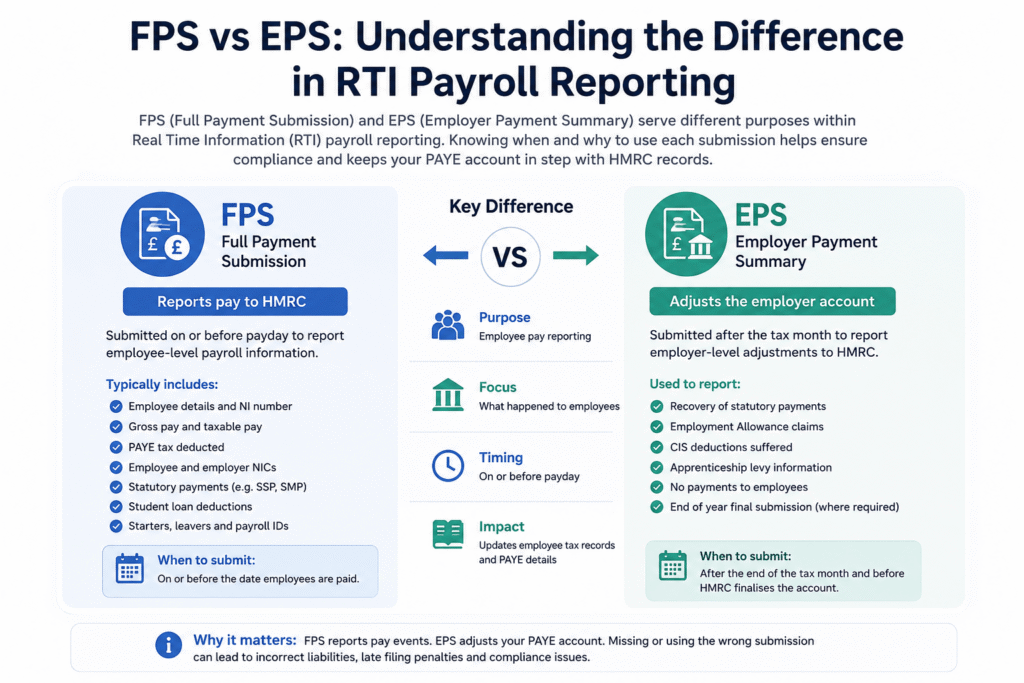
FPS vs EPS comparison
The two submissions are part of the same RTI system, but they answer different questions. They also sit within the wider PAYE filing process, where HMRC expects the submission type, tax month and payroll event to match.
- Question answered by FPS: What did each employee receive, and what was deducted from their pay?
- Question answered by EPS: What adjustment should HMRC make to the employer’s PAYE liability?
- Typical timing for FPS: On or before the employee’s payday.
- Typical timing for EPS: After the end of the tax month, generally by the 19th of the following tax month for HMRC to apply it to that period.
- Level of detail: FPS is employee-level; EPS is employer-account level.
- Common trigger: FPS is triggered by paying staff; EPS is triggered by adjustments, no-pay periods or certain claims.
The timing difference is often overlooked. Payroll teams tend to focus on the pay run deadline because employees need to be paid. The EPS deadline can feel less urgent because it does not normally affect employees’ net pay. Yet it can affect the employer’s PAYE balance and HMRC’s view of whether the account is up to date.
Why the difference matters beyond payroll software
Modern payroll software can create the impression that RTI compliance is largely automatic. In reality, software follows inputs, settings and process discipline. It may generate the submission, but it cannot always know whether the employer has correctly interpreted the payroll event.
A few examples show the point.
If a company pays staff monthly and submits an FPS on time, HMRC receives the employee pay and deduction data. If the company also needs to recover statutory maternity pay but fails to submit an EPS, the internal payroll reports may show the recovery while HMRC’s PAYE account may not.
If a small employer has a month with no wages because the director takes dividends only, HMRC may still expect an RTI update. In that situation, an EPS may be required to tell HMRC that no employees were paid. Without it, HMRC may assume a submission is missing.
If a limited company subcontractor has CIS deductions suffered by contractors and wants to offset those deductions against PAYE liabilities, an EPS is normally the mechanism used to report that offset. This is not the same as reporting deductions made from subcontractors paid by the company. CIS can affect payroll reporting from both directions, which is why construction payroll often needs tighter controls than a standard office payroll.
Common misunderstanding: “We filed payroll, so HMRC knows everything”
One of the most persistent RTI misunderstandings is the belief that filing the monthly payroll automatically covers every HMRC payroll matter. It does not.
An FPS may tell HMRC that employees were paid correctly, but it may not tell HMRC that the employer is entitled to reduce the PAYE payment because of statutory pay recovery or CIS deductions suffered. Equally, if no employees were paid, there may be no FPS, but HMRC may still need an EPS to explain the absence of payroll data.
This gap often becomes visible only after HMRC issues a PAYE notice, the online account shows a balance that does not match internal records, or a year-end reconciliation exposes differences between payroll reports and HMRC liabilities.
By that point, the employer may have to reconstruct what happened several months earlier: who was paid, what was submitted, which tax month the submission related to, whether the EPS was accepted, and whether the PAYE payment reference was used correctly. The administrative burden is usually greater than it would have been if the payroll controls were clear at the time.
How timing works in practice
UK PAYE months run from the 6th of one month to the 5th of the next. This matters because RTI submissions are tied to tax periods, not simply calendar months.
For an FPS, the critical date is usually the employee’s contractual or actual payday. If employees are paid on 31 May, the FPS should normally be submitted on or before 31 May. If payroll is processed early because of a bank holiday, the reported payment date still needs careful handling. The pay date entered in the software should reflect the payroll reality, not just the processing date.
For an EPS, the key practical deadline is usually the 19th after the end of the tax month if the employer wants HMRC to take the adjustment into account for that period. PAYE and NIC payments are generally due by the 22nd if paid electronically, or the 19th if paid by post, although payment frequency and employer circumstances can vary.
This creates a narrow operational window. Payroll may be finalised, the EPS may need review, and the PAYE payment may need authorisation by finance. In a small business, the same person may be handling wages, bookkeeping, supplier payments and VAT records. In a growing company, payroll data may pass between HR, finance and an external bureau. The risk is not usually lack of knowledge; it is a weak handover at the wrong point in the month.
For employers running regular pay cycles, monthly payroll processing needs a clear split between payday filing and post-tax-month review. Treating both as one software task is where missed EPS adjustments often arise.
Where small employers tend to go wrong
Small payrolls are not automatically simple payrolls. A director-only payroll, a business with one employee, or a company paying casual staff may still face RTI timing and reporting issues.
Typical failure points include:
- running payroll after the pay date because cash flow was uncertain;
- assuming no submission is needed when no wages are paid;
- using the wrong pay date in payroll software;
- forgetting to submit an EPS after statutory pay recovery;
- claiming Employment Allowance in the software but not checking HMRC recognition;
- changing payroll software mid-year without reconciling year-to-date figures;
- duplicating employees because payroll IDs are not handled correctly;
- treating CIS suffered as a bookkeeping issue only, rather than a PAYE reporting issue where relevant.
The smaller the payroll, the more likely it is that the process depends on memory rather than documented controls. That may work for ordinary months. It is less reliable when there is a starter, leaver, maternity leave, irregular director salary, CIS offset, software migration or HMRC query.
Where employers need more reliable PAYE routines, the underlying payroll services process should be designed around filing dates, approval points and evidence retention rather than only net pay calculations.
Construction payroll and CIS add another layer
Construction businesses often experience more FPS and EPS complexity than they expect. This is partly because payroll, subcontractor payments, CIS returns and bookkeeping records can overlap without being the same thing.
A company employing site staff must report employee wages through FPS submissions like any other employer. If it also pays subcontractors, CIS deductions made from those subcontractors are handled through CIS reporting, not simply through the FPS. If the company itself suffers CIS deductions from contractors, those deductions may be offset against PAYE liabilities through the EPS if the company is eligible and the figures are correctly maintained.
The confusion usually comes from using the phrase “CIS payroll” loosely. Employees, subcontractors and company-level CIS suffered all have different reporting routes. Mixing them can distort PAYE liabilities, create reconciliation problems, or cause HMRC balances to appear wrong even where the underlying payments were made.
For construction firms, the strongest control is not just a payroll checklist. It is a joined-up month-end process that agrees payroll records, CIS suffered, CIS deducted, bookkeeping entries and HMRC submissions before PAYE payments are made.
Payroll software helps, but it does not remove judgement
Xero Payroll, QuickBooks Payroll, Sage Payroll and other online payroll systems can handle FPS and EPS submissions efficiently when configured correctly. They can also reduce manual error by carrying forward employee data, calculating PAYE and NIC, and storing submission records.
However, software does not remove the need to understand what is being submitted. Common software-related issues include:
- assuming an FPS has been accepted because it was created, without checking submission status;
- not realising an EPS is optional in some months but essential in others;
- entering statutory pay but failing to review the employer recovery position;
- changing settings for Employment Allowance without checking eligibility and HMRC account treatment;
- processing payroll in one period while reporting the wrong payment date;
- moving between systems without preserving payroll IDs and year-to-date data properly.
Payroll software is strongest when the underlying process is disciplined. Good payroll software setup should reflect pay frequency, employee records, RTI credentials, payment dates and employer adjustment rules before the first live submission is made.
Someone still needs to know what should happen before payday, what should happen after the tax month ends, and what evidence should be retained if HMRC later queries the account.
What HMRC sees — and why your records may not match
HMRC’s systems build the employer PAYE account from RTI submissions, payments received and adjustments processed. The employer’s records may be built from payroll reports, bookkeeping entries and bank payments. These are related, but they are not identical data sets.
Differences can arise where:
- an FPS was submitted late, duplicated or corrected;
- an EPS was missed or submitted for the wrong tax period;
- PAYE was paid with an incorrect reference;
- statutory pay recovery was recorded internally but not recognised by HMRC;
- CIS suffered was offset in bookkeeping but not properly reported through payroll RTI;
- software reports were changed after submissions had already been sent;
- an employee’s year-to-date figures were corrected but the correction was not reflected as expected.
This is why payroll reconciliation matters. A business should not rely only on the net wage payments leaving the bank. It should also reconcile gross pay, PAYE tax, National Insurance, pension deductions, statutory pay, CIS offsets where relevant, RTI submissions and HMRC account balances.
For larger employers, this is a control issue. For smaller employers, it is often a continuity issue: if the person who normally runs payroll is away, leaves the business, or changes software, the new person needs enough records to understand what has already been reported.
Corrections: what happens if an FPS or EPS is wrong?
Payroll corrections are possible, but the method depends on the timing and nature of the error. Some FPS errors can be corrected by submitting updated year-to-date figures in a later FPS. In other cases, an additional or corrected submission may be required. After the end of the tax year, the correction route may differ.
EPS errors also need careful handling because they affect employer-level liabilities. If an employer has overstated a recovery or missed an adjustment, the correction may change the PAYE amount HMRC expects. That can affect cash flow, interest exposure and month-end reconciliation.
The practical point is that corrections should not be made casually just to force software reports to match a desired figure. Before correcting RTI submissions, the employer should identify the original error, the tax period affected, what HMRC has already accepted, what has been paid, and whether the correction changes employee records or only the employer account.
Payroll is cumulative across the tax year. A small correction made in the wrong place can create a second difference that is harder to identify later.
FPS, EPS and year-end payroll
At the end of the tax year, RTI reporting feeds into employee records, employer PAYE reconciliation and year-end payroll documents. Employees rely on accurate payroll records for their P60s, tax codes and personal tax position. Employers rely on accurate submissions to support PAYE compliance and accounting records.
The year-end process is not only about pressing a finalisation button. It should include checks such as:
- all pay periods have been submitted through FPS where required;
- starters and leavers have been treated correctly;
- statutory payment recovery has been reported through EPS where relevant;
- Employment Allowance claims are consistent with eligibility and payroll records;
- CIS suffered offsets are supported by contractor statements and bookkeeping records;
- HMRC PAYE balances have been reviewed against internal payroll reports;
- employee year-to-date figures look reasonable before P60s are issued.
Year-end is often where earlier shortcuts become visible. A missed EPS in July, an incorrect payroll ID in October or an unresolved PAYE payment allocation can complicate the final position months later.
Director payrolls and irregular payments
Director payrolls deserve specific attention because they often do not follow a standard monthly salary pattern. Some directors take a regular salary. Others take occasional payments, combine salary with dividends, or pause salary during cash-constrained periods.
RTI obligations do not disappear because the payroll is small or director-only. If a director is paid through payroll, the FPS timing rules still matter. If no payment is made in a tax month, the employer may need to consider whether an EPS is required to report no payment. If the director is paid irregularly, the payroll setup and reporting indicators should be reviewed so HMRC does not interpret missing months incorrectly.
There is also a wider accounting point. Director salary decisions may interact with Corporation Tax planning, dividend records, director loan accounts and bookkeeping entries. The FPS and EPS do not decide those wider matters, but inaccurate payroll reporting can make them harder to support cleanly.
Household and one-employee payrolls are not exempt from RTI discipline
Household employers and one-employee companies sometimes underestimate RTI because the payroll feels informal. A nanny, carer, personal assistant or single administrative employee may be paid regularly, but the employer may not have a finance team or payroll department behind the process.
The risk is usually practical rather than technical. Pay dates shift around holidays, pension duties are forgotten, payroll software is checked only occasionally, and HMRC letters may not be understood quickly. An FPS still needs to reflect the pay event. An EPS may still be relevant if there is a no-pay period or employer-level adjustment.
Small payroll does not mean low importance. For the employee, payroll records affect tax, National Insurance, payslips and sometimes benefit or mortgage evidence. For the employer, poor records can turn a simple payroll into a time-consuming compliance clean-up.
A practical workflow for keeping FPS and EPS under control
A reliable payroll workflow separates the pre-payday tasks from the post-tax-month checks. That separation helps prevent the most common confusion between FPS and EPS.
Before payday
- Confirm starters, leavers, salary changes, overtime, deductions and statutory pay data.
- Check tax codes, National Insurance categories and pension settings.
- Run payroll reports and review unusual movements.
- Submit the FPS on or before the payment date.
- Check that the FPS has been accepted, not merely created.
After the tax month ends
- Review whether an EPS is required for statutory recovery, Employment Allowance, CIS suffered or no payment to employees.
- Submit the EPS in time for HMRC to apply it to the correct PAYE period, normally by the 19th after the end of the tax month where an EPS is required.
- Reconcile payroll reports to the PAYE amount due.
- Check HMRC’s employer account where available.
- Keep submission receipts, payroll reports and supporting records together.
This workflow is not complicated, but it needs ownership. The person making the bank payment should know whether the RTI submissions have been accepted. The person maintaining the bookkeeping should know whether payroll liabilities have been adjusted by EPS. The person reviewing HMRC balances should know where to find the underlying payroll evidence.
Record keeping: the part that protects the filing position
Payroll compliance is not only about sending data to HMRC. Employers also need records that explain how the figures were reached. This includes employee details, gross-to-net calculations, tax code notices, statutory pay evidence, pension records, CIS statements where relevant, RTI submission confirmations and PAYE payment records.
Good records matter when HMRC’s view differs from the employer’s view. They also matter during software changes, accountant handovers, director changes and year-end review. Without records, the business may know that payroll was “done”, but not be able to prove exactly what was filed, when it was filed and why the PAYE payment was calculated as it was.
For SMEs, the most useful habit is to store payroll reports and RTI confirmations by tax month, not just by calendar month or pay date. PAYE reporting follows tax months, and aligning records to that structure makes later reconciliation much easier.
Questions to ask if your PAYE account does not look right
If HMRC shows a PAYE balance that does not match internal records, the answer is not always to make an immediate payment or assume HMRC is wrong. A structured review usually gives a clearer result.
- Were all FPS submissions accepted for the relevant tax months?
- Was an EPS required, and if so, was it submitted for the correct period?
- Were PAYE payments made with the correct Accounts Office reference?
- Do payroll reports agree to bookkeeping entries?
- Were any statutory payment recoveries or Employment Allowance claims included?
- Is CIS suffered being offset correctly and supported by contractor statements?
- Has payroll software been changed, corrected or migrated during the year?
- Are there duplicated employees or changed payroll IDs affecting year-to-date records?
The aim is to identify whether the difference is a filing issue, a payment allocation issue, a bookkeeping issue or a genuine liability. Each has a different remedy.
The strategic lesson: RTI is a control system, not just a filing system
FPS and EPS submissions are often described as compliance filings, but for a well-run business they also operate as controls. They connect payroll calculations, HMRC liabilities, bookkeeping records, pension data and cash payments.
That connection becomes more important as a business grows. A company with a few employees may manage payroll informally for a while. Once there are multiple pay rates, variable hours, statutory leave, benefits, workplace pensions, CIS activity or several people involved in approvals, informal payroll habits begin to create avoidable risk.
The businesses that handle RTI well tend to have a few things in common: clear payroll cut-off dates, properly configured software, documented review points, month-end reconciliation and someone responsible for checking HMRC acceptance rather than assuming submission success.
Key takeaways for employers
- FPS and EPS are not interchangeable. FPS reports employee pay and deductions; EPS reports employer-level adjustments.
- The FPS deadline is linked to payday. It is normally due on or before employees are paid.
- The EPS affects HMRC’s PAYE expectation. Missing EPS submissions can make HMRC balances appear too high.
- No-pay months still need attention. An EPS may be needed to tell HMRC no employees were paid.
- CIS can complicate payroll reporting. CIS suffered, CIS deducted and employee payroll are different records with different reporting routes.
- Software does not replace review. Submission acceptance, tax periods, payment dates and employer adjustments still need checking.
- Reconciliation prevents surprises. Payroll reports, HMRC submissions, bookkeeping entries and PAYE payments should agree or be explainable.
Final perspective
The FPS versus EPS distinction is not merely a payroll technicality. It is one of the points where payroll processing, HMRC reporting, cash flow and accounting records meet.
An employer can pay staff correctly and still have an HMRC mismatch if the wrong RTI submission is missing. Equally, a payroll report can look tidy while the PAYE account remains unsettled because an adjustment has not been reported or a payment has not been allocated correctly.
The safest approach is to treat FPS and EPS as separate parts of one monthly payroll control cycle. The FPS confirms what happened at employee level. The EPS explains what should change at employer account level. Once that distinction is embedded in the payroll process, PAYE reporting becomes easier to review, easier to reconcile and less likely to create unwelcome surprises later in the tax year.