

Payroll Deadlines UK: Key Dates Every Employer Should Know
Payroll deadlines are rarely missed because an employer does not care about compliance. More often, they are missed because payroll sits at the point where several moving parts meet: employee changes, timesheets, pensions, bank processing, PAYE reporting, bookkeeping cut-offs, cash flow and HMRC filing obligations.
For a small employer, the work may look straightforward from the outside. Pay staff, send a report to HMRC, keep records. In practice, the timing matters as much as the calculation. A payroll that is technically correct but submitted late can still create problems. A payment that reaches employees on the wrong day can damage trust. A PAYE liability overlooked until after the payment deadline can strain cash flow unnecessarily.
Leave your details and our team will get back to you shortly.
This guide explains the main payroll deadlines UK employers need to understand, how HMRC payroll deadlines fit into the monthly payroll cycle, and why a reliable payroll calendar is not just an administrative convenience but a control point for the wider business.
The payroll cycle is built around more than pay day
Employers often think of payroll dates in terms of the day employees receive their wages. That is understandable: pay dates are visible, emotional and operationally important. But for compliance purposes, pay day is only one part of the timetable.
A typical UK payroll cycle usually involves several deadlines:
- collecting hours, overtime, commission or absence data;
- processing starters, leavers and salary changes;
- calculating PAYE, employee National Insurance and employer National Insurance;
- assessing pension contributions and auto-enrolment duties;
- submitting payroll information to HMRC through Real Time Information;
- paying employees through the bank;
- paying PAYE and National Insurance to HMRC;
- keeping payroll records and reconciling payroll to the accounts.
The mistake is treating these as separate tasks. They are connected. A late timesheet can delay payroll processing. Delayed payroll processing can compress the RTI filing window. A rushed submission can lead to errors in pay, tax codes or pension deductions. A payroll journal posted late can leave management accounts, VAT records or cash flow forecasts out of step with reality.
The main HMRC payroll deadlines employers need to know
HMRC’s payroll system is based on Real Time Information, commonly known as RTI. Employers must report pay and deductions to HMRC on or before the date employees are paid. This is the central payroll submission deadline UK employers need to build around.
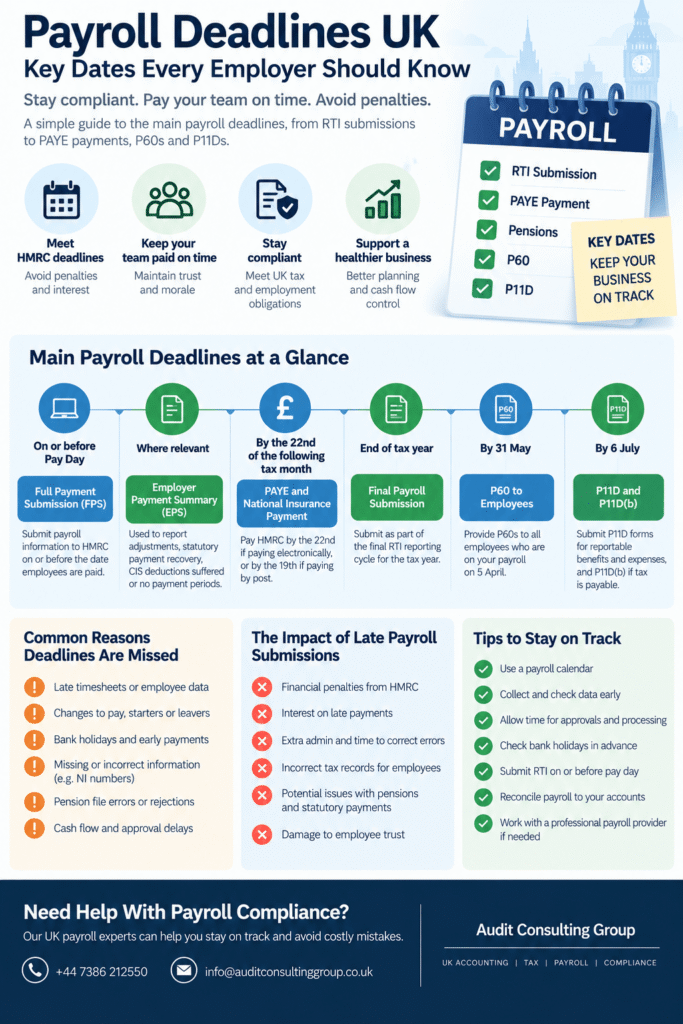
The most important HMRC payroll deadlines are:
- Full Payment Submission: normally sent to HMRC on or before each employee’s pay day.
- Employer Payment Summary: used where relevant to report adjustments such as statutory payment recovery, Construction Industry Scheme deductions suffered, or periods where no employees were paid.
- PAYE and National Insurance payment: due to HMRC by the 22nd of the following tax month if paying electronically, or the 19th if paying by post.
- Final payroll submission of the tax year: submitted as part of the final RTI reporting cycle for the tax year.
- P60 deadline: employees who are on the payroll at 5 April must receive their P60 by 31 May.
- P11D and P11D(b) deadline: where benefits and expenses are reportable, forms are generally due by 6 July after the tax year.
These dates sound manageable when listed neatly. The difficulty is that real payroll does not happen in a neat environment. Bank holidays intervene. Directors approve payroll late. A new starter’s details arrive without a National Insurance number. A leaver queries holiday pay. A pension provider rejects a file because a date of birth is missing. The deadline remains fixed while the inputs move around.
Why “on or before pay day” is the deadline that catches employers out
The Full Payment Submission is not something to deal with after wages have gone out. It is supposed to be filed on or before the date employees are paid. That point matters because some employers still mentally separate “running payroll” from “filing payroll”. Under RTI, the filing is part of the pay event. For more detail on the filing side of PAYE, employers may find this explanation of filing PAYE returns useful alongside HMRC guidance.
If staff are paid on the last working day of the month, the FPS should normally be submitted no later than that date. If wages are paid early because of Christmas, a bank holiday or a business closure, the payroll reporting position needs to be considered before the payment is made. HMRC has specific guidance for some early Christmas payments, but employers should not assume that informal changes to pay dates have no reporting effect.
The practical lesson is simple: pay dates UK employers use internally must match the dates reported through payroll. If the business changes the actual payment date, payroll needs to know before the file is submitted and before the bank payment is released.
Monthly payroll deadlines: a realistic working timetable
For employers paid monthly, the payroll calendar usually needs to start well before pay day. A workable month-end process might look like this:
- Seven to ten working days before pay day: collect timesheets, overtime, bonuses, unpaid leave, statutory leave details and starter or leaver information.
- Five working days before pay day: process payroll, check tax codes, review unusual changes and prepare draft reports.
- Three working days before pay day: approve payroll, prepare bank payments and review employer costs.
- On or before pay day: submit the FPS to HMRC and ensure employees are paid on the correct date.
- After pay day: post payroll journals, reconcile net pay, review PAYE liabilities and prepare pension uploads where required.
- By the 22nd of the following tax month: pay PAYE and National Insurance electronically to HMRC, unless a different payment method or arrangement applies.
This timetable is not a legal requirement in itself. It is a practical control structure. The legal deadlines are the HMRC filing and payment dates, but meeting them reliably depends on earlier internal deadlines that employees, managers and finance teams respect. Where a business needs a more structured recurring cycle, monthly payroll management is often the point at which cut-offs, approvals and reconciliations become formalised rather than informal.
Payroll calendar UK: how the tax month affects deadlines
UK payroll does not run only by calendar month. HMRC tax months run from the 6th of one month to the 5th of the next. This creates occasional confusion, especially for employers who think in terms of month-end accounts.
For example, pay made on 30 April falls in tax month 1, which runs from 6 April to 5 May. The PAYE and National Insurance arising from that payroll is normally payable electronically by 22 May. Pay made on 31 May falls in tax month 2, with electronic payment normally due by 22 June.
This distinction matters for bookkeeping and cash flow. Payroll reports may be prepared by calendar month, while HMRC liabilities follow tax months. If the finance team does not understand the difference, the business may accrue costs in one reporting period but pay HMRC in another, which can distort management accounts or short-term cash planning.
Key payroll dates UK employers should track during the tax year
Although every employer has its own pay frequency, several payroll dates UK businesses should have in their annual calendar are broadly consistent.
- 5 April: end of the UK tax year.
- 6 April: start of the new tax year, often involving threshold, tax code and payroll software updates.
- 19th of each month: postal PAYE payment deadline for the previous tax month.
- 22nd of each month: electronic PAYE payment deadline for the previous tax month.
- 31 May: deadline for giving P60s to employees employed at 5 April.
- 6 July: deadline for submitting P11D and P11D(b), where required.
- 19 July: Class 1A National Insurance postal payment deadline, where applicable.
- 22 July: Class 1A National Insurance electronic payment deadline, where applicable.
There are also pension deadlines set by pension providers and auto-enrolment rules, which may not mirror HMRC deadlines. This is a common weak point. A payroll can be filed correctly with HMRC but still create pension administration issues if contribution files or payments are late.
UK Payroll Deadlines at a Glance
| Payroll Deadline | What Employers Need to Do | When It Is Due | Who It Applies To |
|---|---|---|---|
| Full Payment Submission (FPS) | Report employee pay and deductions to HMRC through RTI | On or before the employee’s pay day | Employers making reportable payments through PAYE |
| Employer Payment Summary (EPS) | Report relevant adjustments, recoveries or other information not included in the FPS | According to the relevant HMRC reporting timetable | Employers that need to submit an EPS for the tax period |
| PAYE & National Insurance – Electronic Payment | Pay PAYE and National Insurance due to HMRC | Normally by the 22nd of the following tax month | Employers paying HMRC electronically |
| PAYE & National Insurance – Postal Payment | Pay PAYE and National Insurance due to HMRC | Normally by the 19th of the following tax month | Employers paying by post |
| Payroll Year End | Complete the final payroll reporting cycle for the tax year | Tax year ends 5 April | PAYE employers |
| P60 | Provide a P60 to employees who were on the payroll at the end of the tax year | By 31 May | Employees who were on the payroll at 5 April |
| P11D & P11D(b) | Report relevant taxable benefits and expenses where required | By 6 July | Employers with reportable benefits or expenses |
| Class 1A National Insurance | Pay Class 1A National Insurance where applicable | Normally by 22 July electronically or 19 July by post | Employers with a Class 1A National Insurance liability |
Important: These statutory dates should sit alongside the employer’s own payroll cut-offs, approval dates, bank processing times and pension deadlines. A practical payroll calendar should therefore begin before the HMRC deadline, not on it.
Payroll calendar 2026 UK: planning beyond the current month
Employers searching for a payroll calendar 2026 UK are usually trying to avoid last-minute pressure around bank holidays, year-end and monthly cut-offs. That is sensible. Payroll planning works best when it looks ahead, not when it reacts to each month as it arrives.
For pay dates 2026 UK employers should pay particular attention to months where normal pay days fall near weekends or bank holidays. If the business pays on the 25th, the last working day, or the final Friday of the month, the actual payment date may move several times during the year. Each movement needs to be reflected in payroll processing, approval and RTI submission timing.
The most useful payroll calendar is not just a list of statutory dates. It should include:
- internal cut-off dates for payroll changes;
- manager approval deadlines;
- bank file submission dates;
- employee pay dates;
- FPS submission dates;
- PAYE payment deadlines;
- pension file and payment dates;
- year-end reporting dates;
- holiday periods where staffing may affect approvals.
For 2026, the principle is the same as any year: do not wait for a statutory deadline before beginning the payroll process. The compliance deadline is the end point. The operational deadline is earlier. Employers should also verify final dates against HMRC guidance, pension provider requirements and banking calendars before confirming payroll schedules to staff.
Weekly, fortnightly and four-weekly payrolls create different pressure
Monthly payroll receives most of the attention, but weekly and fortnightly payrolls can be more demanding. The cycle is shorter, the tolerance for late information is lower, and there is less time to correct errors before the next run begins.
Weekly payroll is common in sectors such as construction, hospitality, care, logistics and agency work. These sectors often involve variable hours, shift changes, overtime, CIS interactions, casual workers or frequent starters and leavers. The payroll filing deadlines are not relaxed simply because the workforce is operationally complex.
Where workers are paid weekly, an FPS is normally required on or before each weekly pay date. PAYE liabilities may still be paid monthly to HMRC unless the employer is using a different arrangement, but the reporting rhythm is weekly. This creates a recurring compliance dependency: if time records are late every week, payroll risk becomes part of the business model rather than an occasional inconvenience.
What employers often misunderstand about payroll filing deadlines
Several misunderstandings appear regularly in payroll reviews. They are not always dramatic, but they can create avoidable exposure over time.
“The accountant can fix it after pay day”
Some payroll errors can be corrected in later submissions, but that does not make late or inaccurate filing harmless. RTI is designed to report pay as it happens. Repeated corrections may indicate poor controls, and they can create confusion for employees whose tax or Universal Credit position depends on payroll data.
“The payment date is just an internal detail”
The payment date is central to payroll reporting. If employees are paid earlier or later than usual, payroll needs to reflect the actual date. Informal changes made for convenience can create mismatches between bank payments, payslips and HMRC records.
“No pay means no payroll action”
If no employees are paid in a tax month, the employer may still need to tell HMRC, usually through an Employer Payment Summary or another relevant process depending on the circumstances. Silence is not always interpreted correctly by HMRC systems.
“Director payroll is too small to matter”
Single-director companies and employers with one employee still have payroll responsibilities if a PAYE scheme is in place and reportable pay is made. Small payrolls can be neglected precisely because they feel low risk, but missed submissions or unclear records can complicate year-end accounts and director tax positions. First-time employers should also make sure PAYE registration is dealt with before the first reportable payroll is due.
The cash flow side of PAYE deadlines
Payroll deadlines are not only compliance dates; they are cash flow dates. Employers must fund net wages, PAYE, National Insurance, employer National Insurance and pension contributions. These amounts do not always leave the bank account on the same day, which can create a misleading sense of available cash.
A business may pay staff at month end, then pay HMRC by the 22nd of the following tax month, then pay pension contributions shortly afterwards. If management accounts do not accrue payroll costs properly, the bank balance may look healthier than the business position really is.
This is particularly relevant for growing employers. Adding employees increases more than gross wages. Employer National Insurance, pension contributions, holiday accrual, statutory pay exposure and administrative workload all rise. Payroll deadlines become part of working capital management, not just payroll administration.
How payroll interacts with bookkeeping, VAT and accounts
Payroll data feeds the wider accounting records. Net wages, PAYE liabilities, pension deductions and employer costs all need to be posted correctly. If payroll journals are missing, late or inaccurate, the effect spreads into bookkeeping, management accounts and year-end accounts.
VAT is not charged on wages, but payroll can still affect VAT-registered businesses indirectly. Labour costs influence pricing, margins and cash flow. For businesses using management accounts to monitor performance, late payroll information can make monthly figures unreliable. A director reviewing profit before payroll journals are posted may make decisions based on incomplete numbers.
For companies, payroll also intersects with Corporation Tax calculations because staff costs affect taxable profits. For owner-managed companies, director salaries, dividends, benefits and reimbursed expenses need to be considered carefully and recorded consistently. Payroll does not sit in isolation from tax planning or statutory accounts.
CIS and construction payroll: where deadlines become more layered
Construction businesses often face a more complicated timetable because payroll may sit alongside Construction Industry Scheme reporting. Employees, subcontractors and labour-only arrangements can be confused in practice, especially where a business grows quickly or uses a mixture of site labour.
CIS monthly returns have their own deadlines, and CIS deductions suffered may affect payroll reporting in certain circumstances. Employers in construction need clear distinctions between employees paid through payroll and subcontractors reported under CIS. Misclassification can create tax, National Insurance and employment status issues, as well as administrative corrections.
The operational risk is not just missing a date. It is building a process where site records, subcontractor verification, payroll data and bookkeeping do not agree with each other. Once that happens, deadline pressure exposes deeper record-keeping weaknesses.
Year-end payroll is a process, not a single event
The tax year ends on 5 April, but payroll year-end work starts before then. Employers need to ensure final pay runs are accurate, leavers have been processed correctly, statutory payments are recorded, benefits are identified and payroll software is ready for the new tax year.
The final FPS or EPS for the year confirms the closing position to HMRC. After that, employees who were employed on 5 April must receive P60s by 31 May. If benefits or expenses are reportable, P11D and P11D(b) filings may be needed by 6 July, with Class 1A National Insurance paid by the July deadline.
New tax year preparation is just as important. Tax thresholds, National Insurance rates, student loan plan settings, tax codes and pension parameters may change. Employers relying on payroll software still need to check that updates have been applied and that carried-forward employee data is sensible.
Bank holidays and early pay: the quiet source of payroll errors
Bank holidays create payroll risk because they disrupt normal assumptions. If the usual pay date falls on a weekend or bank holiday, the business must decide whether to pay earlier or later. That decision affects cash flow, employee expectations, bank processing and RTI reporting.
Christmas payroll is a familiar example. Employers may pay staff earlier than usual so wages arrive before the holiday closure. That early payment needs to be planned properly. Payroll teams need enough time to process and approve pay, submit the FPS correctly, and communicate payslip timing to employees.
The problem is often not technical knowledge. It is communication. HR may agree a payment date. Finance may manage the bank file. Payroll may be told after the event. Employees may assume the same arrangement will apply every year. A good payroll calendar UK employers can rely on should remove ambiguity before holiday periods arrive.
Payroll controls that make deadlines easier to meet
Reliable payroll depends on controls that are modest but consistently applied. Over-engineering the process can slow smaller employers down, but having no structure usually creates more work later.
Useful controls include:
- a written payroll timetable with internal cut-off dates;
- a named person responsible for approving payroll changes;
- evidence for salary changes, bonuses and deductions;
- starter and leaver checklists;
- regular reconciliation between payroll reports and bank payments;
- review of PAYE liabilities before HMRC payment dates;
- pension contribution checks against payroll deductions;
- restricted access to payroll software and employee bank details;
- a year-end checklist covering P60s, benefits and new tax year updates.
These controls are not only for larger employers. A business with five employees can suffer if an incorrect bank detail is used, a leaver remains on payroll, or HMRC payments are based on old figures. The smaller the team, the more likely it is that one person holds too much of the payroll knowledge informally. Clear payroll controls help turn deadline management from a memory-based task into a repeatable process.
What a missed payroll deadline can mean in practice
Not every missed deadline leads to immediate disaster. HMRC systems can allow corrections, and genuine errors can often be addressed. But repeated or unexplained late filing may result in penalties, interest or increased scrutiny. More importantly, missed payroll deadlines can create practical disruption inside the business.
Employees may lose confidence if wages or payslips are late. Directors may make cash decisions without allowing for PAYE liabilities. Bookkeeping records may fall behind. Pension contributions may need investigation. If payroll errors affect tax codes, student loans or statutory payments, employees may expect the employer to resolve issues quickly, even where the correction depends on HMRC processing.
The reputational effect inside the workforce is often underestimated. Staff rarely see the complexity behind payroll. They see whether they were paid correctly and on time.
Questions employers should ask before the next payroll run
A useful payroll review does not need to begin with software or outsourcing. It can start with practical questions:
- Do we have fixed internal deadlines for payroll information?
- Are our pay dates clearly documented for the year ahead?
- Do managers understand that late changes can affect HMRC submissions?
- Are FPS submissions being made on or before pay day?
- Do payroll reports reconcile to bank payments and bookkeeping records?
- Are PAYE liabilities reviewed before the 22nd of each month?
- Are pension files and payments checked separately from HMRC filings?
- Do we have a process for starters, leavers, statutory leave and benefits?
- Is year-end payroll planned before 5 April rather than after it?
If the answer to several of these questions is uncertain, the issue is unlikely to be one missed date. It is usually a payroll process that depends too heavily on memory, goodwill or last-minute effort. Smaller employers and director-led companies may find dedicated guidance on payroll services for small businesses helpful when deciding what level of structure is proportionate.
How to build a practical payroll calendar
A useful payroll calendar should be specific to the employer. Generic lists of payroll filing deadlines help, but they do not tell a business when department managers must submit overtime, when directors must approve bonuses, or when the bank file needs to be uploaded.
The calendar should begin with actual pay dates. From there, work backwards. Allow time for data collection, processing, review, approval and bank submission. Then add the HMRC deadlines for FPS filing and PAYE payment. Add pension deadlines separately. Finally, add year-end obligations and any dates affected by bank holidays or business closures.
For employers planning pay dates 2026 UK schedules, this exercise should be done before the year starts. Once employees have been told their pay dates, changing them becomes more sensitive. The calendar should be shared with anyone who influences payroll: directors, HR, finance, department managers and external advisers where relevant.
Why payroll deadlines deserve board-level attention in growing businesses
In a very small business, payroll may be seen as an admin task. As headcount grows, that view becomes risky. Payroll becomes a recurring financial commitment, a compliance obligation, a data process and an employee trust issue.
Directors remain responsible for ensuring the company meets its obligations, even where payroll processing is delegated. That does not mean directors need to run every payroll calculation personally. It does mean they should understand the key deadlines, review payroll cost trends, ensure PAYE is paid, and make sure the business has adequate controls.
Companies House deadlines are separate from payroll, but the connection appears through accounting records and statutory accounts. If payroll records are incomplete or poorly reconciled, company accounts may require additional adjustments. For owner-managed businesses, payroll decisions can also affect director remuneration planning and tax reporting. Companies House does not receive routine payroll filings, but weak payroll records can still affect the quality of company accounting records.
Key takeaways for UK employers
- The central payroll submission deadline UK employers need to remember is that the FPS is normally due on or before pay day.
- Electronic PAYE and National Insurance payments are generally due to HMRC by the 22nd of the following tax month.
- Payroll dates should be planned around actual pay dates, bank processing, internal approvals and HMRC reporting.
- A payroll calendar UK employers can use properly should include internal cut-offs, not only statutory deadlines.
- Weekly payrolls often carry more operational pressure than monthly payrolls because the correction window is shorter.
- Payroll year-end requires preparation before 5 April and follow-up work through May, July and beyond where benefits apply.
- Payroll records should reconcile with bookkeeping, pensions, PAYE liabilities and management accounts.
- Bank holidays and early payments need explicit planning because they can change the practical filing timetable.
Final perspective
Payroll deadlines are easy to list and harder to manage. The difference between a compliant payroll and a stressful one is usually not technical knowledge alone. It is the discipline of gathering information early, agreeing pay dates in advance, filing with HMRC at the right point, funding liabilities on time and reconciling the results properly.
For UK employers, the strongest payroll processes are rarely dramatic. They are predictable. People know when information is due. Pay dates are planned. HMRC submissions are not left until after the event. PAYE liabilities are visible before the deadline arrives. Year-end does not come as a surprise.
That is the real value of understanding payroll deadlines UK employers face: not simply avoiding penalties, but creating a payroll rhythm that supports employees, protects cash flow and keeps the wider accounting records reliable.