

What Is RTI Payroll? A Guide to Real Time Information for Employers
RTI payroll is one of those HMRC requirements that can appear deceptively simple from the outside. Pay employees, send a submission, keep records. In practice, Real Time Information affects how employers run payroll, correct errors, manage starters and leavers, handle pensions, reconcile PAYE liabilities and keep HMRC’s view of the business aligned with what has actually happened.
For UK employers, RTI is not a separate payroll system. It is the reporting framework that requires PAYE information to be submitted to HMRC on or before the date employees are paid. The system was introduced to move PAYE reporting away from annual summaries and towards live payroll data. That change matters because HMRC now builds much of its PAYE understanding from the employer’s regular submissions rather than waiting until the end of the tax year.
The operational consequence is clear: payroll is no longer just an internal calculation exercise. Each pay run creates a compliance event.
Leave your details and our team will get back to you shortly.
What RTI payroll actually means
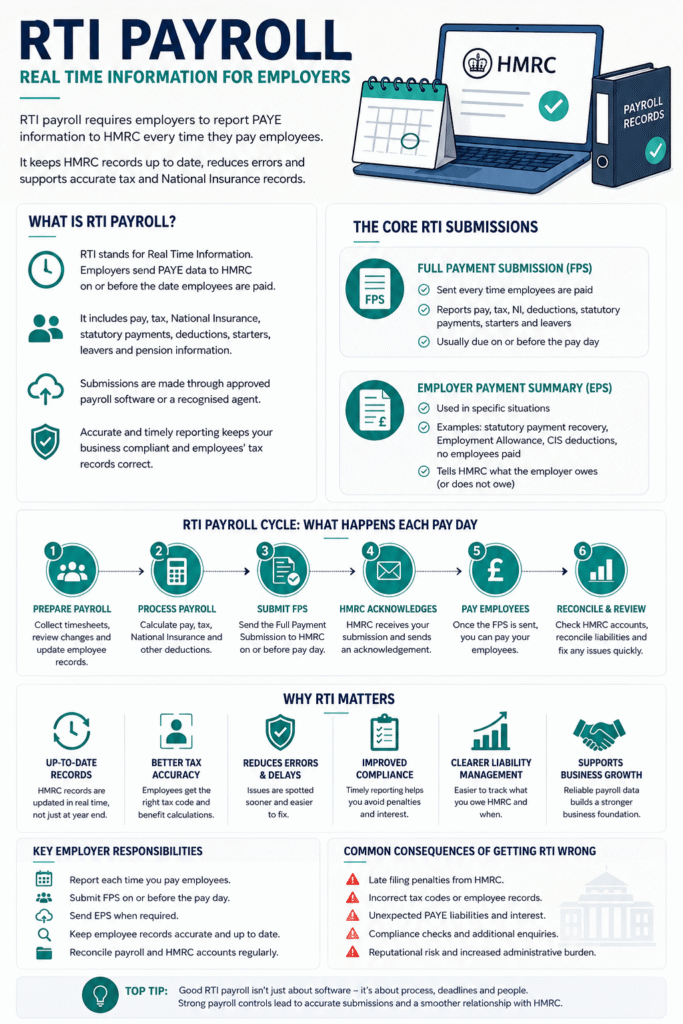
RTI stands for Real Time Information. Under RTI, employers submit payroll information to HMRC every time they pay employees through PAYE. The main submission is the Full Payment Submission, usually referred to as an FPS.
An FPS tells HMRC who has been paid, how much they have earned, what tax and National Insurance has been deducted, and other payroll details such as statutory payments, student loan deductions, pension-related information and leaving dates where relevant. The timing is central: the FPS is normally due on or before the employee’s payday.
There is also an Employer Payment Summary, or EPS. This is used in specific situations, such as reporting statutory payment recoveries, claiming Employment Allowance, notifying HMRC that no employees were paid in a tax month, or adjusting certain amounts due. Not every employer needs an EPS every month, but where it is required, failing to submit one can leave HMRC expecting a payment that does not match the employer’s records.
RTI therefore sits at the centre of PAYE administration. It connects payroll calculations, HMRC reporting, employee tax records, employer liabilities and year-end payroll compliance.
Why HMRC moved payroll reporting into real time
Before RTI, employers generally reported detailed PAYE information at the end of the tax year. That created a long delay between employees being paid and HMRC receiving the full picture. Errors could remain hidden for months. Employees’ tax codes could be based on outdated information. Benefits and tax credit calculations were more difficult to maintain accurately.
RTI changed that rhythm. HMRC receives payroll data throughout the year, which allows it to update employee records more quickly and monitor employer PAYE liabilities with greater precision.
For employers, the advantage is that payroll records can be kept closer to the actual trading position of the business. The downside is that mistakes become visible sooner and timing discipline becomes much more important. A late or incorrect submission can affect not only the employer’s HMRC account but also the employee’s personal tax position.
The submissions employers need to understand
RTI is often described as a single payroll obligation, but in practice it is a set of reporting duties built around different submission types.
Full Payment Submission
The FPS is the core RTI submission. It is sent each time employees are paid. It includes employee pay, PAYE tax, National Insurance contributions, deductions, statutory payments, starter information and leaver information where applicable.
The FPS is not merely a technical file sent from payroll software. It is the employer’s formal payroll report to HMRC for that pay date. If the data is wrong, HMRC’s records may also be wrong.
Employer Payment Summary
The EPS is used to report information that affects what the employer owes HMRC but is not always included in the FPS. This can include statutory payment recovery, Construction Industry Scheme deductions suffered by limited companies, Employment Allowance claims and periods where no employees have been paid.
A common misunderstanding is that no payroll activity means no reporting activity. That is not always the case. If HMRC is expecting PAYE payments and the employer has not paid anyone, an EPS may be needed to tell HMRC there is no payment due for that period. EPS is not a substitute for an FPS; it serves a different reporting purpose.
Earlier Year Update and corrections
Corrections depend on the tax year and the nature of the error. Some errors can be corrected in the next FPS for the current year. Historic errors may require a different process. Employers sometimes underestimate how awkward payroll corrections can become once year-end reporting has passed, especially where payslips, employee records, PAYE accounts and pension submissions have already moved on.
For employers looking at the filing mechanics in more detail, filing for PAYE is the practical process through which FPS and EPS submissions are sent and monitored.
What information is reported under RTI?
An RTI submission can include more than basic gross pay and tax deducted. Depending on the employee and the pay run, the employer may need to report:
- employee name, address, date of birth and National Insurance number where available;
- payroll ID and employment details;
- gross pay, taxable pay and pay frequency;
- PAYE tax deducted;
- employee and employer National Insurance contributions;
- student loan or postgraduate loan deductions;
- statutory sick pay, statutory maternity pay and other statutory payments;
- pension contributions and auto-enrolment-related payroll data;
- starter declaration details, P45 information and leaving dates;
- irregular payment indicators where relevant.
The quality of this information matters. Small inaccuracies can create disproportionate consequences. A wrong payroll ID, missing starter declaration or incorrect leaving date may cause duplicate employment records, incorrect tax codes or employee queries that take time to unwind.
Where employers tend to misunderstand RTI
RTI problems rarely begin with a dramatic failure. They usually start with small assumptions that seem harmless at the time.
One common assumption is that payroll can be finalised after payment has been made. That creates risk because the FPS deadline is normally tied to the payment date, not to when the employer has time to tidy up the payroll file. If staff are paid early because of a bank holiday, holiday period or cash flow decision, the reporting deadline may move with that payment.
Another frequent issue is treating payroll software as if it guarantees compliance. Software can calculate and submit, but it cannot know whether the employer entered the correct start date, selected the right tax code, processed a leaver at the right time or included a director’s pay correctly. RTI compliance depends on the data behind the submission.
Employers also sometimes confuse accounting records with payroll records. Bank payments, bookkeeping entries and management accounts may show what left the business account, but RTI requires employee-level payroll reporting. The two should reconcile, but they are not the same record.
Real-world examples of RTI friction
Consider a small company that pays its director irregularly. If the payroll is not set up properly, the director’s National Insurance position may be mishandled, and HMRC may receive inconsistent pay information. Directors have specific National Insurance calculation considerations, and irregular payroll patterns can make this more sensitive.
Another example is a business that takes on its first employee quickly after winning new work. The owner registers for PAYE, chooses software and pays the employee, but the first FPS is late because the payroll process was not ready before payday. The problem was not a lack of intention; it was a sequencing failure.
Construction businesses can face additional complexity. Payroll, CIS deductions, subcontractor records and employment status decisions may overlap. A worker being moved from subcontractor treatment to payroll is not just a practical payment change. It affects PAYE, RTI reporting, National Insurance, possibly pension duties and the way records are reconciled.
Household employers, hospitality businesses and small companies with variable hours can face a different problem: payroll changes every pay period. Starters, leavers, overtime, casual hours, statutory sick pay and holiday pay can all create moving parts. RTI does not prevent that complexity; it requires the employer to report it accurately and on time.
RTI and PAYE registration
Before an employer can submit RTI payroll reports, they generally need to be registered as an employer with HMRC and have PAYE references. This is particularly relevant for businesses hiring their first employee, paying directors above relevant thresholds, or formalising pay arrangements that were previously informal.
PAYE registration is not something to leave until the first payday has already passed. HMRC references can take time to arrive, and payroll software needs the correct details before submissions can be filed. A rushed setup often leads to avoidable errors: missing references, incorrect pay periods, incomplete employee details or uncertainty over tax codes.
For new employers, the sequence should be thought through before money is paid: decide who is being paid, confirm employment details, register for PAYE where required, set up payroll records, choose compliant software, gather starter information, calculate pay, submit the FPS and pay the employee. The order matters.
How RTI affects employees
Although RTI is an employer reporting obligation, employees feel the consequences when the data is wrong. HMRC may use RTI submissions to update tax codes, track income and maintain employment records. Incorrect payroll information can result in unexpected tax code changes, apparent underpayments or duplicate employment records.
Employees may also notice problems through payslips, personal tax accounts, student loan deductions or Universal Credit calculations. For employers, these issues can become time-consuming because payroll queries often arrive emotionally charged: the employee may not distinguish between an HMRC data issue, a software issue and an employer input error.
Clean RTI reporting reduces this friction. It does not remove every HMRC or employee query, but it gives the employer a defensible audit trail.
RTI, pensions and auto-enrolment
Payroll reporting does not sit apart from workplace pension duties. Auto-enrolment requires employers to assess workers, calculate contributions, communicate with employees and pay pension contributions to the pension provider. RTI and pension reporting are not the same thing, but they depend on the same payroll data.
If gross pay, pay periods, worker categories or employee details are wrong in payroll, pension calculations can also be wrong. For a small employer, that can create two separate problems from one weak process: HMRC records may be inaccurate, and pension obligations may not be met correctly.
This is why payroll setup matters. A payroll system should be configured not only to send FPS files but also to support pension assessment, contribution calculations, payslip reporting and month-end reconciliation.
RTI and bookkeeping reconciliation
Payroll should reconcile with the employer’s bookkeeping records. In practice, this means the payroll reports, PAYE liability, pension deductions, net wage payments and bank transactions should tell the same story.
Where this does not happen, the differences often emerge later. PAYE shown as due to HMRC may not match the amount paid. Net wages in the accounts may not agree with payslips. Pension deductions may sit in the balance sheet without being cleared. Directors’ loan accounts may be affected if payments are treated inconsistently.
RTI has made these weaknesses more visible because HMRC receives regular payroll data. A business may still be able to produce accounts at year end, but if the payroll records have not been reconciled throughout the year, the clean-up can be inefficient and sometimes uncomfortable. Regular payroll reconciliation helps identify those differences before they become year-end problems.
Deadlines and late filing risks
The general rule is that the FPS must be submitted on or before payday. There are limited situations where a late reporting reason can be used, but this should not be treated as a routine workaround. HMRC can issue penalties for late submissions, although the penalty position depends on the circumstances and HMRC’s rules at the time.
Employers should also pay attention to PAYE payment deadlines. Reporting payroll under RTI and paying PAYE to HMRC are related but separate duties. Submitting an FPS does not pay the liability. Paying HMRC does not correct a missing or inaccurate FPS.
This distinction is a source of confusion for small employers. They may believe they are compliant because the PAYE has been paid, while HMRC’s records show missing or inconsistent RTI filings. The reverse can also happen: submissions are made correctly, but payment is late or for the wrong amount.
What a sound RTI payroll workflow looks like
A reliable RTI process is less about dramatic technology and more about disciplined sequencing. The employer needs a repeatable workflow that fits the way the business actually pays people. That may mean a simple in-house routine, a reviewed software process or professional payroll services where the internal team does not have the time or payroll knowledge to manage the process consistently.
A practical monthly payroll routine might include:
- confirming starters, leavers, pay changes, overtime, bonuses and deductions before the payroll cut-off;
- checking tax codes, National Insurance categories and pension status;
- calculating gross-to-net pay through payroll software;
- reviewing exception items before payslips are issued;
- submitting the FPS on or before payday;
- sending payslips to employees;
- paying employees, HMRC and pension providers on time;
- reconciling payroll reports to bookkeeping records and bank payments.
The most resilient employers build in review points before submission. Once employees have been paid and the FPS has gone to HMRC, corrections are still possible, but they are rarely as clean as getting the pay run right before payday. Clear payroll controls are often what separate a routine pay run from a recurring source of HMRC mismatches and employee queries.
Payroll software helps, but configuration decides the outcome
Modern payroll software has made RTI filing far easier than manual processes. Online payroll systems can calculate PAYE, produce payslips, submit FPS and EPS reports, maintain employee records and connect with bookkeeping software.
Yet software quality depends heavily on setup. The employer PAYE reference, Accounts Office reference, pay calendar, pension scheme, employee records, opening balances and year-to-date figures all need to be correct. Moving from one system to another mid-year requires particular care because cumulative payroll values must carry across accurately.
For employers using platforms such as Xero, QuickBooks or Sage, the question is not only whether the system can file RTI. It is whether the payroll software has been configured and reviewed in a way that reflects the business’s actual pay arrangements. Software is an execution tool, not a substitute for payroll judgement.
RTI for small employers and single-director companies
RTI can feel disproportionate for a business with one employee or a company paying only a director. The reporting obligation, however, does not disappear because the payroll is small. A one-person payroll still needs correct PAYE setup, accurate pay records and timely submissions where PAYE reporting is required.
Single-director companies can be especially prone to informal habits. Money may be withdrawn from the company without being clearly separated between salary, dividends, expenses and director’s loan account movements. RTI only deals with payroll, but payroll decisions interact with wider tax and accounting treatment.
This is where director responsibility becomes relevant. Company directors are responsible for ensuring company records are accurate, tax obligations are met and filings are made where required. Companies House accounts, Corporation Tax returns, payroll records and bookkeeping may be separate compliance areas, but weak payroll data can still complicate the wider company record.
RTI and irregular pay
Irregular pay is not unusual. Seasonal employers, owner-managed companies, casual labour businesses and growing SMEs may not pay the same people the same amount every month. RTI can handle irregularity, but the employer must report it properly.
Problems arise where employees are left on payroll records after leaving, casual workers are not marked correctly, directors are paid without a clear pattern, or nil periods are not reported when HMRC expects activity. An irregular payroll needs more attention, not less, because assumptions from the previous month may no longer be valid.
Common RTI payroll errors
The same types of errors appear repeatedly in payroll reviews. They are not always large, but they can be persistent.
- Late FPS submissions: often caused by paying staff before payroll has been finalised.
- Incorrect starter information: leading to tax code issues or duplicate records.
- Missing leaver dates: leaving employees active in HMRC or payroll records longer than they should be.
- Wrong National Insurance category: particularly for directors, apprentices or employees with age-related changes.
- Unreconciled PAYE liabilities: where HMRC’s expected amount does not match the employer’s accounts.
- Incorrect treatment of statutory payments: especially where recovery or compensation needs to be reported through EPS.
- Mid-year software migration errors: caused by inaccurate year-to-date figures or duplicated employee records.
- Confusion between net payments and payroll costs: which can distort bookkeeping and management accounts.
These errors are usually preventable. The difficulty is that they often sit at the boundary between payroll administration, bookkeeping, tax understanding and day-to-day business operations.
How RTI connects with wider business compliance
RTI is payroll-specific, but payroll data flows into broader compliance work. PAYE liabilities affect cash flow. Wage costs feed into management accounts. Payroll taxes and pension contributions affect balance sheet control accounts. Directors’ remuneration may influence Corporation Tax calculations and year-end accounts. CIS deductions suffered by limited companies may interact with EPS reporting.
For VAT-registered businesses, payroll itself is generally outside the scope of VAT, but payroll records still affect financial reporting, staff cost analysis and management information. For construction businesses, the separation between employees, subcontractors and CIS workers needs careful handling because mistakes can affect both payroll and CIS compliance.
This is why RTI should not be treated as a narrow filing chore. It is part of the company’s financial control environment.
What employers should check before relying on their RTI process
An employer does not need to become a payroll technician to run a responsible process, but someone should be asking the right questions. Are all employees on the correct pay frequency? Are tax codes being updated from HMRC notices? Are leavers processed promptly? Are pension deductions reviewed? Does the PAYE liability in the accounts agree with HMRC’s online account? Are payroll journals posted correctly? Are statutory payments and recoveries being handled through the right submission?
The answers reveal whether RTI is genuinely under control or merely being submitted. There is a difference. For smaller teams, this is often where payroll for small businesses becomes less about calculation and more about repeatable process, review and clear responsibility.
Key points for employers
- RTI means PAYE information is reported to HMRC in real time, usually on or before payday.
- The FPS is the main submission; the EPS is used for specific adjustments and notifications.
- EPS is not a replacement for FPS, and no-payment periods may still need reporting.
- Payroll software helps with RTI, but accurate setup and review remain essential.
- Late or incorrect submissions can affect HMRC records, employee tax positions and employer reconciliations.
- RTI payroll should be connected to bookkeeping, pension administration, PAYE payments and year-end accounts.
- Small payrolls still need proper controls, especially where directors, casual workers or irregular pay are involved.
A practical view of RTI payroll
RTI has made payroll more immediate. That is its strength and its challenge. Employers no longer have the luxury of treating payroll as something to tidy up at year end. HMRC expects timely, employee-level information as part of the normal pay cycle.
For well-organised employers, RTI creates a useful discipline: payroll records stay current, PAYE liabilities are easier to monitor, and employee information is less likely to drift. For employers with weak processes, RTI exposes the gaps quickly. The issue is rarely the submission button itself. It is the quality of the payroll process behind it.
The best approach is to treat RTI payroll as a recurring control point within the business. Accurate employee data, timely submissions, clear reconciliations and sensible review procedures do more than satisfy HMRC. They make payroll easier to trust.