

Do I Need to File a Self Assessment Tax Return in the UK?
For some people, Self Assessment is obvious. A sole trader with regular income, a landlord with rental profits, or a partner in a business partnership usually knows that a tax return is part of the annual routine.
The difficult cases are rarely that clear. A director takes dividends from a company but no salary. An employee earns extra income through a side project. Someone rents out a room, sells investments, receives overseas income, or crosses the High Income Child Benefit Charge threshold without noticing. Another person stopped trading part-way through the year and assumes there is nothing left to file.
Self Assessment is not simply a form for the self-employed. It is HMRC’s mechanism for collecting information that is not fully captured through PAYE, payroll reporting, bank interest data, property reporting or other tax systems. The practical question is not “Am I self-employed?” but “Has something happened in the tax year that HMRC needs me to report?”
Leave your details and our team will get back to you shortly.
The short answer: who usually needs to file?
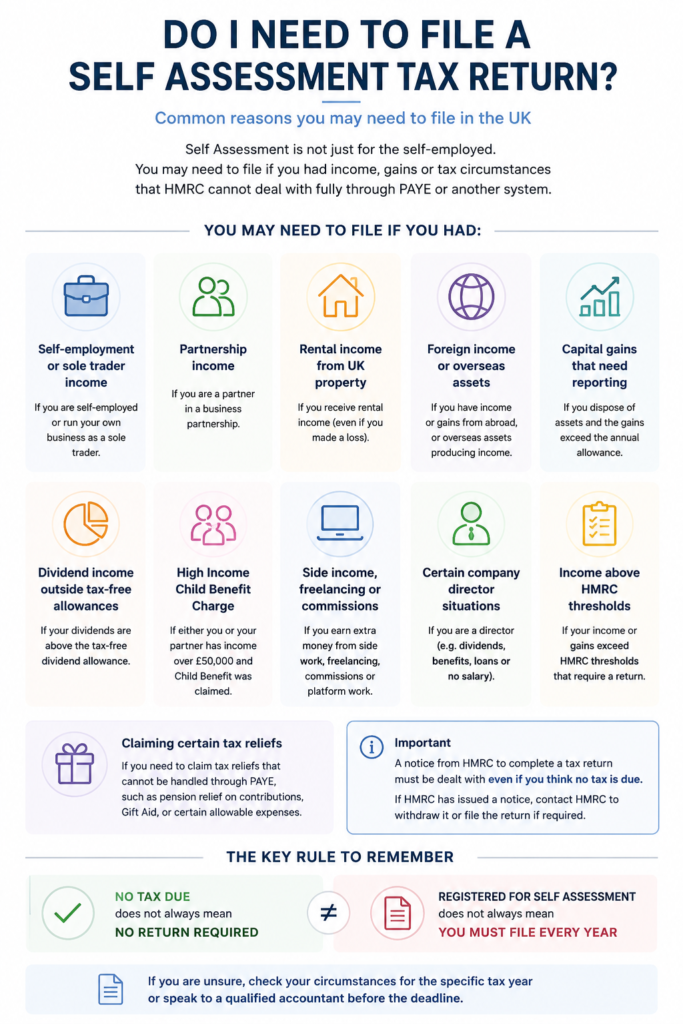
You may need to file a UK Self Assessment tax return if, during the tax year, you had income, gains or tax circumstances that HMRC cannot deal with fully through PAYE or another reporting route.
Common reasons include:
- self-employment or sole trader income;
- being a partner in a business partnership;
- rental income from UK property;
- foreign income or overseas assets producing income;
- capital gains that need reporting;
- dividend income outside tax-free allowances;
- high income where Child Benefit was claimed in the household;
- untaxed income from side work, freelancing or commissions;
- certain company director situations;
- income above HMRC thresholds where a tax return is required;
- claiming certain tax reliefs that cannot be handled through PAYE alone.
That list is useful, but it is not enough. The real issue is the interaction between income type, amount, allowances, tax already deducted, and HMRC’s administrative rules for the specific tax year.
Why Self Assessment catches people out
Most filing mistakes begin with a reasonable assumption. An employee assumes PAYE means all tax is settled. A landlord assumes a small rental loss does not matter. A director assumes Companies House filings cover personal tax. A freelancer assumes occasional income is too small to declare. A parent assumes Child Benefit is not connected to their tax return because the benefit was paid to their partner.
HMRC does not look at those situations through the same lens. PAYE may collect tax on salary, but it does not necessarily collect the right tax on dividends, rental profit, taxable benefits, side income, foreign income or chargeable gains. Companies House receives company accounts and confirmation statements, but it does not replace a director’s personal tax obligations. Payroll submissions report employment pay, but they do not report all personal income.
The boundary between “no tax due” and “no return required” is also widely misunderstood. A person may have no additional tax to pay and still need to file if HMRC has issued a notice to complete a tax return. Conversely, a person may owe tax but not yet be registered for Self Assessment. Those are separate problems, and confusing them often leads to late filing, late payment or inaccurate reporting.
If HMRC sends you a notice to file
If HMRC issues a notice to complete a tax return, the safest starting point is that a return is required unless HMRC formally withdraws the notice. Ignoring it because you believe no tax is due is not the same as resolving it.
This distinction matters. Penalties can arise for failing to file a return after a notice has been issued, even where the eventual tax liability is low or nil. If the return is not needed, the taxpayer should contact HMRC and seek withdrawal of the notice. If HMRC does not withdraw it, the filing obligation usually remains.
This is one reason historic Self Assessment records should not be ignored. A taxpayer may have registered when self-employed years ago, stopped trading, and assumed the matter ended. HMRC may still expect returns until the record is closed or the notice is withdrawn.
Self-employed income and side work
Self-employment is the best-known trigger for Self Assessment, but the practical reality is more nuanced than simply “I did some work for myself”. HMRC generally expects a person to register if they are trading and their gross self-employed income exceeds the relevant trading allowance threshold. The distinction between a hobby, casual income and a trade can be fact-sensitive.
Indicators that activity may be a trade include repeated work, profit-seeking behaviour, advertising, buying materials for resale, invoicing customers, using platforms to secure clients, or operating with some commercial organisation. A one-off sale of personal possessions is different from regularly buying and selling goods for profit.
Side income causes particular confusion because people often receive it alongside employment. PAYE may be operating correctly on wages, but the additional work is not automatically taxed unless it is reported. Delivery work, online freelancing, consultancy, tutoring, beauty services, construction work outside payroll, content income and platform-based earnings can all create Self Assessment obligations. If this has moved beyond casual activity, self-employed registration may need to be considered.
Record keeping matters from the beginning. Bank statements alone may not explain what happened. HMRC may expect evidence of invoices, receipts, mileage records, business expenses, platform statements and dates of activity. Good bookkeeping is not just an administrative preference; it protects the accuracy of the tax return.
Property income: the landlord situations that are often missed
Rental income is one of the most common reasons people need to file a Self Assessment tax return. That includes income from a buy-to-let property, letting a former home, jointly owned property, furnished holiday accommodation, or certain short-term letting arrangements. Landlords with unclear filing obligations often need to look specifically at property tax returns, because the answer depends on profit, ownership and the nature of the letting.
The most common misunderstanding is that mortgage payments are deducted in full. For residential property, finance cost relief has specific rules, and the tax position is not the same as simply subtracting the mortgage from the rent. Repairs, replacements, service charges, insurance, agent fees and allowable costs need to be analysed properly. Capital improvements are not treated in the same way as repairs.
Joint ownership also creates practical issues. Spouses, civil partners, unmarried couples, family members and business partners may not all be taxed in the same way. The legal ownership, beneficial ownership and actual profit-sharing arrangement can matter. If records are weak, the tax return becomes less a calculation and more a reconstruction exercise.
Property income can produce a filing requirement even where the cash result feels modest. A landlord may have rental profit after allowable deductions even if cash flow is tight because of mortgage capital repayments, void periods or maintenance timing.
Company directors, dividends and owner-managed companies
Directors often assume that company accounts deal with everything. They do not. A limited company is a separate taxpayer for Corporation Tax, while the director or shareholder may have personal tax obligations on salary, dividends, benefits, loans or other income.
Not every director automatically needs to file solely because they are a director, but many director-shareholders do because their personal income is not limited to PAYE salary. Dividends are a frequent trigger. So are taxable benefits, director’s loan account issues, expenses not handled correctly, or other untaxed income.
Owner-managed companies create a particular timing problem. Dividends are declared and paid by the company, but they belong on the shareholder’s personal tax return for the relevant tax year. Company bookkeeping, payroll records and dividend paperwork need to agree. If the company records are untidy, the director’s Self Assessment may inherit the same problem.
High income and Child Benefit
The High Income Child Benefit Charge is one of the less intuitive Self Assessment triggers. The person who may need to report and pay the charge is not always the person who received the Child Benefit. The charge can apply where adjusted net income exceeds the relevant threshold and Child Benefit was claimed by the person or their partner.
This catches employees who have never filed a tax return before. Their salary may be fully taxed through PAYE, yet the Child Benefit charge still needs to be dealt with. Pension contributions, gift aid and other adjustments may affect the calculation, so looking only at gross salary can produce the wrong conclusion.
The practical risk is that the issue may not be noticed until HMRC contacts the taxpayer later. By then, several tax years may be involved. It is better to review the position when income changes, not after a letter arrives.
Capital gains, investments and dividend income
Capital gains can create a filing or reporting obligation when assets are sold or disposed of. This may include shares, investment funds, second homes, cryptoassets, business assets or other chargeable assets. A disposal does not always mean cash was received; gifts and transfers can also matter in some circumstances.
UK residential property gains have specific reporting and payment rules, which can sit outside the normal annual Self Assessment rhythm. Waiting until the January deadline may be too late for certain property disposals.
Dividend income is another area where PAYE employees can be caught out. Dividends from a limited company, investment portfolio or overseas shareholding may need to be reported if they exceed available allowances or if HMRC otherwise requires a return. Interest income can also affect the position, especially for higher earners or people with substantial savings.
Foreign income and residence complications
Foreign income is rarely straightforward. UK tax residence, domicile concepts, double tax treaties, foreign tax paid, remittance issues and exchange rates can all affect the reporting position. The income may be from overseas employment, rental property abroad, pensions, dividends, interest or business activity.
A common mistake is assuming that because tax was paid overseas, nothing needs to be reported in the UK. That may be wrong. Foreign tax can sometimes be credited or relieved, but the income may still need to be included on a UK tax return.
People moving to or from the UK should be particularly careful. Split-year treatment, residence status and overlapping tax years can change the answer. These cases are not well suited to guesswork because the consequences of an incorrect assumption can run across several years.
Practical examples
The employee with a profitable weekend trade
An employee earns a salary taxed through PAYE and starts repairing bicycles at weekends. The activity grows through word of mouth, parts are bought for resale, and customers pay by bank transfer. Even if the salary tax is correct, the weekend trade may create a Self Assessment requirement. The taxpayer needs records of income, parts, tools, mileage and other allowable costs.
The landlord with no spare cash
A homeowner lets out a former flat. Mortgage payments, service charges and repairs leave little cash at the end of the year. That does not automatically mean there is no taxable rental profit. The tax calculation depends on allowable expenses, finance cost rules and the ownership position. A tax return may still be required.
The director taking dividends
A director-shareholder takes a modest salary and dividends from a limited company. The payroll is reported through PAYE, but the dividends are personal income and may need to be reported through Self Assessment. The company’s Corporation Tax return does not report the shareholder’s personal dividend tax.
The parent caught by Child Benefit rules
A parent earns more after a promotion while Child Benefit continues to be paid to their partner. The household may fall within the High Income Child Benefit Charge rules. Even if PAYE deducts tax from salary correctly, Self Assessment may be needed to report and pay the charge.
The deadlines that shape the decision
The UK tax year runs from 6 April to 5 April. Self Assessment deadlines are built around that cycle, and missing the administrative dates can create avoidable pressure.
- 5 October: deadline to notify HMRC if you need to register for Self Assessment for the previous tax year and have not filed before.
- 31 October: deadline for paper tax returns, where applicable.
- 31 January: online filing deadline and usual deadline for balancing tax payment for the previous tax year.
- 31 January and 31 July: payment on account dates where applicable.
Payment on account is another surprise for new filers. A taxpayer may budget for the tax due on last year’s income, then discover they also need to make advance payments towards the current year. This can be particularly difficult for sole traders, landlords and directors whose income fluctuates.
What most people get wrong
The same errors appear repeatedly in Self Assessment work. They are rarely dramatic at first; they are usually small misunderstandings that compound.
- Assuming PAYE means all personal tax is complete.
- Confusing company filings with a director’s personal tax return.
- Looking at cash received rather than taxable profit or taxable income.
- Ignoring rental income because the property made poor cash flow.
- Missing the High Income Child Benefit Charge.
- Not registering after starting self-employment or side work.
- Claiming expenses without keeping evidence.
- Forgetting dividends, savings interest or foreign income.
- Believing no tax due means no filing obligation.
- Leaving the decision until January, when records are incomplete.
The pattern behind these mistakes is usually not carelessness. It is the fragmented nature of the UK tax system. Payroll, Companies House, VAT, CIS, bank interest, property records and personal income tax all operate through different channels. Self Assessment often becomes the place where those channels meet.
How to decide whether you need to file
A practical review should begin with the tax year, not the calendar year. Ask what changed between 6 April and 5 April. Did you start trading, stop trading, rent out property, receive dividends, sell assets, earn overseas income, claim Child Benefit in a higher-income household, or receive income that was not taxed at source?
Then consider whether HMRC has already issued a notice to file. If it has, the immediate issue is compliance with that notice or getting it withdrawn. If no notice has been issued, the question becomes whether there is a duty to notify HMRC.
The next step is to separate income from profit. Self-employed people and landlords are generally taxed on profit after allowable deductions, not simply on money received. But the gross income may still matter for registration thresholds, allowances and reporting. That is why waiting until the end of the process to organise records is a poor strategy.
Finally, consider whether the position affects another tax area. A sole trader may also need to think about Class 2 National Insurance, VAT registration, CIS deductions or Making Tax Digital requirements. A director may need to align payroll, dividends, benefits and company accounts. A landlord may need to consider property finance cost rules, capital gains, joint ownership or future disposals.
Records HMRC may expect you to keep
Self Assessment is only as reliable as the records behind it. HMRC does not require every person to use the same software or process, but it does expect taxpayers to keep adequate records to support the figures submitted.
Depending on the circumstances, records may include:
- sales invoices, platform statements and customer receipts;
- business bank statements and payment processor reports;
- purchase invoices and expense receipts;
- mileage logs and travel evidence;
- rental statements, tenancy agreements and property expense records;
- mortgage interest statements for rental property;
- dividend vouchers and company records;
- P60s, P45s, P11Ds and payslips;
- pension contribution evidence and gift aid records;
- capital gains calculations and acquisition records;
- foreign income statements and foreign tax evidence.
The problem is often not that records do not exist. It is that they sit across email inboxes, bank feeds, accounting software, spreadsheets, property agents, payroll systems and personal accounts. Reconstructing them close to the filing deadline increases the risk of omissions and weak expense claims.
VAT, CIS, payroll and other systems can change the picture
Self Assessment does not operate in isolation. A sole trader approaching the VAT registration threshold needs to monitor turnover, not just profit. A subcontractor in construction may have CIS tax deducted at source but still need to file to calculate the final position and claim any repayment due. An employer running payroll may still have separate personal tax obligations if they also trade, receive dividends or own rental property.
For small business owners, this is where compliance becomes operational rather than purely technical. Bookkeeping quality affects VAT returns, Self Assessment, management accounts, cash flow planning and business decisions. Payroll accuracy affects PAYE, benefits and personal tax. Company records affect director-shareholder returns. A small error in one area can create questions in another.
Making Tax Digital is also changing expectations around digital records and reporting. Even where a taxpayer is not yet within a specific MTD obligation, the direction of travel is clear: more frequent digital record keeping, fewer annual reconstructions, and closer alignment between bookkeeping and tax reporting.
What happens if you should have filed but did not?
If you realise you should have registered or filed for an earlier tax year, the worst response is to wait and hope the issue disappears. HMRC has access to increasing amounts of data from employers, banks, platforms, property sources and other reporting channels. Errors can surface later, and delay can make the position more expensive and harder to explain.
The right response depends on the facts. Sometimes the issue is a late registration. Sometimes a tax return is outstanding because HMRC issued a notice. Sometimes an earlier return was filed but contained an error and needs an amended Self Assessment tax return. In more serious cases, a disclosure route may be needed.
Penalties and interest are fact-specific, and it would be unhelpful to treat every late case as the same. What matters is establishing the tax years involved, the reason for the failure, the tax at stake, the available records and the most appropriate route to bring the position up to date. Where HMRC has already charged penalties, the relevant issue may be whether there is a basis to consider Self Assessment penalties and appeals.
How early should you deal with it?
The best time to review the need for Self Assessment is soon after the tax year ends, not in the final week of January. Early review leaves time to register, obtain a Unique Taxpayer Reference if needed, gather missing records, clarify uncertain transactions and budget for tax.
For people with irregular income, earlier review also helps with cash flow. Self Assessment is not only a filing exercise; it determines payment dates, payments on account and sometimes repayment claims. A sole trader with CIS deductions, a landlord with changing mortgage costs, or a director with variable dividends may benefit from understanding the numbers before the deadline becomes urgent.
Where the position is mixed, historic or unclear, careful review can be more useful than relying on a single threshold or online assumption. Audit Consulting Group’s personal tax Self Assessment guidance explains the types of situations where additional clarification may be needed, including late filing, property income, self-employment and corrections.
Key takeaways
- Self Assessment is not only for the self-employed; it applies whenever HMRC needs information not fully dealt with elsewhere.
- PAYE, payroll submissions and Companies House filings do not automatically settle personal tax.
- Rental income, dividends, capital gains, foreign income and Child Benefit rules are common triggers.
- If HMRC issues a notice to file, deal with it formally; do not ignore it because you believe no tax is due.
- Good records are central to accurate filing, especially for expenses, property income, dividends and side income.
- Late registration or late filing can often be corrected, but delay usually makes the position harder to manage.
- Individual circumstances can change the filing requirement from one tax year to the next, so the answer should be reviewed against the facts for the relevant year.
A final professional perspective
The question “Do I need to file a Self Assessment tax return?” looks simple, but the answer often depends on several connected facts. Income type, tax deducted, allowances, HMRC notices, business records, property arrangements, company income and family benefit rules can all change the outcome.
A sensible approach is to treat Self Assessment as an annual checkpoint. If nothing changed, the answer may be straightforward. If income, ownership, employment, directorship, property, investments or family benefit circumstances changed, the position deserves a closer look.
The aim is not to file unnecessary returns or create needless administration. It is to avoid the more expensive problem: discovering too late that HMRC expected information, tax or a formal response that was never provided.