

Payments on Account Explained: How Self Assessment Advance Payments Work
Payments on account are one of the parts of Self Assessment that often surprise people after their first substantial tax bill. The tax return may be correct, the deadline may have been met, and the amount due may have been expected — then HMRC asks for an additional payment towards next year’s tax as well.
For sole traders, landlords, partners, consultants, company directors with untaxed income, and individuals with investment or dividend income, this can create a cash flow shock. The difficulty is not only the size of the payment. It is the fact that the system looks backwards to estimate a forward liability, which does not always reflect how income actually behaves.
Leave your details and our team will get back to you shortly.
This guide explains how Self Assessment payments on account work, why HMRC uses them, who has to make them, how the calculations are made, when reductions may be appropriate, and where businesses and individuals commonly go wrong.
What payments on account actually are
A payment on account is an advance payment towards the following tax year’s Self Assessment liability. HMRC uses the previous year’s tax bill as a practical estimate of what the next year’s liability may be.
The system applies where your Self Assessment tax bill is more than £1,000 and less than 80% of the tax you owe has already been collected at source, usually through PAYE. In practice, this often affects people whose income is not fully taxed before they receive it. Readers who need wider context on filing obligations may find Self Assessment support useful as a related reference.
Typical examples include:
- self-employed individuals and sole traders;
- partners in a business partnership;
- landlords with rental profits;
- company directors receiving dividends;
- freelancers and consultants;
- individuals with untaxed savings, investment or overseas income;
- people with mixed income sources where PAYE does not cover the full tax position.
Payments on account are not an extra tax. They are advance instalments of the next year’s Income Tax and Class 4 National Insurance liability where applicable. The confusion arises because they are collected alongside the balancing payment for the year just filed.
Why HMRC asks for tax in advance
PAYE employees usually pay tax throughout the year as income is earned. Someone taxed through Self Assessment may not pay the final liability until many months after the tax year has ended. Without payments on account, tax on self-employed profits earned in April 2024, for example, might not be fully paid until January 2026.
HMRC’s payment on account system narrows that gap. It is designed to bring Self Assessment taxpayers closer to a pay-as-you-go model, using two instalments based on the previous year’s liability.
That administrative logic is clear enough. The practical issue is that income from self-employment, property, contracting, consultancy, dividends or seasonal trade rarely moves in a straight line. A strong year can create large payments on account for a weaker following year. A new business may face its first major tax bill at exactly the point when cash is being reinvested. A landlord may have taxable profit but limited spare cash after mortgage costs, repairs and void periods.
How the calculation works
HMRC normally calculates each payment on account as 50% of the previous year’s Self Assessment tax and Class 4 National Insurance liability. Class 2 National Insurance, Capital Gains Tax, student loan repayments and certain other amounts are not usually included in the payment on account calculation. The figures are usually generated through the Self Assessment calculation after personal tax filing, then shown on the taxpayer’s HMRC online account or statement.
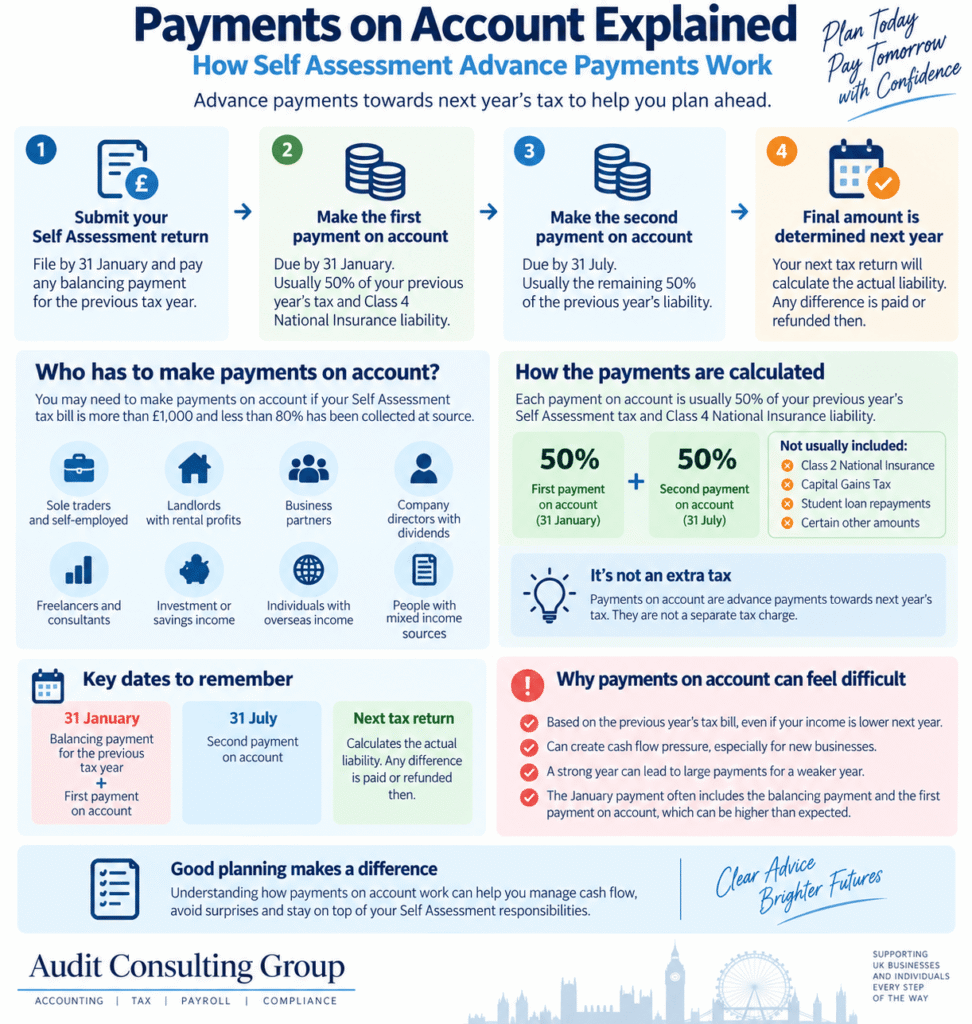
The standard pattern is:
- 31 January: balancing payment for the previous tax year, plus the first payment on account for the current tax year;
- 31 July: second payment on account for the current tax year;
- following 31 January: final balancing payment or refund, once the actual tax return is submitted.
For example, if your 2023/24 Self Assessment liability is £6,000 and payments on account apply, HMRC will usually ask for:
- £6,000 balancing payment by 31 January 2025 for 2023/24;
- £3,000 first payment on account by 31 January 2025 for 2024/25;
- £3,000 second payment on account by 31 July 2025 for 2024/25.
That means the January payment is not £6,000. It is £9,000. This is the point at which many taxpayers first notice the system.
The first-year cash flow problem
The first significant Self Assessment bill is often the most difficult because it can combine two obligations in one month: the tax for the year just completed and the first advance instalment for the year already underway.
A sole trader who has grown quickly may be profitable on paper but still short of available cash. Money may have gone into stock, equipment, subcontractors, software, rent, marketing, vehicles or simply covering the lag between invoicing and payment. A director who has taken dividends may have planned for the tax on those dividends but not realised that payments on account would follow.
This is why payments on account are as much a cash flow planning issue as a tax calculation issue. The tax may be technically correct, but the timing can be uncomfortable if no provision has been built into the business bank account.
When payments on account do not apply
Not every Self Assessment taxpayer has to make payments on account. They are generally not required if your Self Assessment bill is £1,000 or less, or if at least 80% of the tax you owe has already been collected at source.
This is why someone with employment income and a small amount of bank interest or rental profit may not need to make advance payments, while a sole trader with similar total income may do so. The distinction is not simply how much income you have. It is how much of the tax has already been collected before the Self Assessment calculation is finalised.
There are also situations where payments on account apply one year but not the next. A change in employment, incorporation, retirement, sale of a rental property, reduced profits or lower dividend income can all alter the position.
Why the figure can feel wrong even when HMRC has calculated it correctly
Payments on account are based on the previous year’s liability, not the current year’s actual results. This can make the figure feel disconnected from reality.
Consider a consultant who had an exceptional year because of one large project. HMRC may use that year’s tax bill to set payments on account for the following year, even if the project was not repeated. A landlord may have sold a property or faced major repairs. A freelancer may have taken time off, lost a client, or moved into employment. A small business owner may have incorporated part-way through the year, changing how profits are taxed.
The payment request is not HMRC saying your current year’s income is definitely the same. It is a default estimate. If that estimate is too high, it may be possible to reduce the payments on account, but the reduction needs to be approached carefully.
Reducing payments on account
If you reasonably expect your current year’s Self Assessment liability to be lower than the previous year’s, you can ask HMRC to reduce your payments on account. This can be done through the Self Assessment online account or by submitting the relevant claim. Where the position is uncertain, a personal tax consultation can help clarify the assumptions before a claim is made.
Reasons might include:
- profits have fallen;
- you stopped trading or reduced trading activity;
- you moved from self-employment into PAYE employment;
- rental income has reduced or a property has been sold;
- dividend income is lower;
- allowable expenses have increased;
- a business structure has changed.
The key word is reasonably. Reducing payments on account is not a cash flow deferral tool in isolation. If the reduction is too aggressive and the final liability is higher than the reduced amount, HMRC may charge interest on the underpaid tax.
A sensible reduction normally depends on current-year figures, not guesswork. Management accounts, bookkeeping records, rental statements, dividend vouchers, payroll information and up-to-date expense records can all help establish whether the original HMRC estimate is materially overstated. For sole traders, reviewing self-employed deductions and allowances can also help distinguish genuine taxable profit changes from simple cash pressure.
What happens if you overpay
If payments on account turn out to be higher than the final tax liability, the excess is set against other amounts due or repaid. This is common where profits fall after a strong year.
Overpayment is not ideal from a cash flow perspective, but it is usually less problematic than underpayment. The real issue is whether the business or individual could have used that cash more effectively during the year. For small businesses, that might mean supplier payments, VAT reserves, wages, materials, rent, loan repayments or working capital.
This is where regular bookkeeping changes the quality of tax decisions. The earlier the likely liability is visible, the easier it becomes to decide whether payments on account should remain unchanged, be reduced, or simply be planned for.
What happens if you underpay
If payments on account are reduced too far, or if income increases and the payments are not enough, the difference becomes payable as a balancing payment by the following 31 January. HMRC may also charge interest where tax has been underpaid.
Underpayment can also distort business planning. A person may believe they are up to date because the July payment has been made, only to find that the following January includes a larger balancing payment plus a new first payment on account for the next year. This stacking effect can create a repeated January cash flow problem.
Penalties are a separate issue from interest and depend on the circumstances, but late payment should not be treated casually. Once a deadline is missed, the position can become more expensive and more difficult to manage, particularly where several tax obligations fall close together. Further context on Self Assessment penalties and appeals may be relevant where filing, payment or dispute issues have already arisen.
The January deadline is not just one deadline
For Self Assessment taxpayers, 31 January often carries more weight than it first appears. It can include:
- the deadline for filing the online tax return;
- the balancing payment for the tax year just ended;
- the first payment on account for the current tax year;
- student loan repayments collected through Self Assessment, where relevant;
- Class 2 National Insurance, where applicable;
- late filing or late payment consequences from earlier periods.
This is why leaving the tax return until January is rarely just an administrative inconvenience. It delays visibility of the actual payment position. A return prepared in May, June or September does not necessarily mean the tax must be paid immediately, but it gives more time to plan.
Common misunderstandings about payments on account
Payments on account generate avoidable confusion because the terminology is not especially intuitive. Several misunderstandings appear repeatedly.
“HMRC has charged me twice”
This is the most common reaction. The taxpayer sees a balancing payment and a first payment on account due on the same date and assumes the same tax has been charged twice. It has not. The balancing payment relates to the tax year already filed. The payment on account relates to the current year.
“I do not need to think about next year until I file next year’s return”
Self Assessment does not work neatly on that assumption once payments on account apply. The current year is already being paid in instalments before the tax return is submitted.
“If my income falls, HMRC will automatically know”
HMRC will not usually know the current year’s position until the next tax return is filed. If payments on account are too high, action may be needed to reduce them.
“Reducing payments on account removes the tax”
It does not. It changes the advance payments. The final liability is still calculated from the actual tax return. If the reduction was too large, the difference will become payable later.
“Payments on account include everything on the tax return”
They do not always include every amount. Capital Gains Tax, student loan repayments and certain other liabilities may not be included in the same way. This can make the balancing payment higher than expected even where payments on account were made.
Real-world examples
A self-employed designer earns £48,000 profit in 2023/24 after several strong contracts. Their Self Assessment liability triggers payments on account. In 2024/25, two clients leave and profit is likely to fall to £30,000. Unless the payments on account are reduced, HMRC’s default request may be based on the stronger year. Reducing them may be sensible, but only if the updated figures support the reduction.
A landlord has rental profit in one year but sells the property the next. Payments on account may still be generated from the earlier rental profit unless the expected current-year liability is reviewed. There may also be separate tax considerations if the sale created a capital gain.
A company director receives dividends that create a Self Assessment liability. The following year, dividends are reduced because the company retains cash for VAT, PAYE, Corporation Tax or investment. Payments on account may still be based on the previous dividend tax bill, even though the director’s current-year personal tax position has changed.
A sole trader incorporates their business part-way through the year. The personal tax position may change significantly because future profits may fall within Corporation Tax at company level, while the individual is taxed on salary, dividends or other extraction. Payments on account may need reviewing, but the wider position should be considered rather than looking at the Self Assessment account in isolation.
Why bookkeeping quality affects payment decisions
Payments on account expose weak record keeping. If income and expenses are not up to date, it is difficult to know whether HMRC’s estimate is reasonable. A taxpayer may either overpay because they are cautious or underpay because they are optimistic.
For self-employed individuals and small businesses, the practical evidence usually sits in ordinary records: invoices issued, income received, supplier bills, bank transactions, mileage logs, software subscriptions, subcontractor costs, CIS deductions, payroll records, stock purchases and finance charges. For landlords, mortgage interest restrictions, repairs, service charges, agent fees and periods without tenants all affect the calculation.
Good records do not only support the tax return. They support tax timing decisions during the year. That distinction matters. A person who waits until after the tax year to organise records may still file correctly, but they have lost the chance to manage payments on account intelligently.
Links with VAT, CIS and payroll obligations
Payments on account are part of Self Assessment, but they rarely exist in isolation for business owners. A sole trader may also be dealing with VAT returns, CIS deductions, payroll costs, pension contributions, supplier payments and business loans. The Self Assessment payment is only one claim on cash.
For construction businesses, CIS can make the position more complex. Tax may already have been deducted from income by contractors, but the Self Assessment calculation still needs to reconcile profits, allowable expenses, CIS deductions and National Insurance. A subcontractor may feel tax has already been “paid” through CIS, yet still face a balancing payment or payments on account depending on the final calculation.
Payroll can also affect expectations. Someone moving between PAYE and self-employment may assume employment tax deductions remove the need for Self Assessment payments. That may be true in some cases, but not where untaxed income remains significant or PAYE does not collect enough of the total liability.
Company directors and mixed income
Company directors often have a more layered position than straightforward sole traders. Salary may be taxed through PAYE, but dividends are taxed through Self Assessment. Benefits, director loan account issues, rental income, interest, pension contributions and other income can change the overall liability.
Payments on account can be triggered by the personal tax bill even if the company itself is fully compliant with Corporation Tax, VAT, payroll and Companies House filing. The company’s obligations and the director’s personal obligations are connected in planning terms, but they are not the same liability.
This distinction matters where cash is held inside a company. A director may need to plan personal tax payments from dividends or salary, while the company must retain enough for Corporation Tax, VAT, PAYE, pension duties and operating costs. Poor timing can create pressure on both sides.
How to plan for payments on account during the year
The most reliable approach is to treat payments on account as part of annual cash flow, not as a January surprise. That does not require a complicated forecasting model for every taxpayer, but it does require periodic visibility.
A practical workflow may include:
- keeping bookkeeping records current rather than reconstructing them after year end;
- reviewing profit levels before 31 January and again before 31 July;
- checking whether PAYE, CIS or other deductions have already covered part of the liability;
- setting aside a realistic tax reserve from income received;
- reviewing major changes such as incorporation, retirement, property sale, dividend reduction or loss of contracts;
- estimating the current-year liability before reducing payments on account;
- filing the tax return early enough to avoid discovering the payment position at the last moment.
The habit of setting aside a percentage of income can help, but it is imperfect. Tax rates, allowable expenses, National Insurance, student loans, payments already deducted, pension contributions and personal allowances all affect the actual figure. A flat percentage is better than no discipline, but it should not be confused with a proper estimate.
What to check before reducing a payment
Before reducing payments on account, it is worth asking a few practical questions:
- Is current-year income genuinely lower, or is cash simply tight?
- Are expenses higher in a way that is allowable for tax?
- Have all invoices, costs and bank transactions been recorded?
- Has PAYE, CIS or other tax deducted at source been included correctly?
- Are there one-off items that affected last year but will not repeat?
- Could income recover before the end of the tax year?
- Will Capital Gains Tax, student loans or other liabilities still create a balancing payment?
A reduction based only on bank balance is risky. Cash flow and taxable profit are related, but they are not the same thing. Loan repayments, drawings, dividends, asset purchases and unpaid invoices can all make cash feel tighter without reducing taxable profit in the same way.
If you cannot pay on time
If a payment on account cannot be paid by the deadline, ignoring it usually makes the position worse. HMRC may charge interest on late payment, and further consequences can follow if amounts remain unpaid.
Where cash flow is genuinely under pressure, the immediate priorities are to understand the correct liability, file any outstanding return, avoid unnecessary delay, and consider whether a Time to Pay arrangement may be available. HMRC will normally expect realistic figures and an explanation of affordability.
It is also important not to reduce payments on account simply because the amount cannot currently be paid. Reduction should reflect a lower expected liability, not just a shortage of cash. Those are different issues, and HMRC treats them differently.
How Making Tax Digital may change expectations
Making Tax Digital for Income Tax is expected to increase the importance of timely digital records for affected taxpayers. The direction of travel is clear: HMRC wants more frequent reporting and better-quality in-year information.
Payments on account remain part of the wider question of tax visibility. Taxpayers who already maintain digital records, review income regularly and understand their liability during the year are likely to find transition easier than those who treat tax as an annual exercise.
The administrative details may evolve, but the underlying principle will remain familiar: late visibility creates poor decisions. Better records give more control over payment timing, cash reserves and compliance risk.
Key practical takeaways
- Payments on account are advance payments towards the next Self Assessment tax bill, not an additional tax.
- They normally apply where the Self Assessment bill exceeds £1,000 and insufficient tax has been collected at source.
- Each payment is usually 50% of the previous year’s relevant liability.
- The first payment on account is due on 31 January alongside the balancing payment for the previous year.
- The second payment on account is due on 31 July.
- Payments can be reduced if the current-year liability is expected to be lower, but over-reduction may lead to interest.
- Accurate bookkeeping is central to making sensible decisions about reductions and cash planning.
- PAYE, CIS, VAT, payroll, dividends, rental income and company structure can all affect the wider cash flow picture.
- Filing early improves visibility, even if the tax itself is not due until later.
A professional perspective on advance tax payments
Payments on account are not especially complicated as a calculation, but they are often difficult as a business reality. They sit at the intersection of tax timing, cash flow, bookkeeping quality and commercial judgement.
For a stable business with predictable profits, the system can become routine. For a growing sole trader, a seasonal trade, a landlord with uneven costs, a director managing company and personal cash, or a subcontractor under CIS, the position needs more care. The figures on the HMRC account may be mechanically correct while still requiring interpretation.
The most effective way to manage payments on account is not to wait for HMRC’s statement and react. It is to maintain enough financial visibility during the year to know whether the advance payments are reasonable, excessive or insufficient. That visibility turns Self Assessment from a once-a-year shock into a manageable part of financial planning.