

Self Assessment for Company Directors: Do Directors Need to File a Tax Return?
For years, company directors were often told that becoming a director automatically meant filing a Self Assessment tax return. That belief still circulates widely among small companies, contractors, family businesses and newly incorporated founders. The reality is more precise: being a company director does not, by itself, always create a Self Assessment filing requirement.
The difficulty is that directors rarely have simple tax affairs for long. Salary, dividends, benefits, reimbursed expenses, director loans, rental income, side income, pension contributions and overseas matters can all change the position. A director may not need a tax return because of the directorship alone, but may still need one because of how money is taken from the company, or because HMRC has issued a notice to file.
Leave your details and our team will get back to you shortly.
This distinction matters. It affects deadlines, penalties, cash flow, dividend planning, record keeping and the way directors understand their personal tax position alongside the company’s Corporation Tax and Companies House obligations.
The short answer: directorship alone is not always enough
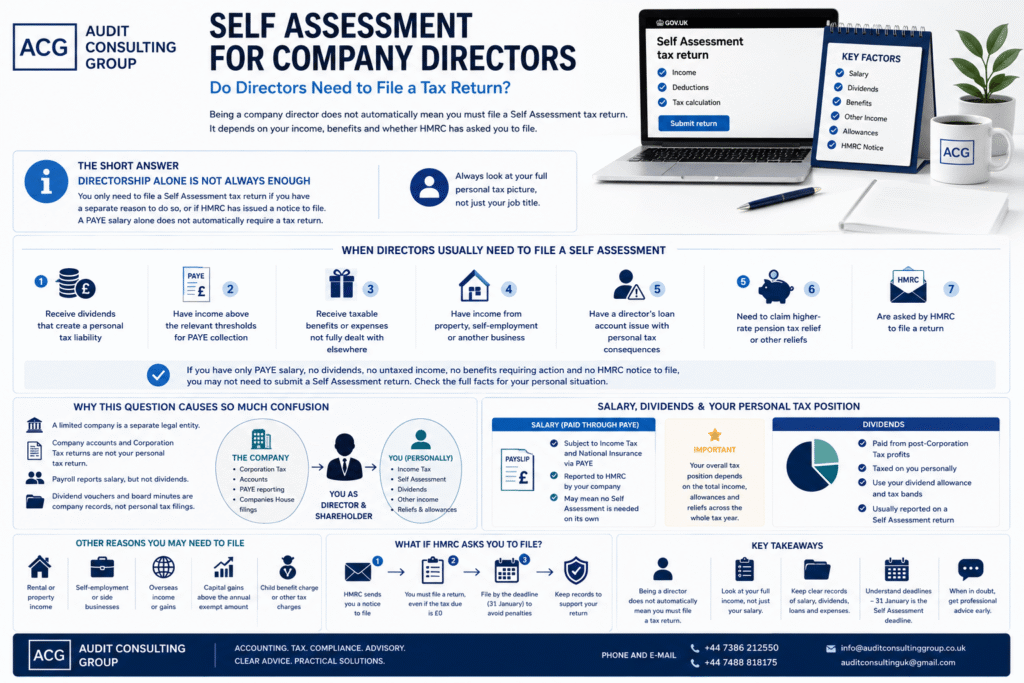
HMRC guidance has moved away from the old assumption that every company director must file a tax return purely because they are a director. A director normally needs to file a Self Assessment tax return if there is a separate reason to do so, or if HMRC has issued a notice requiring one. Where the position is unclear, reviewing the facts early or using appropriate Self Assessment support can help separate genuine filing obligations from outdated assumptions.
In practice, directors commonly enter Self Assessment because they:
- receive dividends that create a personal tax liability;
- have income above the relevant thresholds for PAYE collection;
- receive taxable benefits or expenses not fully dealt with elsewhere;
- have income from property, self-employment or another business activity;
- have a director’s loan account issue with personal tax consequences;
- need to claim higher-rate pension tax relief or other reliefs;
- are asked by HMRC to file a return.
A director paid only through PAYE, with no dividends, no untaxed income, no benefits requiring action and no HMRC notice to file, may not automatically need to submit a Self Assessment return. That said, “may not” is doing important work. Directors need to look at the whole personal tax picture, not the job title alone.
Why this question causes so much confusion
The confusion comes from a mismatch between company law, payroll practice and personal tax reporting. Companies House records a person as a director. Payroll may record the same person as an employee. The company may vote dividends to the same person as a shareholder. HMRC may see PAYE submissions, dividend income declared later, P11D benefits, Corporation Tax filings and historic Self Assessment records at different times.
To a director, it can feel like one role. To the tax system, it is several streams of information.
A limited company is a separate legal entity. Its Corporation Tax return is not the director’s personal tax return. Confirmation statements and accounts filed at Companies House do not report a director’s personal income tax position. Payroll submissions tell HMRC about salary and PAYE deductions, but they do not normally report dividend income. Dividend vouchers and board minutes are company records; they do not automatically settle the director’s Self Assessment obligations.
This is why directors sometimes believe everything has already been reported because the company accounts were filed. In many cases, the company has met its obligations, but the individual director still has a separate reporting position to consider.
Salary, dividends and the director’s personal tax position
Most owner-managed companies use some combination of salary and dividends. The salary is processed through PAYE. Dividends are paid from post-Corporation Tax profits and are taxed on the shareholder personally, subject to allowances and rates that depend on the wider income position.
This is where Self Assessment becomes relevant for many directors. PAYE can handle salary reasonably well, but it does not automatically collect tax on dividends unless HMRC adjusts the tax code or requests the information through another route. Where dividends create further tax to pay, personal tax filing is often the practical mechanism for calculating and reporting the liability.
Dividend planning is also not just a year-end exercise. A director who takes regular drawings may think of them as “wages”, but if the company records them as dividends, they need supporting paperwork and sufficient distributable profits. If they are not properly documented, or if profits are insufficient, the amounts may instead sit in a director’s loan account. That can create a different tax and accounting issue entirely.
The director’s loan account is often where problems surface
Director’s loan accounts are a frequent source of misunderstanding. A director may withdraw money during the year, expecting the accountant to “sort it out” later as salary or dividends. Sometimes that is possible. Sometimes it is not.
If the company has not made enough profit to support dividends, or if payroll has not been operated at the right time for salary, withdrawals can become loans from the company to the director. Overdrawn loan accounts may create company tax implications, benefit-in-kind considerations, disclosure requirements and personal tax consequences depending on the circumstances and timing of repayment.
This does not mean every director’s loan issue automatically creates a Self Assessment filing requirement in the same way. It does mean the director’s personal tax position cannot be assessed by looking only at PAYE salary. The company’s bookkeeping, dividend records, payroll timing and year-end accounts all feed into the answer.
Common situations where directors usually need to consider Self Assessment
The clearest cases are those where the director has income or reliefs outside straightforward PAYE. The following examples are common in UK small companies.
A director receiving dividends
A director who is also a shareholder may receive dividends in addition to salary. If those dividends exceed the available dividend allowance or push the director into a further tax liability, Self Assessment will often be required or at least advisable to ensure the position is correctly reported.
A director with property income
Rental income is separate from the company’s trading activity unless the property is held by the company itself. A director who owns a buy-to-let property personally may need Self Assessment because of property income, even if the directorship itself would not be enough.
A director with benefits in kind
Company cars, private medical insurance, beneficial loans and certain other benefits can create personal tax issues. Some benefits are reported through payroll; others may be reported on a P11D. The reporting method affects whether Self Assessment is required, but the director should not assume the matter is dealt with unless the PAYE and benefits position has been checked.
A director with income above PAYE limits or complex coding
High income, multiple employments, pension taper issues, child benefit charge exposure or coding restrictions can bring a director into Self Assessment. These cases are not about being a director in isolation; they are about the personal tax complexity attached to the individual.
A director who has received a notice to file
If HMRC issues a notice to file a tax return, the director normally needs to respond, even if they believe no tax is due. If the notice is unnecessary, it may be possible to ask HMRC to withdraw it, but ignoring it is rarely a sensible approach. Late filing penalties can arise even where the final tax liability is low or nil.
What directors often get wrong
The most common mistake is assuming that company compliance and personal compliance are the same thing. They are connected, but not interchangeable.
Company accounts may show salary, dividends, directors’ loans and Corporation Tax. Companies House may receive statutory accounts. HMRC may receive the company tax return. None of that automatically means the director’s personal dividend tax, benefit position or other income has been settled.
Another frequent error is treating all withdrawals as if they are tax-neutral until year end. For an owner-director, the bank account can become blurred: company funds, personal spending, reimbursed expenses and dividend drawings may all pass through similar routines. Good bookkeeping reduces that ambiguity. Poor bookkeeping turns the Self Assessment process into a reconstruction exercise months after the decisions were made.
Directors also underestimate timing. Self Assessment is based on the tax year to 5 April. Company accounts may run to a different year end. A company with a 31 December year end, for example, may prepare accounts on a timeline that does not neatly match the director’s personal tax year. Dividends declared in one company accounting period may fall into a different personal tax year depending on payment and documentation.
HMRC and Companies House see different parts of the picture
A useful way to understand the issue is to separate the compliance systems.
- Companies House records company information, directors, shareholders, confirmation statements and statutory accounts.
- HMRC Corporation Tax deals with the company’s taxable profits and Corporation Tax return.
- PAYE reports salary, tax and National Insurance for employees and directors paid through payroll.
- Self Assessment deals with the individual’s wider personal tax position, including dividends and other untaxed income.
- VAT and CIS, where relevant, sit within separate compliance regimes and do not replace personal tax reporting.
For a small company director, these systems overlap operationally but not legally. A VAT-registered company can be fully compliant for VAT while the director has unreported dividends. A company can file its accounts on time while the director misses a Self Assessment deadline. A payroll can be accurate while a director’s personal tax code still fails to collect all tax due.
Deadlines directors should keep in view
For Self Assessment, the tax year runs from 6 April to 5 April. Online tax returns are normally due by 31 January following the end of the tax year. The same date is usually the payment deadline for any balancing payment, and it may also trigger the first payment on account for the next tax year if the conditions apply.
Registration deadlines matter too. A director who becomes liable to Self Assessment for the first time should not wait until January to consider registration. HMRC processing times, access codes, Government Gateway issues and missing dividend paperwork can all create avoidable pressure close to the filing deadline.
The company’s own filing cycle may be different. Corporation Tax is usually due nine months and one day after the company accounting period ends, while the Corporation Tax return is generally due 12 months after the period end. Companies House accounts have their own deadlines. Directors who manage compliance by memory rather than a calendar often discover too late that the personal and company deadlines do not line up neatly.
If a deadline has been missed, or HMRC has issued a penalty after a notice to file was overlooked, the position should be reviewed against the facts rather than ignored. Guidance on Self Assessment penalties and appeals may be relevant where there is a genuine dispute, reasonable excuse issue or administrative error to consider.
Record keeping: the practical difference between clean and difficult filings
A director’s Self Assessment return is only as reliable as the underlying records. For owner-managed companies, the records usually need to show more than bank movements. They should support the nature of each payment.
Useful records commonly include:
- payroll summaries and P60 information;
- P11D or payrolled benefit details where relevant;
- dividend vouchers and board minutes;
- shareholding details and dividend dates;
- director’s loan account movements;
- expense claims and reimbursement records;
- pension contribution details;
- property income and expense records if applicable;
- interest, investment income or overseas income statements.
The quality of these records affects more than the tax return. It affects dividend legality, the clarity of the company accounts, the accuracy of Corporation Tax computations and the ability to answer HMRC queries if figures are challenged later. As HMRC continues to push tax administration towards digital records and more regular reporting, directors with mixed salary, dividends and other income should also keep an eye on Making Tax Digital for Self Assessment where future obligations may affect their record keeping.
Payroll, VAT and CIS: not the main question, but often part of the same story
Self Assessment for directors is a personal tax matter, but it rarely sits in isolation inside a real business. Payroll decisions determine salary reporting. Bookkeeping determines whether withdrawals are correctly analysed. VAT records may affect how expenses are treated. CIS can be relevant where a company operates in construction and directors take income from a company that also manages subcontractor deductions.
These regimes do not make a director file a tax return by themselves. Their importance is practical: they shape the records and tax treatment that feed the director’s personal position. For example, a director in a construction company may have PAYE income, dividends, reimbursed expenses, CIS-related business records and a loan account all interacting in the same accounting year. The Self Assessment question then becomes part of a wider compliance review, not a single yes-or-no box.
Should a director file voluntarily if not strictly required?
There are situations where a director may not be legally required to file, but still wants a formal record of their tax position. This can be sensible where income is close to thresholds, dividends vary, reliefs are being claimed, or HMRC’s tax code has been unreliable.
However, voluntary filing should not be treated casually. Once HMRC expects a return, the director must manage the filing obligation unless HMRC agrees it is no longer required. Filing unnecessary returns year after year can create administrative work without much benefit. Not filing when required can create penalties and interest. The better approach is to review the position each tax year against the director’s actual income, benefits, reliefs and HMRC notices.
A practical review process for directors
A director can usually reach a sensible view by working through the facts in a structured way rather than relying on old assumptions.
- Confirm whether HMRC has issued a notice to file for the relevant tax year.
- Review salary received through PAYE and check the P60 or final payslip.
- Identify dividends paid personally during the tax year, not merely the company accounting year.
- Check whether any benefits in kind or taxable expenses arose.
- Review the director’s loan account for overdrawn balances or unusual movements.
- Consider other personal income, including property, self-employment, investments or overseas income.
- Check whether reliefs need to be claimed, such as higher-rate pension relief or Gift Aid adjustments.
- Consider whether payments on account may arise and how they affect cash flow.
This process is not complicated in theory. The difficulty is that the evidence is often scattered between payroll software, bookkeeping records, board paperwork, bank statements and HMRC correspondence. The earlier those records are reconciled, the less likely the Self Assessment return becomes a rushed January exercise.
Where the risk usually sits
The risk is rarely that a director did not know the technical wording of HMRC guidance. The risk is usually operational: income was taken informally, dividend paperwork was not prepared, benefits were not reviewed, a notice to file was missed, or the company and personal tax records were considered separately by different people.
Small companies are especially exposed because the same person may act as director, shareholder, finance manager and operational decision-maker. That concentration of roles is efficient, but it can hide weak processes. A director may approve dividends without checking available profits, use the company card for mixed expenses, postpone bookkeeping during busy trading periods, then expect the tax position to be clear months later.
Good compliance is less about perfection and more about timely classification. Was the payment salary, dividend, loan repayment, reimbursed expense or something else? The answer determines which tax system applies and what evidence is needed. If earlier returns omitted dividends, benefits or loan account details, tax return amendments may be needed to correct the record.
Key points for company directors
- A company director does not always need to file a Self Assessment tax return purely because they are a director.
- Dividends, benefits, rental income, high income, relief claims or HMRC notices can create a filing requirement.
- Company accounts and Companies House filings do not replace the director’s personal tax return.
- PAYE salary reporting does not usually deal with dividend tax in full.
- Director’s loan accounts should be reviewed before year end, not only after accounts are prepared.
- Deadlines for Self Assessment, Corporation Tax and Companies House are separate and should be managed separately.
- Accurate bookkeeping and dividend documentation make the director’s personal tax position easier to defend and explain.
Final perspective
The question “Do directors need to file a tax return?” is simple only if the director’s affairs are simple. For a purely PAYE director with no dividends, no benefits, no other income and no HMRC notice to file, Self Assessment may not be necessary. For an owner-director drawing dividends, managing a loan account, receiving benefits or holding other income, the answer can change quickly.
The more useful question is not whether the title “director” automatically triggers Self Assessment. It is whether the director’s personal income, company withdrawals, reliefs and HMRC records create a reporting obligation for the tax year in question.
That distinction helps directors avoid both over-filing and under-reporting. It also encourages better habits: cleaner bookkeeping, clearer dividend decisions, earlier loan account reviews and a compliance calendar that recognises the difference between the company’s obligations and the individual’s personal tax position.