

Self Assessment for Landlords: Tax Return Guide for UK Property Income
Rental income looks simple from a distance: rent comes in, mortgage and repairs go out, and the remaining profit is taxed. In practice, self assessment for landlords is rarely that tidy. A property may be jointly owned, partly occupied by the landlord, let for only part of the year, refinanced, inherited, renovated, managed through an agent, or owned by someone who lives overseas. Each of those details can affect what appears on the tax return.
The difficulty is not usually the concept of tax on rental income. Most landlords understand that property income has to be declared. The difficulty is knowing what HMRC expects to see, which figures belong in the property pages, what expenses can be claimed, how finance costs are treated, and when registration for Self Assessment becomes necessary.
Leave your details and our team will get back to you shortly.
This guide explains self assessment for landlords in the UK from a practical filing perspective. It is designed for landlords who want to understand the structure of a property tax return before they file, amend, or review their records.
Why landlords are drawn into Self Assessment
HMRC uses Self Assessment to collect tax where income has not already been fully taxed at source. Property income is a common example. Unlike employment income, rent is not normally processed through PAYE. Even if a letting agent deducts fees before transferring the balance, the landlord still needs to consider the gross rental income and the allowable costs behind it.
A landlord may need to complete a Self Assessment tax return if they receive income from UK land or property, even where the property makes little profit after costs. The requirement does not depend only on cash left in the bank. It depends on taxable income, allowable deductions, ownership, and whether HMRC already has enough information to collect the tax in another way. Readers who need a wider explanation of the personal tax return process may find Self Assessment support for personal tax useful as a next reference point.
For smaller amounts of property income, HMRC may sometimes collect tax through a PAYE tax code. That does not mean the income can be ignored. It means HMRC may not require a full tax return in that specific case. The line between a coding adjustment and a self assessment tax return for landlords can be easy to misread, especially when the figures change from one year to the next.
When rental income must be reported
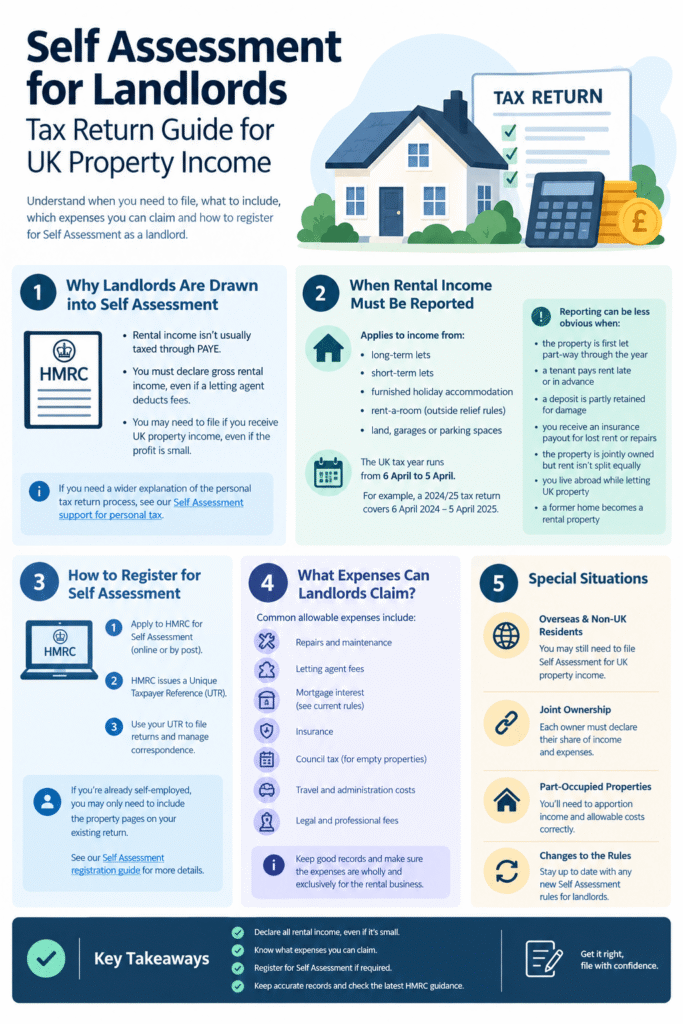
Self assessment for rental income usually applies where a landlord receives income from letting residential or commercial property. This includes long-term lets, short-term lets, furnished holiday accommodation, rent-a-room arrangements outside the relief rules, and income from land, garages or parking spaces where taxable property income arises.
HMRC looks at the tax year, not the calendar year or the landlord’s mortgage year. The UK tax year runs from 6 April to 5 April. A landlord preparing a 2024/25 tax return, for example, must report rental income and expenses arising between 6 April 2024 and 5 April 2025.
The reporting position may become less obvious in situations such as:
- a property is first let part-way through the year;
- a tenant pays rent late or in advance;
- a deposit is partly retained for damage;
- a landlord receives an insurance payout for lost rent or repairs;
- a property is jointly owned but rent is not split equally in practice;
- a landlord lives abroad while letting UK property;
- a former home becomes a rental property after the owner moves out.
These are ordinary landlord scenarios, but they can change the figures. Good self assessment work starts with the property history, not just a spreadsheet total. For landlord-specific reporting issues, property tax return support can provide a more focused route into the property income rules.
How to register for Self Assessment as a landlord
A landlord who has not filed a tax return before normally needs to register with HMRC for Self Assessment. Registration is separate from filing the return itself. Once HMRC processes the registration, it issues a Unique Taxpayer Reference, usually referred to as a UTR. That UTR is needed to file the return and manage Self Assessment correspondence.
For landlords asking how to register for Self Assessment as a landlord, the route depends on their wider position. A person with rental income but no self-employment will generally register for Self Assessment as an individual with untaxed income. A landlord who is also self-employed may already be within the Self Assessment system and may only need to include the property pages on the existing return. Guidance on registering for Self Assessment can be useful where a landlord has not previously dealt with HMRC Self Assessment.
The registration deadline is generally 5 October following the end of the tax year in which the landlord first had a requirement to notify HMRC, although readers should check current HMRC guidance for their circumstances. For example, if taxable rental income began in the 2024/25 tax year, the usual notification deadline would be 5 October 2025. The tax return and payment deadline would usually follow on 31 January 2026 for online filing, subject to current HMRC rules.
Landlords sometimes delay registration because the property has not yet made a meaningful profit. That can be a poor assumption. A first year often includes repairs, agent fees, safety checks, insurance, and periods without tenants. Even so, HMRC may still expect notification depending on the income and circumstances. Losses may also need to be recorded correctly so they can be carried forward against future property business profits.
The Self Assessment tax return forms landlords usually need
The main Self Assessment tax return is the SA100. Landlords then usually complete the UK property supplementary pages, known as SA105, where UK property income is reported. These are the self assessment tax forms for landlords most commonly associated with UK rental property.
A landlord may need additional pages depending on their circumstances. Foreign property income is not reported in exactly the same way as UK property income. A non-UK resident landlord may need to consider residence pages, and someone with employment, self-employment, dividends, capital gains, or partnership income may need further sections of the return.
The phrase “self assessment form for landlords” can therefore be misleading. There is not one universal landlord form. The return is assembled from the main return and the supplementary pages relevant to the taxpayer’s full position.
What belongs in the property income section
The property section of the return is not simply the net amount received from the letting agent. HMRC generally expects landlords to report gross rental income and then deduct allowable expenses. If an agent collects £1,200 rent and transfers £1,050 after deducting fees, the landlord should not automatically treat £1,050 as the rental income figure. The fee is usually an expense; the rent remains the gross income.
Property income may include more than monthly rent. It can include payments for services provided to tenants, retained deposits where the landlord becomes entitled to them, insurance receipts linked to lost rental income, and other amounts connected with the letting. The right treatment depends on the nature of the receipt.
Joint ownership also needs care. Where a property is jointly owned by spouses or civil partners, income is often treated as split 50:50 unless the beneficial ownership and HMRC declaration support a different split. For other joint owners, the split usually follows beneficial entitlement. Bank transfer patterns do not necessarily decide the tax position.
Allowable expenses: where landlord records often go wrong
Self assessment rental property expenses are one of the areas where mistakes are most common. The test is not whether a cost feels connected to the property. The cost must generally be incurred wholly and exclusively for the rental business, and it must be revenue in nature rather than capital, unless specific rules allow otherwise. Wider guidance on allowable deductions and allowances can help with the principles, but landlord expenses have their own property-specific rules.
Typical allowable expenses may include letting agent fees, landlord insurance, repairs and maintenance, safety certificates, accountancy costs relating to the rental accounts, council tax paid by the landlord during void periods, service charges, ground rent, advertising for tenants, and some utility costs paid by the landlord.
The difficult cases are usually not the obvious ones. They include:
- Repairs versus improvements: replacing a broken boiler with a modern equivalent may be a repair, but adding a new extension or materially improving the property is usually capital.
- Pre-letting costs: work done before the first tenant moves in may be allowable if it relates to bringing the property into a lettable condition, but some expenditure may be capital depending on the facts.
- Mixed-use costs: travel, phone, home office and mileage claims need a sensible business basis rather than rough estimates.
- Furniture and appliances: replacement domestic items relief has specific conditions and does not apply to every purchase.
- Legal and professional fees: fees for tenancy agreements may be revenue, while costs connected with buying or selling the property may be capital.
A frequent practical problem is that landlords keep invoices but do not record the reason for the work. Six months later, “building works” on a contractor invoice may not show whether the cost was a repair, an improvement, or part of a wider refurbishment. HMRC may ask for evidence, and the quality of that evidence often depends on notes made at the time.
Mortgage interest and finance costs are not treated like ordinary expenses
Residential landlords cannot usually deduct mortgage interest as a normal expense in the way they once could. Instead, finance costs are generally relieved through a basic rate tax credit. This can create a surprising result for higher-rate taxpayers, because taxable rental profit may look higher than the cash profit they feel they have made.
This is one of the most misunderstood parts of tax self assessment for landlords. A landlord may see mortgage payments leaving the bank and assume the whole amount reduces taxable profit. Capital repayments are not deductible, and interest relief is restricted for residential property. Commercial property and furnished holiday lettings may involve different considerations, and the rules have changed over time.
The practical implication is that property cash flow and property taxable profit can diverge. A highly geared landlord can owe tax even where the net cash retained after mortgage payments feels modest. This is not a software error; it is often the result of the finance cost rules.
| Landlord Income or Cost | Self Assessment Treatment | What Landlords Should Know |
|---|---|---|
| Rental income | Report as property income | Normally report gross rent before letting agent fees are deducted. |
| Letting agent fees | Usually allowable expense | Fees relating to managing the rental property can generally be deducted. |
| Repairs and maintenance | Usually allowable expense | Repairs may qualify, but improvements and capital expenditure are treated differently. |
| Landlord insurance | Usually allowable expense | Insurance relating to the rental business can generally be claimed. |
| Service charges and ground rent | Usually allowable expense | Costs paid by the landlord for the rental property may normally be deductible. |
| Council tax and utilities | May be allowable | Can usually be claimed where the landlord is responsible for these costs, including certain void periods. |
| Mortgage capital repayments | Not deductible | Repaying the amount borrowed does not reduce taxable rental profit. |
| Residential mortgage interest | Special finance cost rules apply | Individual residential landlords generally receive relief through a basic-rate tax reduction rather than deducting interest as an ordinary expense. |
| Property improvements | Usually capital expenditure | Extensions and significant improvements are generally not treated as ordinary rental expenses. |
| Accountancy and professional fees | May be allowable | Fees relating to the rental business may qualify, while costs connected with buying or selling property may be capital. |
Deadlines landlords should not treat as admin trivia
Self Assessment deadlines are familiar, but landlords still miss them for avoidable reasons. A new landlord may not realise registration is needed. A landlord with an existing PAYE job may assume HMRC will adjust the tax code automatically. Someone who inherited a property may focus on probate and tenancy issues and leave tax until late January.
The usual online filing deadline is 31 January after the end of the tax year. The same date is normally the payment deadline for the balancing tax due. Payments on account may also apply, meaning HMRC asks for advance payments towards the next year’s liability. For landlords with rising rental profits, this can create a January payment that is larger than expected.
Paper filing deadlines are earlier. Most landlords now file online, but the distinction matters where records are incomplete or where access to HMRC online services has not been set up in time.
Payments on account: the surprise bill after the first return
A first self assessment tax return landlord filing often reveals not only the tax due for the year just ended, but also payments on account for the next tax year. These are advance payments, normally due on 31 January and 31 July, based on the previous year’s tax liability.
Payments on account do not apply in every case. They are generally triggered where the Self Assessment liability exceeds certain thresholds and insufficient tax has been collected at source. For landlords whose rental profits sit alongside employment income, the interaction can be confusing: PAYE may cover salary tax, but not enough to cover property tax.
If next year’s income is expected to fall, a landlord may be able to reduce payments on account. That decision should be made carefully. Reducing them too far can lead to interest if the final liability is higher than estimated.
Overseas landlords and non-resident complications
Self assessment for overseas landlords has its own complications. A landlord living outside the UK may still have UK tax obligations on UK rental income. The Non-Resident Landlord Scheme can require letting agents or tenants to deduct basic rate tax from rent unless HMRC approves rent to be paid without deduction.
Approval to receive rent gross does not remove the need to report the income. It simply changes how tax is collected during the year. Non-resident landlords may still need to complete a UK tax return, and residence status can affect which pages are needed and how other income is considered.
Self assessment for non UK residents can also overlap with tax obligations in another country. A landlord may need to consider double tax treaty relief, foreign tax credits, and local reporting duties outside the UK. UK property income remains a UK tax matter, but it may not be the only tax matter.
Foreign property income is different again. A UK resident receiving rental income from an overseas property may need to report that income through the foreign pages of the UK Self Assessment return. Local taxes paid abroad may be relevant, but the UK treatment requires careful conversion, timing and relief calculations. Self assessment for foreign income is therefore not just a translation of an overseas tax statement.
Property owned through a limited company
Not every landlord reports property income through personal Self Assessment. If the property is owned by a limited company, the company usually reports rental profits through Corporation Tax rather than the individual’s SA105 property pages. The company also has Companies House filing obligations, including accounts and confirmation statements.
The director or shareholder may still have a personal Self Assessment position if they receive salary, dividends, loan benefits, or other taxable income from the company. This is where property tax, Corporation Tax, payroll and director responsibilities start to overlap.
Some landlords consider incorporation because of mortgage interest restrictions, succession planning, or portfolio growth. The decision is not only about tax rates. Stamp Duty Land Tax, refinancing, capital gains, lender requirements, administrative costs and Companies House obligations all need to be weighed. A structure that looks efficient on a spreadsheet may be less attractive once implementation costs and compliance are included.
VAT, CIS and payroll issues that can sit beside property income
Residential rent is usually exempt from VAT, but VAT should not be dismissed without thought. Commercial property, opted-to-tax buildings, serviced accommodation and mixed-use arrangements can create VAT questions. A landlord with other business activities may also need to consider how property income interacts with the wider VAT position.
CIS can become relevant where a landlord is also operating through a construction business or company, or where property development activity sits alongside investment letting. A private landlord paying a builder for repairs is not automatically within CIS, but property groups, developers and construction-linked businesses may need to check the rules rather than assume all property work is outside the scheme.
Payroll issues arise where a property business employs staff: for example, a caretaker, administrator, cleaner, estate worker or maintenance employee. Casual arrangements can be misclassified. If someone is genuinely employed, PAYE, National Insurance, workplace pension duties and payroll records may follow.
These issues do not affect every landlord. Their importance lies in recognising that property income is sometimes part of a wider business ecosystem rather than a standalone annual tax return.
Common filing mistakes HMRC can pick up
HMRC receives information from several sources: letting agents, deposit schemes, land registry data, mortgage interest data, bank information in some enquiries, and disclosures made during property campaigns or investigations. A landlord’s return should be consistent with the evidence likely to exist elsewhere.
Common mistakes include reporting net rent after agent deductions, claiming mortgage repayments instead of finance costs, treating improvements as repairs, omitting jointly owned property, forgetting a short letting period, ignoring retained deposits, and failing to report income because it was reinvested into the property.
Another frequent issue is assuming that no tax return is needed because no cash was withdrawn. Tax follows income and allowable expenditure, not drawings. A landlord who leaves rent in a separate property bank account may still have taxable income.
Some errors are discovered after filing. Where a landlord has filed an incorrect return, amending a Self Assessment tax return may be possible within the amendment window. Older errors may require a different disclosure route. The right approach depends on timing, behaviour, amounts involved and whether HMRC has already opened an enquiry.
Record keeping that makes the tax return easier
Good landlord records do not need to be elaborate, but they do need to be complete. The tax return is easier to prepare when records follow the property rather than being mixed with personal spending.
Useful records typically include:
- tenancy agreements and rent schedules;
- letting agent statements showing gross rent and deductions;
- mortgage statements separating interest from capital repayments;
- invoices for repairs, safety checks, insurance and professional fees;
- bank statements for the rental account;
- records of void periods and landlord-paid council tax or utilities;
- completion statements for property purchases and sales;
- notes explaining significant works carried out during the year.
The notes often matter more than landlords expect. If a kitchen was replaced because of water damage, the evidence may support a different treatment from a kitchen replaced as part of an upgrade before sale. The invoice alone may not tell the full story.
Self Assessment changes landlords should be watching
Self assessment changes for landlords are not limited to tax rates. Administrative reform is just as important. Making Tax Digital for Income Tax is expected to bring more digital record keeping and more frequent reporting for some landlords and self-employed individuals, based on qualifying income thresholds and implementation dates set by HMRC.
The practical shift is from annual reconstruction to ongoing record keeping. Landlords who currently gather receipts once a year may find new self assessment rules for landlords harder to manage if they do not adapt their bookkeeping habits. Digital systems can help, but software does not decide whether an expense is allowable, whether a cost is capital, or whether ownership has been reported correctly.
Other policy areas can also affect property tax planning: finance cost restrictions, furnished holiday letting reforms, capital gains reporting requirements, and changes in personal allowances or tax bands. Not every change applies to every landlord, but landlords with growing portfolios need to monitor the direction of travel rather than treat each return as an isolated event.
A practical workflow for preparing a landlord tax return
A reliable property tax return usually follows a sequence. Starting with the form often leads to missed context. Starting with the property history produces a better result.
First, identify all property income for the tax year. That means each property, each ownership share, each letting period, and any non-standard receipts. Next, reconcile rent to agent statements and bank receipts. Differences should be explained before figures are entered.
Then classify expenditure. Routine running costs, repairs, finance costs, capital items and private elements should be separated. Mortgage statements need particular care because monthly bank payments rarely equal deductible interest.
After that, consider wider tax return sections. Employment, self-employment, dividends, pension contributions, student loans, child benefit charge, capital gains and foreign income can all alter the final Self Assessment position. A landlord tax return is still a personal tax return; the property pages are only one part of it.
Finally, review the result against cash flow. If the tax due feels unexpected, the reason should be understood before filing. The cause may be finance cost restriction, payments on account, a coding adjustment, a missing expense, or a genuine increase in taxable profit.
Where landlords should apply judgement rather than guesswork
Some decisions are mechanical. Rent received is income. Agent fees are usually deductible. The filing deadline is the filing deadline. Other areas require judgement.
Judgement is usually needed where a cost improves the property, where a property changes use, where ownership differs from legal title, where rent is below market value, where family members occupy the property, where overseas tax is involved, or where a landlord moves between personal ownership and company ownership.
The danger is not only underpaying tax. Overclaiming expenses can lead to HMRC challenge, but underclaiming can also distort decisions. A landlord who does not record allowable costs properly may believe a property is more profitable than it really is. Poor tax records become poor business records.
Key points landlords should take from Self Assessment
Self assessment for landlords UK is best understood as a reporting system for a property business, even where the landlord owns only one property and does not think of themselves as running a business. HMRC still expects accurate rental income, correctly classified expenses, adequate records and timely filing.
The most important practical points are straightforward but often neglected:
- register with HMRC when a requirement to notify arises, rather than waiting until the filing deadline;
- report gross rental income, not just the amount received after agent deductions;
- separate repairs from improvements and interest from capital repayments;
- keep evidence that explains the nature of significant costs;
- consider payments on account before assuming the January bill is wrong;
- treat non-residence, foreign property and company ownership as specialist areas rather than routine entries;
- review property tax alongside wider personal income, not in isolation.
Final perspective
A good self assessment guide for landlords should not make property tax sound more dramatic than it is. Most landlord returns can be prepared accurately when the facts are clear and the records are organised. The problems arise when small assumptions accumulate: net rent used instead of gross rent, mortgage payments treated as interest, improvements claimed as repairs, overseas status ignored, or ownership shares copied from bank transfers rather than legal and beneficial entitlement.
HMRC self assessment for landlords is becoming more data-driven and more dependent on consistent digital records. That does not remove the need for judgement. If anything, it makes the quality of the underlying tax treatment more visible.
For landlords, the strongest position is not simply filing on time. It is understanding what the return is saying about the property, the cash flow, the evidence behind the figures, and the tax consequences of future decisions. A rental property may be an investment, a former home, a family asset, or part of a larger portfolio. The Self Assessment return is where those real-world facts are translated into a tax position HMRC can understand.