

Corporation Tax for New Limited Companies: A First-Year Guide
The first year of a limited company often feels deceptively quiet from a tax perspective. Companies House confirms the incorporation. The bank account opens. Invoices begin to go out. Expenses start building in the accounting software. Nothing may be payable to HMRC for several months, and that gap can create a false sense of breathing space.
Corporation Tax rarely causes problems because directors do not know it exists. Problems usually arise because the first year contains several moving parts that do not line up neatly: the company’s incorporation date, its accounting reference date, the date it actually starts trading, the Corporation Tax accounting period, bookkeeping quality, director payments, payroll decisions, VAT registration, and the timing of the first accounts.
Leave your details and our team will get back to you shortly.
For a new UK limited company, the main challenge is not simply “paying Corporation Tax”. It is building enough financial discipline early enough that the first Corporation Tax responsibilities are understood, the first return is accurate, and the records properly reflect how the company has traded.
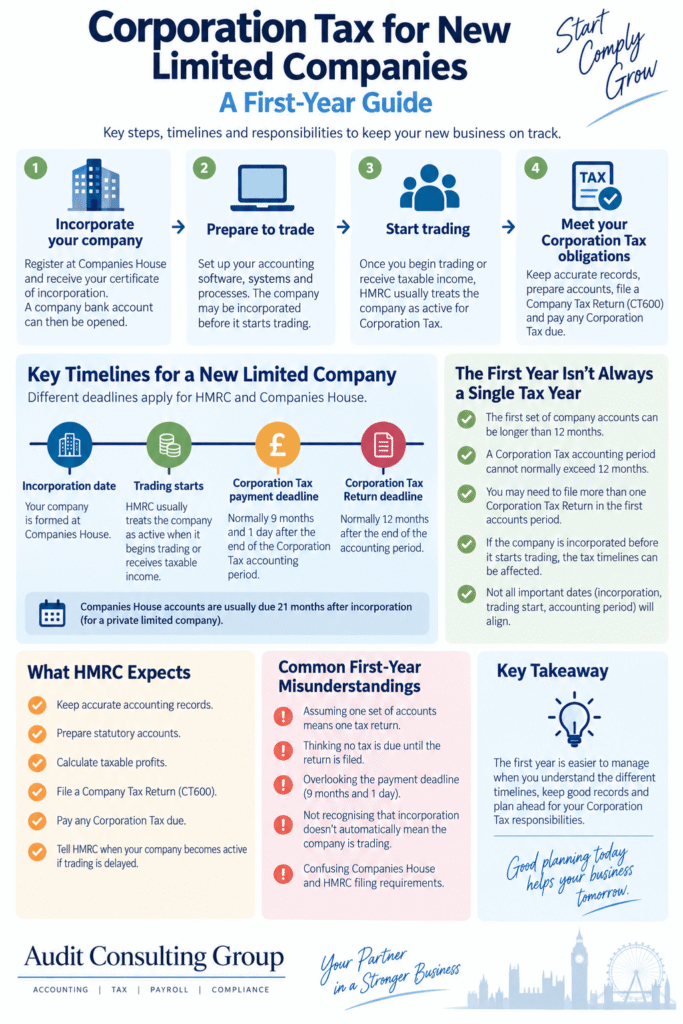
The first year is not always a single tax year
A common misunderstanding is that a company’s first year for Corporation Tax is the same as its first year at Companies House. It often is not.
Companies House sets an accounting reference date when the company is incorporated. The company’s first statutory accounts normally cover a period starting on the incorporation date and ending on the accounting reference date. That first accounts period can be slightly longer than 12 months.
Corporation Tax works differently. A Corporation Tax accounting period cannot normally exceed 12 months. If the first set of company accounts covers more than 12 months, the company may need to file more than one Corporation Tax Return for that first accounts period. This can catch out directors who assume that “one set of accounts” automatically means “one tax return”.
The position can also be affected by when the company actually starts trading. A company may be incorporated before it has customers, stock, contracts, equipment, software subscriptions, staff, or commercial activity. HMRC usually treats a company as active for Corporation Tax when it begins trading or starts receiving taxable income, not merely because it exists at Companies House.
This is particularly relevant for founders who complete company formation before the business is ready to trade. Incorporation creates the company, but it does not automatically mean every tax clock starts in the same way.
What HMRC expects from a new limited company
After incorporation, HMRC is usually notified by Companies House and will send Corporation Tax information to the company’s registered office. The company may need to tell HMRC when it becomes active, especially where trading does not begin immediately.
Once active, the company must keep appropriate accounting records, prepare statutory accounts, calculate taxable profits, file a Company Tax Return, and pay any Corporation Tax due. The Company Tax Return is usually submitted using form CT600 together with accounts and tax computations.
The filing and payment deadlines are easy to confuse because they are not the same.
- Corporation Tax payment is normally due nine months and one day after the end of the Corporation Tax accounting period.
- The Corporation Tax Return is normally due 12 months after the end of the accounting period.
- Companies House accounts have their own filing deadline, which for a first set of accounts is usually 21 months after incorporation for a private limited company.
This means a company may have to pay Corporation Tax before the final deadline for filing its Corporation Tax return. Directors sometimes assume no tax needs to be paid until the return is filed. That assumption can lead to interest, cash flow pressure, or rushed calculations close to the payment date.
HMRC and Companies House are not one combined filing system
Companies House is concerned with company law filing obligations, including statutory accounts, registered company information and the confirmation statement. HMRC is concerned with tax registration, taxable profits, tax computations, CT600 filing, Corporation Tax payments and compliance checks.
The two systems interact, but they are not interchangeable. A company can be up to date with Companies House and still have unresolved HMRC obligations. Equally, submitting accounts to Companies House does not automatically mean the Corporation Tax Return has been filed.
This distinction matters most in the first year because directors may receive several pieces of correspondence at different times and assume they all relate to the same annual filing. They do not. The accounts, the Company Tax Return and the tax payment each need to be understood on their own timetable.
Why first-year Corporation Tax is more than a percentage of profit
At a surface level, Corporation Tax is charged on company profits. In practice, taxable profit is not always identical to the profit shown in management reports or the figure sitting in the bank account.
Some expenses may be allowable for tax; others may be disallowed or restricted. Capital expenditure may be treated differently from day-to-day running costs. Director payments need to be categorised correctly. Business entertaining, private use, travel, home working costs, subscriptions, equipment, software, training, and pre-trading expenditure all need careful handling.
The first year is also when habits form. If the director uses the company bank account as if it were a personal account, pays themselves irregularly without deciding whether amounts are salary, dividends, loan repayments, or expenses, and leaves receipts scattered across email, apps, and paper folders, the Corporation Tax calculation becomes less reliable. The problem is not always the tax rule itself. It is the lack of a clean evidence trail.
The point at which trading actually begins
Determining the start of trading can be more nuanced than expected. A consultant may incorporate a company in January, build a website in February, sign a client contract in March, and issue the first invoice in April. A retailer may form a company months before opening because it needs to secure a lease, buy stock, apply for licences, and fit out premises.
Pre-trading costs can often be relevant, but they need to be identified and recorded properly. Some costs incurred before trading begins may be treated as if incurred on the first day of trade, provided they meet the relevant conditions. Others may not qualify, or may need to be treated as capital rather than revenue expenditure.
This matters because the trading start date affects the Corporation Tax period, the first return, and the way early costs are presented. It also affects how directors interpret early losses. A company may spend money before trading and only generate income later. Without a clear timeline, the first accounts can give a misleading picture of the business.
What new directors often get wrong
First-year Corporation Tax errors tend to come from practical misunderstandings rather than deliberate non-compliance. The same themes appear repeatedly.
Leaving Corporation Tax until the accounts deadline
The first accounts deadline can feel distant. That distance encourages delay. By the time the director starts preparing records, bank transactions may be unclear, receipts may be missing, and dividend decisions may have been made without checking available profits.
Good first-year tax management usually begins long before the return is due. Monthly bookkeeping, early review of profitability, and an estimate of the tax liability can prevent a year-end surprise.
Confusing cash with profit
A company can have cash in the bank and still owe suppliers, VAT, PAYE, or director loan balances. It can also have low cash because profits have been spent on stock, equipment, or repayments. Corporation Tax is based on taxable profits, not simply the closing bank balance.
This distinction is especially important for owner-managed companies. Directors may look at the bank account and assume funds are available for dividends, only to discover later that tax liabilities and other commitments were not properly reserved.
Treating every cost as tax-deductible
Not every business-related payment reduces Corporation Tax in the way directors expect. Some costs are disallowable. Some are capital in nature. Some require apportionment where there is private use. Some need stronger evidence to support the business purpose.
The issue is not merely whether money left the company. The question is how the cost should be classified for accounting and tax purposes.
Director pay, dividends and Corporation Tax
Director remuneration is one of the areas where first-year decisions have wider consequences. A director may take salary, dividends, expense reimbursements, loan repayments, or a combination of these. Each has different tax, accounting, payroll, and documentation implications.
Salary is usually an allowable company expense if it is properly processed through payroll and relates to the director’s duties. Dividends are paid from post-tax profits and are not deductible for Corporation Tax. Director loans need to be recorded carefully, particularly where the director withdraws more than they have introduced or formally been paid.
Dividend paperwork also matters. A dividend should be supported by sufficient distributable profits, appropriate approval, and dividend vouchers. In first-year companies, directors sometimes declare dividends based on bank balance rather than profits after tax. That can create problems if the company later proves not to have had enough distributable reserves.
Payroll registration may be necessary if the company pays salary above relevant thresholds, employs staff, or needs to report benefits. PAYE and National Insurance obligations sit alongside Corporation Tax rather than inside it, but poor payroll handling can distort the company’s accounts and tax position.
Bookkeeping is the foundation of the tax calculation
Corporation Tax compliance depends heavily on the quality of the bookkeeping. A clean first year does not require unnecessary complexity, but it does require consistency.
The company should be able to show what income was earned, when invoices were issued, which expenses were incurred, whether costs were paid personally by the director or through the company, how assets were purchased, what money the director introduced, and what amounts were withdrawn.
For small companies, the most useful bookkeeping discipline is often simple: keep the company bank account separate, reconcile it regularly, attach evidence to transactions, and review uncategorised items before they become a year-end backlog.
Cloud accounting software helps, but software does not decide the tax treatment. Bank feeds can import transactions; they do not know whether a payment is entertaining, subcontractor labour, equipment, drawings, a director loan movement, or a capital purchase. The judgement still has to come from someone who understands the business and the rules.
VAT can change the first-year picture
VAT is separate from Corporation Tax, but the two often intersect operationally. A new company may need to register for VAT if taxable turnover exceeds the registration threshold, or it may choose voluntary registration where commercially sensible.
VAT registration affects pricing, invoices, cash flow, bookkeeping, and the way income and expenses appear in the accounts. A VAT-registered company usually accounts for output VAT on sales and input VAT on qualifying purchases. Corporation Tax is calculated on profits excluding VAT where VAT is properly accounted for, but mistakes in VAT records can still distort bookkeeping and management figures.
The timing is important. A company that grows quickly in its first year can cross the VAT threshold earlier than expected. If the director checks turnover only at the year end, registration may already be late. For businesses selling to consumers, VAT can also affect margins because prices may not be easy to increase after registration.
CIS, subcontractors and sector-specific complications
Companies operating in construction can face additional responsibilities under the Construction Industry Scheme. CIS does not replace Corporation Tax, but it can affect cash flow, deductions, subcontractor verification, monthly returns, and record keeping.
A contractor company may need to deduct CIS tax from subcontractor payments and report those deductions to HMRC. A subcontractor company may suffer CIS deductions from its own income and later offset them against liabilities. If CIS is not recorded properly during the year, the Corporation Tax position and cash flow forecasts can become harder to interpret.
This is a good example of why first-year tax compliance cannot be viewed in isolation. The Corporation Tax Return may be annual, but the records behind it are created weekly and monthly through invoicing, payroll, VAT, CIS, and bank activity.
Dormant, non-trading and active companies
A newly incorporated business is not always active immediately. Some companies are dormant from incorporation. Others are temporarily non-trading while the director prepares the business. Others start trading almost straight away.
The distinction matters because HMRC and Companies House may need different information. A dormant company may still have Companies House filing duties. A company that has not yet traded may need to make its position clear to HMRC. An active company with income or taxable activity will usually need to deal with Corporation Tax registration, records, accounts, payment and CT600 filing.
Directors should be careful about assuming that “no profit” means “no obligation”. A company can have no Corporation Tax to pay and still have filing or reporting responsibilities.
Companies House obligations still matter
Corporation Tax sits with HMRC, but Companies House obligations form part of the same compliance environment. A limited company must keep statutory information up to date, file accounts, and usually submit a confirmation statement each year. Directors are responsible for these obligations even if day-to-day administration is delegated.
For newly formed companies, the administrative calendar can feel fragmented. A confirmation statement may be due before the first accounts. Companies House identity verification requirements and corporate governance changes may also affect directors and persons with significant control. Some businesses need licences, regulatory permissions, EORI registration for importing or exporting, or trade mark protection before they trade properly.
None of these replaces Corporation Tax work, but they influence how organised the company needs to be. A company that treats compliance as a single annual task is more likely to miss dependencies between tax, accounting, governance, and commercial operations.
A practical first-year Corporation Tax workflow
The most reliable approach is to manage Corporation Tax as a year-long process rather than a year-end event. For a new limited company, that workflow usually includes several stages.
- Confirm the incorporation date, accounting reference date, and expected trading start date. These dates shape the first accounts and Corporation Tax periods.
- Tell HMRC when the company becomes active where required. Do not assume inactivity or trading status has been interpreted correctly.
- Set up bookkeeping before transactions become complex. Bank feeds, invoice records, receipt capture, and expense categories should be established early.
- Separate director payments clearly. Salary, dividends, expenses, and loans should not be allowed to blur into one another.
- Review VAT and payroll exposure during the year. Waiting until the accounts are prepared may be too late for timely registration or reporting.
- Estimate Corporation Tax before the payment deadline. This helps with cash flow and reduces the risk of using tax money for working capital.
- Prepare accounts, tax computations, and the CT600 with supporting evidence. The return should reflect both accounting records and tax adjustments.
- Follow a clear corporate tax filing process. Preparation, review, submission and payment should be treated as connected steps, not separate last-minute tasks.
This workflow does not remove every complication, but it gives directors a structure. It also makes year-end conversations more productive because the records are already coherent.
How first-year losses should be understood
Not every new company makes a profit in year one. Start-up costs, delayed income, stock purchases, equipment, recruitment, marketing, or slow payment from customers can all create losses or weak early profits.
A trading loss may have tax value, but the treatment depends on the facts. Losses may be carried forward against future profits of the same trade, and in some cases other reliefs may be relevant. The important point is that the loss must be properly calculated and supported by records. A vague sense that “the business lost money” is not enough.
Directors should also distinguish between an accounting loss, a tax loss, and a cash shortfall. These are related but not identical. A company may show a loss because of depreciation, while tax computations use capital allowances instead. It may have cash pressure because customers have not paid, even though invoices have been recognised as income.
Capital allowances and early equipment purchases
New companies often buy laptops, tools, machinery, furniture, vehicles, software, or specialist equipment in the first year. These purchases can have Corporation Tax implications, but they are not always treated as simple expenses.
Capital expenditure is usually recorded as an asset and may qualify for capital allowances depending on the type of asset and the circumstances. The Annual Investment Allowance can be relevant for many plant and machinery purchases, but not every asset qualifies in the same way. Cars, for example, have their own rules and often require more careful analysis.
The practical issue is documentation. The company should keep invoices, note business use, identify whether the director bought the item personally before reimbursement, and distinguish equipment from repairs, consumables, or subscriptions. Early mistakes can persist into later accounts through fixed asset records and depreciation policies.
Expenses paid personally by directors
In the first months, directors often pay company costs from a personal card because the company bank account is not ready or suppliers need immediate payment. This is not unusual, but it needs to be recorded properly.
If the cost is genuinely for the company and is allowable, the company may reimburse the director or credit the amount to the director’s loan account. The evidence still matters: invoices should ideally be in the company’s name where possible, and the business purpose should be clear.
Problems arise where personal and company spending are mixed without explanation. A year later, it may be difficult to establish whether a payment was a business expense, private cost, director loan movement, or reimbursement. That uncertainty can affect Corporation Tax and the director’s personal tax position.
Corporation Tax planning in the first year
Tax planning for a new limited company should not be confused with aggressive tax reduction. Sensible first-year planning is usually about timing, structure, documentation, and avoiding decisions that create avoidable tax or administrative problems.
Examples include reviewing the balance between salary and dividends, considering pension contributions where appropriate, timing capital expenditure, checking whether losses are being used effectively, monitoring VAT registration, and ensuring director loan accounts do not drift into problematic territory. These areas are context-sensitive, so corporate tax planning should be based on the company’s actual trading position, cash needs and director circumstances rather than generic assumptions.
The best planning tends to happen before the year end. Once the accounting period has closed, options narrow. Some decisions can still be made during accounts preparation, but others depend on actions taken during the year, such as payroll submissions, dividend approvals, or investment timing.
Cash flow: the overlooked first-year risk
A profitable first year can still produce a tax problem if the company has not reserved cash. Corporation Tax is not deducted automatically from each invoice. The company must estimate and hold back enough to pay the liability after the period ends.
This is especially relevant for companies with uneven income. A project-based consultancy may receive large payments in a few instalments. A construction company may have CIS deductions, subcontractor costs, and delayed receipts. An e-commerce company may hold cash briefly before spending heavily on stock and advertising. In each case, the bank balance can move sharply during the year, making the future tax bill easy to underestimate.
A practical approach is to review profit quarterly and set aside a sensible tax reserve. The percentage will depend on the company’s expected taxable profit, reliefs, and current Corporation Tax rates, but the principle is straightforward: do not wait until the payment deadline to discover whether the cash is still available.
Records HMRC may expect to see
HMRC does not need to inspect every company every year, but records should be strong enough to support the return if questions are asked. Good records also protect directors from relying on memory.
Relevant records may include sales invoices, purchase invoices, bank statements, receipts, payroll records, VAT returns where applicable, CIS records where applicable, loan agreements, dividend vouchers, board minutes or written resolutions, mileage logs, asset purchase documents, and evidence for any significant tax adjustments.
The required retention period can vary depending on circumstances, but companies generally need to keep records for several years. The safest mindset is to assume that any figure in the accounts or tax return should be traceable back to credible evidence.
If the first return is wrong
Mistakes can happen, particularly in a first year where the director is still learning the administrative rhythm of running a company. The response matters.
If an error is identified after filing, the company may be able to amend the Corporation Tax Return within the permitted amendment window. If HMRC raises an enquiry, issues a penalty, or makes a decision the company disagrees with, there may be formal routes to respond or appeal depending on the situation and deadlines.
Directors should avoid ignoring HMRC correspondence, even where they believe the issue is minor. Tax problems are usually easier to resolve while records are fresh and deadlines are still open. Silence can turn a manageable correction into a more time-consuming compliance issue.
What a well-managed first year looks like
A well-managed first year is rarely perfect. Receipts still get missed, customers still pay late, software categories still need correcting, and directors still face commercial decisions before every tax implication is known. The difference is that the company has a system for catching issues before they become structural.
By the end of the first year, a limited company should ideally understand its profit position, expected Corporation Tax liability, director loan balance, payroll status, VAT position, major allowable and disallowable expenses, capital purchases, and key filing dates. That level of visibility gives directors a more accurate view of both tax and business performance.
It also makes the second year easier. The first year sets the accounting architecture: how transactions are classified, how directors are paid, how tax is reserved, how compliance dates are monitored, and how financial information is used for decisions. Poor habits compound. Good habits also compound.
Key takeaways for new limited companies
- Corporation Tax is based on taxable profits, not simply cash in the bank.
- The first Companies House accounts period and the Corporation Tax accounting period may not align perfectly.
- Corporation Tax is normally payable nine months and one day after the accounting period end, while the Company Tax Return is generally due 12 months after that period end.
- Bookkeeping quality directly affects the accuracy of the Corporation Tax calculation.
- Director salary, dividends, expenses, and loans need clear separation and documentation.
- Dormant, non-trading and active companies can have different HMRC reporting implications.
- VAT, payroll, CIS, and Companies House obligations can all affect the first-year compliance picture.
- Early tax estimates reduce the risk of cash flow surprises.
- Pre-trading expenses, capital purchases, and first-year losses need careful treatment.
A final perspective for first-year directors
Corporation Tax in the first year is not just a technical filing obligation. It is a test of whether the company’s financial records, director decisions, and compliance calendar are working together.
The companies that handle it best tend not to be the ones with the simplest affairs. They are the ones that recognise early that incorporation creates a separate legal and tax structure, and that structure needs deliberate administration. The earlier the records are organised, the easier it becomes to calculate tax, plan cash flow, pay directors correctly, and meet both HMRC and Companies House obligations without last-minute reconstruction.
For a new limited company, the first Corporation Tax cycle should be treated as the foundation for future financial discipline. Done properly, it gives directors more than a filed return. It gives them a clearer view of how the business is actually performing.