

What Expenses Can a Limited Company Claim Against Corporation Tax?
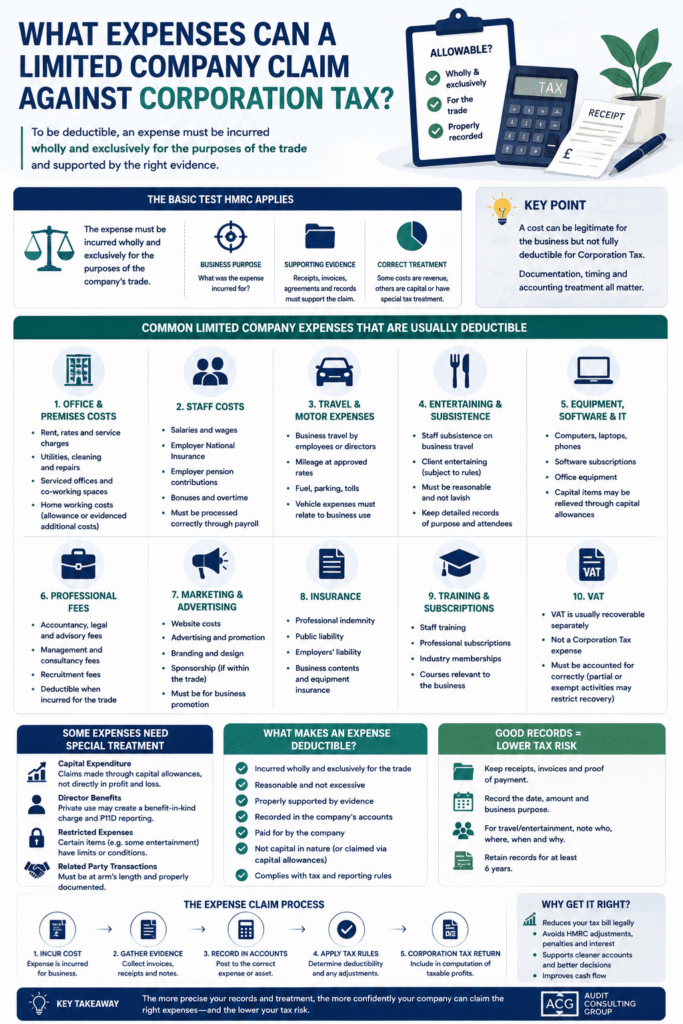
Corporation Tax relief is often discussed as if it were a simple list of “allowable expenses”. In practice, the question is more precise: has the company incurred the cost wholly and exclusively for the purposes of its trade, and is the expense treated correctly in the accounts and tax computation?
That distinction matters. A cost may be perfectly legitimate for the business to pay, but not fully deductible for Corporation Tax. Another cost may be deductible, but only if the paperwork, timing and accounting treatment are right. Some items reduce taxable profit immediately; others are dealt with through capital allowances, payroll reporting, benefit-in-kind rules or adjustments in the Corporation Tax return.
Leave your details and our team will get back to you shortly.
For directors of UK limited companies, the real challenge is rarely knowing that stationery or software can be claimed. It is understanding the grey areas: travel with a personal element, home working costs, director expenses, client entertainment, vehicles, equipment, professional subscriptions, staff costs, VAT, and expenditure paid personally before being reimbursed by the company.
The basic test HMRC applies
The starting point for most trading expenses is HMRC’s “wholly and exclusively” test. The expense must be incurred wholly and exclusively for the purposes of the company’s trade. If there is a dual purpose — part business, part personal — the tax treatment becomes more complicated.
This does not mean every expense must be used only at business premises or only during office hours. A laptop used for business may be deductible even if it occasionally sits at home. A director may travel from the office to a client meeting and claim the cost. The issue is the purpose of the expenditure, the evidence behind it, and whether any private benefit needs to be separated, restricted or reported.
Corporation Tax deductibility also depends on the nature of the cost. Revenue expenditure, such as rent, wages or accountancy fees, is usually considered against taxable profits in the period it relates to. Capital expenditure, such as plant, machinery or certain fixtures, is not normally deducted in the same way in the profit and loss account for tax purposes; instead, tax relief may be given through capital allowances. This is where the company’s wider Corporation Tax position depends on more than simply collecting receipts.
Common limited company expenses that are usually deductible
Most limited companies have a core group of expenses that are routinely deductible when they are properly incurred and recorded. These are the costs that directly support trading activity and are usually straightforward unless documentation is poor or the business/personal boundary is blurred.
Office, premises and working space costs
Rent for business premises is generally allowable, along with service charges, business rates, light, heat, power, cleaning and repairs. If the company operates from a serviced office or co-working space, the fees are usually deductible where the arrangement is genuinely for business use.
Home working is more nuanced. A company can pay a director or employee a modest home working allowance where conditions are met, or reimburse additional household costs supported by evidence. Some owner-managed companies prefer a simple allowance because it is administratively cleaner. Larger claims based on a proportion of household bills need more care, especially where the home is used for mixed personal and business purposes.
Staff wages, employer National Insurance and pension contributions
Employee salaries are normally deductible for Corporation Tax, provided they are actually incurred by the company and processed correctly through payroll. Employer National Insurance contributions and employer pension contributions are also generally allowable, subject to the usual rules.
For director-shareholders, salary planning often interacts with Income Tax, National Insurance, dividend extraction and Corporation Tax. A salary may reduce company taxable profits, but the overall tax position depends on the wider remuneration strategy. The company also needs accurate payroll records, RTI submissions and evidence that payments were made or properly accrued.
Dividends are different. They are distributions of post-tax profit, not deductible trading expenses. Confusing salary, dividends, reimbursements and drawings is one of the quickest ways for a director’s records to become unreliable.
Subcontractors, freelancers and professional support
Payments to subcontractors, consultants, freelancers and professional advisers are generally deductible where they relate to the company’s trade. This can include accountancy fees, legal advice, tax advice, bookkeeping support, business consultancy, design work, IT support and other specialist services.
Construction businesses need particular care because payments to subcontractors may fall within the Construction Industry Scheme. CIS deductions, verification, monthly returns and subcontractor records can affect both compliance and the reliability of the company’s Corporation Tax figures.
Software, subscriptions and digital tools
Most trading companies now rely on cloud software, accounting platforms, project management tools, CRM systems, cyber security products, website hosting, domain names and industry-specific applications. These costs are usually deductible where they are used for the business.
The accounting treatment can vary. A monthly software subscription is usually revenue expenditure. A major software implementation, licence acquisition or system build may require closer review to decide whether the cost is revenue or capital in nature. This distinction can affect the timing of tax relief.
Marketing, advertising and website costs
Advertising, print materials, online campaigns, photography, copywriting, public relations, search marketing, signage and website maintenance are commonly allowable where they promote the company’s trade.
Website costs are not always identical for tax purposes. Routine hosting, updates and maintenance are usually revenue expenses. A substantial new website build may need analysis: some costs may be treated as revenue, while others could be capital depending on what has been created and how long-term the asset is expected to be.
Insurance
Business insurance premiums are generally deductible. This may include professional indemnity insurance, public liability insurance, employer’s liability insurance, office insurance, cyber insurance, business vehicle insurance and other policies required for trading.
Life insurance and director protection policies need more careful treatment. The deductibility of premiums can depend on who benefits from the policy, the purpose of the cover and how the arrangement is structured. It is not safe to assume that every policy paid by the company automatically reduces taxable profits.
Travel and subsistence: where mistakes often start
Travel expenses are one of the areas where directors frequently overestimate what a limited company can claim. Business travel is generally allowable where it is necessary for the trade: journeys to client sites, supplier meetings, temporary workplaces, training venues or business events.
Commuting is different. Travel from home to a normal permanent workplace is usually ordinary commuting and not deductible for tax purposes. The difficulty for small companies is that directors often work from several places: home, a rented office, client premises and occasionally overseas. The tax treatment depends on the pattern of work, the purpose of the journey and whether the location is temporary or permanent.
Subsistence costs, such as meals while travelling on business, may be allowable where they are part of qualifying business travel. A meal bought because the director is working late at home is not the same as a meal bought while away at a client site. The distinction may feel artificial, but it is exactly the kind of distinction that matters if HMRC reviews the records.
Mileage and company vehicles
If a director or employee uses their own car for business journeys, the company can usually reimburse mileage at HMRC-approved rates. The company should keep mileage logs showing dates, destinations, business purpose and miles travelled. Bank payments alone are not enough.
Company cars are more complex. The company may obtain relief for lease costs, running costs or capital allowances, but the director or employee may face a benefit-in-kind charge where there is private use. Cars with higher emissions can be tax-inefficient compared with alternatives. Vans, electric vehicles and pool vehicles each have their own rules and practical risks.
A common error is judging vehicle costs only by whether the company pays for them. The better question is: what Corporation Tax relief is available, what personal tax charge arises, and does the record keeping support the treatment?
Equipment, assets and capital allowances
Limited companies often buy laptops, phones, tools, machinery, office furniture, cameras, vehicles and specialist equipment. These purchases may be essential to the trade, but that does not mean they are always treated as ordinary expenses for tax purposes.
Equipment with an enduring business use is usually capital expenditure. In the accounts it may appear as a fixed asset and be depreciated over time. For Corporation Tax, depreciation is normally added back and tax relief is considered through capital allowances.
The Annual Investment Allowance can provide full relief for many qualifying plant and machinery purchases, subject to the relevant limits and conditions. Some assets qualify differently. Cars, for example, are subject to specific capital allowance rules based partly on emissions. Structures, buildings and integral features may also need separate analysis.
This is where bookkeeping and tax work need to speak to each other. If assets are coded as “general expenses” without review, the accounts may look simple but the tax computation may be wrong. If everything is capitalised without considering allowances, the company may delay relief unnecessarily.
Director expenses and the company/personal boundary
Owner-managed companies have a particular risk: the director controls both the business decision and the company bank card. That makes it easy for personal costs to drift into the accounts.
A limited company is a separate legal entity. The fact that a director “needs” something does not automatically make it a company expense. Clothing, ordinary meals, personal travel, gym memberships, household costs, family mobile contracts and lifestyle purchases can create tax problems if they are treated as business costs without a clear basis.
Some director-related costs are legitimate. A business mobile phone contract, properly structured, may be allowable. Training related to the company’s trade can often be deductible. Eye tests for screen users may be claimable in specific circumstances. Professional memberships can be deductible where they are relevant to the role and meet the rules.
The practical test is not whether the director can explain the expense informally. It is whether the company could justify the cost as a business expense using records, policy, invoices and a consistent treatment.
Client entertainment, gifts and hospitality
Client entertaining is one of the most misunderstood Corporation Tax areas. A company may pay for hospitality, meals, events or entertainment for commercial reasons, but client entertaining is generally not deductible for Corporation Tax.
That distinction surprises directors because the expense may be genuinely business-related. A lunch with a prospective client might help win work, but HMRC normally disallows business entertainment when calculating taxable profits.
Staff entertaining is different. Annual events, such as a Christmas party, may be allowable and may avoid a taxable benefit for employees if conditions are met, including the annual cost limit per head and availability to staff generally. If directors are the only attendees, or if the event is not structured properly, the treatment needs closer review.
Business gifts also require care. Some low-cost promotional gifts may be allowable if they meet the conditions, but gifts of food, drink, tobacco or exchangeable vouchers are commonly problematic. Good bookkeeping should identify these costs separately rather than burying them in marketing or general expenses.
Training and development
Training costs can be deductible where they maintain or improve skills used in the company’s existing trade. For example, technical updates, compliance training, software training, industry seminars and continuing professional development may be allowable.
Training that creates an entirely new capability or prepares the director for a different trade can be more difficult. A limited company paying for a director’s unrelated qualification may create a private benefit or fail the wholly and exclusively test.
The strongest position is usually supported by a clear business reason: how the training relates to current services, current staff duties, regulatory requirements, operational efficiency or the company’s commercial activity.
Professional fees, finance costs and bank charges
Accountancy fees, bookkeeping fees, tax compliance costs and company secretarial costs are generally deductible where they relate to the company. Legal fees may be deductible or capital depending on what they are for. A contract review connected to trading activity may be treated differently from legal costs to acquire a business or defend ownership of a capital asset.
Bank charges, payment processing fees, business loan interest and merchant fees are usually deductible where they relate to business finance. Loan arrangement fees and other finance costs may need to be spread or treated under specific rules depending on the facts.
Penalties are different. Fines and penalties for breaking the law or failing to meet statutory obligations are generally not deductible. Interest charged by HMRC may be treated differently from penalties, but it should still be identified separately in the records.
VAT and Corporation Tax do not follow the same logic
VAT recovery and Corporation Tax deductibility are related in the accounts, but they are not the same question. A cost can be deductible for Corporation Tax but have no recoverable VAT. Another cost may include VAT that is blocked or restricted. Entertainment, vehicles, mixed-use costs and overseas expenses often create confusion.
If a VAT-registered company reclaims VAT incorrectly, the Corporation Tax figures may also become distorted because the net expense posted to the profit and loss account may be wrong. For example, if VAT is reclaimed on a cost where input tax should have been blocked, the expense value used for tax and management reporting may be understated.
This is why clean VAT coding matters. Corporation Tax work at year-end is harder when bookkeeping has treated every receipt with VAT as recoverable simply because a VAT number appears on the invoice.
Pre-trading expenses and formation costs
Companies often incur costs before they start trading: company formation fees, website development, equipment, market research, initial professional advice, branding, insurance and software setup. Some pre-trading expenses may be treated as incurred on the first day of trading if they would have been deductible had the company already been trading.
Not everything qualifies. Share capital costs, certain company formation costs and expenditure connected with setting up the corporate structure rather than the trade may be treated differently. Directors also need to separate costs paid personally from costs paid by the company. If a director pays personally and expects reimbursement, the company should keep the invoice, proof of payment and a clear expense claim or director’s loan account entry.
This area is especially relevant for new limited companies because early bookkeeping habits often shape the first Corporation Tax return. If setup costs are mixed with personal spending or recorded months later from memory, the company may either miss relief or claim costs that are not supportable.
Stock, cost of sales and timing differences
For product-based companies, the question is not simply “did we buy stock?” but “what stock was used or sold during the accounting period?” Purchases may be adjusted for opening and closing stock, work in progress or direct costs. A company holding significant stock at year-end should not normally deduct all purchases as if everything had already been sold.
Service businesses can have timing issues too. Work in progress, deferred income, accrued costs and prepaid expenses can affect taxable profits. A software subscription paid annually in advance, for example, may need to be spread over the period it relates to. A supplier invoice received after the year-end may still need to be accrued if it relates to work done before the year-end.
These adjustments can feel technical, but they are often where the difference arises between bookkeeping records and accounts that are suitable for Corporation Tax filing.
What companies often get wrong
The most common errors are not always aggressive tax claims. They are ordinary administrative failures: missing receipts, unclear descriptions, mixed bank accounts, inconsistent mileage records, director costs posted as general expenses, VAT reclaimed without review, and capital purchases treated as day-to-day overheads.
Several patterns appear repeatedly in small company accounts:
- Assuming “paid by the company” means “tax deductible”. The company bank account is not the test. Business purpose and tax rules are.
- Leaving expense analysis until year-end. By then, receipts are missing and the commercial context has been forgotten.
- Using broad bookkeeping categories. “Sundry expenses” may be convenient during the year, but it weakens the tax trail.
- Confusing director drawings with company costs. Personal spending through the company can affect the director’s loan account, benefits reporting or payroll treatment.
- Ignoring benefits-in-kind. Some company-paid costs are deductible for the company but taxable on the director or employee.
- Overlooking Companies House and accounts presentation. The statutory accounts and Corporation Tax return must be consistent even though they serve different purposes.
None of these mistakes requires bad intent. They usually come from speed, poor systems or a director trying to keep operations moving while finance administration waits until later.
Record keeping is part of the tax position
HMRC expects companies to keep adequate records to support Corporation Tax returns. Invoices, receipts, mileage logs, expense claims, payroll records, VAT records, bank statements, supplier contracts and board-level decisions may all be relevant depending on the claim.
Good records do more than survive an enquiry. They help the company make better decisions during the year. Management accounts are more reliable when expenses are coded properly. Cash flow forecasts improve when recurring costs are understood. Directors can see whether margins are being eroded by travel, subcontractors, software, finance charges or staff costs.
Poor records have the opposite effect. They can lead to missed deductions, disallowed claims, inaccurate VAT returns, unreliable annual accounts and last-minute pressure before the Corporation Tax filing deadline.
How allowable expenses connect with the Corporation Tax return
A company’s Corporation Tax position is not produced by adding up receipts and applying the tax rate. The process usually starts with accounting profit, then adjusts for items that are treated differently for tax purposes. These adjustments feed into the company’s Corporation Tax return and supporting tax computation.
Typical adjustments may include:
- adding back depreciation and considering capital allowances;
- disallowing client entertaining or non-business expenditure;
- reviewing legal and professional fees for capital elements;
- checking payroll, pension and benefits treatment;
- adjusting for accruals, prepayments, stock and work in progress;
- reviewing loan interest, finance costs and related-party transactions;
- checking VAT treatment where expense values may have been affected.
The Corporation Tax return must align with the company’s annual accounts, but the taxable profit is not always the same as the accounting profit. That is normal. Problems arise when the differences are not understood or documented.
Companies House obligations sit alongside tax obligations
Corporation Tax is filed with HMRC. Annual accounts are filed with Companies House. These are separate obligations, but they are connected by the same underlying accounting records.
A company may file accounts on time yet still have tax issues if expenses have been treated incorrectly in the Corporation Tax computation. Equally, tax adjustments may be technically correct but the annual accounts for limited companies may still need to present assets, liabilities, accruals and director balances properly.
For small limited companies, the director’s loan account is often the bridge between tax and company law presentation. If personal expenses have been paid by the company and are not allowable business costs, they may need to be posted to the director’s loan account. An overdrawn loan account can create further tax consequences if not managed correctly.
Practical examples: how the rules behave in real situations
A director buys a laptop
If the laptop is bought for company work, the company may claim tax relief, usually through capital allowances if it is treated as equipment. If the invoice is in the director’s name but the company reimburses the cost, the paperwork should show that the asset belongs to the company. If the laptop is mainly personal, the position changes.
A company pays for a meal with a client
The meeting may be commercially sensible, but the cost is likely to be treated as client entertaining and disallowed for Corporation Tax. The bookkeeping should identify it separately rather than posting it as travel or marketing.
A consultant works from home
The company may pay a home working allowance or reimburse specific additional costs if the evidence supports it. Claiming a broad proportion of rent, mortgage, utilities and household bills without a clear method can create unnecessary risk.
A contractor uses a personal car for site visits
Business mileage can usually be reimbursed at approved mileage rates, but the company needs a mileage log. Fuel receipts alone do not prove business mileage. If the journeys are ordinary commuting to a regular workplace, relief may be restricted.
A company buys tools and equipment before trading starts
Some costs may qualify as pre-trading expenditure and be treated as incurred when trading begins. Others may be capital assets eligible for allowances. The outcome depends on what was bought, when, why, and whether the records show the company’s business purpose.
Decision-making: what should directors ask before claiming?
A useful internal review does not need to be overcomplicated. Before an expense is claimed against Corporation Tax, directors should ask a few practical questions:
- Was the cost incurred for the company’s trade?
- Is there any personal element or private benefit?
- Is the expense revenue or capital in nature?
- Does VAT need separate treatment?
- Is payroll, P11D or benefit-in-kind reporting relevant?
- Do the accounts need an accrual, prepayment or stock adjustment?
- Is the evidence strong enough if HMRC asks for support later?
- Does the treatment align with the statutory accounts and Corporation Tax return?
These questions are especially useful before year-end, not after it. Once the accounting period has closed, options may be narrower and evidence may be harder to reconstruct.
Expenses that deserve extra caution
Some categories are not automatically wrong, but they should be reviewed carefully because the tax treatment is often misunderstood.
- Clothing: ordinary clothing is usually not allowable, even if worn for work. Protective clothing or uniforms may be different.
- Training: relevant work-related training is often allowable; training for a new trade may not be.
- Travel: business journeys can qualify; ordinary commuting usually does not.
- Entertaining: staff entertaining may be allowable in certain circumstances; client entertaining is generally disallowed.
- Vehicles: tax relief, VAT recovery and benefit-in-kind rules need to be considered together.
- Home office costs: modest claims are often simpler; larger claims need evidence and a defensible method.
- Legal fees: trading-related fees may be deductible; capital or structural matters may not be immediately deductible.
- Director-paid expenses: reimbursement should be documented, not treated casually through the bank account.
Why expense policy matters even in a small company
Small companies often avoid formal expense policies because everyone knows what is happening. That works until the business grows, hires staff, takes on subcontractors, becomes VAT registered, applies for finance, or faces an HMRC query.
A basic expense policy helps define what the company will reimburse, what evidence is required, how mileage is recorded, who approves staff expenses, how company cards should be used and what happens where an expense has a personal element. It also protects directors from inconsistent treatment across employees.
The policy does not need to be lengthy. It needs to be usable. A clear system that staff actually follow is more valuable than a perfect document ignored during busy periods.
Corporation Tax planning is not just about finding more expenses
Some directors approach Corporation Tax planning by asking what else they can claim. That is understandable, but limited. Stronger corporate tax planning looks at timing, structure, investment decisions, remuneration, pension contributions, capital allowances, R&D eligibility where relevant, financing, asset purchases, VAT interaction and the quality of management information.
Accelerating a deductible cost may reduce taxable profit this year, but it still uses cash. Buying equipment solely to reduce tax is rarely sensible if the business does not need the asset. Paying a pension contribution may be tax-efficient, but timing, affordability and scheme rules matter. Increasing salary may reduce Corporation Tax but create PAYE and National Insurance costs.
The best expense decisions usually begin with commercial logic, then consider tax treatment. Tax relief improves the economics of a good business cost; it does not automatically make a poor cost worthwhile.
Key takeaways for limited company directors
- A limited company can claim many business expenses against Corporation Tax, but the cost must normally be incurred wholly and exclusively for the trade.
- Business payment and tax deductibility are not the same thing.
- Capital purchases may receive relief through capital allowances rather than ordinary expense deduction.
- Travel, vehicles, home working, entertainment and director expenses are common risk areas.
- VAT recovery, payroll reporting and benefit-in-kind rules can affect the wider tax position.
- Accurate bookkeeping during the year is usually more valuable than a rushed review after the year-end.
- Corporation Tax returns, annual accounts and Companies House filings all rely on the same underlying records.
- Good documentation supports both compliance and better management decisions.
A final professional perspective
The question “what expenses can a limited company claim?” has a long answer because limited companies do not all operate in the same way. A consultancy, construction contractor, online retailer, professional practice, agency and property-related company may all have different cost patterns, evidence requirements and tax adjustments.
The safest approach is not to be timid, nor to claim everything that passes through the bank. It is to build a disciplined record-keeping process, understand the main categories of expenditure, identify the grey areas early and make sure the Corporation Tax computation reflects the accounts accurately.
For most companies, the largest tax improvements do not come from obscure loopholes. They come from clean bookkeeping, correct classification, timely review, sensible director decisions and a tax return that properly reflects the commercial reality of the business.