

VAT Return Deadlines UK: Important Dates Every Business Should Know
VAT deadlines rarely cause problems because a business does not know VAT exists. Problems usually arise because the deadline sits at the end of a chain of smaller dependencies: sales invoices not raised, purchase invoices missing, bank feeds unreconciled, reverse charge entries overlooked, import VAT statements not downloaded, or a director assuming the accountant has everything needed when the records are still incomplete.
For UK businesses, the VAT return deadline is not simply a calendar date. It is a test of whether bookkeeping, cash flow planning, software controls and internal responsibility are working together. Missing the date can be expensive, but the more damaging issue is often what the missed deadline reveals about the business’s financial systems. For readers reviewing the wider VAT administration behind their deadlines, a broader overview of VAT services can be useful context without replacing the need to check the exact dates in the HMRC VAT account.
The standard UK VAT return deadline
Most VAT-registered businesses submit VAT returns quarterly. The usual deadline for both submitting the VAT return and paying any VAT due is one calendar month and seven days after the end of the VAT accounting period.
If a VAT quarter ends on 31 March, the filing and payment deadline is normally 7 May. If the quarter ends on 30 June, the deadline is normally 7 August. The same principle applies to most standard quarterly VAT periods.
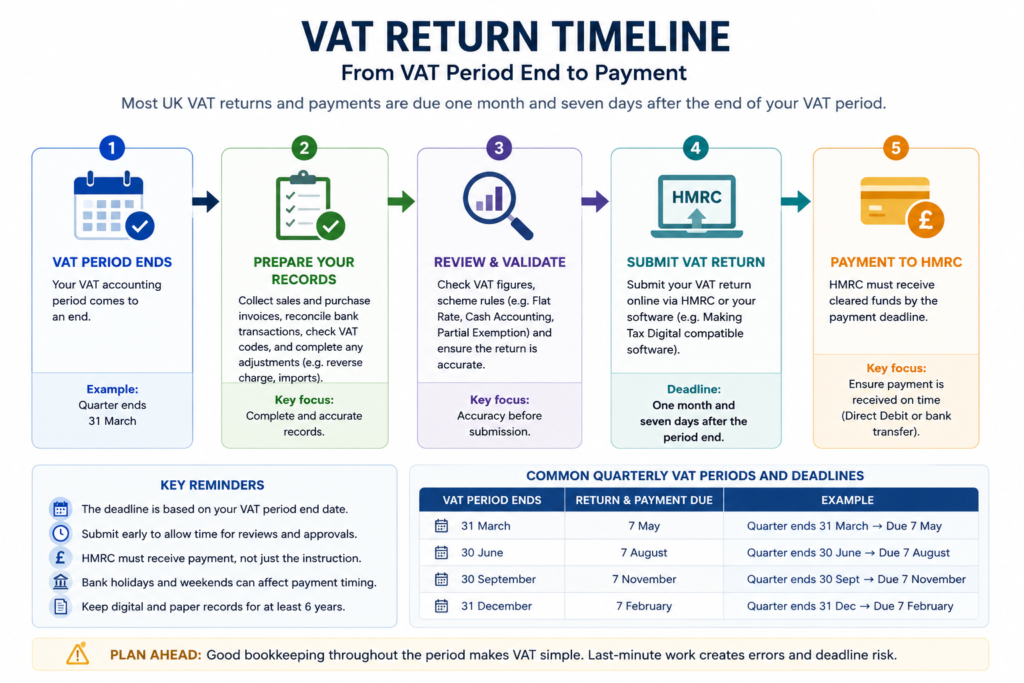
The key point is that the deadline is based on the VAT period end date, not the month in which the return is prepared. This sounds obvious, but it is a common source of confusion for businesses that operate with several reporting rhythms at once: payroll each month, management accounts after month-end, Corporation Tax annually, Companies House confirmation statements on a separate cycle, and VAT on quarterly stagger dates.
Common VAT quarter dates and filing deadlines
HMRC allocates VAT accounting periods when a business registers for VAT. Many businesses operate on one of three quarterly cycles, although monthly and annual accounting arrangements may apply in specific circumstances.
- Quarter ending 31 March: VAT return and payment usually due by 7 May.
- Quarter ending 30 June: VAT return and payment usually due by 7 August.
- Quarter ending 30 September: VAT return and payment usually due by 7 November.
- Quarter ending 31 December: VAT return and payment usually due by 7 February.
Other stagger periods are also common. A business may have quarters ending in January, April, July and October, or February, May, August and November. The same rule generally applies: add one month and seven days to the VAT period end date.
Businesses should not rely on memory or an old spreadsheet alone. The VAT return period and deadline should be checked in the business’s HMRC VAT account, especially after VAT registration, changes to accounting schemes, deregistration planning, group changes or migration to new bookkeeping software.
Submission deadline and payment deadline are not always the same in practice
For most businesses, the submission deadline and payment deadline appear to be the same date. In practical terms, however, payment timing needs more care.
HMRC must receive cleared funds by the deadline. A business that approves payment late in the day, uses a slower payment method, has bank authorisation delays, or depends on a director who is travelling may technically initiate payment before the deadline but still create a late-payment issue if funds are not received in time.
Direct Debit can reduce this risk, but it is not a substitute for completing the return early. HMRC normally collects VAT by Direct Debit a few working days after the deadline, provided the Direct Debit is already set up and the return is submitted on time. New Direct Debit instructions may not apply immediately, so businesses should avoid setting them up at the last moment.
Why VAT deadlines create pressure inside real businesses
VAT is unusual because it combines compliance, cash flow and operational record keeping. Corporation Tax can often be planned over a longer period. Payroll has a predictable monthly cycle. VAT, by contrast, is affected by the speed and accuracy of everyday administration.
A VAT deadline may depend on several people who do not think of themselves as part of the VAT process: sales staff issuing invoices, operations teams approving supplier costs, directors using company cards, project managers dealing with CIS subcontractors, and finance staff matching receipts to customer accounts. If any part of that chain is weak, the VAT return becomes harder to finalise.
The businesses that manage VAT deadlines well usually do not wait until the return is due. They build a monthly rhythm: reconcile bank accounts, review aged debtors and creditors, clear suspense transactions, check VAT coding, and identify unusual items before the quarter closes.
What businesses often misunderstand about VAT return dates
Several VAT deadline mistakes are not caused by carelessness. They come from reasonable assumptions that happen to be wrong.
Leave your details and our team will get back to you shortly.
Assuming the quarter follows the financial year
A company’s accounting year-end and VAT quarters may not align. A company with a 31 March year-end may have VAT quarters ending in February, May, August and November. This can create confusion when directors expect year-end accounting work and VAT work to follow the same timetable.
Thinking nil returns do not matter
A VAT-registered business may still need to submit a VAT return even if it has not traded during the period. A nil return is still a return. Dormant activity for Companies House or limited trading for Corporation Tax purposes does not automatically remove VAT filing obligations.
Confusing invoice date with payment date
Under standard VAT accounting, VAT is often based on invoice dates rather than when money is received or paid. Businesses using the cash accounting scheme follow different timing rules. Confusing the two can distort both the return and the expected payment amount.
Expecting software to understand context
Making Tax Digital software can submit data, but it does not guarantee the VAT treatment is correct. A system may process a transaction exactly as coded, even if the code is wrong. Common examples include mixed-rate purchases, exempt income, reverse charge services, import VAT, fuel scale charges, deposits and credit notes.
Making Tax Digital has changed the deadline conversation
Making Tax Digital for VAT means most VAT-registered businesses within scope must keep digital records and submit VAT returns using compatible software. This has improved discipline for some businesses, but it has also exposed weak processes.
The practical issue is not just whether a business can press “submit”. It is whether the digital records behind the return are complete, connected and reviewable. HMRC expects VAT figures to come from digital records, with appropriate digital links where required. Copying figures manually between disconnected records can create compliance risk unless specific rules or exemptions apply.
MTD has made the VAT deadline less forgiving because poor bookkeeping cannot always be repaired quickly at quarter-end. If supplier invoices have not been uploaded, if bank rules have posted transactions to the wrong VAT codes, or if online sales platforms have not been reconciled properly, the return may look complete while still being materially unreliable. This is why the process of filing VAT returns should be treated as a records-led workflow, not just a software submission task.
VAT payment planning matters as much as filing
A technically accurate VAT return can still create pressure if the business has not planned for the payment. VAT collected from customers is not business profit, but it often sits inside the bank balance until the due date. During tight trading periods, that cash can be unintentionally absorbed into wages, suppliers, rent, loan repayments or director drawings.
This is where VAT deadlines become a cash flow issue rather than an administrative one. A growing business can be especially vulnerable because VAT liabilities may rise faster than cash reserves. A company with strong sales but slow customer payments may owe VAT before it has collected the cash from its own customers, unless it uses a suitable VAT scheme and meets the conditions.
Good VAT discipline usually includes estimating the liability before the quarter ends. Even a rough monthly VAT control review can prevent the deadline from becoming a surprise.
Monthly VAT returns, annual accounting and repayment traders
Not every business follows the standard quarterly pattern. Some businesses submit monthly VAT returns, usually because they regularly reclaim VAT from HMRC. This can apply to exporters, businesses with zero-rated sales, or companies making significant taxable purchases while output VAT remains low.
Monthly returns can improve cash flow where repayment claims are consistent, but they also increase administrative frequency. A business that struggles to maintain records quarterly may find monthly compliance demanding unless the bookkeeping process is reliable.
Annual accounting is different. Under the VAT Annual Accounting Scheme, eligible businesses usually submit one VAT return per year and make payments on account during the year. This can simplify filing frequency, but it requires careful cash planning because the final balancing payment or repayment may still be significant. Annual accounting is not automatically easier for every business; it changes the pattern of administration rather than removing the need for accurate records.
What happens if a VAT return is late
HMRC’s penalty system for VAT late submission and late payment is points-based and time-sensitive. A late VAT return may result in a penalty point. Once a business reaches the relevant threshold, financial penalties can apply. Late payment can also lead to penalties and interest, with the consequences depending on how late the payment is and whether Time to Pay arrangements are agreed where appropriate.
The details of the penalty regime can change, and businesses should check current HMRC guidance for the exact rules that apply at the time. From a practical perspective, the lesson is steady: file on time where possible, pay on time where possible, and communicate with HMRC early if payment difficulty is unavoidable.
A late return also has a wider effect. It may delay repayment claims, complicate lending applications, disrupt management accounts, and reduce confidence in the company’s financial reporting. For directors, persistent late filing can become a governance issue as much as a tax issue.
VAT deadlines and director responsibility
Directors do not need to personally prepare every VAT return, but they remain responsible for ensuring the company meets its obligations. Delegating VAT work to staff, bookkeepers or external advisers does not remove the need for oversight.
That oversight does not have to be complicated. It may involve confirming the VAT period, checking who is responsible for preparing the return, reviewing the expected liability, ensuring funds are available, and making sure unusual transactions have been raised before submission. The more complex the business, the more important this review becomes.
Companies House filings and VAT returns are separate obligations, but they often reveal the same underlying issue: whether the company has reliable records and clear responsibility for compliance. A business that misses VAT deadlines may also struggle with annual accounts preparation, confirmation statement discipline, Corporation Tax information, payroll records or dividend documentation.
Records that should be ready before the VAT deadline
A VAT return is only as reliable as the records behind it. For most UK businesses, the following should be reviewed before submission:
- sales invoices and credit notes for the VAT period;
- purchase invoices, receipts and supplier statements;
- bank and credit card reconciliations;
- VAT coding for expenses, income and adjustments;
- import VAT statements and postponed VAT accounting entries where relevant;
- reverse charge transactions, including construction industry reverse charge where applicable;
- online marketplace, payment processor and e-commerce platform reports;
- bad debt relief claims, if conditions are met;
- partial exemption calculations, if the business has exempt and taxable income;
- evidence supporting VAT reclaims on business costs.
This list is not just administrative. Each item affects the quality of the VAT return. Missing paperwork can lead to underclaimed input tax, overstated claims, incorrect output tax or avoidable amendments later.
Where VAT returns become difficult
Some VAT returns are straightforward. A small consultancy with UK clients, simple expenses and tidy bank records may have a relatively predictable quarterly process. Complexity increases quickly once the business model changes.
Construction businesses may need to consider the domestic reverse charge and CIS interactions. Retailers may deal with mixed VAT rates, refunds, vouchers and point-of-sale systems. E-commerce businesses may need to reconcile Shopify, Amazon, Stripe, PayPal and bank deposits, none of which necessarily present VAT information in the same way. Importers need to handle postponed VAT accounting and customs evidence. Businesses selling digital services or goods into the EU may need to consider OSS registration and filing obligations.
The deadline itself does not change simply because the business is complex. That is why the process needs to change before the deadline arrives. Where recurring deadline pressure is caused by partial exemption, unusual transactions, cross-border activity or repeated correction issues, VAT compliance advisory may be more relevant than simply adding another reminder to the calendar.
Practical examples of deadline risk
The growing agency with late invoicing
An agency raises several large invoices in the final week of a VAT quarter but does not collect payment until six weeks later. Under standard VAT accounting, the VAT may be due before the cash arrives. The filing deadline is met, but the payment strains working capital. The issue is not the VAT return calculation alone; it is the mismatch between invoicing, debtor collection and VAT planning.
The builder relying on manual VAT codes
A construction business uses bookkeeping software but applies VAT codes manually. Some subcontractor invoices fall under CIS, some involve domestic reverse charge rules, and some are standard-rated purchases. If the coding is reviewed only at the deadline, errors are easy to miss. The business may submit on time but still file an inaccurate return.
The online seller with platform timing differences
An e-commerce seller receives payouts from payment processors after fees, refunds and timing delays. The bank receipt does not equal the gross sale. If VAT is calculated from bank deposits alone, the return may be wrong. The deadline pressure exposes a deeper reconciliation issue between platform reports, sales data and accounting records.
How to build a VAT deadline workflow that works
A reliable VAT process does not need to be elaborate. It needs to be consistent, owned and early enough to leave room for review.
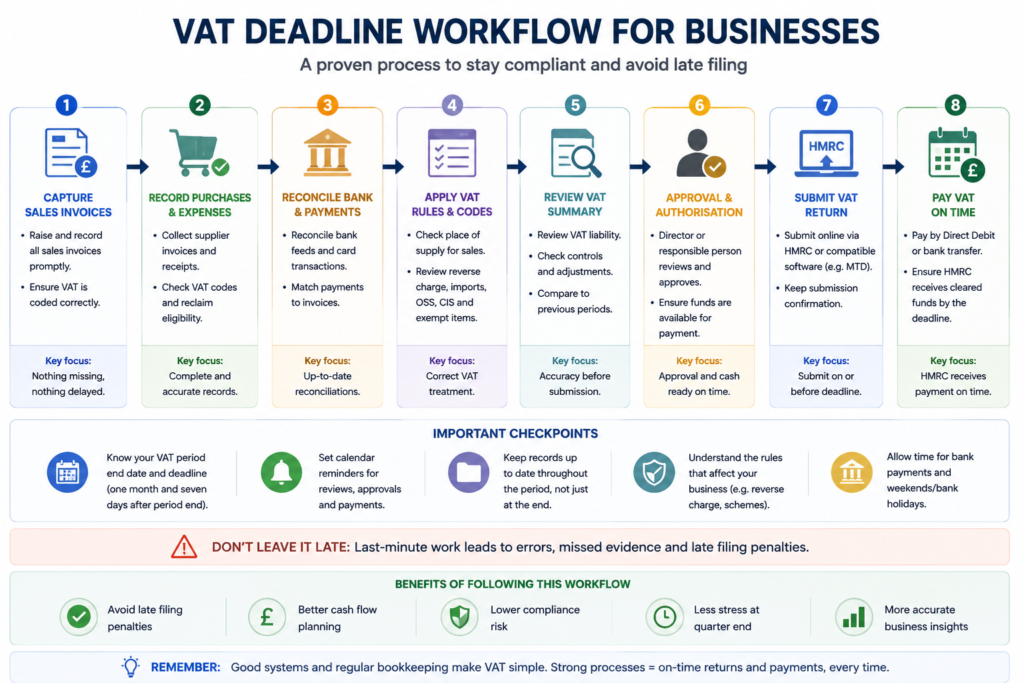
For many SMEs, a sensible VAT workflow looks like this:
- During the month: raise sales invoices promptly, upload purchase invoices, reconcile bank feeds and correct obvious coding errors.
- Shortly after month-end: review unpaid sales and supplier balances, clear suspense items, and check unusual transactions.
- Before the quarter closes: estimate the VAT liability and identify cash flow pressure early.
- After the VAT period ends: complete reconciliations, review VAT reports, check adjustments and confirm supporting records.
- Before submission: obtain internal approval where needed and ensure payment arrangements are ready.
The weakest VAT processes usually depend on one person remembering everything at the end. A stronger process leaves evidence: reconciled accounts, reviewed VAT codes, saved supporting documents and a clear record of decisions made. The final VAT submission to HMRC should be the endpoint of that review, not the first moment the figures are properly tested.
VAT reclaims and repayments can be delayed by poor evidence
VAT is not only about paying HMRC. Some businesses are regularly in a repayment position. For them, deadlines matter because late or incomplete returns can delay cash coming back into the business.
HMRC may ask questions before releasing repayments, especially where claims are large, unusual or inconsistent with previous periods. A repayment claim supported by clean records, invoices, import statements and clear explanations is easier to defend than one reconstructed under time pressure.
Businesses sometimes focus heavily on output VAT while treating input VAT evidence casually. That is risky. Reclaiming VAT generally requires proper VAT invoices and evidence that the cost relates to taxable business activity. Weak documentation can turn a legitimate claim into a practical dispute.
Registration, deregistration and changing VAT obligations
VAT deadline awareness begins before the first return is due. A business approaching the VAT registration threshold needs to monitor taxable turnover on a rolling basis, not just at year-end. Missing the registration point can lead to backdated VAT liabilities and awkward customer pricing issues.
After registration, HMRC confirms the effective date and first VAT period. The first return can cover a longer or shorter period than expected, which makes it easy to misjudge the first deadline. This is a common area where new VAT-registered businesses are caught out.
Deregistration also needs care. A business that stops trading, falls below the deregistration threshold, or changes its activities may still have final VAT obligations. A final VAT return may include adjustments, stock or assets on hand, and outstanding input tax or output tax matters. The deadline discipline does not disappear simply because the business is leaving the VAT system.
EU sales, OSS and deadline discipline
UK businesses selling to EU consumers may have VAT obligations beyond standard UK VAT returns. The One Stop Shop system can simplify reporting for certain cross-border B2C supplies, but it introduces its own registration, reporting and payment timetable.
The operational challenge is data quality. The business needs to know where customers are located, what was sold, which VAT rate applies, and how platform data reconciles to accounting records. The UK VAT return deadline may be familiar; OSS filing can create an additional compliance calendar that needs separate ownership.
For businesses expanding internationally, VAT deadlines should be mapped before sales channels go live. Retrofitting compliance after trading has started is usually more expensive and less reliable.
What to do if a VAT deadline may be missed
If a business realises it may miss a VAT deadline, the worst response is silence. The best next step depends on the reason.
If the return is nearly ready but cash is short, the business should still consider filing the return on time and then address payment options. If payment difficulty is genuine, HMRC may consider a Time to Pay arrangement, but this should be approached before enforcement pressure builds.
If the records are incomplete, the business needs to judge whether a reliable return can be submitted. Filing knowingly incorrect figures is not a solution. In some cases, errors can be corrected on a later VAT return if they meet HMRC’s correction rules; in other cases, separate disclosure may be needed. The right approach depends on the size, nature and cause of the error.
Professional judgement matters here. VAT errors are not all the same. A missed invoice, a repeated coding issue, a partial exemption mistake and an incorrect reverse charge treatment may each require a different response.
The link between VAT deadlines and wider financial control
VAT deadlines often reveal the health of the finance function. If a business cannot produce a VAT return without a scramble, it may also struggle to produce reliable management accounts, monitor margins, forecast tax liabilities or provide lenders with timely information.
This is why VAT should not be treated as a quarterly interruption. It is part of the financial control environment. Strong VAT records support better bookkeeping, more reliable profit reporting, cleaner year-end accounts, smoother Corporation Tax preparation and more informed director decisions.
For growing companies, this becomes increasingly important. A business may cope with informal processes at £80,000 turnover but face serious strain at £800,000. VAT deadlines that once felt manageable can become a bottleneck as transaction volume, staff involvement, supplier complexity and international activity increase.
Key dates every VAT-registered business should monitor
A practical VAT calendar should include more than the final HMRC deadline. The most useful calendars include internal dates as well.
- VAT period end date: the date the VAT quarter, month or annual period closes.
- Internal records deadline: the date by which invoices, receipts and bank transactions should be complete.
- Review date: the date for checking VAT codes, reconciliations and unusual items.
- Approval date: the date directors or finance managers approve the return and expected payment.
- Submission deadline: usually one month and seven days after the period end for standard VAT periods.
- Payment clearance date: the latest safe date for HMRC to receive cleared funds.
- Scheme-specific dates: relevant dates for annual accounting, monthly returns, OSS filing or other arrangements.
Businesses that only record the statutory deadline leave too little room for correction. Internal deadlines are what make the statutory deadline manageable.
Questions to ask before the next VAT return is due
A short review before each VAT period closes can prevent most deadline problems. Useful questions include:
- Are all sales invoices for the period raised and dated correctly?
- Have supplier invoices and receipts been captured with proper VAT evidence?
- Are bank and credit card accounts reconciled?
- Have imports, reverse charge items and unusual transactions been reviewed?
- Does the expected VAT liability make sense compared with sales and purchases?
- Is there enough cash reserved for payment?
- Who is responsible for final review and submission?
- Has the deadline been checked against the HMRC VAT account rather than assumed?
These questions are deliberately practical. VAT compliance often improves not through grand policy changes, but through small controls applied consistently.
Final perspective: the deadline is only the visible part
The UK VAT return deadline is easy to state: for most businesses, submit and pay one month and seven days after the VAT period ends. The harder task is building a business process that makes that date uneventful.
VAT deadlines should not depend on last-minute searches for receipts, rushed director approvals or uncertain software reports. They should sit inside a wider rhythm of bookkeeping, review, cash planning and compliance responsibility.
For directors and finance teams, the useful question is not only “When is the VAT return due?” It is “What needs to be true two weeks before the deadline for this return to be accurate, funded and defensible?” Businesses that answer that question well tend to find VAT deadlines less disruptive — and their wider financial reporting usually improves at the same time.